WEKT Lucy R5 Switch Review
If you clicked your way into this review from the front page of the website, then I have no doubt that you’ll have noticed the Meta Update article just below this one on your way into here. Without explaining exactly why there is a numerical mismatch between the two, those of you who have been around for a bit will know what Meta Update VIII means – this website is now officially six years old! That’s right, you all have been reading these longer-than-ever switch reviews for over half a decade straight now and are still coming back for some reason. Since a good amount of you did come around not just to continue reading reviews over this past week, but also to send heartfelt wishes and appreciation my way after having posted about the website’s anniversary I wanted to start out this review by once again saying thank you for everything. It’s because of everyone’s continued readership, support, and even occasional financial donations via Patreon that I’ve been able to sustain this website and all of the work that comes with it for as long as I have and it wouldn’t be the same if I was just doing this all in the vacuum. Those of you who did read the Meta Update article, though, I’m sure found it to be a bit dry and sort of ‘Type A’ of me; This is not a bug, though, but rather a feature of me as an actual person. I am definitely not one for celebration, and the little bit of joy that I did try and shine through in that Meta Update as well as posting a family photo of the collection on various social media platforms is actually way more pomp and circumstance than I really roll out for any other personal celebrations of mine. (Yes, I do in fact celebrate the birthday of this website more festively than even my own birthday.) So with all of that out of the way, this will be the last time I speak of the website’s birthday and all of the weird feelings I have surrounding it for one more calendar year until we return back around the sun again. In the meantime, we’ve got a lot of fun switches to talk about between now and then. Like some WEKT Lucy R5 silent linears, perhaps…
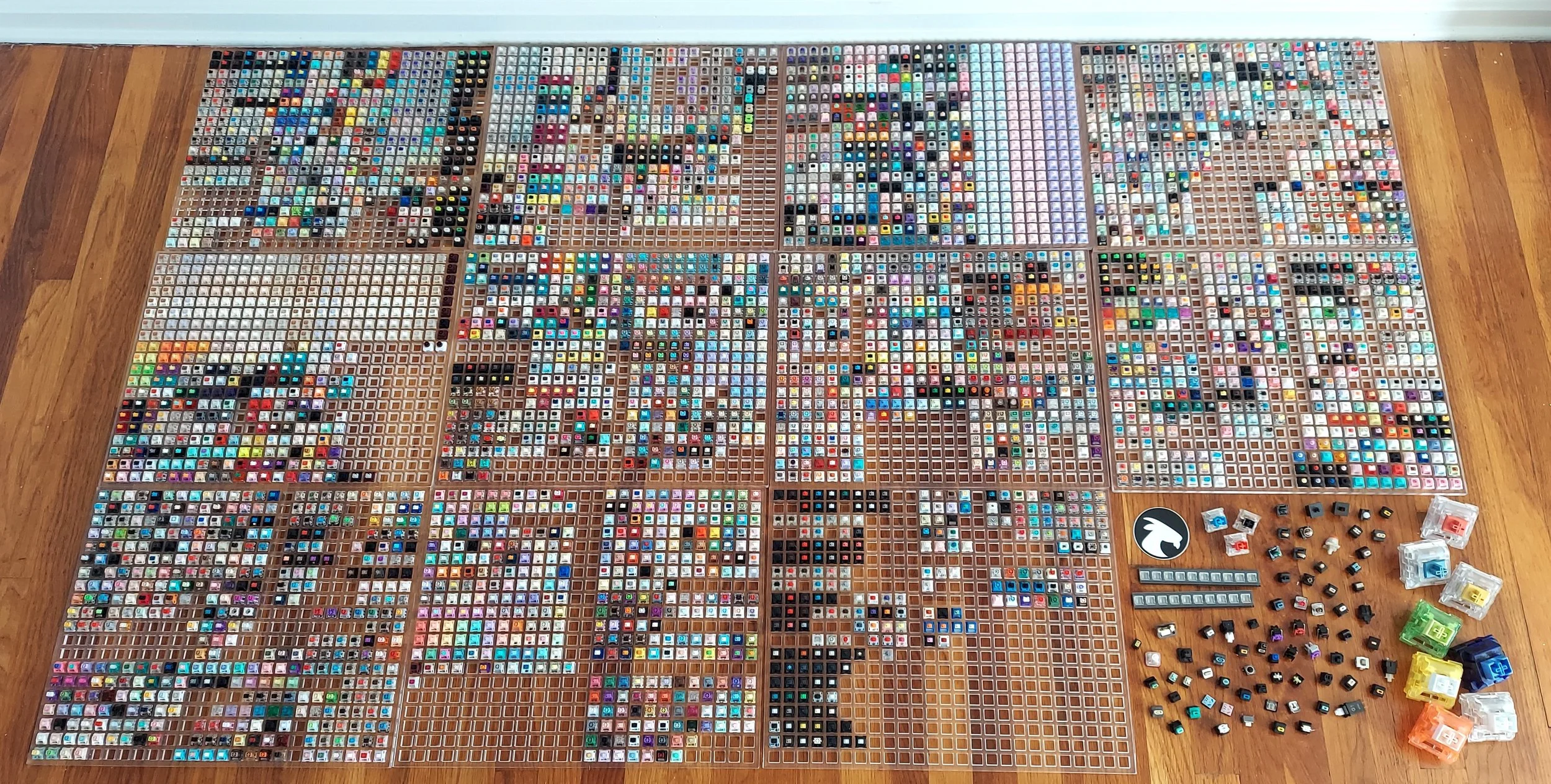
Figure 1: A game of spot the WEKT Lucy switches from the Meta Update's 4005-switch family photo. Makes me wonder what 5000 switches will look like!
Switch Background
What better way to kick off another year of switch reviews than with one that has as much of a “unique” circumstance and aura about it as WEKT’s Lucy R5 switches. Unlike some of my other less than grammatically correct syntax and markings, I really did mean to put that word in quotes here to emphasize just how far ‘out there’ these switches really are at a contextual level. On the surface, the fact that these switches are “R5”s implies that they are not the first, nor even second to look like this. This very pale blue, pink, and pastel purple colorway seen in the Lucy R5s was in fact originally released to the market all the way back in the middle of 2023 by LICHICX in the form of their LICHICX Lucy switches. But wait, isn’t LICHICX an entirely different manufacturer than WEKT? How exactly does Lucy “R1” come out with this three part colorway and a winglatch housing with “LICHICX” nameplates and only three years later come out as “R5” with the exact same colorway and winglatch design but a “WEKT” nameplate instead? But what if I told you that the actual subtle differences between these switches went deeper than that? In fact not only do the R5 Lucy switches have different nameplates and a different manufacturer than the R1 Lucy switches, but they also have an entirely different kind of silencing mechanism on their sliders as well! So really, the WEKT Lucy R5 switches are that unique: they are newly designed switches that at first glance look to be the exact same as their R1 inspirations, but are different in virtually every single substantial manner except for their colorway. Despite having written about switches on this very website now for well over half a decade, I can’t say that I’ve ever come across a switch that was redesigned to be a different and/or better version of another switch while still looking and being named after that exact switch down to the smallest of details before. The situation becomes even more niche within its niche, somehow, when I point out that the surface level similarities may actually be because these otherwise entirely different switches from entirely different places may actually be being made using the exact same housing molds as each other.

Figure 2: A V1 Lucy silent linear switch from LICHICX that maybe shares molds with but is also entirely functionally diferent than that of an R5 Lucy made by WEKT is the closest we'll ever likely come to a "Who's on First" skit in the keyboard switch hobby.
As covered in my ‘2025 Manufacturer Update’ Short article, the connection between LICHICX and WEKT, aside from their particular fondness for Lucy silent linear switches, actually stretches all the way back to the tail end of 2023 when posts began popping up in eastern keyboard threads suggesting that LICHICX was financially struggling as a production facility. Ultimately choosing to shut down operations and sell off ownership of designs, plans, and even production molds for some things in order to recoup debts that were declared as part of a ‘bankruptcy’, LICHICX ultimately sold a decent portion of their assembly machines and designs to a collective of new designers and vendors who banded together to form a new manufacturing umbrella of a brand – WEKT. Bringing in names that had a track record of producing hit switches with LICHICX such as XCJZ, WEKT appeared poised to take hold of these new pieces of equipment and LICHICX’s old designs to continue perpetuating what was at the time the most prolific line of silent linear switches that the modern mechanical keyboard market had ever seen. But as time has went on since WEKT first made their debut, though, they seem to be doing really anything but this; Rather than making LICHICX-style three part silenced stems right out of the gate, they quickly switched up the design to something entirely different, citing difficulties with ‘patents’ or ‘intellectual property’ of some form along the way. And without hardly even a short public facing explanation beyond these one liner mentions of ‘patents’ or design ownership, WEKT moved along with influencers like XCJZ posting teasers on ZFrontier to new, “improved” silent stem designs in housings and general molds which looked a whole hell of a lot like the original LICHICX ones, minus the newly emblazoned ‘WEKT’ nameplates, though. And it’s in these very initial teasers for the WEKT brand by XCJZ that we first encountered the Lucy R5 switches and a thorough explanation of how they differed from the original LICHICX Lucy stems.
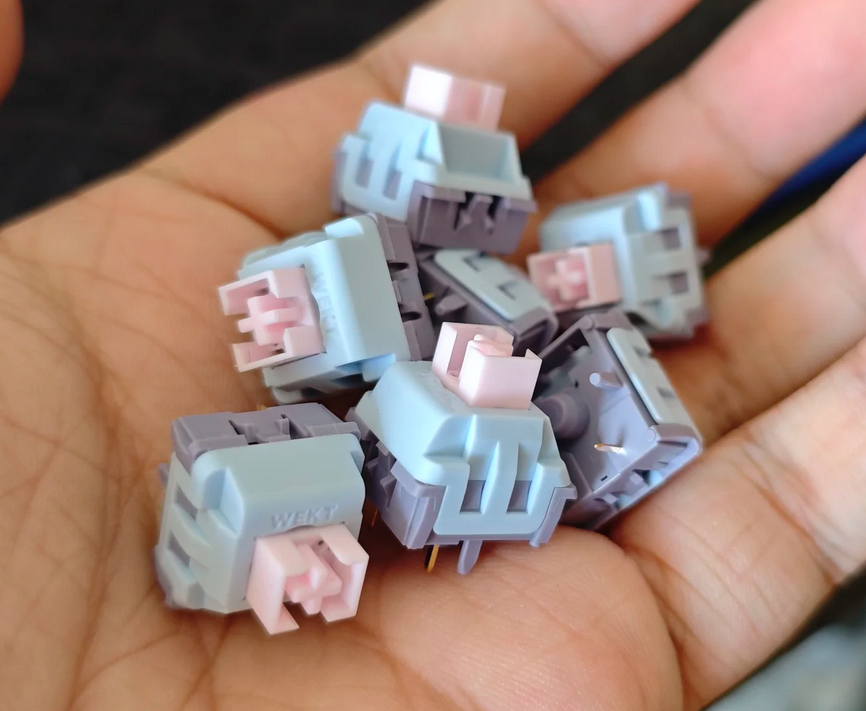
Figure 3: Very first teaser photo of WEKT Lucy R5 switches from XCJZ's ZFrontier post. What's funny is that this is the exact same image that he used for teasing the R5T switches in their debut ZFrontier post as well.
The original LICHICX Lucy stem design that everyone at least here in the west had assumed WEKT would continue on following their acquisition of significant portions of LICHICX’s property were ones that featured a three-part injection molded design with a unique mechanism for dampening the bottom outs of switches. With an edge-to-edge middle layer of the stem that was softer and more springy than the upper portion where the keycap is mounted or the lower portion with the stem pole where most switches conventionally bottom out, the original Lucy stem designs leveraged a very particular length to bottom out the stems onto the edge of the center pole holes of their bottom housings, colliding with that softer inner middle layer than the bottoms of the stems. This design was so incredibly popular, in fact, that it was continued into a wide range of identically functional but aesthetically different versions of the Lucys, including a V2 with a different LED/diode diffuser as well as R3/V3 and R4/V4s featuring different color schemes as well. From the onset of the WEKT Lucy revival on August 1st, 2025, XCJZ showed a series of stem designs that were entirely different than that of the popular LICHICX Lucy stems before them. Designed in collaboration with NANOLAB, these “new Lucy stems” also featured a three-part system to their design, though not stratified by layers. With a top and bottom portion of the stems that appeared identical, the remaining two parts of the stem design were what were used to dampen the WEKT Lucy stems – one being a soft, inner TPU “glue” layer and the other a soft, black O-Ring attached to that. Placed in the same location as the original inner dampening layer of the LICHICX Lucys, and meant to dampen bottom outs by the exact same fashion, the WEKT stems instead leveraged a combination semi-soft TPU polymer inner layer and black O-Ring to dampen bottom outs instead of one solid layer.
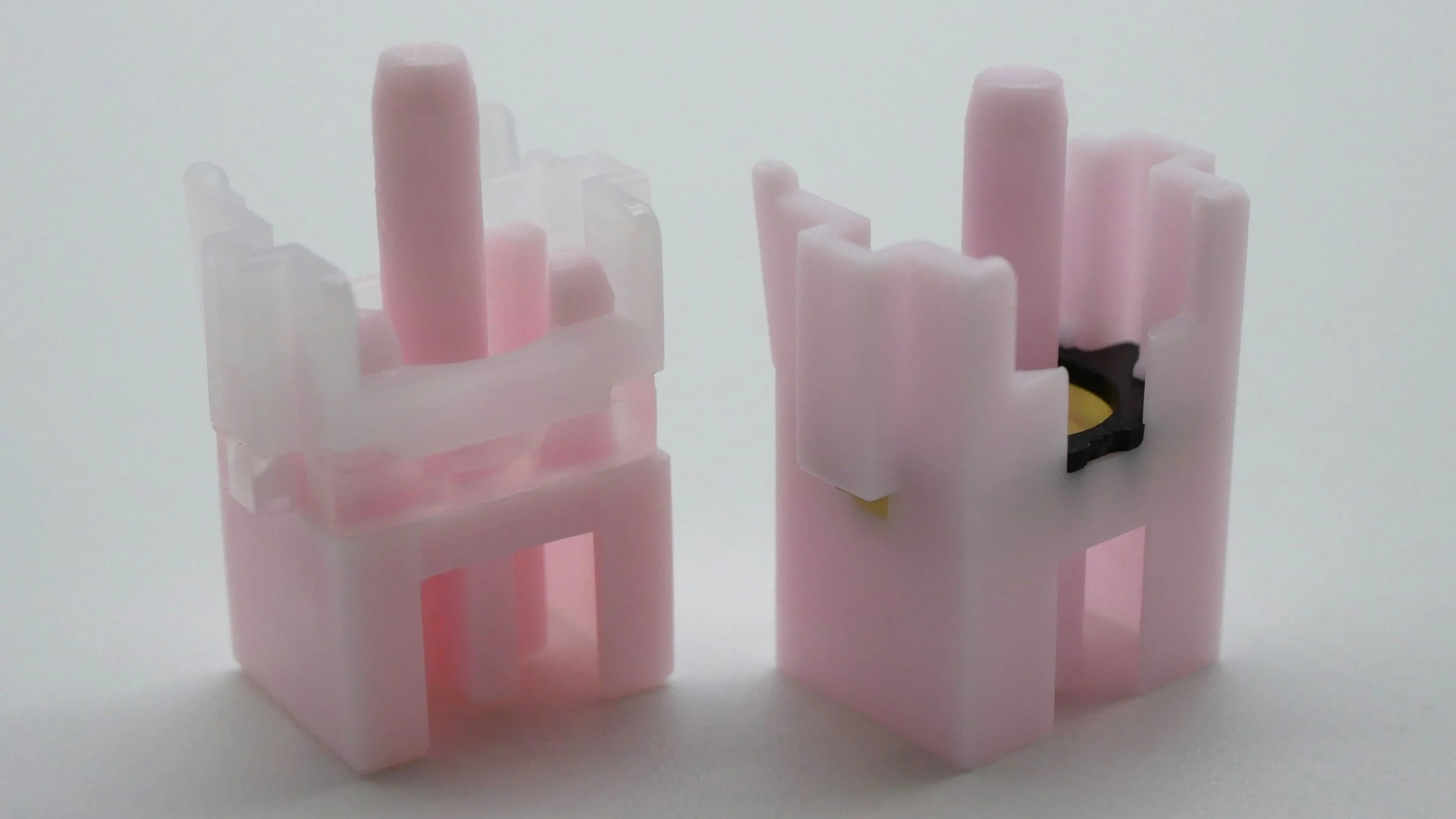
Figure 4: LICHICX Lucy V1 stems (Left) vs. WEKT Lucy R5 stems (Right).
With the ZFrontier post debuting the new “R5” WEKT Lucy switches did seem to have a lot of positive acclaim surrounding it, nobody seemed to publicly point out that this new stem design actually imparted another degree of freedom to the switches which could very well make them not feel like the original LICHICX Lucys as well. Whereas the original LICHICX Lucy switches only really had to change their singular, solid inner layer in order to change the feeling of their switches – not that they actually really survived that long or produced nearly enough in order to do such – WEKT now had two different materials to work with to try and match the properties of a single one in the LICHICX switches. Despite having not even had time to get hands on them as of the time of this next post, the difference in feeling between the original LICHICX Lucy stem designs and the WEKT-made NANOLAB collaborations became no more apparent to us in the west than when XCJZ posted a follow up ZFrontier post on September 30th, 2025, titled “Lucy axis R5T”. Actually looking identical to the Lucy switches before them unlike the claim of the R5 revival of LICHICX’s famous silent switches, the R5T introductory thread discussed how XCJZ and WEKT developed a modified inner ‘glue’ layer that was harder than that of the original R5 stems, something which was aimed to make them bottom out more harshly than that of the R5 switches. While I can only provide supposition post hoc since these switches are several months old as of the time of writing, the fact that many users who have since tried both the R5 and R5T stems in the west have claimed that the R5T stems are “more like” the LICHICX Lucy stems than the R5 ones, I guess the WEKT team had realized they may not have nailed the one-part dampening mechanism design with their two-part scheme quite as well as they had hoped. And so despite the claims of carrying on the designs and molds of LICHICX, as well as their flair for silent switch design, in barely two short switch iterations WEKT pivoted, separating themselves with a mechanism that is very clearly delineated from those of the original LICHICX Lucy stems that inspired them.
While WEKT clearly separated themselves mechanically from the bread and butter designs of LICHICX as of that ZFrontier posting at the tail end of 2025, it doesn’t appear as if they’ve commercially separated themselves from the legacy of LICHICX much at all as a result of their lack of releases since. Since the days that these new WEKT silent linear stems were first introduced, only a handful of WEKT switches have been released since with the WEKT Wild Gardenias being plain old linear rehashings of the WEKT x XCJZ Green Mustards that came before the Lucys and the Engage Studio NAFUs announced on January 1st, 2026 being a silent rehash of the Lucy R5T stems. With perhaps a few more not listed here that were only released in mainland China and without my awareness, this makes for a pace and lack of mechanical flavor amidst releases by WEKT that was no better than what LICHICX managed to carry even with XCJZ’s assistance as a switch design and influencer throughout their time. As for the Lucy switches that appear to be leading runner in WEKT’s offerings to date, the WEKT Lucy R5 switches have had a moderate amount of success and commercial availability to western audiences since their release. While the R5T switches have not been nearly as commercially accessible for some odd reason, as of the time of writing the Lucy R5s are available from a range of vendors including Unikeys, Divinikey, Moyu Studio, Keebz N Cables, PantheonKeys and a few others as well roughly priced around $0.40 per switch depending on where they are purchased from. (This is an expectedly slightly higher price than what the Lucy R5 and R5T switches were initially released at in China, debuting at prices of 2 Chinese Yuan or ~$0.29 per switch.) With enough popularity to have sold through their stock at least once at a couple of these vendors since their release, there does appear to be enough sustained western interest to see the WEKT Lucy R5 switches have some staying power as silent linears for a good few months or a year or two into the future. However, WEKT’s inconsistent and slow release schedule like LICHICX before them does leave some room for doubt as to how available they will be in the far flung future.

Figure 5: ZFrontier promotional photo of the WEKT-made Engage Studio NAFUs featuring Lucy R5T-like stems.
Lucy R5 Performance
Note: This switch review is specifically covering the WEKT Lucy R5 silent linear switches and not the R5T variants with the newer, harder middle layer for stiffer bottom out. Any references made to Lucy switches should be assumed to be for the R5 WEKT-made switches unless otherwise specifically stated as such.
Appearance
At the highest level, the WEKT Lucy R5 switches come in a three part pink, light blue, and pastel purple colorway that is close to that of the V1 and V2 LICHICX-made Lucy switches that they clearly take inspiration from here. (Or rather they are kind of sort of but also not really trying to one for one duplicate, I guess?) As belabored in the background section above, as a result of either directly using LICHICX’s housing molds, or at least the designs and schematics acquired during WEKT’s buying out of LICHICX, these switches are similar at the detail level but a bit different in their color scheme. By direct comparison as can be seen below, the WEKT-made switches are a bit less ‘yellow’ in their top housings than the LICHICX-made ones, giving them a deeper, more richly blue color look to them. Admittedly I was a bit stunned by just how yellow the light blue top housings of the LICHICX Lucy V1s looked in this comparison and part of me wonders if they have slowly yellowed over a time a bit like Gazzew’s Boba U4T switches. As is also belabored in the background section above, though, the similarities between these switches do effectively end at the skin-deep level. There’s quite a bit of differences in between the stems of these switches, as well as in a few other tiny places that are worth discussing and can be found featured in the paragraphs and photographs below.

Figure 6: WEKT Lucy R5 switches and their components.
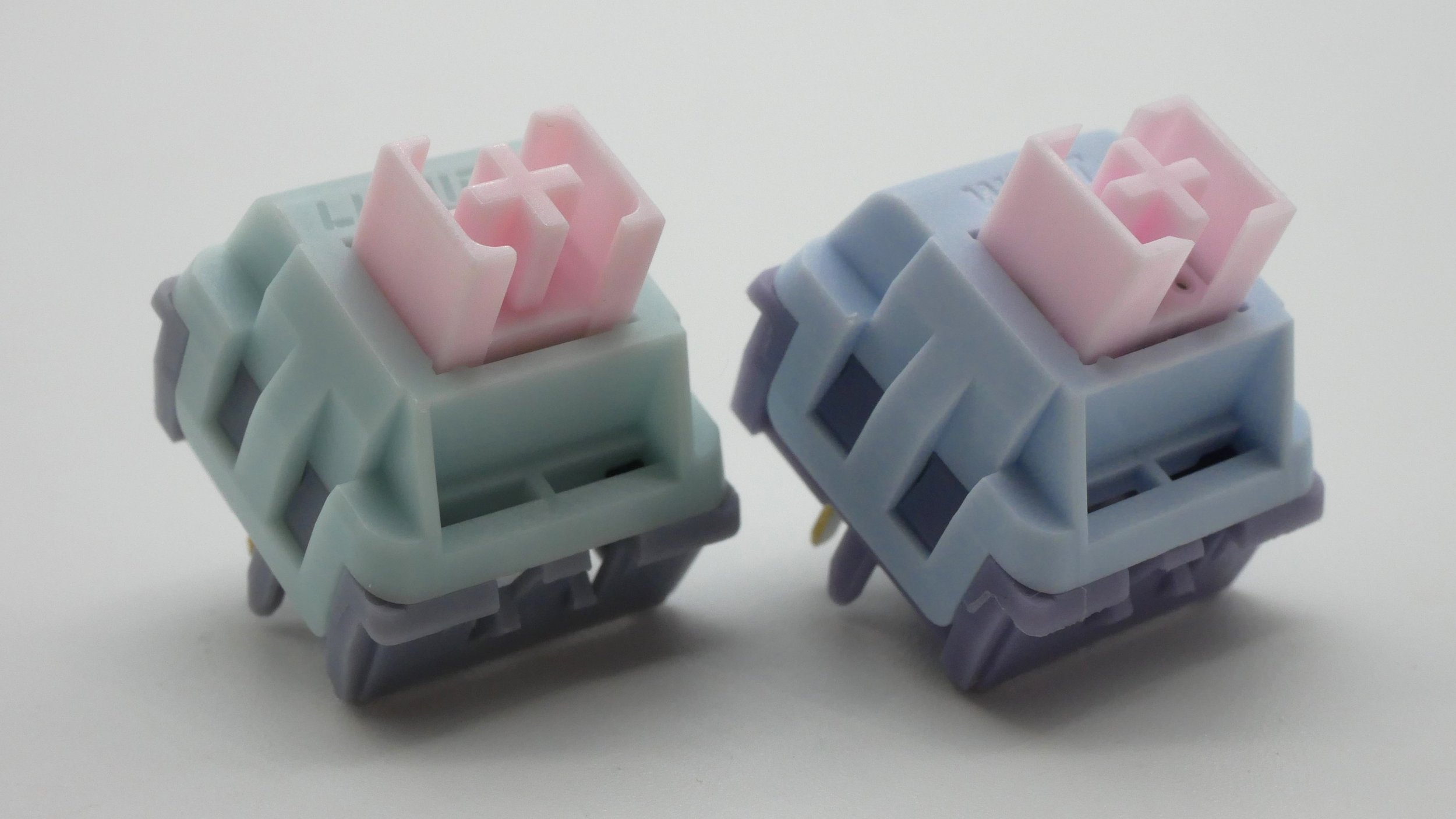
Figure 7: Side by side color comparison of the LICHICX Lucy V1s (Left) and WEKT Lucy R5s (Right).
Looking first to the light blue, POK-material top housings of the WEKT Lucy R5 switches, we’re greeted with an overall structure and design that is almost exactly identical to those of the housings that I covered in my original LICHICX Lucy Switch Review. Externally, these winglatch top housings are fairly barren of detail and only feature a nameplate embossed with the name of their respective manufacturer as well as thin, rectangular LED/diode slot that is bifurcated down the middle with a thin divider of material. No other mold markings of note are seen on the outside of the housing. Internally, the structures and overall shape of the housings also appear identical to those of LICHICX-made housings, even including a small, capital letter mold marking located in the upper right-hand corner of the housing underneath the nameplate region. While certainly not visible to the naked eye, the only actual differences that I could find between the housings of the WEKT-made R5s and the LICHICX-made R1s came by way of the measurements included further along in this review, with the rectangular stem hole of the WEKT-made R5 housings being slightly narrower in the horizontal direction (7.48 mm vs. 7.64 mm.) and wider in the vertical direction (6.20 mm vs. 6.03 mm) to accommodate the stems than the LICHICX-made R1s – a difference which is definitely greater than batch to batch variation from production.
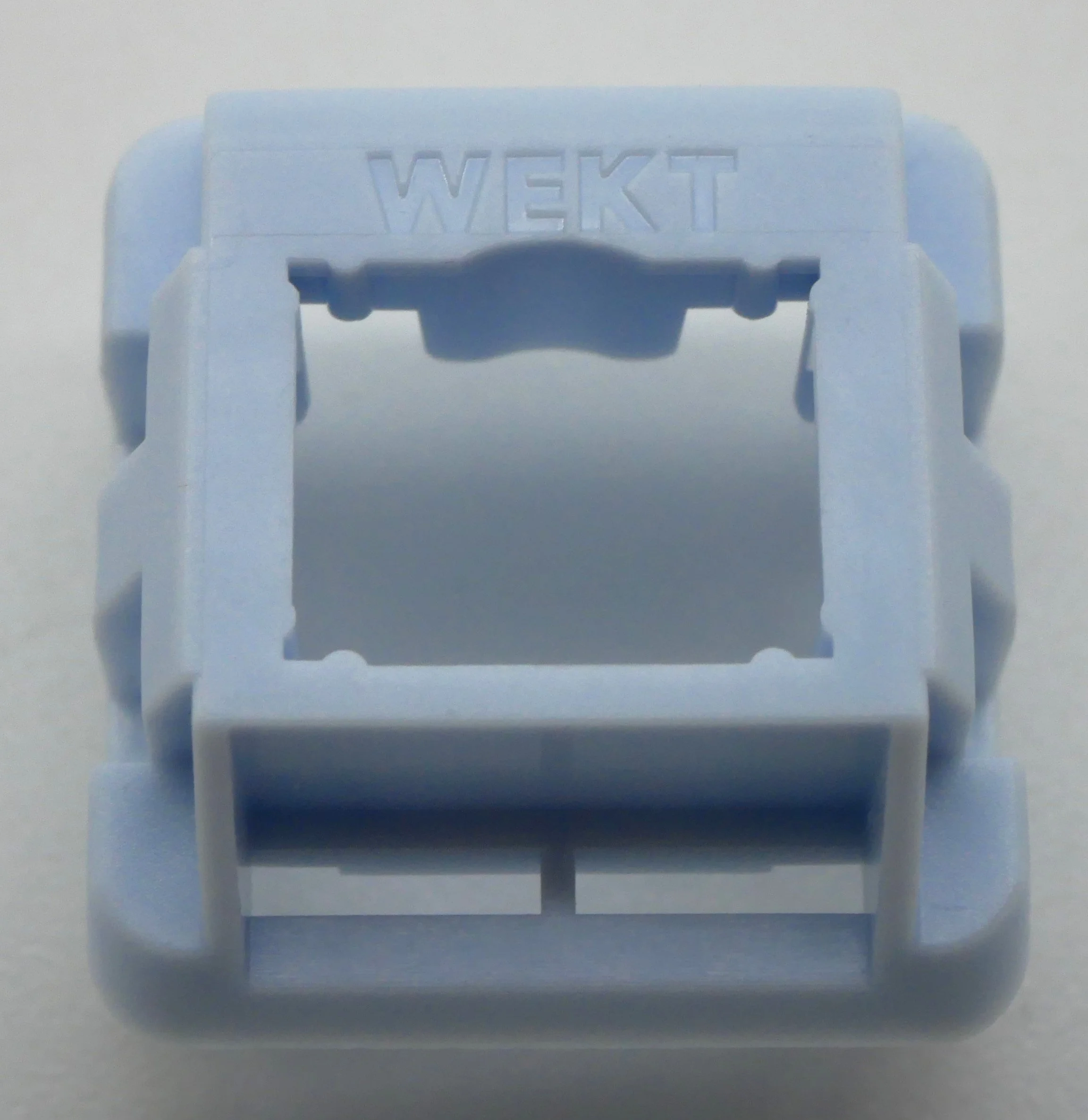
Figure 8: WEKT Lucy R5 top housing exterior featuring "WEKT" nameplate and thin, rectangular LED strip with bifurcation strip down the middle.
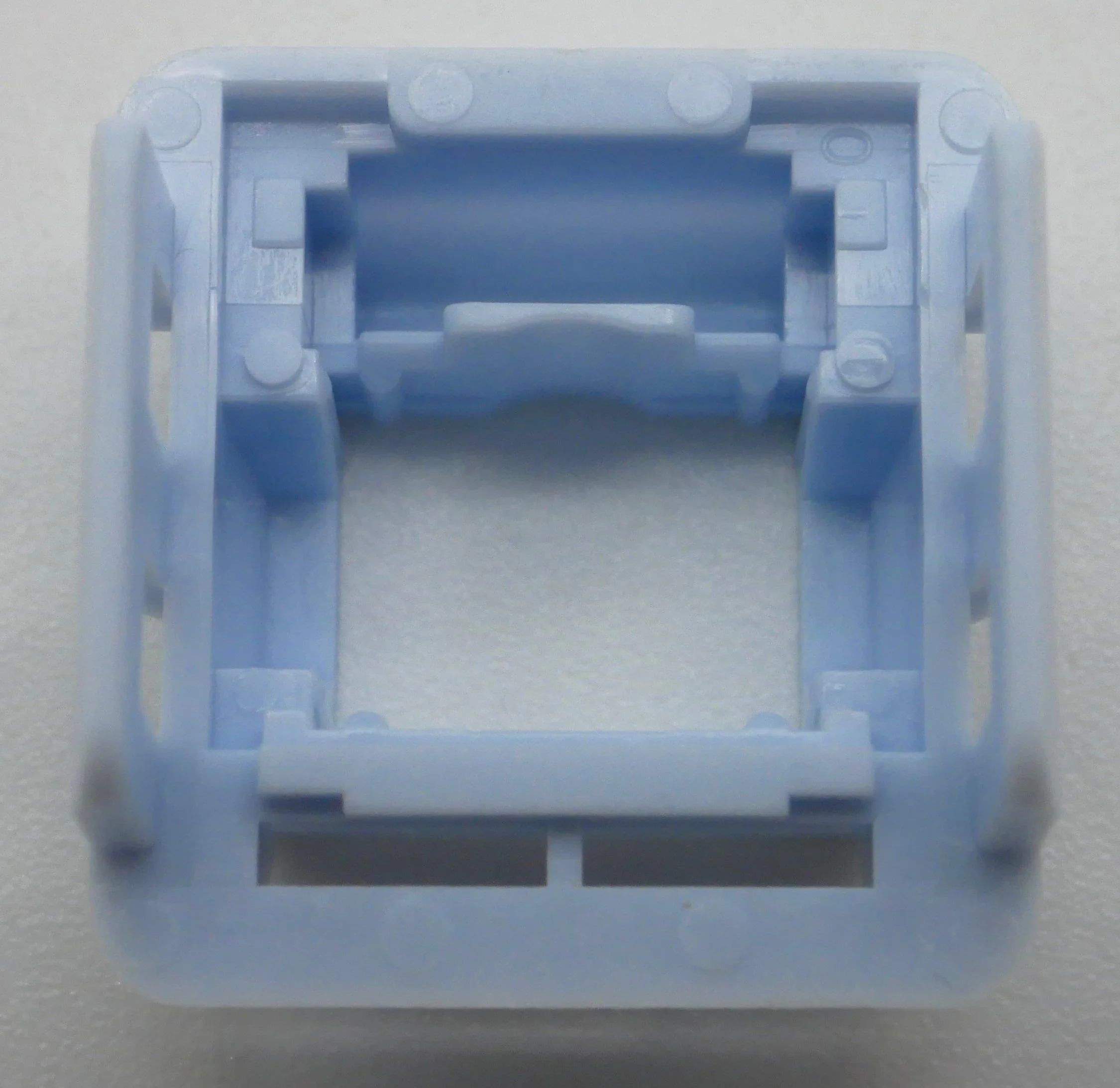
Figure 9: WEKT Lucy R5 top housing interior featuring designs incredibly similar to those of the LICHICX-made Lucy V1 switches, including the solitary capital letter mold marking in the upper right-hand corner underneath the nameplate region.
Moving next to the pink, multi-part stems of the WEKT Lucy R5 switches, we find these to be the only part of these switches which are significantly different in design than those of the LICHICX-made Lucy R1s. The most immediately different of these features is the two part inner dampening layer which features first a soft, yellow gray TPU “glue” layer that protrudes out of slots in the sides of the stems just above the tops of the POM slider rails as well as a dark black O-ring adhered to that TPU made of unknown material. Whereas the LICHICX Lucy V1 switches featured an entire middle layer that served to dampen both topping out and bottom out of the switches equally, the split in design here leads to the topping outs of the WEKT Lucy R5s to be on the softer TPU glue material while the bottoming outs are dampened by the O-Ring instead. While the rest of the R5 stems themselves appear fairly similar to the V1 stems in that they also have non-tapered slider rails, a flat center pole, and a general lack of adorning features otherwise, one big difference still exists between the stems that isn’t as obvious without a side by side comparison – their overall length. The WEKT Lucy R5 stems are significantly shorter than the LICHICX Lucy V1 stems, combing in at an average of 12.41 mm long as opposed to the V1 stem length of ~13.02 mm. As for comparison to the R5T stems, the WEKT Lucy R5 stems appear identical to those of the R5Ts with no obvious differences between them able to distinguish the different hardnesses of O-Rings included in the stems.
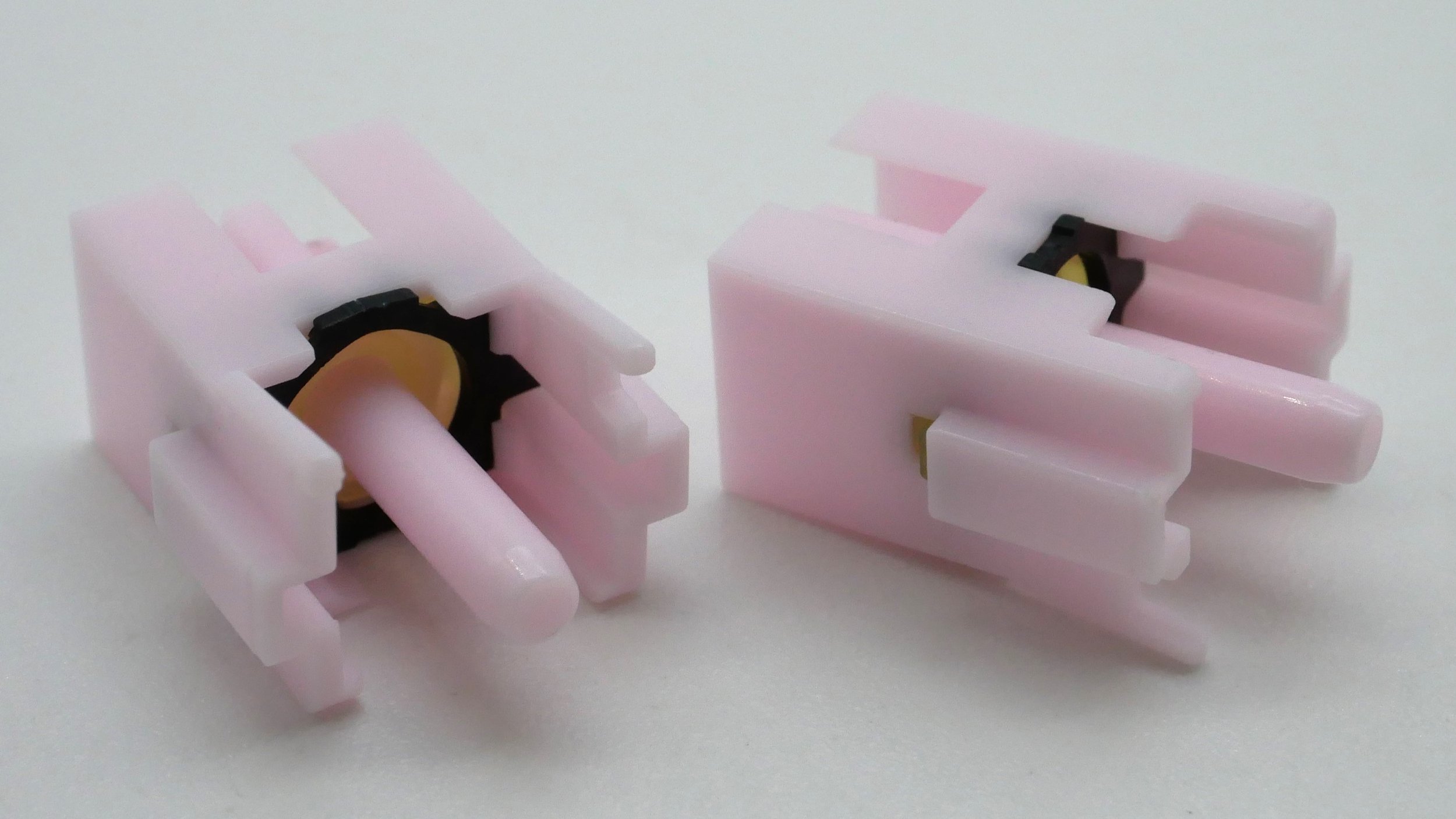
Figure 10: WEKT Lucy R5 stems front and back showing their two-piece internal dampening mechanism featuring a yellow-clear TPU "glue" that protrudes from the upper edges of the slider rails and the black dampening O-ring that collides with the bottom housing at bottom out.
Finally arriving to the pastel purple, ‘MPA’ material bottom housings of the WEKT Lucy R5 switches, we’re greeted with a set of similarities and differences that are somewhere in between those of the top housings and stems as described above. Generally speaking, the housings are fairly similar to one another in terms of their physical measurements as well as a slew of features including a strong south side spring collar, ring around the base of the center pole hole walls, and PCB mounting pins on the underside of the bottom housings. The only two differences that really stood out to me upon close inspection were at the base of the slider rails inside of the housings and with respect to the mold markings on the undersides. The base of the slide rails in the WEKT Lucy R5 switches appear to be completely barren of features whereas this ‘bottom out’ point in the LICHICX Lucy V1 housings featured small circular bumps to help deaden any bottom out not taken on by the center pole hole wall/stem inner layer collision point. As for the differences in mold markings, on the WEKT Lucy R5 switches these come in the form of an incredibly small, inverted single capital letter mold marking in between the metal PCB pins whereas the LICHICX Lucy V1 switches featured a mixed letter-number inverted mold marking in the same place that was larger and much more visually obvious.
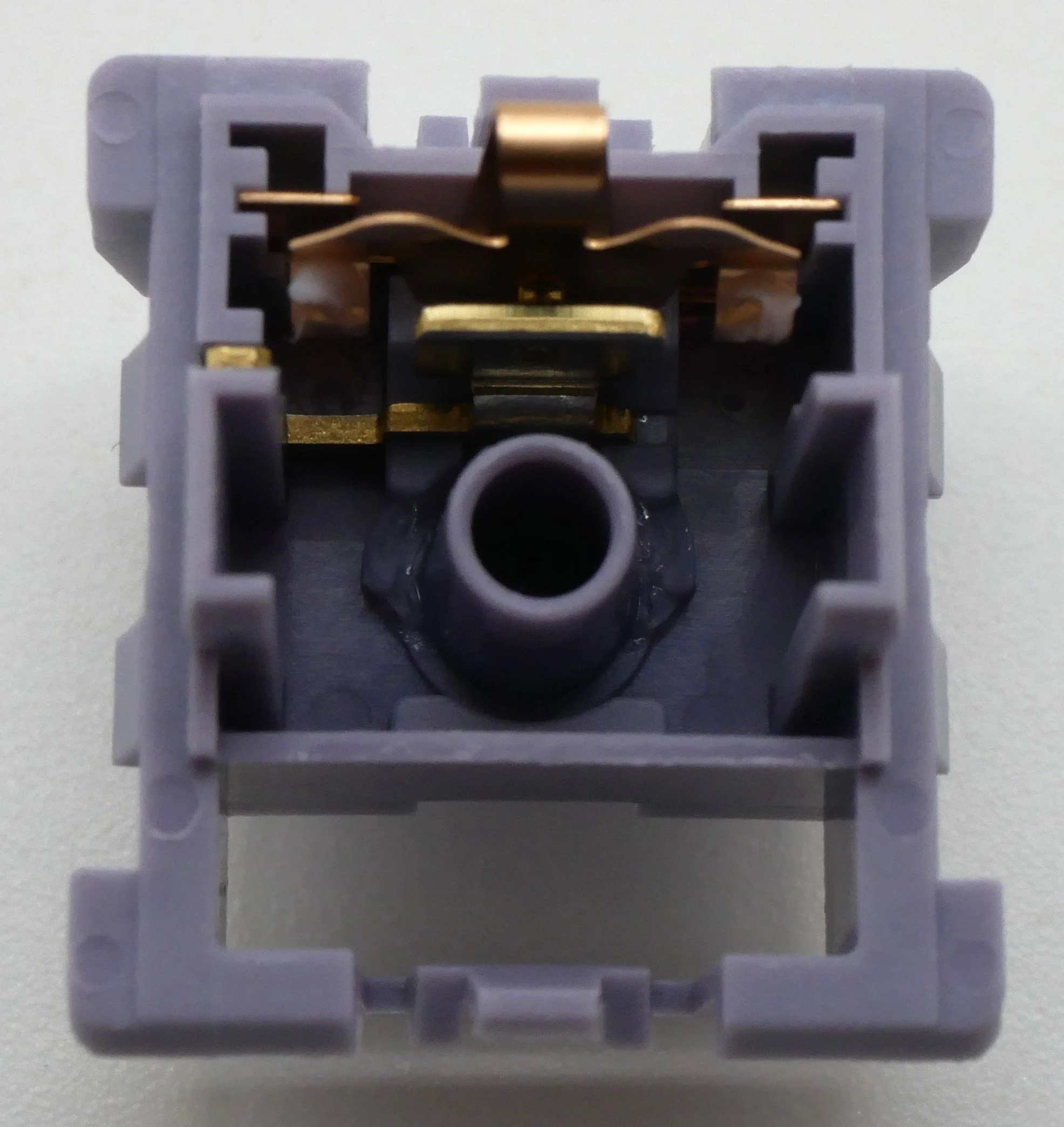
Figure 11: WEKT Lucy R5 bottom housing interior showing south side spring collar, lack of dampening pads at the base of the slider rail, and trace amounts of factory lube around the center pole hole walls.
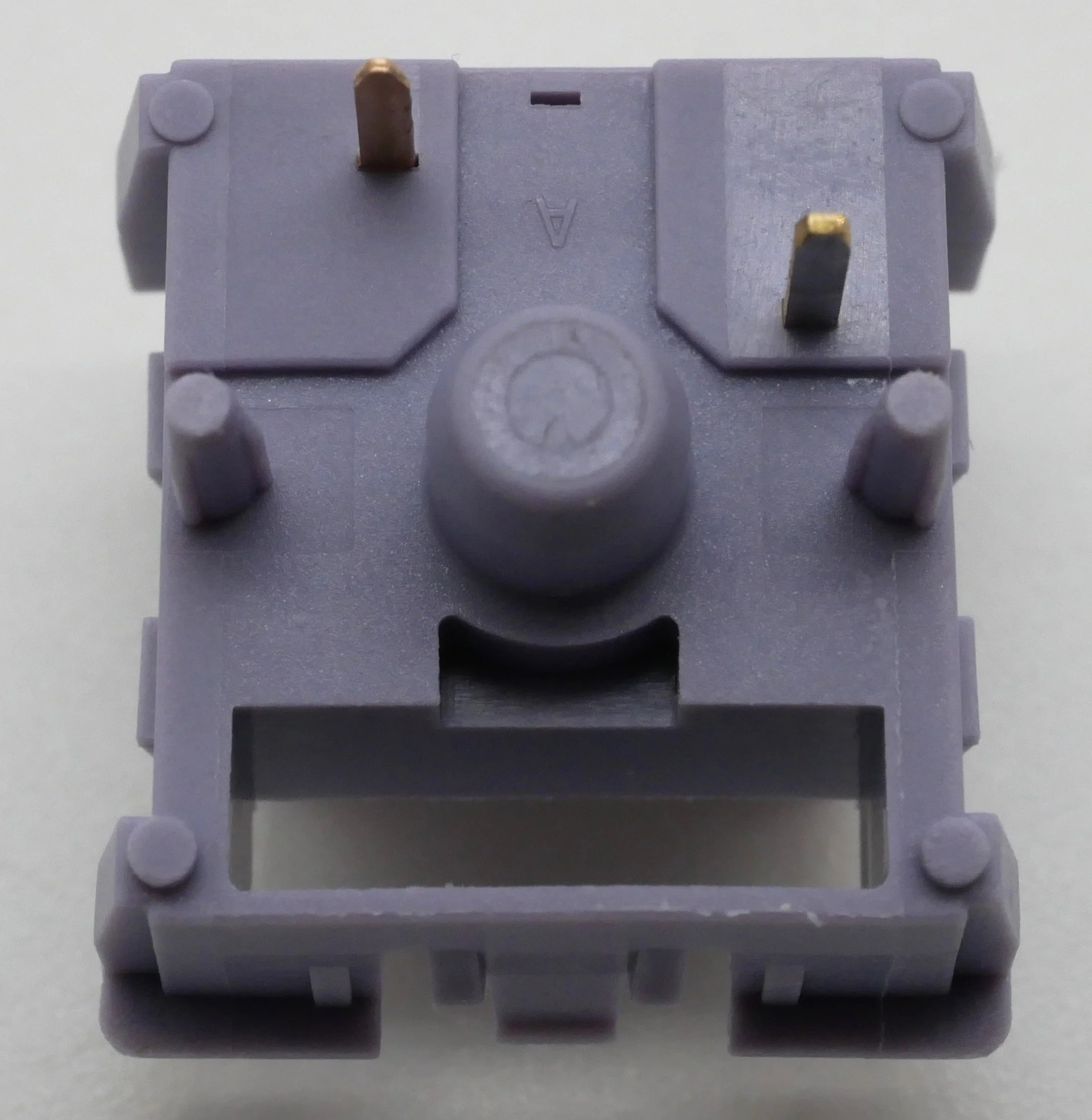
Figure 12: WEKT Lucy R5 bottom housing exterior showing PCB mounting pins and small, inverted capital letter mold marking centered between the metal PCB pins.
Push Feel
In the original review I did of the LICHICX Lucy silent linears, I started off this section by simply pointing out how weird the switches felt on account of them having a unique silencing mechanism at the time. However, the WEKT Lucy R5s don’t get any of the grace of unexpectedness that those switches did as we are not only all well acquainted with this type of silencing mechanism because of LICHICX over the past few years but also because of the expectations that WEKT has shouldered in marking these as the “R5” version of those very Lucys. To that end, the WEKT Lucy R5 switches do very much live up to the specific kind of silent mechanism feeling that the original switches had. Overall, the WEKT Lucy R5s are smooth silent linear switches that have soft, dampened bottom out feelings that have just enough firmness as to not make them feel squishy but just enough hardness to give them a solid backstop. These switches absolutely dodge all of the tropes of conventional silent switch dampening mechanisms and instead land the typists using them squarely onto a light, pillow-firm bottom out that doesn’t move much if at all with actuation speeds. The Lucy R5s also very much feel in line with their listed weight and travel distances, not feeling any heavier or harder than what I would have expected of them throughout all of the abuse I put them through in testing. Much to my surprise, even like the original LICHICX Lucys, the WEKT Lucy R5s also suffer from some switch to switch variation. Some of the R5 Lucys are slightly scratchy, with a fine grain shuffling sort of feeling to them that is presumably due to inconsistent factory lubing in some spaces as well as some ever so slightly tacky bottom outs in some other switches, also presumably due to the same lube issues. These inconsistencies are not great enough to affect their general usage and won’t leave users having to cherry pick them in order to build a fine personal keyboard. (Not as if I’m biased in any way and currently typing on LICHICX silent linears myself, though…)
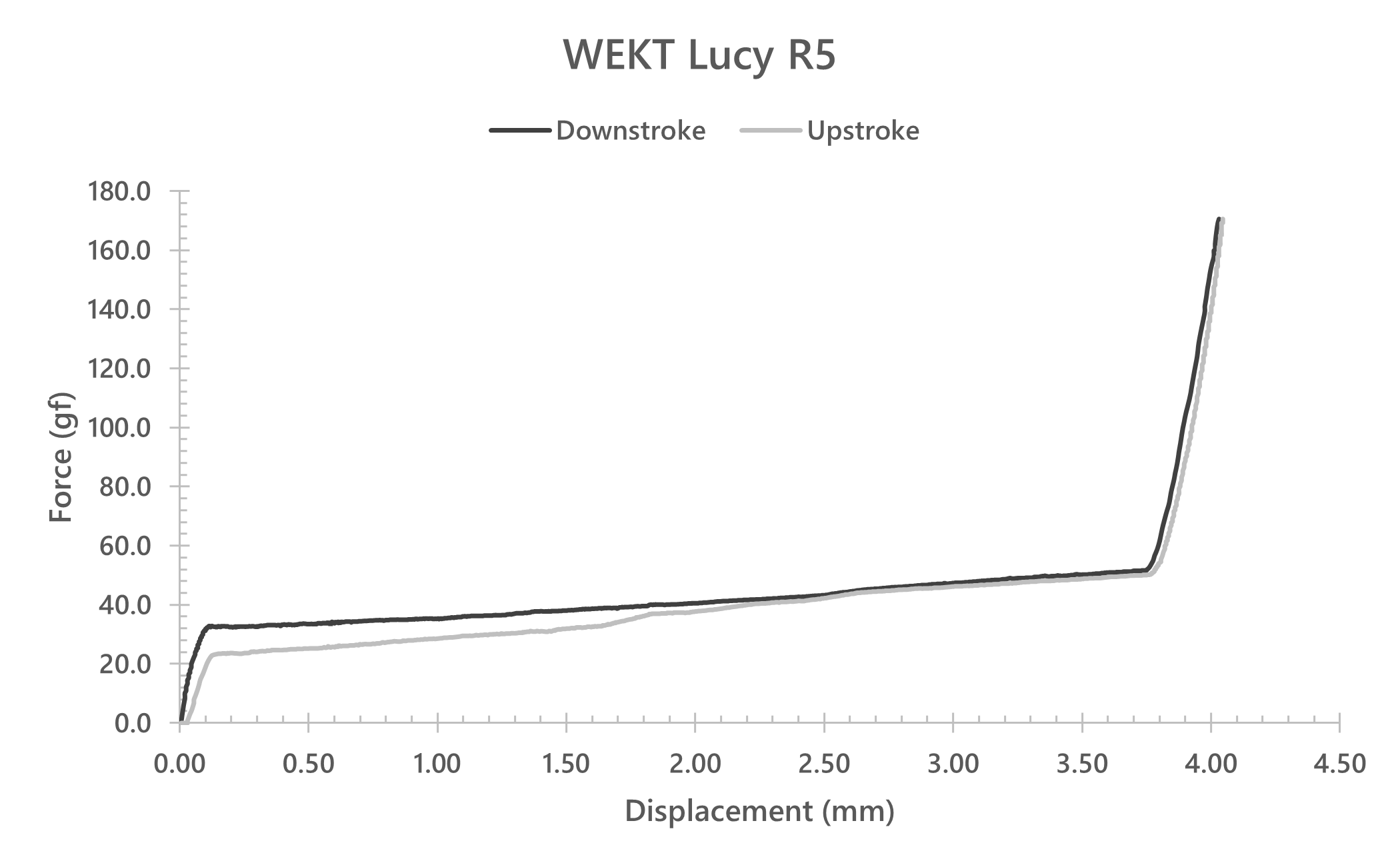
Figure 13: Force curve diagram for the stock WEKT Lucy R5 switch.
As for the more contextual comparisons that the WEKT Lucy R5 switches get when directly considering the LICHICX Lucy V1s before them and WEKT Lucy R5Ts that follow them, I am also surprised to find the general community sentiment surrounding these differences to be accurate for once. It’s generally not that often that I agree with the broader keyboard community on account of them being the same subset of people who also popularized those hideous onomatopoeias ‘thock’ and ‘clack’, yet both the WEKT Lucy R5Ts and original V1 Lucys from LICHICX do feel as if they “bottom out harder” than the WEKT-made R5s. ‘Harder’ may not be the most fitting of initial descriptors, though, as it is not as if the V1s and R5Ts necessarily feel like they bottom out with greater force than the R5s, rather it is as if their dampening media is just some less porous and/or stiffer and more resistant to deflection than the WEKT-made R5s. When directly comparing the WEKT Lucy R5s to the original LICHICX-made switches, I can absolutely see how those who sought out the originals could be a bit let down with how these switches feel here, though personally I find the R5s to be intriguing variation on the mechanism that LICHICX made so popular. Given that LICHICX wasn’t exactly exploring variability in their switches nearly as much as really any other manufacturer, having any degree of differentiation in a similar mechanism like in the R5s makes for a more unique kind of typing experience. As well, this could very well make this kind of inner-stem based dampening mechanism more appealing to users who were put off by the perceived harshness and firmness of the original LICHICX mechanisms. Of course this does though also seem to defeat the purpose of making the “R5” version of a switch if the actual mechanism, feeling, and sound of them are different than the originals.
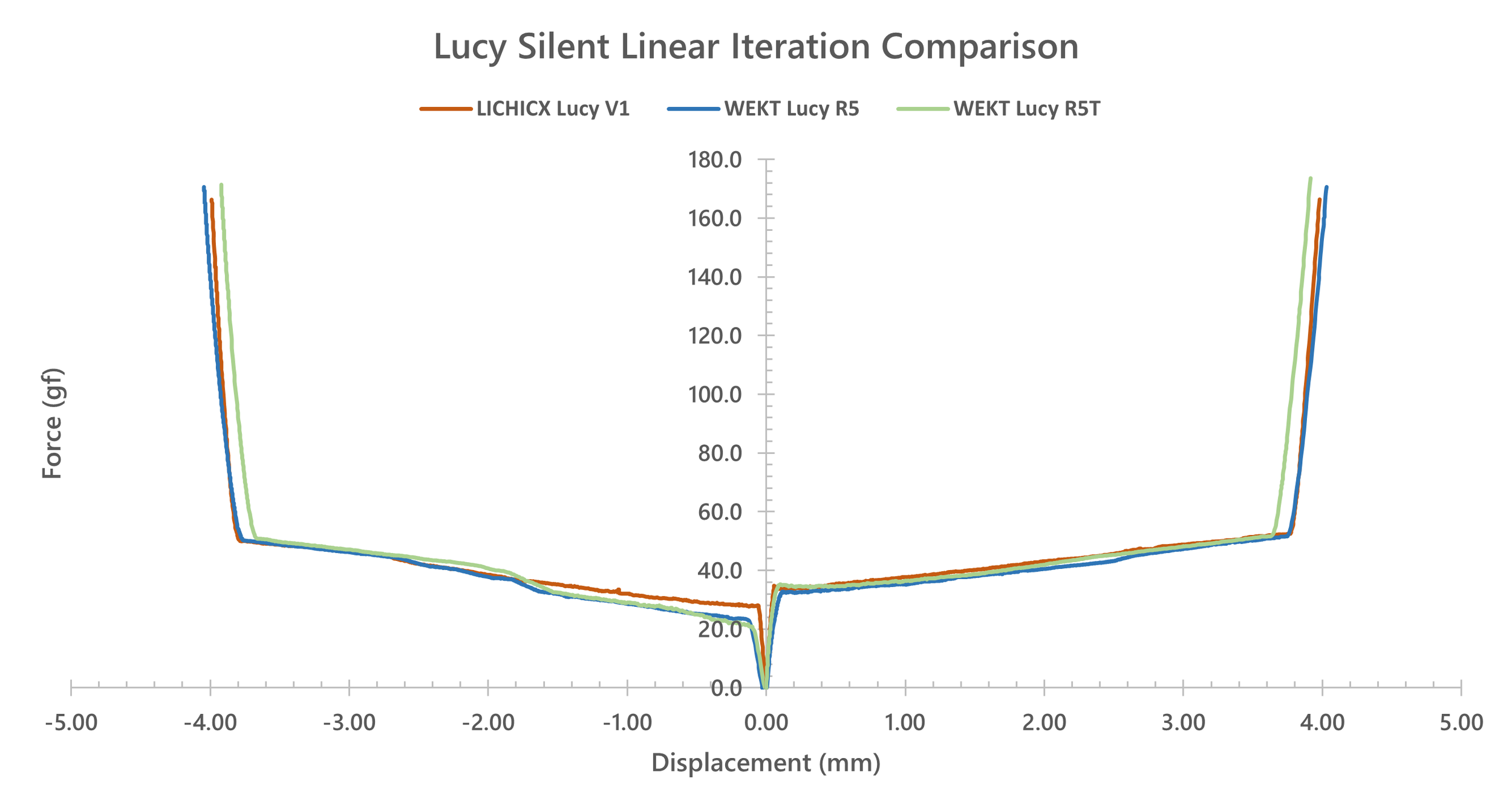
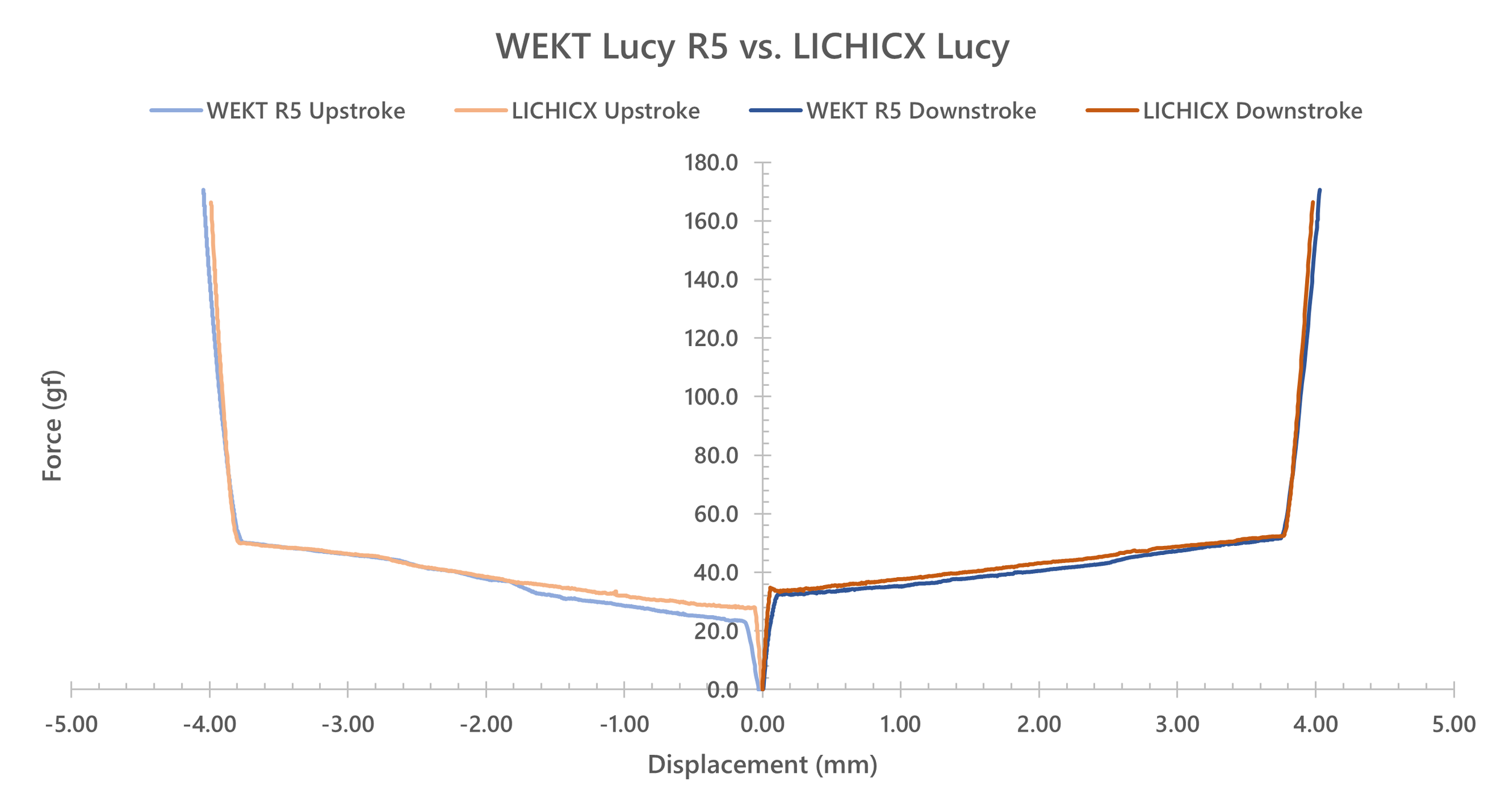
Figure 14: Comparative force curve between the multiple iterations of Lucy silent linear switches discussed above. Note the lack of substantial differences between them despite the obvious in-hand differences in their feeling.
Sound
Overall, the WEKT Lucy R5s do a great job in carrying on the spiritual legacy of LICHICX’s dampening mechanism insofar that they do make for silent linears that have not only incredibly little sound to them, but also far less than the general silent linear switch that uses more conventional mechanisms. In fact, the Lucy R5s could be described as almost black hole-like in their sound profiles, as the softness of the bottom carries only the tiniest of bass notes and feels as if it takes in more sound than it lets free in return. Even in spite of the fact that the bottom outs of the R5s are softer feeling than the R5Ts and the V1s, these switches are no more or less prone to harsh bottom out sounds or rapping that picks up with increased actuation speeds than the originals. More or less, the WEKT Lucy R5s are uniformly quiet. Really the only sounds that are at all noticeable outside of the small, deep, and bassy thud at the point of bottom out in the Lucy R5s comes from the few inconsistent switches as noted in the push feeling switches above. Those few “defectively” silent switches among them, though, are hardly loud by any stretch of the imagination and only really have light, papery shuffling sounds or squishy tones to them that directly match their under-finger feeling. In fact, as a result of being softer and a bit less harsh at the point of bottom out, I could swear that in hand the WEKT Lucy R5s actually have a softer sound and an overall slightly more quiet volume to them than the original LICHICX Lucy switches…
Wobble
One ‘key’ feature of the WEKT Lucy R5 switches that WEKT did a good job in mimicking LICHICX, per se, is in their decision to leave a decent amount of wobble in the stems of the Lucy switches. Almost certainly a byproduct of other design choices rather than an intentional lack of tolerancing, the WEKT Lucy R5 stems have a decent amount of N/S direction stem wobble and noticeably less E/W direction stem wobble. Without any direct head to head comparisons in mind, I don’t seem to recall any switches in recent memory with as much N/S to E/W mismatch as the WEKT Lucy R5s. While this may bother some users who are picky about stem wobble, I doubt too many people in the community would be upset by this feature – especially if they previously used and enjoyed any of the LICHICX Lucy variants.
Measurements
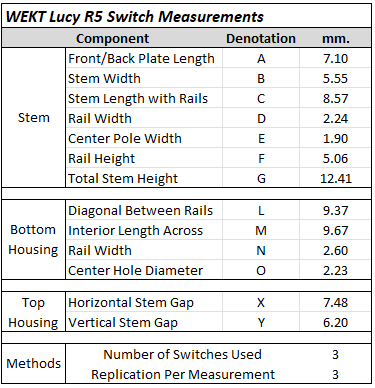
If you’re into this level of detail about your switches, you should know that I have a switch measurement sheet that logs all of this data, as well as many other cool features which can be found under the ‘Archive’ tab at the top of this page or by clicking on the card above. Known as the ‘Measurement Sheet’, this sheet typically gets updated weekly and aims to take physical measurements of various switch components to compare mold designs on a brand-by-brand basis as well as provide a rough frankenswitching estimation sheet for combining various stems and top housings.
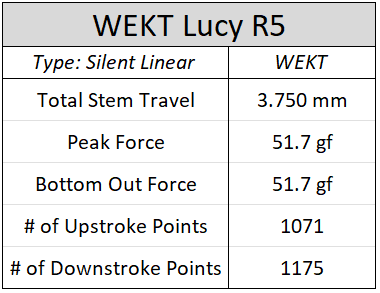
Figure 16: Numerical details regarding the force curve for the stock WEKT Lucy R5 switches.
Have you ever wanted to be bombarded with more switch data than you’ve ever seen at any point in your life before? Consider checking out the ‘Force Curve Repository’ hosted on my GitHub that contains all force curves that I take both within and outside of these full-length reviews. In addition to having these graphs above, I have various other versions of the graphs, raw data, and my processed data all available for over 2000 different switches for you to use however you see fit. Check it out via the ‘Archive’ tab at the top of this page or by clicking any of the force curve cards above.
Break In
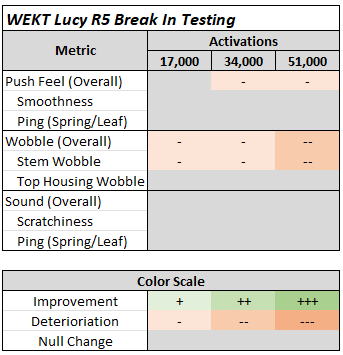
Break In Notes
17,000 Actuations
- After 17,000 actuations, the WEKT Lucy R5 switches began to increase in both their N/S and E/W direction stem wobbles while still maintaining the same asymmetry between these two directions as noted in their stock form.
- Even though I’m really not able to add a score to the break in testing card above to accurately summarize this finding, I did notice that those switches which were identified as having sounds that were out of line with the rest of the batch became even more noticeable after going through this break in cycle. It is as if those with the slightly squishier sounding bottom outs became more obvious on the ears after 17,000 actuations than their stock counterparts.
34,000 Actuations
- After 34,000 actuations, the WEKT Lucy R5 switches began to pick up some minor inconsistencies in their bottom out that matched the noted increase in tonal change from the previous break in period above. Generally speaking, the bottom outs of WEKT Lucy R5 switches broken in to 34,000 actuations did feel as if they were ever so slightly squishy and/or gummy than the stock versions of the switches, though I suppose this isn’t all that unreasonable to expect given the fact that these would likely wear in and begin to break down over time.
51,000 Actuations
- Out at 51,000 actuations, there were no further changes to the sound nor feeling of the bottom outs of the WEKT Lucy R5 switches as was captured at the previous break in stages above. The only notable difference was a further increase in N/S and E/W direction stem wobble over that of the previous two stages.
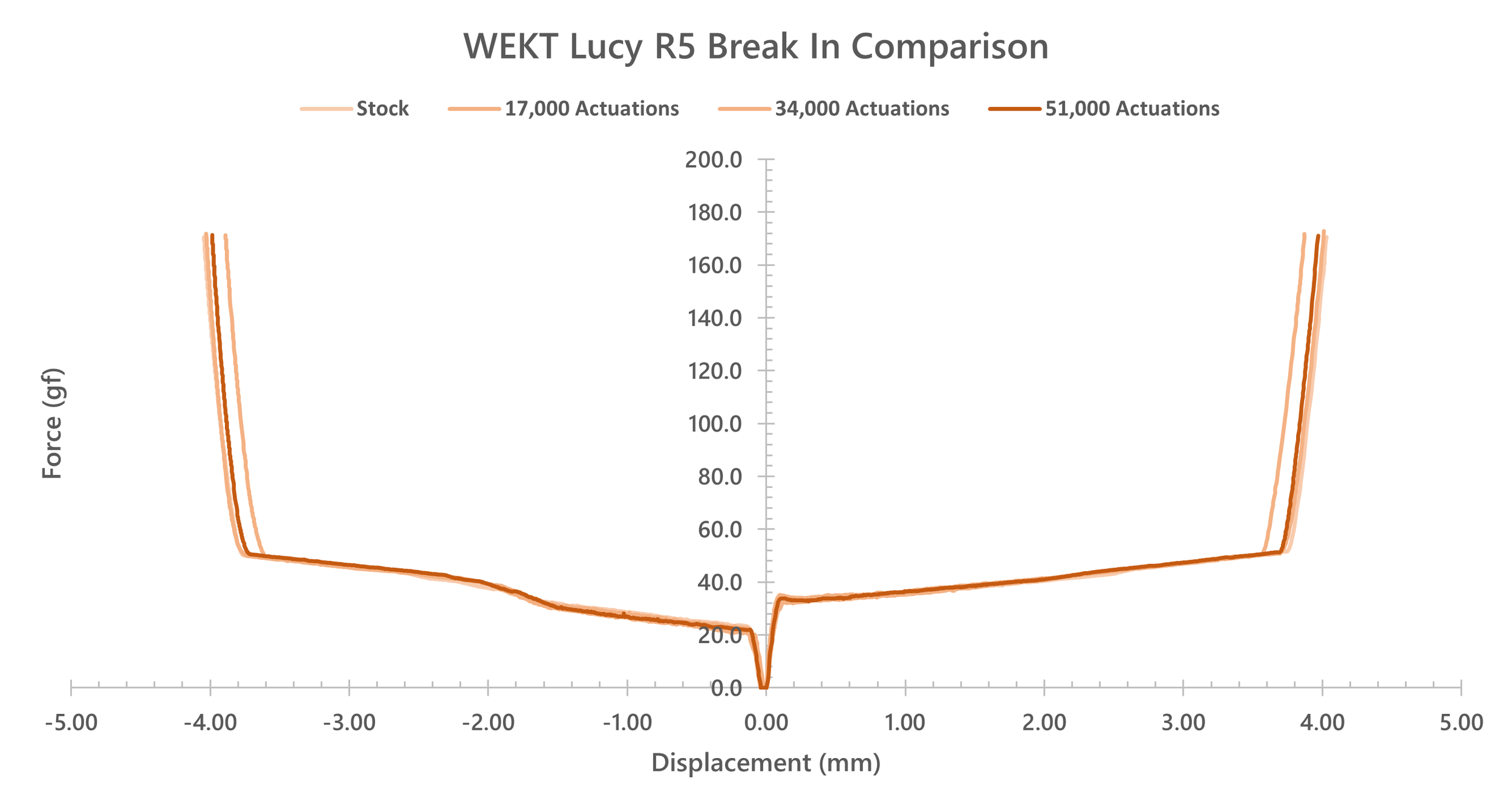
Figure 18: Comparative force curve diagram showing no substantial, consistent change in the force curves of the WEKT Lucy R5 switches throughout the break in process.
Comparison Notes to Other Notable Silent Linear Switches
Note – These are not aimed at being comprehensive comparisons between all factors of these switches as this would simply be too long for this writeup. These are little notes of interest I generated when comparing these switches to the WEKT Lucy R5 switches side by side.
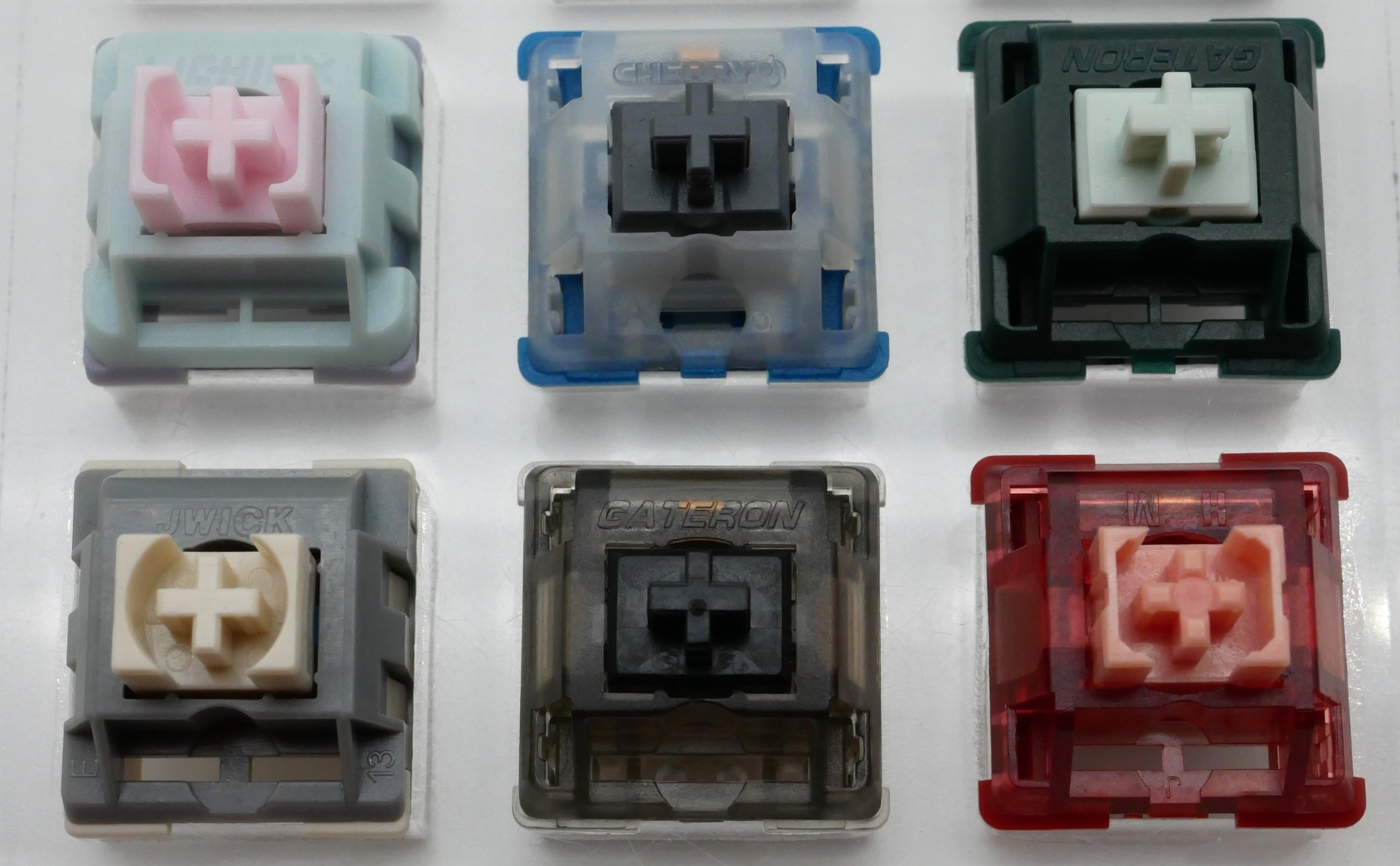
Figure 19: Switches for comparison. (L-R, Top-Bot: LICHICX Lucy V1, Cherry MX Northern Light, Kinetic Labs Gecko, JWICK Semi Silent, Gateron Silent Ink V2, and Haimu Heartbeat)
LICHICX Lucy V1
- Unlike the original LICHICX-made Lucys that inspired these switches, which had an average amount of equal magnitude N/S and E/W direction stem wobble, the WEKT Lucy R5s are asymmetrical and have a much greater N/S direction stem wobble than E/W direction.
- As is described in the full length review above, the WEKT Lucy R5s do in fact feel as if they have a softer, more muting bottom out feeling and sound than the original LICHICX Lucy V1s. That is not to say, though, that the WEKT-made R5s are necessarily squishier, gummier, or more like conventional silencing mechanisms than the LICHICX-made V1s. Instead, it’s as if the WEKT-made bottom outs are just ever so slightly more compressive and dampening.
- In terms of their overall sound, the stock WEKT Lucy R5 switches are a tiny bit more quiet than the LICHICX Lucy V1s, with their bottom outs seemingly being black hole-like in that they almost take in more sound than the brief, bassy notes that they let out. By comparison, the original LICHICX Lucy V1s were more firm sounding and had a bit more of a light rapping sound at bottom out than the Lucy R5s.
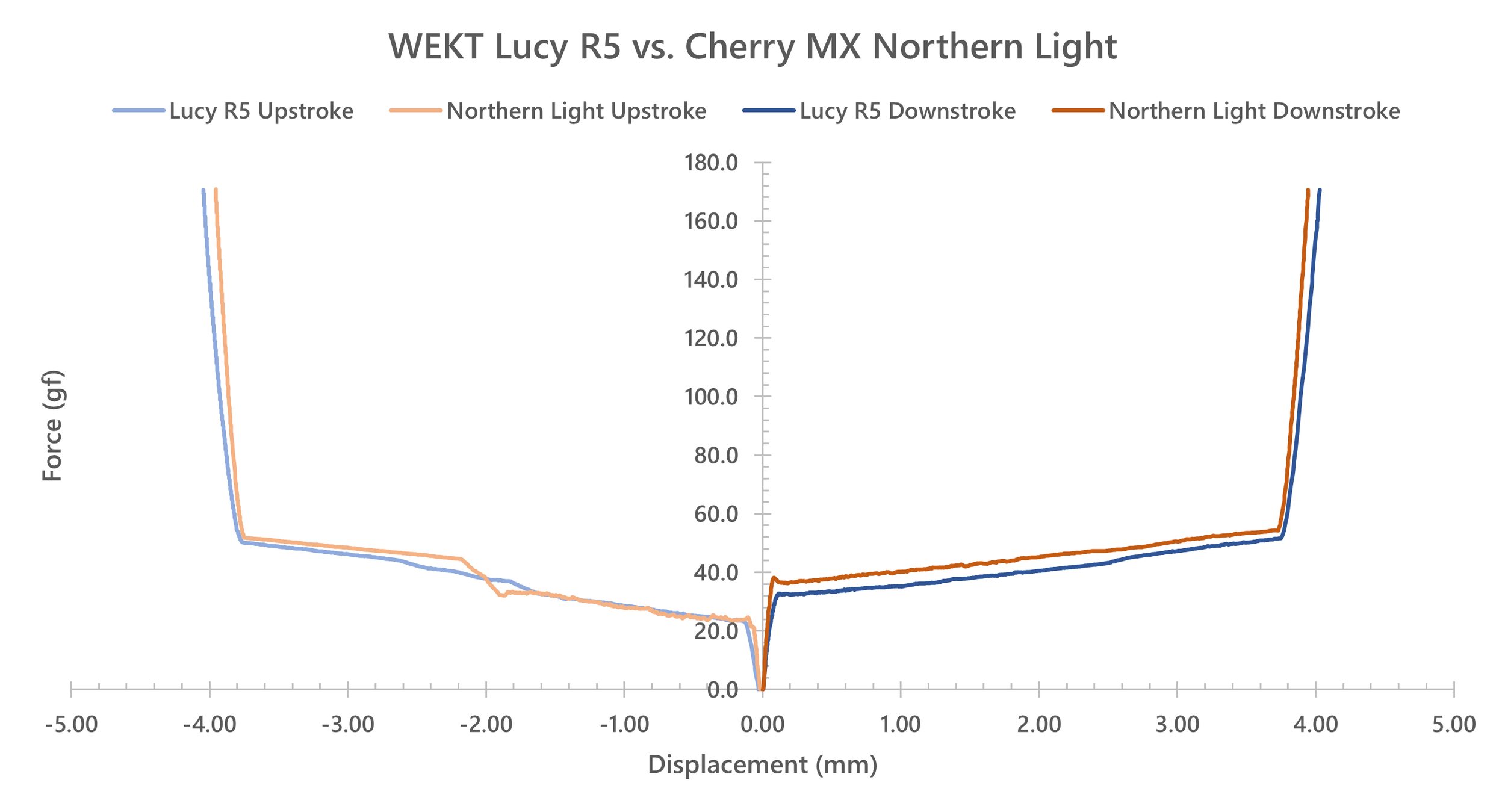
Cherry MX Northern Light
- Much like with the LICHICX Lucy V1 switch comparison above, the MX Northern Lights also have a similar overall magnitude to their stem wobble as the WEKT Lucy R5s, though they are more symmetrical in that give rather than N/S heavy in their stem wobble.
- Of these two silent linears, the WEKT Lucy R5s are far and away more silent than the Cherry MX Northern Lights. The Lucy R5s are consistent in their tone and what little sound they do produce whereas the MX Northern Lights get louder, more plasticky through their topping out, and a bit more sticky at their bottom out at higher actuation speeds.
- While the MX Northern Lights are definitely among the smoother of the Cherry-made silent linears to date, they still just don’t have the same refined, clean application of lubing that puts them on par with modern produced alternatives like the WEKT Lucy R5s. The Lucy R5s are simply more consistently lubed and feel just as effortless through their strokes at all typing speeds unlike the Northern Lights.
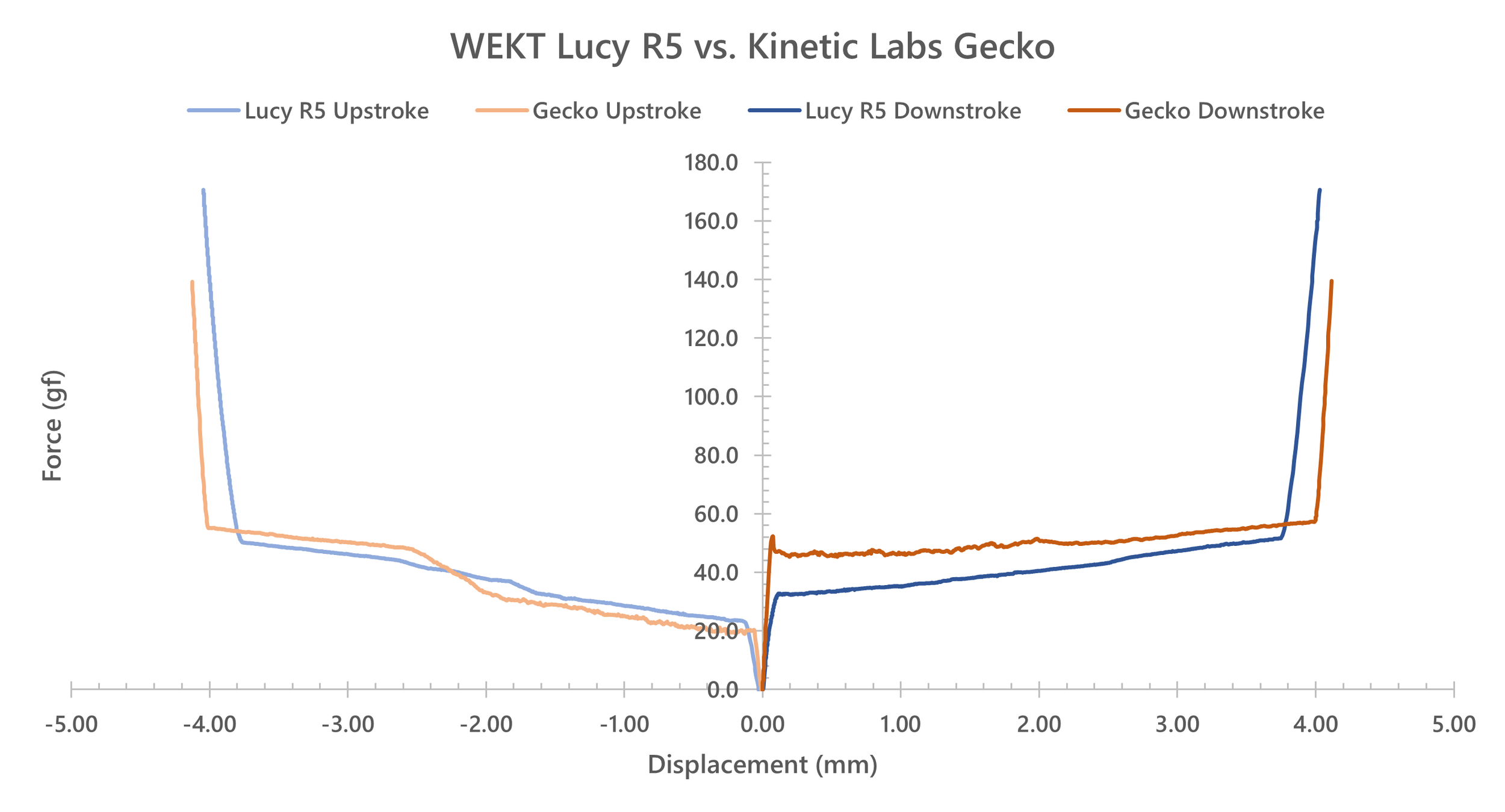
Kinetic Labs Gecko
- While the Kinetic Labs Geckos do have a fairly quiet overall sound to them on account of their solid housing material choices and good factory lubing from Gateron, they still make more sound at both topping and bottoming out than the WEKT Lucy R5 switches, and especially at higher actuation speeds.
- There is significantly less N/S and E/W direction stem wobble in the Gateron-made Kinetic Labs Gecko switches than there is in the WEKT Lucy R5s.
- Despite both of these switches being smooth and effectively free of scratch, the factory lubing is just a bit more impactful in the feeling of the WEKT Lucy R5s, giving them a more effortless, gliding feeling throughout their strokes than the Geckos.
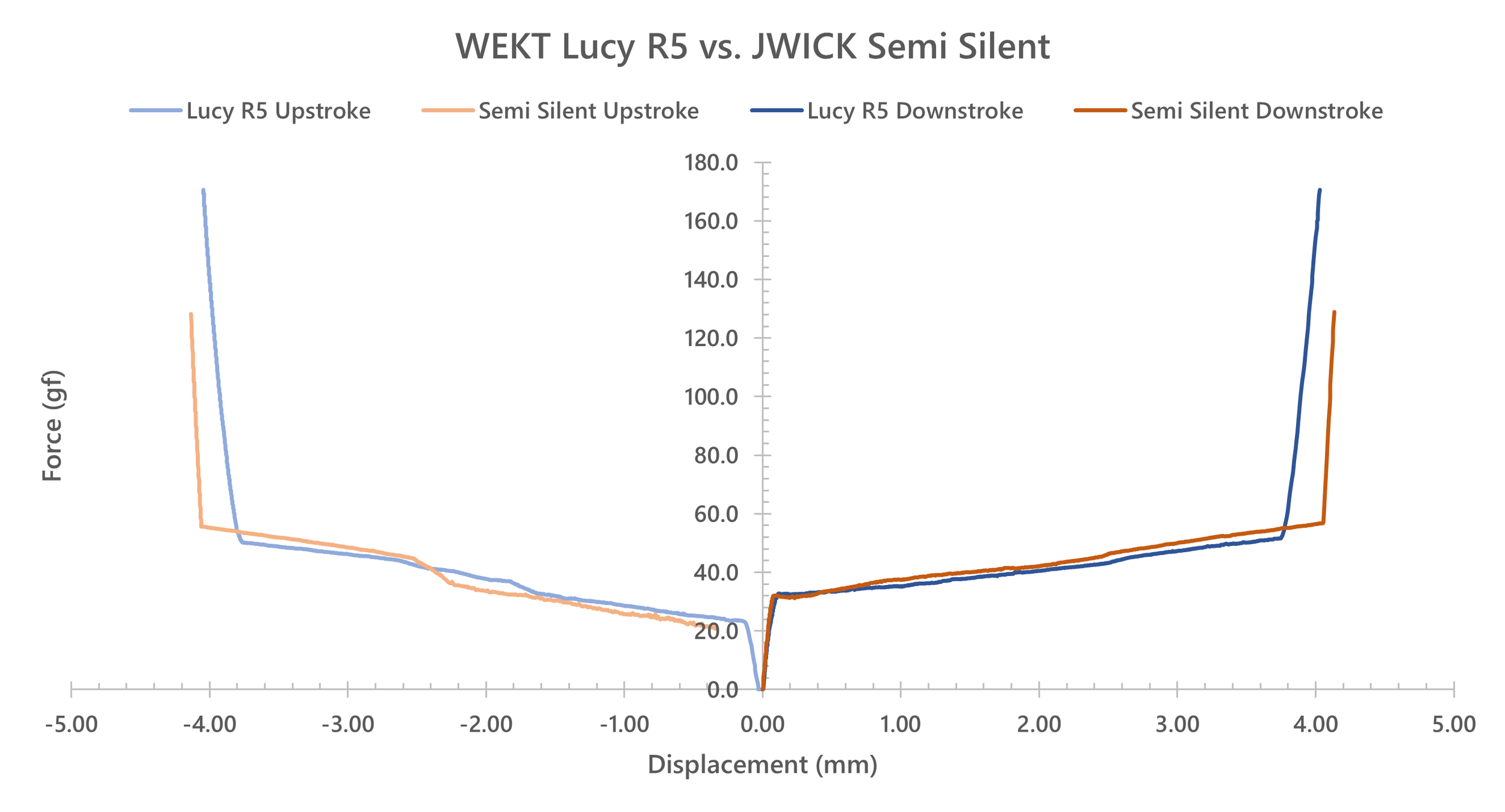
JWICK Semi Silent
- While the JWICK Semi Silent switches share the same directional asymmetry in their stem wobble as the WEKT Lucy R5 switches, they are a bit less wobbly in the N/S direction than the Lucy R5s.
- Comparing just the topping out sound of these two switches, on account of the fact that the JWICK Semi Silents are really only silenced at that point of their stroke, the Lucy R5s are all around more quiet and surprisingly so given the difference in size of their topping out dampening mechanism versus those of the JWICK Semi Silents.
- The JWICK Semi Silent switches are smooth, but not overly smooth, and still have a tiny bit of texture to their strokes that becomes a bit more apparent at higher actuation speeds and simply isn’t present at all in the WEKT-made Lucy R5 switches.
Gateron Silent Ink V2
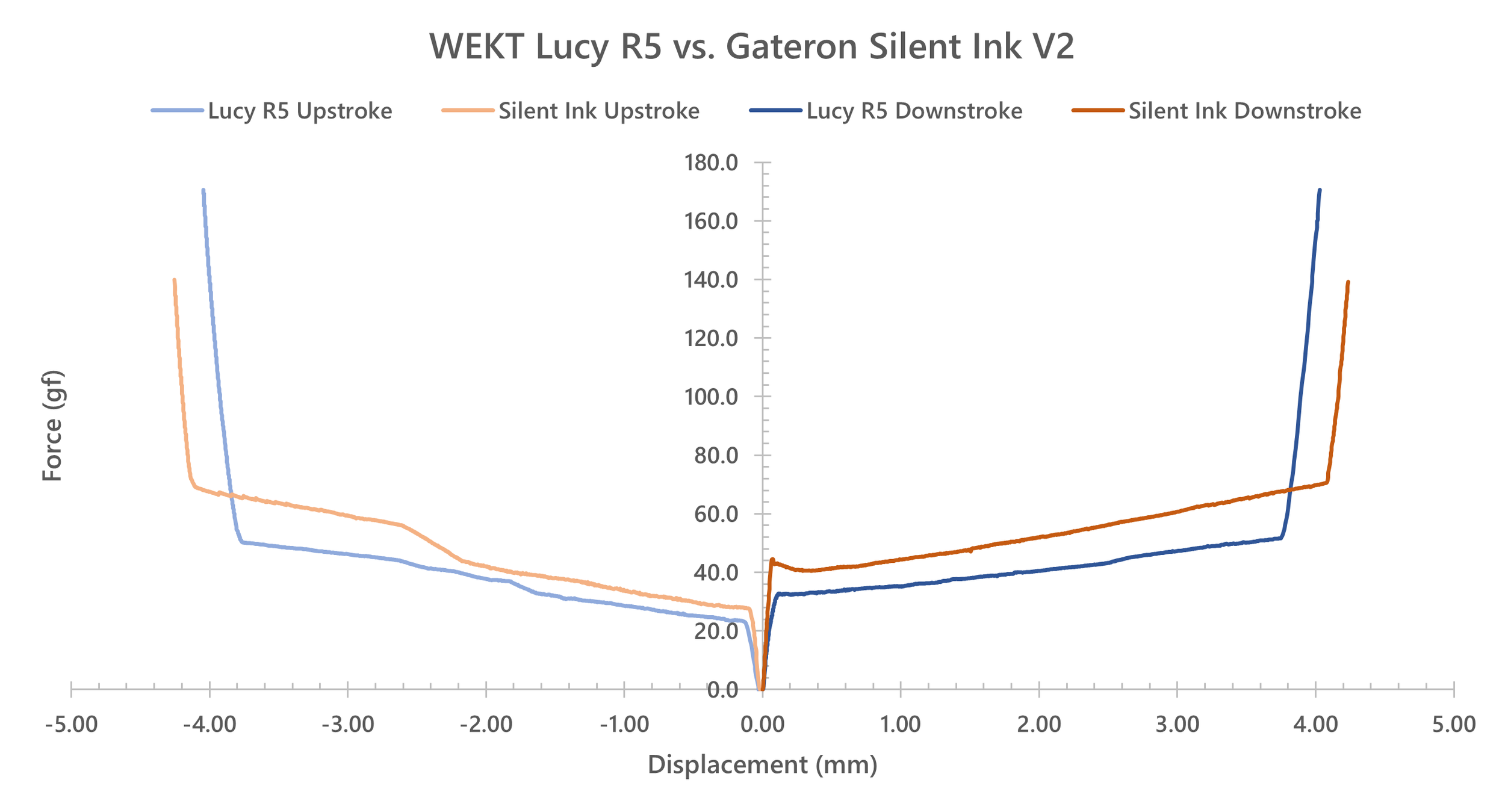
- This head to head comparison makes the overall age of the Gateron Silent Ink V2 switches especially apparent as they are nowhere as smooth or well lubed by the factory as the WEKT Lucy R5s were. Back in the day the Ink V2 line of switches were among some of Gateron’s best work when it came to factory lubing, and to see it so effortlessly batted down by a relatively new manufacturer using molds and equipment of a failed one from before them is quite a bit jarring!
- Overall, and in spite of the asymmetry, the WEKT Lucy R5 switches have a bit less stem wobble than the Gateron Silent Ink V2s.
- In terms of their overall sound, the Silent Ink V2 switches are a fair bit noisier than the WEKT Lucy R5s on account of their less well designed leaves that are more prone to develop ticking with time and usage.
Haimu Heartbeat
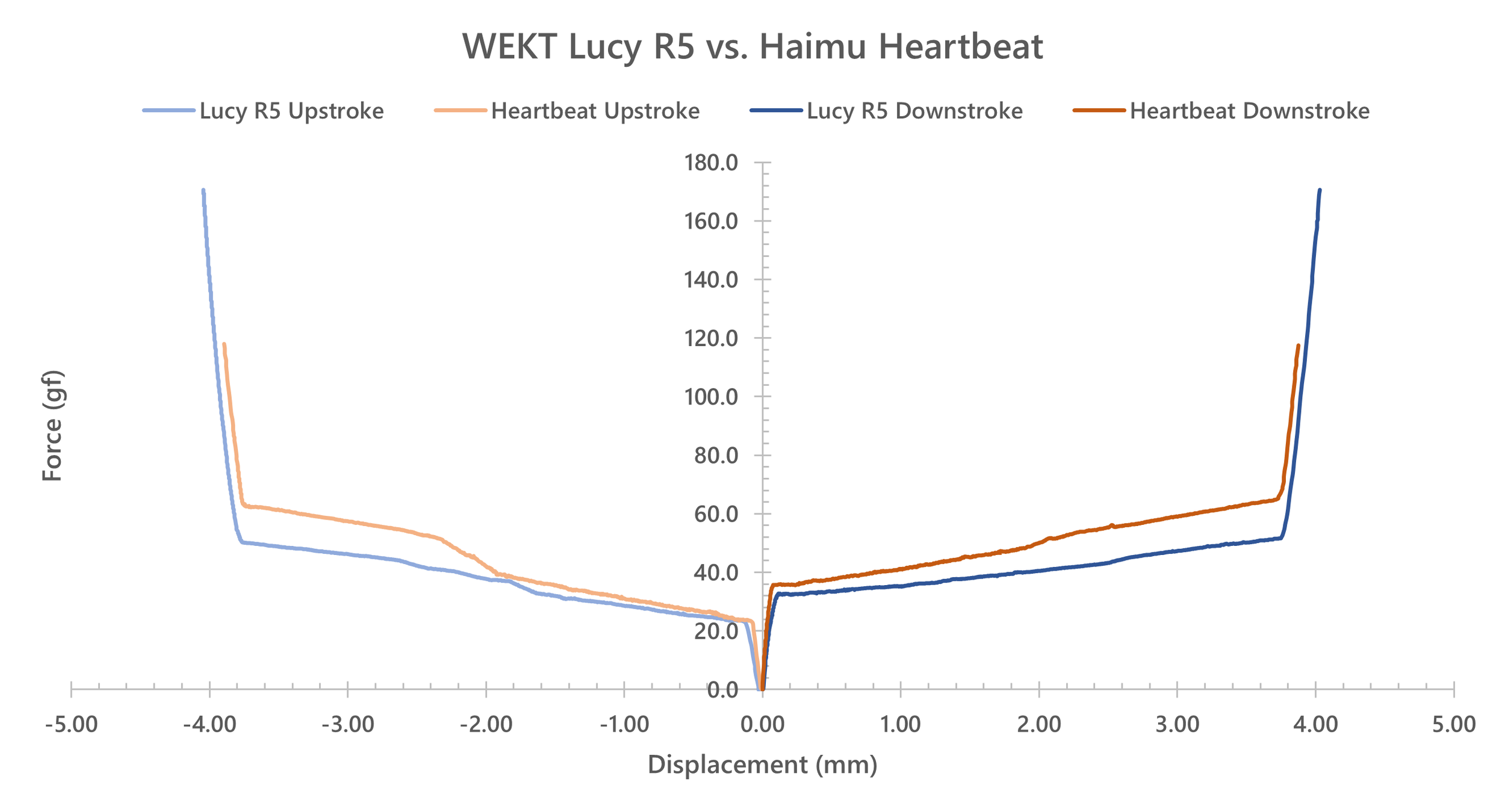
- Like many other switches on this comparison list, the Haimu Heartbeats have a symmetrical N/S and E/W direction stem wobble that is lesser in magnitude than the N/S direction stem wobble of the WEKT Lucy R5s but also greater than their E/W direction stem wobble. The offset is a bit hard to judge head to head as being asymmetrical about this point is far from a ‘bad’ thing, per se.
- Both the Haimu Heartbeats and WEKT Lucy R5 switches struggle with cross-batch inconsistencies due to factory lubing, though the differences in sound between Heartbeats that have greater or lesser factory lubing is much more apparent on the ears than the Lucy R5s. This makes the Heartbeats more prone to needing to be cherry picked for a good, consistent batch for a keyboard build than the WEKT Lucy R5s.
- The bottom out feeling of the WEKT Lucy R5s is one that is generally a bit firmer and less prone to a mushy, gummy feeling than those of the Haimu Heartbeat switches – even in spite of the fact that the dampening mechanism used in the Lucy R5s is closer to that of the traditional silencing mechanism for MX switches than the S-curve stem dampeners of the Haimu Heartbeats.
Scores and Statistics
Note – These scores are not necessarily completely indicative of the nuanced review above. If you’ve skipped straight to this section, I can only recommend that you at least glance at the other sections above in order to get a stronger idea of my opinion about these switches.
Push Feel
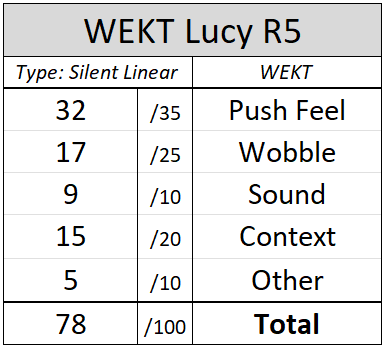
Using a newly updated version of the iconic LICHICX style stem silencing mechanism, the WEKT Lucy R5s are everything that their V1 predecessors were – smooth, incredibly well dampened, and free from the soft, gummy feeling commonly expected of silent linear switches. The WEKT Lucy R5s bottom out just shy of a full conventional stroke length around 3.50 mm with a ~52 gf. bottom out weight and feeling that is like a soft yet firm pillow that doesn’t change at all with typing speeds. There is some minor batch-wide variation in the WEKT Lucy R5s though, causing some to feel (and sound) ever so slightly sticky or gummy at bottom out unlike the rest.
Wobble
The WEKT Lucy R5s have an asymmetrical stem wobble that is significantly greater in the N/S than E/W directions, though on the whole is a bit worse than average? Or a bit around the average? Most users won’t have issues here unless they’re particularly picky about this metric.
Sound
With only the slightest degree of batch wide variation holding them back, the WEKT-made incarnation of LICHICX’s famous Lucy switches are just as silent, and maybe even more so on account of their slightly softer bottom outs. These switches have a well-balanced topping and bottoming out that are effortlessly unnoticeable, with the bottom outs being vacuum like in how they seemingly take in more sound than they give off in short, bassy bursts.
Context
Priced at $0.40 per switch and available from a noticeable range of western facing vendors, these have been among the highlights of WEKT’s debut since they first popped onto the scene. However, their long term availability, like LICHICX before them, is questionable at best.
Other
Despite the subtle innovation, the WEKT Lucy R5s rely heavily on the Lucy V1’s legacy and thus feel trapped in the orbit of them rather than standing out as something unique on their own.
Statistics
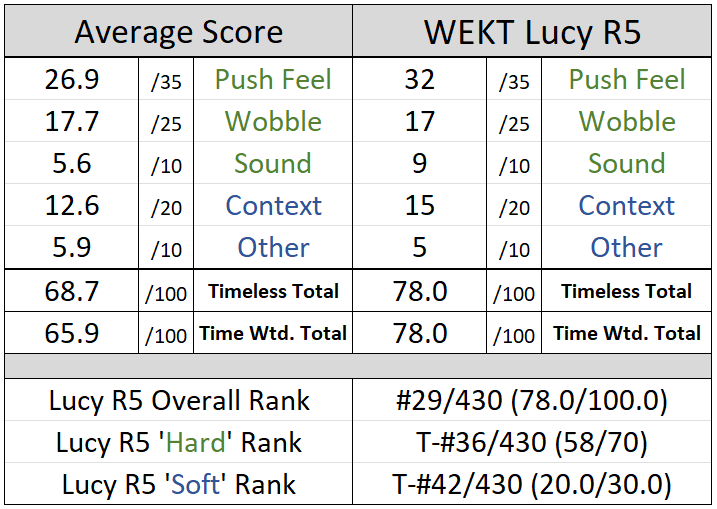
If you are looking at this statistics section and wondering what the heck ‘Timeless’ and ‘Time Weighted’ scoring is, consider checking out my short article titled ‘A Scorecard Time Change’. As a result of scoring becoming a bit anachronistic over the years, switches are now ranked in this statistics table using a “time weighted total” as opposed to their day-of scoring as discussed in that article. If you’d also like to learn about what ‘hard’ versus ‘soft’ ranks refer to specifically, I’d encourage you to head on over to my GitHub linked in the table above or at the links in the top right hand of this website to check out my database of scorecards as well as the ‘Composite Score Sheet’ which has a full listing of the rankings for each and every switch I’ve ranked thus far.
Final Conclusions
On the whole, I was quite surprised to find that the WEKT Lucy R5 silent linears actually seem to live up to not only the small bit of hype that they’ve generated in the west, but also the legacy of the original LICHICX-made silent linears that they are so blatantly connected to. Much like the originals, the Lucy R5s are nearly perfectly silent linear switches that are well factory lubed, have precisely balanced housing collisions that almost seem to absorb sound like sponges, and are ruthlessly consistent no matter how fast they are type on. Also much like the originals, they have some minor flaws with the asymmetrical stem wobble and occasional inconsistency at bottom out by way of factory lubing, though these are fairly minor points to overlook in pursuit of silent switches that are just so damn consistent and quiet. However, I have to admit that I am a bit personally disappointed in XCJZ and WEKT for the Lucy R5s because of the fact that they very clearly aren’t faithful recreations of the colorway and name that they are adopting here. Why choose to adopt the name, the heritage, and the legacy of a line of switches if you, yourself, are a new manufacturer invoking a new (but similar) mechanism to try and differentiate yourselves from the ghosts of the past that you acquired? The fact that they actually managed to break apart LICHICX’s one part dampening mechanism into two and control it with enough precision to make not one, but two entirely differently feeling silent linears in the Lucy R5s and Lucy R5Ts should be the pivot point about which WEKT breaks away from the old LICHICX that they stand atop of. These could have been being painted as the new, more customizable, and more precisely tuned version of the LICHICX mechanism that came before it… and yet I spent the entirety of the review tying every opinion I had of the R5s back to the V1s because of their similarity in name and colorway. The fact that WEKT also seems to be going the way of the original LICHICX and porting this mechanism from the R5s/R5Ts directly into their next silent linear release with hardly anything different than a spring weight and a colorway is also deeply concerning as well. The lack of variety in mechanism and ‘overprinting’ of the same thing over and over in switches likely didn’t help LICHICX stay afloat for as long as they did and assumedly won’t fair WEKT much better. I’m not saying that it directly contributed to their downfall, but why would WEKT be picking up the pieces of the failed LICHICX brand and seemingly continuing it just the same way they were and expecting it to turn out any differently? The WEKT Lucy R5s are great switches and an equally great stepping stone forward for WEKT to show that they aren’t just producing switches out of old LICHICX molds and reputation, but they could be doing so, so much more here to really mark these as the future and not just ‘iteration number five’ of a well-regarded silent linear.
Sponsors/Affiliates
Mechbox UK
- A wonderful UK based operation which sells singles to switches that I’ve used above in my comparisons for collectors and the curious alike. Matt has gone out of his way to help me build out big parts of my collection, and buying something using this link supports him as well as my content!
KeebCats UK
- A switch peripheral company based out of the UK which sells everything switch adjacent you could ask for, they’ve been a huge help recently with my film and lube supply for personal builds, and they want to extend that help to you too. Use code ‘GOAT’ for 10% off your order when you check them out!
proto[Typist] Keyboards
- An all-things keyboard vendor based out of the UK, proto[Typist] is a regular stocker of everything from switches to the latest keyboard and keycap groupbuys. While I’ve bought things from the many times in the past, they also are a sponsor of my work and allow me to get some of the great switches I write about!
Divinikey
- Not only do they stock just about everything related to keyboards and switches, but they’re super friendly and ship out pretty quick too. Divinikey has been a huge help to me and my builds over the last year or two of doing reviews and they’ll definitely hook you up. Use code ‘GOAT’ for 5% off your order when you check them out!
ZealPC
- Do they really need any introduction? Zeal and crew kicked off the custom switch scene many years ago with their iconic Zealios switches and the story of switches today couldn’t be told without them. Use code ‘GOAT’ (or click the link above) for 5% off your order when you check them out!
MechMods UK
- A rising vendor based in the UK, Ryan and crew have been a pleasure to work with and have nearly everything you’d need to build your first or fourteenth keyboard. Go build your latest or greatest one right now with them by using code ‘GOAT’ at checkout for a 5% discount!
Dangkeebs
- A longtime supporter of the website and the collection, Dangkeebs has quite possibly the widest variety of switches of any vendor out there. Not only is their switch selection large, but it rotates and is constantly adding new stuff too. You’re going to need 5% off your order with my affiliate to save off the cost of all those switches!
SwitchOddities
- The brainchild of one my most adventurous proxies, SwitchOddities is a place where you can try out all the fancy, strange, and eastern-exclusive switches that I flex on my maildays with. Follow my affiliate code and use code ‘GOAT’ at checkout to save 5% on some of the most interesting switches you’ll ever try!
Cannonkeys
- Does anybody not know of Cannonkeys at this point? One of the largest vendors in North America with keyboards, switches, keycaps, and literally everything you could ever want for a keyboard always in stock and with an incredibly dedicated and loving crew. Follow my affiliate link above in their name to support both them and I when you buy yourself some switches!
Kinetic Labs
- One of the most well-rounded keyboard vendors out there, Christian and crew have been supporters of all my switch and switch-adjacent needs for some years now. I’m honored to have them as an affiliate and think you should check them out using my affiliate link above to support both them and I when you check out their awesome products!
Keebhut
- Want to try out some switch brands that fly under most vendor’s radars? Keebhut is always seeking out that next latest and greatest and has been super helpful in hooking me up with new brands over the past year. They are all about sharing that love as well, and want to give you 5% off your next order with them when you use code ‘GOAT’ at checkout!
Kailh
- No, you’re not mistaken – this is actually that Kailh that manufactures switches. As one of the longest running manufacturers in the hobby, they have a massive variety of switches available over on their website at any point in time. I’m lucky to be affiliated with them now, and so consider using my affiliate link above when ordering some Kailh switches to support me!
Keebz N Cables
- Australia and Oceania’s very own is now a part of the sponsor list here and I couldn’t be happier to add this long time supporter of the collection to it. They’ve always got an amazing selection of switches (and other keyboard parts) in stock and they want to share the love that they’ve shown me with you all too! Use code ‘thegoat’ for 5% off your first order when you visit!
Further Reading
XCJZ’s WEKT Lucy R5 ZFrontier Debut Post
XCJZ’s WEKT Lucy R5T ZFrontier Debut Post
Unikeys’ WEKT Lucy R5 Switch Sales Page
SwitchOddities’ WEKT Lucy R5 Switch Sales Page
Divinikey’s WEKT Lucy R5 Switch Sales Page
Moyu Studio’s WEKT Lucy R5 Switch Sales Page
Keebz N Cables’ WEKT Lucy R5 Switch Sales Page