BSUN Golden Apple Switch Review
To be entirely honest with you all, I had plans about leading off this weekend’s article with some sort of commentary about just how strange everything feels right about now. Perhaps it’s the stress of an increasing volume of work and responsibility at my in real life job that is getting to me, or maybe I’m just finally getting old enough to hit those weird age-induced moments of confusion about how everything ended up the way that it did. You know, like those moments your parents would talk about walking through the store and not recognizing the names nor faces of musicians or actors on the covers of any of the magazines anymore. (Something which actually did happen to me this week, by the way.) Or maybe that’s just me becoming entirely out of touch. The reason I didn’t lead off with that introduction, though, is that the feeling has been a sort of vague one thus far – there’s been no real specific situation or series of events underpinning that sort of vague paranoia and confusion I’m feeling. However, I must admit that seeing the news that Drop (formerly Massdrop) is officially closing up its doors here in a little under a month as of the time of writing definitely felt like it perfectly hit that confusing strangeness dead on the nail. Sure, the writing was on the wall for Drop a while ago when they first sold the company to Corsair, and then doubly so when they stopped their contracted short articles that I had had with them over the past few years, though Drop has just kind of always been a part of the hobby. For at least as long as I’ve been around, Drop has always been there selling mechanical keyboards. I remember when Halo Trues would sell out almost instantly upon restock there, or when the Geekmaker Creamy or Moyu Black switches that I wrote a review for all those years ago first released. Some of my first keycap sets like GMK Nautilus and Laser came from there too. My first Evil Artisan Box, a slew of deskmats, and even some of the formative in person interactions I had at meetups over the years all came directly or indirectly from Drop, and they no longer being here as I continue in the hobby just doesn’t feel quite right. I unfortunately don’t have much in the way of a eulogy for Drop despite my tendency to over write every thought that I ever have as it just feeds into that numb, tingling strangeness about the world I’ve been feeling lately. Alongside TKC disappearing just earlier last year, it is as foundational chunks of the hobby that I once joined just aren’t around anymore and my time in the community, as well as my interest in keyboards will have outlasted brands that I simply didn’t think had a clock that could be outlasted. I really wish I had a good set of words to describe how this feels, as it just doesn’t quite sit right in my head…
Figure 1: Alright John Koenig, what's the word for this one?
Switch Background
Normally when I’m seeking out switches to choose for a full length review, it really is just one large factor that stands out about a switch that can lead me to drafting them for the cause. (Pun intended.) For example, the continuation of a treasured or well sold family of switches such as the Invokeys Goji Reserves carrying on the Reserve family through yet another entry. Or, it could be novel aesthetics like those of the Huano Hi/Fi switches. Even functionally intriguing mechanisms or switches with actions that are different from the norm like Gateron Lanes get equal footing in that mix as well. While I’d like to believe that I’m more of a complex connoisseur of switches for my long-winded ramblings than that, it really isn’t the truth of the matter at all; Sometimes the best switches I’ve reviewed and the most enjoyment that I’ve had in reviewing them have came out of these tunnel visioned selection criteria. The BSUN Golden Apple switches, though, hardly fall strongly into any one singular category that makes them stand out amidst all of the other switch offerings I have yet to review. It was more so a collection of many small details that pulled me in. The first and most visually obvious feature of the Apples was that of their strikingly golden yellow color. Sure, this might come across a bit like the color of piss from a distance and be far from the first switch to attempt such a feat, but any switch that is as boldly colored as these at least deserves a brief glance at during switch shopping right? One step closer I found the Golden Apples to not just be tactiles but specifically BSUN-made tactiles – an interesting subset of switches that I’ve enjoyed significantly more than I would have expected in recent months despite scant few offerings like the Invokeys Hojicha Reserves, BSUN Peach Meadows, and BSUN Bordeaux. Getting even closer to the Golden Apples, I found through the descriptions on various sales pages that they had bottom housings made of PEI, or polyetherimide material. While I had thought at first glance that I had recognized that yellow color from somewhere else other than a trip to the bathroom, it didn’t click until I saw this detail that it is the exact same color of Ultem PEI pellets that I once trialed in the aerospace R&D lab where I worked sometime around a year ago. All but sealing the deal of me having to review these switches was an even finer, more granular detail about the Golden Apples than all of those previous ones that kept making me more interested bit by bit – their nameplates. Anyone who has shared time in the aerospace industry knows that “FOD”, or foreign object debris, is about as critical of a production concern as anything else in the world and seeing this emblazoned across the top of a switch using a type of resin pellet that I had explored in the lab all while being a type of switch from a manufacturer that I’ve enjoyed previously. How could I not review these switches?
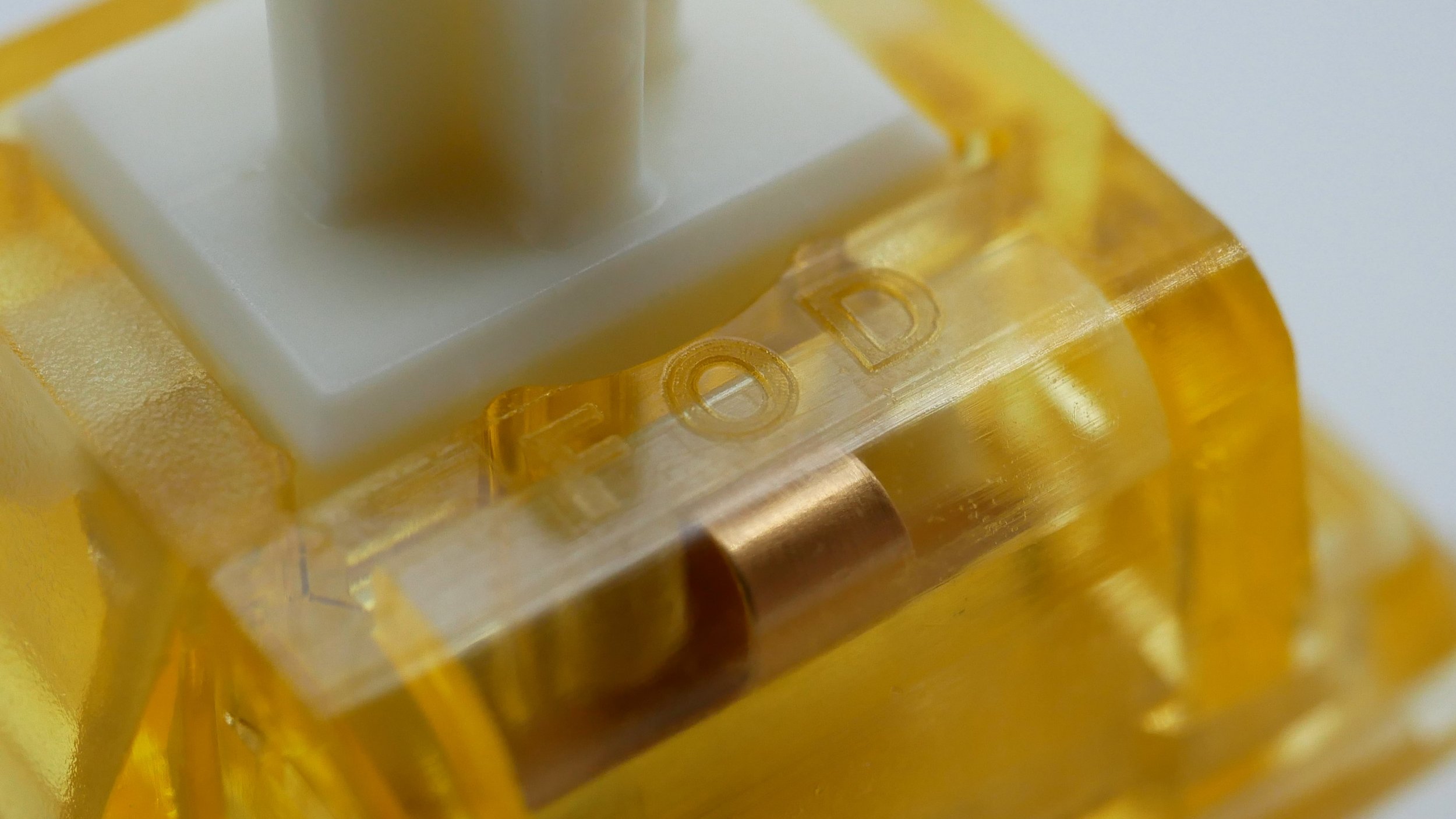
Figure 2: Sure, I had mentioned work was grinding me to dust in the introduction, but even I can appreciate the serendipity in this one.
The serendipity of all of those tiny details colliding together and striking me at just the right time as I began the hunt for a switch to review unfortunately ends at the fact that ‘FOD’, here, doesn’t actually stand for ‘Foreign Object Debris’. In fact it doesn’t stand for that on nearly any of the half dozen different switch nameplates that I’ve encountered it on over the years. However I sincerely doubt that anyone other than me, or the few very dedicated switch enthusiasts out there, would recognize this as anything other than a “throwaway” random nameplate that BSUN occasionally slaps onto their switches. And that’s certainly a shame as ‘FOD’ is actually the abbreviation of ‘Four of Diamonds’ – another China-based switch designer/brand that I have yet to cover here! While Four of Diamonds does share some similarities with HEX Studio that I covered in the Keygeek Muse Switch Review recently in that they are both very particular about their switch material explorations with their specific manufacturers, the similarities really end there. Hitching their ride to BSUN once they were formally established as the ‘FOD’ brand, Four of Diamonds actually started out as a solo female engineer with nearly a decade of production experience employed by BSUN collaborating with Angry Miao to push the release of their Ice Silver Axis Pro switches in late 2023. Building upon the successes that they had found in this debut collaboration, FOD spun off into their own brand that has pushed a series of 5 different BSUN switches from early 2024 to present day, not counting the Golden Apples detailed here. With each of these switches being manufactured by BSUN, it would be possible for me to go down FOD’s choices of what material they used for each housing or their transition from Y3 to Y4 stem materials over the releases, but it is actually the way in which FOD goes about their releases that makes them significantly more interesting to me. Despite sometimes pushing “not so interesting” switches by their own admission, FOD often releases a switch through a series of 3-4 posts on ZFrontier that start with an interest check and move through a couple of multi-paragraph long development updates before actually releasing them in groupbuy sale. Within each of those stages, it’s not uncommon for FOD to send out a dozen or more sample sets of prototype switches for people to review and provide iterative feedback on – sometimes sourcing these individuals from random ZFRontier comments, sometimes from applications one has to submit for a chance, and even sometimes in special slots reserved for previous FOD switch groupbuy participants. While the practice of designers reaching out to content creators for feedback on their switches is far from uncommon, this truly “anyone can help out” style of prototype scattering mixed with FOD’s over abundance of information that they share for each of their painstaking design decisions makes them a brand that I can really only recommend everyone look into. I can’t hardly recommend enough seeing just how much effort goes into their ZFrontier posts and trying to shorten them to any degree would feel like trying to shorten my own work! So as to not water down and over-simplify what are otherwise lengthy, nuanced, and poorly Google-translated articles, I felt it more fitting to simply share a ‘photo’ list of FOD’s releases as of the time of writing:
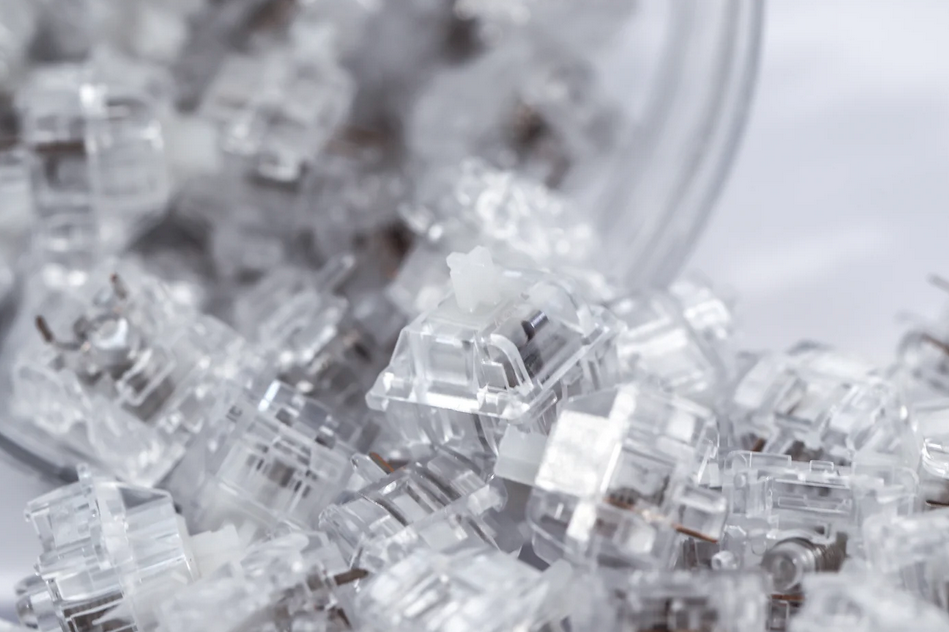
Figure 3: The Ice Silver Axis Pro switches debuted on August 22nd, 2023, as a pre-FOD collaboration with Angry Miao and were a BSUN-made linear with full polycarbonate housings, Y3 stems, and lightly weighted springs ~45gf. at bottom out.
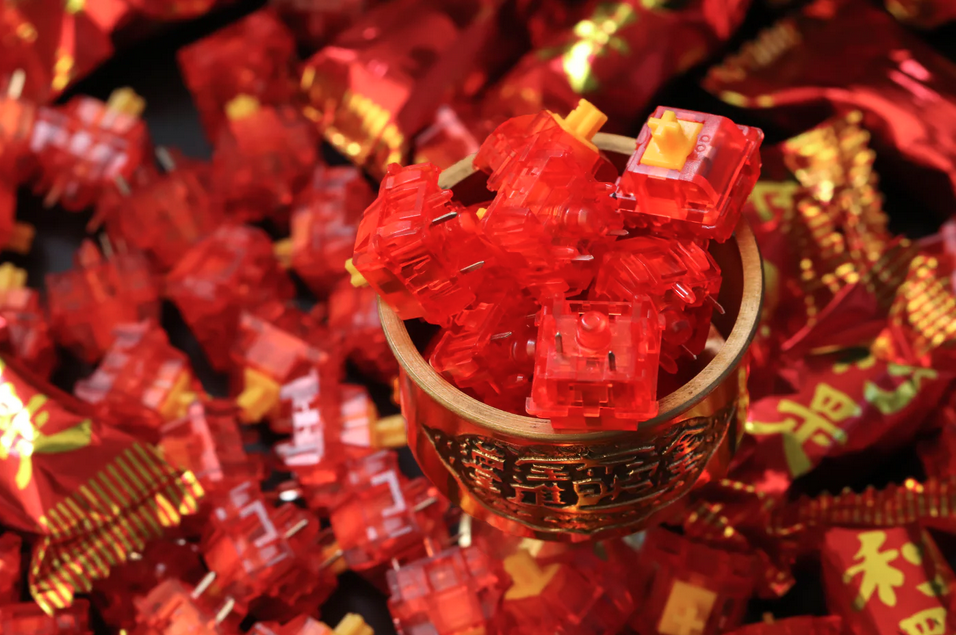
Figure 4: The FOD 'Li is the Axis' (or "BSUN Li") switches were the first of FOD's official switches debuted on December 22nd, 2023, and were effectively identical to the Angry Miao collaboration above but in brilliant red and yellow coloring instead of white and clear.
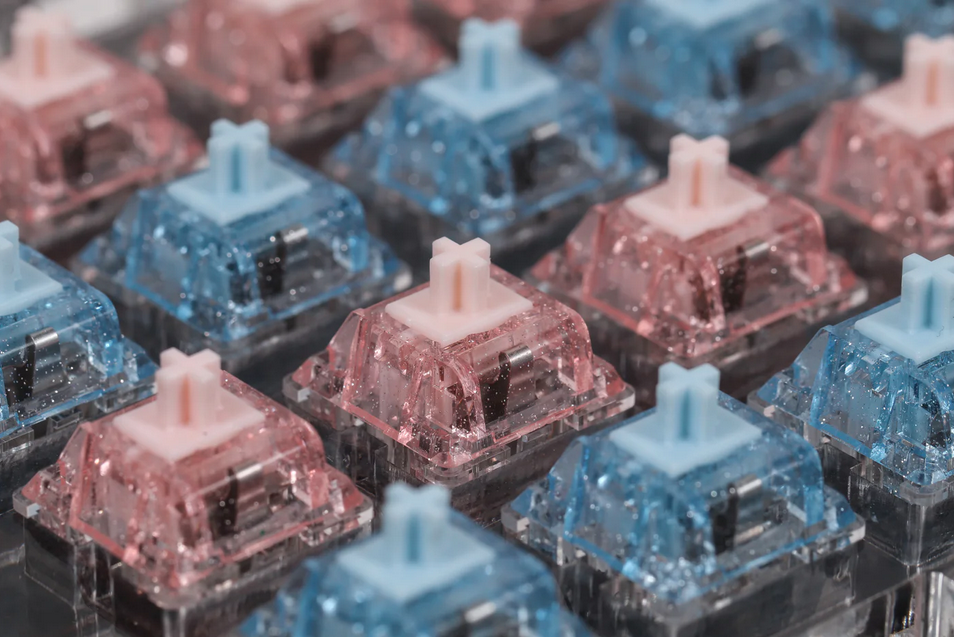
Figure 5: The FOD Butterfly Pink and Blue switches were a pair of linears released on April 28th, 2024, featuring Y3 stems embedded in full "premium nylon" housings. Differentiated by color, the pink were the lighter linears with a 45gf. bottom out while the blues were more conventionally weighted for western audiences ~65gf. at bottom out.
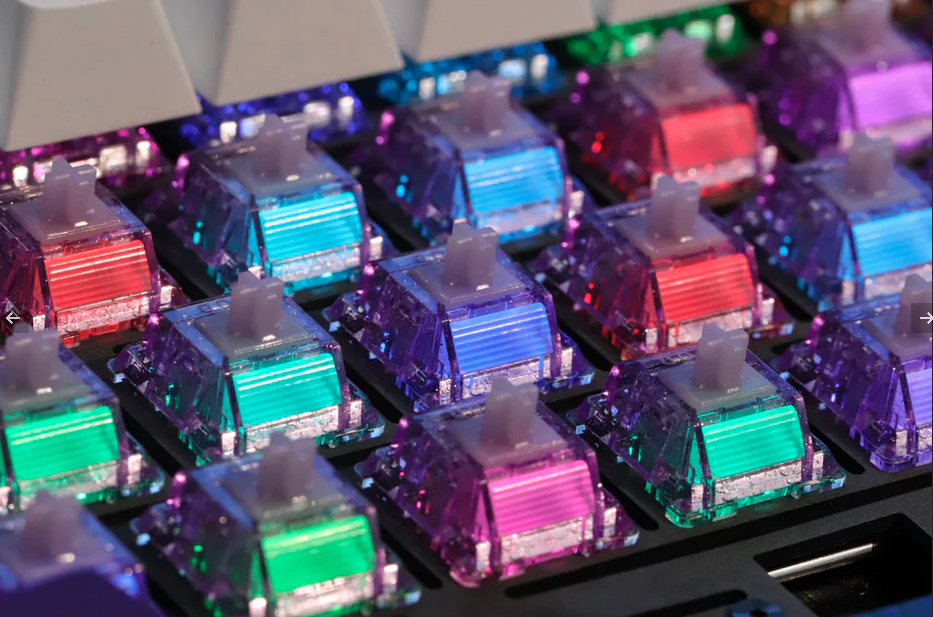
Figure 6: Boasting a new 'Y3.5' stem material from BSUN, the FOD Butterfly Purples followed up the Pink/Blue duo a few months later on August 29th, 2024, with an intermediate spring weighting at 52gf. and some small internal structural changes.
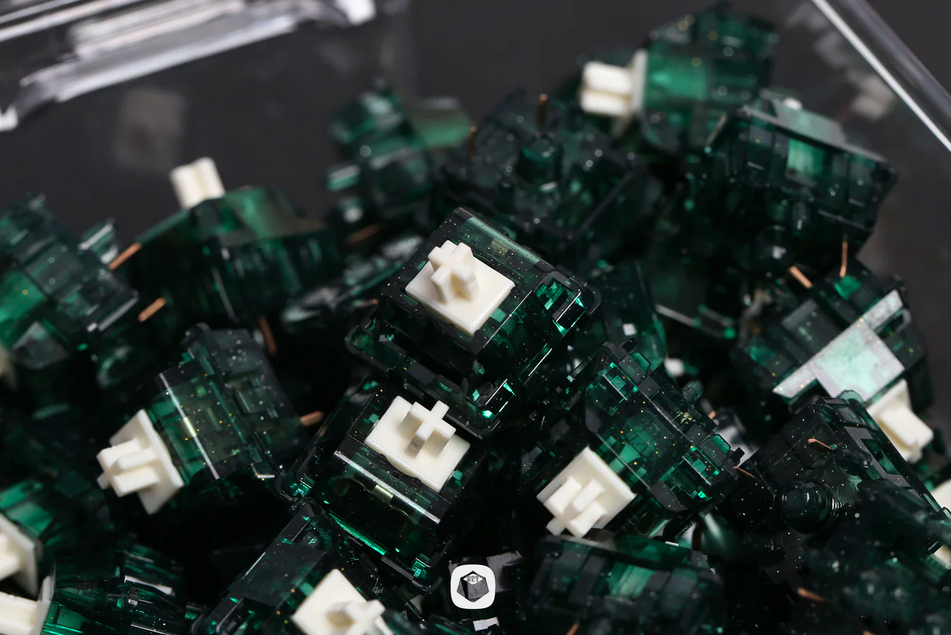
Figure 7: On March 21st, 2025, the FOD 'Luxor' or 'Lux Star' switches officially went to groupbuy with a similar Y3.5 material stem as the Butterfly Purple switches but full polycarbonate housings and a 45gf. bottom out spring weight, effectively mixing and matching details from all previous FOD releases before them.
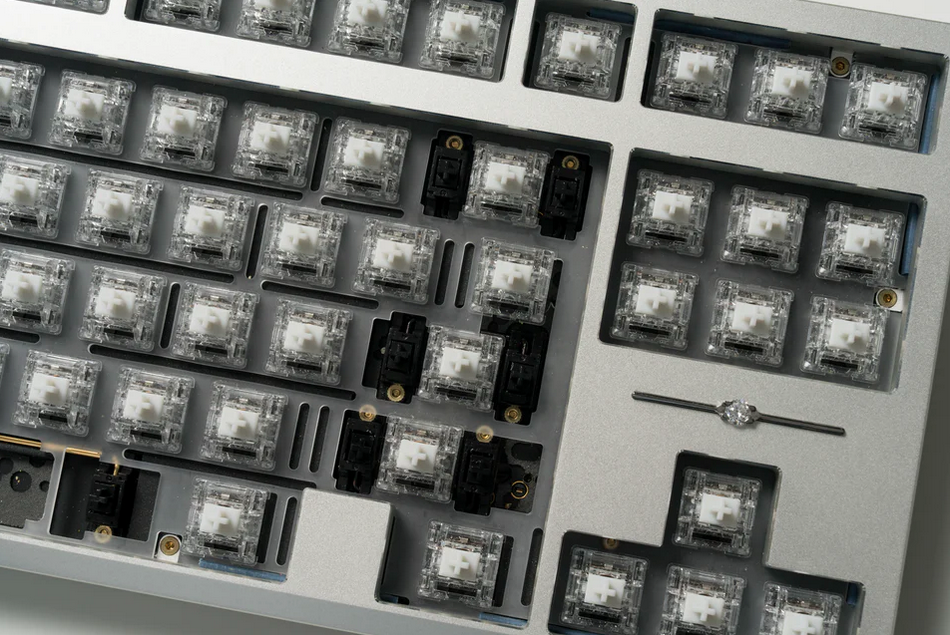
Figure 8: The final FOD switch to be released before the Golden Apples was that of the 'Ruixue' or 'Iceberg' swittches featuring new and improved BSUN Y4 mateiral stems in a split material housing of polycarbonate over nylon. These ~50gf. bottom out linears were listed for sale on August 19th, 2025.
For all of the information that FOD does cram into their ZFrontier interest checks and product development updates, I found it incredibly strange that when prepping for this review I found absolutely no information about the BSUN Golden Apples on their page at all. Instead, it was actually a ZFrontier post by user ‘nerve gager’, who appears to be the posting page for a very small switch brand known as ‘Wishbone Studios’ where the information was first displayed on November 15th, 2025. (Without a mention of FOD anywhere on either of the pages for these switches I’m incredibly confused as to how they ended up with FOD nameplates in the first place? Perhaps this is BSUN flexing some authority over their molds that wasn’t approved by FOD otherwise…) In addition to not being expounded upon significantly in writing, the BSUN Golden Apples are also quite different from all of FOD’s other previous offerings insofar that they are tactiles instead of linears! Featuring a mixed material combination of polycarbonate top housings, LY stems, and a first-of-its-kind PEI bottom housing material, the Golden Apples did not just sell well through their initial groupbuy date on November 27th of 2025, but also through a range of western-facing vendors they were stocked at in the months following. Available through vendors like Milktooth, Unikeys, and Divinikey, the BSUN Golden Apples are still presently available for sale as of the time of writing at ~$0.35-0.40 per switch depending on the source that they are purchased from. With neither FOD, the ostensible brand behind the switches, nor Wishbone Studios who actually debuted them on ZFrontier showing no tendency to re-run or re-iterate switch releases, it is entirely uncertain as to how long the switches will remain available for. Furthermore, given BSUN’s historical tendency to not reiterate upon designs numerous times, it is very possible that this may be the only stretch of time wherein these switches are available.
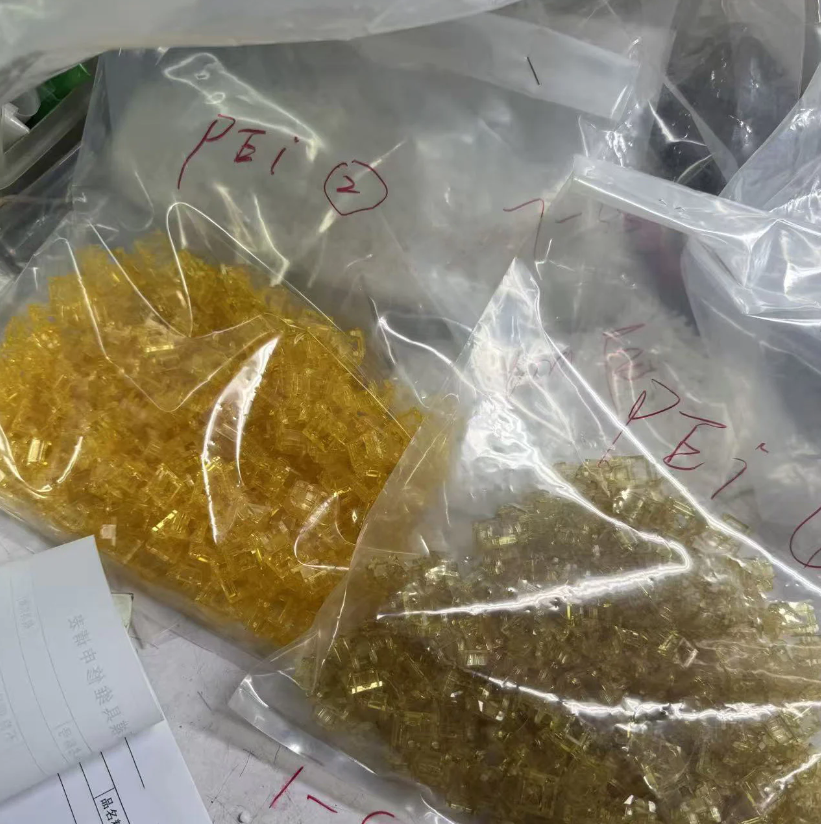
Figure 9: Photos from the BSUN Golden Apple ZFrontier IC showing off bags of PEI housing samples as produced at BSUN.
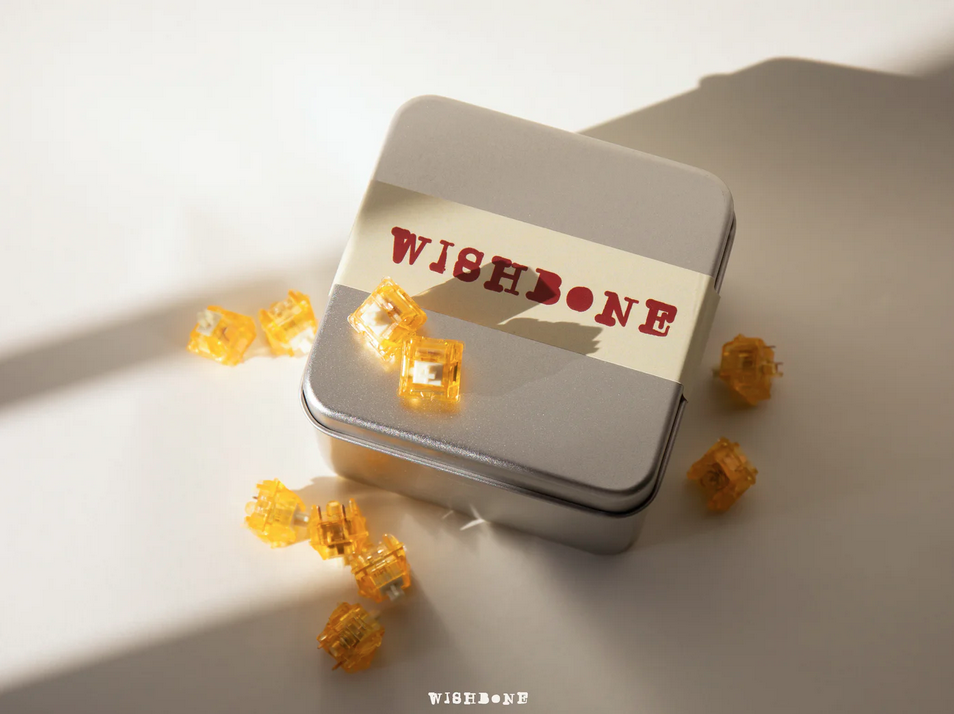
Figure 10: Marketing photo from the BSUN Golden Apple ZFrontier GB post showing off packaging with 'WISHBONE' branding instead of FOD...
Golden Apple Performance
Appearance
At the highest level, the BSUN Golden Apple switches come in a two-part color scheme with off-white colored stems and translucent yellow housings that carry a color that really only conjures up the idea of piss. Look, I want nothing more than to see a bright, golden shiny yellow switch such as these and to think of something like sunshine or the famous Minecraft item that bares a similar name, but I just can’t. The best I can do, instead, is to think of other partially or fully translucent yellow switches of the past such as the Ajazz x Huano Bananas, Gateron Ink Yellows, and the Keyfirst Bling Yellows. Despite there being some other switches which come to mind when thinking of fully translucent yellow switches, its highly unlikely that these could be mistaken for any of those previous entries as a result of their tactile nature, off-white stems, and inverted ‘FOD’ nameplate when inspected up close. Since it has been a minute since we’ve covered a BSUN-made switch in a full length review, and FOD has been known to document minute details and sub-part level changes that they do make in their iterations of switches assuming that they did actually work on these, there’s quite a few details at the part and sub-part level of these switches which are worth discussing. Discussions of these features may be found in the paragraphs and photos below.
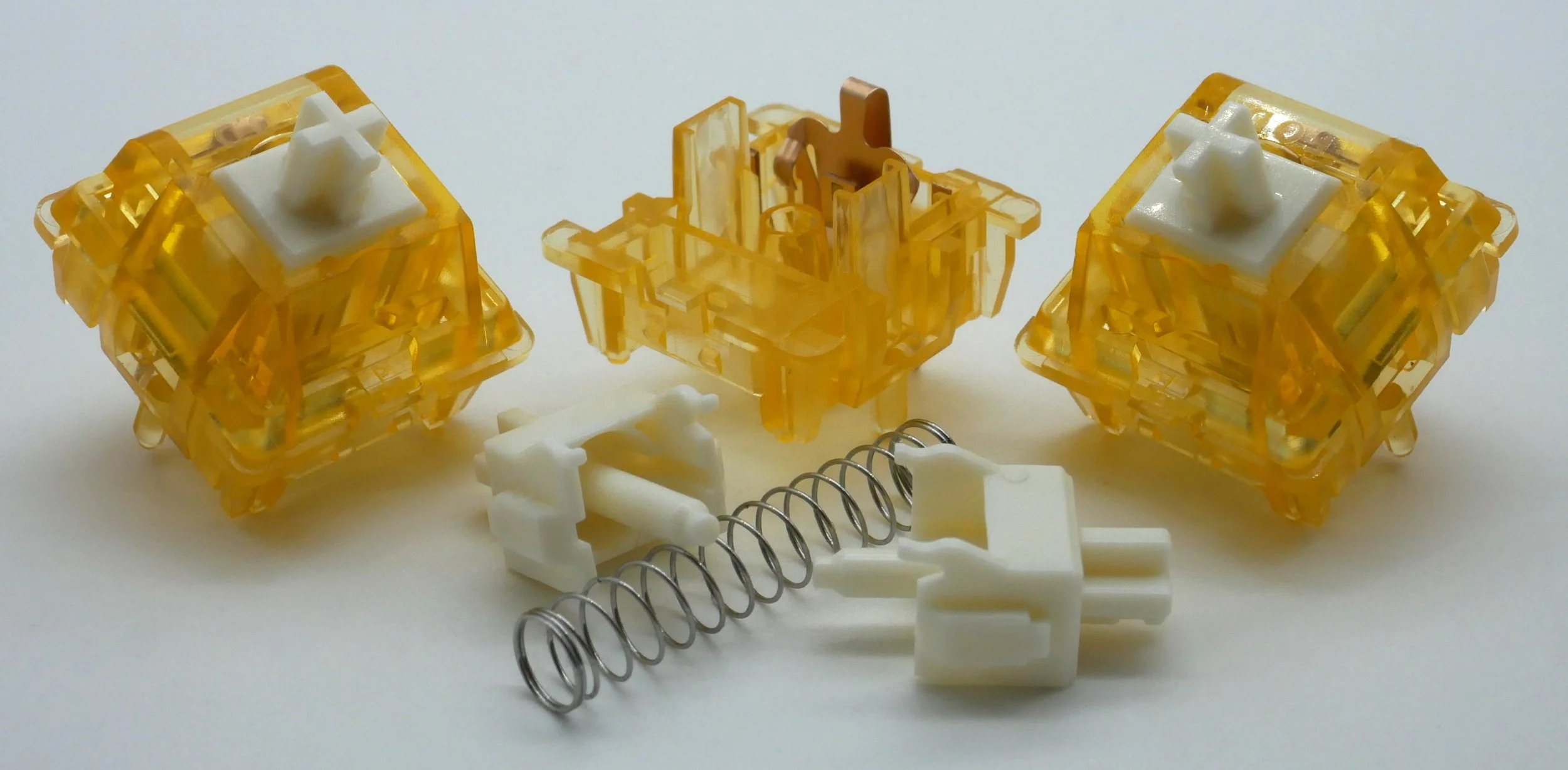
Figure 11: BSUN Golden Apple switches and their components.
Looking first to the translucent golden yellow polycarbonate top housings of the BSUN Golden Apple switches, my eyes are first drawn to an unexpected detail that is actually present inside of the housings. Rather than looking first to the nameplate or even the additional mold markings on the outside of the housings, it is the globs of white factory lube located in the upper inner recesses of the housings that can be seen from the outside of the switch that stand out to me. While this is far from the first time that I’ve seen excess factory lubing through the top housings of the switch, it feels a bit striking as stock lubing just simply doesn’t seem to stick here in most switches on most days, seemingly choosing to pool in the base of the bottom housings instead. Externally the Golden Apple top housings feature an inverted, thinly raised font nameplate of ‘FOD’ with large spacing between each letter as a well as a large capital letter mold marking on the outer lip of the housing. Traveling through the wide, thin rectangular LED slot with centered circular cut out, the interior of the BSUN Golden Apple housings are fairly mundane despite their excess lubing. It should be noted that this lubing appears to be pooled in a relatively flat, non-channeled topping out point to the housings – something I’m only inclined to note because of FOD showing off prototypes of angled/grooved topping out recesses in their development posts about the FOD Butterfly switches.
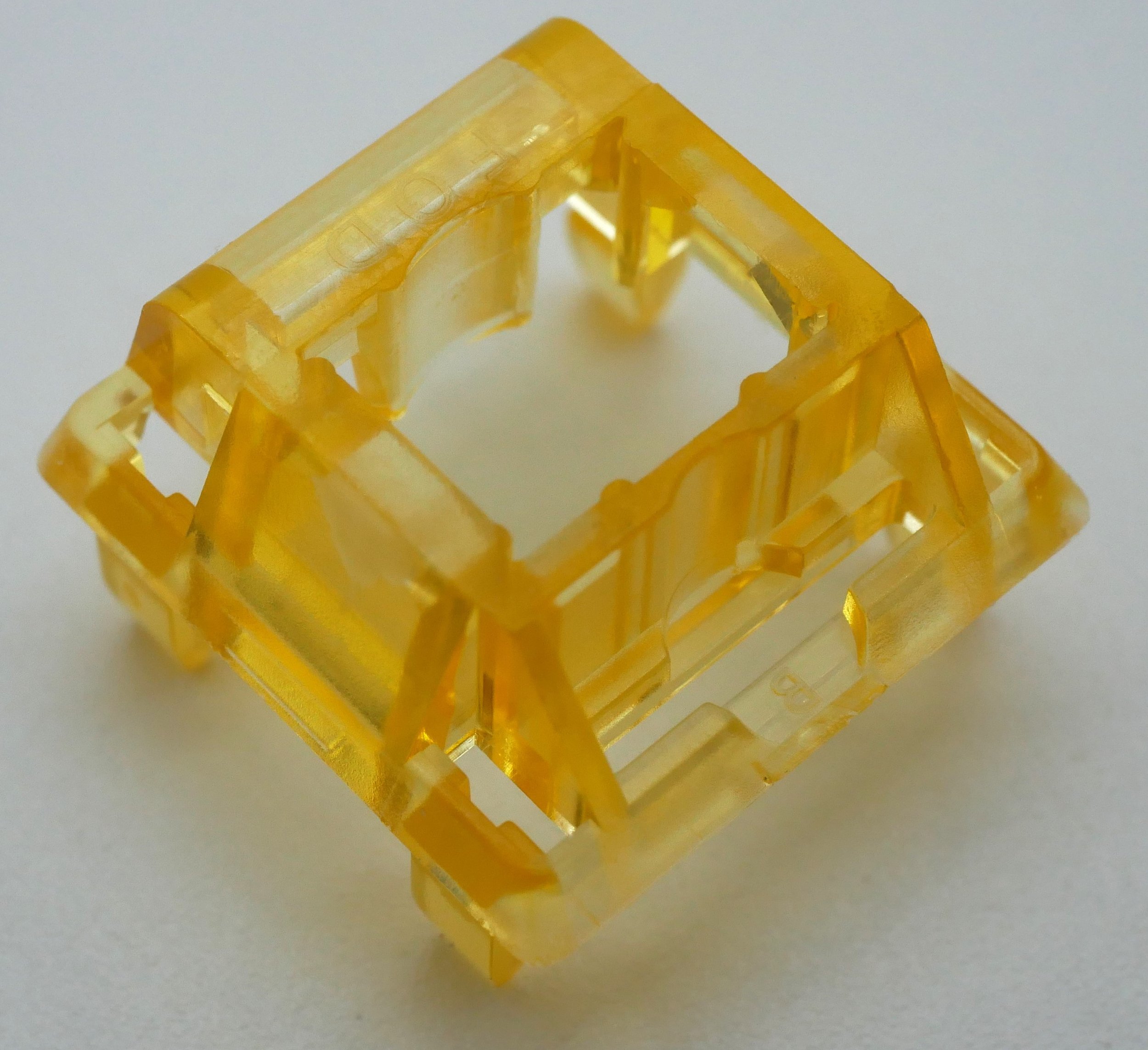
Figure 12: BSUN Golden Apple top housing exterior showing inverted 'FOD' nameplate, long, thin rectangular LED/diode slot, and capital letter mold marking on outer lip of said slot.
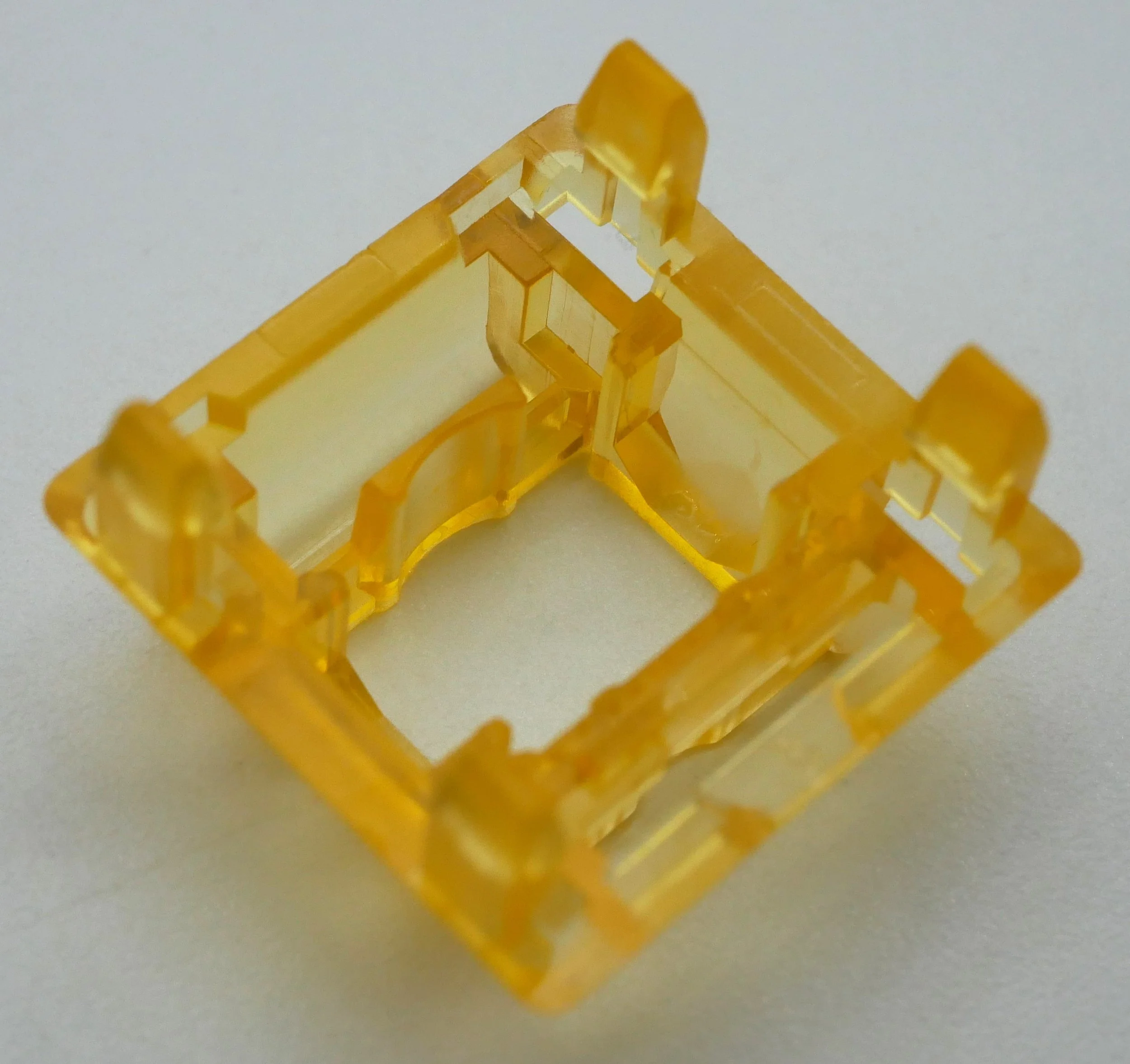
Figure 13: BSUN Golden Apple top housing interior showing no differences from most other BSUN-made and FOD-designed switches. Do note the trace amounts of factory lube present in the upper recess of the housing where the stems contact at topping out.
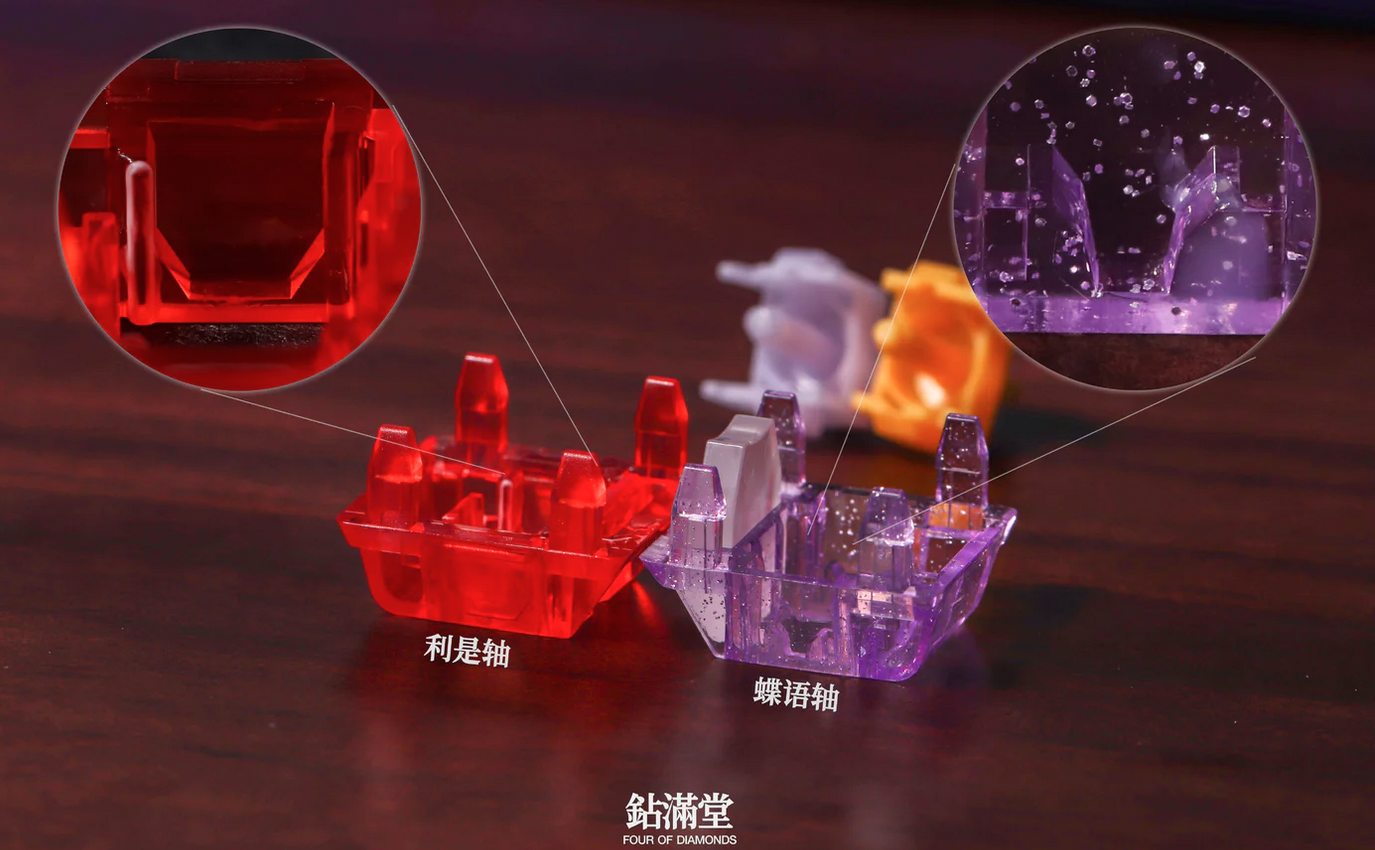
Figure 14: Differences in topping out location geometry as seen in FOD's Purple Butterfly switch documentation. The red comparison switch is FOD's 'Li is the Axis' switch.
Moving next to the LY material off-white stems of the BSUN Golden Apples, we’re greeted with a slew of details that are far from uncommon to see in modern switches. The stems play all of the classics featuring tapered slider rails, a tiered center pole with a slightly longer than average length to induce stem-pole bottom outs, and even mold ejector circles on the front plate of the stems above their tactile legs. On all four sides of the stem factory lubing can be found, though not nearly in as large of volumes as seen above in the top housings or below in the bottom housings. I’ll leave the side profile of the tactile stems to speak for themselves.
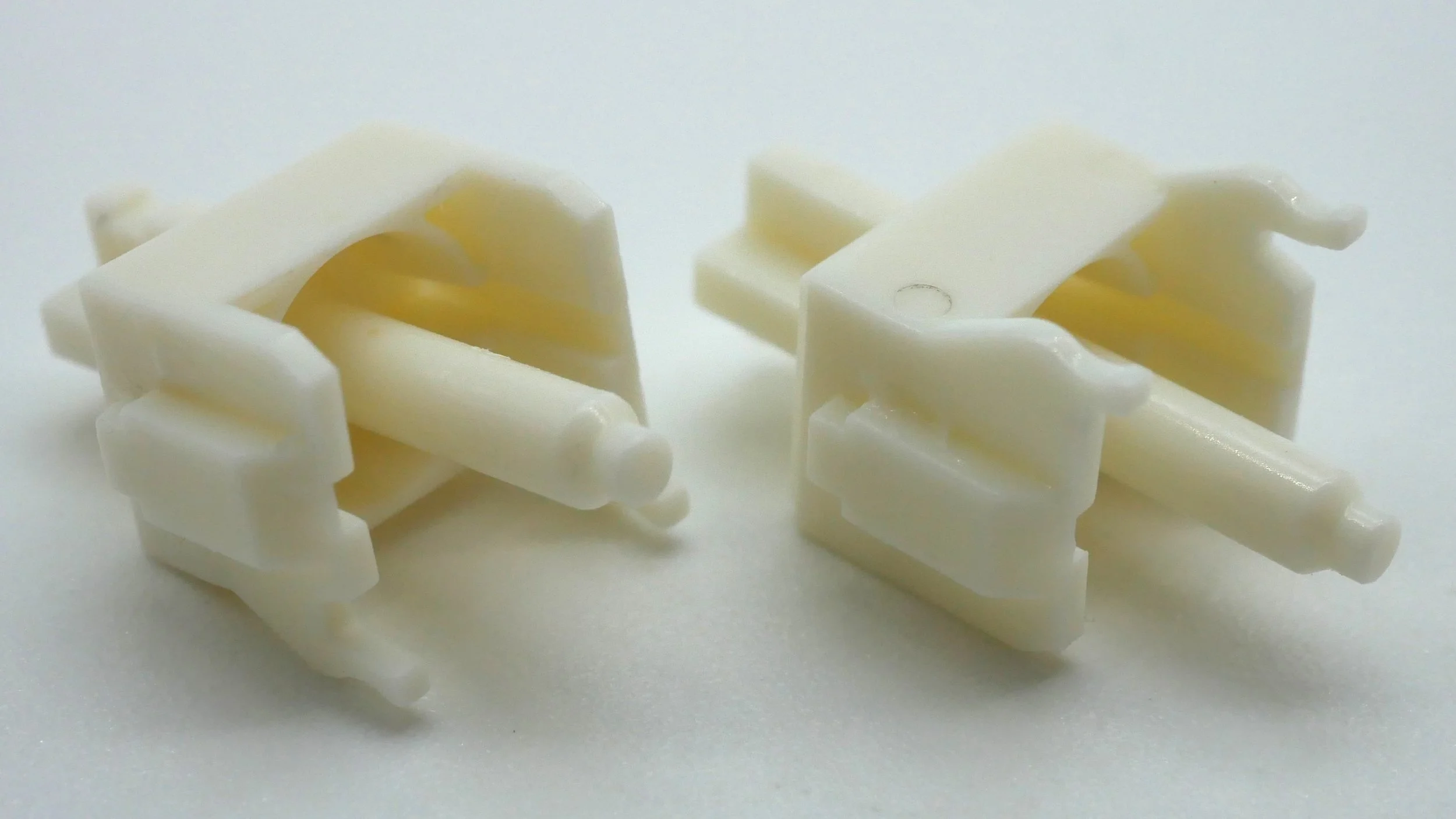
Figure 15: Front and back of BSUN Golden Apple stems showing tapered slider rails, a long, tiered center pole, and mold ejector markings on the front plates above the tactile legs.
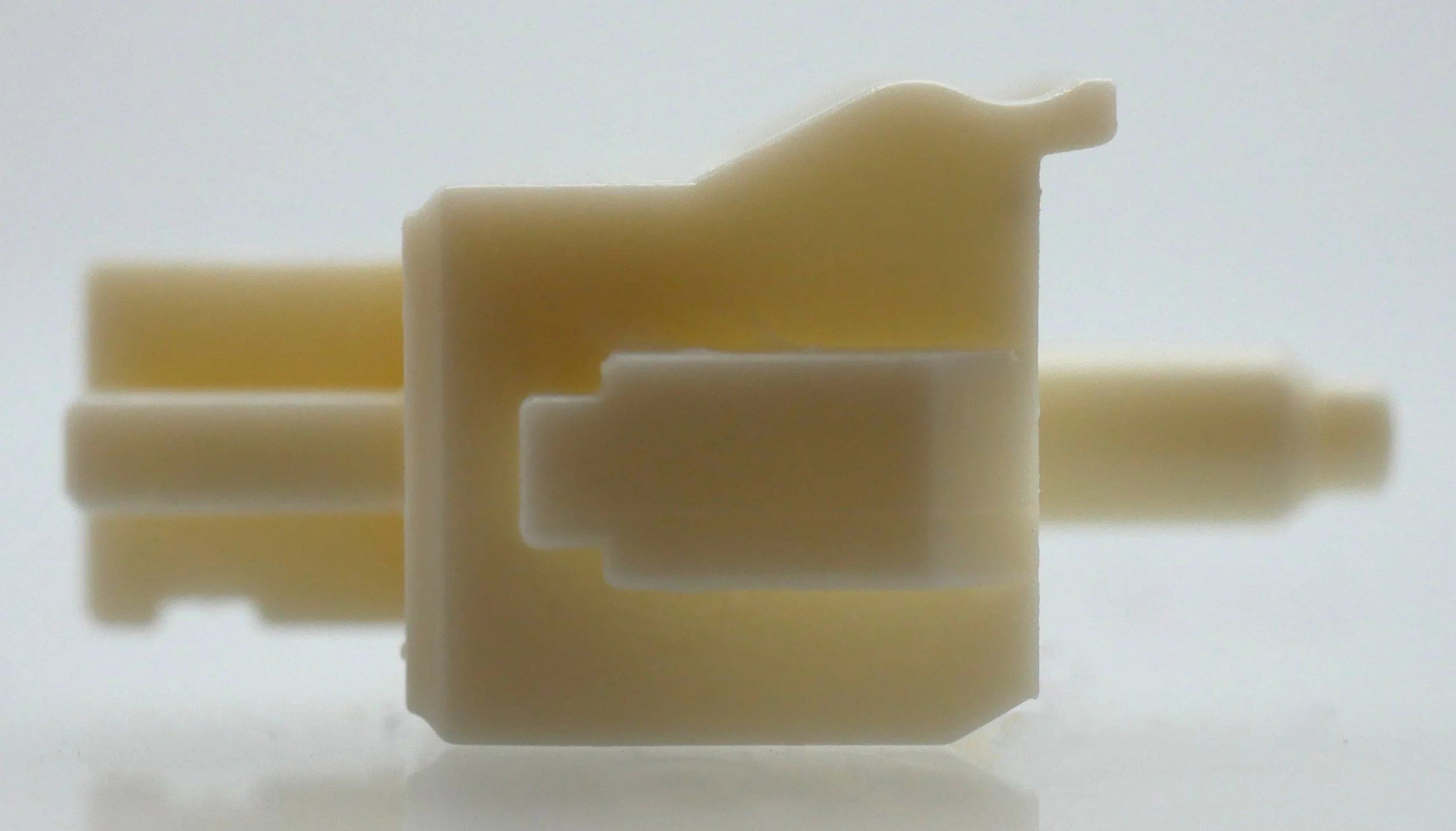
Figure 16: Side profile of the BSUN Golden Apple stems.
Finally arriving to the translucent golden yellow PEI bottom housings of the BSUN Golden Apple switches, I’m surprised to say that there really aren’t that many interesting details to be seen in these housings. Having worked with PEI material before and knowing that Ultem (Sabic brand name for their PEI resin) comes in a range of grades that also include fiberglass inclusions, I was really hoping to see if I’d spot anything of the sort in the final housing structures. (As well, I tried to do some FTIR on the housings themselves for comparison but was unable to get a flat sample that was able to read a good enough signal.) Internally, the housings feature a strong south side spring collar, mold ejector circles in the base of the housing, and non-padded slider rails that are drenched in excess factory lube. Externally, the BSUN Golden Apple switches come in PCB mount/5-pin variety only and feature a small, inverted number mold marking in between the metal PCB pins that has been noted quite a few times over in BSUN-produced switches to date.
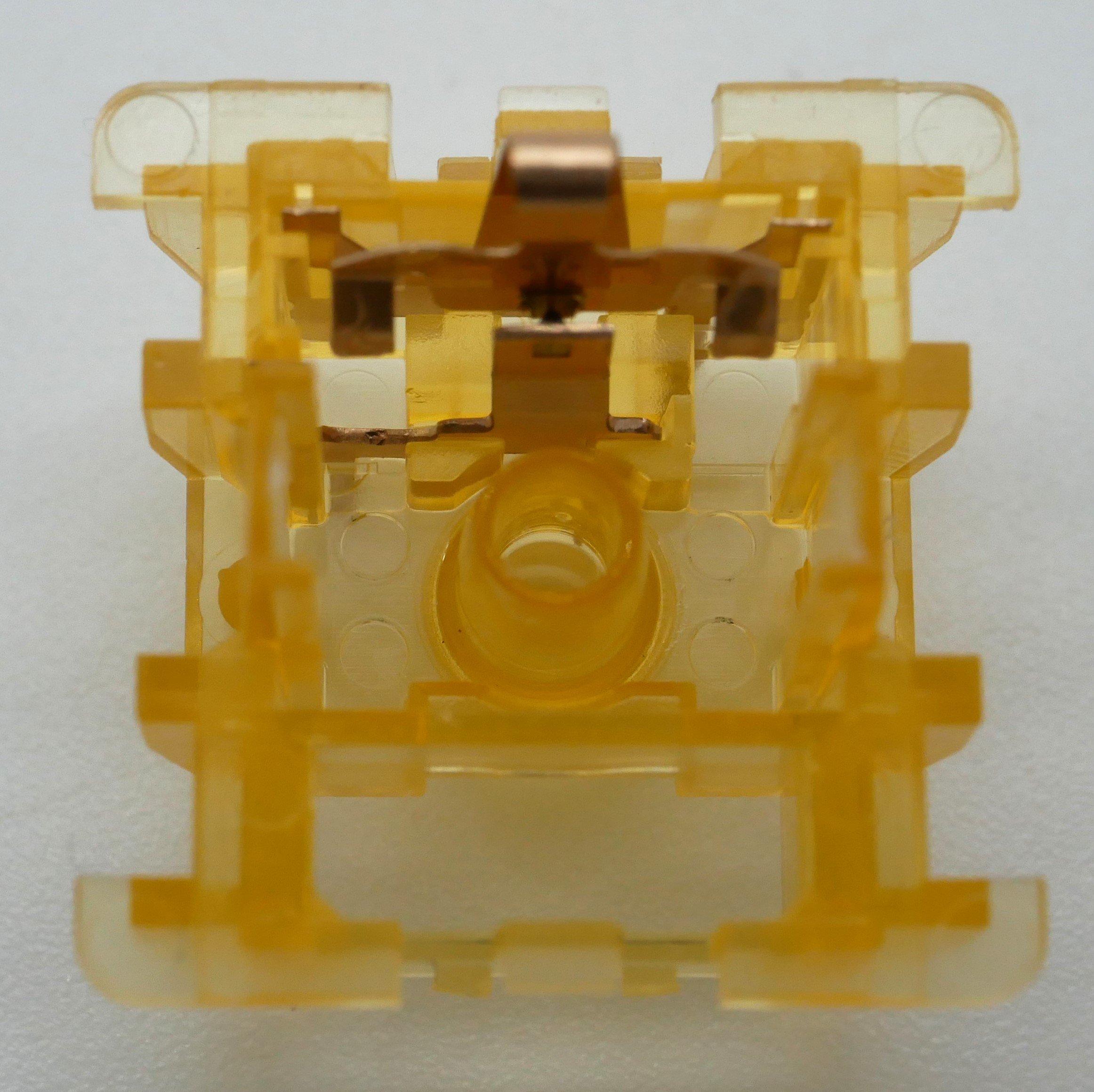
Figure 17: BSUN Golden Apple bottom housing internal showing strong south side spring collar, mold ejector markings in the base of the housing, non-dampened slider rails, and copious amounts of factory lubing present.
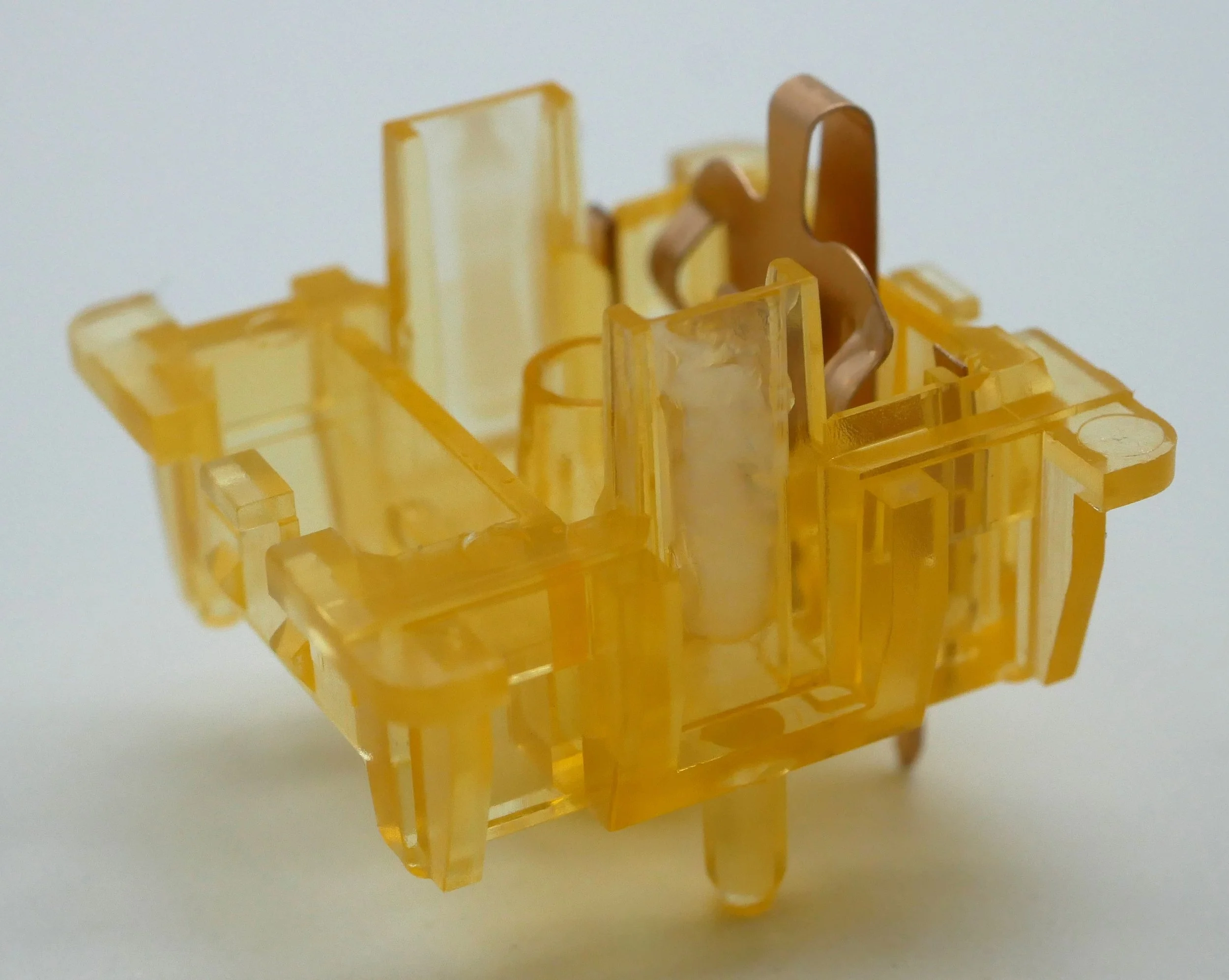
Figure 18: Alternative angle of the BSUN Golden Apple bottom housings emphasizing the large amounts of white factory lubing present on the slider rails of the switch.
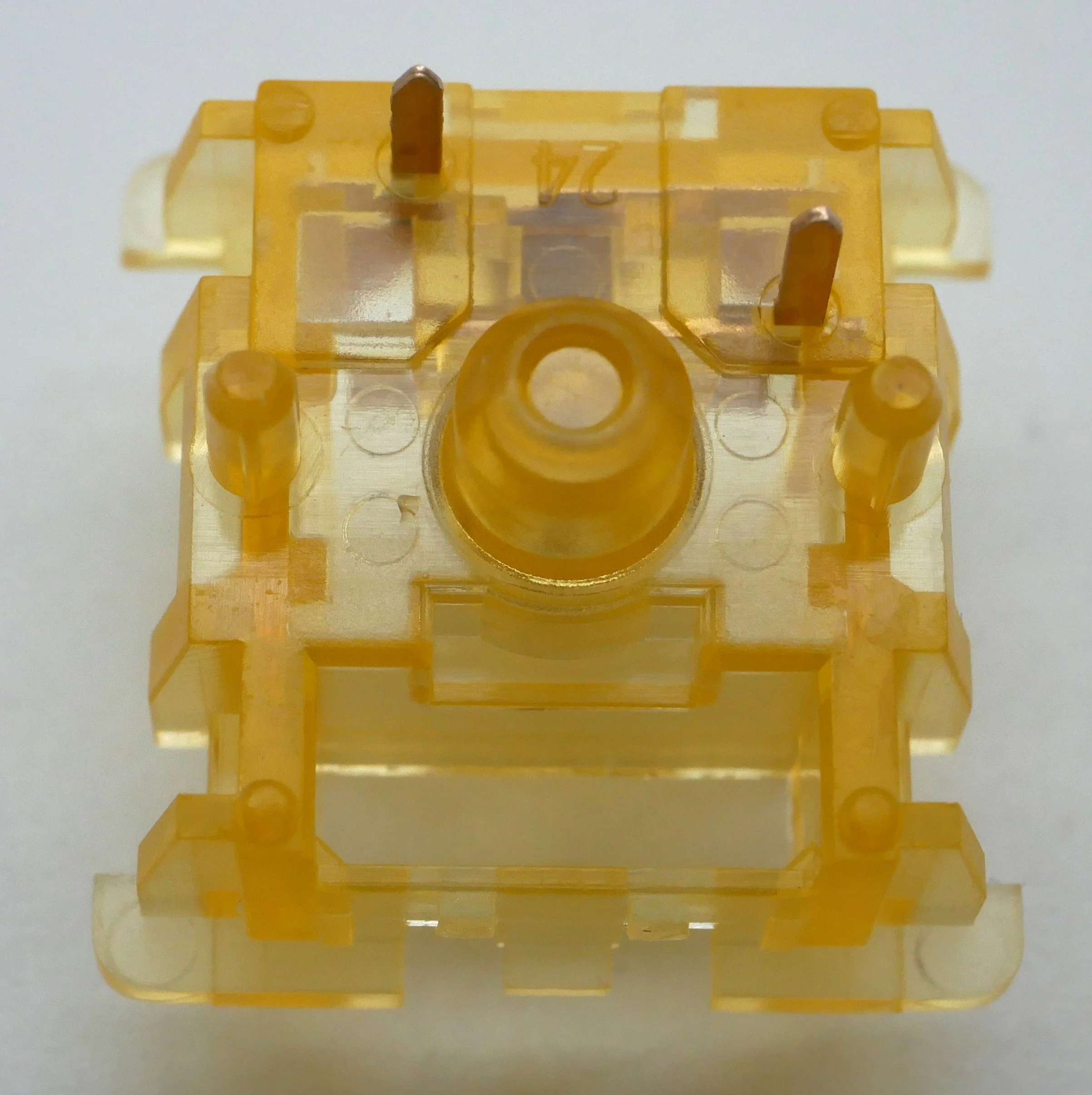
Figure 19: BSUN Golden Apple bottom housing exterior showing PCB mounting pins and inverted number mold marking located between the metal PCB pins.
Push Feel
When trying to understand how the BSUN Golden Apples actually feel in hand, my advice would be to first look at the force curve in between the two paragraphs of this section and then secondly throw that entire mental concept of it that you formed in the trash and come back to reading this paragraph. While the force curve does accurately portray how the switches perform, it does not really align well at all with the under-finger subjective experience of typing on the switches at all. For one, while the bump appears to be one that hits effectively right out of the gate and with no pretravel to it whatsoever, in hand the tactility actually sort of sneaks up on you instead. You start out the downstrokes with a feeling that is definitely not a pre-bump linear region, but by the time you catch on as to what is happening you’re already rolling over the top and backside of the wide, low-flying medium strength tactile bump, rocketing towards the bottom out. And while the force curve also shows that there is a rather pronounced shortened total stem travel in the Golden Apples, it really doesn’t do well to highlight the location or strength of that bottom out, either. Feeling as if the stem plunges much deeper into the housings than the 3.355 mm of stem travel recorded in the force curve, the stems of the BSUN Golden Apples bottom out with a pointed, though flat and fairly firm housing collision. At this collision point they don’t register as sharp, pokey, or even pin-prick like at all – just a firm ‘slap’ that is ever present across all typing speeds. And all of these feeling sandwich the actual stroke of the switches which come across smooth as a result of their generous factory lubing save for some occasional texturing that can be felt as the stem legs rake across the leaves of the switches. Don’t worry though, as this is not only not all that uncommon to come across in tactile switches with some degree of force and something that you can’t well see on a force curve. (I really didn’t want to have to ruin the theme of the paragraph right at the very end!)
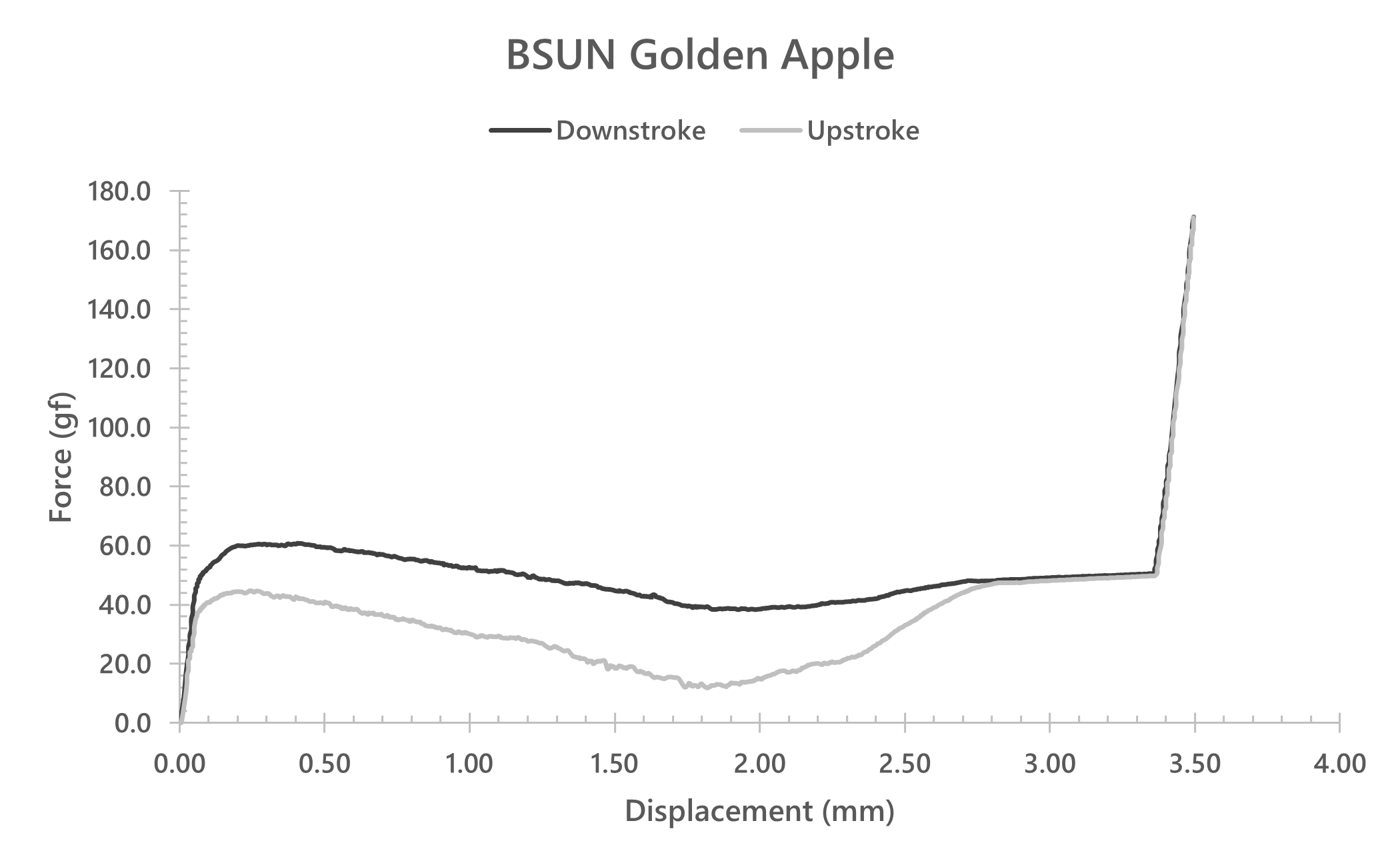
Figure 20: Force curve diagram for the stock BSUN Golden Apple switch.
While the decoupling of a switch from its force curve is always a bit jarring to experience as a reviewer, and especially so when nearly every single part that I inspect doesn’t feel as if it aligns with my own internal expectations all that well, I’m still a bit more surprised by the real lack of differentiation I get in these switches as a result of the specific material choices chosen for them. I really would have expected the LY stems and/or the intersection of them with the first-of-its-kind polyetherimide bottom housings would have produced more distinctive of a feeling than what I actually have here. Perhaps I’m just completely in the wrong state of mind about these particular switches because I’ve worked with PEI material before in the lab and thus have a closer connection to it, but I really did just have a greater anticipation of being able to feel the differences in material for these specific switches. (And that is a fairly rare thing for me to say as someone who generally doesn’t seem to see nearly as much in the differences among all of the special blends of materials and housing choices that other switch reviewers seem to hype up.) I can identify that the topping out collisions of these switches feel a bit thinner than their bottom out, but with that note I could just as easily be convinced that this was a polycarbonate over nylon housing construction instead of polycarbonate over PEI. I’m also sure I could just as easily have been led astray had the marketing for these switches said that they were built using new BSUN “mystery materials X and Y” as if BSUN were going the route of naming their formulas like flagship Pokemon games. So while these certainly don’t feel bad by any stretch of the imagination, and in fact are strongly consistent in their feeling and execution, I suspect my imagination was stretched a bit more by their marketing than it should have been.
Sound
Building on the momentum from the last section, I can’t help but reiterate again just how much the BSUN Golden Apples don’t sound leagues apart from other tactiles that I’ve tried before. In a mindset focused on the sound of switch rather than their push feeling, I could again just as easily be convinced that these were actually polycarbonate over nylon in construction or some BSUN-specific mystery blend of materials too! At the least, the marketing I’ve seen surrounding the Golden Apples seems to tacitly endorse this kind of thinking on my end as it uses descriptions of “deep, full, satisfying” or “crisp and clean” sounding that not only does actually fit the description of these switches… but also many others that I’ve tried over the years as well. This is not to say that the BSUN Golden Apples sound bad, or are even forgettable per se, as they actually have a sound that is dominated by their flat, resounding stem pole bottom out that both feels and sounds prompt, authoritative, and direct. Remaining steadfast throughout all typing speeds and across all switches in the batch that I received, the bottom outs of these switches are their key feature and the collisions are deep, rich, and rounded in tone and come across way more complex than just two pieces of plastic slamming together. While the slightly thinner topping out and very subtle leathery scratching tones can be heard through the tactile bump of the Golden Apples if you focus really hard while using them, realistically these are subtle features that really are drowned out in the medium-loud volume and large presence of their bottom outs.
Wobble
Ever so slightly greater in the N/S direction than the E/W direction, the BSUN Golden Apples feature a better than average but still potentially noticeable amount of stem wobble to them. Unless you’re a user who is especially picky about the stem wobble of their switches, I sincerely doubt that you’ll have an issue with how the wobble of these switches come across under finger.
Measurements
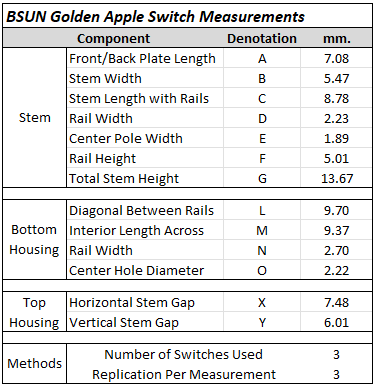
If you’re into this level of detail about your switches, you should know that I have a switch measurement sheet that logs all of this data, as well as many other cool features which can be found under the ‘Archive’ tab at the top of this page or by clicking on the card above. Known as the ‘Measurement Sheet’, this sheet typically gets updated weekly and aims to take physical measurements of various switch components to compare mold designs on a brand-by-brand basis as well as provide a rough frankenswitching estimation sheet for combining various stems and top housings.
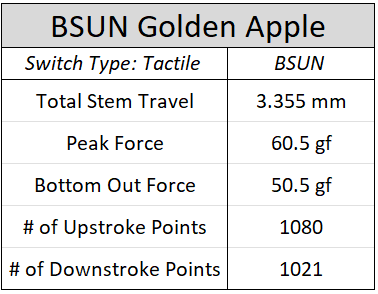
Figure 22: Numerical details regarding the force curve for the stock BSUN Golden Apple switches.
Have you ever wanted to be bombarded with more switch data than you’ve ever seen at any point in your life before? Consider checking out the ‘Force Curve Repository’ hosted on my GitHub that contains all force curves that I take both within and outside of these full-length reviews. In addition to having these graphs above, I have various other versions of the graphs, raw data, and my processed data all available for over 2000 different switches for you to use however you see fit. Check it out via the ‘Archive’ tab at the top of this page or by clicking any of the force curve cards above.
Break In
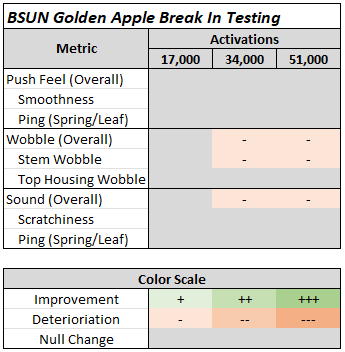
Break In Notes
17,000 Actuations
- Even after 17,000 actuations in the break in machine the BSUN Golden Apple switches were basically indistinguishable from their stock counterparts. There was no real significant changes in push feeling nor sound, and even the stem wobble of these switches were about the same as their original stock versions.
34,000 Actuations
- It turns out that it takes at least 34,000 actuations before the BSUN Golden Apple switches begin to show any sign of breaking in, though it should be noted that what little differences were noted were minimal at that. In addition to an ever so slight increase in N/S and E/W direction stem wobbles, the most notable change was a subtle shift in the bottom out tone consistency from switch to switch. Presumably a function of factory lube migration, the Golden Apples broken out to this degree occasionally have more dampened, even partially silenced bottom outs that feel slightly gummier than normal.
51,000 Actuations
- If the lack of change through 17,000 actuations wasn’t surprising enough, the BSUN Golden Apples showed even further resiliency through 51,000 actuations and didn’t change or shift one bit from the batch that was broken in to 34,000 actuations. All of the small, hardly impactful quirks noted in the previous section all still apply here but none of them grew in magnitude or severity at all.
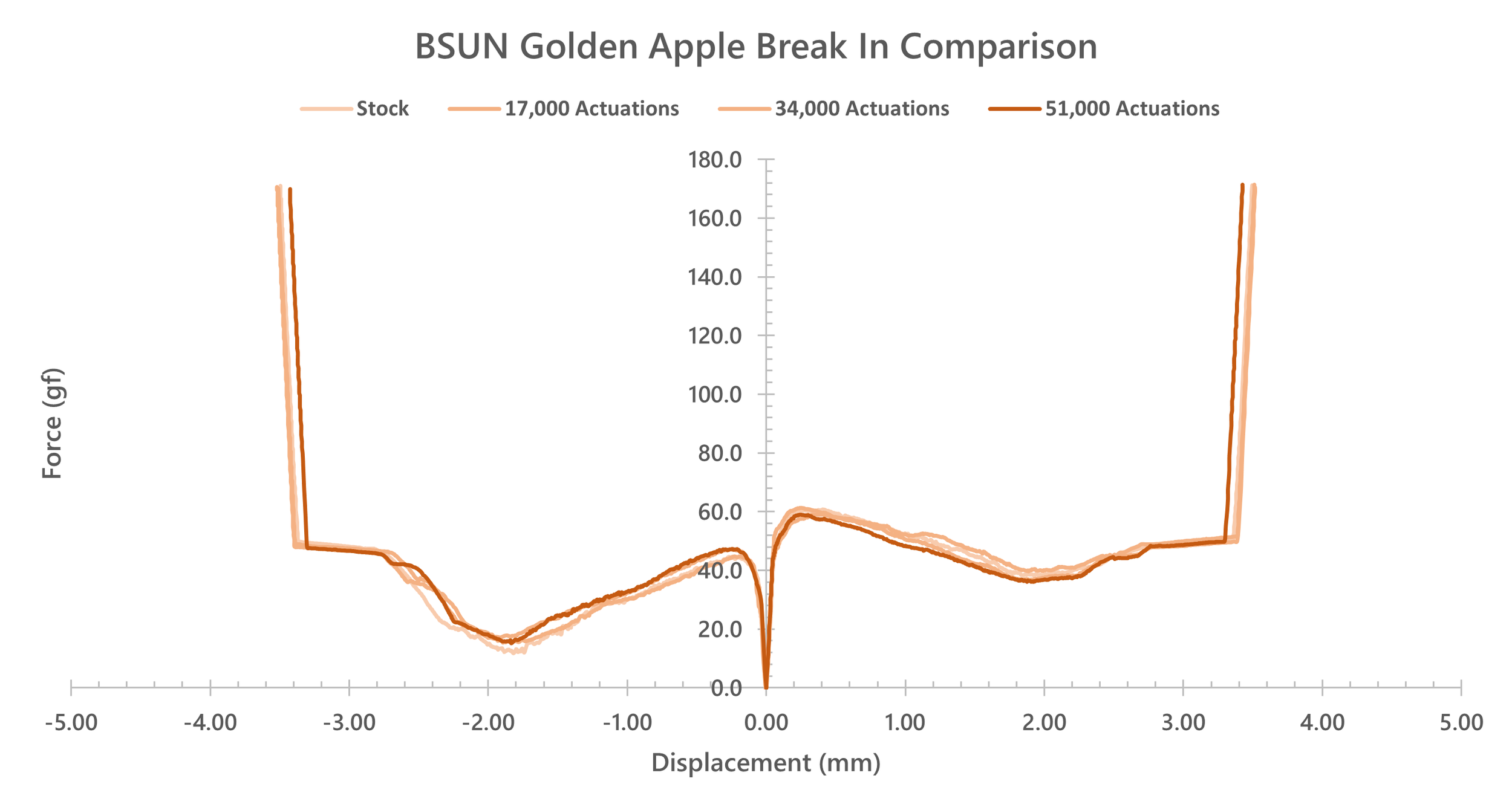
Figure 24: Comparative force curve diagram showing no substantial, consistent change in the force curves of the BSUN Golden Apple switches throughout the break in process.
Comparison Notes to Other Notable Tactile Switches
Note – These are not aimed at being comprehensive comparisons between all factors of these switches as this would simply be too long for this writeup. These are little notes of interest I generated when comparing these switches to the BSUN Golden Apple switches side by side.
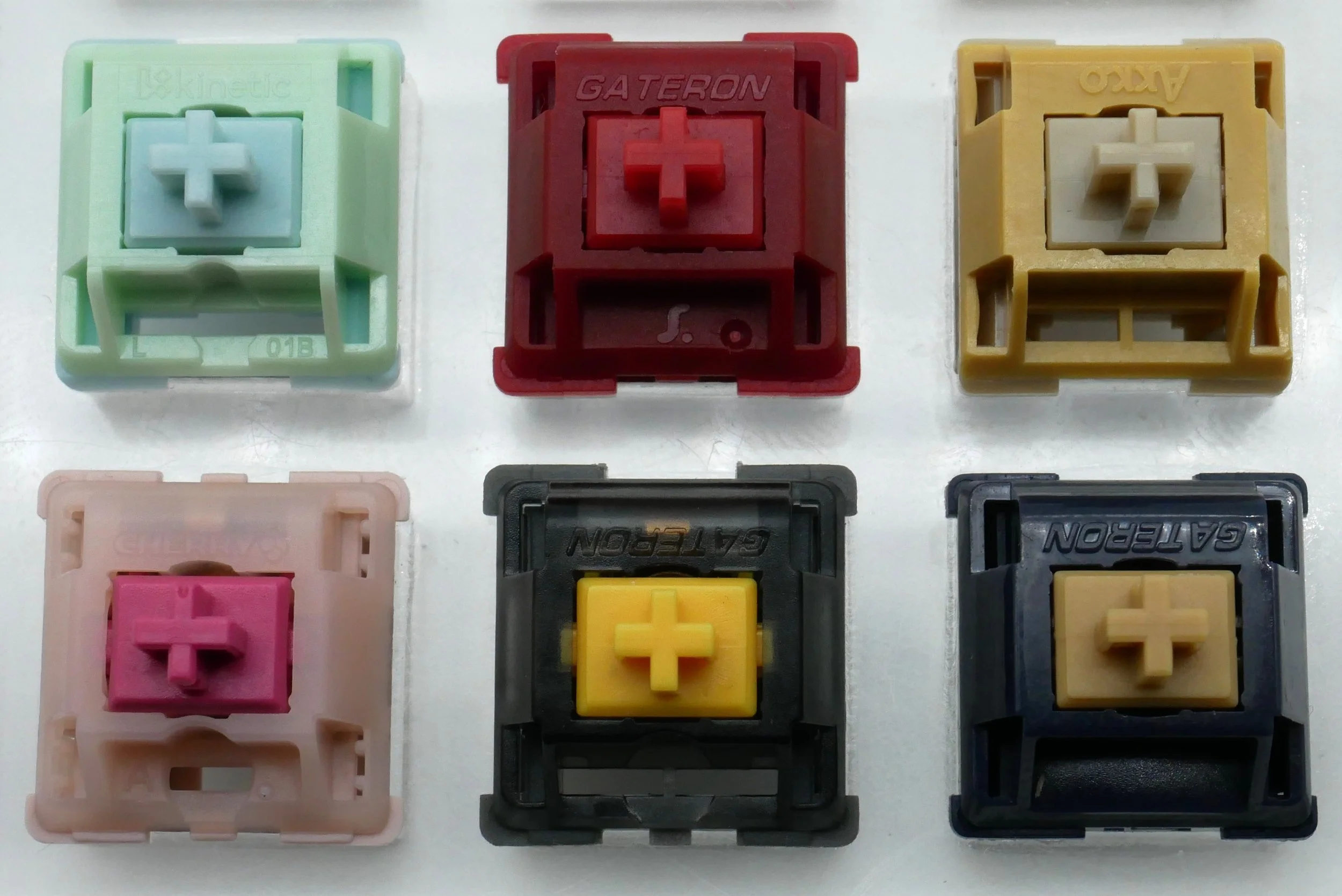
Figure 25: Switches for comparison. (L-R, Top-Bot: HMX Frog, Sillyworks x Gateron Type R, Akko Bittersweet, Cherry MX Petal, Drop Holy Panda X, and Gateron Lanes)
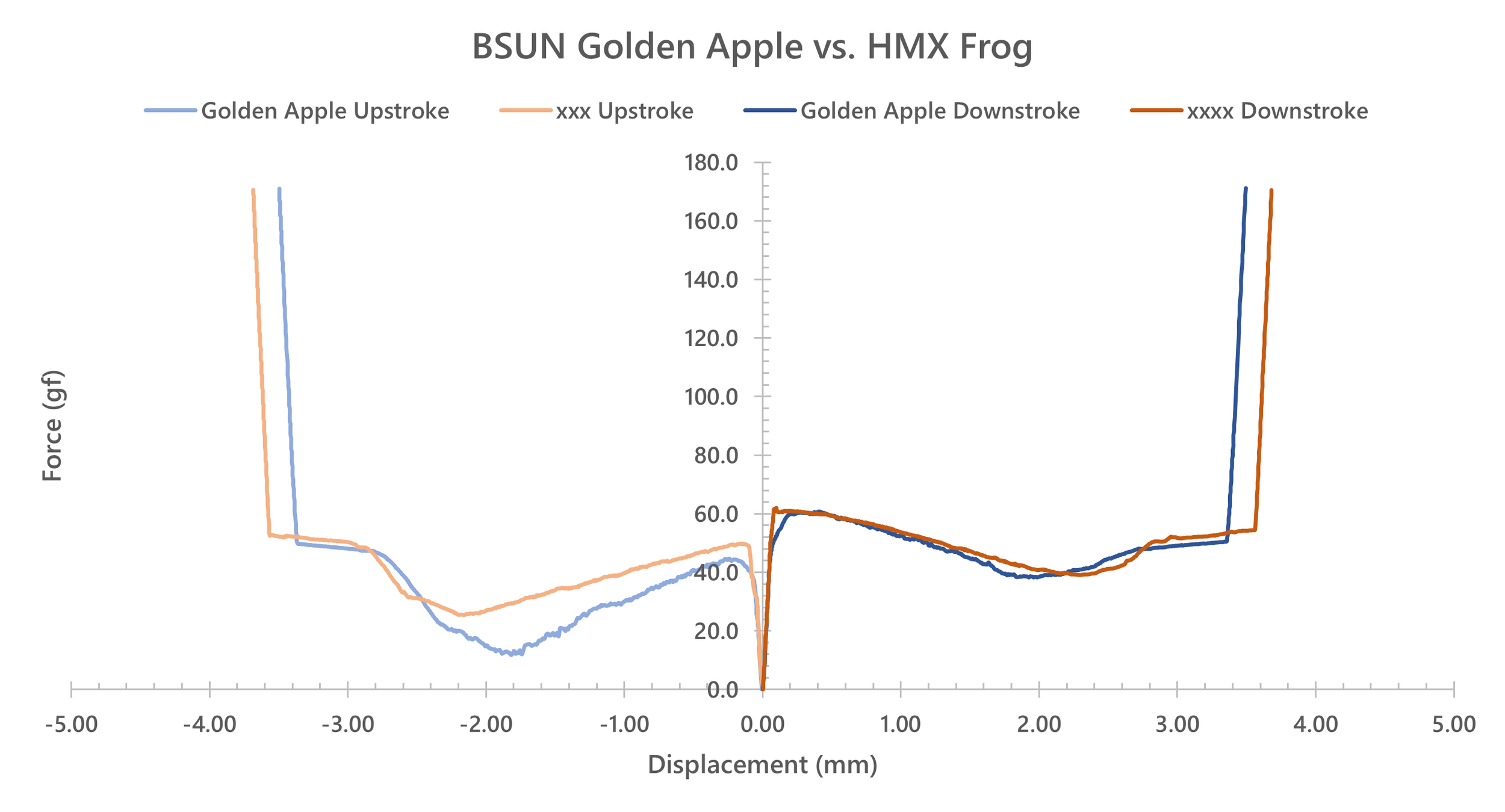
HMX Frog
- Despite being a fairly close comparison, the HMX Frog switches have slightly lesser N/S and E/W direction stem wobble than the BSUN Golden Apple switches.
- While the comparative force curve between these two switches below would suggest that they have a similar tactility to one another, in hand the HMX Frog switches come across much snappier, with a tactile bump that doesn’t meander into its peak force like the Golden Apples do. This gives the Frogs an ever so slightly sharper and heavier feeling than the Golden Apples despite their similar peak tactile force.
- The BSUN Golden Apple switches are definitely the better sounding of these two tactiles with a more consistent sound that is singular and focused at the point of bottom out than the more inconsistent, two-part sound of the Frogs.
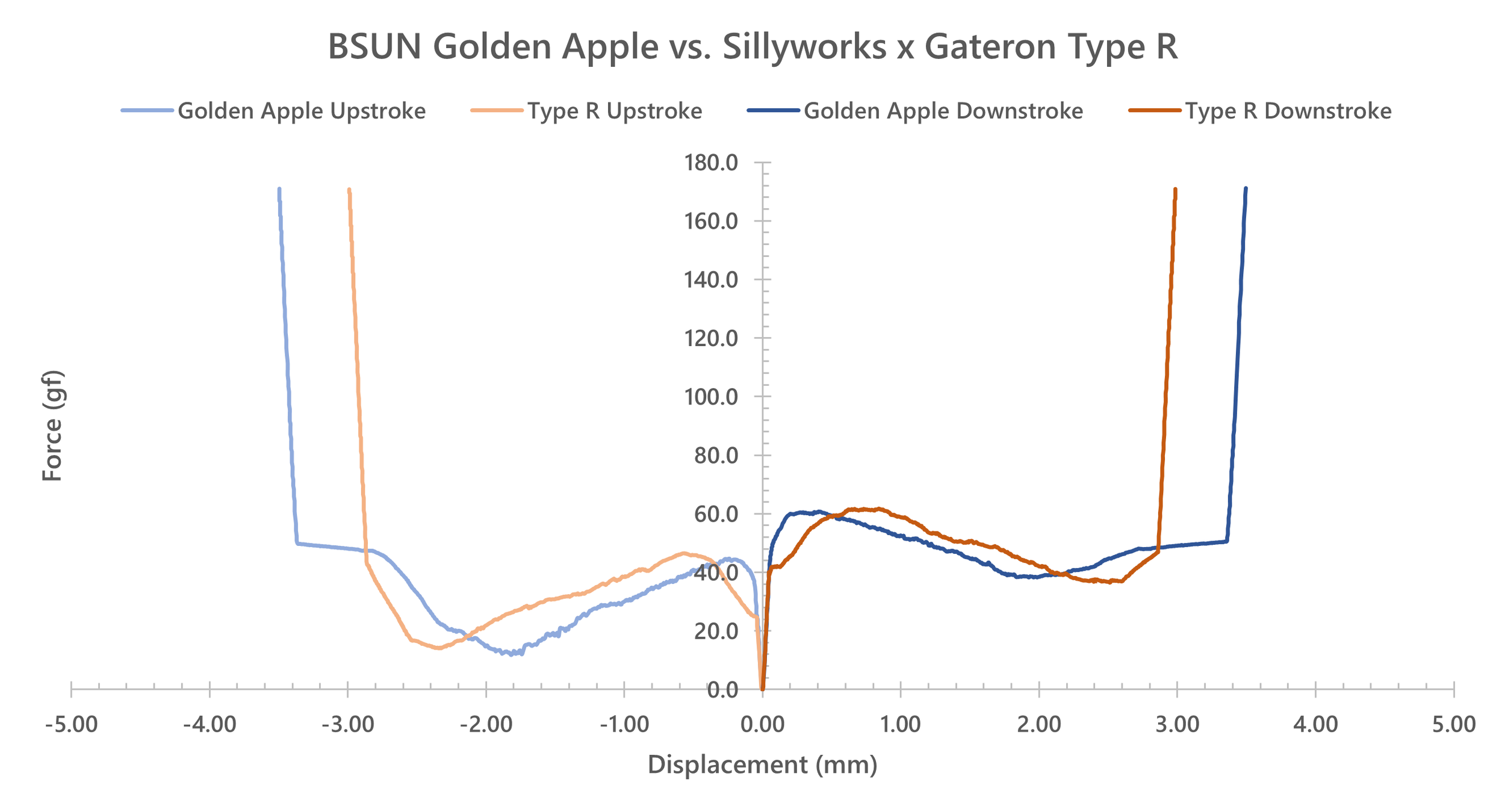
Sillyworks x Gateron Type R
- Of all of the switches on this comparison list, these two are the most similar with respect to their overall feeling. While the Type R switches are a bit punchier at their point of bottom out on account of having truly no linear post-bump travel, the forcefulness really feels like a more souped up version of the Golden Apple’s bottom out. As well, the tactile bump strength, length, and under-finger size are all fairly well matched between these two switches.
- There is less N/S and E/W direction stem wobble in the BSUN Golden Apple switches than there is in the Sillyworks x Gateron Type R switches.
- As a result of their less aggressive stem pole bottom out, the BSUN Golden Apple switches are more quiet than the Type R switches and have a sound that is more rich and complex in its medium volume than the more pointed, sharper sounds of the Type R bottom out.
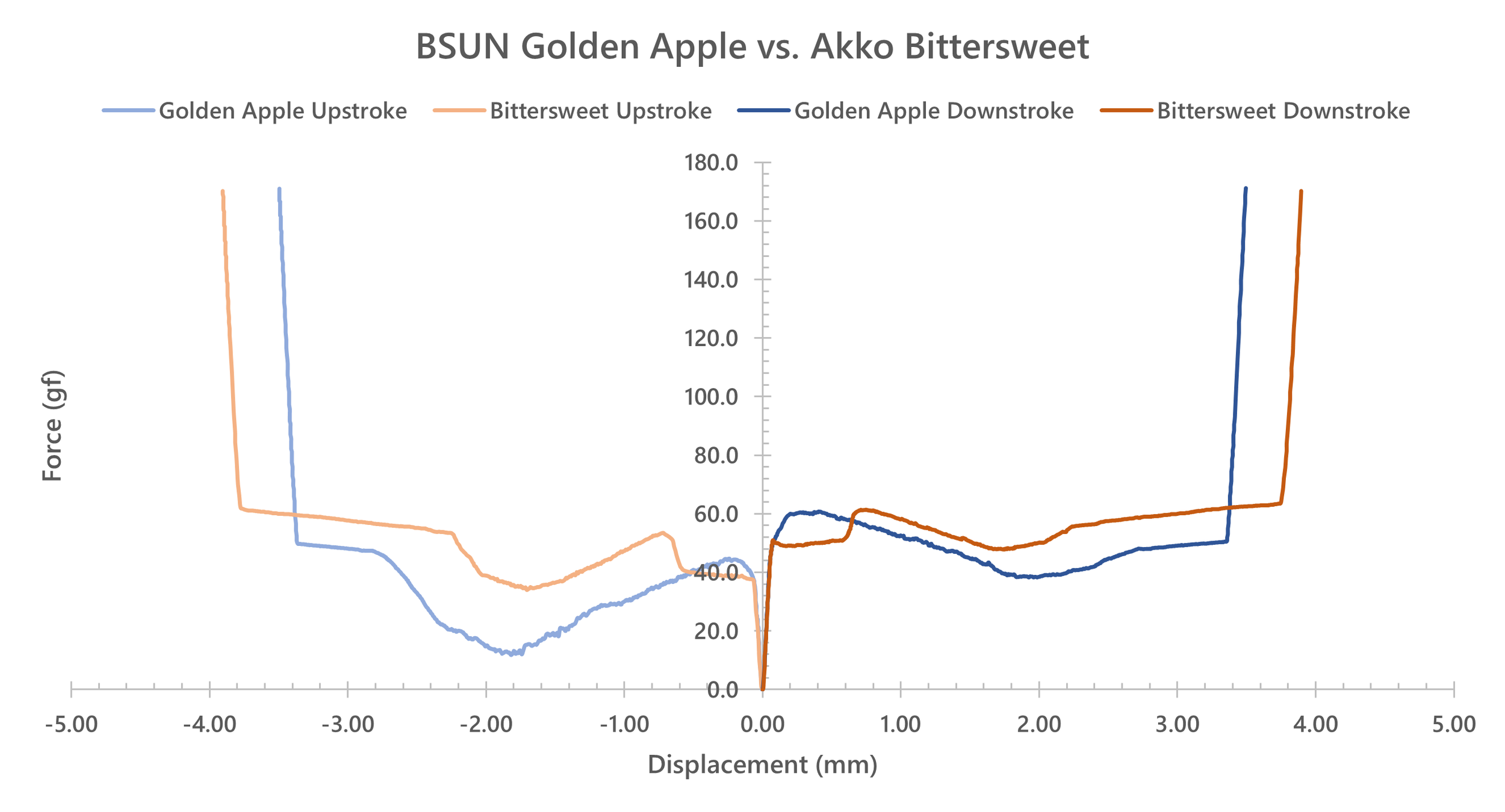
Akko Bittersweet
- Despite these two switches having similar overall peak tactile force as one another, they feel wildly different from one another on account of their bump size. Whereas the BSUN Golden Apples have a large tactile bump that steadily unfurls throughout the majority of their stroke, the Bittersweets have a small, centrally located tactile bump that feels softer, more subtle, and almost entirely hidden in the head to head comparison between the two.
- There’s quite a bit less stem wobble in the BSUN Golden Apple switches than there is in the Akko Bittersweets.
- As a result of the Bittersweets having a less aggressive and forceful bottom out, they ultimately are the quieter of these two switches. However, what sounds they do produce are a little bit more jumbled and inconsistent than the pure, almost singular bottom out sounds of the Golden Apples.
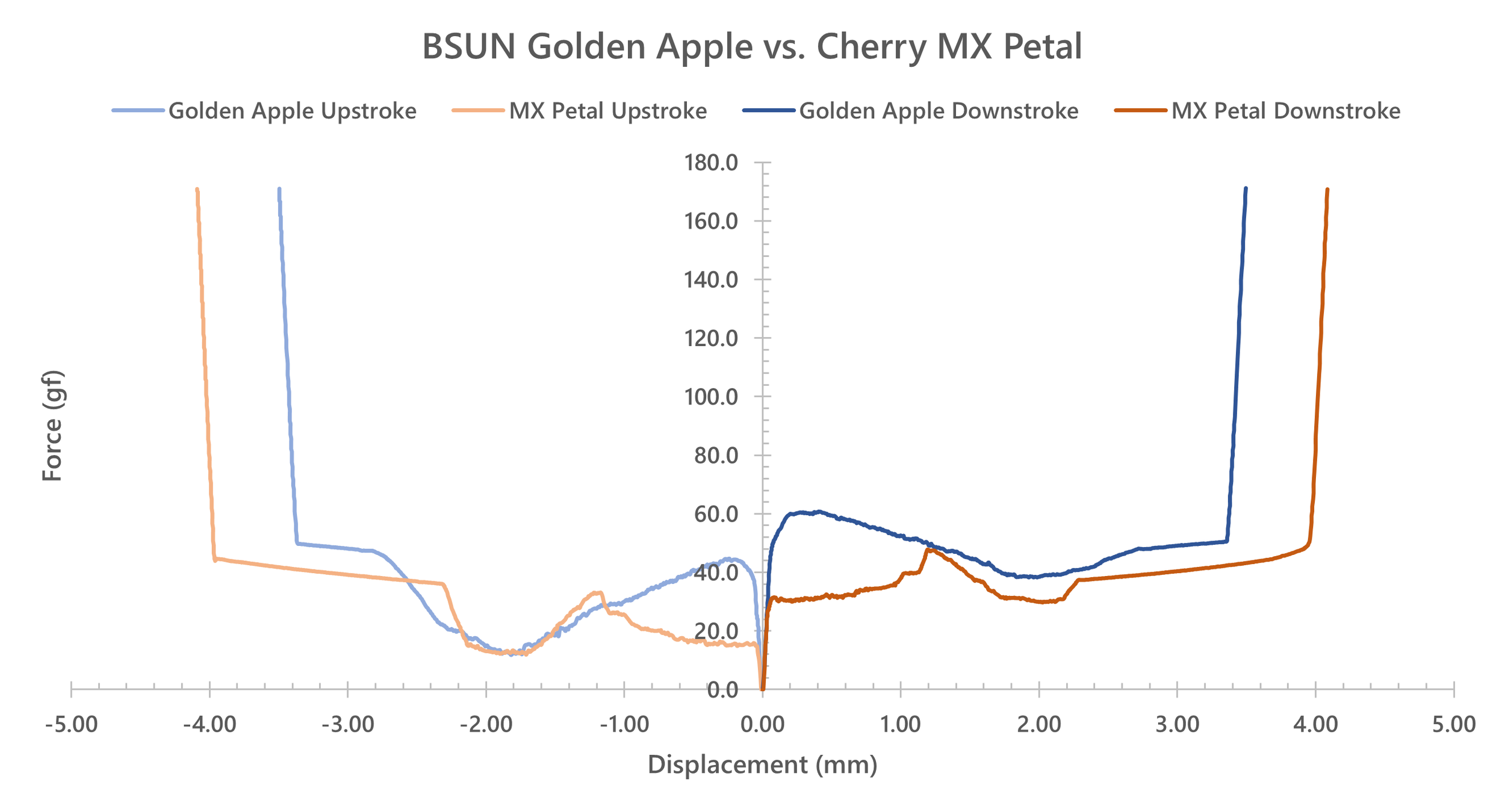
Cherry MX Petal
- The sound comparison between these two tactile switches is fairly rough on account of the Cherry MX Petal switches being a fair bit more inconsistent and scratchier than the singular, focused, and very consistent sounding bottom outs of the BSUN Golden Apples.
- There is significantly less N/S and E/W direction stem wobble in the BSUN Golden Apple switches than there is in the Cherry MX Petals. (Yes, this is even accounting for the asymmetrical nature of the Golden Apples for that matter.)
- Much like with the Akko Bittersweet comparison above, the tactility and especially the bottom out of the BSUN Golden Apples are just so much more substantial, forceful, and noticeable than the MX Petals that they almost make the MX Petals pseudo-linear by comparison.
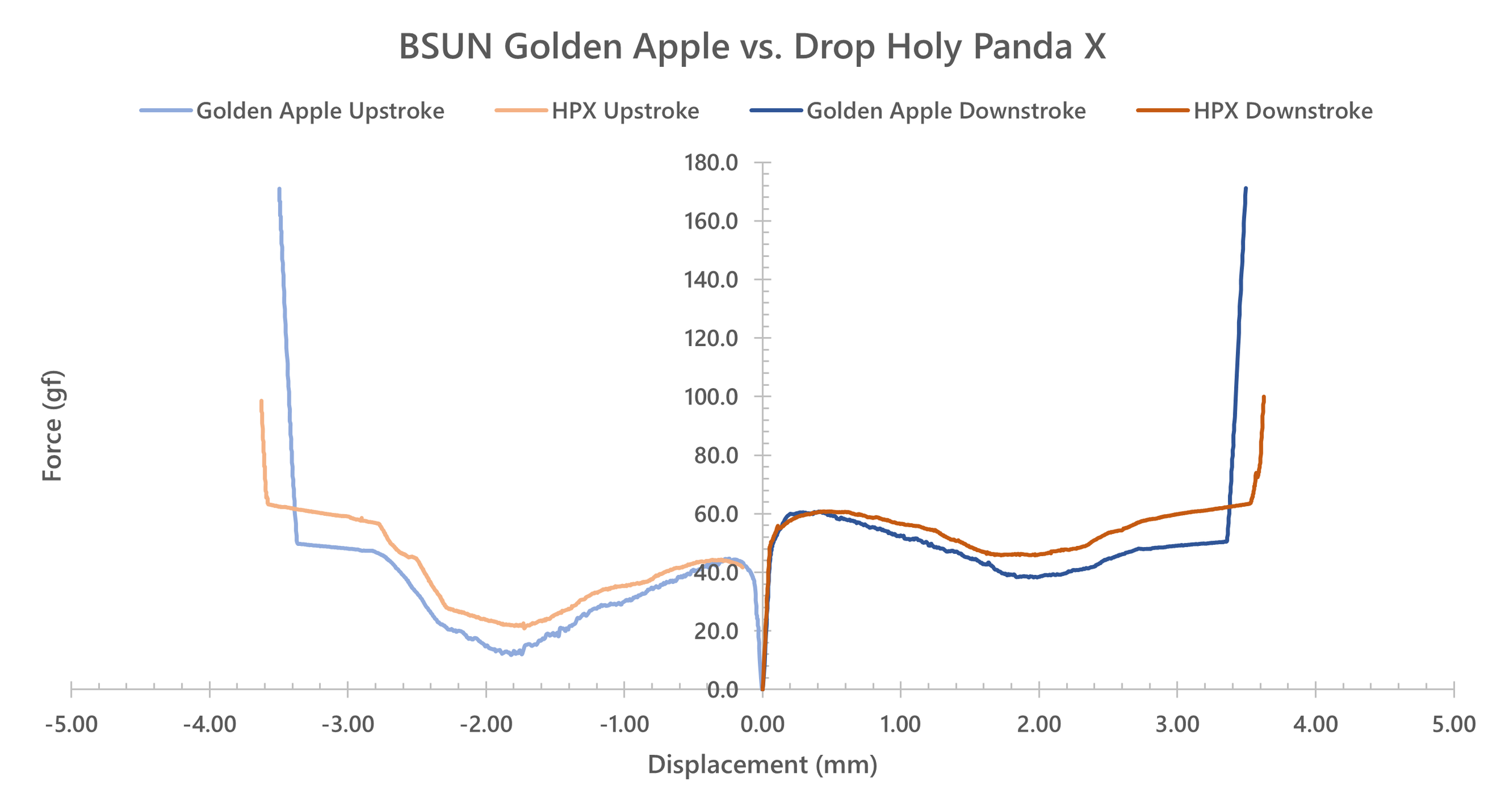
Drop Holy Panda X
- Of all of the switches on this comparison list, the Drop Holy Panda X’s, of all things, are actually the ones that have the most similar tactility as that of the BSUN Golden Apples. While I do think that the HPX switches’ tactility is a bit more poppy and aggressive at the onset than the Golden Apples, the overall size of the bump and how it breaks down after the peak feels quite similar between these two.
- Despite being a switch made by Gateron that I reviewed almost four years ago to the day, the Holy Panda X switches actually have less stem wobble than the late 2025 produced BSUN-made Golden Apples.
- The Drop HPX switches are definitely the louder of these two and have bright, airy sounding topping outs that almost entirely drown out the sound of the otherwise impressively forthright Golden Apple bottom outs when using these switches next to one another.
- And yes, I had to at least include this switch for comparison given the statement at the start of this article about the end of Drop. It almost makes me nostalgic for the HPX switches in a weird way…
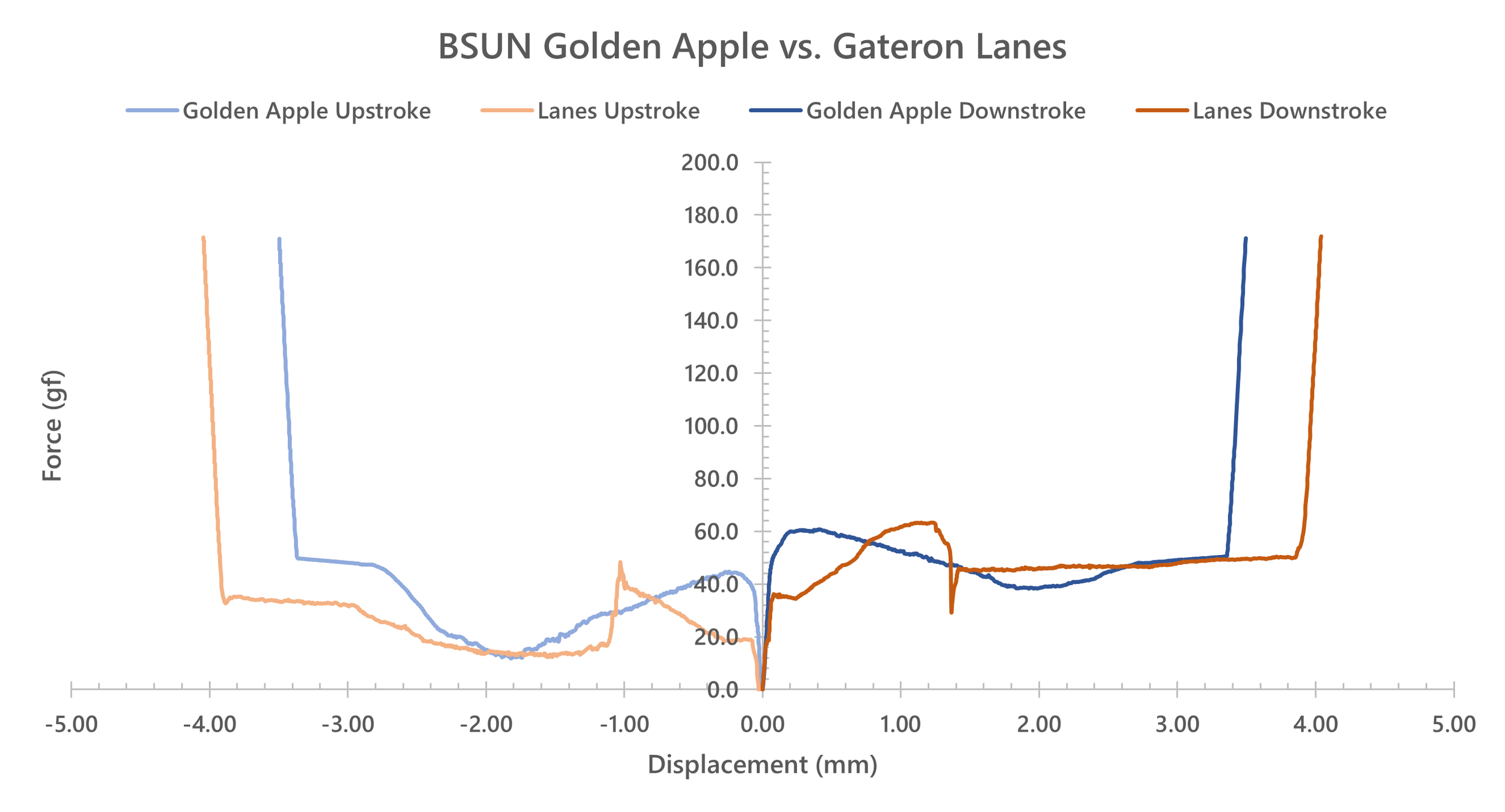
Gateron Lanes
- Even though the comparative force curve between these two switches below would suggest that the Lanes have a slightly stronger tactile bump, they feel much weaker in the in-hand comparison on account of how narrow they feel. Almost directly proportional to the size of the mechanism that produces the tactility in each of the switches, the Golden Apples feel wide, substantial, and as if they have a strong body through their tactility as opposed to the thinner, needle-like nature of the tactile leaf bump of the Lanes.
- There is less N/S and E/W direction stem wobble in the BSUN Golden Apple switches than there is in the Gateron Lanes.
- The sound of the BSUN Golden Apple switches is one that is more simple, consistent, and direct in tone than the Gateron Lanes. While the tactile leaf of those switches does produce quite an interesting tone when using them, the switch-to-switch inconsistency of such as well as the chalky scratch that the Lanes has makes for a more convoluted, less straight forward sound than the Golden Apples.
Scores and Statistics
Note – These scores are not necessarily completely indicative of the nuanced review above. If you’ve skipped straight to this section, I can only recommend that you at least glance at the other sections above in order to get a stronger idea of my opinion about these switches.
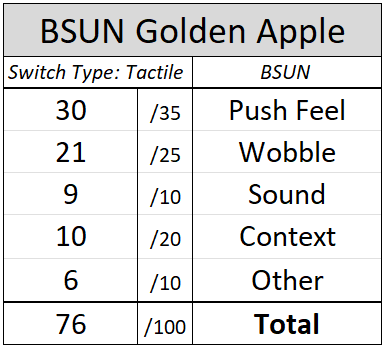
Push Feel
The BSUN Golden Apples are medium-strength tactiles that sneak up on you at the start of the downstroke, unfurl in a wide, meandering bump, and then land you directly into the prominent, flat but pointed bottom out that is the real star of the show for these switches. Consistent from switch to switch and across all typing speeds, the Golden Apples are bottom out tapping machines with only a slightly thinner topping out and occasional stem leg/leaf scratch from a lack of factory lubing there holding them back.
Wobble
Ever so slightly greater in the N/S direction than the E/W direction, the Golden Apples have a small and noticeable amount of stem wobble that’s highly unlikely to actually be problematic to most users unless they are really picky about this metric.
Sound
Despite the BSUN Golden Apples not having any over-the-top unique sound to them on account of their LY material stems or first-of-its-kind PEI bottom housings, they present an incredibly uniform, consistent sound that is driven by the medium volumed, flat slaps of their bottom outs which are deep, complex, and well-rounded in tone. With an accenting, ever so slightly tinner sounding topping out these switches are great examples of well built, deep sounding tactiles.
Context
Priced between $0.35 and 0.40 per switch, the BSUN Golden Apples are yet another example of a great BSUN tactile experience from late 2025 into 2026. However, like all of those other offerings they suffer from extreme lack of broader marketing or community adoption. Given the one-and-done nature of their designers, the longevity these have to make an impact is uncertain.
Other
Perhaps there is more to this PEI bottom housing material than I give it credit for. Historical firsts are always neat, sure, but the consistency among these switches is quite impressive…
Statistics
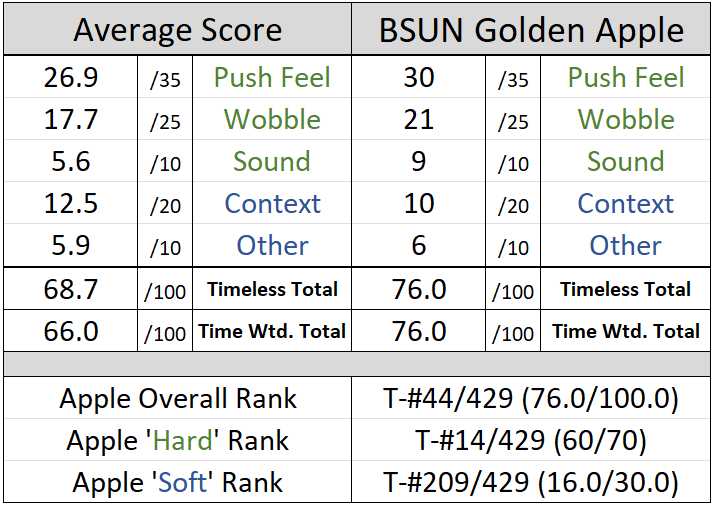
If you are looking at this statistics section and wondering what the heck ‘Timeless’ and ‘Time Weighted’ scoring is, consider checking out my short article titled ‘A Scorecard Time Change’. As a result of scoring becoming a bit anachronistic over the years, switches are now ranked in this statistics table using a “time weighted total” as opposed to their day-of scoring as discussed in that article. If you’d also like to learn about what ‘hard’ versus ‘soft’ ranks refer to specifically, I’d encourage you to head on over to my GitHub linked in the table above or at the links in the top right hand of this website to check out my database of scorecards as well as the ‘Composite Score Sheet’ which has a full listing of the rankings for each and every switch I’ve ranked thus far.
Final Conclusions
Towards the front end of this review, I had shared that one of the numerous reasons that the BSUN Golden Apples had stood out to me for a review was that BSUN tactiles from late 2025/early 2026 have just been downright good in my experience. To that end, I think my hunch in picking up these tactiles for review was more spot on than I could have imagined. Despite not getting any sort of unique, performance defining experiences with the PEI material bottom housings that I was expecting out of the gate, the Golden Apples come across as extremely technically clean and proficient at all of the goals that their marketing suggests that they were shooting for. The downstrokes and upstrokes are smooth, the tactility is noticeable, though subtly leads into and unfurls from its peak with a wide grace that makes them non-aggressive and not overly forceful, and the bottom outs of these switches are truly the start of the show. With a feeling and sound that perfectly align to be flat and forceful, yet rounded, complex, and not too fatiguing on any of the senses, the collision point between the LY stems and PEI bottom housings of the Golden Apples is one that is clean, consistent, crisp, and probably a multitude of other positive ‘c’ words that I can’t conjure up while writing in this moment. Unfortunately, though, for all of the positive things that I can say about the technical performance of the Golden apples, I’m entirely uncertain as to what their longevity in the market or ability to sustain interest from the community will be on account of where they were manufactured at and who they were ‘marketed’ by. BSUN generally doesn’t market their switches with the same sort of community outreach and pitch as the larger, more established brands in the west like Kailh or Gateron. As well, they rarely follow up on re-hashing their designs for multiple runs. While they typically would leave this to the designers of the switches to do for them, both of the potential designers and runners of these switches in either Four of Diamonds and/or Wishbone Studios don’t seem to have any history in running things back themselves too. The only reason that I, or really any of us over here in the western keyboard scene for that matter, have the chance to be exposed to the BSUN Golden Apples was on account of the few vendors that stocked them after their groupbuy date was completed and I’m incredibly doubtful that they’ll have the ability to push BSUN to make more of these switches. Hopefully I’ll get to see some uptick in community appreciation for these tactiles to hopefully sustain interest not just in them a bit longer, but really any BSUN tactiles as of the last few months to be honest. Perhaps just a tiny bit more attention and demand for them will lead to us getting some with as much staying power and marketing as something like Invokeys’ BSUN lineup. The BSUN Golden Apples and their PEI-filled bottom housings are yet another great example of how there’s clearly something a bit better than what we all seem to realize going on with BSUN and their tactiles right now. Maybe don’t skip out on these…
Sponsors/Affiliates
Mechbox UK
- A wonderful UK based operation which sells singles to switches that I’ve used above in my comparisons for collectors and the curious alike. Matt has gone out of his way to help me build out big parts of my collection, and buying something using this link supports him as well as my content!
KeebCats UK
- A switch peripheral company based out of the UK which sells everything switch adjacent you could ask for, they’ve been a huge help recently with my film and lube supply for personal builds, and they want to extend that help to you too. Use code ‘GOAT’ for 10% off your order when you check them out!
proto[Typist] Keyboards
- An all-things keyboard vendor based out of the UK, proto[Typist] is a regular stocker of everything from switches to the latest keyboard and keycap groupbuys. While I’ve bought things from the many times in the past, they also are a sponsor of my work and allow me to get some of the great switches I write about!
Divinikey
- Not only do they stock just about everything related to keyboards and switches, but they’re super friendly and ship out pretty quick too. Divinikey has been a huge help to me and my builds over the last year or two of doing reviews and they’ll definitely hook you up. Use code ‘GOAT’ for 5% off your order when you check them out!
ZealPC
- Do they really need any introduction? Zeal and crew kicked off the custom switch scene many years ago with their iconic Zealios switches and the story of switches today couldn’t be told without them. Use code ‘GOAT’ (or click the link above) for 5% off your order when you check them out!
MechMods UK
- A rising vendor based in the UK, Ryan and crew have been a pleasure to work with and have nearly everything you’d need to build your first or fourteenth keyboard. Go build your latest or greatest one right now with them by using code ‘GOAT’ at checkout for a 5% discount!
Dangkeebs
- A longtime supporter of the website and the collection, Dangkeebs has quite possibly the widest variety of switches of any vendor out there. Not only is their switch selection large, but it rotates and is constantly adding new stuff too. You’re going to need 5% off your order with my affiliate to save off the cost of all those switches!
SwitchOddities
- The brainchild of one my most adventurous proxies, SwitchOddities is a place where you can try out all the fancy, strange, and eastern-exclusive switches that I flex on my maildays with. Follow my affiliate code and use code ‘GOAT’ at checkout to save 5% on some of the most interesting switches you’ll ever try!
Cannonkeys
- Does anybody not know of Cannonkeys at this point? One of the largest vendors in North America with keyboards, switches, keycaps, and literally everything you could ever want for a keyboard always in stock and with an incredibly dedicated and loving crew. Follow my affiliate link above in their name to support both them and I when you buy yourself some switches!
Kinetic Labs
- One of the most well-rounded keyboard vendors out there, Christian and crew have been supporters of all my switch and switch-adjacent needs for some years now. I’m honored to have them as an affiliate and think you should check them out using my affiliate link above to support both them and I when you check out their awesome products!
Keebhut
- Want to try out some switch brands that fly under most vendor’s radars? Keebhut is always seeking out that next latest and greatest and has been super helpful in hooking me up with new brands over the past year. They are all about sharing that love as well, and want to give you 5% off your next order with them when you use code ‘GOAT’ at checkout!
Kailh
- No, you’re not mistaken – this is actually that Kailh that manufactures switches. As one of the longest running manufacturers in the hobby, they have a massive variety of switches available over on their website at any point in time. I’m lucky to be affiliated with them now, and so consider using my affiliate link above when ordering some Kailh switches to support me!
Keebz N Cables
- Australia and Oceania’s very own is now a part of the sponsor list here and I couldn’t be happier to add this long time supporter of the collection to it. They’ve always got an amazing selection of switches (and other keyboard parts) in stock and they want to share the love that they’ve shown me with you all too! Use code ‘thegoat’ for 5% off your first order when you visit!
Further Reading
Divinikey’s BSUN Golden Apple Sales Page
Unikeys’ BSUN Golden Apple Sales Page
Milktooth’s BSUN Golden Apple Sales Page
Four of Diamond’s ZFrontier Profile Page
Wishbone Studio’s BSUN Golden Apple ZFrontier Groupbuy Post
Keyboard_dad’s BSUN Golden Apple Instagram Post
MikeyTypes’ BSUN Golden Apple Review Video