Keygeek Muse Switch Review
If you’ve been on the internet at any point in the last week in time, it’s likely that you too saw the updates regarding Discord’s new proposed need for ID verification and/or face scans to access the entirety of their platform. While this is only minorly less dystopian than the whole ‘Ring Cameras using AI to scan for lost pets’ thing that blew up over the same length of time, it does ultimately have quite a big bearing on the state of the modern western keyboard scene. The mechanical keyboard community as a whole has gone through a lot of iterations over the years, first starting out with forums like OTD in Korea and Deskthority for those in the west in and around the 2010’s. Soon thereafter Reddit’s r/mechanicalkeyboards came around and popular in what is quite honestly literal spite of Geekhack and the audience it grew over the years alongside Deskthority. And while niche pockets of Geekhack and r/mk, and the more recently formed Keebtalk, all exist atop the graves of DT and OTD, Discord has really kind of been the place for mechanical keyboard discussion in the west for quite some time. Sans social media platforms like QQ, ZFrontier, and Bilibili, Discord has been the hub for western keyboard enthusiasts for at least as long as I’ve been present and active in the hobby, something which is going on more or less 8 or 9 years at this point… and its proposed changes have people certainly feeling uneasy. Despite negativity and pushes for moves back to IRC by some servers, I don’t think anyone really knows what comes next for the community if Discord as a platform truly goes to shit. My personal fear, as a documentarian, is that a lot of modern keyboard history may be most the sands of time if people decide to leave Discord en masse. Unlike the Deskthority Wiki or the old OTD Forums, or rather the old Wayback Machine-bound ghosts of them, Discord servers largely aren’t archivable or searchable by the general web and the shuttering of them would lead to a significant loss in keyboard history and especially that around modern switches alongside them. Stealios had a Reddit-based component, sure, but a lot of the speculation, early confirmations, and prototype sampling took place on Discord. The first samples of Tecsee switches to ever hit western shores or the discussions about the splitting off of HMX from KTT also took place on Discord too. Without much of a prescriptive answer as to what to do should these places of historical importance become inaccessible at some point in time, I really don’t know what to make of it all. It really has weighed on my mind a lot this past week and made me feel extra motivated for reviews like this one…

Figure 1: Another burning of the Library of Alexandria situation? So close off of the heels of watching the DT Wiki crumble to dust it kind of feels that way...
Switch Background
Luckily for me, it seems that all of these endless paragraphs upon paragraphs that I cram into full length reviews has actually paid off for me for once here. (No, unlike you all I get absolutely no enjoyment out of re-reading these articles; I mostly just get some heartburn and a mild headache regarding grammatical decisions or the countless typos that I clearly missed.) Rather than going on through the incredibly long majority of the backstory that could be documented here for the Keygeek Muses, this specific section will be substantially shortened on account of their history largely already being covered in depth in my Keygeek Athena Switch Review. As you could have probably guessed by the closely related thematic name, the ‘Muse’ switches are a continuation of Moyu Studio’s Greek Mythology family of switches – a now six switch deep family that has spanned the rise and fall of Durock/JWK, a smidge of HMX’s debut, and now squarely spanned across the maturing of Keygeek in the community’s broader limelight. And unlike a couple of the other switch pairings that I’ve reviewed from interconnected families, the Muses are actually the next in the family line following the Athenas, making the jump in history between them brief and slightly uneventful. However, Chen, the proprietor of Moyu Studio who was kind enough to send me these switches for the collection, didn’t just want to leave me high and dry with little to say about his switches leading into this review and instead went out of his way to make sure these switches just a tiny bit different than the rest of the pantheon he is establishing. Rather than an entirely radical new stem design or uniquely appealing aesthetic component, the Keygeek Muses are different than the Poseidons, Hades, Heras, and Athenas in that they are the first to be a collaboration with another switch brand based out of China – HEX Studio.
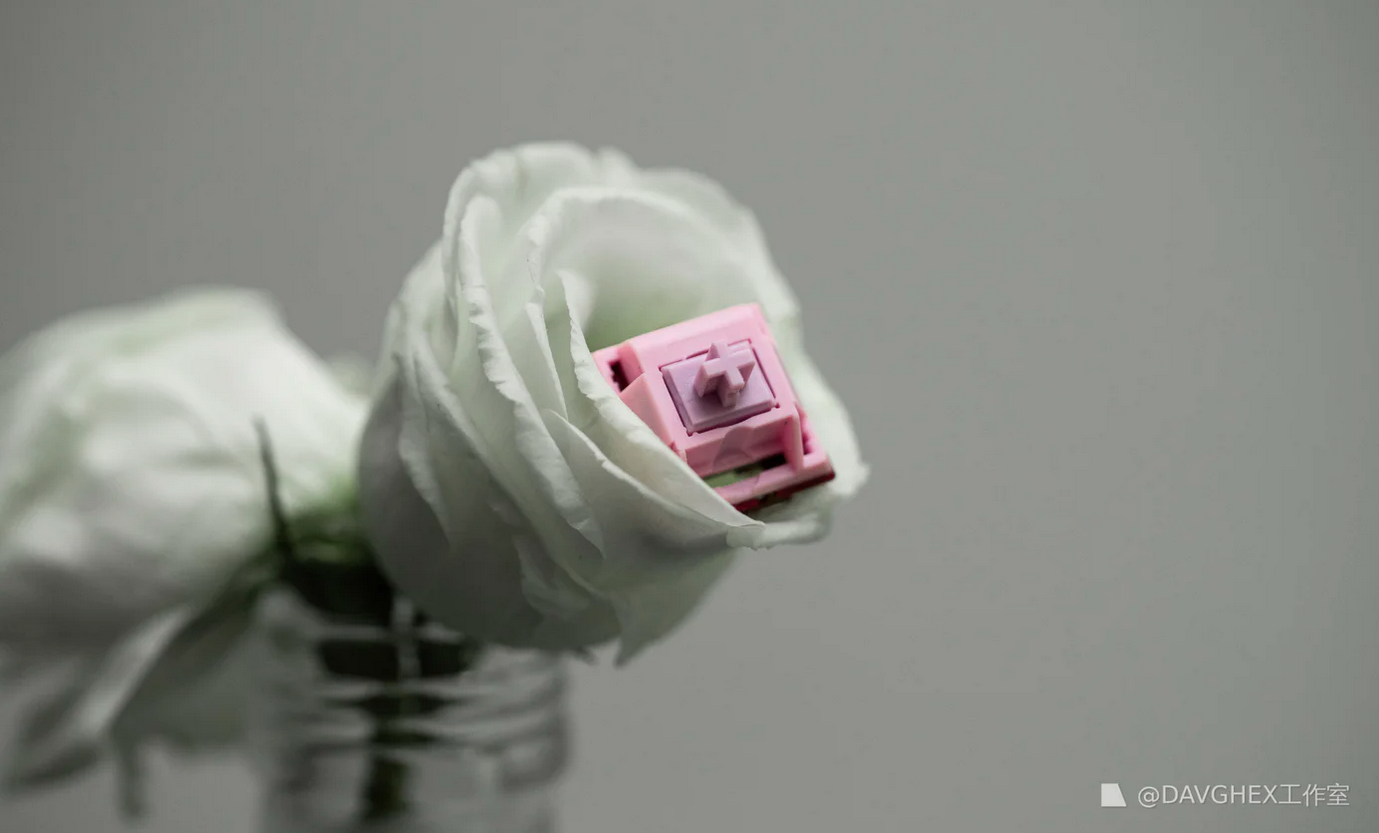
Figure 2: Marketing photo of the Keygeek Muses from their ZFrontier interest check post taken by Han of HEX Studio.
HEX Studio, otherwise known as DAVGHEX Studio on ZFrontier, appears to be yet another Chinese keyboard accessory / switch designing brand that I simply haven’t had a chance to cover yet in a full length review. (It does truly feel like every time I turn around there’s another new one who is six or seven releases deep that I’ve just somehow missed entirely!) However my lack of coverage of HEX Studio is somewhat due in small part to their relatively small and focused nature of switches that they’ve released since they first popped up in middle of 2024. Unlike Moyu Studio, HEX doesn’t have a storefront that both caters to and expands otherwise Chinese-exclusive switch offerings out to western audiences. Also unlike larger, more well known eastern switch designers in the west like Sillyworks, HEX also doesn’t have a large range of switches connected with big, foundational manufacturers in the space like Gateron, either. Instead, HEX Studio has built a respectable operation over the past few years entirely focusing not just on Keygeek-made switches, but a narrow fascination around the custom materials and combinations that Keygeek can provide. The fascination with Keygeek’s material offerings by Hex Studio is made no more apparent than in their very first ZFrontier switch debut for the “H One” switches which first hit interest check on June 29th, 2024. Introducing themselves as a brand as well as sharing photos of some machinery and assembly lines from within Keygeek from their visit to the factory, HEX quickly shifts gears in their debut post to a discussion detailing their multiple iterative steps they took to arrive at a POK based housing and U4 (UPE) material stem for the H One switches – which themselves also come in a random combination of three unique colors. The H (for Hex) One switches were all identical in their material choices as well as phsyical property specs at 45 gf of bottom out and ~3.90 mm of total stem travel, though the mixed three color aesthetic was chosen to match “the three primary colors” – Yellow stems for the “H One Warm Sunshaft”, Blue stems for the “H One Blues”, and Pink stems for the “H One Charmings”. Following a successful interest check post, the H One switches received an equally successful groupbuy release on September 25th of 2024 at prices of 1.78 Chinese Yuan (~$0.26) per switch in both mixed, organized, and ‘experience pack’ stem color options.
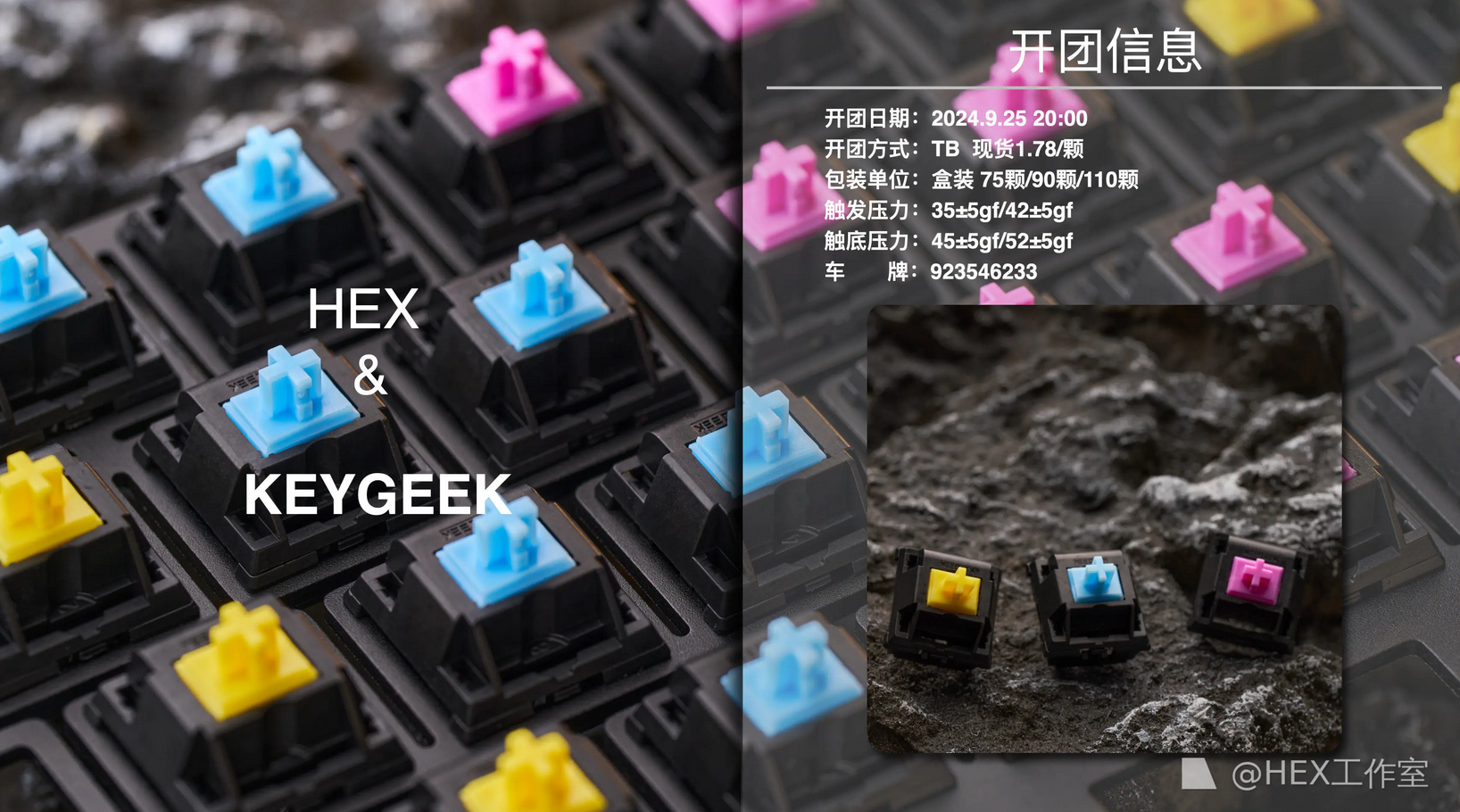
Figure 3: Specifications and color offerings of the H One switches as shown in their sale announcement post on ZFrontier.
Building upon the success of the H One switches throughout the tail end of 2024, HEX Studio went on to parlay this into a moderately sized and successful pair of releases throughout 2025 leading up to their eventual collaboration with Moyu Studio. The first of these switches came in the form of a collaboration with a “Diamond Brother” known as the ‘Other Side Flower Axis’. The translucent red with yellow/gold flaked Keygeek linears boasted PA12 top housings, fiberglass-included bottom housing linears, and a newly enhanced U4+ stem material – something which they really focused on in the interest check for those switches as result of their lack of wear-in and self lubing ability. While the first post for the Other Side Flower Axis switches was actually a teaser post on October 8th, 2024, the full blown interest check didn’t come until January 13th of 2025 and hardly counted as much of an actual check with the first sale of the switches coming just a week later. The sale of these switches saw them come in 45 gf / 52 gf varieties at initial release prices of 1.65 yuan (~$0.24) per switch and instock prices of 1.75 yuan (~$0.25) per switch with a total of 30,000 switches produced. Seeing even greater success than the H One switches, the Other Side Flowers were then subjected to an R2 version on March 10th, 2025 with improved molds and material choices and even a V2 version just a day after Christmas on 2025. The V2 version, unlike both the improved R2 and original Other Side Flower switches saw the use of an improved “R4” stem material as opposed to the U4+ and U4 stem materials from their previous releases. In between the R2 and V2 releases of the Other Side Flowers, HEX Studio also released the Jasmine Milk Green V2M switches on August 21st, 2025 – a less popular Keygeek linear that saw one restock and an exploration of Keygeek’s N1 bottom housings with a 10% fiberglass reinforcement like the Keygeek Explosions and Orange Bois before them, as well as new L4+ stem materials. While the ultimate composition of these various switches released by HEX Studio throughout 2025 – Milk Green V2M and Other Side Flower R1/R2/V2 inclusive – are a bit ambiguous like the majority of Keygeek’s offerings, it’s made pretty clear in each of these posts by HEX Studio that they really strive to perfectly match performance metrics, sounds, and feelings that they are seeking in a switch and are not afraid to go through multiple design iterations to do such.

Figure 4: Marketing photo of the 'Other Side Flower' switches from HEX Studio as seen in their ZFrontier interest check posts. Note the decorative box that larger purchased quantities would come in in the backdrop.
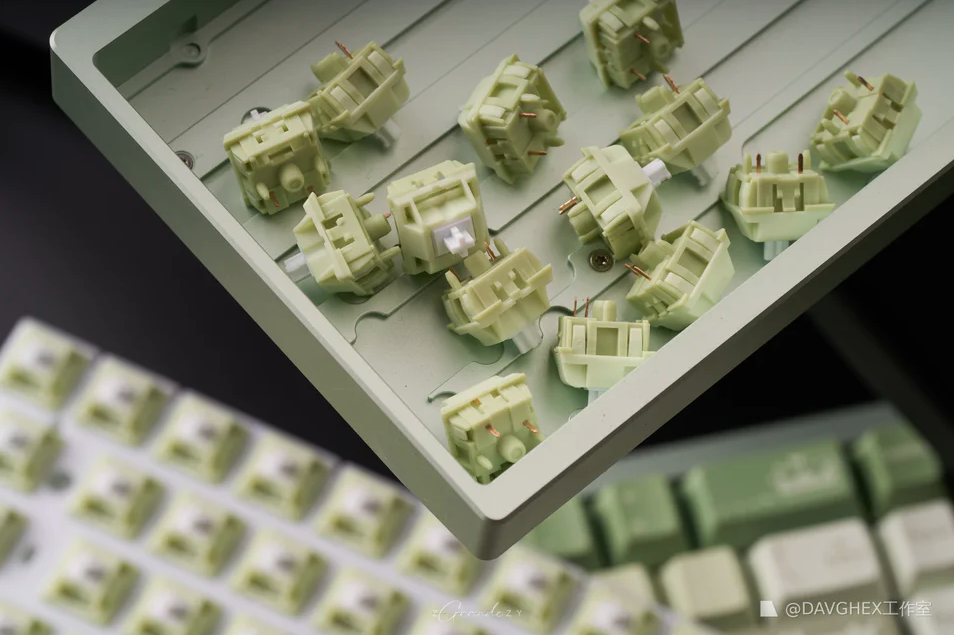
Figure 5: Yet another stunning marketing photo from HEX Studio, this time featuring the Jasmine Milk Green V2M switches from the ZFrontier introductory post.
Fully combining the successes that had been had with the U4 stems by way of the H One switches with the iterative design processes that had been detailed at length for each one of their releases, HEX Studio found themselves officially teasing the release of their fourth switch in collaboration with Moyu Studio in the form of the Keygeek Muses on the final day of 2025. (However it is not described therein exactly where or how Chen of Moyu Studio and Han of HEX Studio first came in contact to come up with such switches…) Leveraging a POM top housing instead of other complex blends of materials, the combined interest check and groupbuy sale announcement for January 15th focused on a multi-round iterative loop trying both domestic and imported POM materials to prove out the exact sound profile that they were going for, even going so far as to describe how the housings interacted with U4 stems in ways similar to and different from original testing samples from the Other Flower Side switch development. Ultimately, the Keygeek Muses ended up as three-part constructions with POM top housings, Keygeek’s N4 (nylon with 40% fiberglass inclusion) bottom housings, and a U4+ stem as had been enjoyed by HEX Studio multiple times over in the past. Officially released for sale on January 15th, 2026, the switches came without a listed quantity but in two variations – one with a 21-mm, 45 gf spring and another with a 17-mm, 53 gf spring – at pricing similar to that of other releases from them. Unlike those other releases, though, the Muses have sustained a much wider western-facing release with Moyu Studio, Unikeys, Divinikey, and several other storefronts stocking these switches ranging anywhere in price from ~$0.30 per switch to $0.35 per switch, a markup that is fairly standard for eastern-released switches that were ported westward. While the longevity of the Keygeek Muses and continual stocking of them has not been discussed publicly anywhere as far as I can tell, Moyu Studio’s longer term support of their Greek Mythology family mixed with HEX Studio’s constant pursuit of reiteration upon releases will likely see the Muses remain available for quite some time into the future, if slightly different than this initial run.
Muse Performance
Note: While the Keygeek Muses were released in two different variants as described above, I have received the 21-mm, 45 gf spring variant that appears to be more commonly available to western audiences. The 17-mm, 53 gf offering does not appear available on any of the sites mentioned in the previous paragraph above.
Appearance
At the highest level, the Keygeek Muse switches come in a three part colorway with pink top housings, lilac purple colored stems, and maroon bottom housings that don’t possibly look like they could go together when the switches are disassembled and the parts are splayed out beside one another. When combined into a complete switch, though, the Keygeek Muses come together to make for surprisingly well matched colorway that definitely is more in line with the idea of a ‘Muse’ in my head than perhaps the Keygeek Athenas did with their purple housings. (This colorway is even especially fitting for this specific review as it was originally published just a day after Valentine’s Day!) While the colorway itself is quite striking and definitely has a depth and darkness to it that likely will separate it from many other switch offerings of the past, it is far from the first modern keyboard switch to feature a multi-tonal pink colorway and likely may be confusable for some others at a distance. Up close, though, the tiny raised ‘HEX’ nameplates as well as other identifying features common to see among Keygeek switches will clearly point to these being the ‘Muses’. While the material choices for each of the housing components was clearly stated as being some of the most pored over aspects of the Keygeek Muses’ designs by HEX and Moyu Studios, there are still a good few details worth noting at the part and sub-part level that make these switches technically interesting. Discussions of these features may be found in the paragraphs and photos below.
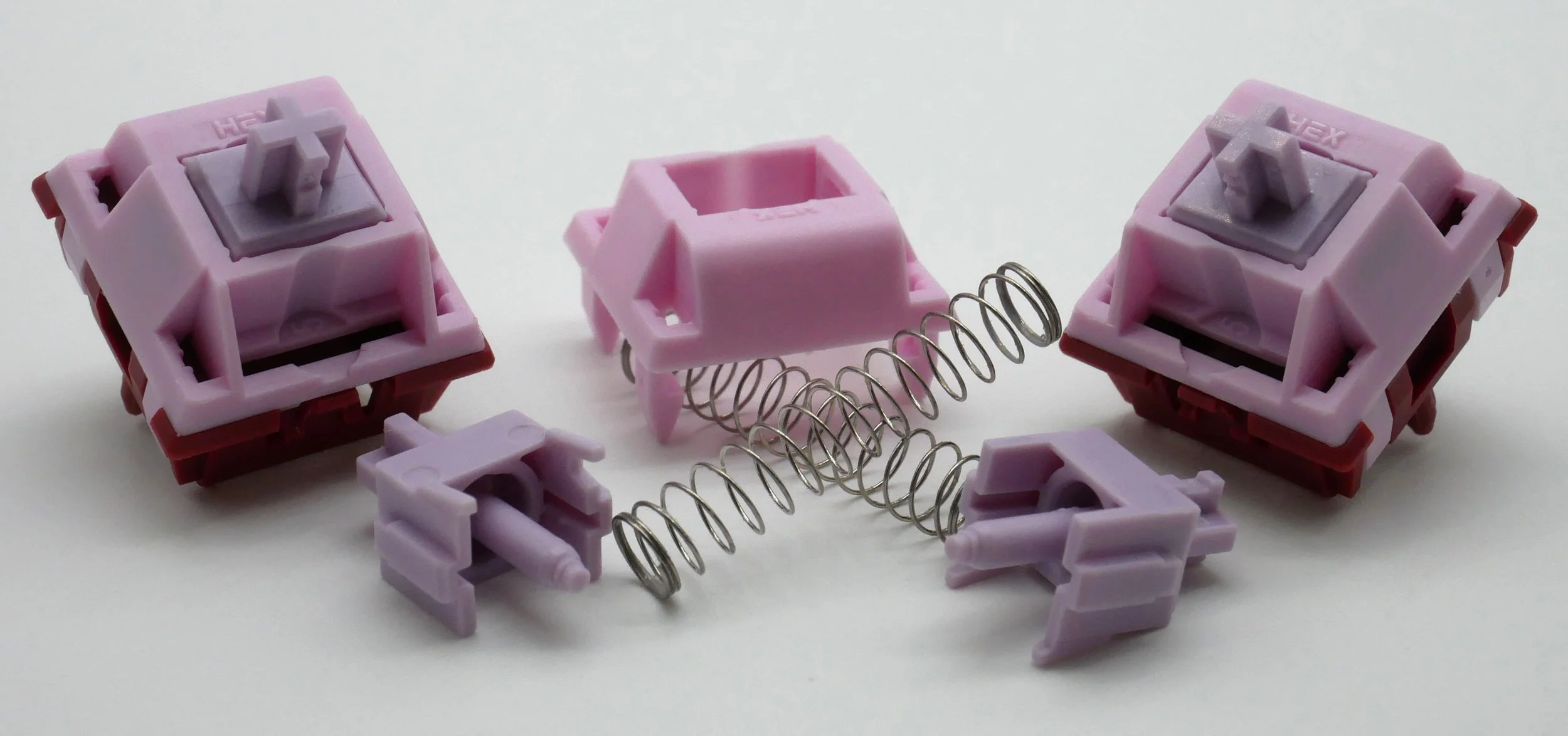
Figure 6: Keygeek Muse switches and their components.
Looking first to the pink, POM top housings of the Keygeek Muse switches, these are very clearly the parts that will make for the easiest identification of these switches in the far-flung future when we are without Discords full of switch nerds to ask. As alluded to above, these housings feature small but strongly bolded, raised ‘HEX’ nameplates inside of the classic Keygeek sunken rectangle nameplate clearly indicating both the manufacturer and one of the designers of origin for these switches. Interestingly, all marketing photos both in ZFrontier posts as well as Moyu Studio’s own website show these switches as having ‘blank’ nameplates with just the Keygeek rectangle as opposed to the raised ‘HEX’ nameplates. Beyond this marking, though, the housings themselves are fairly unremarkable technically and feature a slew of details that are identical to those of the Keygeek Athenas as described in their review. Briefly, these details included a long, rectangular LED/diode slot with centered circular indentation and numerical mold marking on the inner edge of this housing as well as fairly restrictive guiding rails on the insides of the housings. Like the Keygeek Athenas, these too also feature trace amounts of thin factory lubing in the recesses of the top housings though it was a little bit more difficult to photograph here.
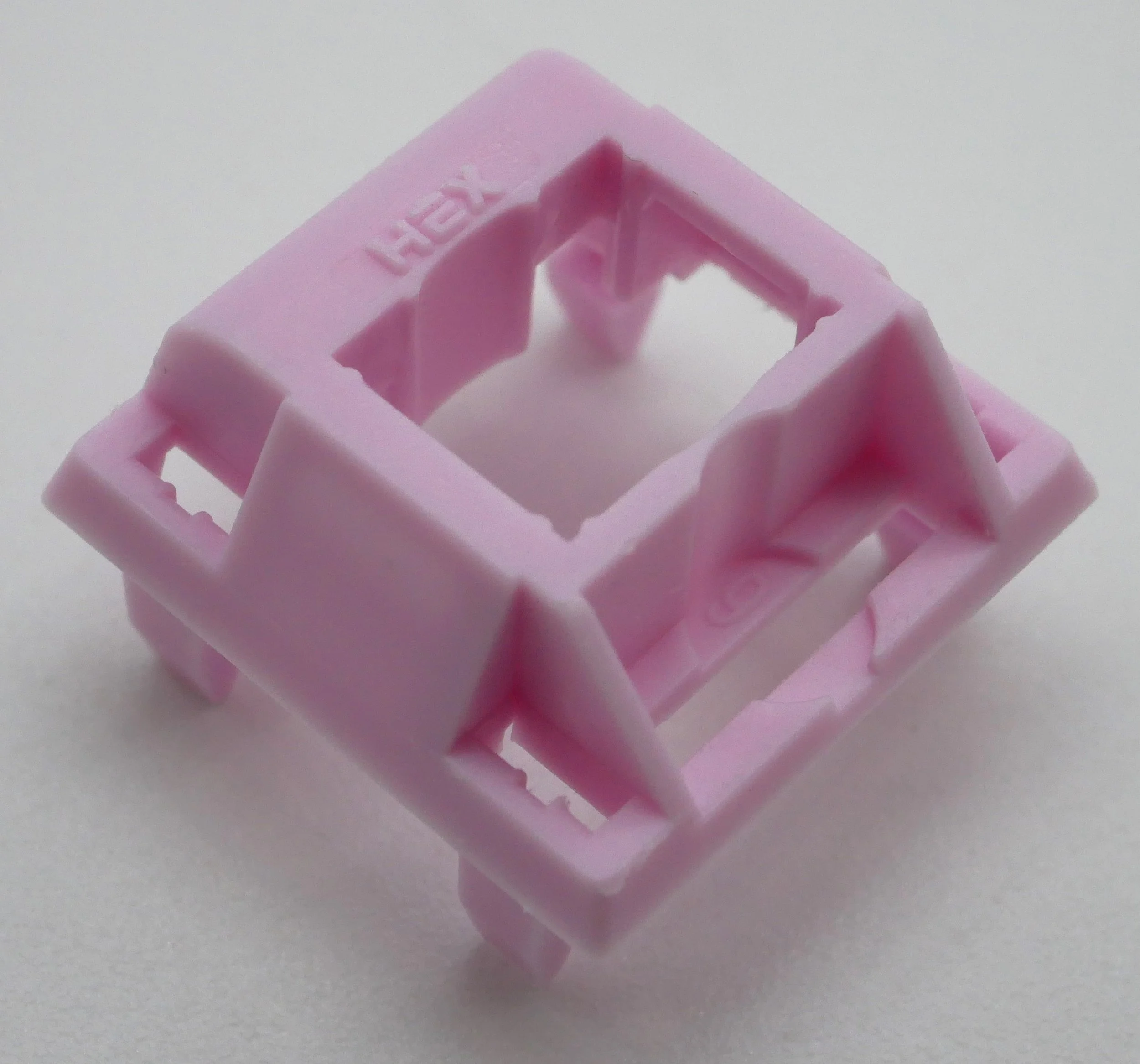
Figure 7: Keygeek Muse top housing exterior showing the 'HEX' nameplates inside of the Keygeek sunken rectangle plates, a wide, rectangular LED/diode slot, and mold marking on the interior circular edge of said slot.
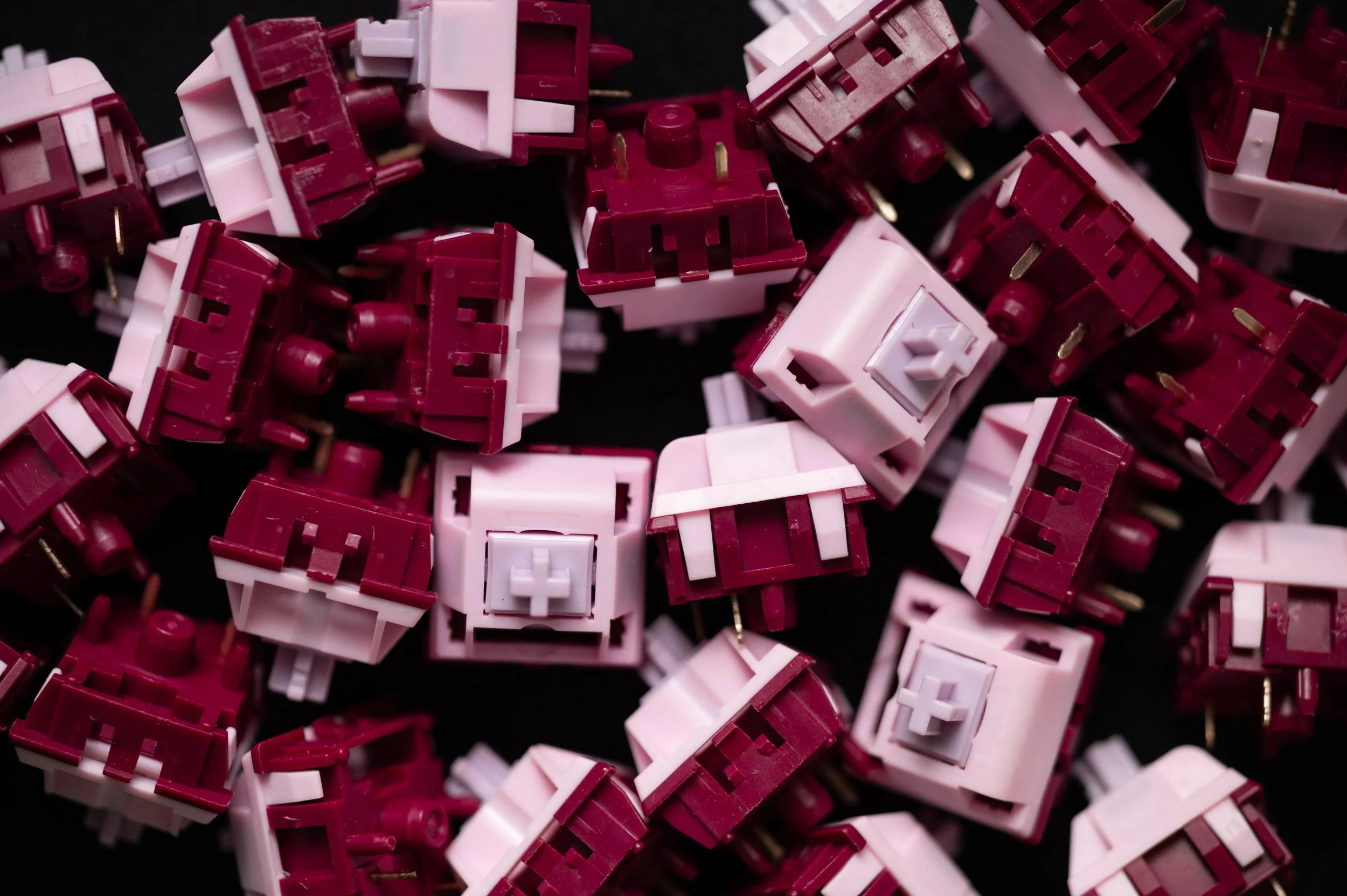
Figure 8: Marketing photo of the Keygeek Muse switches from Moyu Studio's in stock sales page showing traditional Keygeek nameplates rather than the commercially released 'HEX' ones.
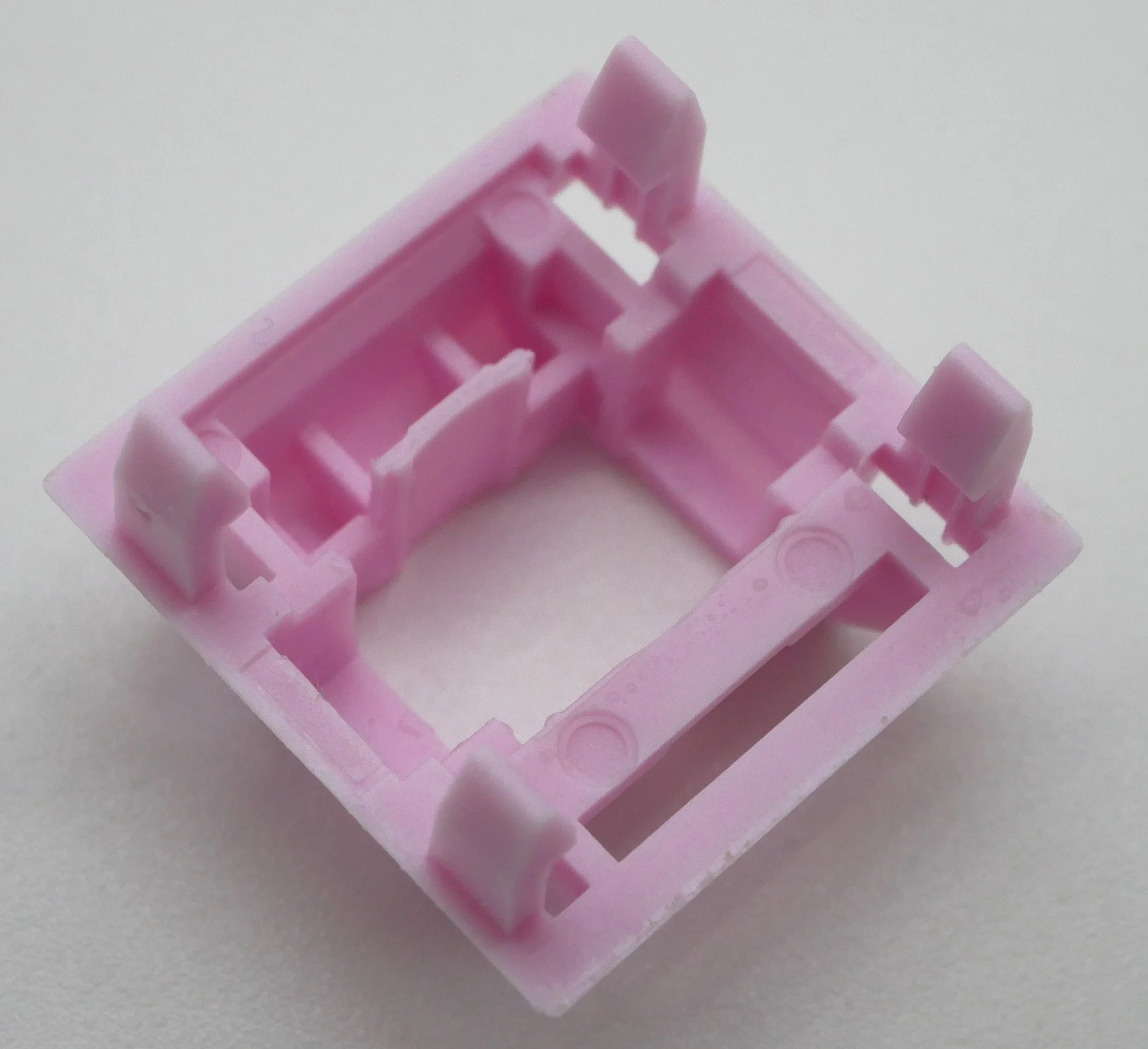
Figure 9: Keygeek Muse top housing interior showing trace amounts of factory lube and all details identical with other Keygeek-made switch top housings reviewed in depth on this website.
Moving next to the lilac purple ‘U4+’ stems of the Keygeek Muse switches, we’re initially greeted with a slew of details that make these appear almost identical to those of the Keygeek Athenas. Down to even the slightest of qualitative details, the Muses appear to match the Athenas, boasting barely tapered slider rails, mold ejection marks on all parts of the stem in identical placements, an indentation behind the slider rails in the sides of the stems, and even a tiered, flat center stem pole. It’s only at the point of physical measurements, however, that these stems really differentiate themselves with the most prominent difference being that of the stem pole length. Whereas the Keygeek Athenas boasted ~13.29 mm stem lengths from tip to tail, the Keygeek Muses are slightly shorter than that at ~13.17 leading to them having a slightly different total stem travel. Paradoxically, comparisons of the force curves between these switches show the Keygeek Muses having a shorter stem travel distance despite being shorter stems, indicating that the bottom housings are definitely different enough from one another to overcome their ostensibly ‘backwards’ stem lengths.
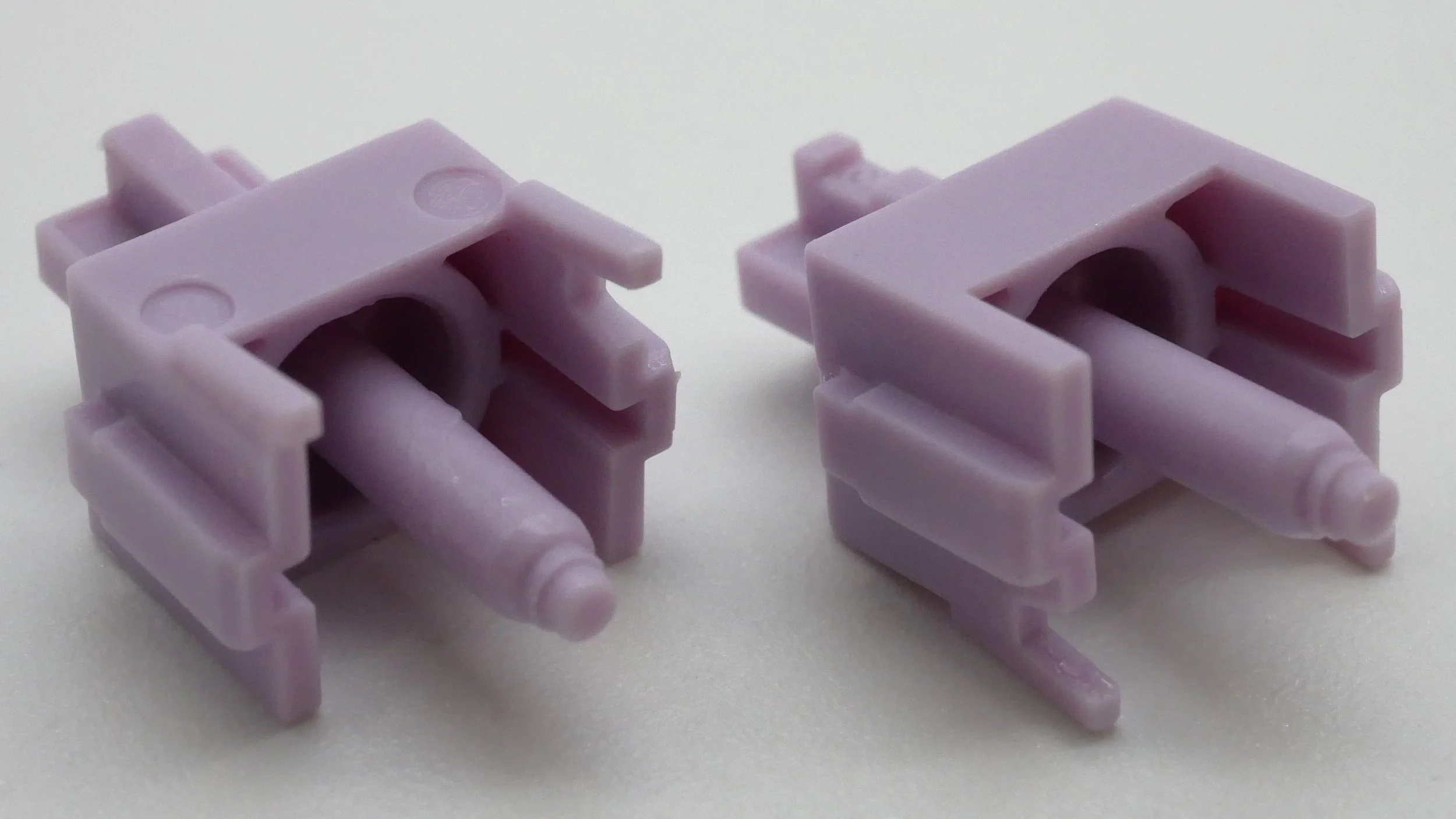
Figure 10: Front and back sides of the Keygeek Muse stems showing front plate mold ejector circles, a barely tapered slider rail, a strongly tiered center pole with flat tip, and trace amounts of factory lubing on all sides of the stems.
Finally arriving to the maroon, N4 (nylon with 40% fiberglass inclusion) bottom housings of the Keygeek Muse switches, we are once again greeted by a lot of features identically seen in other Keygeek switches like the Athenas referenced multiples time over herein. These matching internal features inlcuding mold ejector circles in all of the same places along the upper edges of the housings, a vertical ‘lane’ design in the base of the housings with the slider rails bottoming out on higher ledges than the rest of the housing base, a south side spring collar, and a slight well around the circumference of the center stem pole hole. Unlike the Athenas, though, the Keygeek Muses appear to have substantially more factory lubing in them forming what looks like a whole o-ring’s worth of lube in the base of the housing in addition to coating the slider rails and parts of the contacts on the metal leaves. Externally, the Keygeek Muses come only in 5-Pin/PCB mount variety, feature a very wide, flat, and rimmed center pole hole bottom out, and large numerical mold markings between the metal PCB pins in identical font and size as other Keygeek switches.
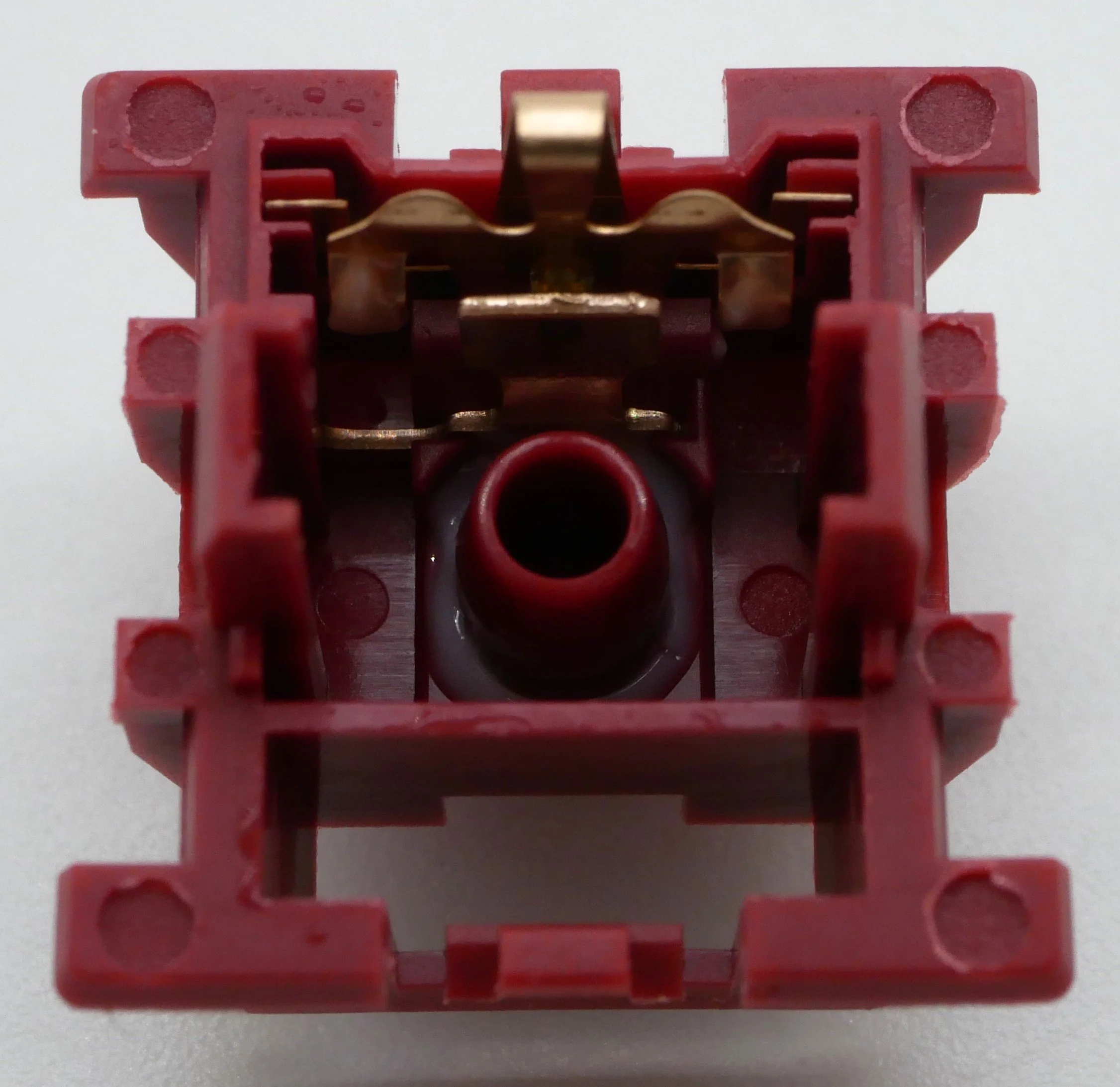
Figure 11: Keygeek Muse bottom housing interior showing a south side spring collar, three-lane vertical housing divide in the base, and a large amount of factory lubing around the base of the center stem pole hole.
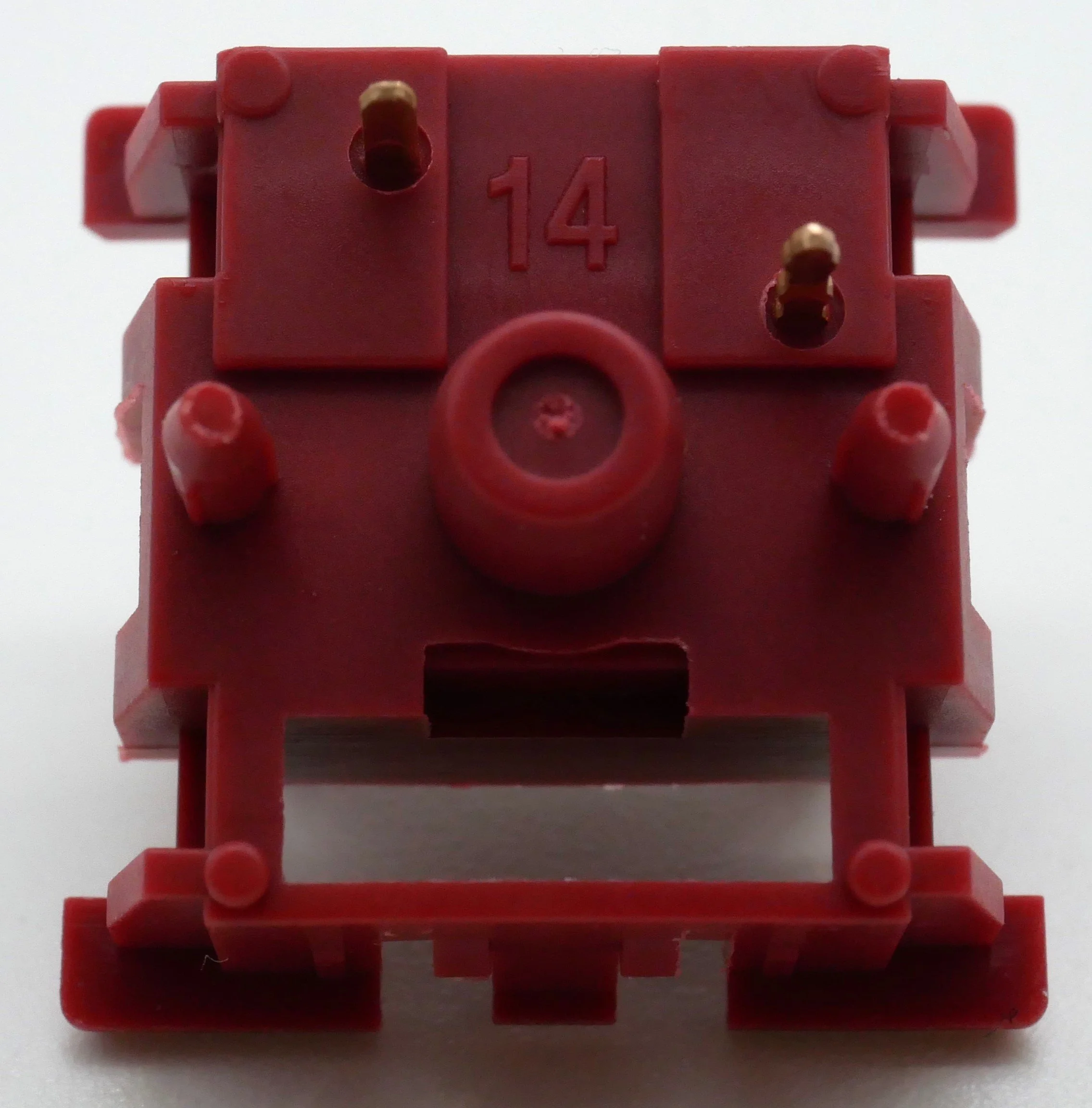
Figure 12: Keygeek Muse bottom housing exterior showing PCB mounting pins and large, right side up numerical mold marking identical to those seen on many other Keygeek-made switches.
Push Feel
The physical paradox that was identified in the previous section above regarding the Keygeek Muses having shorter stem poles and yet a further distance to their bottom out point is one that truly stands out front and center herein the most. The reason that this strange combination of properties is as prevalent as ever in the push feeling of the switches is that the Muses sometimes bottom out with a flat, rapping sort of bottom out feeling and other times they just... don’t really have a bottom out feeling at all? Clearly bottoming out just barely onto their stem poles, the Keygeek Muses have an inconsistent feeling end of their downstrokes that feels as if it is just a touch too far away to really maximize the benefits of a specifically fiberglass embedded nylon housing material choice. While this strange teetering balance does render the Keygeek Muses a surprisingly deep and complex switch for those who are not bottom out typists, I imagine that most people would seek out these switches specifically because of their special bottom housing materials and would thus want to lean into bottoming out in order to maximize their enjoyment of such. Those who are in pursuit of a strong N4 bottom housing experience will be left a bit disappointed here in the stock performance of these switches. Aside from this strange, almost-but-not-quite-enough feeling bottom out strength, the Keygeek Muses are otherwise fairly technically sound linear switches. They have unnoticeable topping outs despite being made of POM, leading these switches to almost really have not topping out feeling at all – even when contrasted against the less prominent of bottom out feelings. Additionally, the factory lubing on these switches is substantial and decently consistent throughout the strokes of these switches, giving them a heft and apparent weight that is both beyond their physical measurements and yet still easy to type on. If only they had just the tiniest bit longer or shorter stem poles to fully lean into the benefits of the materials that HEX and Moyu Studios so carefully selected for.
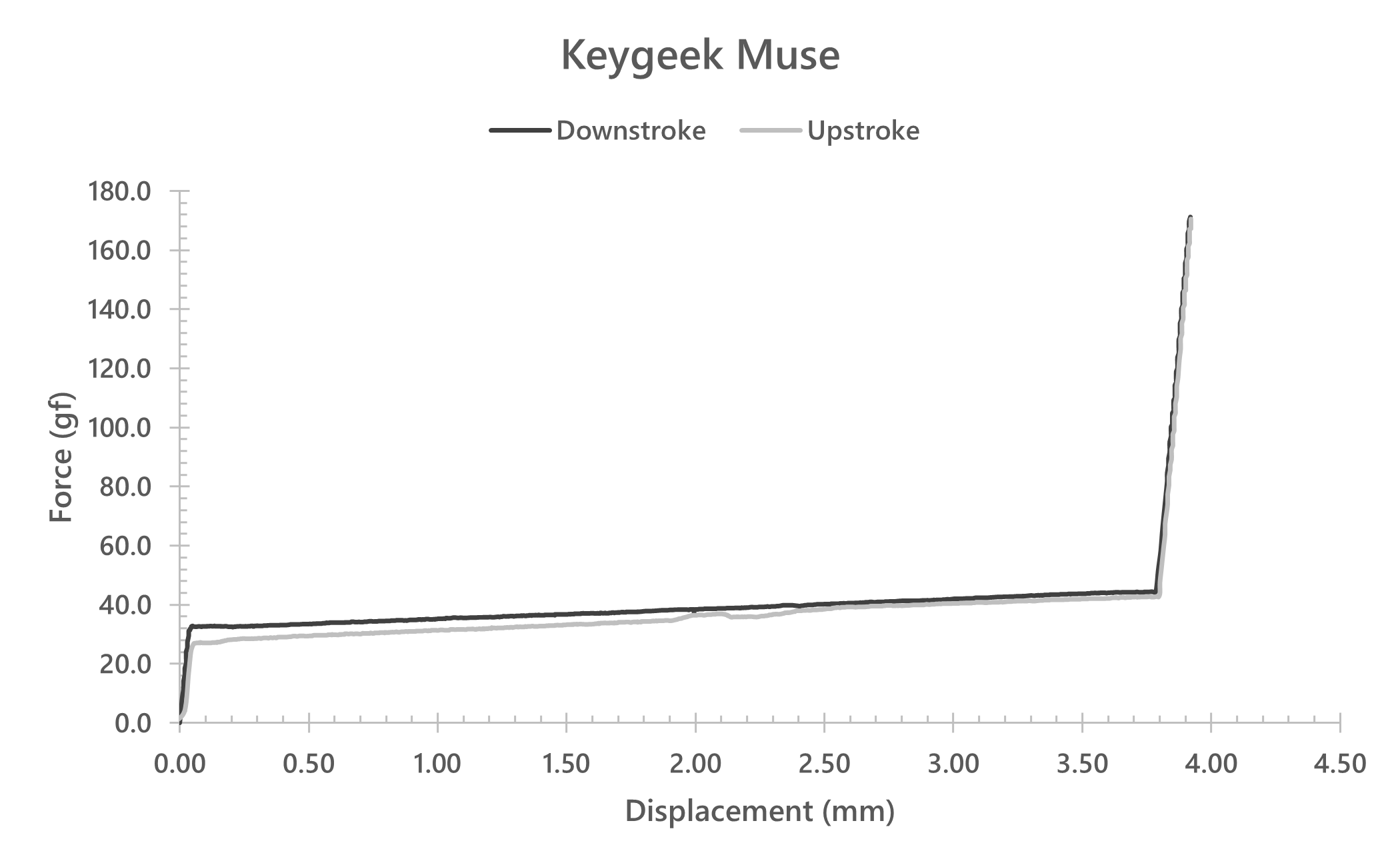
Figure 13: Force curve diagram for the stock Keygeek Muse switch.
Sound
Like the tale as old as time, the sound profile of the Keygeek Muses is one that pretty closely aligns with the push feeling notes as listed above. While perhaps a bit antithetical to a name like “Muse”, everything but the bottom outs of the switches are deep, hardly noticeable at all, and give the switch an audible feeling that is tight, compact, and substantial in its presence. There’s really no scratch sounds, no spring pings, and not even the slightest sort of burr or edge anywhere in their strokes that sticks out and produces an errant hiccup. It’s really just the bottom outs of the Muses that makes them a bit less refined overall. On some downstrokes the bottom outs come in with a slappy, flat, and medium-pitched noise that kind of feels jarring relative to the rest of the switch. On other downstrokes the bottom outs are significantly more subdued and bass heavy, bringing in notes that very distinctively remind me of the classic nylon housings of manufacturers like Cherry. And while normal typing speeds see a random selection as to which of these two kinds of downstokes you will get stroke after stroke, elevated typing speeds causes these random drawings to feel even more erratic and the gap between them grow as the more noticeable bottom outs pitch up and become louder. While I’ve personally never been much of a fan of housings that have pointed, sharp, and more stand-out bottom out sounds, the Keygeek Muses do really leave me wishing that they would just pick a lane so I can clearly enjoy them consistently. Pick a longer stem that lets me enjoy their flat tipped profiles or a shorter stem that allows for slides into a fiberglass laden nylon field on the backend of the strokes, I don’t really care; Just pick one. Perhaps the name of ‘Muse’ is more fitting than ever for a switch like this than I gave it credit for at the top end of this paragraph on a sheer account of the fact that as it bottoms out it, in a way, teases you from a distance and just makes you want more of them. I sincerely doubt that HEX and Moyu Studios intentionally selected for a design that so tightly walks the razors edge just to match their thematic naming for the switch, but it is a bit impressively serendipitous how well it matches.
Wobble
Despite the multiple iterative steps that were discussed as having taken place in the design of the Keygeek Muse switches, there is a surprisingly large amount of stem wobble that is ever so slightly greater in the N/S direction than the E/W direction. While still good by modern standards and a bit less than the average stem wobble of all switches I’ve ever tried, I certainly would have expected it to be a bit better. Most users won’t have an issue with this degree of stem wobble, though, unless they are particularly picky about this metric.
Measurements
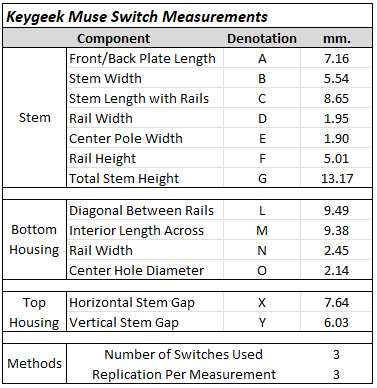
If you’re into this level of detail about your switches, you should know that I have a switch measurement sheet that logs all of this data, as well as many other cool features which can be found under the ‘Archive’ tab at the top of this page or by clicking on the card above. Known as the ‘Measurement Sheet’, this sheet typically gets updated weekly and aims to take physical measurements of various switch components to compare mold designs on a brand-by-brand basis as well as provide a rough frankenswitching estimation sheet for combining various stems and top housings.
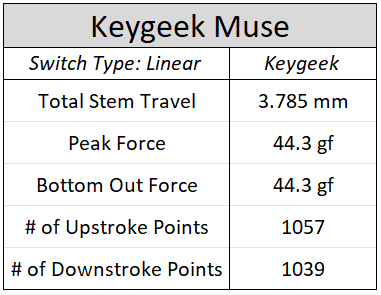
Figure 15: Numerical details regarding the force curve for the stock Keygeek Muse switches.
Have you ever wanted to be bombarded with more switch data than you’ve ever seen at any point in your life before? Consider checking out the ‘Force Curve Repository’ hosted on my GitHub that contains all force curves that I take both within and outside of these full-length reviews. In addition to having these graphs above, I have various other versions of the graphs, raw data, and my processed data all available for over 2000 different switches for you to use however you see fit. Check it out via the ‘Archive’ tab at the top of this page or by clicking any of the force curve cards above.
Break In
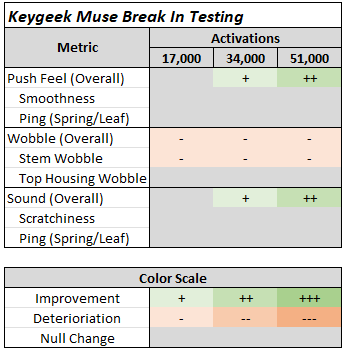
Break In Notes
17,000 Actuations
- After 17,000 actuations, the only actual change which I could quantify cleanly in the chart above was a slight increase in both the N/S and E/W direction stem wobbles of the Keygeek Muses.
- Now as for the changes that I was not able to quantify, it did feel to me as if the push feel consistency of the Muses both improved and got worse through this stage of the break in testing. On one hand, the bulk of the batch broken in to this stage were much more uniform in their bottom out feeling and sound though those that hadn’t folded to that same pressure just only stood out that much more than they did in their stock forms.
34,000 Actuations
- After 34,000 actuations, the Keygeek Muse bottom outs finally begin to come into alignment with almost all switches in this batch being more uniformly dampened, deep, and softer at the ends of their strokes than the stock batch. While the stem pole is still noticeable in some but not all bottom outs of these switches, its definitely not as inconsistently sharp or as aggressive feeling as in the stock forms of the Keygeek Muses.
51,000 Actuations
- After reaching 51,000 actuations the Keygeek Muse switches almost entirely level out in terms of their switch consistency and pretty uniformly reach a state of bottom out that is dampened, muted, and all the descriptors from the last stage that I said they were beginning to hedge into. Without really any increase in stem wobble throughout the break in process beyond the tiny bit through the first 17,000 actuations, the Muses are among some of the better broken in switches I think that I’ve ever tried. These very clearly and cleanly slot into a feeling that emphasizes the unique choice in bottom housing material for these switches very well as opposed to their stem architecture.
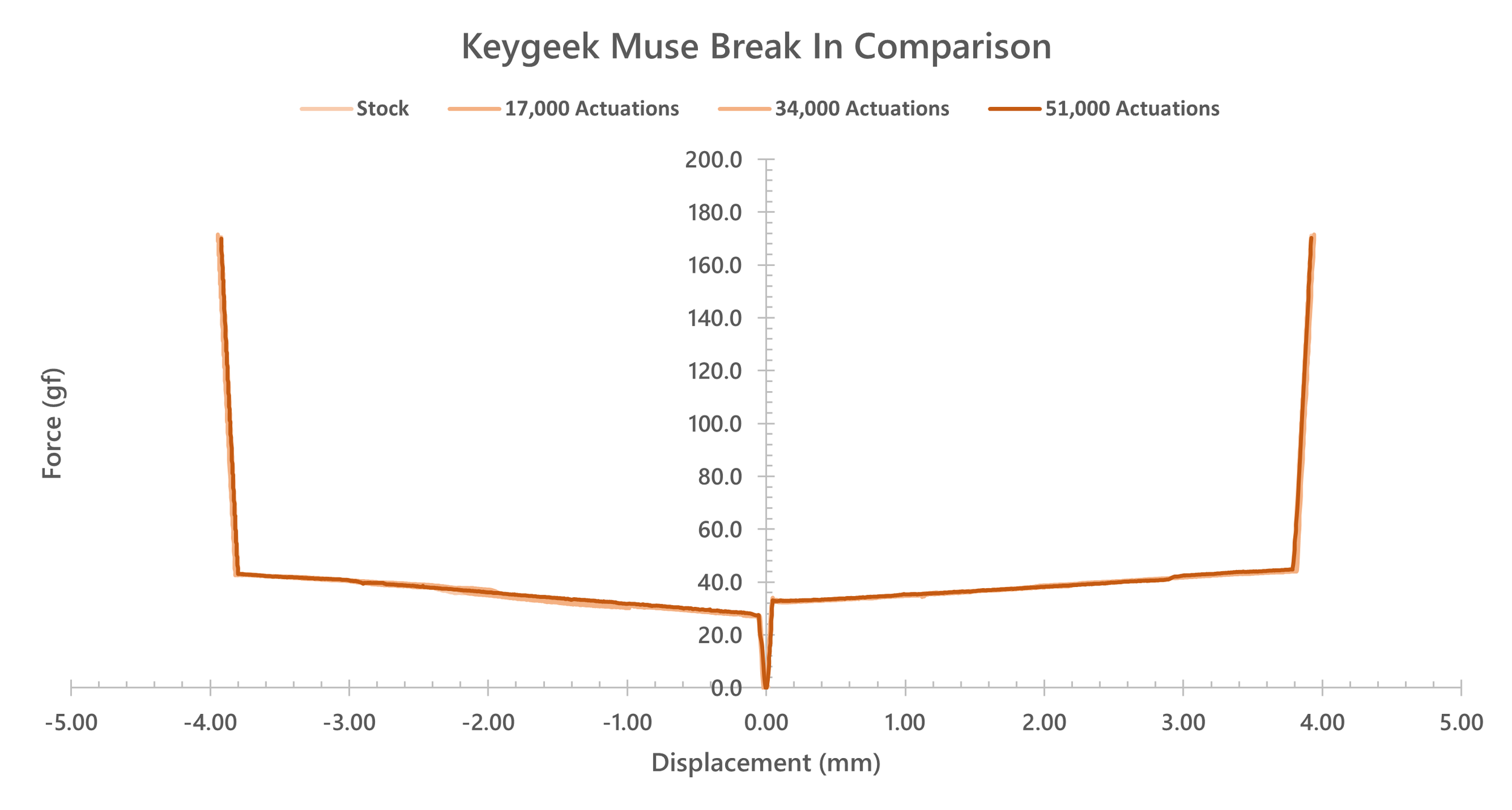
Figure 17: Comparative force curve diagram showing no substantial, consistent change in the force curves of the Keygeek Muse switches throughout the break in process.
Comparison Notes to Other Notable Linear Switches
Note – These are not aimed at being comprehensive comparisons between all factors of these switches as this would simply be too long for this writeup. These are little notes of interest I generated when comparing these switches to the Keygeek Muse switches side by side.
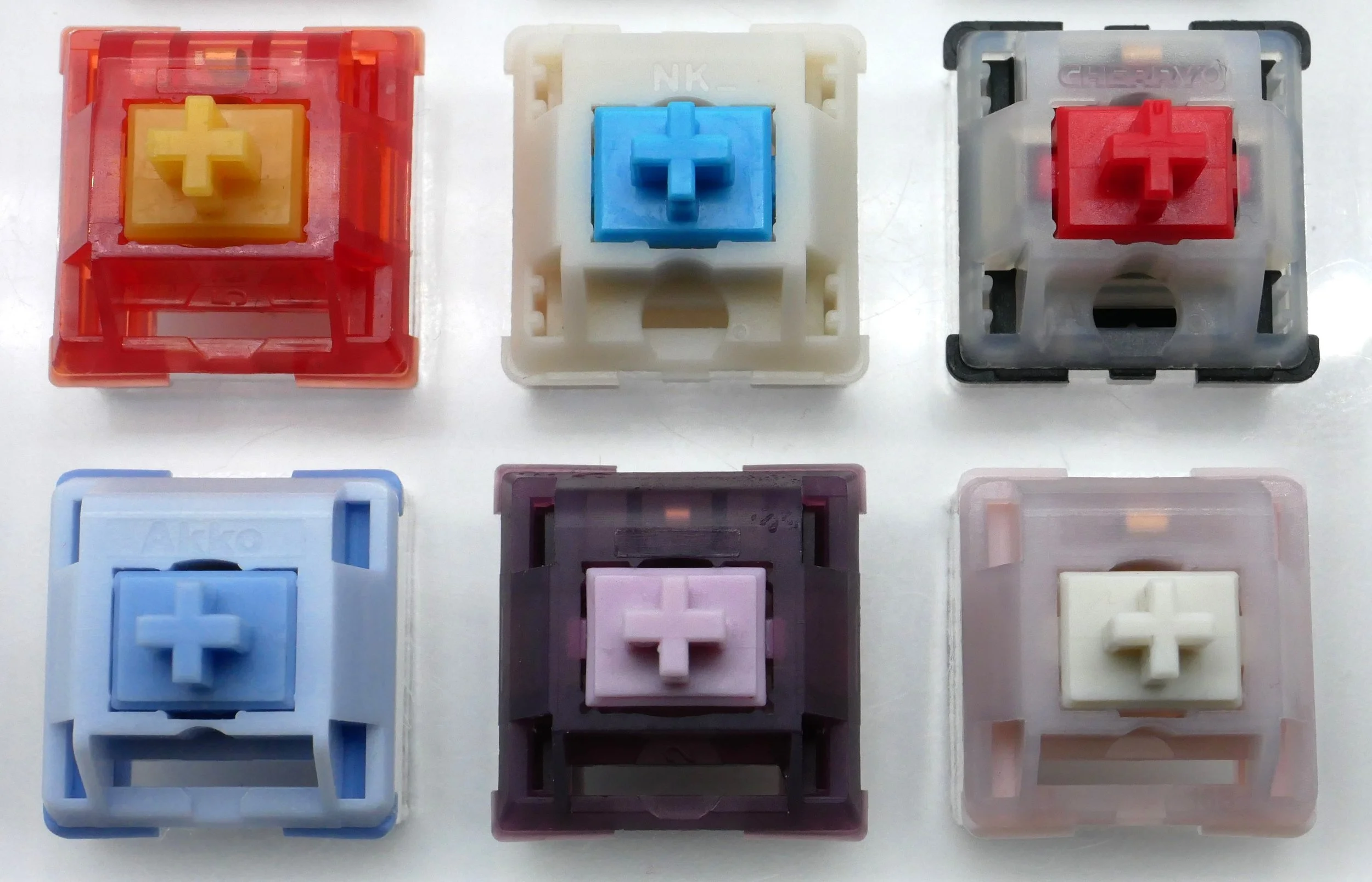
Figure 18: Switches for comparison. (L-R, Top-Bot: Keygeek Y2, Novelkeys Classic Blue, Cherry MX Firefinch, Akko Mirror, Keygeek Athena, and HMX Anti)
Keygeek Y2
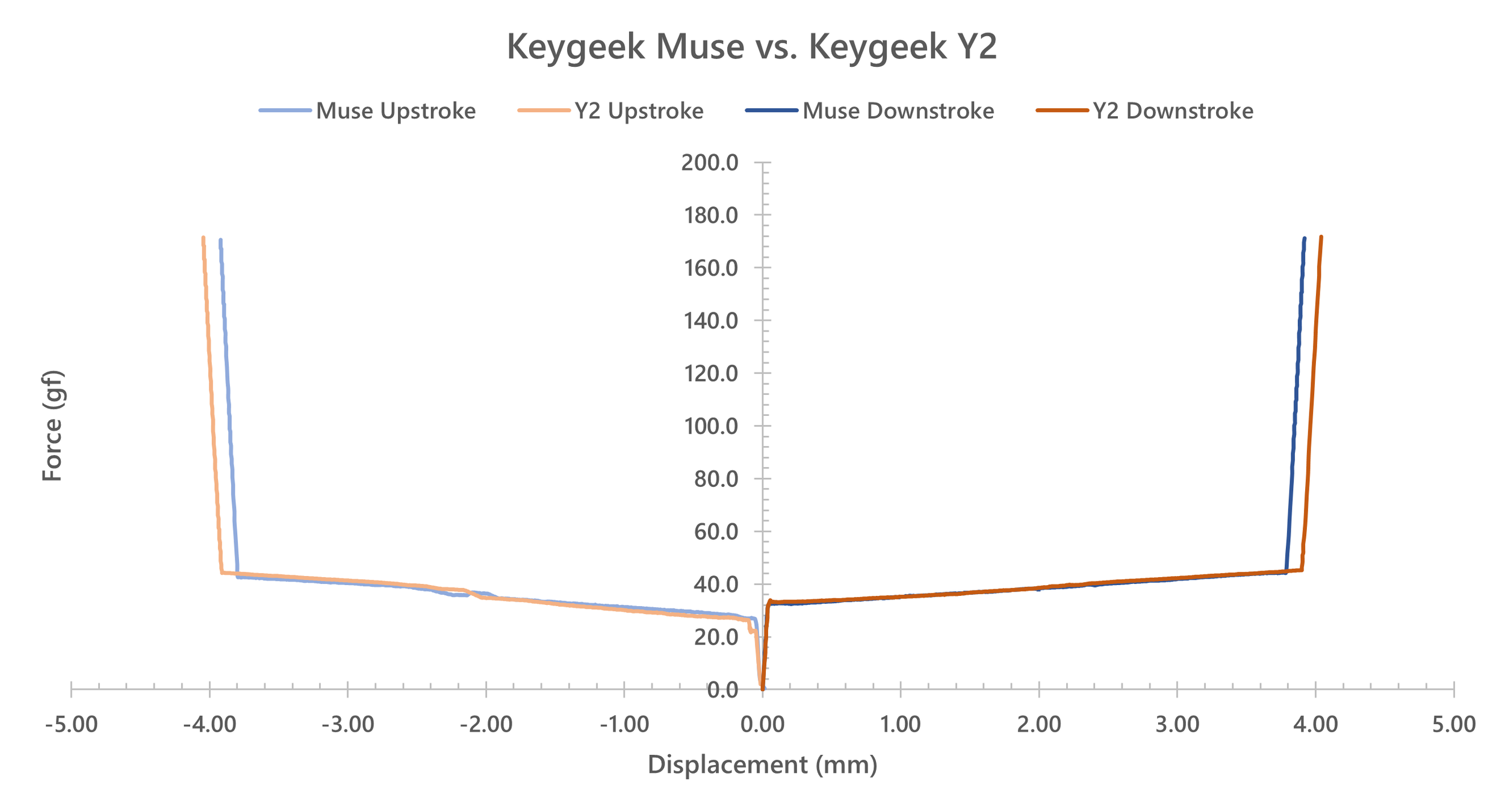
- While these two switches are fairly comparable to one another in terms of their stem wobble, the Keygeek Y2s have just the tiniest bit less N/S and E/W direction stem wobble than the Keygeek Muses.
- Despite the comparative force curve between these two switches below being effectively identical, under finger the Keygeek Y2s feel ever so slightly heavier than the Muses due to what I presume to be the slightly heavier factory lubing on the Y2s. While it definitely doesn’t make the Y2 switches feel sluggish on their own, the degree of factory lubing is much more noticeable when in direct comparison to switches like the Muses.
- The bottom outs of the Y2 switches are not only more consistent feeling and sounding than the stock Keygeek Muses, but push towards a deeper, richer, and more softened tone like the broken in Muses do as opposed to their noticeably inconsistent stock forms.
Novelkeys Classic Blue
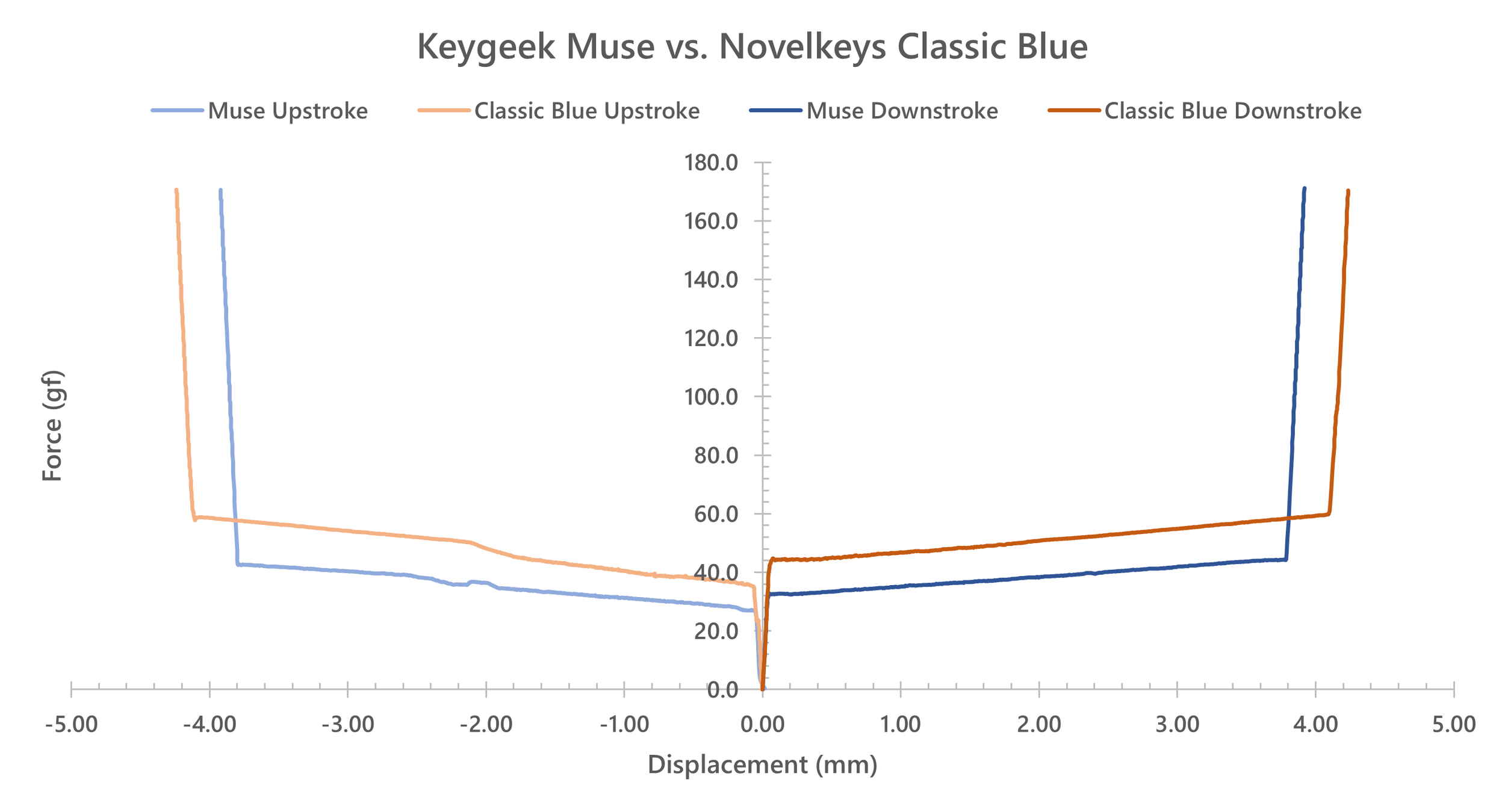
- There is substantially less N/S and E/W direction stem wobble in the Novelkeys Classic Blue switches than there is in the Keygeek Muses and it’s not even really all that close.
- In their stock forms, the Novelkeys Classic Blue switches are much more higher pitched, louder, and slighter sharp in their tones than the Muses, which are quieter, deeper, and more soft at their point of bottom out. This gap only further widens as both of these switches are broken in as results above show the Muses lean into that depth and richness even more at the bottom of their strokes.
- While both of these switches are smooth on their own, the factory lubing of the Keygeek Muses just makes them that much more consistently smooth and effortless through their strokes in than the Classic Blues.
Cherry MX Firefinch
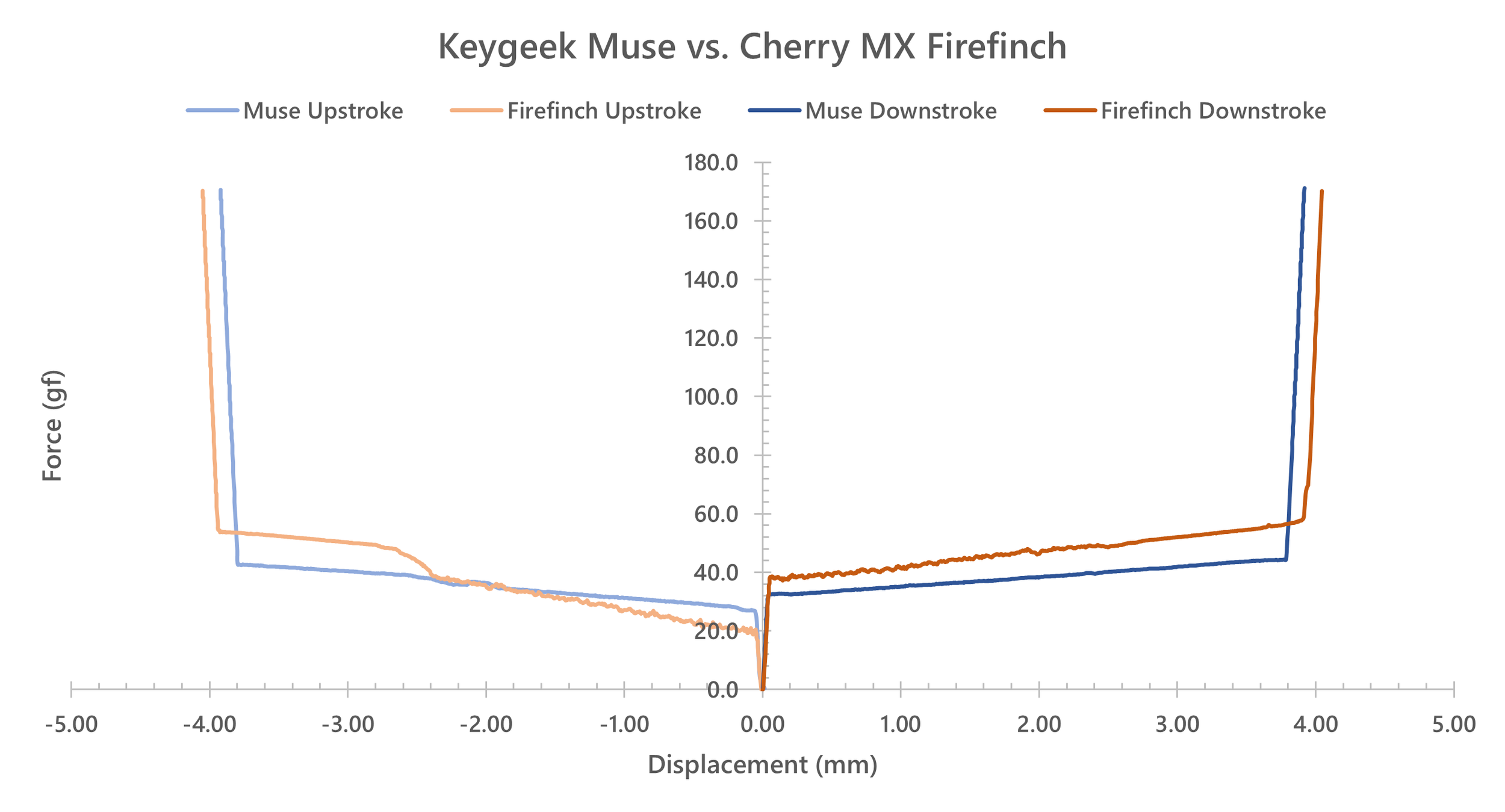
- Even when using Cherry’s MX2A switch platform, which had had several iterations to improve prior to the release of the Firefinches, they are much more scratchy and less smooth throughout their strokes than the Keygeek Muse switches.
- While the MX Firefinches definitely feel a little bit heavier in hand than the Keygeek Muse switches, the experience gap is definitely much more narrow than what their comparative force curves below would suggest.
- Keeping fully in mind the inconsistency at bottom out for the Keygeek Muse switches, their bottom outs are much more refined, singular and cohesive in their tones than the sound of the Cherry MX Firefinch bottom outs.
Akko Mirror
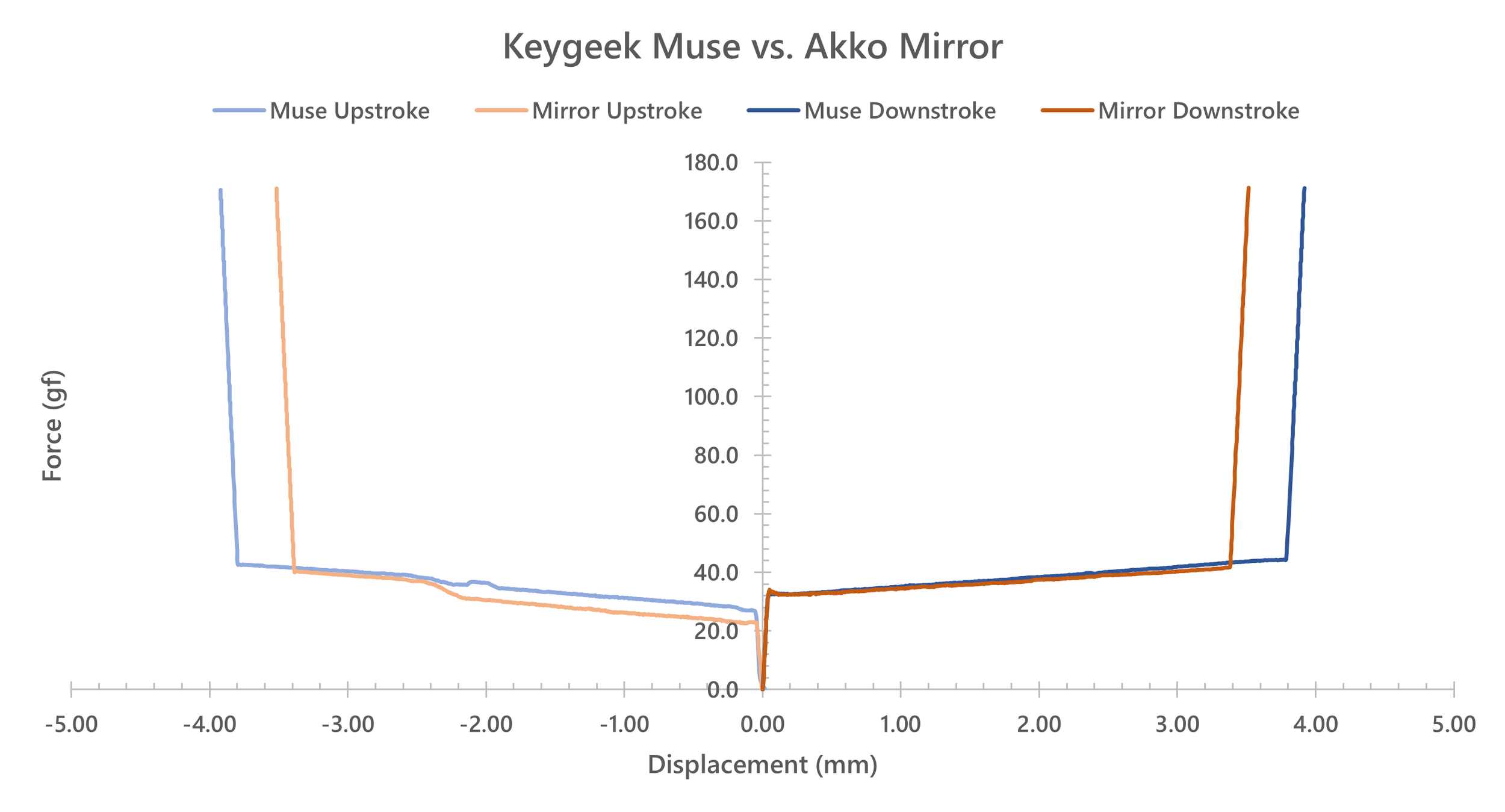
- Much like with the Novelkeys Classic Blue switches above, there is quite a fair bit less stem wobble in the HMX-made Akko Mirror switches than there is in the Keygeek Muse switches.
- The comparative force curve between these two switches below really does well to highlight their differences in total stroke length and bottom out aggression. Whereas the Keygeek Muses travel a relatively normal stem length and teeter on the edge of bottoming out onto their center poles or not, the Mirrors absolutely crash into their bottom outs at a much shorter stem distance and a much more authoritative and pointed feeling bottom out.
- The Akko Mirror switches are a bit smoother than the Keygeek Muses, though without as much of the lube feeling; The application of the lube in the Mirrors simply feels more precisely and consistently placed than by the machines that Keygeek uses.
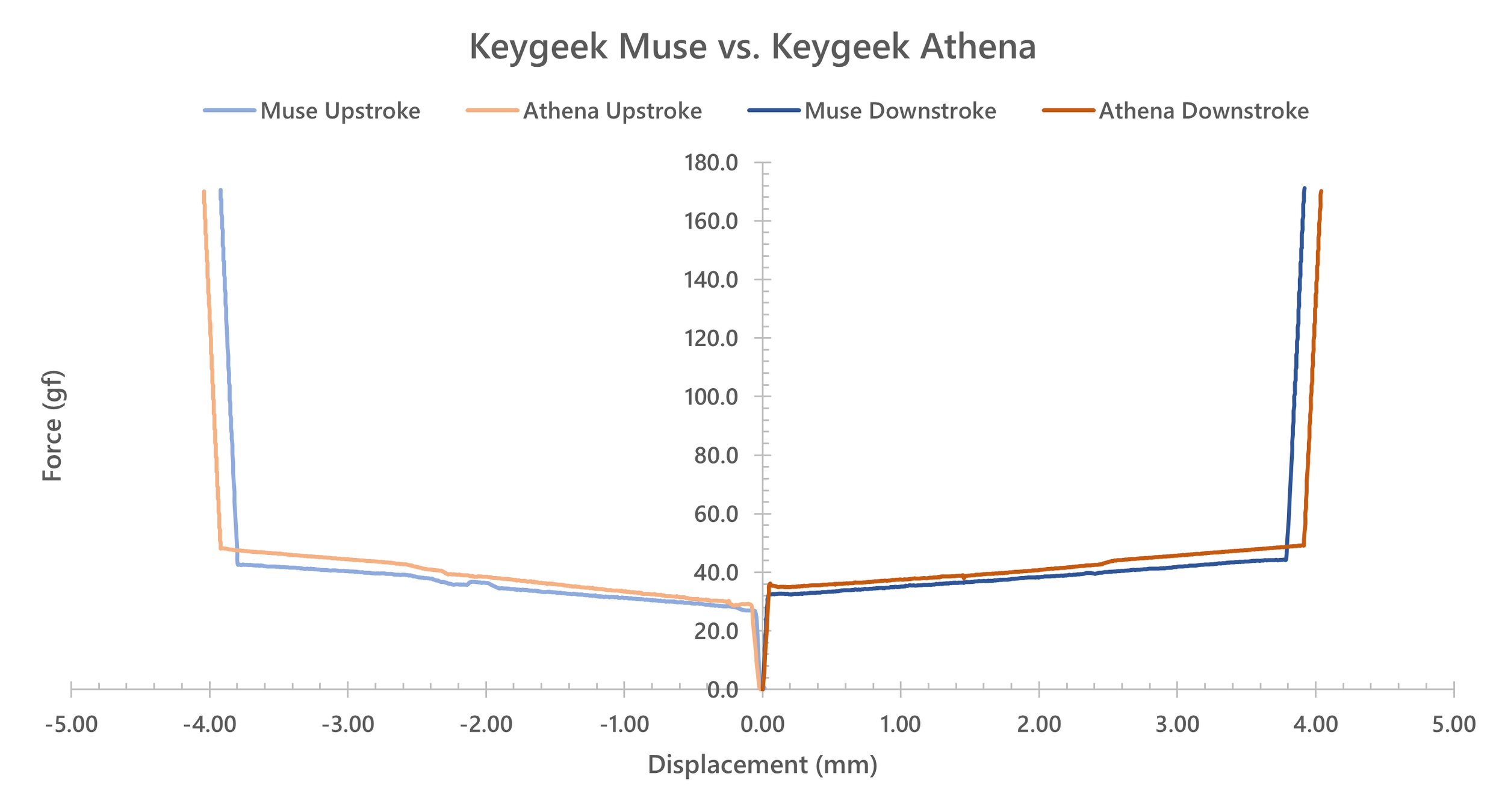
Keygeek Athena
- I’m entirely surprised in this comparison at just how much less N/S and E/W direction stem wobble that the Athenas seem to have than the batch of Muses that I received. If this isn’t explainable by me receiving batches on the extreme opposite ends of Keygeek’s production tolerance variability, this could very well be the difference in consistency and mold precision achievable by the different materials used in the Athenas versus the Muses.
- While the Muses, themselves, are already fairly deep, bass heavy, and quiet as switches, they still are lighter and a bit louder in volume than the very compact, tight feeling and sounding Keygeek Athenas.
- In spite of the fact that there visually appeared to be more factory lubing in the base of the Keygeek Muses in the sections above than in the Keygeek Athenas, the Athenas ultimately feel as if they have a more heavily lubed feeling to them. Perhaps this just means that the lube was better distributed throughout the Athenas in their stock forms than in the Muses.
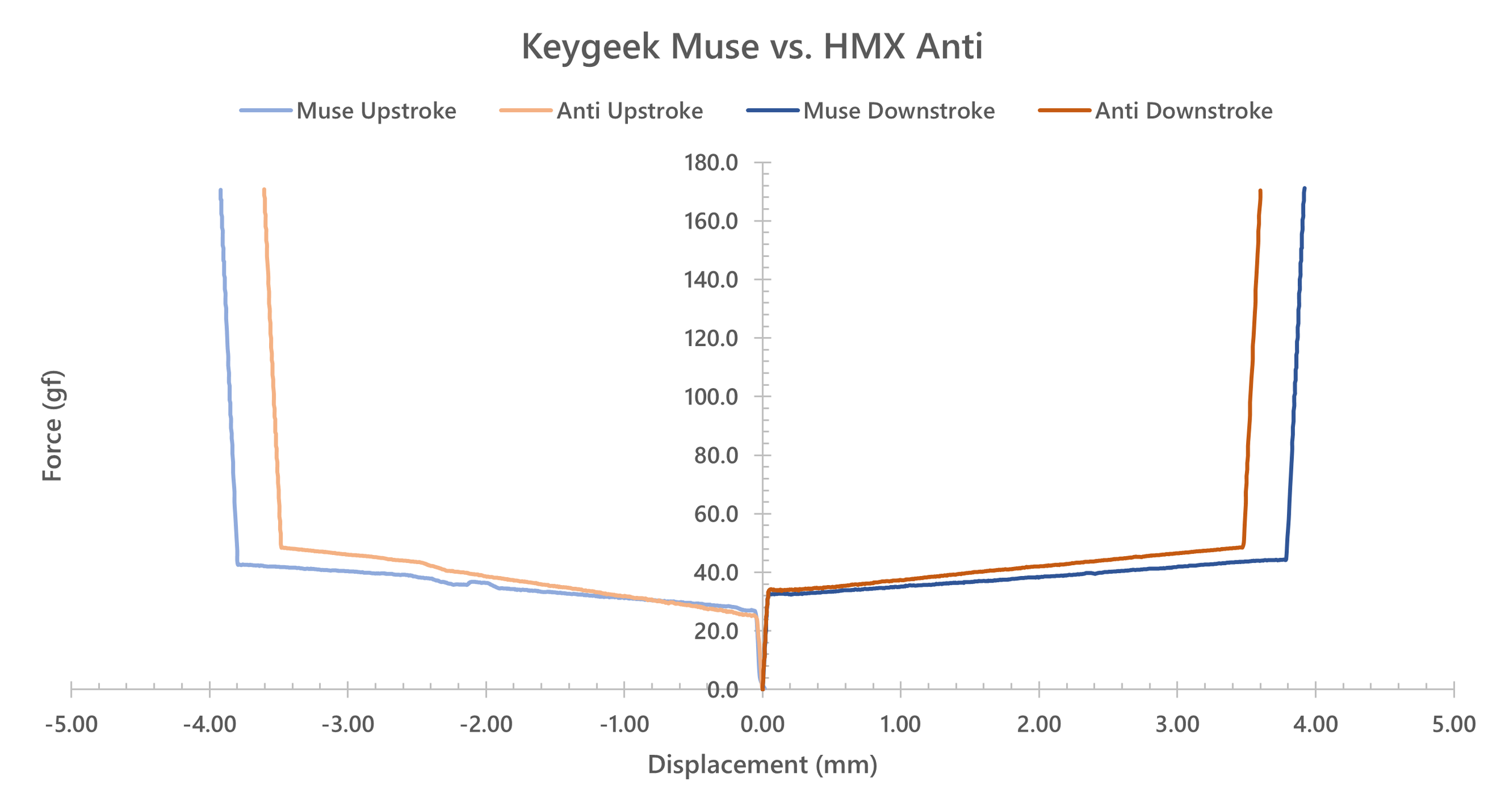
HMX Anti
- Due to the fact that the Keygeek Muses have a more heavy amount of factory lubing to them than the HMX Anti switches, they actually feel slightly heavier throughout their downstrokes and as if they ramp up more in force than the Antis despite what the comparative force curve below physically measures.
- Of all of the switches on this list, the volume, pitch, and overall sound profile of the bottom outs of the HMX Anti switches is the one that most closely matches that of the more aggressive bottom outs of the Keygeek Muses.
- Even with the HMX Antis being slightly asymmetrical in their stem wobble with slightly greater N/S direction wobble than the E/W direction, the Muses have a bit less than them in both directions.
Linearity
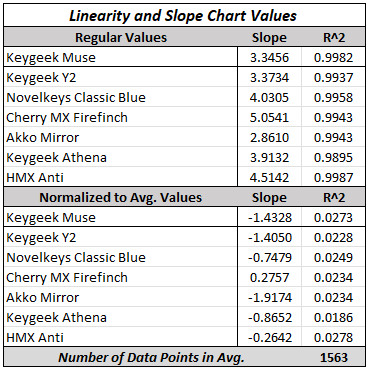
Figure 25: Absolute and relative Linearity and Slope values for each switch in this comparison section.
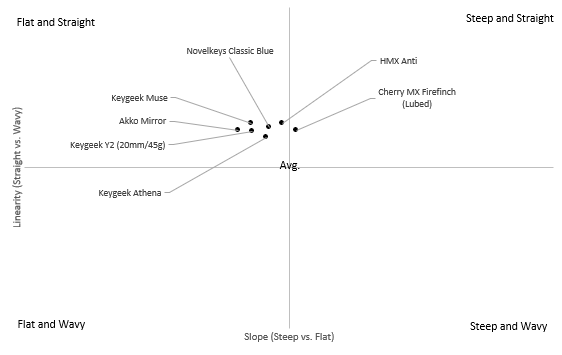
Figure 26: Qualitative comparison of the normalized Slope and Linearity for each switch in this comparison section.
If you are just now seeing this section for the first time and are a bit confused as to what I am talking about when discussing ‘Slope’ and ‘Linearity’, I highly suggest checking out my article titled ‘On Differences in Linear Switches’ where I explain what this section is for and how it came to be! For a bit of a shorter answer, know that this is part of my ongoing attempt to better quantify and articulate differences between linear switches which have historically not been captured in discussions about them.
Scores and Statistics
Note – These scores are not necessarily completely indicative of the nuanced review above. If you’ve skipped straight to this section, I can only recommend that you at least glance at the other sections above in order to get a stronger idea of my opinion about these switches.
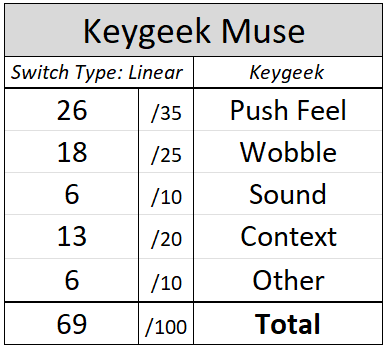
Push Feel
The Keygeek Muses are definitely in line with the typical Keygeek linear experience insofar that they are fairly well lubed, consistent throughout the linear portions of their stroke, and really lean into an interesting selection of part materials. However, the bottom outs of the stock Keygeek Muses are a bit inconsistent from stroke to stroke, with some landing on a flat, slightly slappy stem pole with some force and others landing softly into the fiberglass reinforced nylon (N4) housing materials. When broken in these bottom outs transition more towards the latter feeling than the former, it is definitely a still noticeable detriment in stock form.
Wobble
There is a noticeable but unlikely to be problematic amount of equal magnitude N/S and E/W direction stem wobble to the Keygeek Muses that is consistent from switch to switch.
Sound
Despite the Keygeek Muses randomly varying between bottom outs in their stock form, either of the options that they really land in are fairly good sounding. Free from ping, scratch, or even topping out noise from their POM housings, the Muses are primarily driven by flat, medium-volumed slappy bottom outs in some strokes and deep, rich, more bass-focused tones in others.
Context
Priced at $0.30-0.35 per switch and as a collaborative continuation of Moyu Studio’s Greek Mythology family and HEX Studio’s Keygeek material exploration, these switches are definitely more high profile and supported than either of their maker’s previous switches. However, the community is still apparently undecided if these will make their way towards the front of the pack among Keygeek and linear switch enthusiasts’ current interests right now.
Other
It feels especially bad grading stock switches which just lean into their best qualities with a little bit of break in time. By me as well as others, these are definitely underrated Keygeek linears.
Statistics
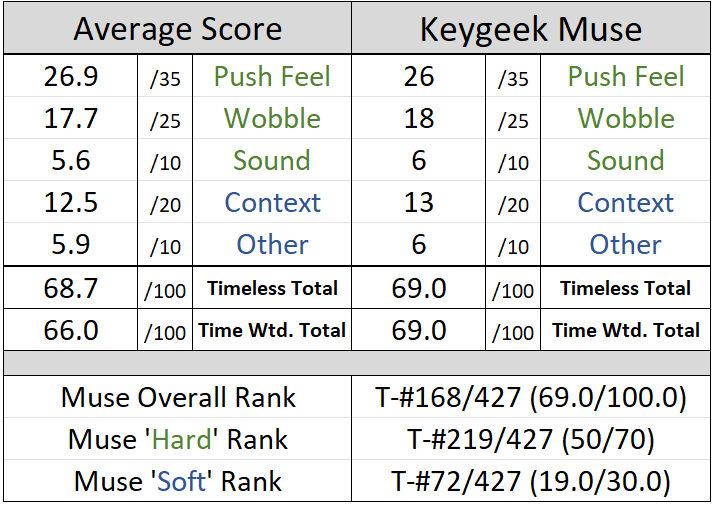
If you are looking at this statistics section and wondering what the heck ‘Timeless’ and ‘Time Weighted’ scoring is, consider checking out my short article titled ‘A Scorecard Time Change’. As a result of scoring becoming a bit anachronistic over the years, switches are now ranked in this statistics table using a “time weighted total” as opposed to their day-of scoring as discussed in that article. If you’d also like to learn about what ‘hard’ versus ‘soft’ ranks refer to specifically, I’d encourage you to head on over to my GitHub linked in the table above or at the links in the top right hand of this website to check out my database of scorecards as well as the ‘Composite Score Sheet’ which has a full listing of the rankings for each and every switch I’ve ranked thus far.
Final Conclusions
Even in spite of having already espoused it at the tail end of the scorecard section above, I feel inclined to reiterate the heartbreaking nature of the Keygeek Muse’s scoring here at the top end of this section. These are simply one of those rare few switches that just have a feeling or in hand experience that to me doesn’t entirely align with the technical scoring criteria that I use for my reviews. While I have all of the agency to try and twist or morph the scoring of these switches to fit my personal expectations or feelings about them, I do try my hardest to remain impartial and consistent in scoring of switches. Switches like the Keygeek Muses really do hit all of the great high points that a solid, Keygeek-made linear offering has such as strong factory lubing, a construction free from commonplace errors like spring pin or scratch, and a selection of materials for each component that really push their switch type that much further than ‘just another linear’. The real kicker here with these switches is that they just have inconsistent bottoming outs in stock form that make them inconsistent from stroke to stroke. (This is especially frustrating on account of them also having nearly silent, black hole-like topping outs onto POM housings which are much more hard to pull off than a solid bottoming out onto a nylon based housing.) In their stock form the Keygeek Muses have bottom outs that sporadically switch between ones driven by their flat, fairly wide area stem pole bottom out and ones that are driven on the opposite end by a depth and bass-focused feeling that is clearly a function of the N4 material bottom housings. And they just teeter on a razor’s edge between those two, occasionally swinging into both despite probably only shooting for one feeling. While this balancing act is firmly shifted towards the latter, more material-driven bottom outs throughout the break in process, I ultimately review and score stock switches here, not their broken in or hand modified variants. Despite the Keygeek Muses not being among the most technically sound switches from Moyu Studio’s pantheon of releases, they do well demonstrate the ability that Keygeek has as a manufacturer to make compelling linears and the ability of designers like HEX Studio to twist all of the knobs that Keygeek gives them to the nearly perfectly correct settings. The Keygeek Muses not only have me feeling as if they’ll be one of the more underrated linears I’ll have reviewed in some time, but also leave me incredibly intrigued if these two studios will run it back for another collaborative release after this one. Another material-driven exploration into the Greek Mythology series would be an interesting switch to see, linear or otherwise.
Sponsors/Affiliates
Mechbox UK
- A wonderful UK based operation which sells singles to switches that I’ve used above in my comparisons for collectors and the curious alike. Matt has gone out of his way to help me build out big parts of my collection, and buying something using this link supports him as well as my content!
KeebCats UK
- A switch peripheral company based out of the UK which sells everything switch adjacent you could ask for, they’ve been a huge help recently with my film and lube supply for personal builds, and they want to extend that help to you too. Use code ‘GOAT’ for 10% off your order when you check them out!
proto[Typist] Keyboards
- An all-things keyboard vendor based out of the UK, proto[Typist] is a regular stocker of everything from switches to the latest keyboard and keycap groupbuys. While I’ve bought things from the many times in the past, they also are a sponsor of my work and allow me to get some of the great switches I write about!
Divinikey
- Not only do they stock just about everything related to keyboards and switches, but they’re super friendly and ship out pretty quick too. Divinikey has been a huge help to me and my builds over the last year or two of doing reviews and they’ll definitely hook you up. Use code ‘GOAT’ for 5% off your order when you check them out!
ZealPC
- Do they really need any introduction? Zeal and crew kicked off the custom switch scene many years ago with their iconic Zealios switches and the story of switches today couldn’t be told without them. Use code ‘GOAT’ (or click the link above) for 5% off your order when you check them out!
MechMods UK
- A rising vendor based in the UK, Ryan and crew have been a pleasure to work with and have nearly everything you’d need to build your first or fourteenth keyboard. Go build your latest or greatest one right now with them by using code ‘GOAT’ at checkout for a 5% discount!
Dangkeebs
- A longtime supporter of the website and the collection, Dangkeebs has quite possibly the widest variety of switches of any vendor out there. Not only is their switch selection large, but it rotates and is constantly adding new stuff too. You’re going to need 5% off your order with my affiliate to save off the cost of all those switches!
SwitchOddities
- The brainchild of one my most adventurous proxies, SwitchOddities is a place where you can try out all the fancy, strange, and eastern-exclusive switches that I flex on my maildays with. Follow my affiliate code and use code ‘GOAT’ at checkout to save 5% on some of the most interesting switches you’ll ever try!
Cannonkeys
- Does anybody not know of Cannonkeys at this point? One of the largest vendors in North America with keyboards, switches, keycaps, and literally everything you could ever want for a keyboard always in stock and with an incredibly dedicated and loving crew. Follow my affiliate link above in their name to support both them and I when you buy yourself some switches!
Kinetic Labs
- One of the most well-rounded keyboard vendors out there, Christian and crew have been supporters of all my switch and switch-adjacent needs for some years now. I’m honored to have them as an affiliate and think you should check them out using my affiliate link above to support both them and I when you check out their awesome products!
Keebhut
- Want to try out some switch brands that fly under most vendor’s radars? Keebhut is always seeking out that next latest and greatest and has been super helpful in hooking me up with new brands over the past year. They are all about sharing that love as well, and want to give you 5% off your next order with them when you use code ‘GOAT’ at checkout!
Kailh
- No, you’re not mistaken – this is actually that Kailh that manufactures switches. As one of the longest running manufacturers in the hobby, they have a massive variety of switches available over on their website at any point in time. I’m lucky to be affiliated with them now, and so consider using my affiliate link above when ordering some Kailh switches to support me!
Keebz N Cables
- Australia and Oceania’s very own is now a part of the sponsor list here and I couldn’t be happier to add this long time supporter of the collection to it. They’ve always got an amazing selection of switches (and other keyboard parts) in stock and they want to share the love that they’ve shown me with you all too! Use code ‘thegoat’ for 5% off your first order when you visit!
Further Reading
Moyu Studio’s Keygeek Muse Sales Page
Unikeys’ Keygeek Muse Sales Page
Divinikey's Keygeek Muse Sales Page
Yushakobo Keygeek Muse Sales Page
Moyu Studio’s Keygeek Muse Teaser Instagram Post
DAVGHEX and Moyu Studio Keygeek Muse ZFrontier Post
DAVGHEX’s H One ZFrontier Post
The Switch Journal’s Keygeek Muse Review Video