Note: In order to keep things as fully transparent as possible, I want to inform readers here that I was sent these switches by Cherry without any prompting or request whatsoever. As well, they made no attempt to ask me to review them, either. With this in mind, this review was conducted entirely of my own will and volition and without any notice nor support from Cherry. They did not receive an advanced copy of this review, editorial notes, nor in any way, shape, or form affected this review. All opinions here, as long winded as they definitely are, are expressly mine and mine alone.
To say that it has been a rather busy couple of weeks since posting the review of the Wingtree x LICHICX Pumpkin silent tactiles would even be an understatement on my part. Having not had a set of weeks so busy in multiple months now hasn’t really helped this situation either. I’ve had a washing machine break down literally weeks after a full HVAC renovation that cost many a pretty penny, the entire process of winterizing our garden and water storage tank to survive these miserable Zone 6 winters to manage, and even tossed in a speed camera trap ticket as well for good measure. My actual real job has also been quite busy as well, with scoping related to the capital project that I’ve been involved in having picked up the pace as well, and in turn is requiring me to spend no less than multiple hours of every single day calling contractors, having them visit the site, and trying to get quotes on virtually everything that could possibly cost money with this project. This list only amorphously expands in the small space in between draining the bank account for the house and subsequently filling it back up on the clock with the college football season, volunteering in our local community, trying to stay in touch with old coworkers, monthly board games weekend, etc., etc. And in addition to all of that stress and chaos, I’ve still got the ever growing pile of keyboard switches on my desk that need to be catalogued, measured, sometimes scored, and shared with you all via the many different ways I do content. In addition to the correspondence with Cherry that has brought us together here today (and maybe could possibly kind of sort of bring us together (potentially) for a truly unprecedented short article here in the near future), I’ve had a solid number of packages show up in the last couple of weeks filled with switches and switch-adjacent stuff that will make for great discussions, stories, and everything of the sort. That is, if I can get through it all in a reasonable time frame. Many of you could likely guess that I see and touch a whole lot more switches than the average barnyard animal, though to really put it in perspective, take a look at what comes in the mail from friend of the website SwitchOddities every couple of months:
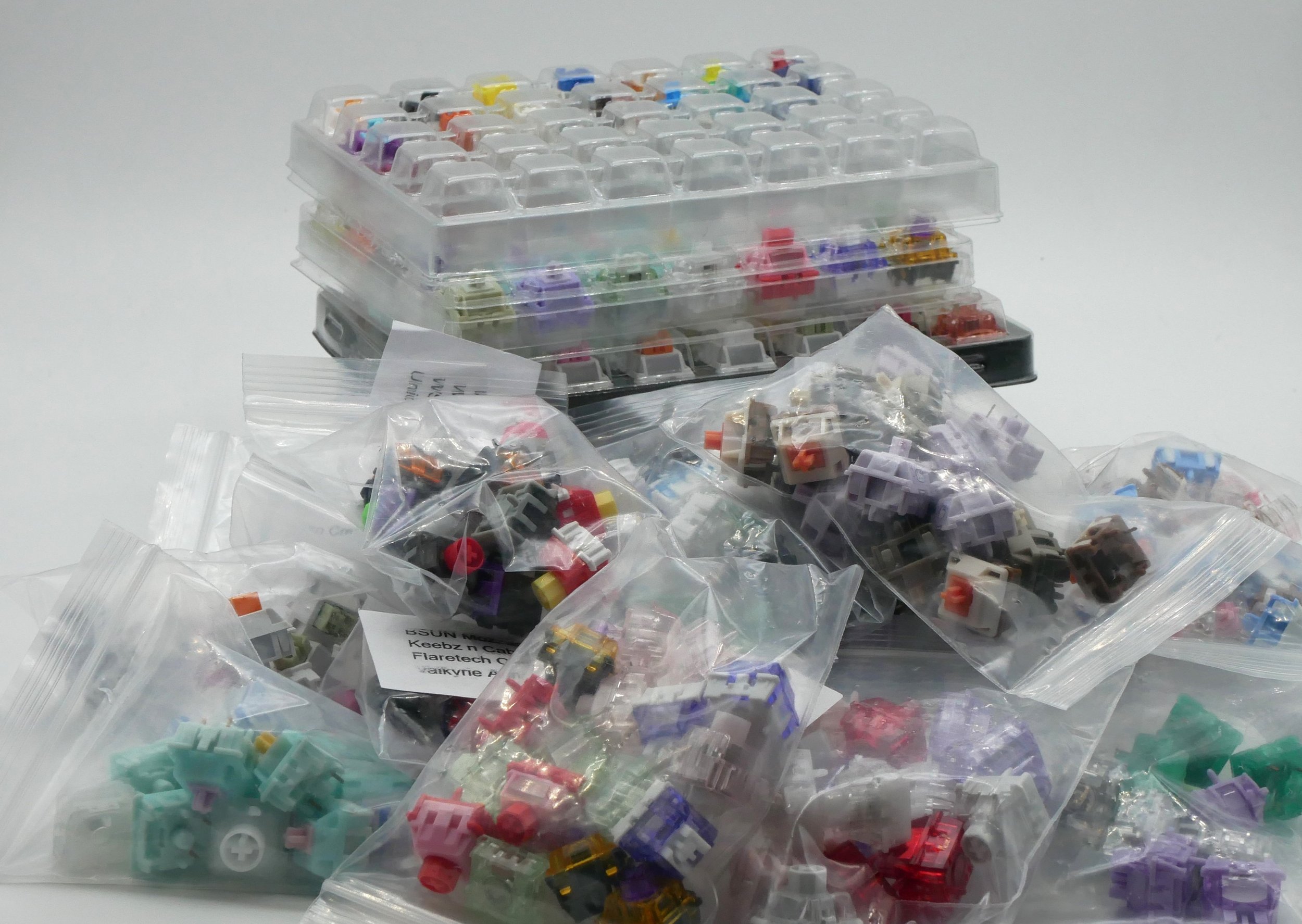
Figure 1: They were even kind enough to my label my sets for me this time around, though it's still a ton of switches to go through anyhow!
In addition to the mountain of bags that each contain 2-5 different switches that I’ve not yet measured or gone over, the trays that rise up behind that mountain are my temporary storage location for those switches to be formally catalogued and added to the over 4,250 switches in my collection – and each one of the slots in those trays is a different switch. So while I have admittedly been a bit hard to contact as of late for those of you who do regularly reach out and/or respond to my various social media posts in turn, just know that it is only because I’ve had everything happening all at once in addition to trying to make sure I pay these switches the same love and care that I’ve shown all of the other ones over the years. Please do stay tuned throughout the final leg of this year, though, as I’m hoping to work on some accessory content with the extra time off work that will really make this a great end of the year for switches!

Figure 2: Analogy #1 for the current state of my life.
Switch Background

Figure 3: Analogy #2 for the current state of my life and an accurate description of how this background section will feel.
The context surrounding the Cherry MX Emerald Reef switches and in turn the reason that they are particularly interesting switches for me to review comes in the form of an intersection of many different events happening at switches across the last couple of months. It’s an intersection of Cherry and their rapidly changing landscape of switches, the rise of involvement of an internal team within them known as C-Lab, and even me, to a not-insignificant extent. I’ll try my best to keep this as coherent as possible.
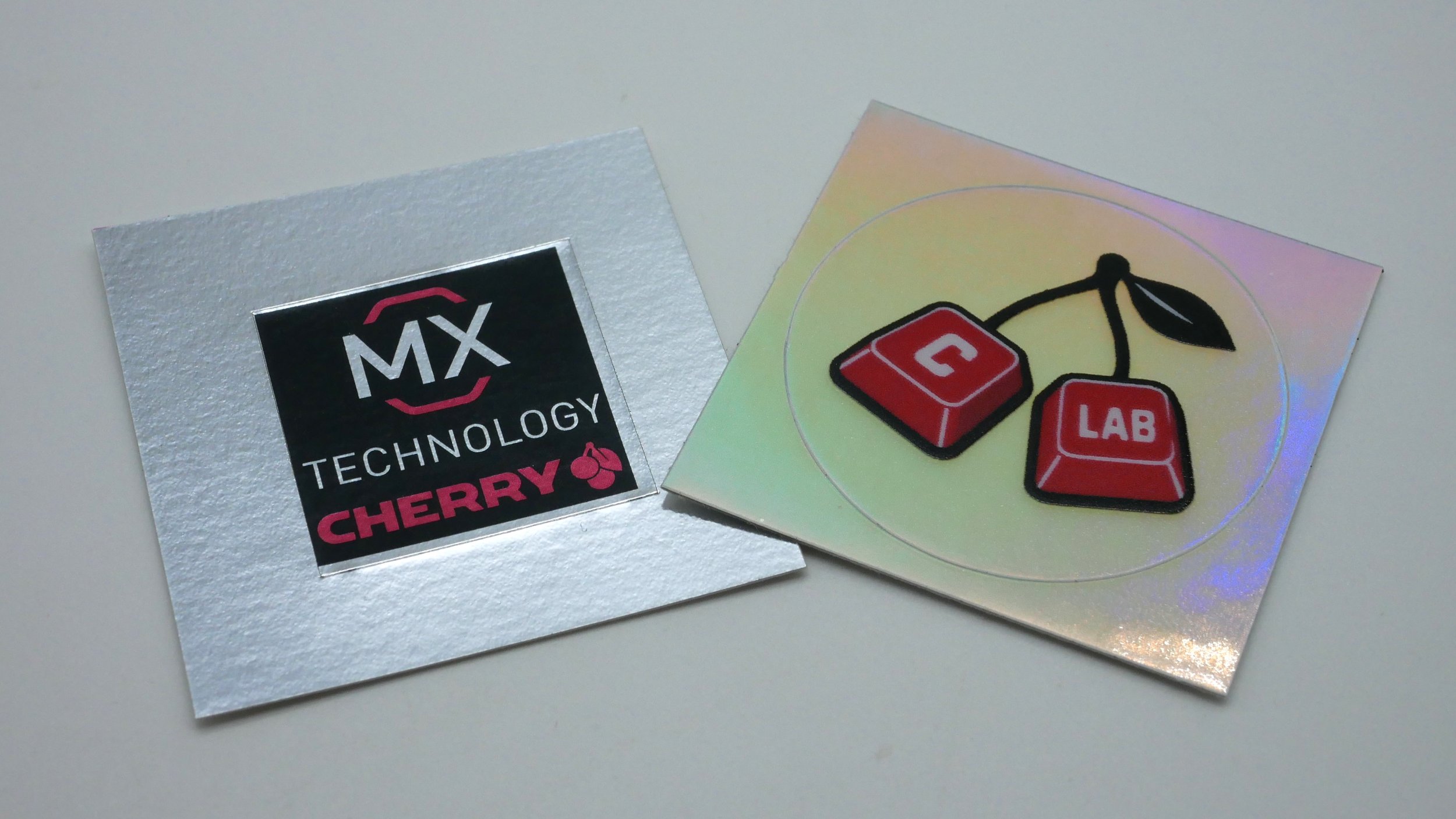
Figure 4: Stickers that accompanied my Cherry MX Emerald Reef switches showing Cherry's MX logo and the C-Lab team's logo.
While frequent readers of reviews that I’ve published here will likely recognize the ‘C-Lab’ moniker on account of me detailing their arrival in the Cherry MX Northern Lights Switch Review, I can appreciate that the audience for silent linears like the Northern Lights and silent tactiles like the Emerald Reefs may not entirely overlap. So, for those of you who are unaware, the C-Lab team is a group of individuals from within Cherry spanning a wide range of departments and levels of their org chart that coalesced together around the idea of developing their spin on a modern, Cherry-made MX style switch from scratch. Unlike more traditional design paths that Cherry has taken previously focusing virtually exclusively on OEM-grade offerings and product scale, what has made this team unique is that the majority of their members consist of genuine mechanical keyboard enthusiasts with enough of an external appreciation of the current market and interests of the community as to offer (relatively) radical design input for Cherry as a company. This has been no more evident than in the three switches that they’ve laid claim to designing in the past year since they’ve first arrived in the form of the Cherry MX Northern Lights, MX Falcons, and here in the MX Emerald Reefs – designs which stand out even amidst the more community oriented, non-OEM style offerings that the formal Cherry organization has been producing in parallel. And while this team may have started out informally as a group tossing around ideas regarding Cherry switches, it’s very evident from both the success of these switches as well as their growing footprint outside of Cherry that they are definitely formalizing themselves as a notable design team. In addition to just designing switches, those who are more connected to the switch community will have noted the rather accessible nature of the C-Lab team from Discord of all places, the current hub of the keyboard community. Staking up positions in many different servers as well as in direct messages with individuals, the C-Lab Discord members have shown a ready willingness to both clarify questions around Cherry’s new products and the unfamiliar territory that their company has moved into as well as discussing rationale for the design choices of the switches that they are producing – something which effectively has never existed from Cherry until now. This kind of forwardness and connection with the community is actually what first put me in contact with them a bit over a year ago, even before their initial active social media engagement.
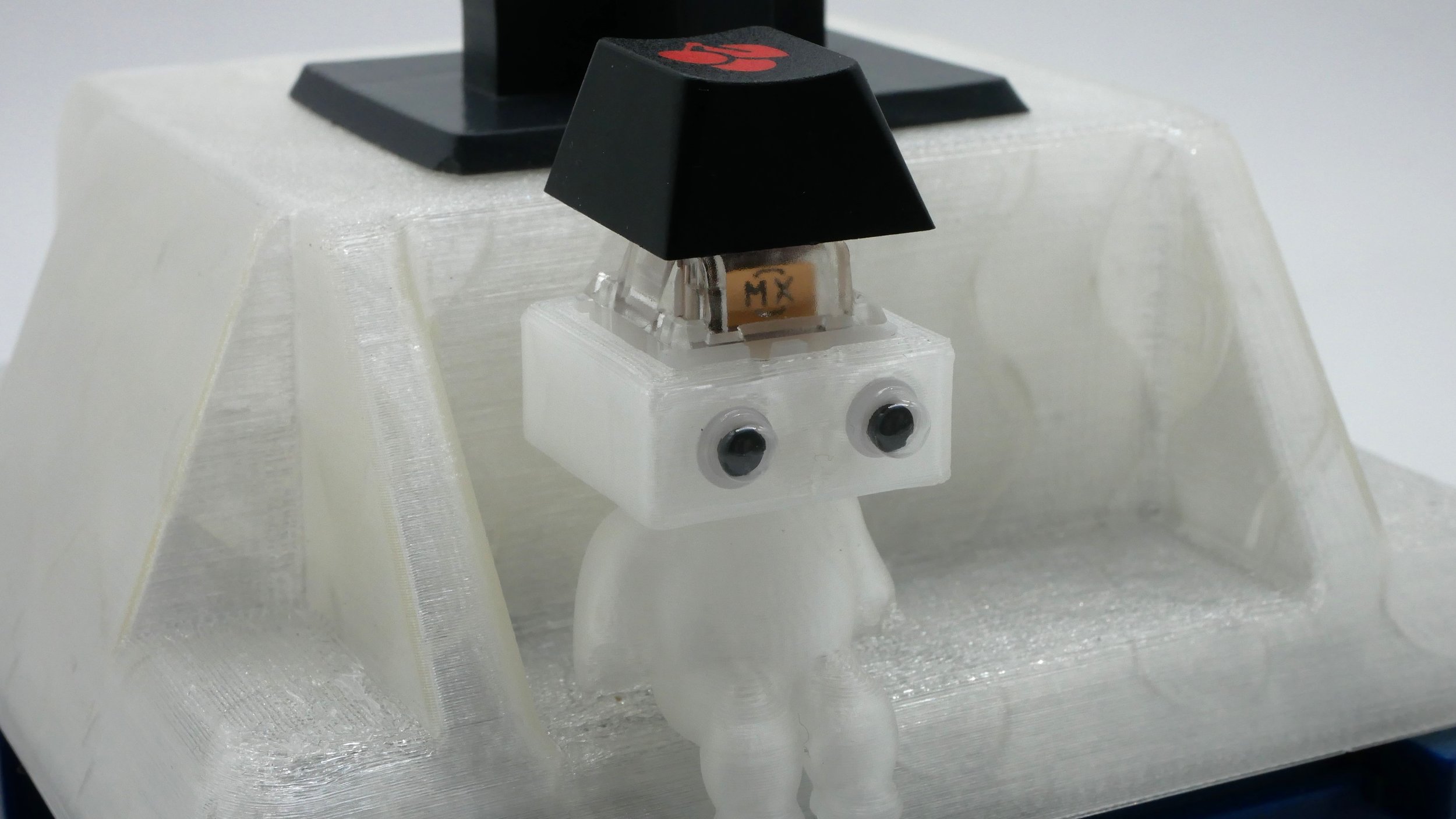
Figure 5: My first interactions with the C-Lab team technically came by way of Walter here as I uncovered him before I read their letter. Sitting at home on my keyboard shelf now I consider him to be a local-to-me extension of the C-Lab team.
As I covered in the background section of my Cherry MX Northern Light Switch Review, my first contact with Cherry’s C-Lab team is one that came about both spontaneously and prior to their presence being announced anywhere to the best of my knowledge. Without any prompting of Cherry on my behalf, I was initially greeted by a package that contained both the Cherry MX Northern Light switches as their debut release as well as a letter that introduced me to them as a team. Within it, they not only described who and what they were, but that many members of their team both read my reviews and wanted to send me the switches not as an ask for review or input, but to simply support what they thought was worthwhile content on switches. (The sheer thought of people from within a major player in the switch game like Cherry reading my reviews still feels weird for me to consider even after all these years.) While I have talked to some extent with basically every manufacturer that I’ve covered on the website here, including Cherry at various levels and to various degrees over the years, this was really the only time the statements coming from such did feel genuine and as if they did know more of my content and my opinions rather than just that I had opinions expressed in content of some form. In addition to establishing a new connection within Cherry, I was equally as excited to review the Northern Light switches as a new, comparatively alien switch designed by this team from within Cherry – something which as directly spawned a pretty fruitful back and forth between me and them behind the scenes. I’ve asked them countless questions I unfortunately can’t share here at this moment and in response they’ve sent not only answers back, but also switches in the form of these MX Emerald Reefs as well helping me secure sets of the other more custom community facing MX2A designs that Cherry has been releasing in parallel. (I should re-emphasize for the record here that the C-Lab team has been extremely explicit in all of their communications with me that I could do whatever it is that I wanted with the switches, and even to the extent that they never even mentioned the idea of my reviewing them.) And as result of all of this goodwill that they’ve shown me over the past year, I’ve returned the favor by being about as critical as ever of Cherry, including both the switches that they’ve produced at the C-Lab team level as well as a company at large. In case you don’t believe me that that is the case, and that I am slowly growing a bias in favor of them, I highly encourage you to go read my Cherry MX Lumina Brown Switch Review.
Figure 6: This was published well after I had started speaking with the C-Lab team and based on the performance of MX Lumina Brown switches that I secured of my own accord from China.
My editorial decision in mentioning my criticisms levied about the MX Lumina Brown switches, and not any of the other Cherry-made switches over the span that I’ve known the C-Lab team, is not unintentional. While the C-Lab team has privately shared their feels about my comments made across all Cherry-made content over this time frame, and considerations they were taking internally in regards to such, the MX Lumina Brown switches were actually explicitly discussed in their letter to me that accompanied the Cherry MX Emerald Reef switches – something which they were okay with me discussing with you all here. More specifically, their response addressed a wide range of my commentary from the background section regarding the confused origin of these switches, perceived lack of quality versus other recent Cherry switches, and broader considerations of the company as a whole following their manufacturing movement to China. With this feedback coming in the form of several paragraphs, and me already having enough of those in the average review, I’ll break out their response to each of these points as per their letter below:
-1. Regarding my comments about the Chinese-based manufacturer that is assisting in the production of Cherry’s switches following their reduction in force in Auerbach, the C-Lab team has explicitly said “As communicated in our press releases, we work together with a Chinese partner and producer. New production equipment was procured jointly, but to Cherry specifications. The same applies to the tooling, development, QA, optimization, and all further specifications. For the switches produced in China…they differ only where it was functionally necessary…”. While this both clearly addresses that there is a manufacturer in China that is assisting Cherry in production and not so clearly evades answering who this is, it is outright stated that this is done using Cherry-designed molds and with materials explicitly approved of by Cherry. The only deviations in designs have stated as coming about from necessities regarding manufacturing that I’m assuming are related to slight differences in injection molding machines.
-2 Regarding my comments with respect to the perceived lack of quality in the Cherry MX Lumina Brown switches, the C-Lab team described these as being a currently Chinese-exclusive OEM switch that does not meet global release standards for Cherry nor the standards established by the C-Lab team. Reading between the lines here, it seems as if the Lumina Browns (as well as the MXAA Lumina Blossoms that have been teased as additional Chinese exclusive switches) were specifically asked for by a keyboard manufacturer with a lower set of standards to keep the price of the switches cheaper and ultimately their margins on their final products higher. This is not an entirely unheard of practice in manufacturing either, for the record.
-3. Regarding my confusion as to whether switches are being produced in Auerbach, China, or some combination thereof, the C-Lab team was explicit in stating that custom, community-oriented switches such as theirs are produced in Auerbach. If the first two points, alone, didn’t elucidate that there is some clear internal standard that they are working from that was present when switches were only produced in their Auerbach facility, hopefully this point will do as much. Based on these statements, Cherry has not abandoned all production to China nor have they ceded their standards in the process. It’s furthermore evident that they view the MXAA Lumina switches which they have produced in China as entirely different part from the MX2A switches which were first produced in Auerbach on account of their differences in part numbers.
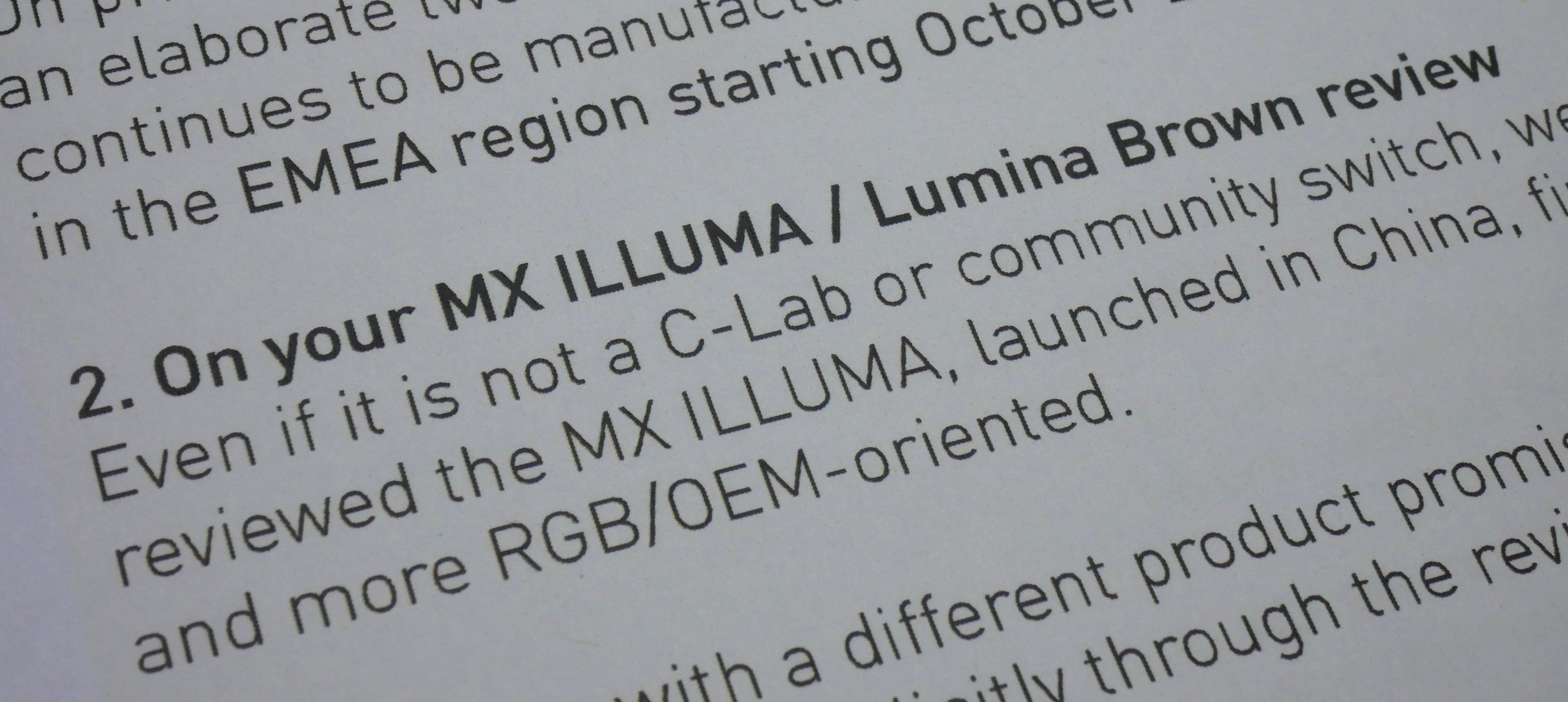
Figure 7: Seriously, they had entire section of their letter that was basically "about those things you were saying..."
So now we have Cherry’s C-Lab team, my own opinions, and their rather direct responses to my Cherry MX Lumina Brown concerns all colliding here to end up forming… the background of the Cherry MX Emerald switches. While the letter provided to me outlines the MX Emerald Reefs as being a C-Lab designed switch that have a design centered around the idea of a smoother, quieter silent tactile than what Cherry has even done recently, there’s actually a subtle detail about their design that gets lost in the margins of this letter. These are not just a direct attempt at improving the Cherry MX(2A) Honey silent tactiles that I panned rather hard (and continued to do so in comparative sections) for not being nearly as smooth or as silent as Cherry would like to market – they’re an entirely different platform. The Cherry MX Emerald Reef switches – MXAA-JCCD – are utilizing the same platform that the MX Lumina Browns were built upon. Take a minute to let that sink in, as upon realizing this fact for the first time myself in writing this section, I was admittedly a bit nervous about the performance of these switches. (Most of the time this section is written well before I even prepare notes of the performance of these switches which outline the further sections below.) The C-Lab team is not only pushing for yet another switch release, but one that is a type that is very much not in Cherry’s historical catalogue, one which Cherry as a broader company has recently struggled with, and using a new platform that has also had issues very recently as I noted before – and all of this with marketing these as smoother, quieter, and better than all of those things. Oh, and I forgot to mention that this makes these the true first worldwide, not just Chinese-exclusive OEM design of the MXAA Lumina platform. If I had any higher opinions of myself and/or grand notions about me influencing the switch market at large, I’d be inclined to think that this was the C-Lab team directly taking all of my feedback that I know they’ve read about as personal as possible and going all out to combat it, all at once, and with as large of stakes as possible. In reality, though, the marketing portion of C-Lab has made it evident to me that they have actually been trialing prototypes of these switches with attendees at meetups they’ve been to over the past several months as the back end of a year’s long (or more) development cycle internally. Furthermore, it’s not unrealistic to think that eventually the C-Lab team would utilize any new platform established by Cherry to push their designs forward. But damn, what a way to go about it all.
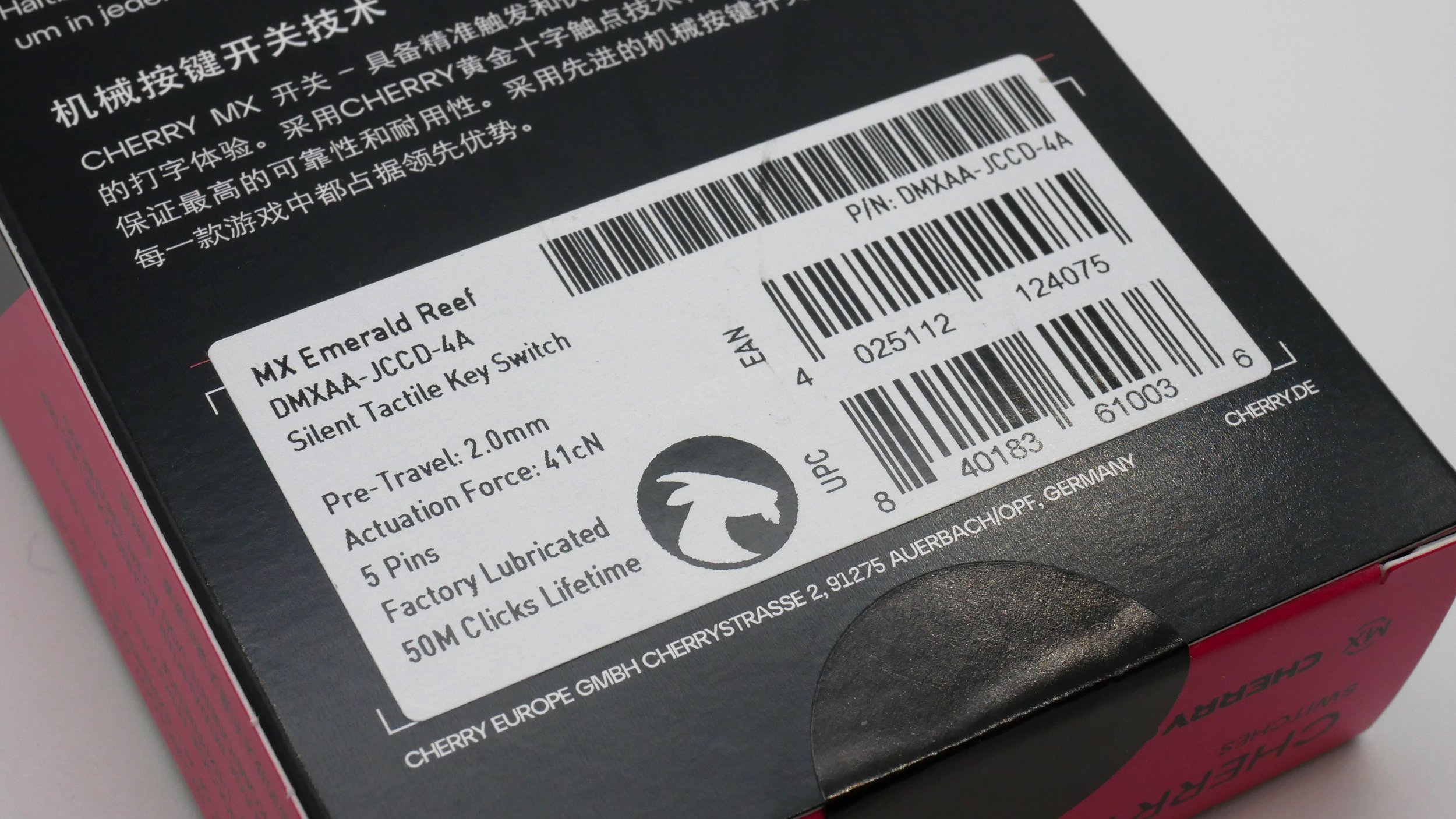
Figure 8: The fact that they printed a custom box label with my logo on it even more so feeds into my conspiratorial brian that says these switches are a direct rebuke of my opinions! (Don't worry, I did ensure with them that these switches were direct from the factory line and not specially produced for me; Just the label was.)
Described in my letter from the C-Lab team as being “a silent tactile built on the ILLUMA (Lumina) platform, but a true C-Lab switch through and through”, the Cherry MX Emerald Reefs are the latest of Cherry’s exceedingly few (read: one) silent tactiles to be released to date. Technical specifications gathered from the data sheet of the Emerald Reefs suggest that they are certainly within the bounds of normal expected switch design, featuring steel springs with a ~40 gf actuation weight, ~60 gf peak weight, and ~50 gf bottom out weight at the tail end of a slightly shortened ~3.50 mm long stroke. (As a fun note as well, as per their specification sheet these switches only operate between 10 and 70 C, or roughly 50 F to 158 F. Just something to keep in mind for those extreme environment off roading keyboard enthusiasts among us.) Beyond these specifications, though, as well as the fact that these are a first for the MXAA platform, the C-Lab team has noted in my letter that these contain both a new grease as well as a new spring for the switch – something which was decided upon through “over roughly a year of development putting it in the community’s hands at keyboard meetups to fold that feedback in”. Set to be released to the EMEA region of the world only a few weeks ago on October 22nd, no explicit price is listed though suggested that they will be similar enough to the MX Northern Lights – something which puts them on the order of ~$0.40 – 0.50 per switch as of the time of writing. As well, if they are to be marketed and sold like the MX Northern Lights, it is reasonable to assume that these will eventually disperse from the EMEA region and be available from a wide range of western facing (and eastern facing) switch vendors in the coming months.
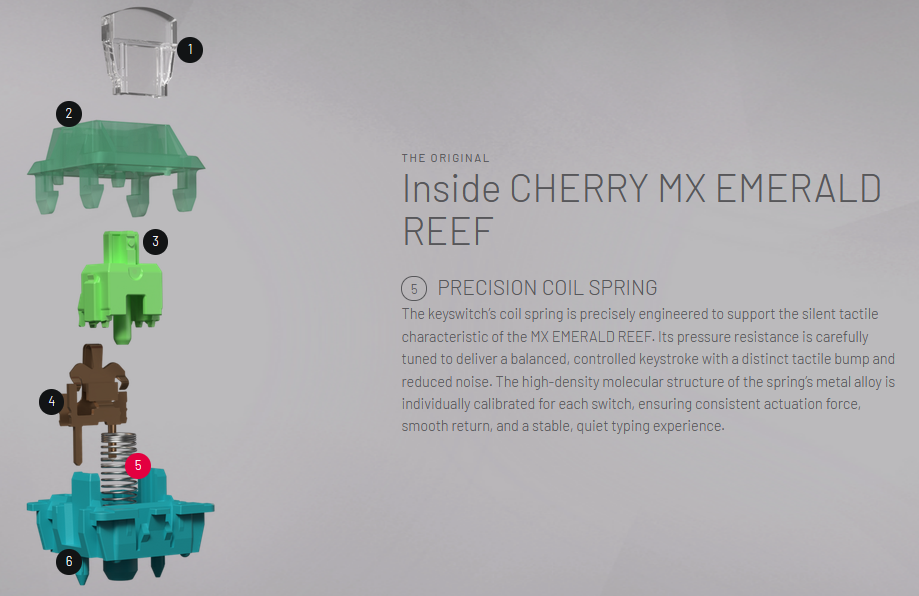
Figure 9: Render of the Cherry MX Emerald Reef switches from Cherry's own website with a small blurb regarding their new springs specifically designed for these switches.
Emerald Reef Performance
Note: Unlike how Cherry’s MX2A platform was rigorously introduced in English with descriptions and renders to highlight its core differences in design from the conventional MX platform, the MXAA (Lumina/Illuma) platform has only had one set of renders in Chinese to describe their differences as shown in my Cherry MX Lumina Brown switch review. Without a head-to-head series of descriptions in English, I may be missing some of the finer points which separate the two platforms.
Note 2: In my letter from the C-Lab team, they refer to the “Cherry MX Lumina Browns” as “Cherry MX Illuma Browns” – a difference that presumably occurred in translation of their name from chinese due to them only being a China exclusive as of the time I received them. Throughout this review I will be using “Lumina” rather than “Illuma” to stay consistent with my other documentation I’ve made on those switches.
Note 3: Don’t mind me, I’m just setting the record for the greatest number of notes I’ve ever had at the top end of this section before.
Appearance
At the highest level, the Cherry MX Emerald Reef switches come in a three-part colorway that is both notably unique amidst the thousands of switches that I’ve collected over the years and quite fitting for their name. While coral reefs naturally come in all colors of the rainbow in their natural habitats, the bright green stems of these switches stand out much like the reefs visually do themselves, with the translucent green top housings over opaque, light-blue bottom housings giving a warm, tropical vibe to the overall appearance of the switch – one that is definitely more specific to that environment than the deep, flat blues commonly seen in other ocean-themed switches. (As an additional side note, the lighter blue bottom housings of these switches actually immediately remind me of the color of one of my favorite ‘old school’ modern switch housings from the pre-pandemic era that we just don’t see anymore – Outemu Sky housings.) From a distance these may not immediately be recognizable as being from Cherry given their historical avoidance of custom-colored switches in favor of their all-black, ‘OEM-style’ housings, though up close there’s no mistaking that these are of Cherry origin as a result of their nameplates and of the modern era of Cherry at that, resultingly from their color and half-height LED diffusers. As noted above at the top of this section, while I may not be able to speak to all of the differences of the MXAA platform that the Emerald Reef switches are a part of, relative to that of the MX2A platform that other C-Lab switches have been defined upon these new switches are evidently of the MXAA platform and bear strong resemblance to the features noted in my Cherry MX Lumina Brown Switch Review. It should also be noted that this strong resemblance detailed below only further supports C-Lab’s claim above that the design is one that Cherry decided upon and ultimately obtained molds for and not a third party manufacturer, as the MX Emerald Reefs produced in Auerbach and Lumina Brown/Reds produced in China would almost certainly require different molds though appear virtually identical in platform.
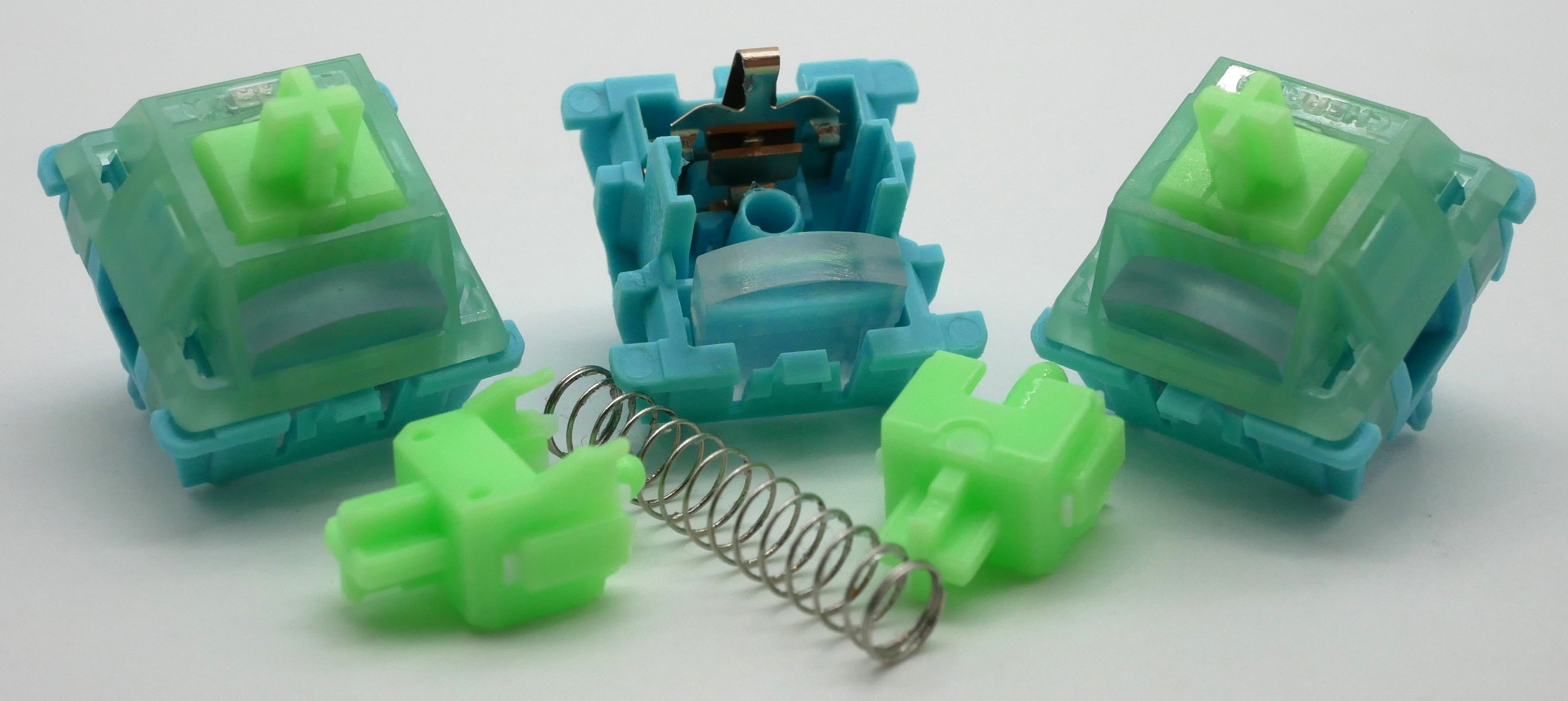
Figure 10: Cherry MX Emerald Reef switches and their components.
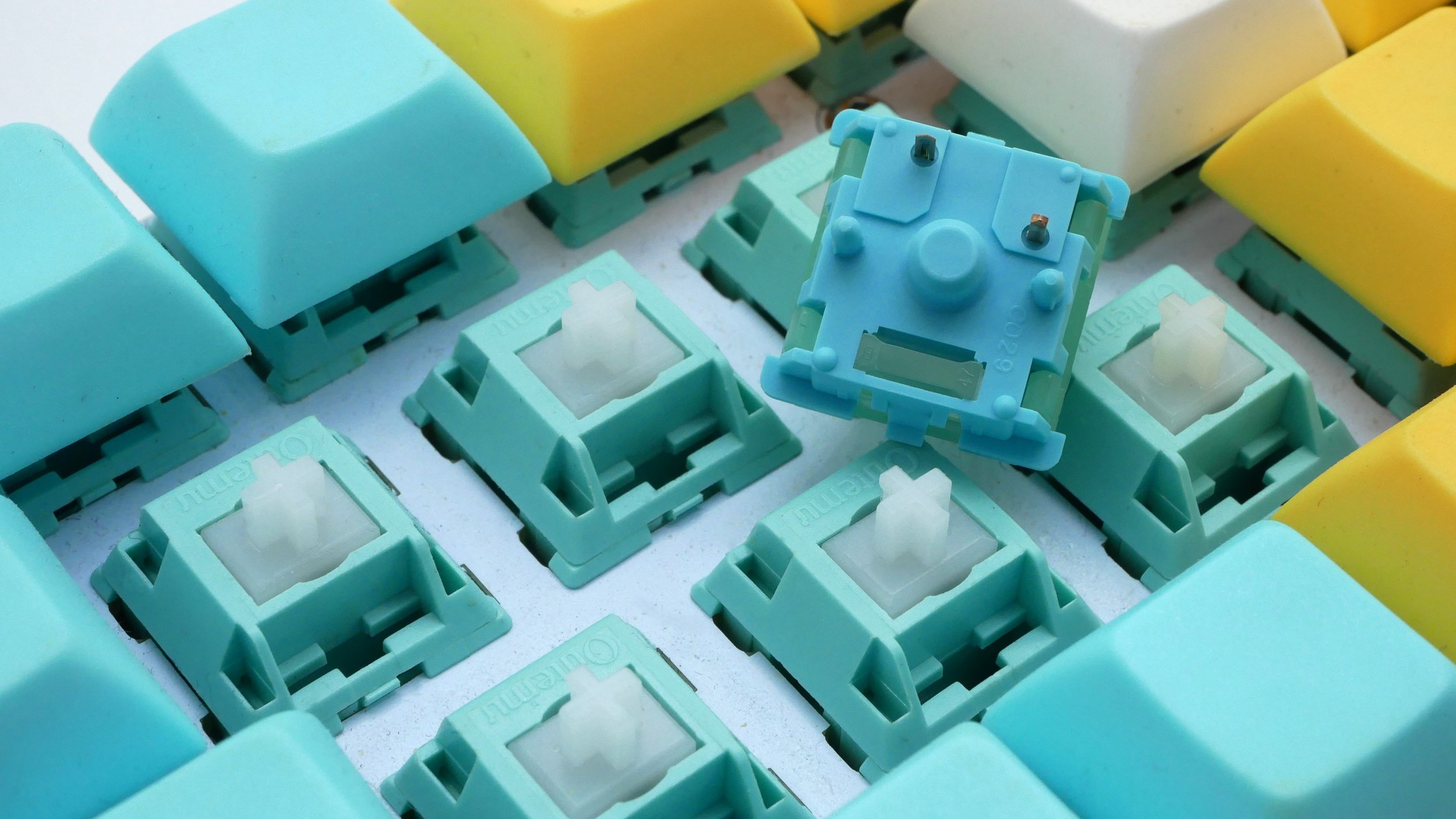
Figure 11: Okay, maybe my memory had me believing that the Outemu Sky Blue housings as being a bit more vibrant than they actually were...
Looking first to the translucent green top housings of the Cherry MX Emerald Reef switches, it is more than evident that these are of the new MXAA platform as they readily bare all of the hallmark features that I first noted in the Cherry MX Lumina Brown Switch Review. The first and most identifiable of these features, believe it or not, is that of their raised, stylized inverted nameplates atop a long, glossy rectangle in the nameplate region. While you likely assumed that I would have pointed to the half-height LED diffuser sitting the front of the switch as the most obvious note of the MXAA platform, especially on account of it being present in both the MX Lumina Brown and Red switches before them, I’m not entirely sure that this will be historically true as this review ages in time. While this is true as of the time of writing, a Chinese Cherry switch collector has informed me that Cherry intends to release a new MXAA Blossom switch into China in the relative future, though the parts described come with two different part numbers (MXAA-LCED and MXAA-LCFD) and no obvious description of the differences between them. It could be that these differences will be 3-Pin versus 5-Pin bottom housings, as Cherry has conventionally assigned switches different part numbers along these differences, though I am not discounting the possibility of non-RGB MXAA platform variants, and especially so when the MX Emerald Reef switches are described as “MXAA RGB” on their respective data sheet. Internally, the housings feature the same three details previously noted in other MXAA top housings – ‘contact balls’ located on the inner edges of the stem hole to presumably increase contact area with the bottom housing, a 4-part mold marking located on the outer, left-hand edge of the housing, and a set of reinforcing ribs underneath of the nameplate region. With the photos below doing more than enough to highlight each of these features, I do want to make a note that the ribs underneath of the nameplate region were mentioned by the C-Lab team in passing in the letter that was provided to me, suggesting that they were necessary for manufacturing purposes. To the best of my understanding of injection molding processes, this could suggest that these were required for either the specific material chosen for the housings of the MXAA platform and/or as a result of the capability of the injection molding machines and corresponding molds used. It is largely unlikely that these ribs affect the performance of the switches in any meaningful capacity.
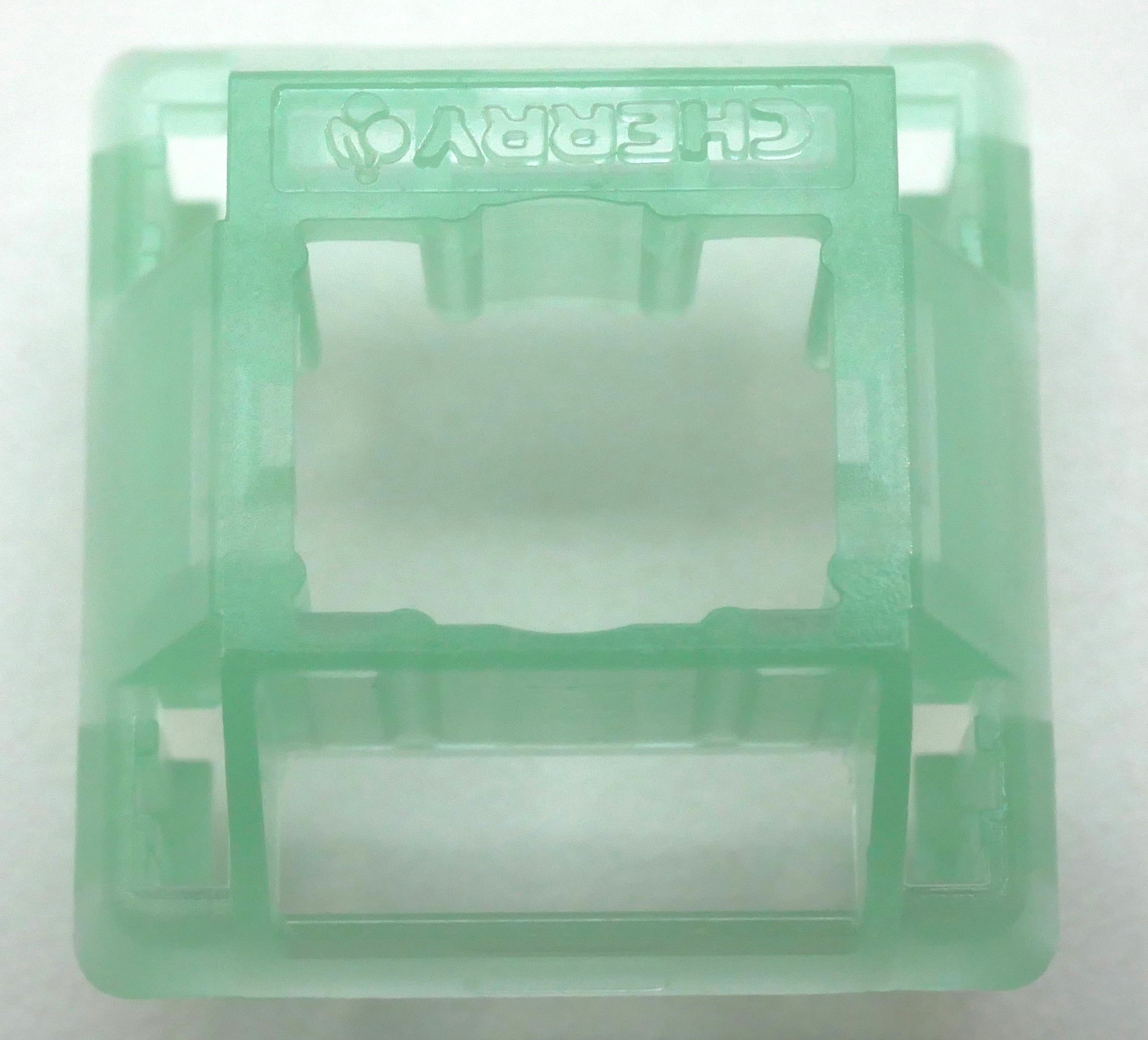
Figure 12: Top housing exterior of the Cherry MX Emerald Reef switches showing their inverted, modern logo nameplate and wide open LED slot for securing the half-height LED diffuser.
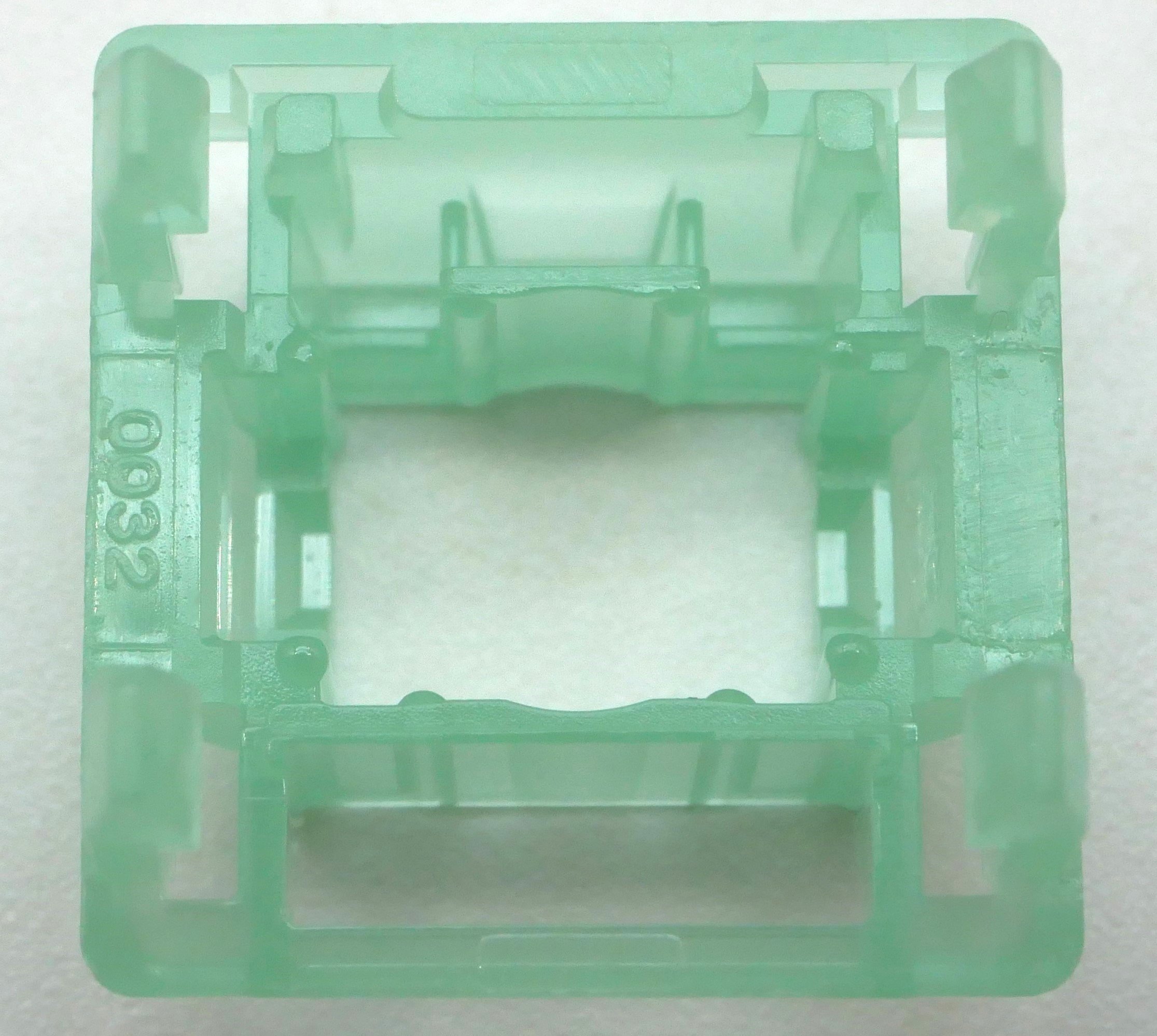
Figure 13: Top housing interior of the Cherry MX Emerald Reef switches showing similarities to other MXAA platform switches including 'contact balls' above the interior corners of the stem hole, bracing ribs underneath the nameplate regions of the housing, and a left-hand side four digit mold marking.
Looking next to the bright lime green, two-part silent tactile stems of the Cherry MX Emerald Reef switches, these too look generally identical to other stems that Cherry has produced recently, though notably those of the MX Northern Lights and MX Honeys of the MX2A platform, rather than the MXAA platform. (I do find it interesting that this poses a somewhat new challenge for Cherry with respect to their internal part numbering system as it would be the first time they’ve seemingly had parts from two different ‘platforms’ combined together.) The similarities are most evident in the form of the contrastingly white dampening pads of these stems which externally peak out of the tops and bottoms of the slider rails as well as in fingers at the bottom edges of the side walls of the stem. Flipping the stems over these white dampening pads streak upwards along the interior of the stem all the way up to their injection point on the backside of the back plate of the stems where they were injection molded into the existing green parts. The stems also feature a slightly tiered center pole, non-tapered slider rails, and all of the holes and mold ejector circles in all of the same places as the stems noted at the beginning of this paragraph. One key difference that is notable on the stems of the MX Emerald Reefs, as well, is that of a significantly thicker factory lubing application on all sides of the stems as well as their center pole which is both visually evident upon opening the switches and able to be felt while touching them. While this factory lubing doesn’t extend all the way up into the most interior part of the stem as seen in the Cherry MX Northern Light Switch Review, it is very much indicative that the comments from the C-Lab team from my initial letter received them were truly accurate and not just marketing fluff. (Not that you all would do that, per se, but you wouldn’t be the first, second, or even dozenth manufacturer to have tried that marketing twist before.) This is not an altogether unexpected design choice either given that Cherry at large has historically been noted as having switches that are uniquely scratchy – something that some manufacturers are ironically attempting to copy in the modern day and age.
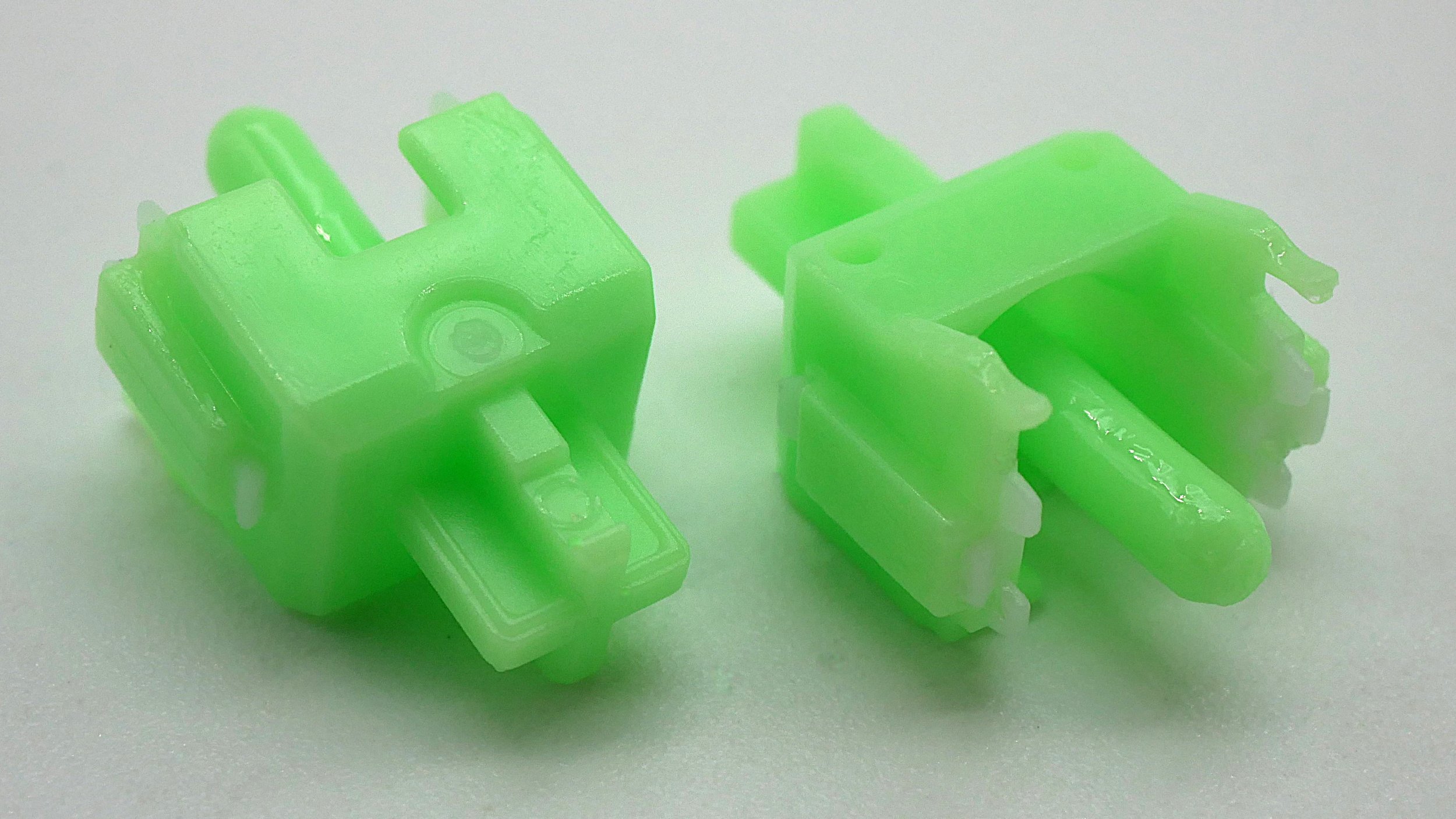
Figure 14: Front and back sides of the Cherry MX Emerald Reef stems showing their two-part stem dampening mechanism, non-tapered slider rails, and noticeable amount of factory lubing alongside other features similar to that of other MX2A silent switch stems.
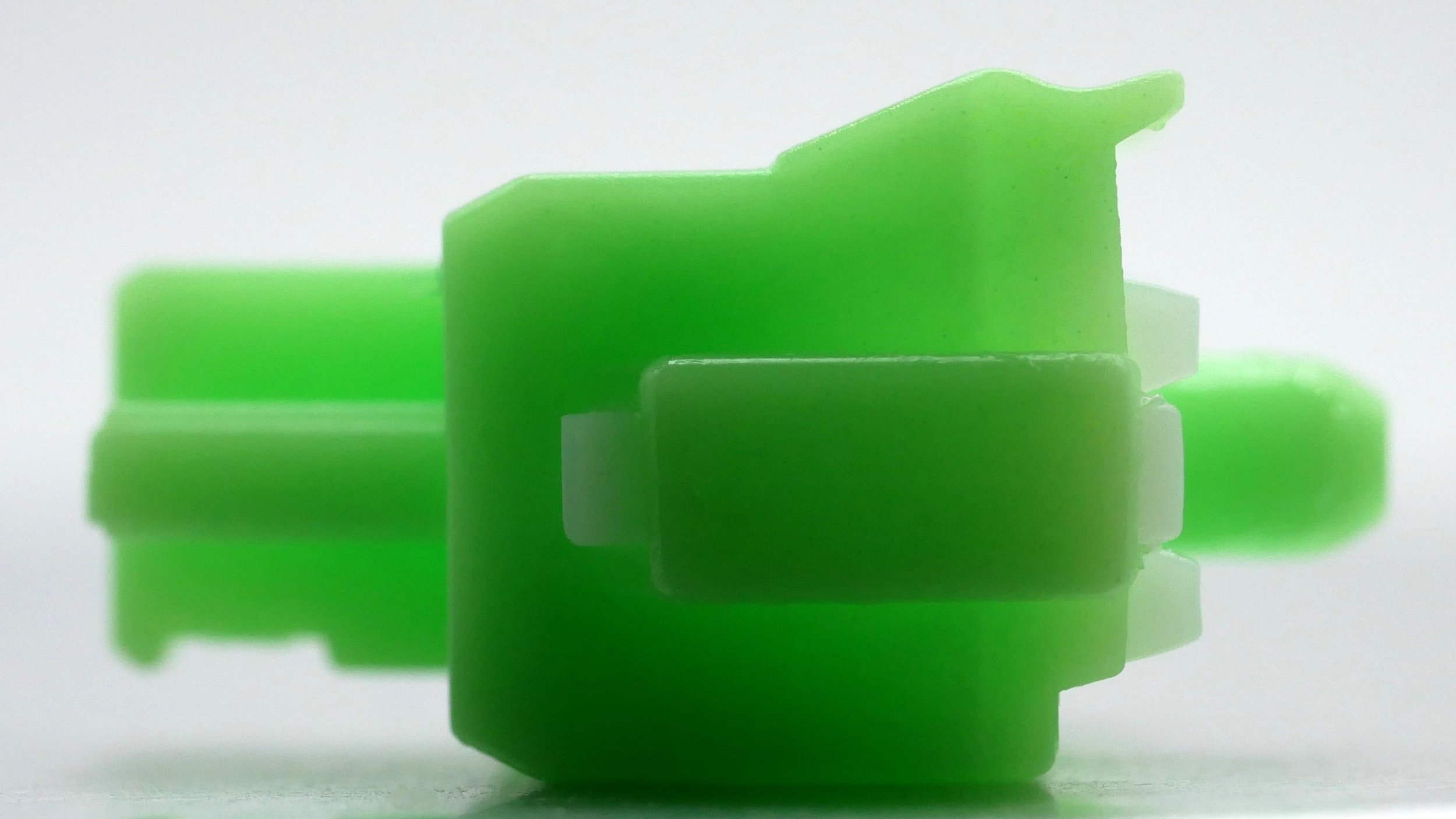
Figure 15: Side profile of the Cherry MX Emerald Reef stems emphasizing both the shape of their tactile stem legs and the dampening pads used in their silencing mechanism.
Finally arriving at the light, ocean blue bottom housings of the Cherry MX Emerald Reef switches, we’re again greeted with a whole range of features that are identical to those of the previously reviewed MXAA platform, just like the top housings. These features include, but are certainly not limited to on account of me not being the most observant, slider rails with a centered depression to reduce contact area with the stems, blocky dampening pads at the base of those slider rails, a raised ring around the center pole hole walls, and a lack of south side spring collar. One feature worth noting here is the raised fins in the bottom portion of the housing used for securing the LED diffuser rather firmly within the housing. This is a feature that is also shared by the MX Lumina Brown switches though I somehow failed to identify such during my review of them. Externally, the housings come in 5-Pin / PCB mount variety only and feature a small, rectangular LED cutout where the diffuser sits flush with when installed, rather than the more square light hole in the bottom of the MX2A platform Northern Light switches. As well, the lower right-hand corner of these housings features the same sideways, four digit mold marking as noted in other MXAA platform switches.
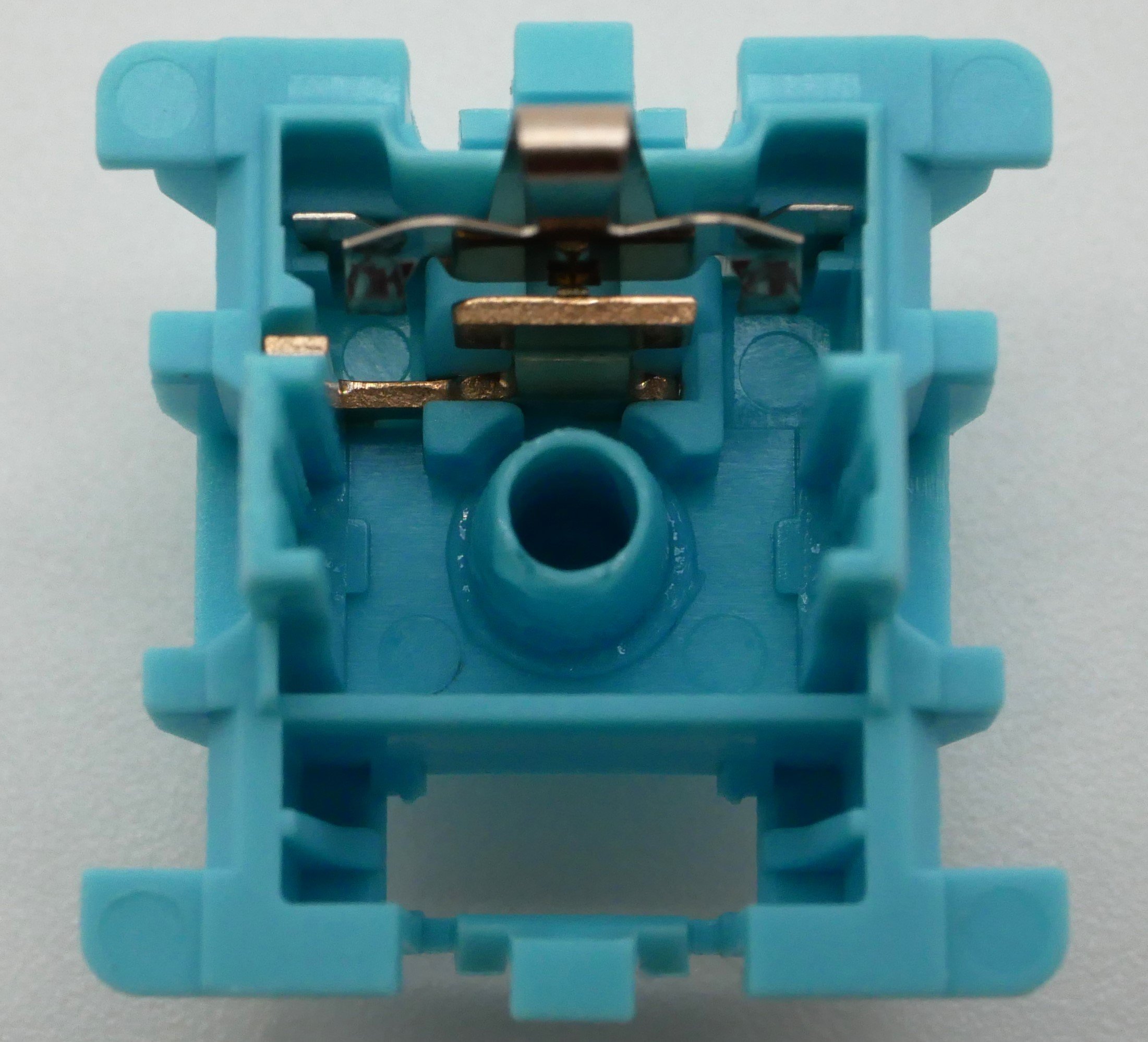
Figure 16: Bottom housing interior of the Cherry MX Emerald Reef switches showing features identical to other MXAA platform switches including a lack of south side spring collar, squared dampening pads at the base of slotted slider rails, and bracing mounts for LED diffusers in the front portion of the housing.
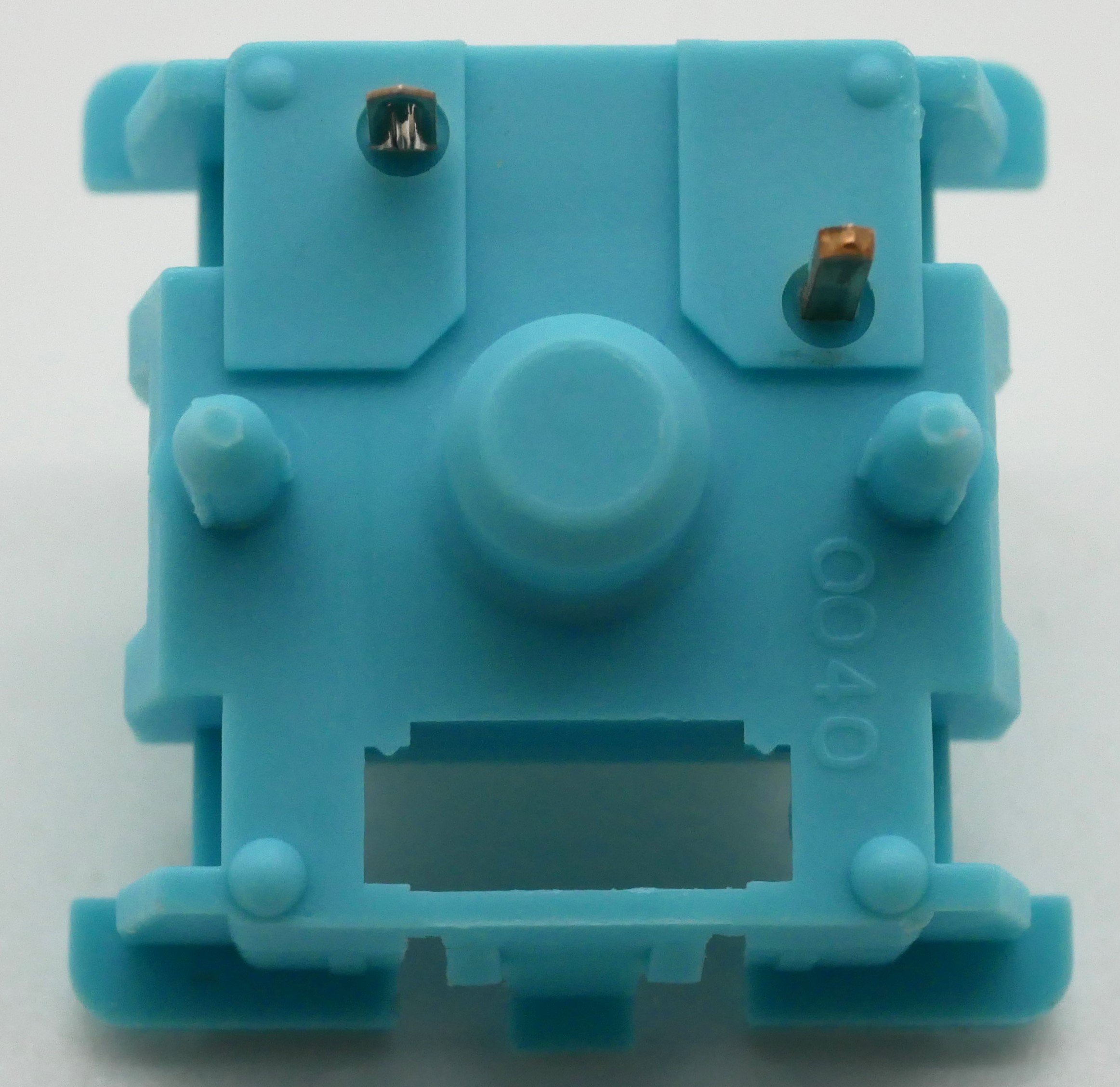
Figure 17: Bottom housing exterior of the Cherry MX Emerald Reef switches showing their PCB mounting pins and four-digit mold mold marking in lower-right hand corner like other MXAA platform switches.
Push Feel
Normally, I try and break out the push feeling section of any review into one or two paragraphs that are each centered around the key features of the switch and its performance. Relatively normal performing linear switches might only require a single paragraph for example, while silent switches of any form tend to have one for their silencing mechanism and then one for the rest of their performance. However, the Cherry MX Emerald Reefs, on account of being silent tactiles with a notable amount of marketing surrounding their smoothness and new, improved factory lubing, ultimately would require three whole paragraphs of their own. Instead of trying to find a way to interconnect each of those into into some number of paragraphs les than that, I’m just going to break them out into their own individual short sections without segues. Before we get to that, let’s start off with their force curve:
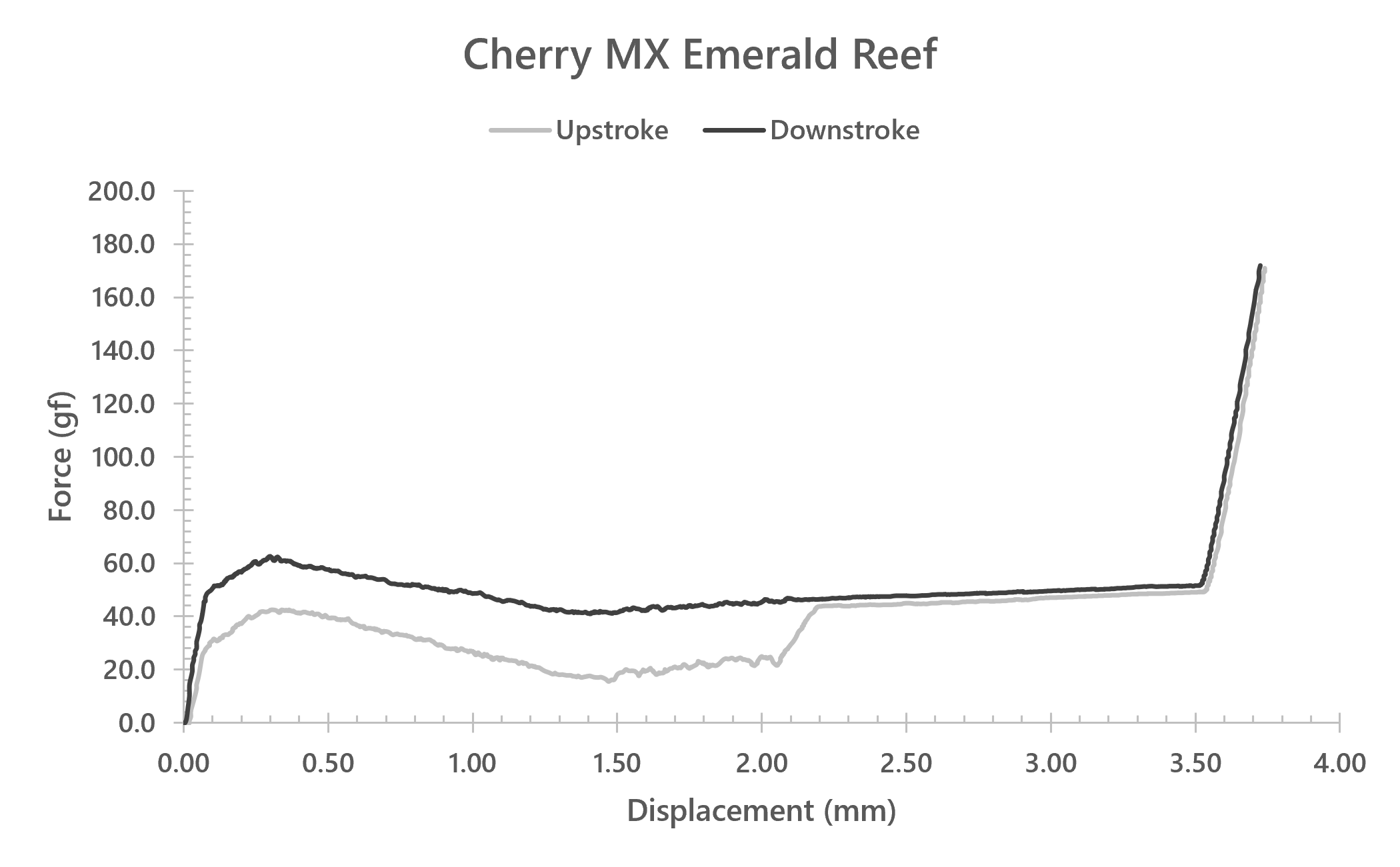
Figure 18: Force curve diagram for the stock Cherry MX Emerald Reef switch.
Tactility
Much like the actual in hand tactility of the MX Emerald Reefs, I want to start right out of the gate in stating that these are surprisingly forceful tactile switches that have absolutely no lead up to them and an effective, snappy tactile bump with a unique trailing off of its own. And while the force curve does a good job of emphasizing the first half of that sentence, it doesn’t do as well after the second comma. For one, the in-hand proximity of the tactile bump to the start of the downstroke is completely in line with the force curve above – there’s no lead in, no wind up, and a relatively straight forward increase in force that is consistently climbing over a short span of time. However, the peak force of that tactile bump does feel a fair bit stronger than what that curve size would suggest. I recognize that the roughly 10 gf difference between their starting force and peak force is by no means trivial, just looking at the shape and relative size of the curve would fool you into thinking they are lighter than what they actually feel like. What is even less obvious from the force curve, though, is that the back end of the tactile bump is also just as ‘angular’ and linear in its force progression as the first half leading up to the peak. Having an inflection point that is hard to visually notice around the 1.50 mm mark of the downstroke, the MX Emerald Reefs have an almost faint ‘echo’ of tactility as they sharply re-correct in force from the back end of that tactile bump into the post-bump linear region that heads toward bottom out. While this downward trajectory in force and subsequent re-correction isn’t nearly as immediately noticeable as the upward portion of the tactile bump nor at faster typing speeds, I suspect it does aid in giving them a slightly more pointed, aggressive feeling snappiness than tactile bumps that are more rounded. (Like Cherry MX Browns or Clears for example!)
The Silencing Mechanism
Given the sheer similarity in design of the dampening mechanism used in the MX Emerald Reef switches as compared to those of the MX Northern Light switches, there’s likely no surprise here that the housing collisions of these switches just feel about the same as the MX Northern Lights. For those of you who didn’t read that review, the high level summary is that these mechanisms generally feel as if they straddle the mid-line between the performance of conventional, soft and squishy dampening pad mechanisms and the more new age, refined variants that have come about in recent years. For one, you can still tell that these switches are dampened using softer materials on the tops and bottoms of their slider rails, though only because they are slightly compressive at the housing collisions, and not overly gummy nor squishy like their predecessors. As well, this gives their housing collisions a little more solidness, leading to a more balanced, generally firm feeling with only a bit of soft fuzziness that underlies them and gives the switch an overall more insular feeling.
The Factory Lubing
Perhaps the most surprising feature of the push feeling performance of these switches to those of you who will pick up a set to try is just how notably smooth they feel relative to your assumed expectations of a Cherry-made switch. In fact I think the C-Lab team should have only further highlighted their efforts surrounding the improvement of the factory lubing with community input as it is beyond evident that effort was taken in doing such. The Cherry MX Emerald Reefs have both none of the scratchiness that is endemic to historical and even more modern MX platforms like MX2A as well as none of the stickiness that was noted in the C-Lab lead MX Northern Lights switches. That being said, though, there is still one issue with the factory lubing in these switches that prevents them from being overwhelmingly impressive with respect to this metric – and it’s the same thing that hurt the Wingtree x LICHICX Pumpkins in the last review: the factory lube present at the intersection of the stem legs and leaves. Stronger tactile switches such as these want to interact with the leaves within their switches in a way that is more harsh than not, often to the point of naturally producing sound as result. Counter to this direction, silent tactiles want to be silent, and in turn are often lubed at this point to try and dampen or altogether mitigate this sound. The collision of these two conflicting design aims tends to result in tactile bumps that have a feeling throughout their bump that could be described as either ‘sandy’ or with a fine grain scratch. Unfortunately, the Cherry MX Emerald Reefs don’t defy this trend and land the C-Lab team in the same bucket as really all other manufacturers who have attempted such to date. In fact, I’m becoming more convinced with time that this is more so a feature of heavy strength silent tactile switches rather than a bug with their performance.
Sound
With my own personal bar for Cherry’s silent tactiles being set quite low on account of the performance of the Cherry MX2A Honey switches, I was initially taken aback by the overall lack of sound present in these switches. That being said, the less involved or switch-experienced among you all reading this may be less impressed and more so simply okay with it, feeling they more or less follow your expectations of modern switches and not having survived the eras prior to the way things are now. Dare I say you could even potentially be happy with this, overall. Generally speaking, the Cherry MX Emerald Reef switches are on the quieter side, featuring only the tiniest bit of sound that is concentrated at the point of their tactile bump in the form of a quiet, subtle shuffling sound. The housing collisions are effectively unnoticeable to the ear behind in the shadow of this shuffling tactile bump noise and if anything only add on a bassier undertone that subtly outlines the rest of the sound of these switches. This also combines with the bottom out feeling above to further reinforce that well-constructed, solid, and insular feeling that the MX Emerald Reefs have. Contextually, the sound of these switches is more on part with what any other manufacturer would be producing in a silent tactile these days (perhaps with the exception of Wingtree on account of owning LICHICX’s old molds), and while that may feel like a bit of a mean comparison to make towards the C-Lab team’s efforts, it is a notable point of reference that Cherry at large simply hasn’t lived up to with quite a few of their releases as of late – especially the other switches within the MXAA platform. (Yes I know they were produced to a different standard!) There is one outlier in the sound profile of these switches that should be noted though in that roughly 10% of the switches I received in my batch had some form of temporary spring and/or leaf ping out of the box that faded quite quickly just through my in hand testing and messing around with the switches. I suspect this may just be factory lubing finally settling into its final resting places within the switch, so I wouldn’t be alarmed if you immediately encounter this upon opening your box of switches. I also wouldn’t run off to the switch break in machine either if you are alarmed by such.
Wobble
With both the sound profile and the factory lubing of the Cherry MX Emerald Reefs already showing quite a bit of growth and change for Cherry as a manufacturer (as well as efforts paid off by the C-Lab team), perhaps the most astonishing feature of these switches is the sheer lack of stem wobble that they have. With only the faintest sliver of give in the E/W direction, there is virtually no stem wobble elsewhere in the MX Emerald Reefs that anyone could even pretend to be concerned about. You can’t complain about this performance and if you do then you’re even more pedantic and annoying than I am. I would never have anticipated this level of mold precision from any Cherry-made switch ever, much less one that is built on the back of an MXAA platform that my only prior experience with has led me to believe it to be beyond acceptably wobbly. This is genuinely one of the largest gaps that I’ve ever encountered between my own internal expectations and the actual reality of a switch or its features before.
Measurements
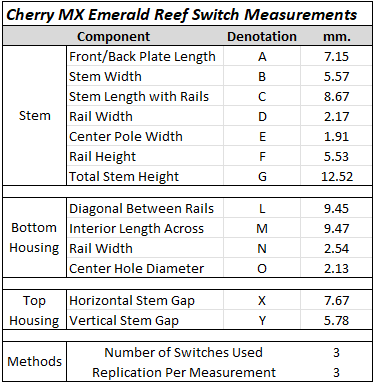
If you’re into this level of detail about your switches, you should know that I have a switch measurement sheet that logs all of this data, as well as many other cool features which can be found under the ‘Archive’ tab at the top of this page or by clicking on the card above. Known as the ‘Measurement Sheet’, this sheet typically gets updated weekly and aims to take physical measurements of various switch components to compare mold designs on a brand-by-brand basis as well as provide a rough frankenswitching estimation sheet for combining various stems and top housings.
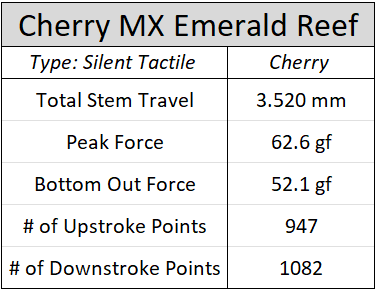
Figure 20: Numerical details regarding the force curve for the Cherry MX Emerald Reef switches.
Have you ever wanted to be bombarded with more switch data than you’ve ever seen at any point in your life before? Consider checking out the ‘Force Curve Repository’ hosted on my GitHub that contains all force curves that I take both within and outside of these full-length reviews. In addition to having these graphs above, I have various other versions of the graphs, raw data, and my processed data all available for over 2000 different switches for you to use however you see fit. Check it out via the ‘Archive’ tab at the top of this page or by clicking any of the force curve cards above.
Break In
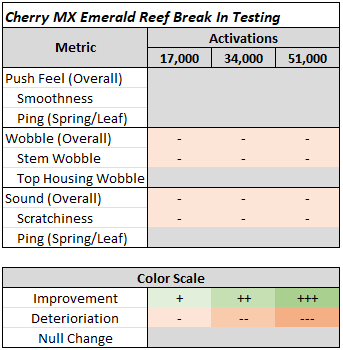
Break In Notes
17,000 Actuations
- After 17,000 actuations, the Cherry MX Emerald Reefs show a very slight increase in both N/S and E/W direction stem wobble, though to such a small degree that most users would still struggle to have an issue with such in hand. As you can also see from the break in card above, this is also the only budging on this metric throughout the entire break in process as well.
- In addition to changing stem wobble, there was a slight change in the sound profile of these switches, and more narrowly with respect to their stem/leaf interaction point. While the stock switches were already a bit scratchy through this point, they did somewhat increase in scratchiness and ever so slightly in volume as a result of this break in testing.
34,000 Actuations
- Despite there not being an evident change in the scoring of the sound profile of the Cherry MX Emerald Reefs broken in to 34,000 actuations as compared to their 17,000 actuation counterparts, there was a shift from one stage to the next in how they sounded. As compared to the slightly scratchier sound of the 17,000 actuation batch, the 34,000 actuation batch was a bit more snappy and almost, to a small degree had a bit of squishiness to their tone as a presumable result of factory lube moving around.
51,000 Actuations
- Strangely enough, the 51,000 actuation batch of Cherry MX Emerald Reefs also change, yet again, from their 34,000 actuation batch and revert back to the slightly louder, brighter, and scratchier notes noted in the 17,000 actuation batch. While this is very directly suggestive of factory lube migration in these switches throughout the break in process, part of me wonders if the differences between each batch of broken in switches is actually more representative of the spread of sound profiles that one could be confronted with as a result of breaking in these switches rather than a singular progression.
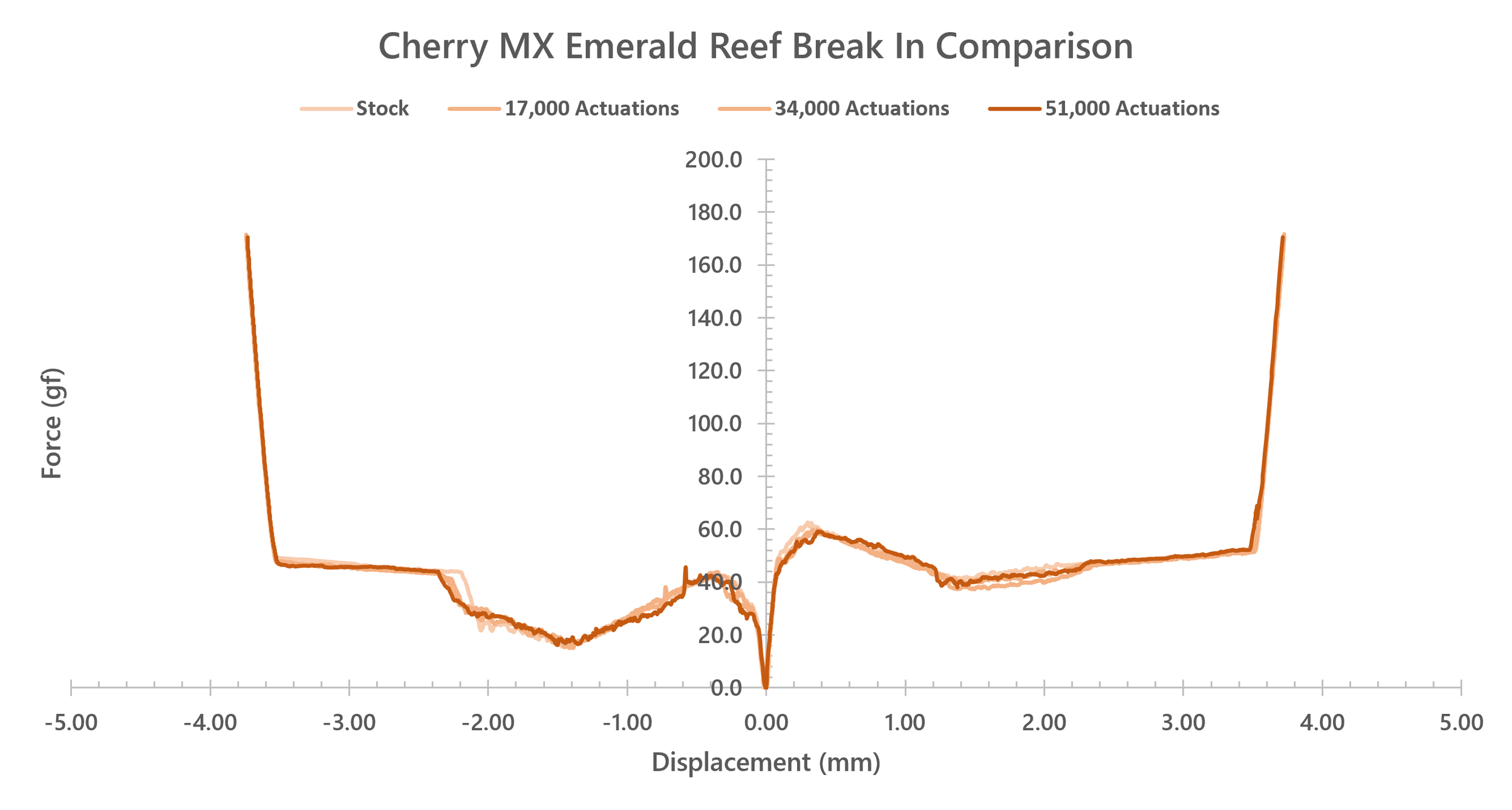
Figure 22: Comparative force curve diagram showing no substantial, consistent change in the force curves of the Cherry MX Emerald switches throughout the break in process.
Comparison Notes to Other Notable Silent Tactile Switches
Note – These are not aimed at being comprehensive comparisons between all factors of these switches as this would simply be too long for this writeup. These are little notes of interest I generated when comparing these switches to the Cherry MX Emerald Reef switches side by side.
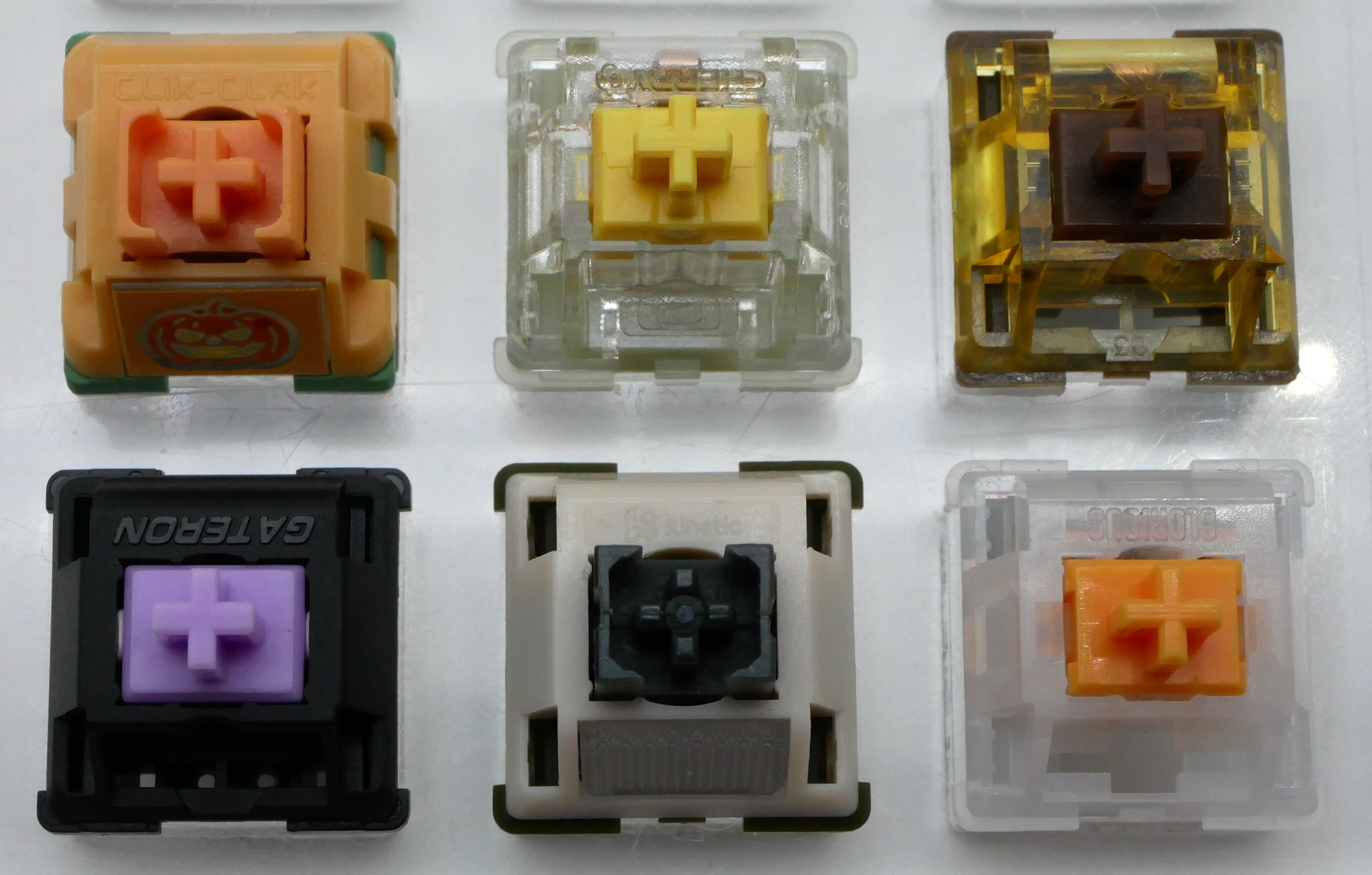
Figure 23: Switches for comparison. (L-R, Top-Bot: Wingtree x LICHICX Pumpkin, Cherry MX Honey, KTT ZenCha, Gateron Oil King Silent Tactile, Kinetic Labs Turtle, and Glorious Panda Silent)
Wingtree x LICHICX Pumpkin
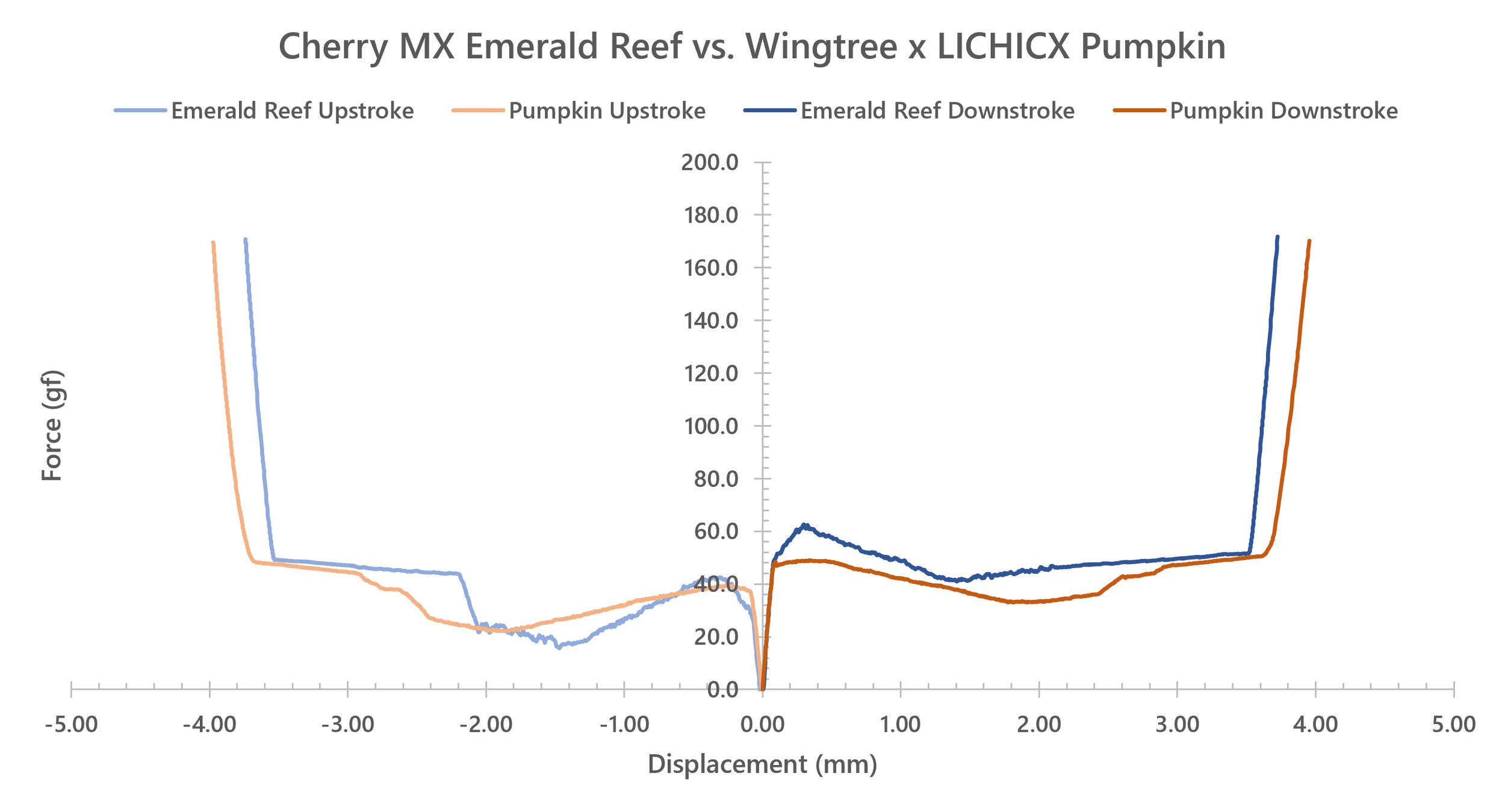
- Much like how the force curve for the Cherry MX Emerald switches on their won is a bit deceiving as to their strength, I feel like the comparative force curve between these two switches below is also deceiving. Yes, the Wingtree x LICHICX Pumpkin switches do feel a bit less strong through their tactile bumps, though not nearly to the degree that the gap would suggest.
- The Cherry MX Emerald Reef switches are far and away better than the Pumpkins with respect to both their N/S and E/W direction stem wobble.
- While both the Pumpkin and Emerald Reef switches suffer a bit from the strong silent tactile paradox in that they both have stem leg/leaf noise on account of how relatively strong they are, this noise is just the tiniest bit more noticeable in the Emerald Reefs than in the Pumpkins.
Cherry MX Honey
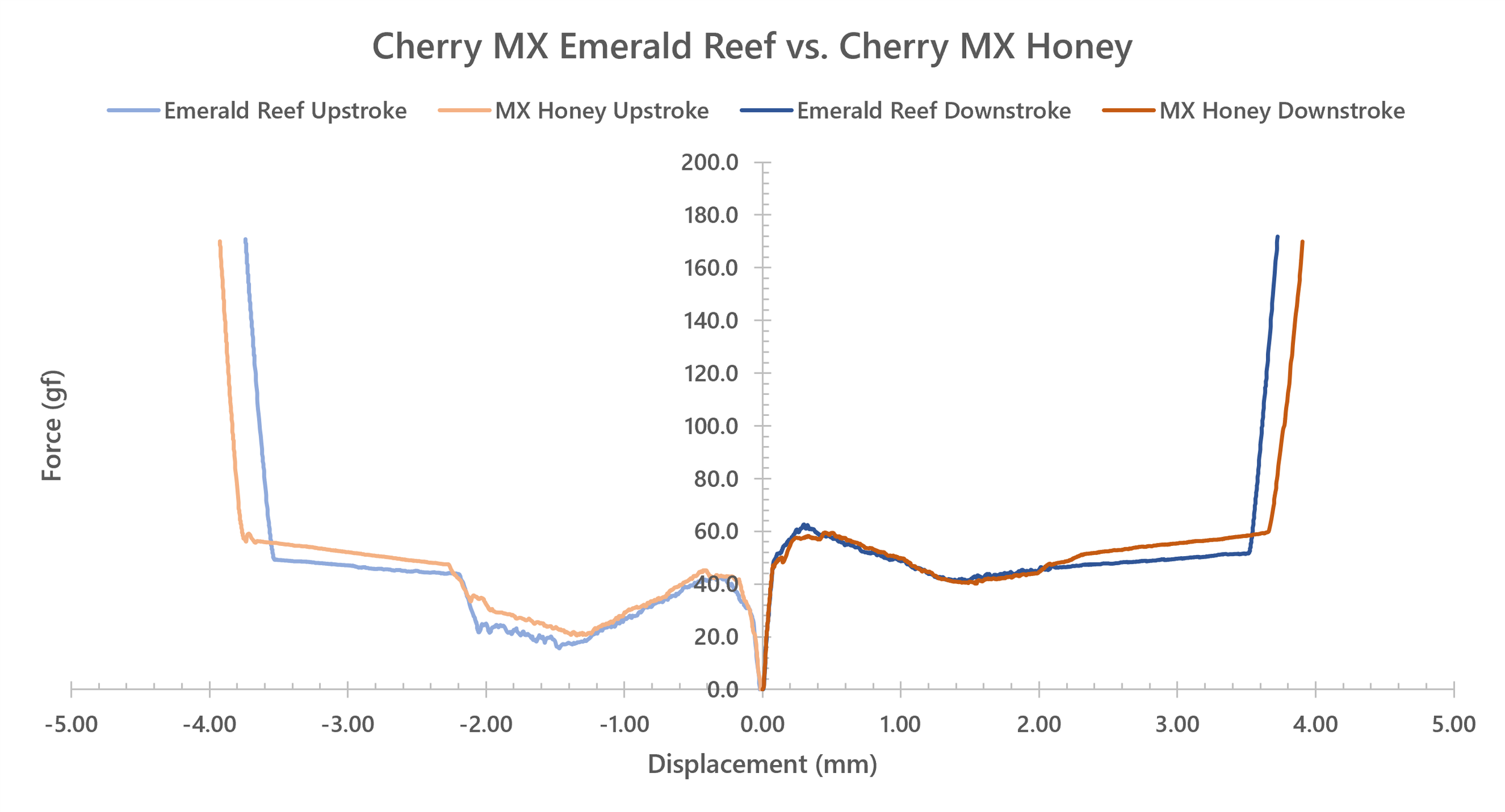
- The difference in the sound profiles between these two switches is about as far apart as I’ve seen from one manufacturer in such a relatively short span of time. None of the grainy, sandpapery notes nor the plasticky tones at housing collisions nor even the snappiness through the tactile bumps of the Cherry MX Honeys is noted anywhere in the sound profiles of the Cherry MX Emerald Reefs – and even the broken in ones too, for that matter.
- In addition to being better than the MX Honeys with respect to their sound profiles, the MX Emerald Reefs also have demonstrably better tolerances and in turn several points less them wobble.
- With the comparative force curve between these two switches below being so noticeably similar, the biggest difference in performance between these two switches comes down to two factors – the MXAA platform a tiny bit for the improved tolerances and the C-Lab team’s efforts in developing/selecting a new factory lube to a very large degree.
KTT ZenCha
- Even with the KTT ZenCha switches having shockingly little stem wobble for a relatively throw away, one-off offering by KTT, they still aren’t nearly as good with respect to this metric than the Cherry MX Emerald Reefs.
- The KTT ZenCha switches suffer from sounds in all the wrong places of a silent tactile switch with both their housing collisions and strokes being quite loud and scratchy at normal typing speeds and even more so at elevated ones. The MX Emerald Reefs, however, just simply don’t have these issues and remain relatively steadfast in their sound across typing speeds as well.
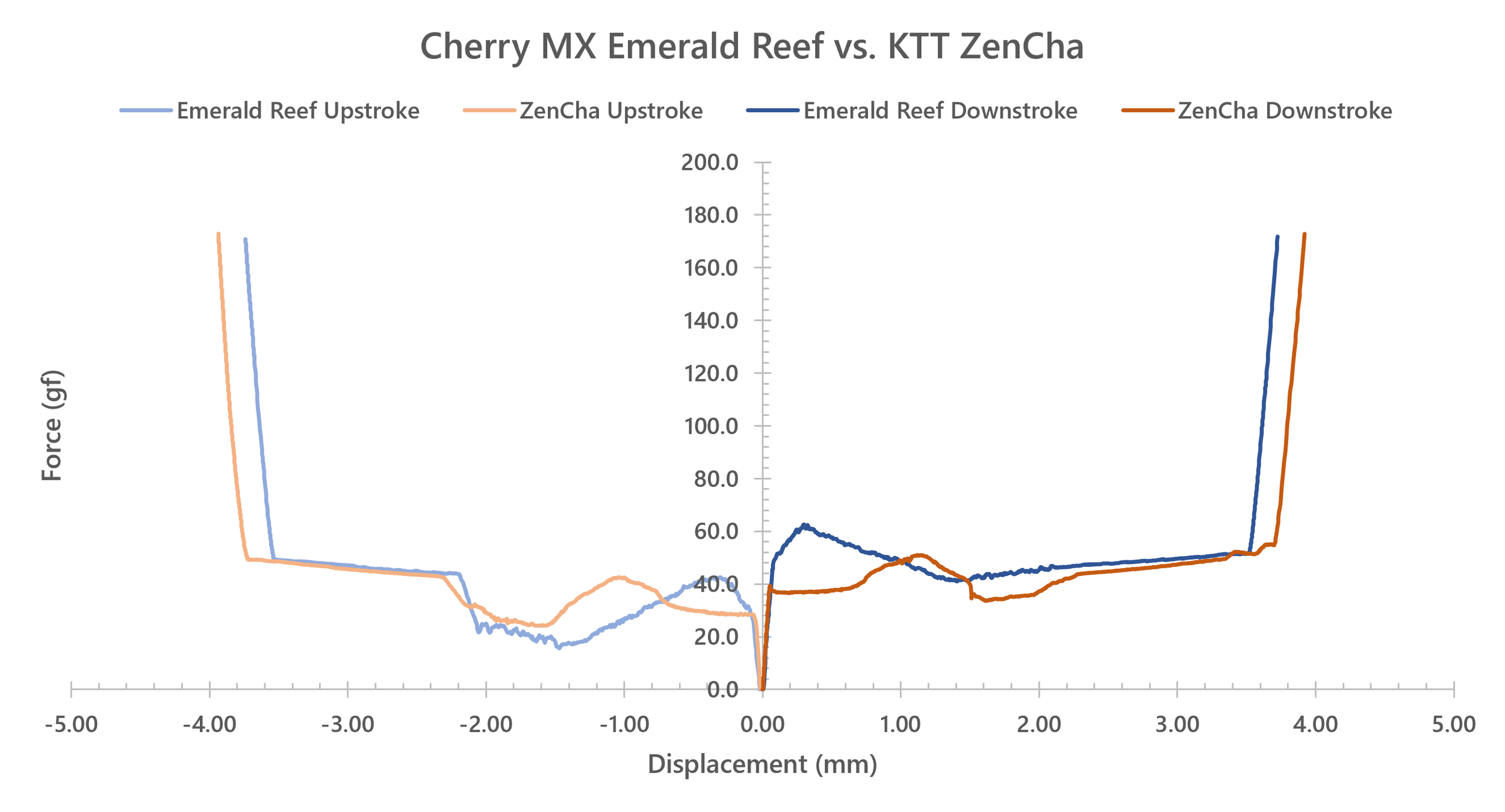
- Overall, the factory lubing on the Cherry MX Emerald Reef switches is a lot better than that of the KTT ZenCha switches and produce an overall smoother switch, even if they are a little bit more textured through their tactile bump on account of its stronger force than the ZenChas.
Gateron Oil King Silent Tactile
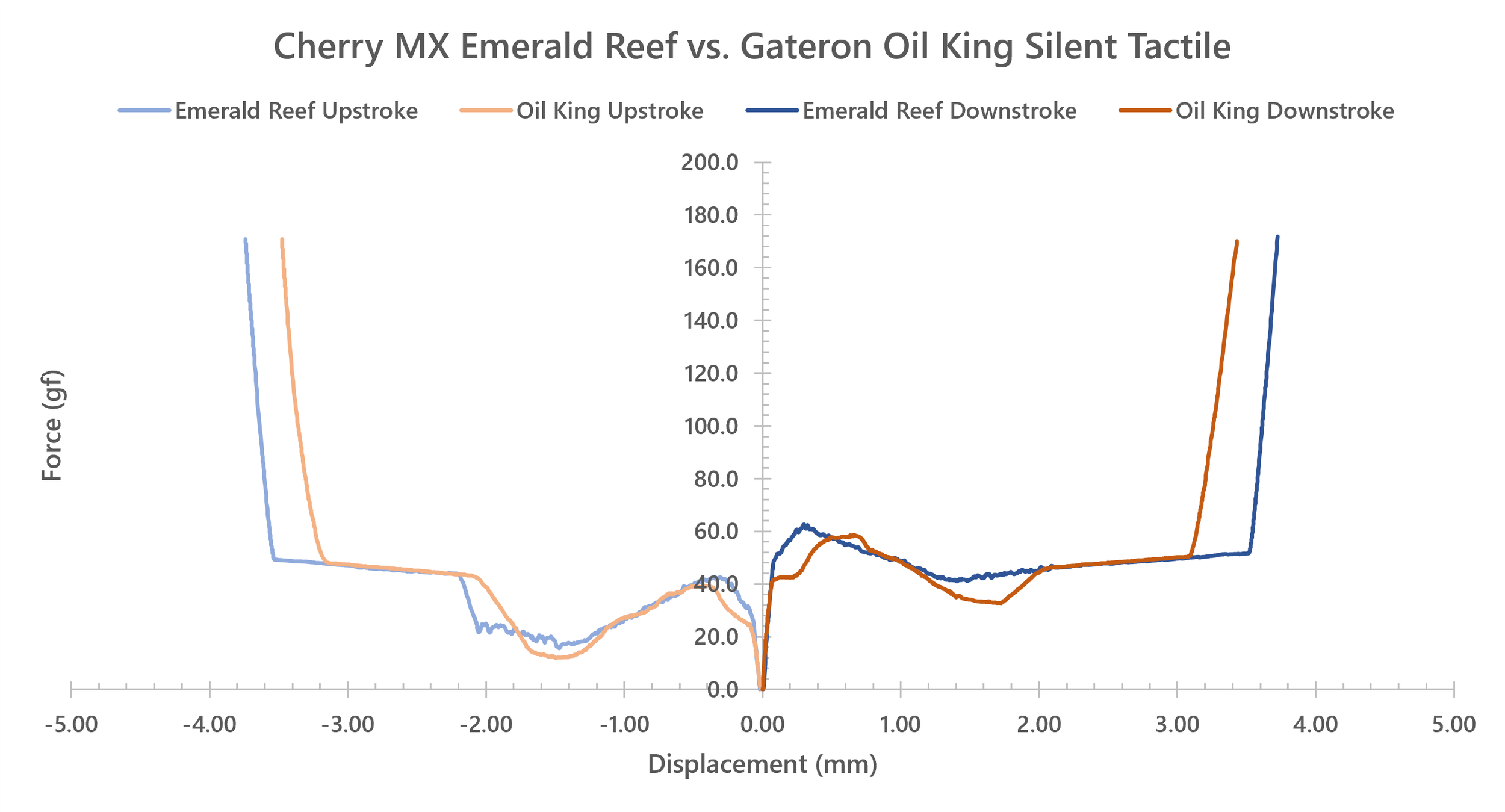
- While both the Gateron Oil King Silent Tactiles and the Cherry MX Emerald Reef switches suffer a tiny bit from scratchiness through their stroke (for fairly different reasons, I should note), the Oil King switches are significantly worse in their overall sound profile as a result of the conventional gumminess that is found at their bottom out as a result of their more conventional stem designs.
- Even with the Gateron Oil King Silent Tactiles having a slight amount of N/S and E/W direction stem wobble, they still are more wobbly than the Cherry MX Emerald Reef switches.
- Despite me very rarely doing contextual comparisons between switches, these two are about as diametrically opposed as one could conceivably get. While the Gateron Oil King Silent Tactiles come across as a low effort cash grab trying to revive a popular platform without paying any homage to where it came from, the efforts by the C-Lab team are very clearly trying to push Cherry forward while directly improving upon issues noted in both their MXAA platform and previous silent tactile at the same time.
Kinetic Labs Turtle
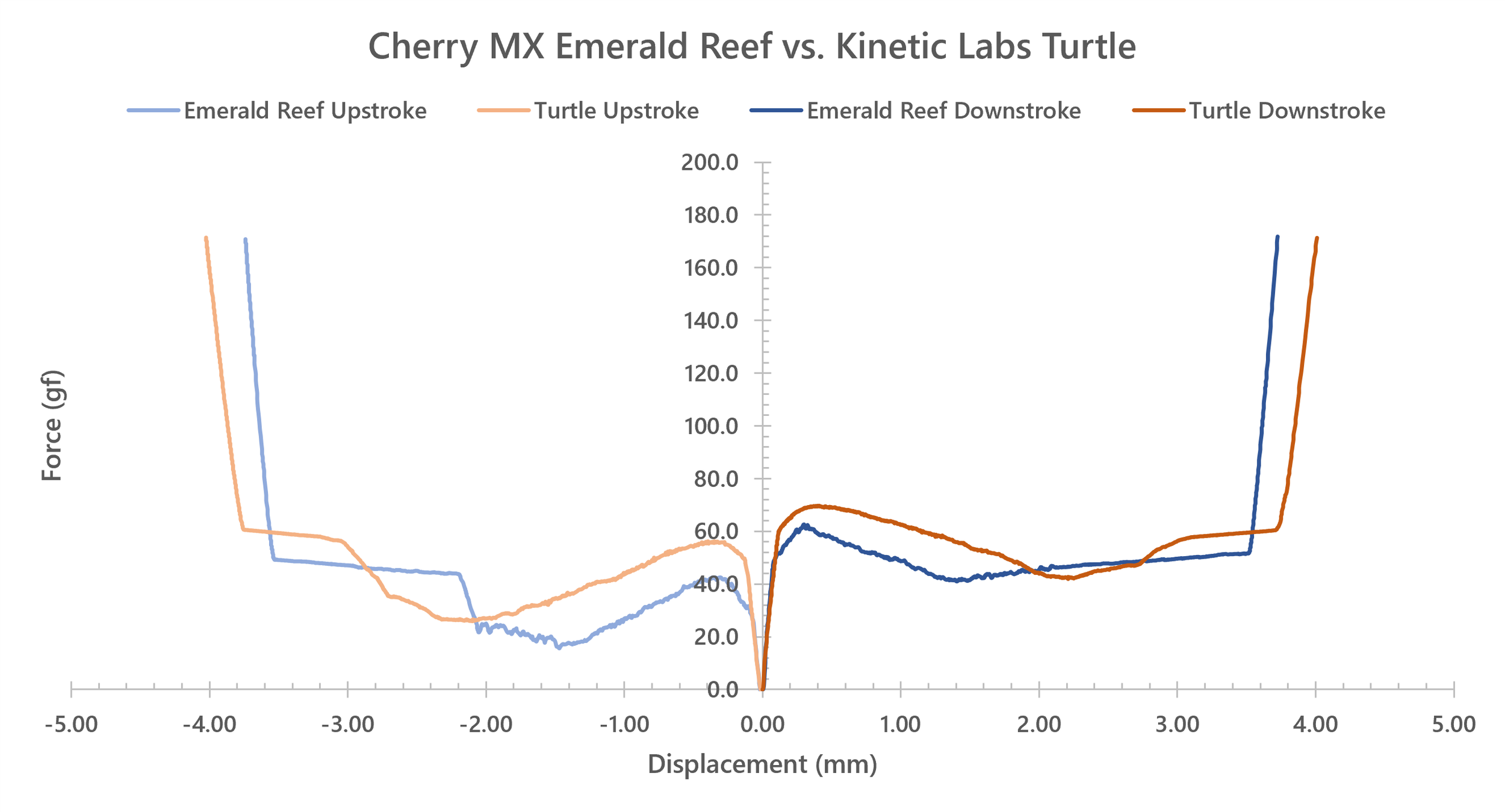
- The comparative force curve for these two switches below does a great job of demonstrating two key differences between how these switches feel in hand – their overall strength as well as the ‘angularity’ of the curve in the MX Emerald Reefs. In addition to the Kinetic Labs Turtles feeling notably stronger than the Emerald Reefs through their tactile bump, it is also more winding and naturally progressing, giving it a more rounded feel and not nearly as abrupt of changes through its progression as the Emerald Reefs.
- There is significantly less N/S and E/W direction stem wobble in the Cherry MX Emerald Reef switches than there is in the Haimu-made Kinetic Labs Turtle switches.
- With respect to their overall sound profiles, the Kinetic Labs Turtles are both louder than the Cherry MX Emerald Reef switches as well as feature spring ping that simply isn’t present in the performance of the Cherry-made switches.
Glorious Panda Silent
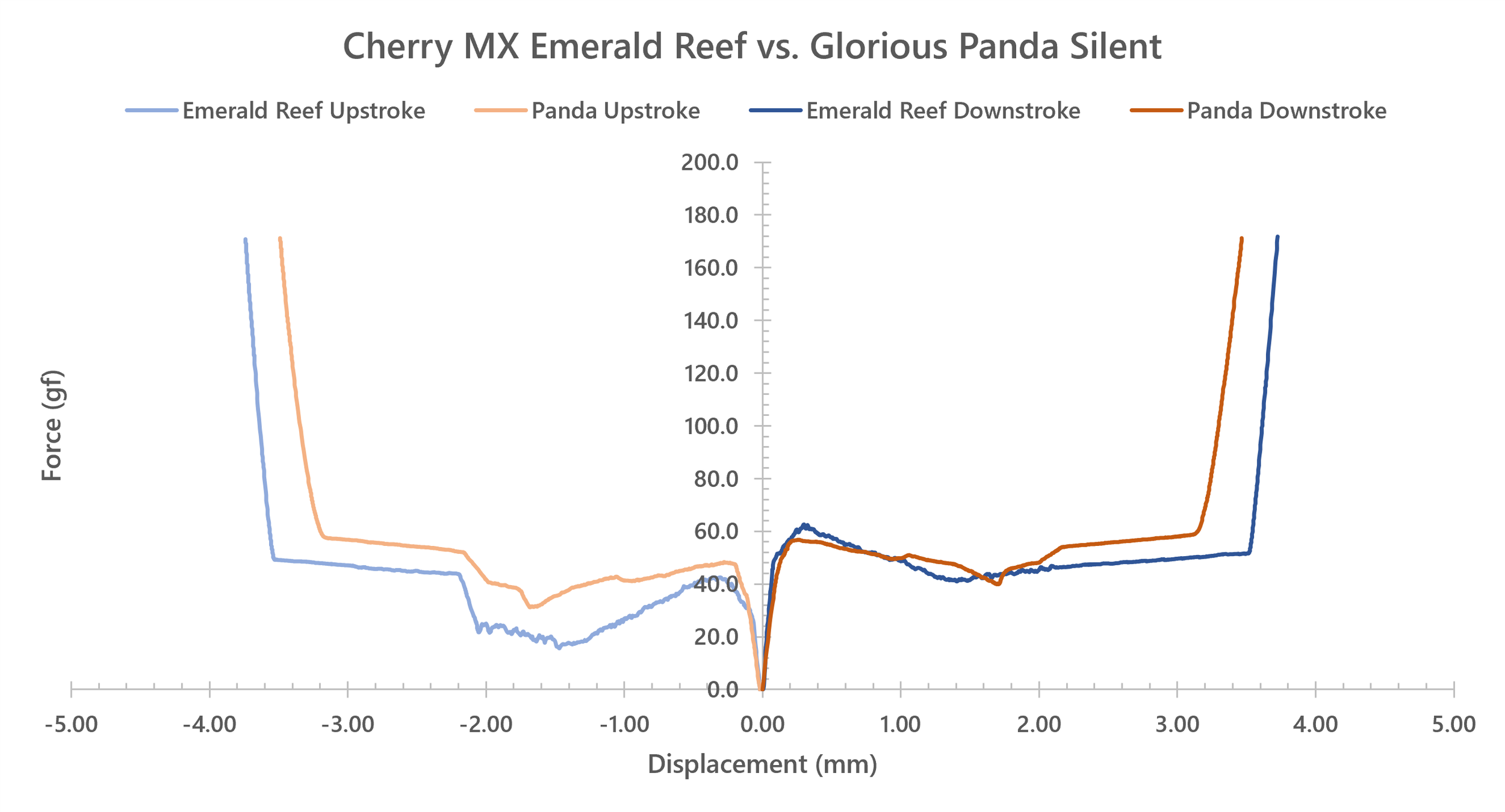
- One should not underestimate the differences in the back half of the tactile bumps in both of these switches in the comparative force curve below. With there not being as much of a change in force leading out of the tactile bump in the Panda Silents as there is in the MX Emerald Reefs, they feel notably softer and less strong through their tactile bump even in spite of relatively similar peak force.
- There is notably less stem wobble in the Cherry MX Emerald Reef switches than there is in the Outemu-made Glorious Panda Silent switches.
- The Glorious Panda Silent switches might be the only switches on this entire comparison list with a comparable lack of sound at all phases of their strokes as the Cherry MX Emerald Reefs do. While I do not have enough of the Panda Silents readily available to make a batch wide comparison between the two, I suspect that may be the one place where they deviate in their sound from the Cherry MX Emerald Reefs on account of Outemu presumably having worse batch-wide consistency relative to the tight control that I’ve seen here from the C-Lab team.
Scores and Statistics
Note – These scores are not necessarily completely indicative of the nuanced review above. If you’ve skipped straight to this section, I can only recommend that you at least glance at the other sections above in order to get a stronger idea of my opinion about these switches.
Push Feel
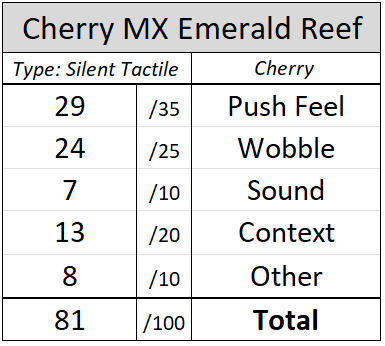
Unlike the only other Cherry silent tactile to date, and the whole body of work that comes before them, the Cherry MX Emerald Reefs are notably smooth silent tactiles with a factory lubing that leaves them feeling tight, insular, and in no way detracts from their performance. As well, the housing collisions (both top and bottom) are firm, balanced, and consistent too. The only detractor from this performance comes with a slight scratchiness through the tactile bump that gives them a sandy, or at least lightly textured, scratchy feeling.
Wobble
With only the slightest of budging in the N/S direction, the MX Emerald Reefs have so little stem wobble that no enthusiast could realistically complain about such. Furthermore, it should be noted that this is leaps and bounds better than Cherry’s historical performance on this metric.
Sound
Much like with the push feeling notes above, the one detractor that breaks these otherwise silent switches comes in the form of a scratchy, low volume note at the intersection of the stem legs and leaves. The switches otherwise live up to their silent switch type with no spring ping, only the most subtle of bassy notes underlying their housing collisions consistently cross-batch.
Context
While I do not know an explicit price, these have been stated by Cherry’s C-Lab team as being ‘similar to MX Northern Lights’ so in the relative ballpark of $0.40-0.50/switch. Even in spite of being excellent pricing per performance, and likely to trickle out to a wide range of vendors in time, the biggest hurdle to their success will be adoption by the otherwise skeptical community.
Other
Cherry’s C-Lab team not only brought a Cherry silent tactile – something they’re least versed in – up to par with modern non-LICHICX-based manufacturers with a new platform (MXAA) and new factory lubing addressing historical concerns of Cherry. And they did this exceedingly well.
Statistics
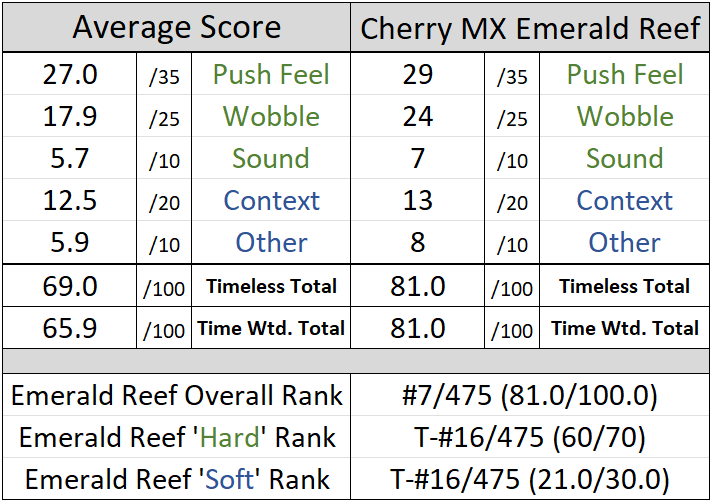
If you are looking at this statistics section and wondering what the heck ‘Timeless’ and ‘Time Weighted’ scoring is, consider checking out my short article titled ‘A Scorecard Time Change’. As a result of scoring becoming a bit anachronistic over the years, switches are now ranked in this statistics table using a “time weighted total” as opposed to their day-of scoring as discussed in that article. If you’d also like to learn about what ‘hard’ versus ‘soft’ ranks refer to specifically, I’d encourage you to head on over to my GitHub linked in the table above or at the links in the top right hand of this website to check out my database of scorecards as well as the ‘Composite Score Sheet’ which has a full listing of the rankings for each and every switch I’ve ranked thus far.
Final Conclusions
To say that I was impressed by the Cherry MX Emerald Reef switches and their performance nuances would be an absolute understatement on my part, and that is admittedly putting it lightly. I know that as a reviewer I’m supposed to try and minimize my biases and preconceptions of a switch before each and every review, sitting down to analyze them as blank slates of opportunity to only be compared against the merits of other switches of similar types. However, I am also human, and like the rest of you I am just as in touch with the preconceived notions of Cherry and how their switches perform. They’ve almost always historically been scratchy, pingy, relatively bad on tolerances, and great for the decades of OEM dominance that they came from, though generally out of touch with the modern times. Even with the C-Lab team putting in the efforts to try and differentiate themselves from these historically rooted beliefs of Cherry and their switches, other recent releases around their MX Falcons and MX Northern Lights haven’t exactly helped in breaking the community’s mindset on Cherry at all. So when I first opened my box of MX Emeralds to test and found out how well lubed they were, how tight their tolerances were, and overall how silent they sounded for a Cherry-made switch, it was hard for me to be anything but blown away. Sure, these switches have some minor issues with how they perform, though they’re largely centered around the intersection of their stem legs and leaves, which introduce a physically sandy feeling to their tactile bumps and a similarly scratchy sound to these bumps. However, if that is really the only glaring issue with the performance of any silent tactile switch I review, I’d be hard pressed to not be impressed with how they perform – let alone a Cherry one. And if all of that wasn’t impressive enough relative to historical context of Cherry and their switches, it’s even more so in the face of current context surrounding the MX Emerald Reefs with them being designed on the basis of the MXAA platform which has thus far not had a generally well regarded by enthusiasts here in the west that have tried them. It is very evident that the C-Lab team put in even more effort into making the Cherry MX Emerald Reefs stand out from both Cherry’s traditional and modern offering, and even more so than the MX Northern Lights and MX Falcons before them. And they did a damn good job.
Sponsors/Affiliates
Mechbox UK
- A wonderful UK based operation which sells singles to switches that I’ve used above in my comparisons for collectors and the curious alike. Matt has gone out of his way to help me build out big parts of my collection, and buying something using this link supports him as well as my content!
proto[Typist] Keyboards
- An all-things keyboard vendor based out of the UK, proto[Typist] is a regular stocker of everything from switches to the latest keyboard and keycap groupbuys. While I’ve bought things from the many times in the past, they also are a sponsor of my work and allow me to get some of the great switches I write about!
Divinikey
- Not only do they stock just about everything related to keyboards and switches, but they’re super friendly and ship out pretty quick too. Divinikey has been a huge help to me and my builds over the last year or two of doing reviews and they’ll definitely hook you up. Use code ‘GOAT’ for 5% off your order when you check them out!
ZealPC
- Do they really need any introduction? Zeal and crew kicked off the custom switch scene many years ago with their iconic Zealios switches and the story of switches today couldn’t be told without them. Use code ‘GOAT’ (or click the link above) for 5% off your order when you check them out!
MechMods UK
- A rising vendor based in the UK, Ryan and crew have been a pleasure to work with and have nearly everything you’d need to build your first or fourteenth keyboard. Go build your latest or greatest one right now with them by using code ‘GOAT’ at checkout for a 5% discount!
Dangkeebs
- A longtime supporter of the website and the collection, Dangkeebs has quite possibly the widest variety of switches of any vendor out there. Not only is their switch selection large, but it rotates and is constantly adding new stuff too. You’re going to need 5% off your order with my affiliate to save off the cost of all those switches!
SwitchOddities
- The brainchild of one my most adventurous proxies, SwitchOddities is a place where you can try out all the fancy, strange, and eastern-exclusive switches that I flex on my maildays with. Follow my affiliate code and use code ‘GOAT’ at checkout to save 5% on some of the most interesting switches you’ll ever try!
Cannonkeys
- Does anybody not know of Cannonkeys at this point? One of the largest vendors in North America with keyboards, switches, keycaps, and literally everything you could ever want for a keyboard always in stock and with an incredibly dedicated and loving crew. Follow my affiliate link above in their name to support both them and I when you buy yourself some switches!
Kinetic Labs
- One of the most well-rounded keyboard vendors out there, Christian and crew have been supporters of all my switch and switch-adjacent needs for some years now. I’m honored to have them as an affiliate and think you should check them out using my affiliate link above to support both them and I when you check out their awesome products!
Keebhut
- Want to try out some switch brands that fly under most vendor’s radars? Keebhut is always seeking out that next latest and greatest and has been super helpful in hooking me up with new brands over the past year. They are all about sharing that love as well, and want to give you 5% off your next order with them when you use code ‘GOAT’ at checkout!
Kailh
- No, you’re not mistaken – this is actually that Kailh that manufactures switches. As one of the longest running manufacturers in the hobby, they have a massive variety of switches available over on their website at any point in time. I’m lucky to be affiliated with them now, and so consider using my affiliate link above when ordering some Kailh switches to support me!
Keebz N Cables
- Australia and Oceania’s very own is now a part of the sponsor list here and I couldn’t be happier to add this long time supporter of the collection to it. They’ve always got an amazing selection of switches (and other keyboard parts) in stock and they want to share the love that they’ve shown me with you all too! Use code ‘thegoat’ for 5% off your first order when you visit!