Cherry MX2A Dummy Switch Review
I’m sure that there’s at least a few of you wondering what exactly is going on with this article drop for multiple different reasons. For one, today is a Wednesday – which is far from the average every other Sunday release rate of normal full length switch reviews here. As well, this is coming fresh off of the heels of a recent review only days ago in the PantheonKeys x TTC PT Black switches. While my immediate canned response to this confusion would be to ask why anyone here reading these reviews would be complaining about me putting out stuff on an actually quick fashion for once, I’ll take this one a bit nicer as this is an article for celebration. After all, it’s that time of year again; The annual time wherein I’m finally freed up from an NDA surrounding a set of switches and race to publish the review before any other content creators can get theirs out. With previous iterations of these day-of-release reviews such as the Cherry MX Northern Lights and Drop Holy Panda X switches being rather well received on their debut, I have a feeling that this one may actually be even more well received than either of those before that. (And to think that I put in all of the effort to publish the MX Northern Light review in a cabin in the woods the day that I was officiating my best friend’s wedding!) There’s just something about these switches that seem so much more revolutionary and unlike anything else that Cherry has put out in recent years that these simply won’t be a review that anyone could skip over on account of not being a particular fan of that type of switch. So without much further ado, especially given that I hardly have any personal life updates that I could possibly share today that I didn’t include at the start of the last review just days ago, let’s go ahead and get right into the background, performance, and every tiny detail about Cherry’s new MX2A Dummy switches!
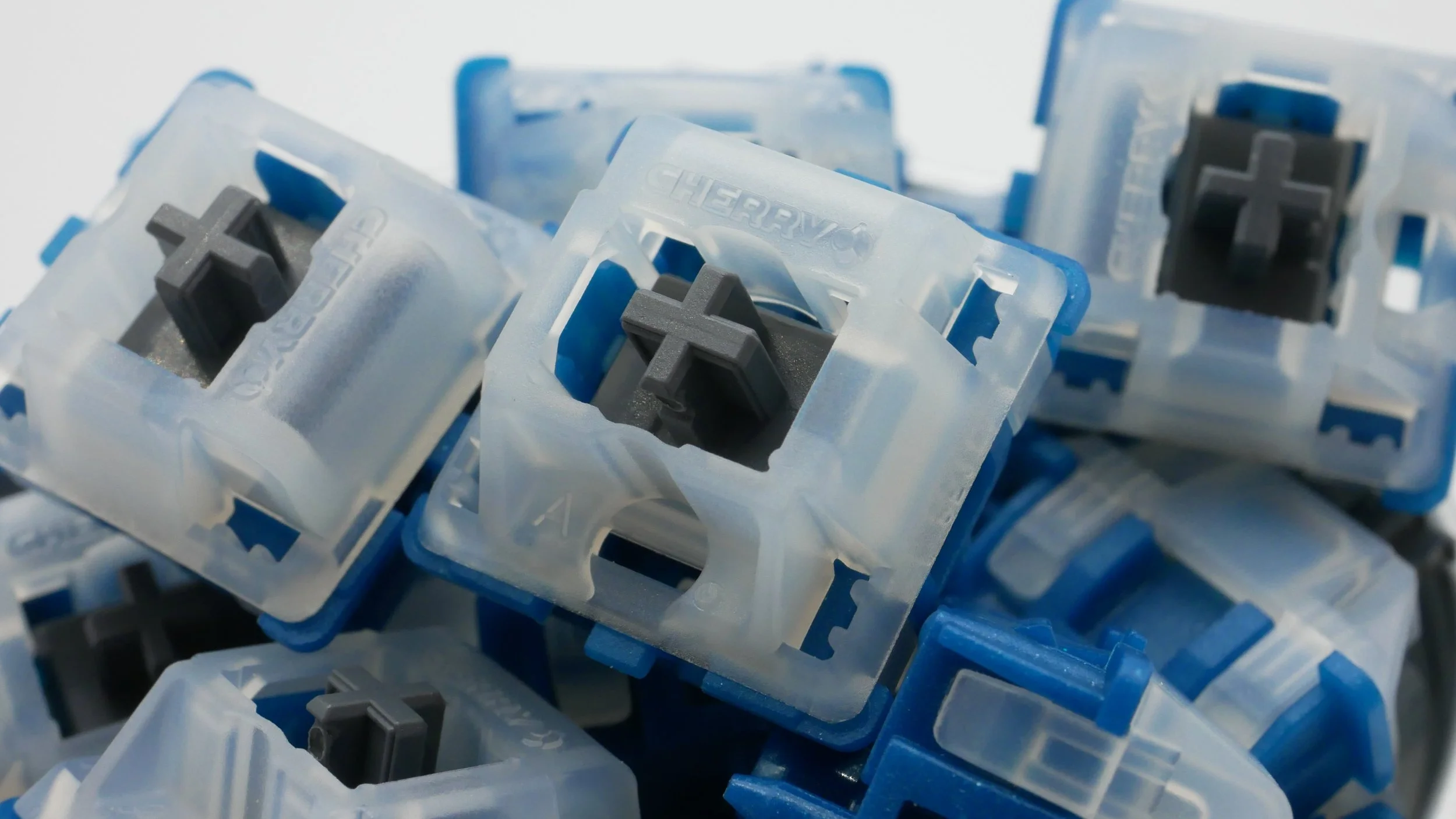
Figure 1: These weird looking things!
Switch Background
Okay, alright, I get it – you probably all think you’ve figured it out by now. A “dummy” switch? Truly Goat must be taking us all for a bunch of dummies if he thinks that we can’t recognize that this is a completely made up, bullshit switch that was dreamed up as some April Fool’s joke. There’s clearly no such thing as a dummy switch, there never has been, and it’s just a cutesy way to poke fun at a new type of switch. (Why not call them silent dummies or Hall Effect dummies instead?) Well what if I told you that not only are “dummy switches” actually real things, but that the specific variants of those from Cherry that inspired their MX2A counterparts were actually multiple decades older than just about all of the keyboard switches I’ve ever covered here over the years? “Dummy” switches are actually an exceedingly rare variant of switches that previously saw a lot of use in vintage keyboards back in the day to act as stabilizers for large keys such as “BAE” Enters or spacebars greater than 7u in size. With wire stabilizers as we’ve become accustomed to in the hobby not being invented in the 70’s and 80’s when dummy switches were a common type to encounter, these springless switches acted as ways to prevent oblong or weirdly shaped keys from tipping over when typed on by the user. Showing up in a whole range of switch platforms such as Cherry MX, Cherry M5/6, SMK, and even some non SKCL/CM versions of Alps switches, all of these switches shared a similar overall design as one another. Each one of these dummy switches, irrespective of their variant, were effectively just sliders trapped inside of a standard housing to keep their supported key moving straight up and down, though without any springs nor leaves as to not add more weight to key than any other switch on the keyboard. (As if many of these very same vintage boards didn’t have heavier spacebar switches than every other key on the board…)
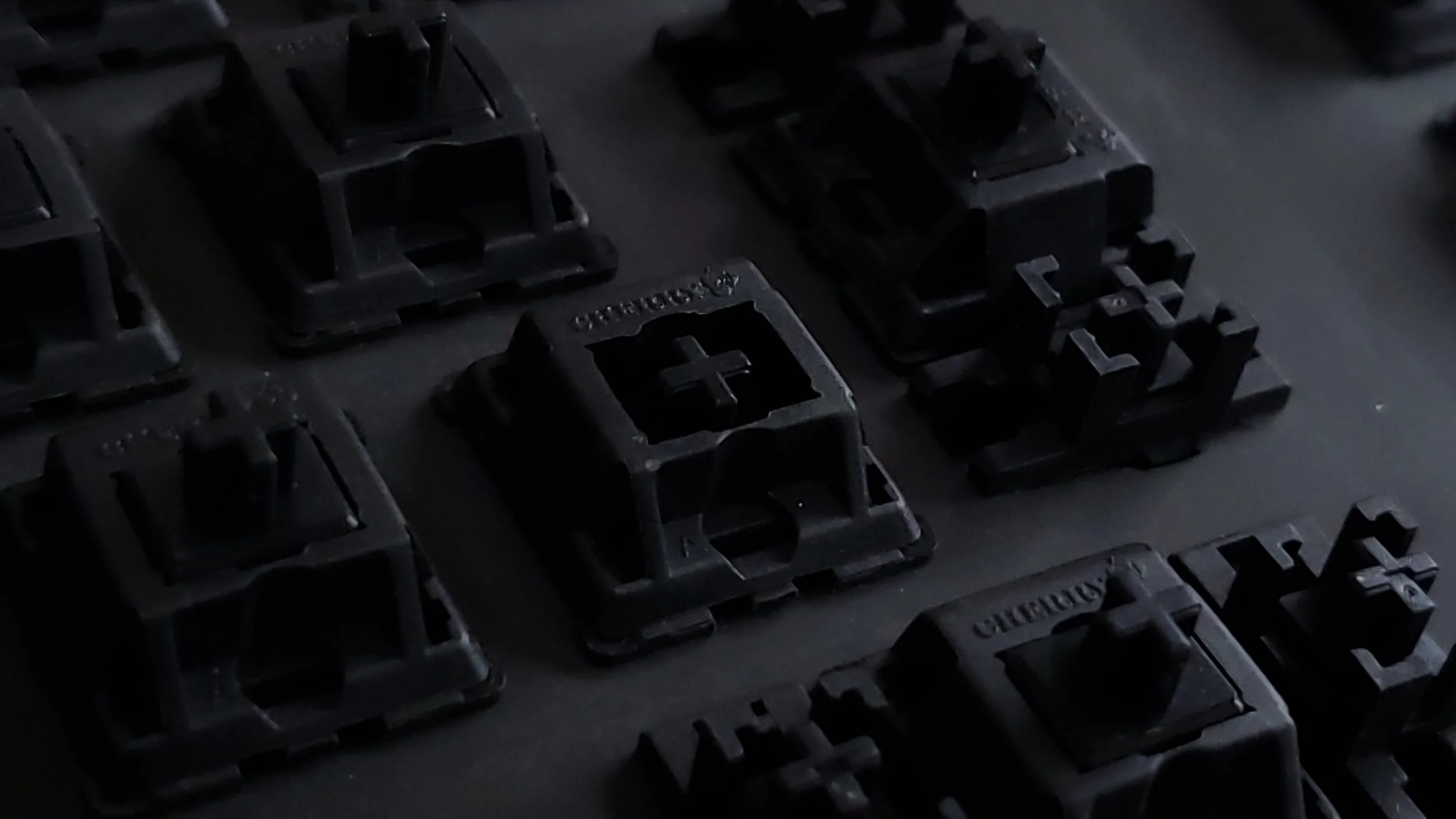
Figure 2: Example of Cherry MX Black Dummy switch in a vintage board owned by vintage keyboard collector mcmaxmcmc.
Alright, seriously Goat – I get that this is definitely an April Fool’s joke now. You got me, “dummy switches” are in fact a very real type of switch that existed once upon a time, but why would Cherry decide to release a new, updated version of this niche variant of switches of all things in 2026? Well, it actually makes more sense than you would initially believe if you think about it, and that’s even without me pointing out that Hall Effect technology was also super old and yet all the rage amongst gamers nowadays. As per the press release that I got from Cherry along with my switches, the German based C-Lab team saw the release of MX2A Dummy switches as a natural extension of the ‘revival and renewal’ campaign that Cherry has been doing with their classic releases over the past couple of years. The keyboard community has always loved and sought out the original Nixdorf Nixies, Ergo Clears, and even Hirose Oranges for their endgame boards, and in turn each and every one of those switches has gotten a deserving and well done retread in modern times as part of Cherry’s more dedicated community outreach in the form of the Cherry MX New Nixies, Cherry MX Ergo Clears, and Cherry MX Oranges. “While the Cherry MX Locks are still something that we’re in the process of redeveloping and re-envisioning given the complexity of their original design and the fact that we lost the molds for them somewhere in the middle of Asia as we transported our production equipment from Germany to China, there’s really only a short list of vintage switches left from Cherry’s long and storied MX history that we still owed proper credit to.” said spokesperson W. Potts in their email to me about the MX2A Dummies. Further details from the press release, as well as discussions that I had with this spokesperson and other C-Lab designers “off the record”, suggested that this move was also partly driven by the complexity of keyboard part production in China where Cherry recently shifted their production to not too long ago. Apparently the scene for custom keyboard stabilizers makes the cutthroat, competitive production environment of keyboard switches look like a walk in a park next to an elderly retirement community by comparison, and with consistency of stabilizer production so incredibly poor, they see the writing on the wall for these “traditional” stabilizing methods. Increasingly, eastern facing custom keyboard designers appear to be designing boards to try and circumvent this unbalanced, inconsistent stabilizer production and Cherry believes they likely will return to dummy switches as an easy solution to this problem. And to be honest, I can’t really blame them for thinking such. I read that Norbauer article on the “pinnacle” of stabilizers, and if my choices were between trying to fit that monstrosity into my keyboard design or just putting another 14 millimeter square hole in a place, I would almost certainly choose the dummy switch option.
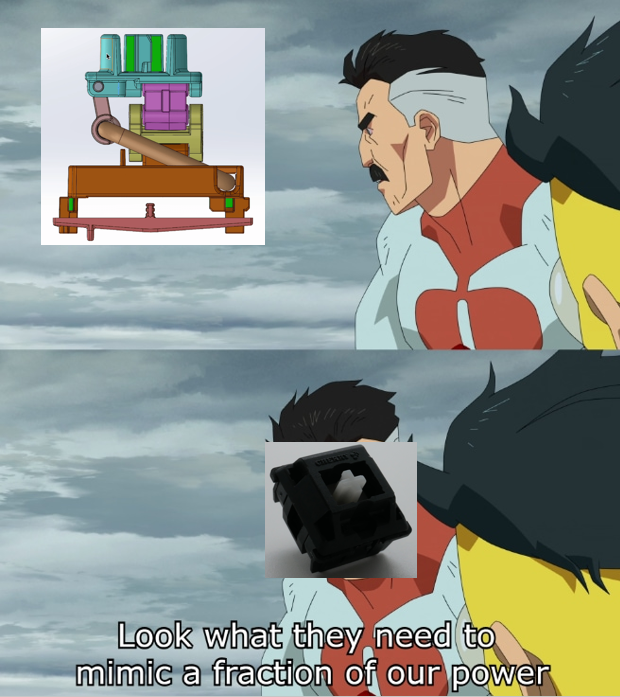
Figure 3: Honestly, the meme speaks for itself.
With this rise in keyboard community interest for an alternative means of stabilization and seeing an opportunity to improve upon their classic vintage switch designs like numerous other recent releases, Cherry has designed their newest iteration of Cherry Dummy switches to have some additional physical upgrades and design flair alongside them. First and foremost, all of the new age Cherry Dummy switches will feature the same MX2A mold and design detail upgrades as their other recent releases. While this obviously will skip over the part where the switches will have barrel-shaped springs, for obvious reasons, all of the same housing structures and stem shapes will also be in place to make sure that tolerances are still perfectly tight and updated from the MX platform as well. The added design flair to this iteration of switches, interestingly enough, is that they will not just be available as a single, static color and linear stem design like their previous vintage iterations in the MX platform. Instead, Cherry has planned to release an entire lineup of “Dummy” switches that will match the colorways and stem designs of all of their other modern MX2A releases – including ones that feature dampening pads such as the Northern Light silent linears – so that users can build a cohesive board aesthetic as well as have large key stabilization that doesn’t sound any different than the rest of the switches in their boards. (While not explicitly stated in the initial press released, much like with the MX2A platform roll out it is assumed that these Dummy switches will then be rolled out to classic Cherry switch colors such as Black, Red, Brown, Green, etc.) While these new MX2A dummy switches will be clearly differentiable from their springy, more responsive lookalikes on account of their stems sitting sunken in their housings upon arriving in packaging, Cherry is still choosing to denote these variants of switches with unique special part codes starting with MXAF- instead of MX2A-, with the following four-part code afterwards matching the style of release they can along with. (For example a modern Cherry MX2A Dummy Lock would be MXAF-31NN instead of their current part number of MX1A-31NN.) As per discussion with the C-Lab team, the designation of “AF” was chosen here as a shortening of the German word “abfangen”, which is used to describe the “breaking or catching of a fall”, much like how the Dummy switches prevent longer keys from tipping over in use.
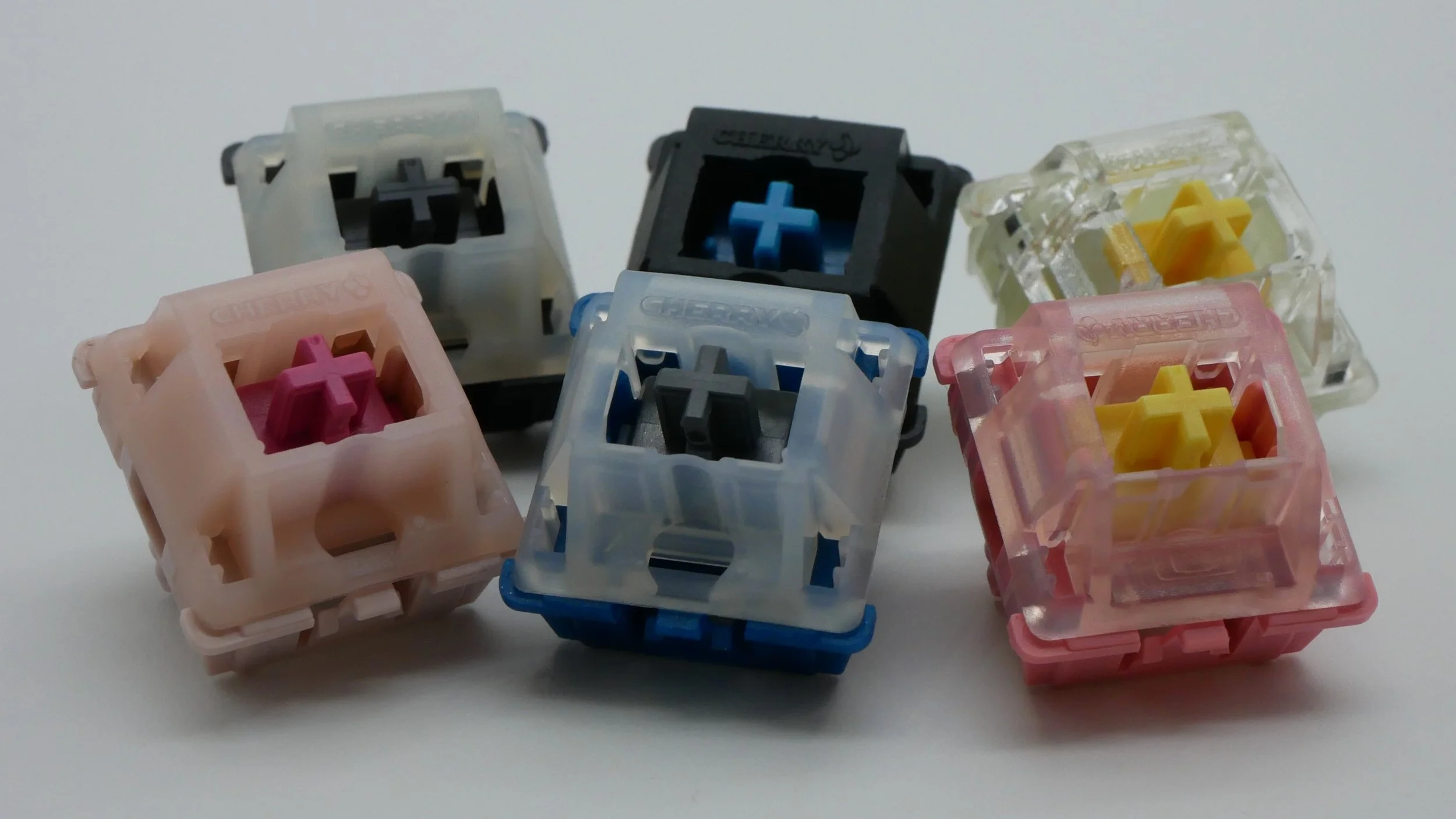
Figure 4: Multiple variants of the Cherry MX2A Dummy switches available for sale as of today including New Nixie, Blue, Honey, Petal, Northern Light, and Blossom colorways.
Given that this review was held back until release on this very day by NDA clauses, there’s likely no surprise in stating that the Cherry MX2A Dummy switch lineup is officially being made available to the community for purchase today, April 1st, 2026. As mentioned above, it does appear that Cherry does have plans to ultimately roll the aesthetic- and type-matched Dummy switches out to all variants of their MX2A switches, though as of the time of writing only a handful of variants were being made available to match their premium modern switches like Blossoms, Petals, Falcons, etc. as well as a couple of their more standard color offerings such as Red, Black, and Blue. Despite not invoking the iconic Cherry gold crosspoint technology, the pricing of these switches still is comparable to, yet ever so slightly higher than that of their non-Dummy variants on account of the fact that they required special sets of molds and variations to the injection molding process to make. In addition to being made available in packs of 70, 90, and 110 directly from Cherry as well as any other retailer which normally directly stocks Cherry switches, Cherry is also rolling out a deal specific to their sales page where purchasing a pack of 110 switches of any of their MX2A switches allows for the optional add on of 5 color- and type-matched Dummy switches for half of the price of what they are being sold at. Currently available only via aftermarket as of the time of writing, it expected that these will begin rolling out in prebuilt, fully size keyboards via brands like Ducky at some point later on in 2026. As well, rumors are presently abound that PCB designers Cipulot and Gondolindrim are working with Cannonkeys and Geonworks, respectively, to develop PCB and plate offerings to not only allow for dummy stabilizers to be used in all future board releases from these companies, but also backwards compatibility with existing popular kits such as the Sat75 for Cannonkeys and the Frogs for Geonworks.
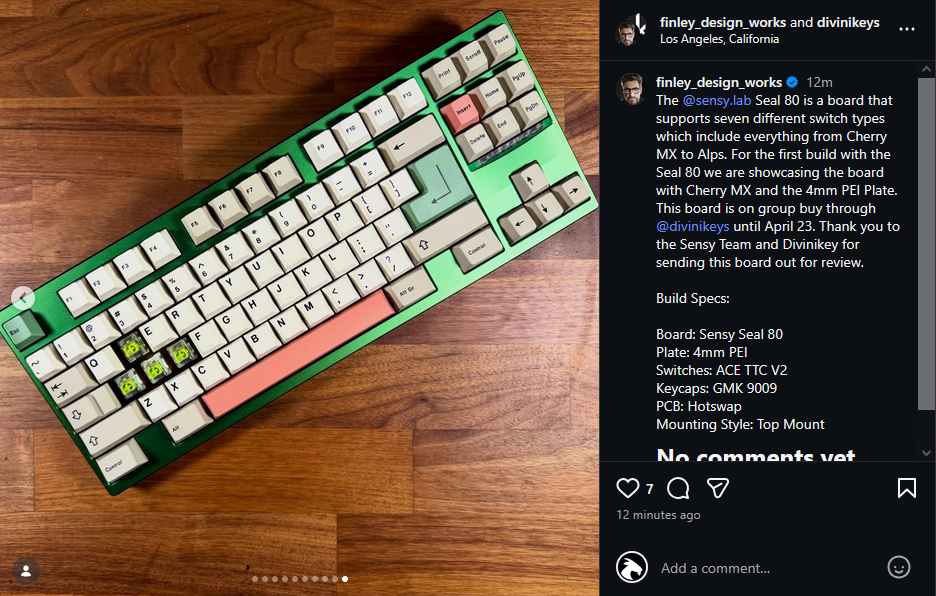
Figure 5: Even Divinikey sees the direction things are going! Pictured here collaborating with Finley Design Works on a keyboard with a BAE enter key.
MX2A Dummy Switch Performance
Note: While the Cherry MX2A Dummy switches come in multiple different types as mentioned above, this specific review will focus on the MX2A Dummy Northern Light switches as they pose a unique silenced Dummy mechanism unlike anything Cherry has made previously in any of their vintage dummy switches. All references to other MX2A Dummy switch variants will be explicitly described as such when used.
Appearance
At the highest level, the Cherry MX2A Northern Light Dummy switches come in a three tone colorway with milky white, translucent top housings over a medium toned, solid blue colored bottom housing and a dark grey-colored stem that is, well, identically matching to the colors of the normal silent linear Northern Light switches. As was clearly marketed by Cherry in the creation of these switches, the aim was to provide color matched stabilizing switches to go with any of their normal MX2A platform switches and so hopefully nobody is surprised at the fact that the colors actually matched. (No need for quality control jokes here.) While the identical colorway between the MX2A Northern Light Dummy switches and regular MX2A Northern Light switches may make it virtually impossible to differentiate them from one another from a distance, any closer inspection should make them more than distinguishable from one another on account of the resting positions of their stem heights when not in a keyboard builds. Aside from the different starting stem height in the Cherry MX2A Northern Light Dummy switches, there are some further strange and unexpected features that I would not have initially expected to encounter in these switches and the new molds used for them by Cherry. These specific sub-part details can be found discussed in the photographs and photos below for the Cherry MX2A Northern Light Dummy switches.
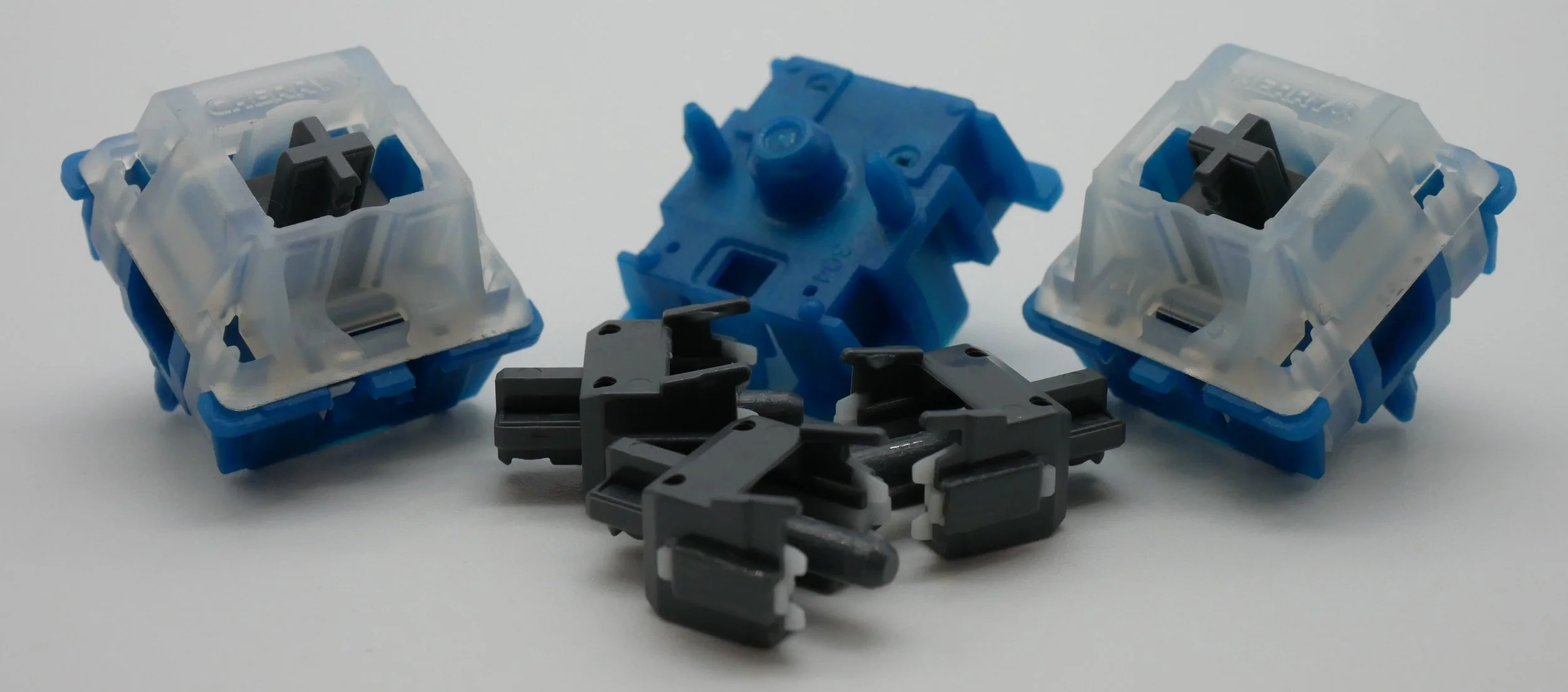
Figure 6: Cherry MX2A Northern Light Dummy switches and their components.
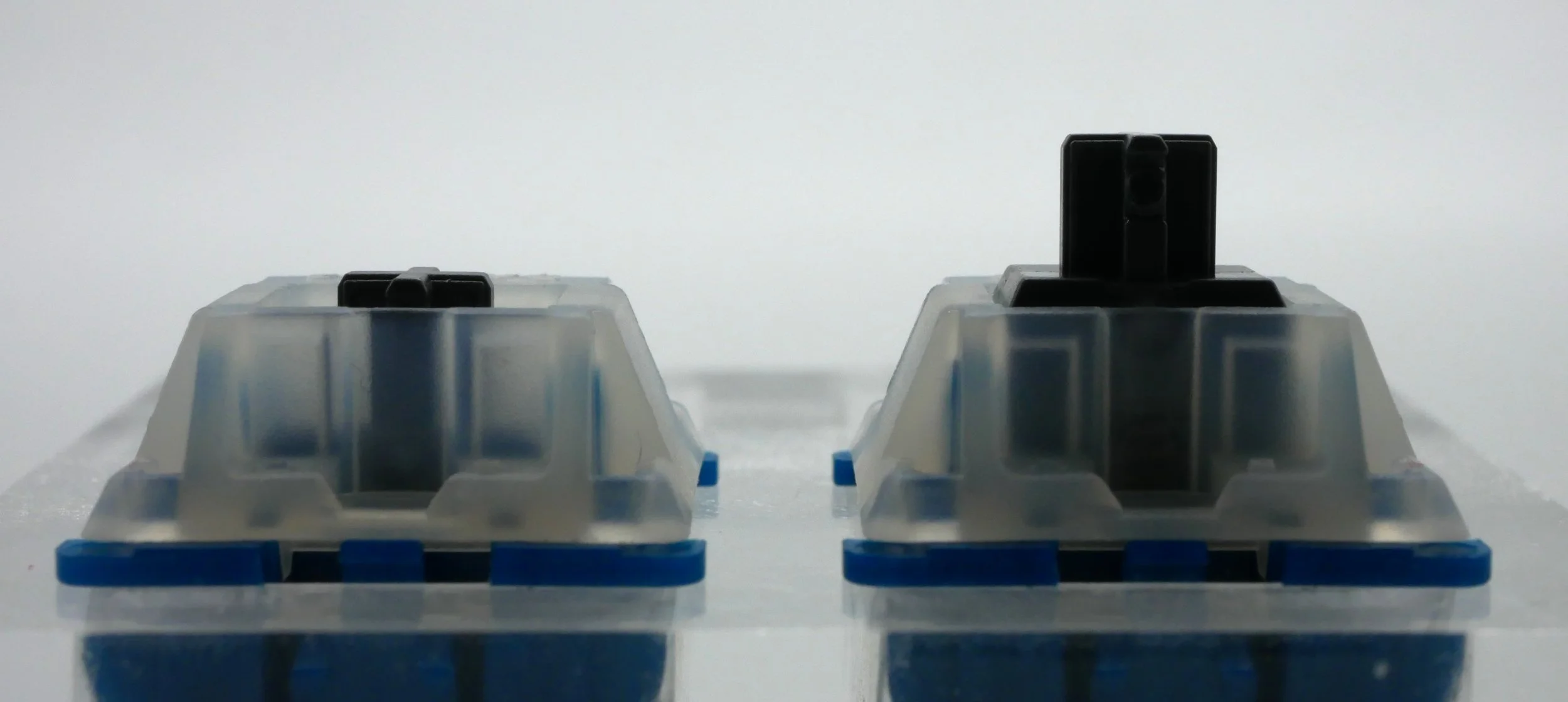
Figure 7: Starting stem height of the Cherry MX2A Northern Light Dummy (Left) and MX2A Northern Light (Right) switches.
Looking first to the milky white, translucent top housings of the Cherry MX2A Northern Light Dummy switches, there’s clear evidence of the presence of Cherry’s MX2A switch platform but little in the way of what makes them ‘unique’ molds as compared to those of the traditional MX2A Northern Light switches. As seen as early as 2023 when the MX2A platform was first introduced, these top housings feature a stylized ‘CHERRY’ and logo nameplate externally and raised guiding rails on the southern side of the housing opposite from that of the nameplate on the inside. As well, these feature a tightly restricted through-switch LED/diode slot that comes in the form of a small rectangular cut out in the bottom of a centered circular indentation – much like the MX2A-platform Northern Light switches. (Yes, I do recall that other more conventional, non-custom colored MX2A platform switches sch as the MX2A Silent Reds don’t feature these and instead feature a small, step pyramid that encloses this part of the housing for light diffusion.) And while presumably these also carry the same polished internals and traces of factory lubing that the conventional Northern Light switches have, I don’t readily see these in the MX2A Northern Light Dummy switches as I did in the original Cherry MX Northern Light Switch Review. Perhaps these were the smaller mold differences that Cherry had indicated warranted new production molds in the creation of these dummy switches? However I’d have to admit that I would have expect less polishing and less factory lubing to be a feature which would have reduced pricing of these switches rather than increasing them…
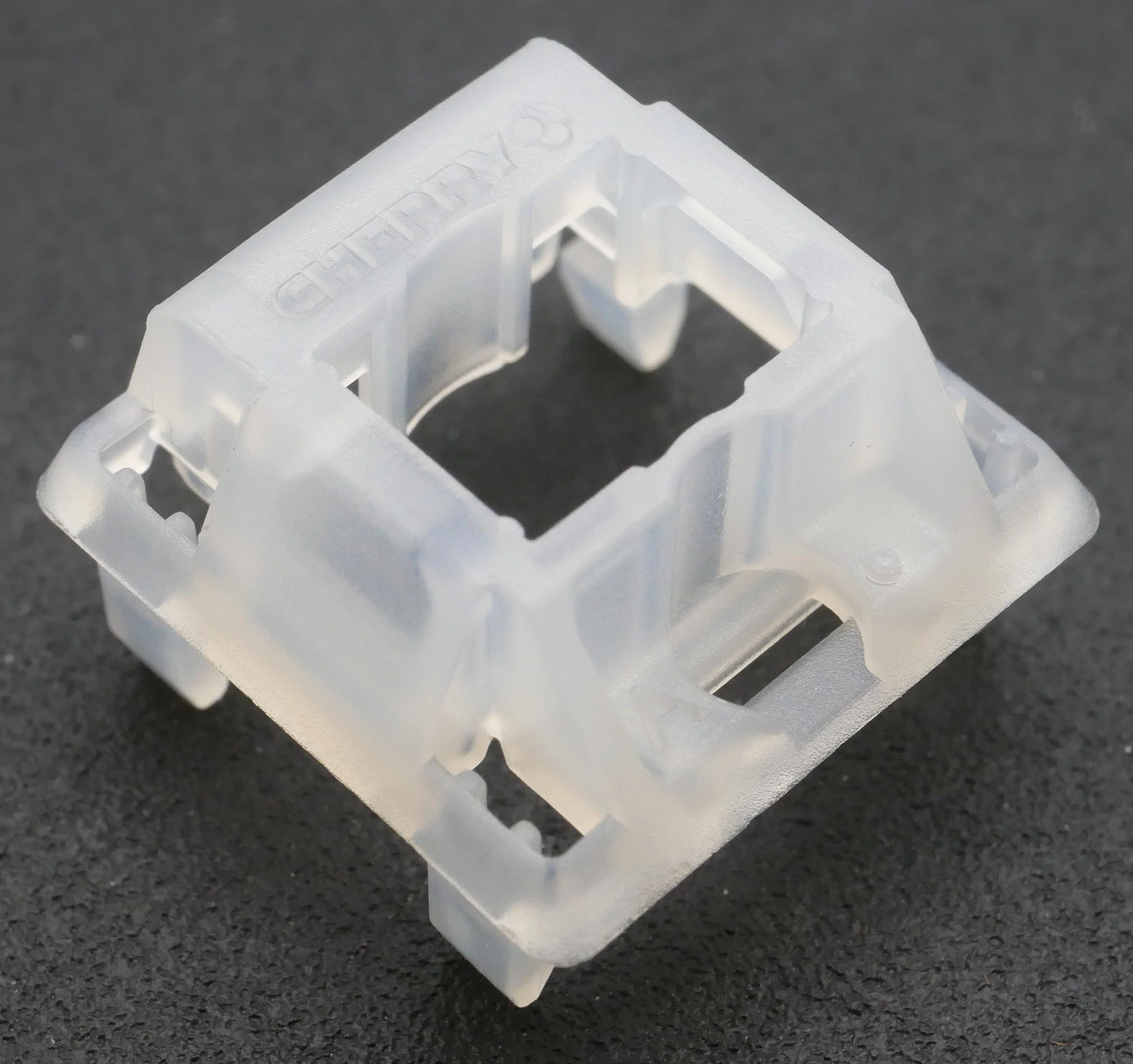
Figure 8: Cherry MX2A Northern Light Dummy top housing exterior showing modern, bubble letter 'CHERRY' nameplate and severely restricted through-switch LED/diode slot.
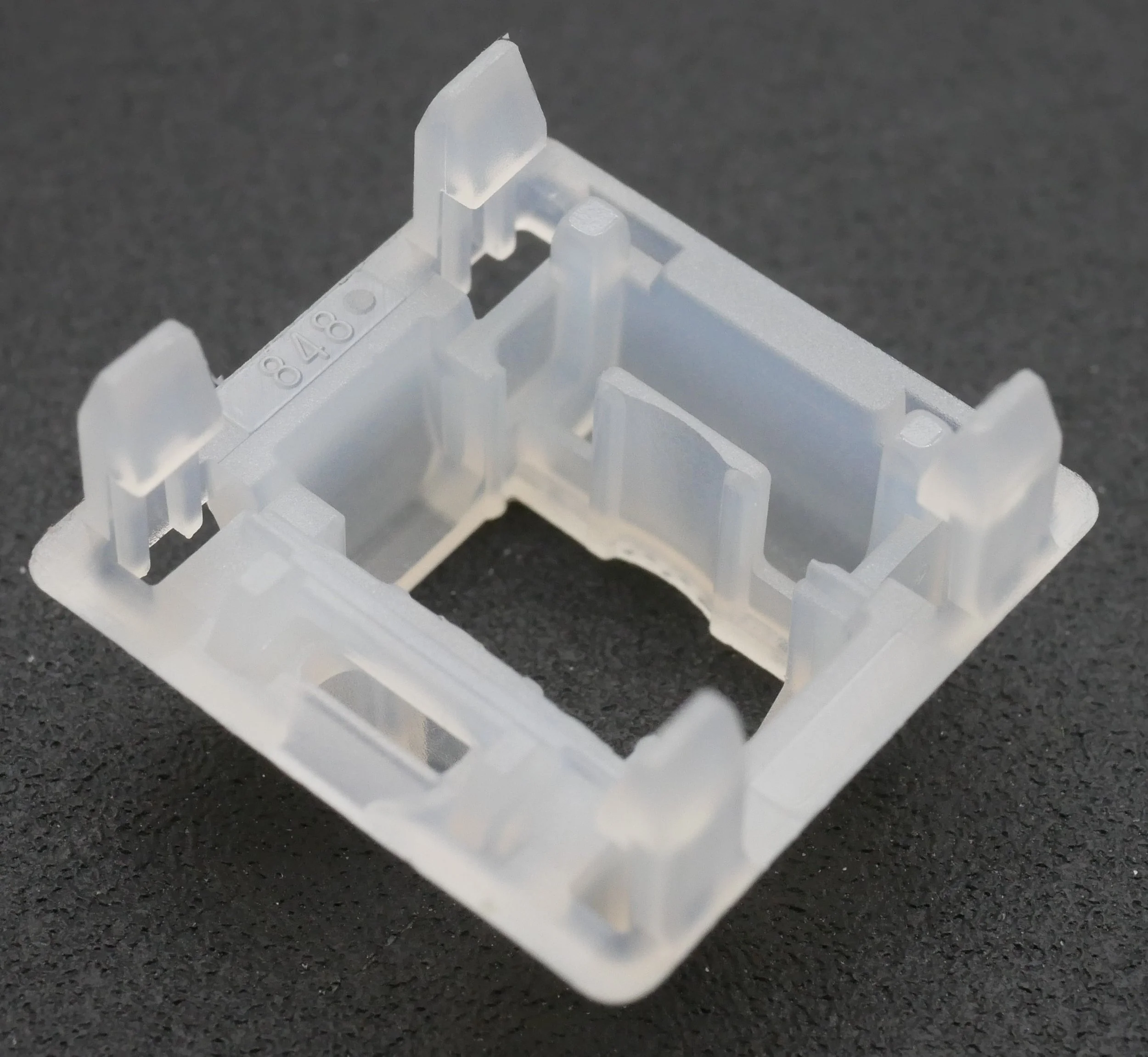
Figure 9: Cherry MX2A Northern Light top housing interior showing design features similar to other MX2A platform switches such as a three digit mold marking on the left-hand edge of the housing.
Moving next to the dark grey “silent” stems of the Cherry MX2A Northern Light dummy switches, I have to admit that they look nearly identical to the original stems of the MX2A Northern Light switches while simultaneously knowing for a fact that they aren’t the same. Or rather, I am using ‘fact’ about as liberally as I can here given that I am only repeating information from my conversation that I had had with one of the designers behind these switches on Cherry’s C-Lab team. I suppose this is more like a “no seriously bro, you have to trust me” kind of statement as you’re all kind of tacitly taking my word for this one. The similarities are clear here between the dummy and normal silent linear stems on account of the fact that they both have squared off slider rails, ejector mold markings on the front plates of both of their stems, mildly tapered normal length stem poles, and trace amounts of factory lubing all around them. And while the finer details of their two-part injection molded dampening portions of the stem may look identical to one another as well, the conversation with that C-Lab team member has actually indicated that the dampening pads on the MX2A Northern Light Dummy switches, as well as all MX2A silent dummy switches for that matter, were made from a different material than the normal switches. Whereas Cherry’s normal MX2A silent stems have a dampening mechanism made of a proprietary silicone blend, for these specific switches they chose to use a blend of thermoplastics and Impiolex G as a dampening material, aimed at helping better reduced the force of the larger keys wherein the MX2A dummy switches would see use. While I’m not entirely certain that I agree with the science behind this claim, the team member seemed more than convinced that this decision was based on the idea that the perceived “dampening strength” of a stem was proportional not just to the type of material used for such, but also the force applied to it. And since the MX2A Northern Light Dummy switches were being used for larger keycaps with more mass to them like spacebars, large enter keys, and so on, they were in need of a stiffer material to help better dampen that strength without landing too hard and wearing out the dampening pads more quickly.
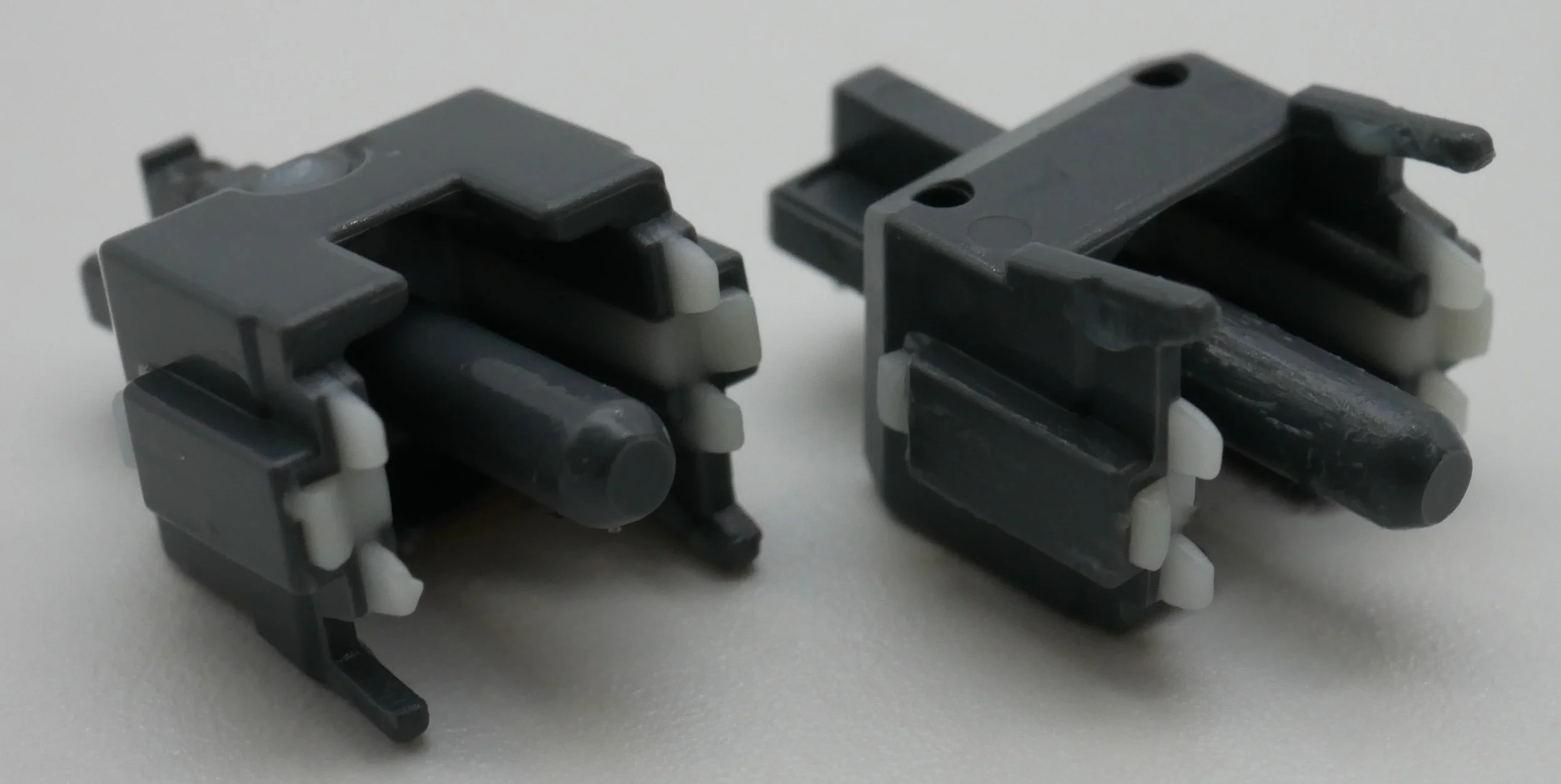
Figure 10: Cherry MX2A Northern Light Dummy switch stems back and front showing non-tapered slider rails, a normal length, slightly rounded stem pole, and special dampening pads designed to better handle bottom outs of large, stabilized keys.
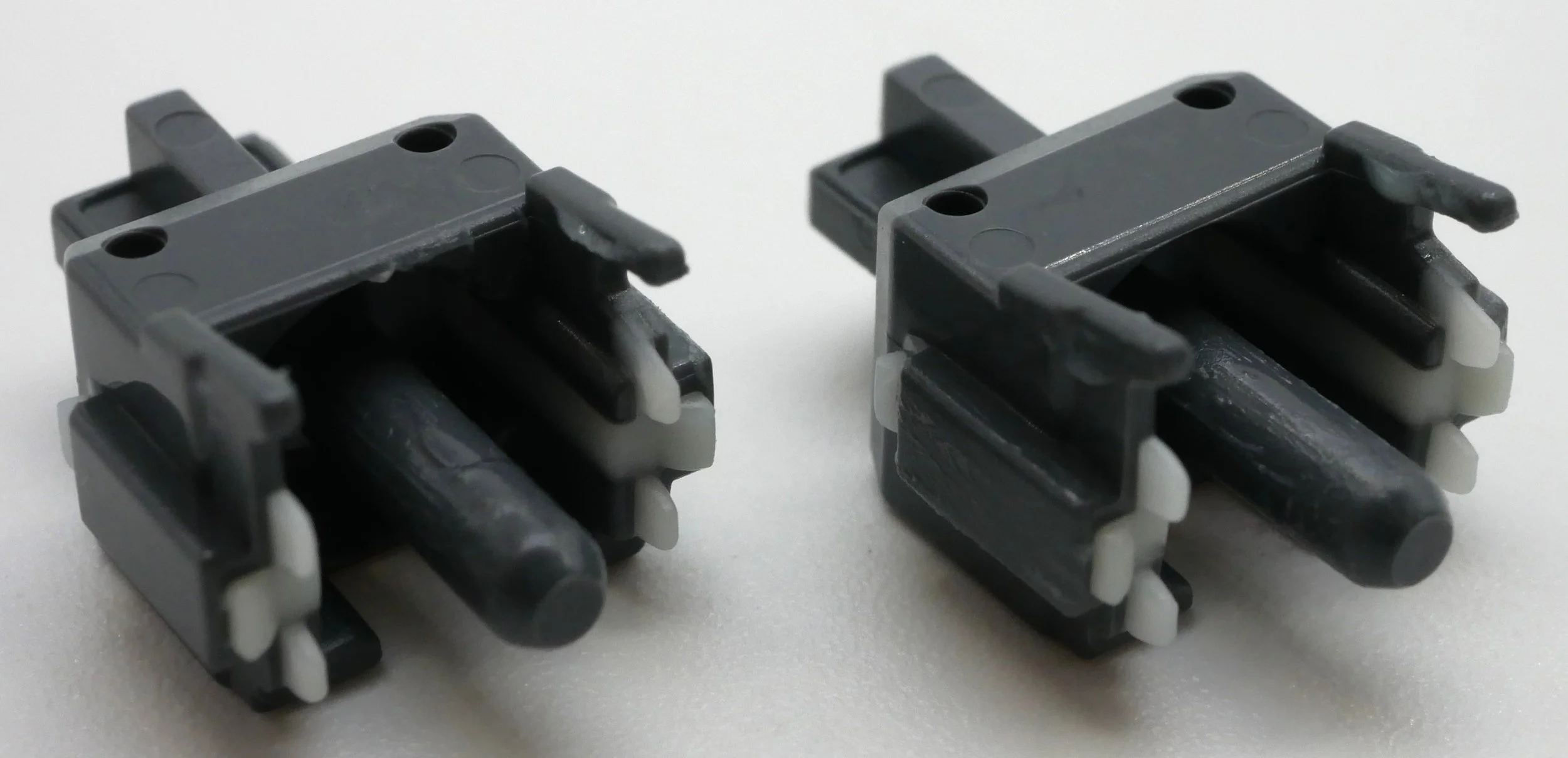
Figure 11: Cherry MX2A Northern Light Dummy (Left) and Cherry MX2A Northern Light (Right) switch stem comparisons. Note the more evenly spread factory lubing and softer, more kinetically responsive dampening pad material in the Dummy switch stems.
Finally arriving at the sparkly, nebula blue glass-fiber reinforce bottom housings of the Cherry MX2A Northern Light Dummy switches, we’re greeted with the details that truly surprised me in the design of these switches. While none of the commonplace features for the MX2A switch platform being here surprised me – such as the raised sections within the slider rails or the more rounded “socket dome” structure of the center pole hole – it was the presence of the complex geometry and through-housing holes on the northern side of the housing interior that were a shock to see. Without a need for Cherry’s gold cross point technology leaves in dummy type switches, I suppose I would have expected these little outcroppings used to hold in the leaves in the normal switches would have been eliminated. Yet they still appear here in their fullest form, leading me to believe that the “new mold” claim was broadly overstated and really only applied to the molds required for injecting the dampening pads on the stems. Or, perhaps this was intentionally done by Cherry in order to help keep the sound profile of the MX2A Dummy switches more consistent and uniform with that of their matching normal MX2A switch counterparts, something which I suppose makes sense given the stem dampening force rebalancing efforts described by the C-Lab team above. Externally all of the features of the Cherry MX2A Northern Light Dummy switches align with their non-Dummy (or would it better be stated as ‘Smart’?) counterparts, including PCB mounting pins, a three number mold marking, and a through switch, small squared-off LED hole that is all in the exact same places.
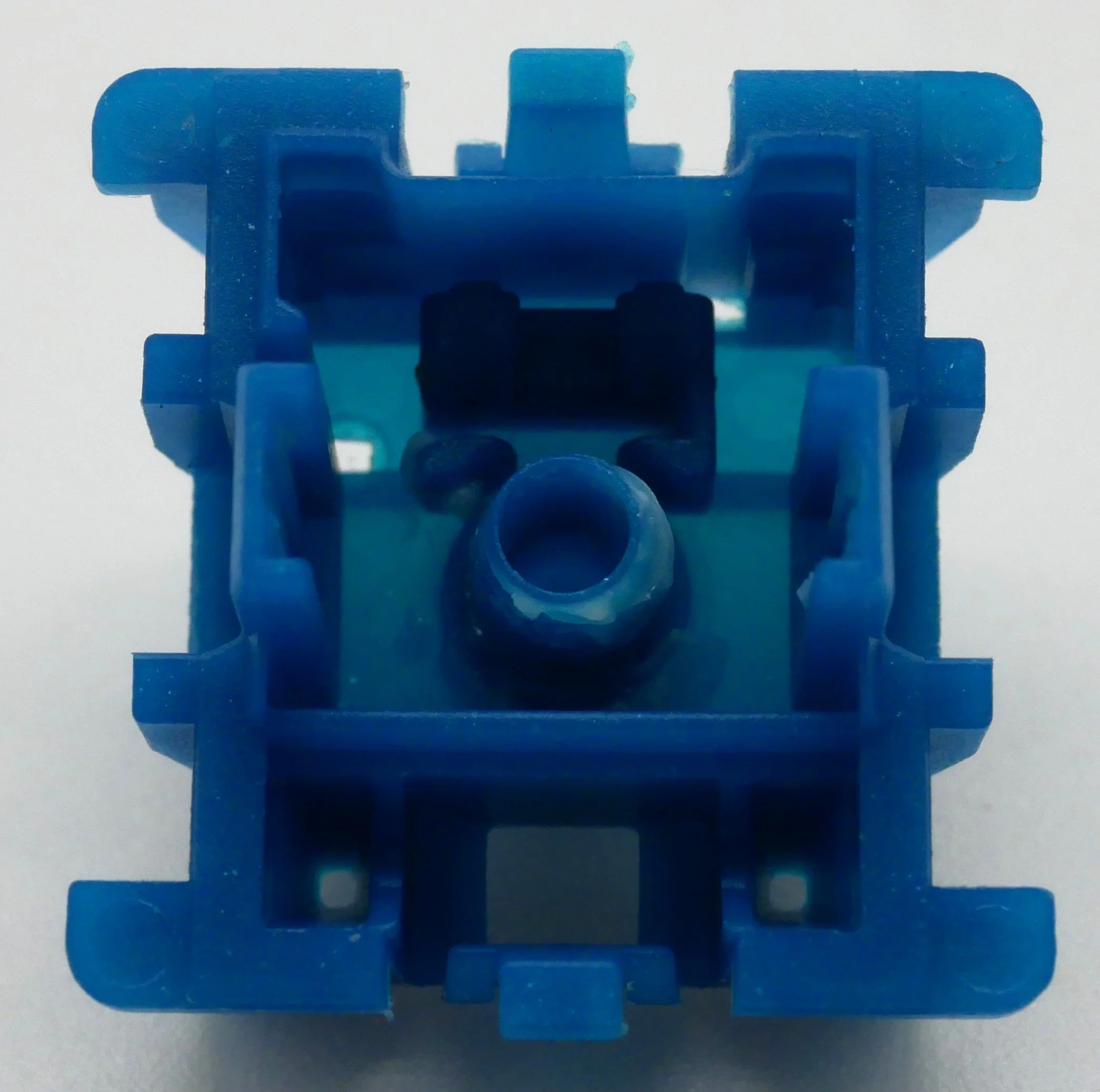
Figure 12: Cherry MX2A Northern Light bottom housing interior showing design features expected of the MX2A Dummy platform as well as sound profile-maintaining vestigial leaf holding geometry and through-housing holes.
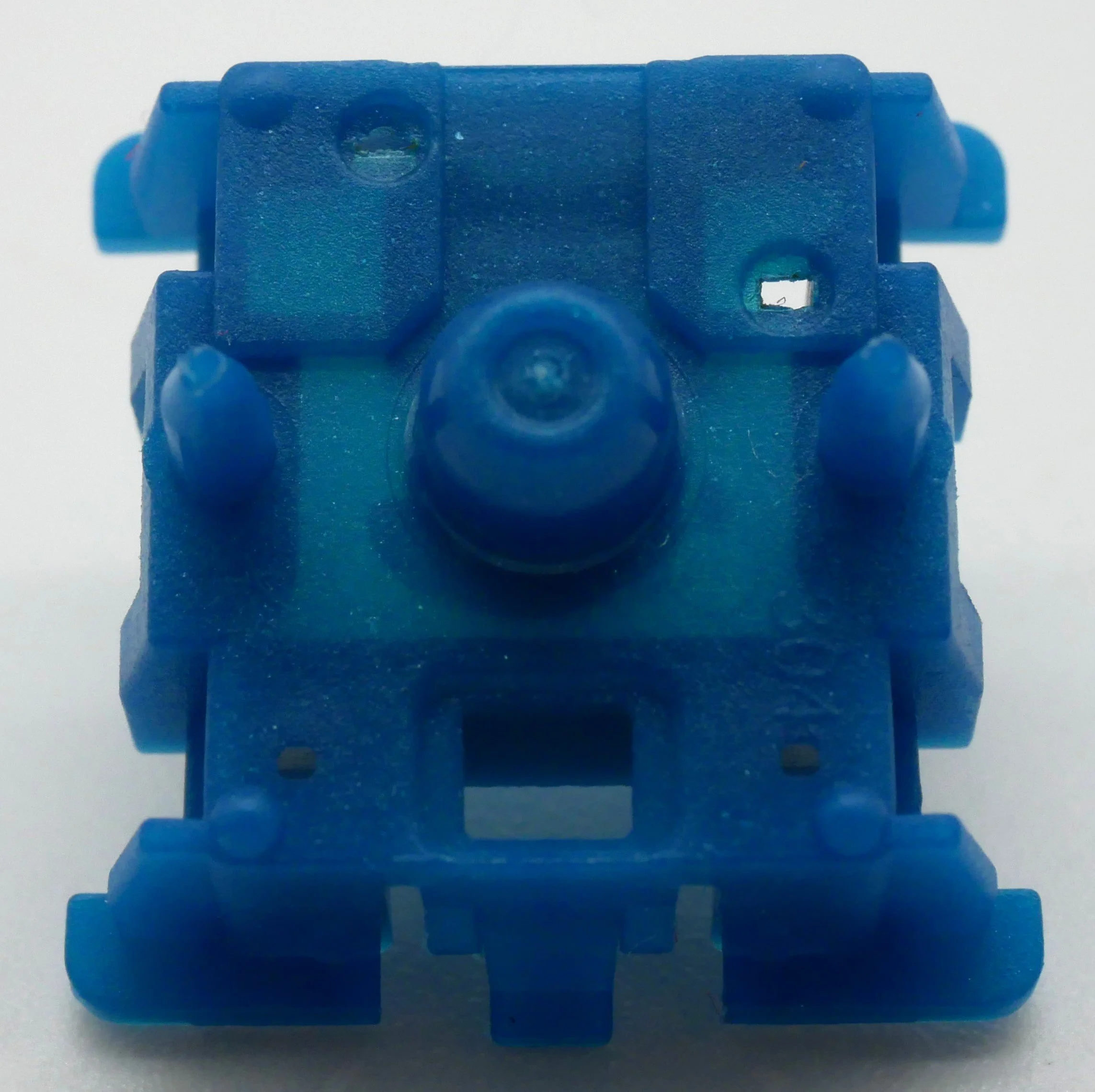
Figure 13: Cherry MX2A Northern Light bottom housing exterior showing PCB mounting pins, three-digit mold markings, and through-switch non-functional pin holes designed to help maintain an even sound profile between the Dummy and non-Dummy variants of the MX2A Northern Light switches.
Push Feel
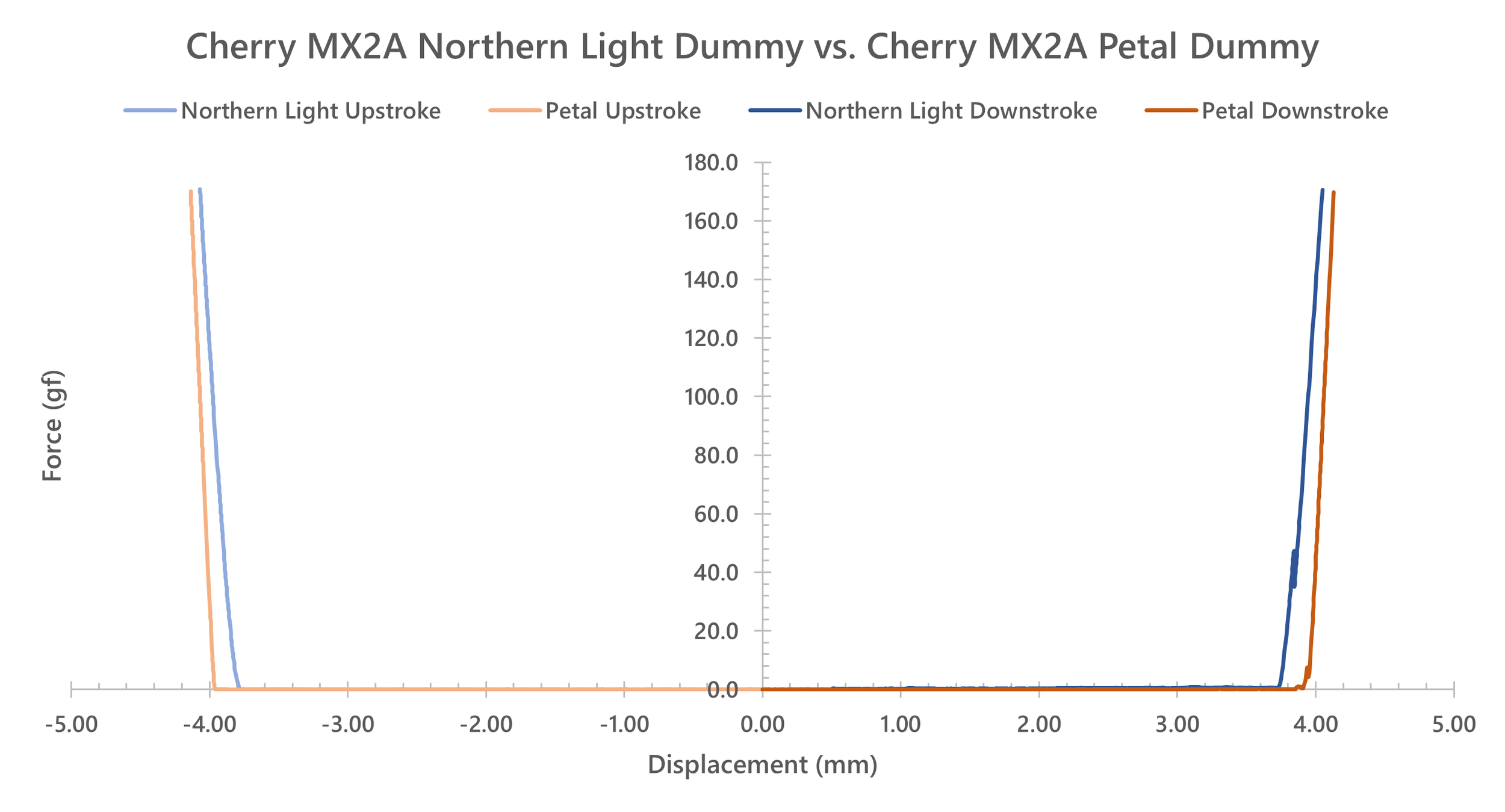
Unlike some of my more normal means of testing switches for full length reviews, the MX2A Northern Light Dummy switches are ones I can’t really just pick up and type away on in hand or between two fingers. With no spring in them to properly return the stem, just pulling and pushing the stems to and fro with a small pair of pliers hardly compares to the feeling of using them with a key attached. And so, after affixing a key to them, I was pleasantly surprised at just how smooth these switches were. Despite the subtle differences in structure and material choices as noted above, its clear that Cherry went about lubing the MX2A Northern Light Dummy switches via the same lubing techniques that were using on the other switches in the MX2A platform, giving them a fairly smooth and consistently smooth feeling with only small pickets of finer grain scratch. In fact, I’d go as far as to say that these switches come across slightly more effortlessly smooth than their non-Dummy counterparts on account of them not having excess lube trapped in their housings by the barrel-shaped springs used in conventional MX2A switches. As for the housing collisions of the MX2A Northern Light Dummy switches, these too are deep and clearly on the firmer end towards the bottom out on account of the fiberglass-reinforced nylon bottom housings used by Cherry. Where these switches really get their kick, though, is at the front end of their bottom out when the Impiolex G material begins its deformation under force. While this is incredibly hard to describe in any coherent words, it is almost as if the dampening pads of the stems of these switches just perfectly dampen the force of whatever they are struck with, no matter what they are struck with. In a way, I think that the actual technical term that may apply here would be “Non Newtonian-like”, but it’s not as if these stems are meltingly soft under light taps nor turning into bricks under forceful blows either. (I mean the force curve below clearly does show that these switches do deform somewhat at bottom out as can be seen in the subtle curve in force at bottom out as is common in silent switches.) Under just a single 1u key and all the way up to a 10u spacebar, these dampening pads just perfectly conform to the force of each key striking them, acting black hole-like in sucking in that force. Ironically enough, I can’t help but recognize that this is the exact sort of phrasing that I’ve used before to describe the bottom outs of normal Cherry switches with their depe, thick nylon housings before.
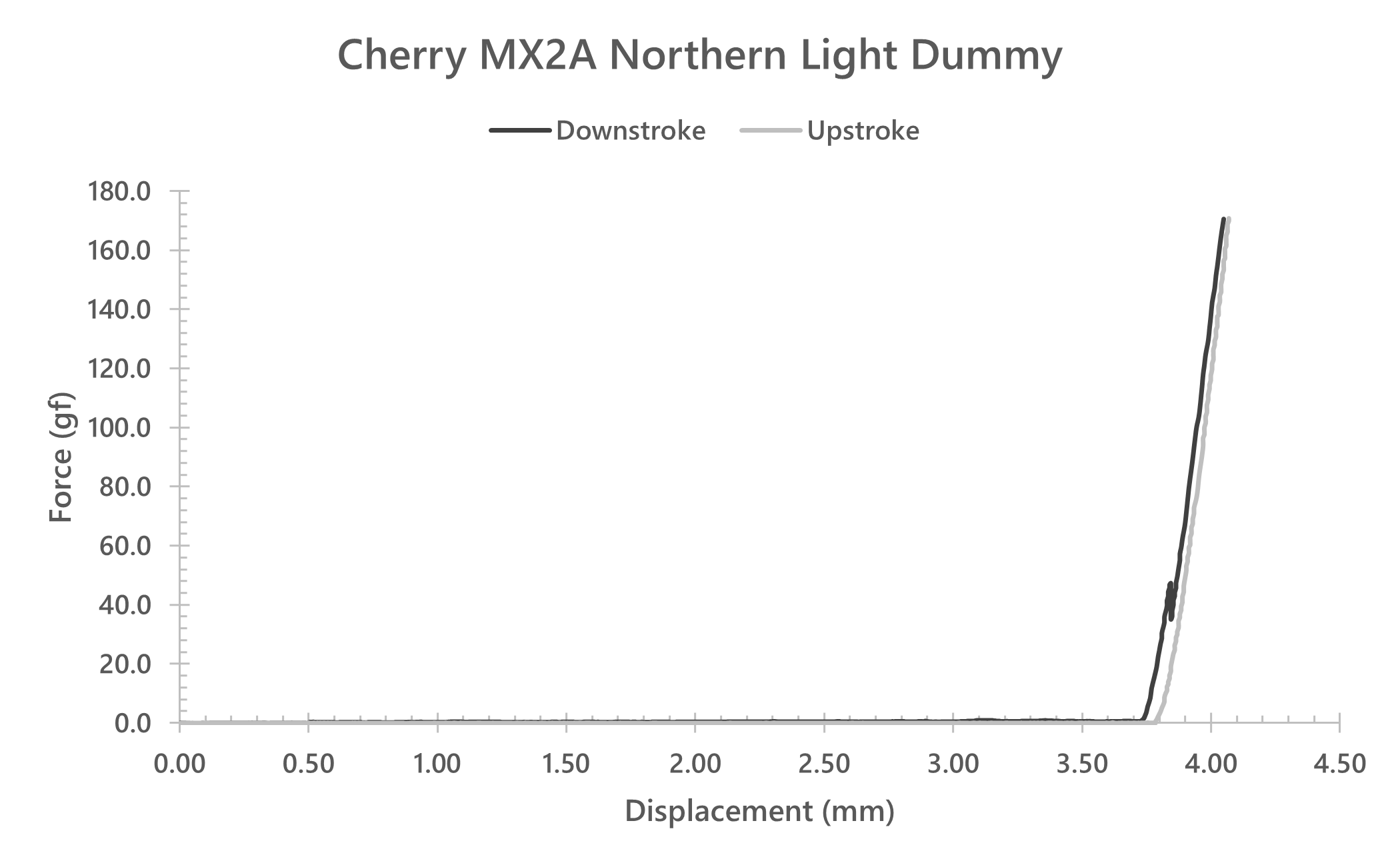
Figure 14: Force curve diagram for the stock Cherry MX2A Northern Light Dummy switch.
While the push feeling results and analysis above were from notes generated while trying these switches out as stabilizers for larger keys that were also in contact with normal MX2A Northern Light switches, much like how Cherry had clearly intended for them to be used, I did notice some strange and extremely unique behavior while using the MX2A Northern Light Dummy switches as stabilizers in conjunction with non-matching, other switches. When used between two non-silent switches such as the Drop Holy Panda X or Gateron Ink Black V2, both of which don’t have rubber dampening pads in their stems, I ended up getting a weird, localized feeling differentiation depending on where I struck the key. While some users have sworn time and again that they can feel differences in the feeling of normal switches depending on if they hit the key they were under head on versus with a glancing blow – something which I’ve never personally been able to do despite my best attempts – this might be the first time where that is a noticeable, clear difference that anyone can see. For example, affixing the Cherry MX2A Northern Light Dummy switches to the outer edges of a 10u spacebar key, propped up in the center by a non-dampened switch causes off center strikes of the spacebar to feel more firm and ever so slightly stiffer than striking the spacebar head on in the dead center. As well, on “Big Ass Enter” or BAE keys, tapping the ‘boot tip’ of the Enter key where these stabilizing switches were located can cause the bottom out of the entire switch to more smoothly increase in force and steadily raise in pressure as opposed to a stiffer, more immediate spike in force striking the other side of the key. Without being able to reasonably try out every possible combination of switches where this difference could be felt, it does point to an interesting horizon where the mass adoption of these switches could see a new meta somewhere around ‘frankenswitching’ wherein playing around with combinations of dampened stabilizing dummy switches with other types on multi-switch keys could be deliberately exploited to maximize a specific feelings when striking certain areas of said larger keys. A sort of “localized force differentiation” which probably will get exploited by crazies from the FGC console community, or 40s users. Those 40s users could find a way to hook these up to some wacky 3u-only keyboard with 14 microcontrollers and a stick of RAM to produce electricity through their fingertips like it’s the Jason Statham Crank movies, I bet.

Figure 15: Average 40s keyboard enthusiast (Front) as viewed by average, reasonable keyboard enthusiast (Back).
Sound
The sound profile of the Cherry MX2A Northern Light Dummy switches, much like with many other details covered at length in this review, just so happens to be fairly closely matched to those of the original MX2A Northern Light switches. (Some editorial coincidence that is, I’m sure.) The first and most obvious of these similarities is in how the original Northern Light switches had no spring or leaf ping in them at all regardless of typing speeds and the Northern Light Dummy switches have equally as little spring and leaf ping due to them physically lacking those parts for the stem to interact with. Beyond this, all of the other details such as the slightly squishy bottom outs, smooth, noiseless downstrokes and upstrokes, and not overly thin topping outs are all completely the same all the way down. Free from ping for obvious reasons and with all of the benefits of the MX2A platform factory lubing, the most interesting feature of the sound profile of the MX2A Northern Light Dummy switches is the sonic extension of the “localized force differentiation” concept as described above. While larger keys are capable of having slightly different feelings depending on what normal and stabilizing switches are underneath them and where they are struck, they actually sound radically different in various configurations. Picking similar switches to the Dummy switches being used for stabilization, such as silent linears with the MX2A Northern Light Dummy switches or other linears with the MX2A Blossom Dummy switches, and placing them under an example DSA 2u x 2u POS key, I can actually audibly differentiate which key is in which corner of the cap despite the weight being spread out evenly amidst all four. Expanding this to combinations of any set of disparate, randomized switches, I can even not only more readily tell which switches are which, but I can more cleanly and distinctly pick out features that were harder to hear in the individual switches such as spring ping or leaf ping. While I hardly had time to explore this concept further while having to also write the PantheonKeys x TTC PT Black Switch Review in the same weekend, and will likely have to leave further exploration for a future short article, I have no doubt that upon seeing this review that some 40s user out there will also figure out some way to turn this into some completely unpredictable sound in some macropad.

Figure 16: For a second niche media reference in two consecutive sections, the combinations of switch placements leading to unique feelings and sounds has me expecting the switch meta to turn into the Cookie Clicker Garden mini game. No, this is not the first Cookie Clicker reference on the website…
Wobble
Ironically, for all the similarities that the MX2A Northern Light Dummy and MX2A Northern Light switches share, the Dummy switch that is used for stabilizing keys actually has more stem wobble than the regular switches on account of lacking a spring to help push the stem up into the upper part of the housing with some force. That’s right, without the spring of all things the stems sitting in the base of the bottom housings actually have more N/S and E/W direction stem wobble here. Don’t worry though, when it is firmly attached to a larger key alongside other switches, this increased wobble effect isn’t noticeable in the slightest.
Measurements
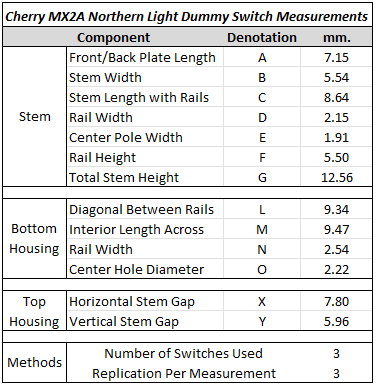
If you’re into this level of detail about your switches, you should know that I have a switch measurement sheet that logs all of this data, as well as many other cool features which can be found under the ‘Archive’ tab at the top of this page or by clicking on the card above. Known as the ‘Measurement Sheet’, this sheet typically gets updated weekly and aims to take physical measurements of various switch components to compare mold designs on a brand-by-brand basis as well as provide a rough frankenswitching estimation sheet for combining various stems and top housings.
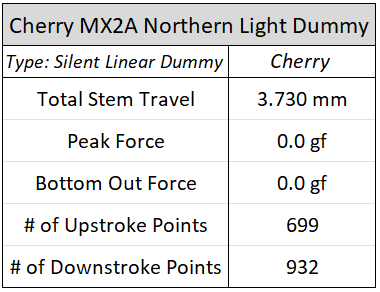
Figure 18: Numerical details regarding the stock Cherry MX2A Northern Light Dummy switches.
Have you ever wanted to be bombarded with more switch data than you’ve ever seen at any point in your life before? Consider checking out the ‘Force Curve Repository’ hosted on my GitHub that contains all force curves that I take both within and outside of these full-length reviews. In addition to having these graphs above, I have various other versions of the graphs, raw data, and my processed data all available for over 2000 different switches for you to use however you see fit. Check it out via the ‘Archive’ tab at the top of this page or by clicking any of the force curve cards above.
Break In
Break In Notes
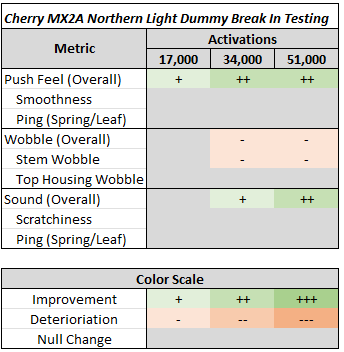
17,000 Actuations
- After 17,000 actuations, the Cherry MX2A Northern Light Dummy switches hardly changed at all as compared to their stock counterparts. The only difference that was even slightly noticeable was an overall decrease in the more ‘sticky’ tones at bottom out of the switches that were broken in to this degree, though these were already fairly minimal to begin with on account of there being no lube caught between their non-existent springs and bottom housings.
34,000 Actuations
- It turns out that the increase in stem wobble after breaking in switches must not actually just be a degradation of their springs through the excessively forceful break in process, but perhaps also wearing down of certain plastic on plastic components. Despite having factory lubing, the stem and bottom housing interfaces of the Northern Light Dummy switches must have worn down to such degree as to cause these switches to increase in both N/S and E/W direction stem wobble at their resting position.
- Perhaps that wearing down effect is to some benefit though as the MX2A Northern Light Dummy switches feel quite a bit smoother and more consistent after having been broken in through 34,000 actuations.
51,000 Actuations
- The most notable change in the MX2A Northern Light Dummy switches broken out to 51,000 actuations is actually the increase in the “localized force differentiation” concept as described above. These Dummy switches that were pushed to this limit really emphasize the cross-key variance in both push feeling and sound of large keys where they are placed under and anyone who is going to seek to exploit this for some weird keyboard design will most assuredly have to break in their switches in order to get the fullest effect.
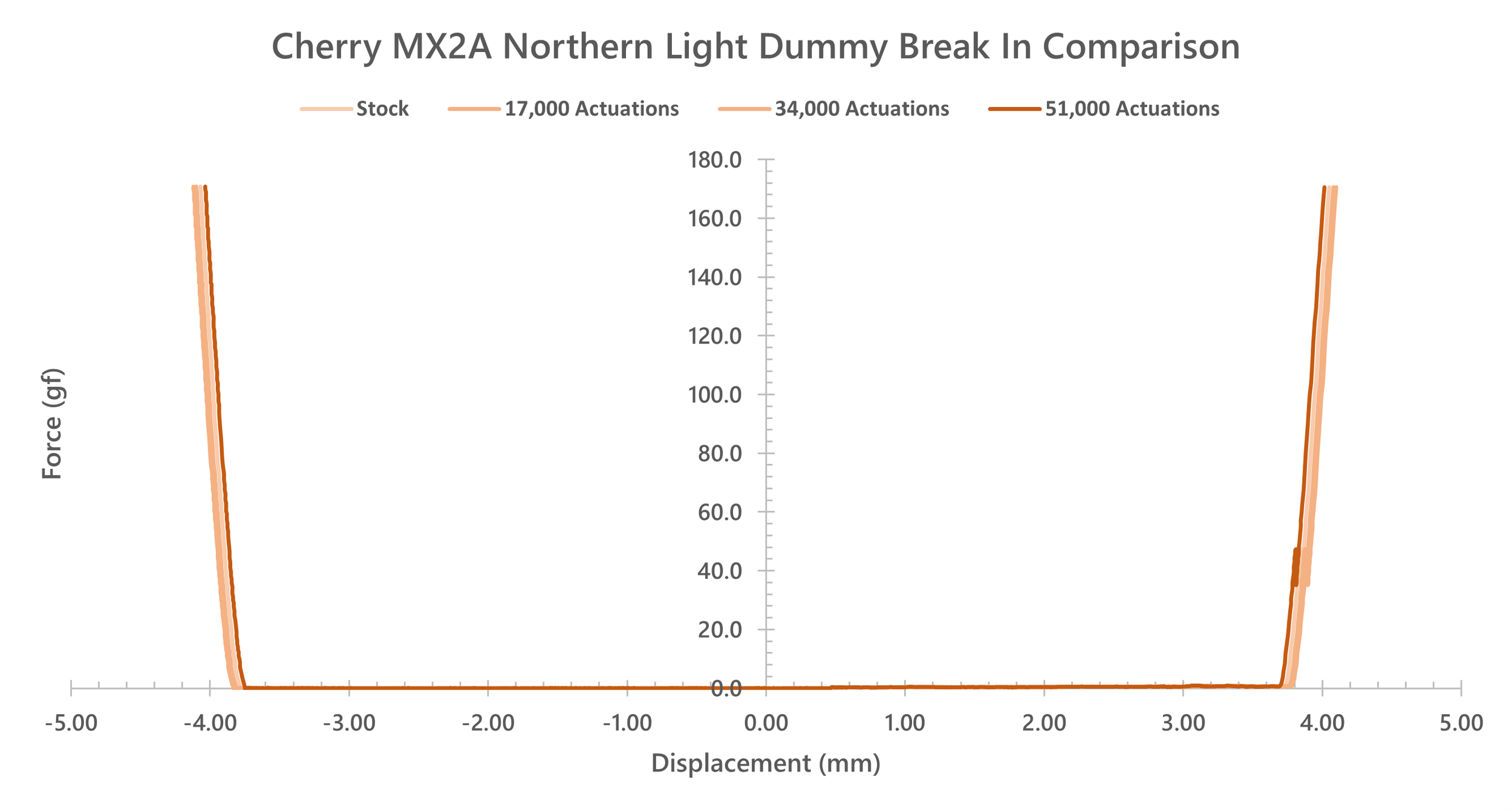
Figure 20: Comparative force curve diagram showing no substantial change in the force curves of the Cherry MX2A Northern Light Dummy switches throughout the break in process.
Comparison Notes to Other Notable Dummy Switches
Note – These are note aimed at being comprehensive comparisons between all factors of these switches as this would simply be too long for this writeup. These are little notes of interest that I generated when comparing these other switches to the Cherry MX2A Northern Light Dummy switches side by side for this review. Note that it is extremely uncommon for me to cross-compare linear, tactile, silent linear, and silent tactile switches of any variety, though given this situation I figured that it was more warranted than not.
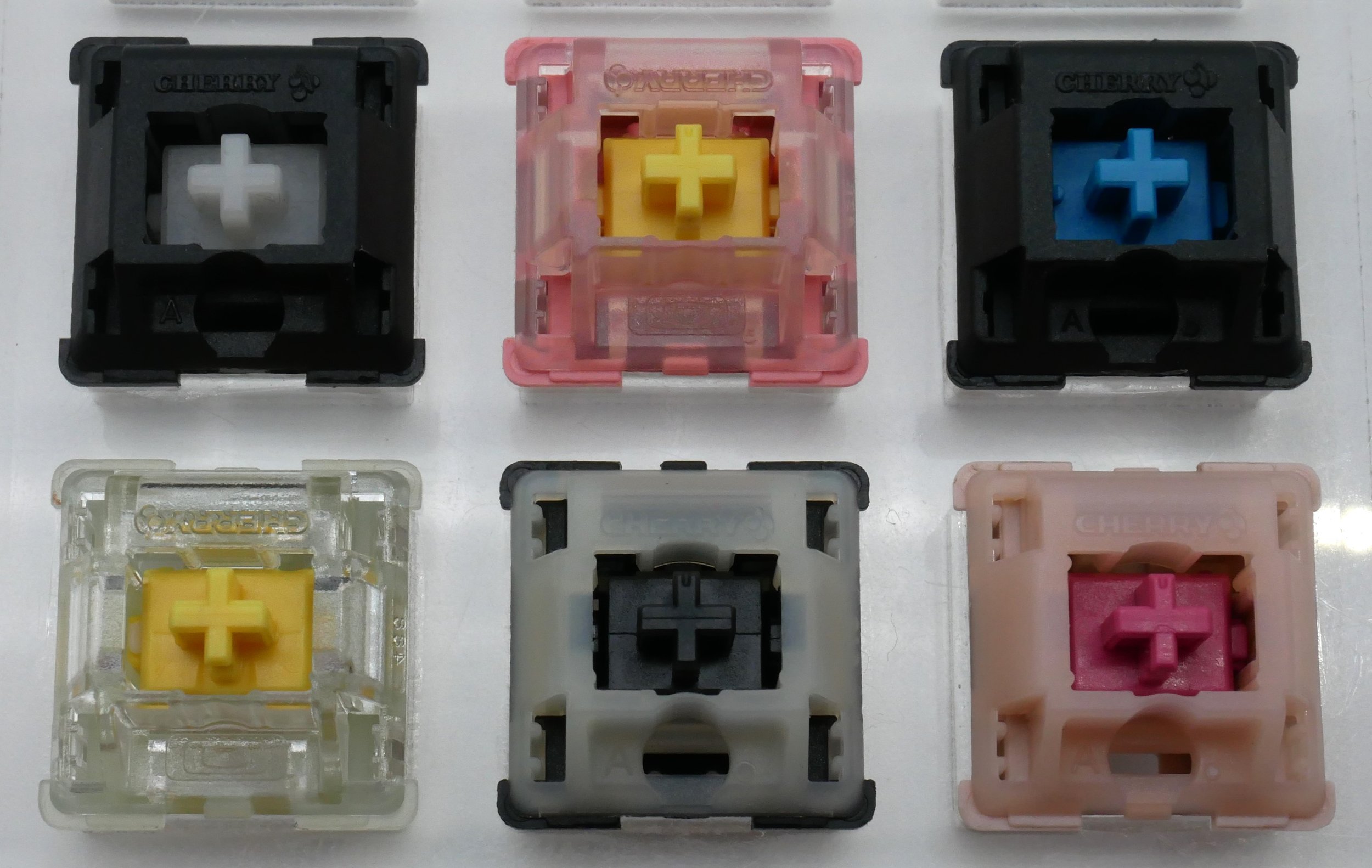
Figure 21: Switches for comparison. (L-R, Top-Bot: Cherry MX White Dummy, Cherry MX2A Blossom Dummy, Cherry MX2A Blue Dummy, Cherry MX2A Honey Dummy, Cherry MX2A New Nixie Dummy, and Cherry MX2A Petal Dummy)
Cherry MX White Dummy
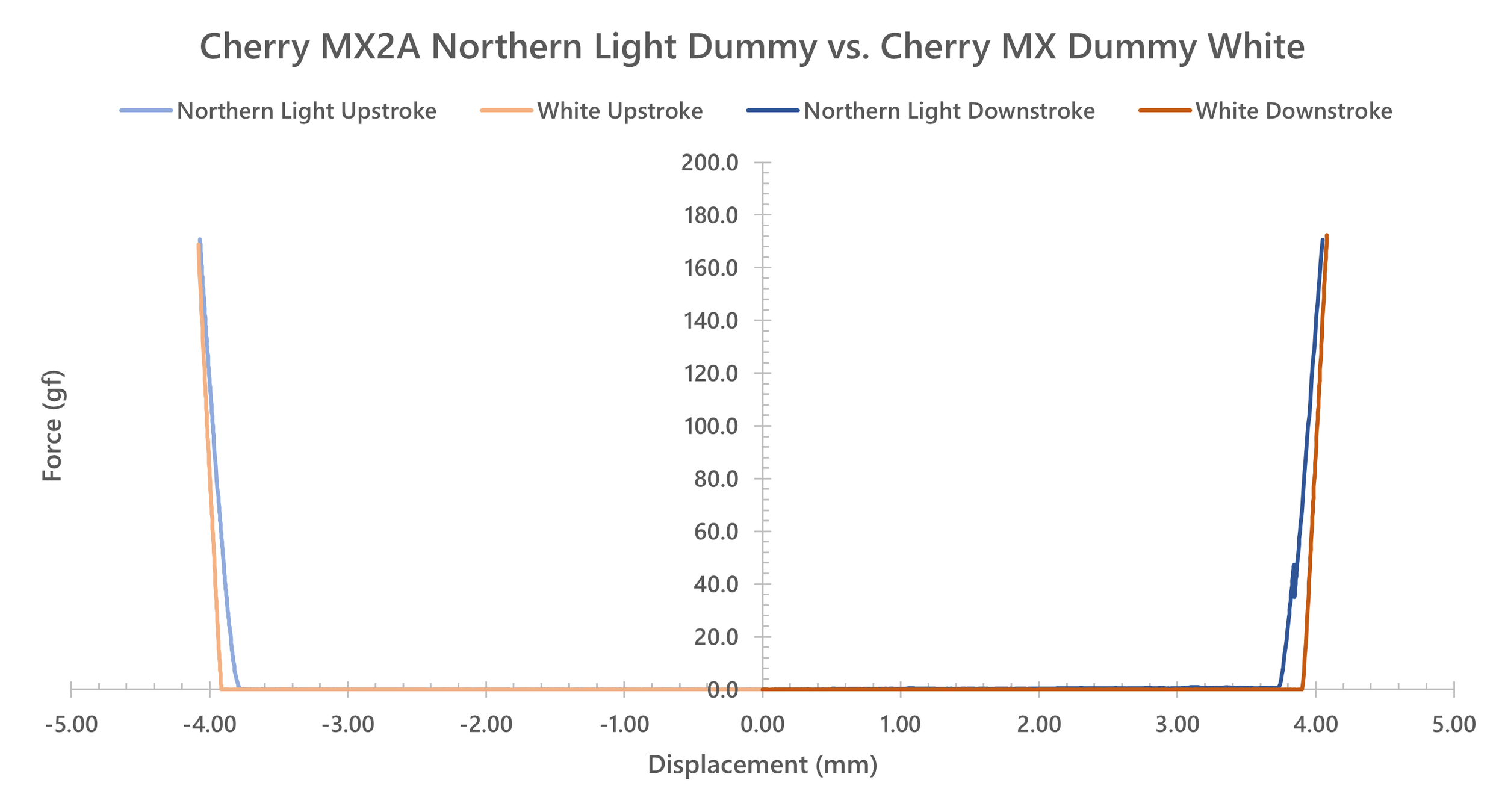
- Presumably as a result of differences in mold precision between the vintage Cherry MX Dummy platform and the modern, newer molds of the Cherry MX2A Dummy platform, the MX2A Northern Light Dummy switches have significantly less N/S and E/W direction stem wobble both when in resting position and with larger keycaps placed on them.
- While the sound of these two dummy switches are quite a bit different from one another on account of one being a silent linear (MX2A Northern Light Dummy) and the other just being a normal linear (MX White Dummy), both have features that exemplify Cherry switches at their best. The Cherry MX White Dummy switches have bottom outs that are deep, rich ,and perfectly in line with the classic full nylon housing bottom out that cherry is most known for whereas the MX2A Northern Light Dummy switches are softer, more muted, but definitely still firm.
- To nobody’s surprise, the Cherry MX2A Northern Light Dummy switches are the smoothest of these two.
Cherry MX2A Blossom Dummy
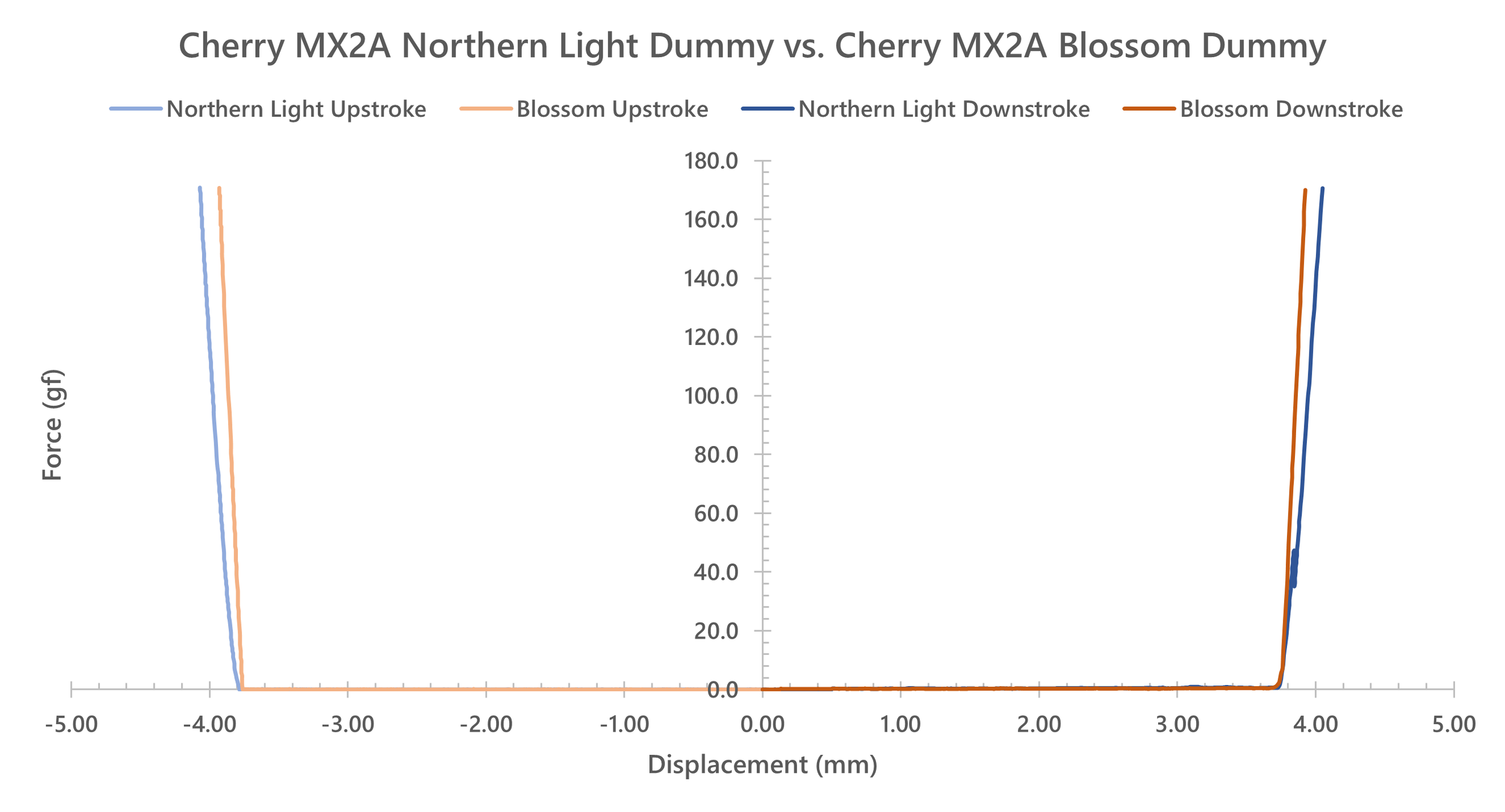
- Of all of the switches on this comparison list, these two are the closest in terms of their physical attributes on account of them likely being the most similar to each other in design in their conventional MX2A platform designs. The biggest difference between them is at the immediate start of bottom out where the Imipolex G dampening pads of the MX2A Northern Light Dummy switches more voraciously devour bottom out sounds.
- On account of having the dampening pads at the base of the slider rails which help mute out both the bottom out feeling and sound, the MX2A Northern Light Dummy switches are much better dummy switches for maximizing the “localized force differentiation” effect. The MX2A Blossoms, by comparison, just sound a bit too much like other Cherry MX2A linears at bottom out.
- The MX2A Blossom Dummy switches have ever so slightly less N/S and E/W direction stem wobble to them than the MX2A Northern Light Dummy switches.
Cherry MX2A Blue Dummy
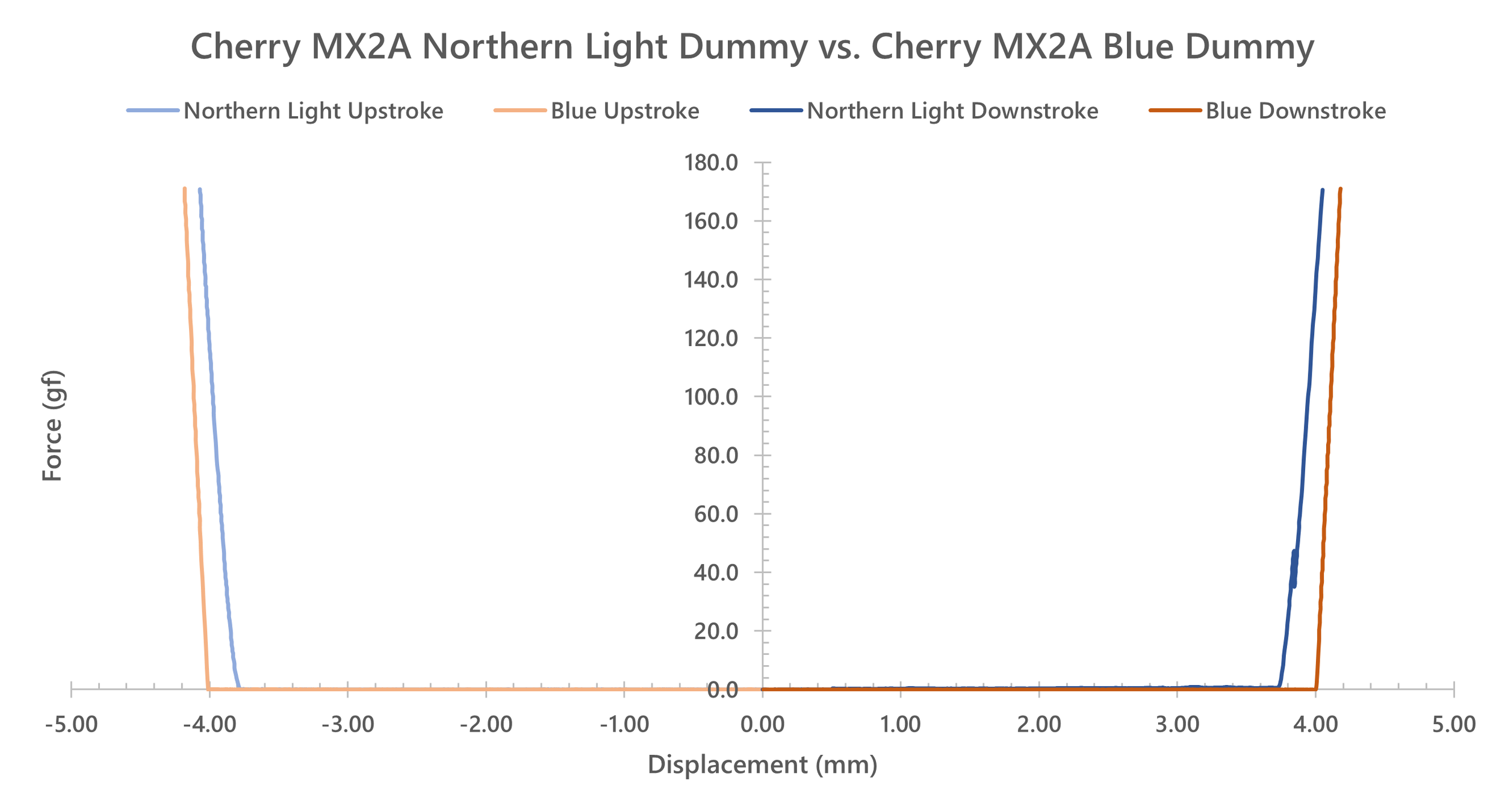
- You know, I don’t really understand why Cherry chose to make the MX2A Blue Dummy switches, and especially so on account of the fact that they are using the same two-part click jacket stems as their non-Dummy counterparts. Without any spring or leaf to separate them throughout a more prolonged stroke, they just result in a sporadic, inconsistent plastic on plastic grinding sound that is just simply not present in the Cherry MX2A Northern Light Dummy switches at all.
- The Cherry MX2A Northern Light Dummy switches have a significantly smoother stroke to them than the MX2A Blue Dummy switches and likely much more precise factory lubing application.
- On account of the dampening pads being present in the Northern Light Dummy switches, as well as the fact that their stems are not constructed of two parts that are partially separable, they have a much more quiet, dampened, and consistent sounding bottom out than the MX2A Blue Dummy switches.
Cherry MX2A Honey Dummy
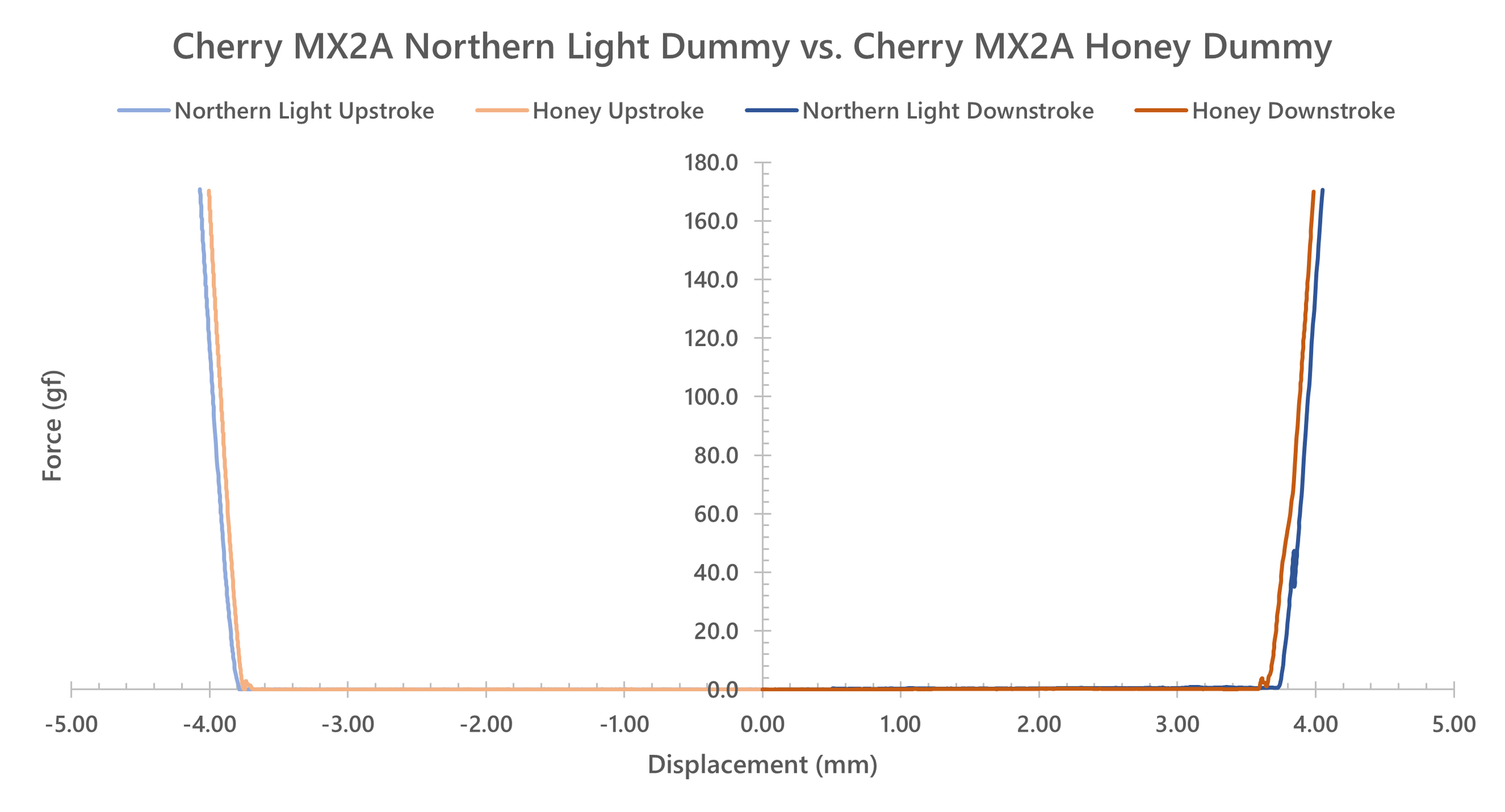
- The Cherry MX2A Honey Dummy switches have ever so slightly less N/S direction stem wobble than the Cherry MX2A Northern Light Dummy switches when in resting position, though surprisingly about the same amount of E/W direction stem wobble. I suspect that this is due to their slightly larger stem legs on account of being silent tactiles bracing up against the bottom housing geometry used for holding the leaves in their normal counterparts better than in the Cherry MX2A Northern Light Dummy switches.
- These two switches are fairly comparable to one another in terms of their factory lubing, coming across equally smooth both through each stroke as well as across the batch of each that I received.
- The dampening pads of the MX2A Honey Dummy switches are a fair bit stiffer and inconsistent than the Cherry MX2A Northern Light Dummy switches, giving their bottoms out a more firm, almost punch-like sound to them as opposed to the more enveloping, black-hole like sound of the MX2A Northern Light Dummy bottom outs.
Cherry MX2A New Nixie Dummy
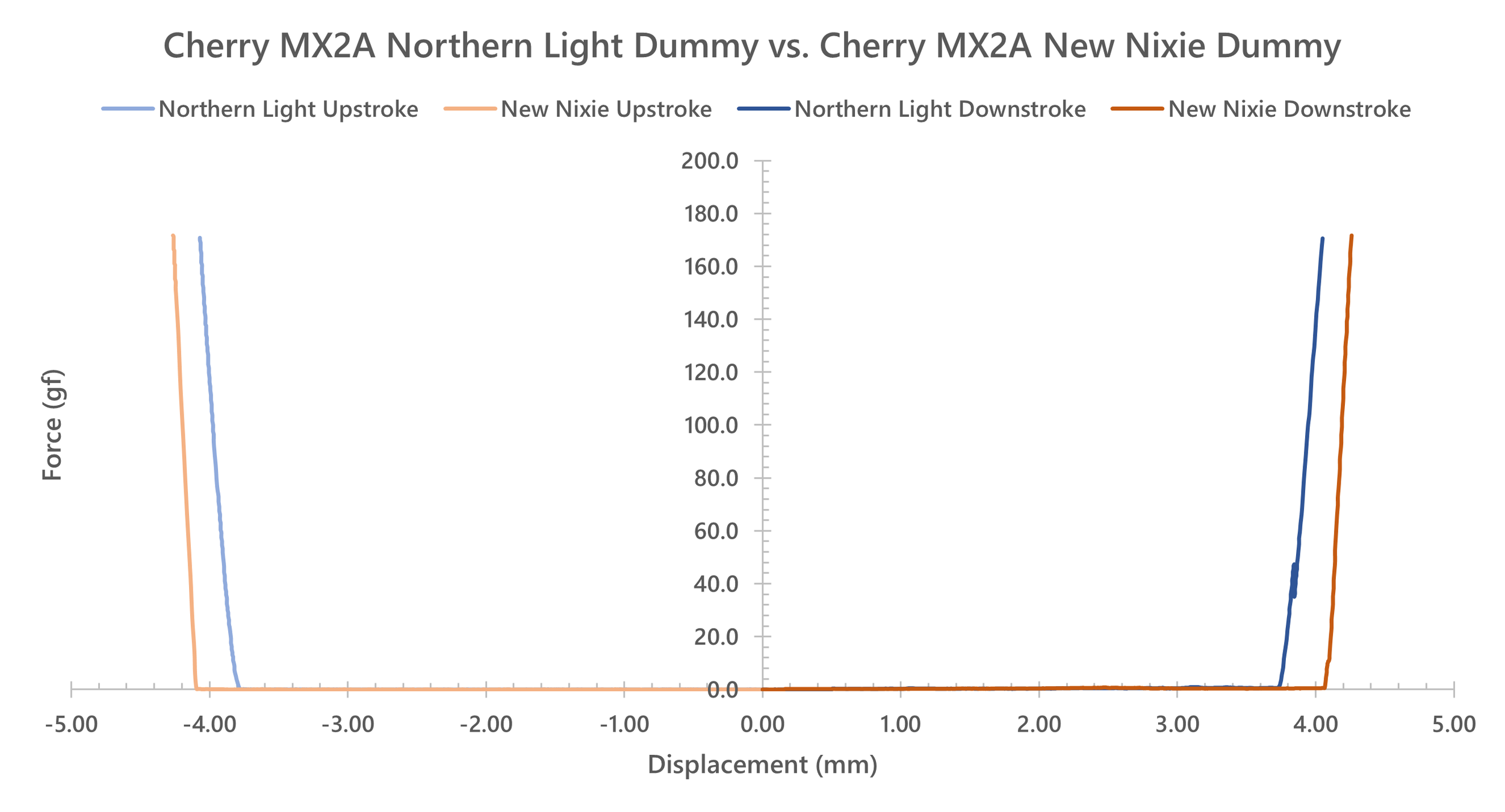
- While I recognize the marketing rational behind Cherry rolling out their Dummy switch variants to all of their MX2A platform designs, the presence of New Nixie Dummy switches is the hardest for me to conceptually wrap my mind around as the Softkeys keyboards where the original Nixie switches were found had no large keys that would have required stabilizers. IT certainly pushes you to imagine what such a board would have looked like with a BAE key, or a 10u spacebar…
- Despite both being lubed on Cherry’s MX2A platform, the MX2A Northern Light Dummy switches are quite a bit smoother and consistently smooth across the batch that I received than the MX2A New Nixie Dummy switches.
- There is less stem wobble in both N/S and E/W directions of the Cherry MX2A Northern Light Dummy switches than there is in the Cherry MX2A New Nixie Dummy switches.
Cherry MX2A Petal Dummy
- While the true tactility of the Cherry MX2A Petal Dummy switches has been neutered on account of not having a leaf for their tactile stem legs to interact, they just have a certain tactile vibe to them that gives them an imbued pseudo-tactile feeling that makes them not only quite a bit different through their strokes than the Cherry MX2A Northern Light Dummy switches, but also fairly unique amongst all of the switches tried here on this comparison list.
- The Cherry MX2A Northern Light switches have a tiny bit greater N/S stem wobble than the MX2A Petal Dummy switches for similar reasoning as described in the comparison to the Cherry MX2A Honey Dummy switches above.
- The bottom outs of the Cherry MX2A Northern Light Dummy switches are much more quiet, void like, and dampened than those of the MX2A Petal Dummy switches.
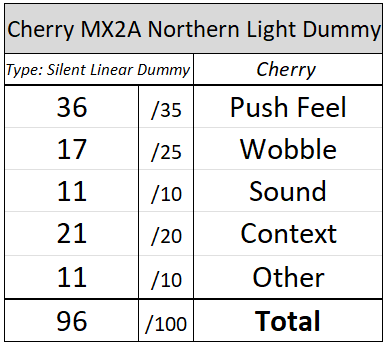
Scores and Statistics
Note – These scores are not necessarily completely indicative of the nuanced review above. If you’ve skipped straight to this section, I can only recommend that you at least glance at the other sections above in order to get a stronger idea of my opinion about these switches.
Push Feel
While the Cherry MX2A Northern Light Dummy switches have all of the characteristics of their non-Dummy counterparts, they also feature “better” factory lubing on account of not having excess lube trapped by springs, a special Impiolex G dampening pad material, and the incredible ability to modify the feeling of individual portions of large keys they stabilize depending on the combination of other switches they are put with. Put simply, they enable an entirely new meta of large-key keyboard design and customization which previously could’ve never been dreamed of.
Wobble
The one Achilles’ Heel of the MX2A Northern Light Dummy switches is their slightly greater N/S and E/W direction stem wobble at resting position. Don’t worry, though, this has no noticeable effect on their ability to help stabilize large enter keys or spacebars.
Sound
These just sound so good. Combining the deep, black hole like bottom outs of the modified dampening pads of these switches which just suck in sound along with their ability to sonically alter the strike location of large keys makes these truly groundbreaking among all other switch offerings that exist out there. If I could put these underneath each and every one of my alpha keys on a keyboard, I would easily do so in a heartbeat.
Context
While these switches are priced a tiny bit higher than their non-stabilized MX2A alternatives, their creation of a new “localized force differentiation” meta while aesthetically matching all present Cherry MX2A platform offerings more than makes them worthwhile switches with incredible price per performance. Cherry absolutely nailed the design and execution of these.
Other
Honestly what more could I possibly say? You’d have to be an absolute dummy to skip over MX switch technology which will define the meta of keyboard design for years to come…
Statistics
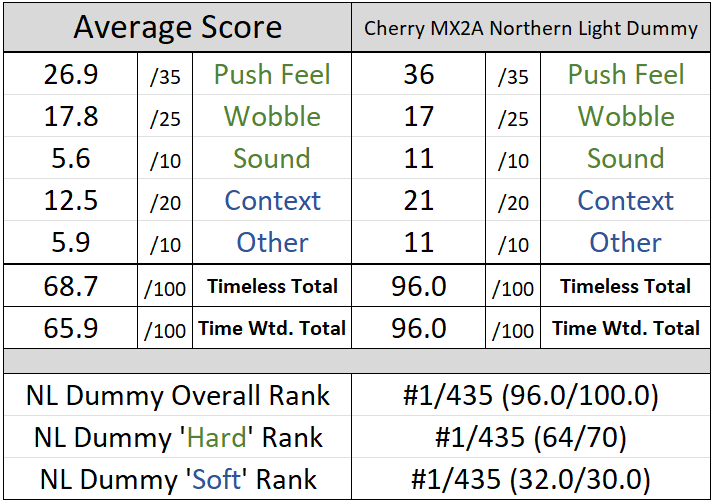
If you are looking at this statistics section and wondering what the heck ‘Timeless’ and ‘Time Weighted’ scoring is, consider checking out my short article titled ‘A Scorecard Time Change’. As a result of scoring becoming a bit anachronistic over the years, switches are now ranked in this statistics table using a “time weighted total” as opposed to their day-of scoring as discussed in that article. If you’d also like to learn about what ‘hard’ versus ‘soft’ ranks refer to specifically, I’d encourage you to head on over to my GitHub linked in the table above or at the links in the top right hand of this website to check out my database of scorecards as well as the ‘Composite Score Sheet’ which has a full listing of the rankings for each and every switch I’ve ranked thus far.
Final Conclusions
When I was initially reached out to by Cherry in order to see if I wanted to review the MX2A Dummy switches, I have to admit that I was quite a bit skeptical of the idea of modern dummy stabilizer switches in 2026. Sure, they laid out a whole great pitch as to how they see keyboards expanding into the direction of needing these kinds of switches in the near future and it was a rather well thought out idea, though this was just not at all the direction I was expecting Cherry to take. (Especially considering their recent move of production away from their C-Lab team and to China and needing to try and fight for relevancy in the current space as it is established today.) After getting the switches on hand and testing out though, the results were initially a bit as expected. The MX2A Northern Light Dummy switches were very similar to their standard MX2A counterparts on account of their through-stroke smoothness, dampened bottom out feelings, and general appearance of types of materials used for their construction. However, as I began looking a tiny bit closer at the finer details, the differences that clearly made Cherry so excited to release these switches began to pop out, including the specialized dampening material that makes their bottom outs dampen sound like they’re noise cancelling headphones or the combined increases in both stem wobble and (shockingly) switch to switch consistency on account of not having springs to reduce the wobble and trap lube in the bottom housings. It was the final moments before I tried the Cherry MX2A Northern Lights Dummy switches on stabilizer-requiring keys within combinations of other switches that I remained left in the dark as to their true potential though. Those first presses after this point were truly eye opening. The sheer ability of the MX2A Northern Light Dummy switches to alter the feeling and sound note just of entire keys but rather specific portions of larger ones such as BAE Enters or 7u+ long spacebars depending on where the Dummy switch is installed opens up an entirely new world for custom mechanical keyboard switch enthusiasts that I could not have imagined existing prior to trying these switches. “Localized force differentiation” makes these switches able to modify the sound and feeling not just of your entire keyboard but narrowly each section of each of your largest, most important keys on your keyboards in ways unparalleled in any past switch designs, MX or otherwise. The Cherry MX2A Dummy switch concept is one that is truly paradigm shifting, and any reviewer of these that tries to convince you otherwise is almost certainly a liar. And if liar is perhaps too strong of a word because they could be misguided, substitute the word “Dummy” instead. You’d have to be a dummy to truly think that the Cherry MX2A Dummy switches won’t altogether change the meta and future trajectory of the modern mechanical keyboard hobby. And you would also have to be a bit of a dummy to think that these were actually real switches. Happy April Fool’s Day everyone!
Sponsors/Affiliates
Mechbox UK
- A wonderful UK based operation which sells singles to switches that I’ve used above in my comparisons for collectors and the curious alike. Matt has gone out of his way to help me build out big parts of my collection, and buying something using this link supports him as well as my content!
KeebCats UK
- A switch peripheral company based out of the UK which sells everything switch adjacent you could ask for, they’ve been a huge help recently with my film and lube supply for personal builds, and they want to extend that help to you too. Use code ‘GOAT’ for 10% off your order when you check them out!
proto[Typist] Keyboards
- An all-things keyboard vendor based out of the UK, proto[Typist] is a regular stocker of everything from switches to the latest keyboard and keycap groupbuys. While I’ve bought things from the many times in the past, they also are a sponsor of my work and allow me to get some of the great switches I write about!
Divinikey
- Not only do they stock just about everything related to keyboards and switches, but they’re super friendly and ship out pretty quick too. Divinikey has been a huge help to me and my builds over the last year or two of doing reviews and they’ll definitely hook you up. Use code ‘GOAT’ for 5% off your order when you check them out!
ZealPC
- Do they really need any introduction? Zeal and crew kicked off the custom switch scene many years ago with their iconic Zealios switches and the story of switches today couldn’t be told without them. Use code ‘GOAT’ (or click the link above) for 5% off your order when you check them out!
MechMods UK
- A rising vendor based in the UK, Ryan and crew have been a pleasure to work with and have nearly everything you’d need to build your first or fourteenth keyboard. Go build your latest or greatest one right now with them by using code ‘GOAT’ at checkout for a 5% discount!
Dangkeebs
- A longtime supporter of the website and the collection, Dangkeebs has quite possibly the widest variety of switches of any vendor out there. Not only is their switch selection large, but it rotates and is constantly adding new stuff too. You’re going to need 5% off your order with my affiliate to save off the cost of all those switches!
SwitchOddities
- The brainchild of one my most adventurous proxies, SwitchOddities is a place where you can try out all the fancy, strange, and eastern-exclusive switches that I flex on my maildays with. Follow my affiliate code and use code ‘GOAT’ at checkout to save 5% on some of the most interesting switches you’ll ever try!
Cannonkeys
- Does anybody not know of Cannonkeys at this point? One of the largest vendors in North America with keyboards, switches, keycaps, and literally everything you could ever want for a keyboard always in stock and with an incredibly dedicated and loving crew. Follow my affiliate link above in their name to support both them and I when you buy yourself some switches!
Kinetic Labs
- One of the most well-rounded keyboard vendors out there, Christian and crew have been supporters of all my switch and switch-adjacent needs for some years now. I’m honored to have them as an affiliate and think you should check them out using my affiliate link above to support both them and I when you check out their awesome products!
Keebhut
- Want to try out some switch brands that fly under most vendor’s radars? Keebhut is always seeking out that next latest and greatest and has been super helpful in hooking me up with new brands over the past year. They are all about sharing that love as well, and want to give you 5% off your next order with them when you use code ‘GOAT’ at checkout!
Kailh
- No, you’re not mistaken – this is actually that Kailh that manufactures switches. As one of the longest running manufacturers in the hobby, they have a massive variety of switches available over on their website at any point in time. I’m lucky to be affiliated with them now, and so consider using my affiliate link above when ordering some Kailh switches to support me!
Keebz N Cables
- Australia and Oceania’s very own is now a part of the sponsor list here and I couldn’t be happier to add this long time supporter of the collection to it. They’ve always got an amazing selection of switches (and other keyboard parts) in stock and they want to share the love that they’ve shown me with you all too! Use code ‘thegoat’ for 5% off your first order when you visit!