HMX Volume 0-T Switch Review
Looking back to the switch review that rounded out the tail end of 2024 – the Mitarashi Dango Switch Review – I can pretty clearly see me pointing out how I get to this part of the year and in the process end up confused as to where the entire 11.5 months preceding it all went. I’m certainly glad I chose to look back at the introduction before writing this one as that confusion is not only still plainly present in my mind but almost led to me writing an early identical introduction again to the last switch review of 2025. In my defense, though, I can hardly help but wonder where all the time has gone as it has been occupied with an endless list of interesting life events, a series of work responsibility and position shifts, and a keyboard switch world that was just as equally tumultuous over that short span of months a well. Even without going into the depths of my actual “in real life” life, just the list of new, unique, and interesting switches we’ve got to experience over the past calendar year by way of reviews has been quite the impressive list looking back. The not too short and yet also not exhaustive list of these impressive switches include the Sillyworks x Gateron Type Rs, the AEBoards Naevy EC and Raed HEs, Cherry MX Northern Lights, WS Flux HEs, Gateron Lanes, Invokeys Goji Reserves, and even more that I didn’t write full length reviews for. Tack on the appearances of new manufacturers in Wingtree, K2, and WEKT as well and there’s almost too much to discuss in switches over the past year of releases. 2025 truly seemed to have a stacked lineup of switch offerings well beyond what I could have hoped for about this time last year – even with the hobby continuing to contract from its post-COVID highs as we head into 2026.
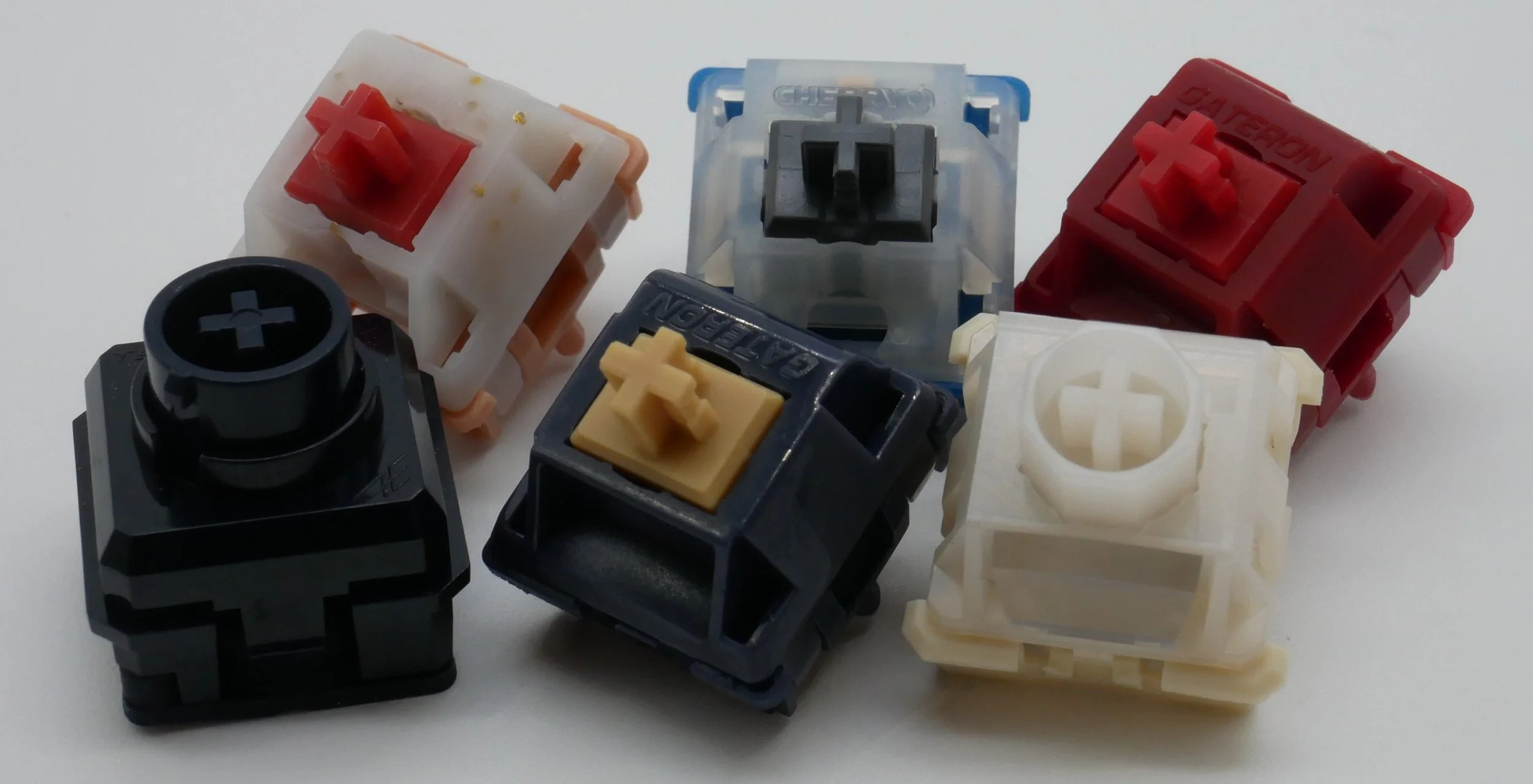
Figure 1: Some of this year's 'big hitters' looking back through all of the switch reviews of the past 12 months.
Speaking of contracting attention surrounding switches, though, before I truly lose all of the casual readers among you to a two paragraph-long introductory section, I wanted to say thank you very much to everyone who has read a switch review, looked at a force curve, or supported my content in any way, shape, or form throughout the course of 2025. (Yes, even those among you who downvote me consistently on Reddit.) While I’ve certainly not lived up to every expectation I had of myself as a content creator this year (and thus probably by extension the expectations of you all, the readers), there’s been a lot of richly complex and winding articles that were written this year, mountains of new force curves and measurements uploaded, and nearly 500 brand new switches added to the collection in just a short span of 12 months – and all of those things wouldn’t have been possible without your continual encouragement and support. No, seriously. Not only is seeing the positive reception of my content five years down the road motivating to keep me coming back to my desk to write every single weekend, but it reminds me of the value of resources that I myself don’t really have much use for. Since I don’t need to engage with reviews to learn about switches since I more or less have all of the ones I could ever ask for, it really is blind to me how much of a help they can be in any of their forms. Even just the reception surrounding the force curves I’ve put out week over week, or the fact that the Scorecard Repository has now officially had over 1,000,000 views all time since I first started it really reminds me of how important it is to keep up this work week in and out. So while I have no explicit plans for the rest of this calendar year when it comes to content and switches, know that I’m already mentally squaring up to try and take on a bunch of new, exciting, and different-for-me ideas throughout 2026 much like I did going into this year. I’m never one to promise or spoil anything too much, so unfortunately the secrets as to what explicitly those plans are will have to remain with me for now, but I promise they’ll be good. Or at least I hope they’ll be as I’ve got to keep you all entertained with writing about switches for yet another year… In the meantime, I hope you all enjoy this deep dive on 80Retros, the first HMX-made silent tactile switches, and one last switch review to close out 2025!
Switch Background
There’s hardly any need for a winding, slowly narrative introduction to help ease into this background section as anyone who has been here before knows how the next handful of paragraphs is bound to end up going. (And for those of you who are here for the first time, firstly welcome, you’re going to have the secrets to my reviews and how they’re structured spilled to you here right now, and yes I do break the fourth wall with run on sentences and dubious grammatical choices often.) As part of my strive to document as much information about interesting modern mechanical keyboard switches as I can, I always try to deeply or shallowly cover the backgrounds of brands, manufacturers, and relevant vendors whenever they put out a unique, exciting, or history-rich switch. This time, we’re in for a long haul of coverage on 80Retros – a fairly young and nominally faithful to vintage-focused aesthetics brand that has produced quite a few switches and keycap sets out of China in recent years. Self-professed lovers of “all things vintage and retro”, their introduction into the mechanical keyboard market by way of their ‘Game 1989’ keycap set interest check on ZFrontier barely two years ago on December 1st, 2023, was the brief, detail heavy start to an equally brief and detail packed two years of production history. Whereas most brands and designers will slowly roll their way onto the scene and test if one or two of their ideas gains community attraction before pushing for multiple at the same time, 80Retros has hit the ground running after the success of the Game 1989 keycap set design and have since pushed out nearly a dozen different switches across two different manufacturers in just two years’ time, as well as a unique line of memorable switch packaging, and even one very special switch-adjacent accessory that may have directly influenced me to pick up these switches and review them in the first place. Needless to say, that’s a lot of ground to cover. So with about as much beating around the bush as 80Retros tends to give in their IC and GB posts, let’s go over their various switches they’ve released in a mostly chronologically correct order.
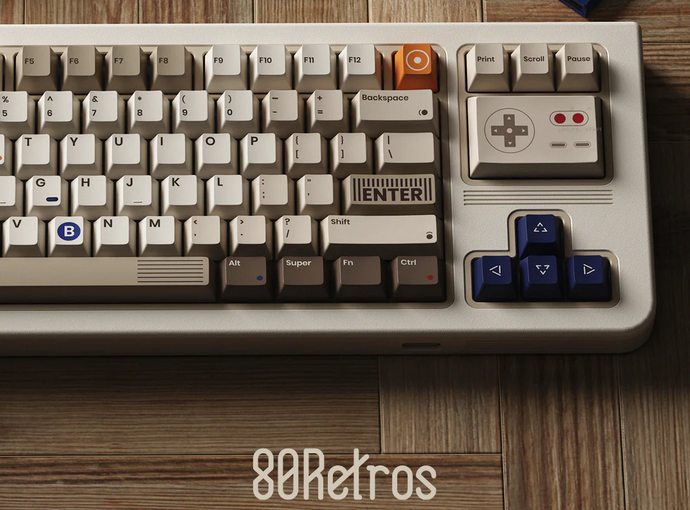
Figure 2: Renders of the original 'Game 1989' keycap set from 80Retros' debut ZFrontier post.
‘Game 1989 Switches’
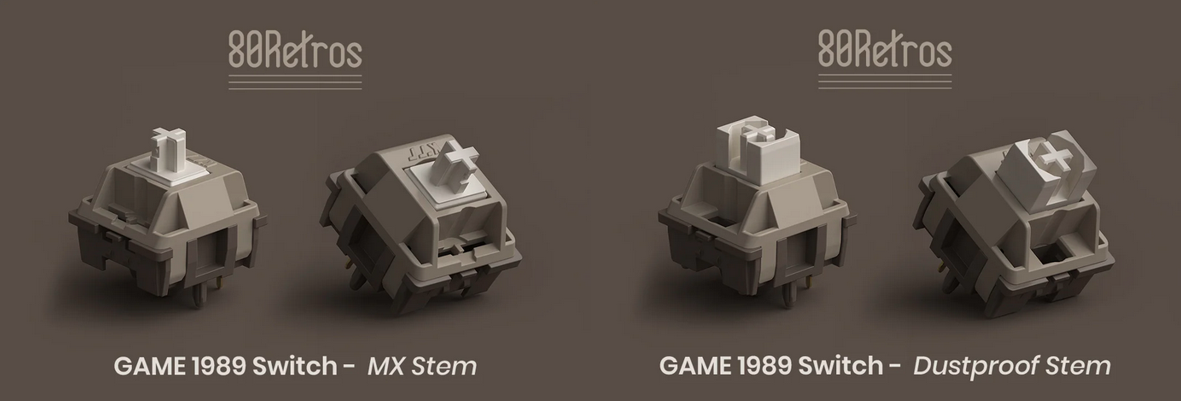
Figure 3: Portions of marketing renders for the original 'Game 1989'/'KTT 80Retros (Dustproof) Silver' switches.
More locally known to western switch audiences as the “KTT 80Retros Silver” and “KTT 80Retros Dustproof Silver” switches, this originally eponymously named set of switches was first debuted by 80Retros a month after the initial interest check post for the matching Game 1989 keycap line. While the initial interest check for these switches, which was really just a ‘for sale’ post made without any obvious outward warning to their customers, was a bit short on details, what is clear from the start is that 80Retros was aiming to differentiate themselves from the rest of the switch scene at large despite their retro inspiration. Utilizing new molds and manufacturing techniques from KTT, the Game 1989 switches were to feature 3.20 mm long strokes (as compared to a traditional 4.00 mm travel) as well as a rapid actuation between 1.30 and 1.50 mm into the downstrokes. Additionally, even the traditional concept of “POM/PC/PA materials” were challenged in these switches with both the POM and PA materials reportedly having a modified, custom blend made exclusively for these switches. These switches were available directly on TaoBao at the time of the original post on January 6th, 2024, at prices of 75 RMB per a box of 45 switches, or $0.24 per switch.
80Retros’ ‘Film Trio’
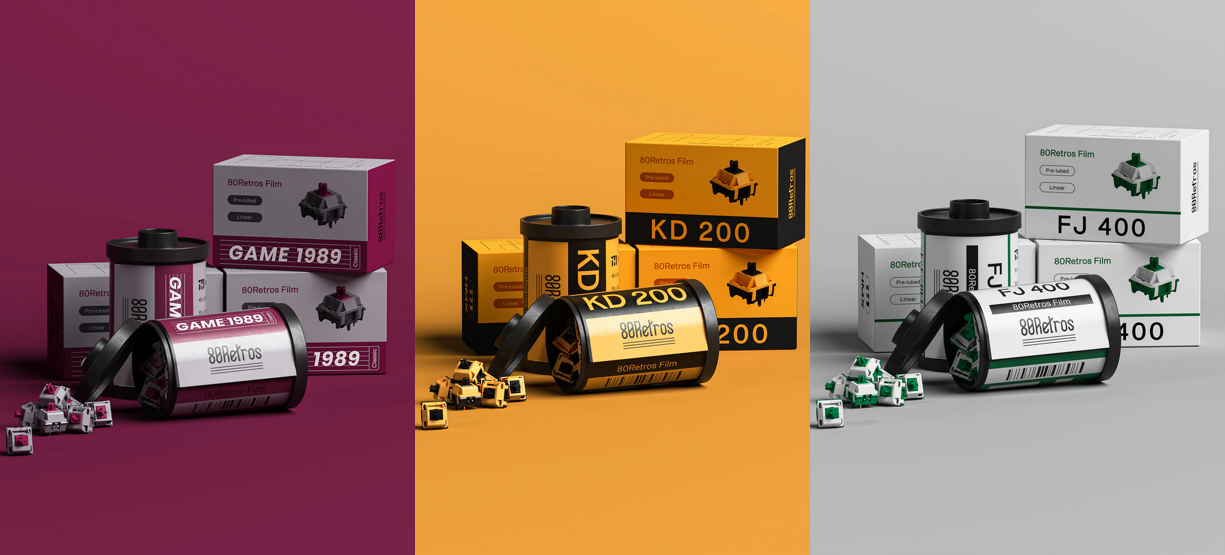
Figure 4: Marketing renders from the initial interest check of the 80Retros 'Film Trio' including Game 1989 (Left), KD200 (Middle), and FJ400 (Right) switches.
Barely five months down the road from the success of their Game 1989 keycap set and matching switch designs, 80Retros went right back to the well and doubled down on their modus operandi in pushing for new and unique production with an obvious inspirational pull from the vintage. While mixed, the inspiration from the old is obvious here – with the Game 1989 switches in purple and grey matching their May-teased Game 1989 Classic GSA keycap set inspired by the Gameboy Classic and the KD200 and FJ400 switches inspired by classic vintage film brands Kodak and Fujifilm, respectively. What was not as obvious, though, was 80Retros’ take on switch packaging for this new trio. Heavily inspired by the film canisters of the Kodak and Fujifilm brands, the interest check for all three switches (yes, even the non-camera ones too) featured renders that showed off a large film canister-like packaging for each of these switches as opposed to conventional cylinders or bags. Clearly a bit more wary about this custom packaging design than their first switch run, this initial post in June of 2024 was only an interest check but easily could have skipped right to the groupbuy phase for these switches which took place a month late on July 5th. Both in the interest check as well as the groupbuy, the community seemed enthralled by these switches, their variety of HMX-made component compositions (KD200: LY/PA/P2 , FJ400: T2/PC/P2 , and Game 1989: T5/PC/P4), and their unique packaging – quickly selling tons of all three at pricing of 65-70 RMB (~$9-10 USD) per canister of 35 switches.
‘80Retros’ Expanded Film Series’
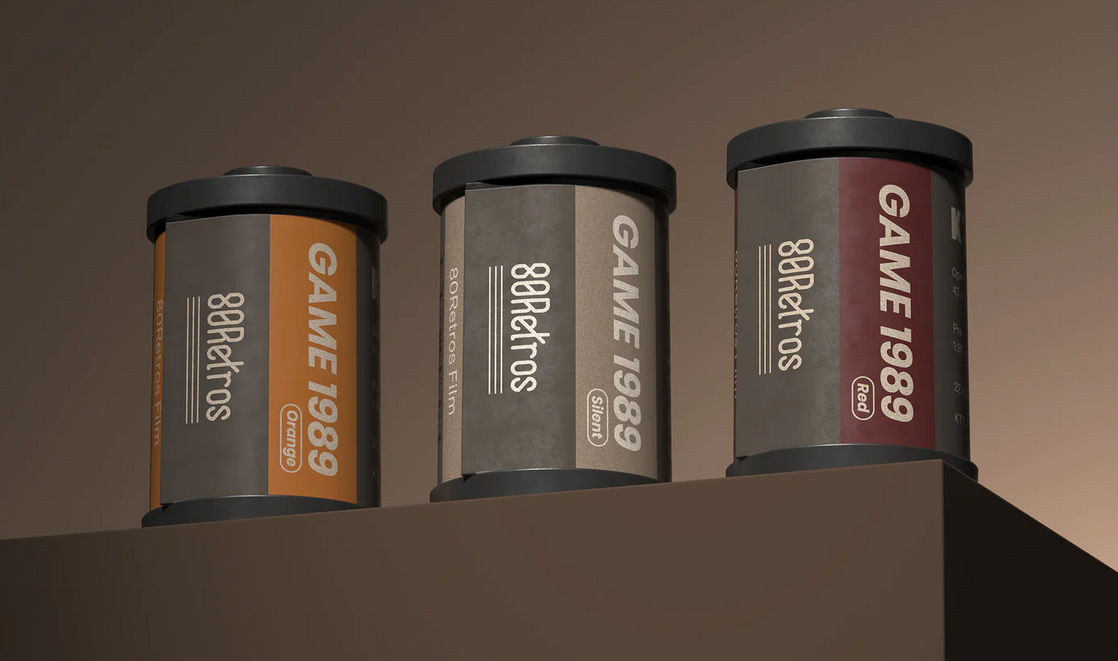
Figure 5: Marketing render of three of the four switches released in 80Retros' 'Expanded Film Series' in their iconic film canister packaging.
While the 80Retros’ ‘Film Trio’ packaging was initially done directly in conjunction with a pair of switches that carried film and photography themes, the overwhelmingly positive community sentiment surrounding the packaging led to them leaning further into the aesthetic than just with that release. If nobody thought the inclusion of film canister packaging for Classic Gameboy-inspired switches was weird, surely they’ll never stop to think if other vaguely vintage, or even holiday themed switches would apply here right? Presumably that is the exact line of thinking that 80Retros chose to engage in on their January 6th, 2025, post to ZFrontier introducing the now expanded “Film Series” of switches with a late XMAS switch from HMX as well as Game 1989 Red, Orange, and Silent White varieties from KTT. (Yes, they had identically marketed and packaged switches produced by two different manufacturers released side by side.) Again leveraging creativity with making custom switch material blends, each of these releases featured a scattering of new materials not seen in the original Film Series trio as well as a fairly uncommon for HMX switch type in ‘silent linears’ for the White switches. (XMAS: T2/P3/PA66 , Orange: KT2/PC/PA66, Red: KT3/PC/PA66, White: POM+TPE/PC/PA66) While I cannot find an explicit groupbuy/sale post announcement on ZFrontier from 80Retros, in line with when I received my switches for the collection as well as their general posting tendencies, its assumed these were available within a couple of weeks before or after this post was made. It should also be noted that initial marketing from 80Retros also showed the HMX Joker switches and film canister packaging as part of this new ‘Expanded Film Series’, though I can find no ZFrontier posting from 80Retros regarding these switches which I believe came out several months prior to the set of four switches teased in this post. Presumably these are also officially part of the Film Series of switches.

Figure 6: Marketing render of the fourth switch released as part of 80Retros’ ‘Expanded Film Series’ – the XMAS switches.
HMX Volume 0 and 0-T
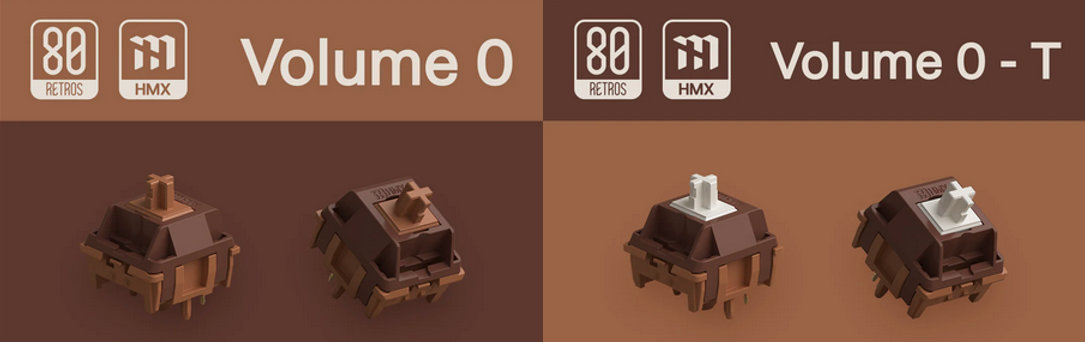
Figure 7: Portions of marketing renders for the 80Retros and HMX Volume 0 and Volume 0-T switches.
Never content with the number of non-film related switch themes being packaged up and shipped out to customers in large scale replica film canisters, 80Retros got right back to work on October 5th, 2025, and fulfilled their vaguely 6 month plus or minus a couple of day release schedule with the debut of the HMX Volume 0 silent linear and Volume 0-T silent tactile switches. Like with most other interest checks and sale posts by 80Retros, these switches are surprisingly short on their details in their introductory post despite being uncommon for HMX (silent linear) and previously unheard of for HMX (silent tactile). And while I could choose to go into more complexity about their weightings, force curves, and PA12 over P4 housing designs, the remainder of this introductory post largely focused on a unique, theme-matched accessory to go with the Volume 0/0-T switches – a Pinqi Blocks 80Retros’ switch café display. No, I’m not kidding – a LEGO-like switch display with articulating stem that is actually a miniature café and cityscape display. Needless to say, many people in the comments were incredibly intrigued by this unique switch addition. As per the bottom of this announcement, the switches were officially to be released on October 16th at the price of 65 RMB ($9.23) per canister of 35 switches and the Pinqi block set at 99 RMB ($14.06), or free with purchase of any four switch canisters.
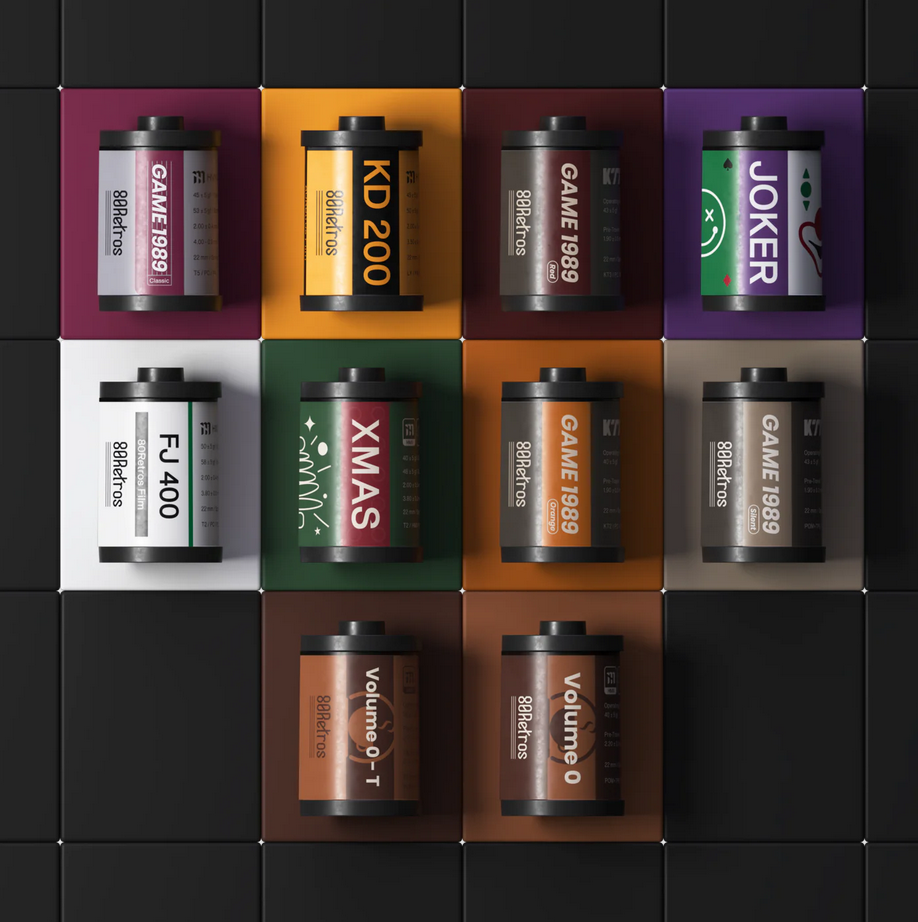
Figure 8: Packaging render from 80Retros' HMX Volume 0 and 0-T introductory ZFrontier post showing the complete 'Expanded Film Series' as of the time of writing this review.

Figure 9: 80Retros' Switch Cafe Pinqi block set render from the HMX Volume 0 and 0-T ZFrontier post.
Did that lineup of switches that 80Retros has designed and released over the last two years feel oddly familiar to anyone else? It’s almost as if there were some other switches which were so uncannily similar in their appearance, design, and marketing that you could almost have believed they would have been on this list, yet they weren’t. Actually, that’s exactly what happened as the quick pivot 80Retros took from KTT to HMX after their first run of switches didn’t really seem to quite fully make the transition that the brand intended for. Whether it was the result of an unknown contract which was not satisfied, harsh feelings following the pivot to HMX, or even the conspiratorial suggestion that the distance from KTT to HMX isn’t really nearly all that far at all, following 80Retros’ pivot to HMX for their Film Trio of switches, KTT went on to release their own line of Retro-colored switches as well. And then they did it again for white-stemmed retro switches. And once more for red-colored stems too. All just like 80Retros’ releases with HMX and all just a couple of months after the success of 80Retros’ runs. Did I mention that KTT also chose to make a blue-stemmed Retro-themed switch as well? Well they did do this, but in an even more confusing fashion 80Retros appears to have enacted their own revenge stealing by debuting their own KTT-made 80Retros Blue switches coming out sometime in early 2026. No, that wasn’t a typo either – KTT made Blue Retro switches clearly ripping off 80Retros’ design motif only for 80Retros to come back and release their own 80Retros Blue Retro switches made by KTT. Don’t worry, at least this is only marginally less confusing when you remember the original KTT-made Blue Retros are linears and the KTT-made 80Retros Blue Retros are silent linears. (Insert confused screaming here.) So while I can assure you that all of the switches discussed above were ones designed and marketed by 80Retros over the last couple of years, I absolutely cannot with any certainty believe that I would be able to tell such looking at them and their KTT inspirations side by side.
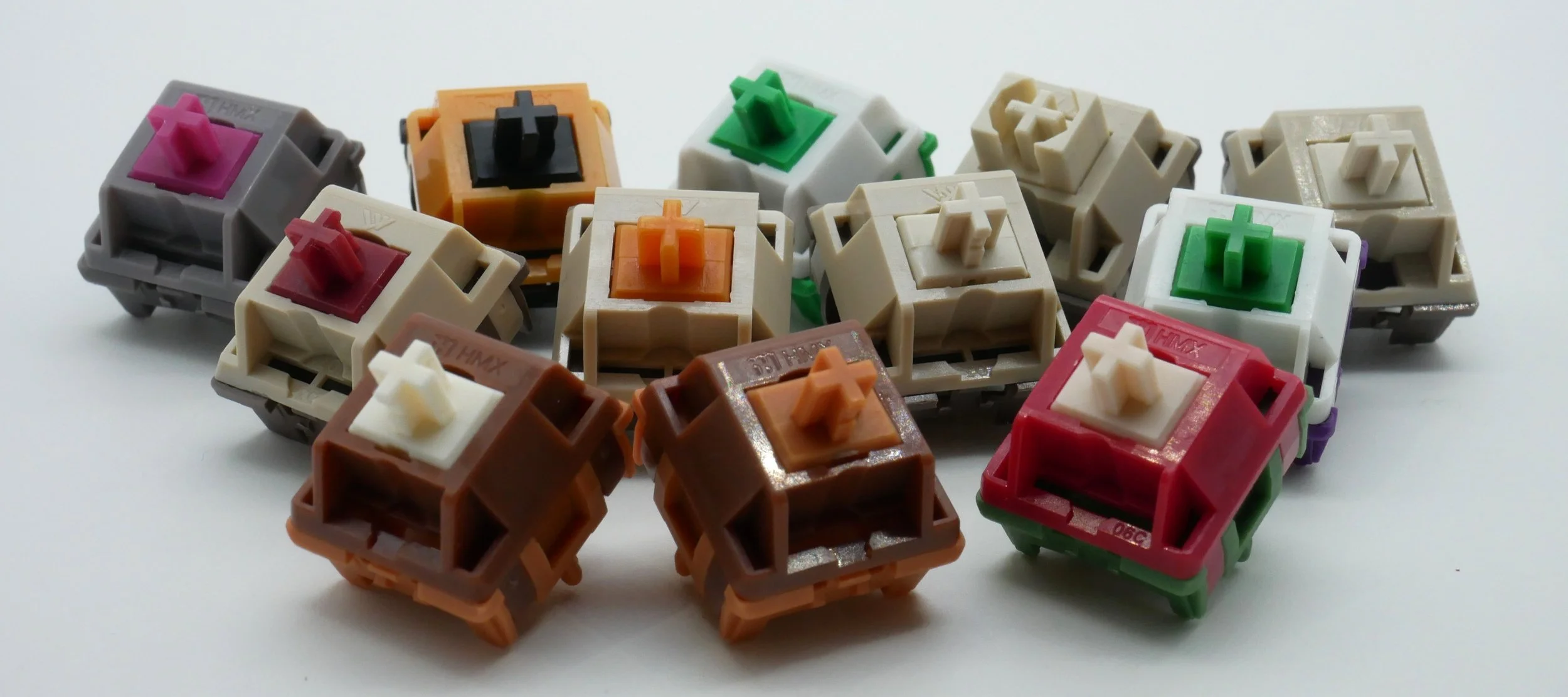
Figure 10: A complete HMX and KTT 80Retros switch family including (L-R, Top-Bot) the Film Trio, KTT 80Retros Dustproof Silver/Silver, KTT 80Retros Retro Red, Orange, and White, HMX Joker, HMX Volume 0 and 0-T, and HMX XMAS)
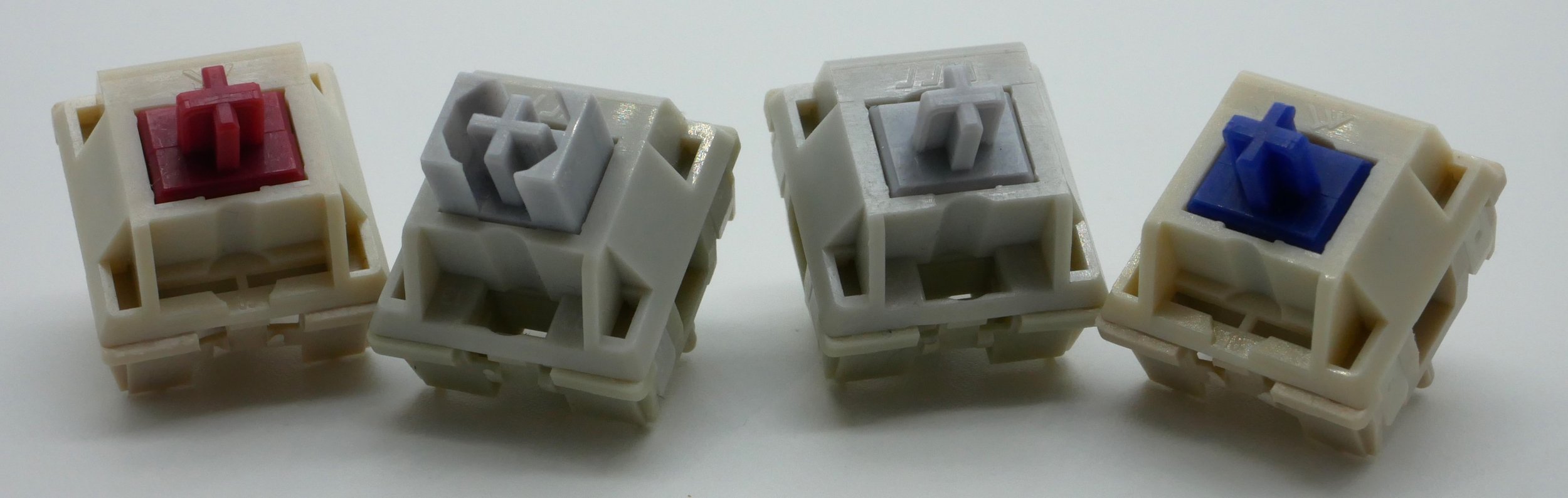
Figure 11: KTT's 80Retros Look-a-like family including (L-R) KTT Retro Red, Retro Dustproof Silver, Retro Silver, and Retro Blue)
Despite 80Retros’ either intentional or incidental inability to break away from KTT through their HMX made switch releases over the years, the Volume 0-Ts might actually be the switches that will allow them do such as they’re a first for HMX and something that KTT has only barely attempted to touch – a silent tactile. Released alongside the HMX Volume 0 silent linears in mid October of 2025, the little marketing that exists surrounding these switches hardly at all focuses on the novelty of their switch type for the manufacturer and instead focuses on their mid to light weight peak tactile force ~53 gf, shortened stem travel ~3.70 mm versus a traditional 4.00 mm travel distance, and dual-injected POM+TPE style stems for silencing. (This is of course in addition to an abundance of marketing surrounding the Pinqi block set that matches the Volume 0 switches released alongside these). Available at the price of ~$0.26 per switch in packs of 35 directly from 80Retros’ Taobao, the hype of a silent tactile made by HMX as well as their marketing accessories has pushed them to nearly a dozen vendors all around the globe with pricing directly varying based on import costs and fees. While 80Retros has never been particularly clear about the direction of their released switches nor how long they will continue to be manufactured for, the fact that these appear to be their most successfully marketed switches to date and fulfill a unique niche in type for an incredibly popular manufacturer in HMX, I imagine that these will continue to be made available for quite some time into 2026, at least.
Volume 0-T Performance
Appearance
At the highest level, the HMX Volume 0-T switches come in a three-part white, dark brown, and caramel colorway that really makes them more deserving of a coffee related theme and name than anything else, including what they actually ended up with. While I know we’re far from short on switches named after drinks, and especially coffee-related ones for that matter, this colorway just feels like an absolute layup for a name like ‘HMX Mocha’ or ‘HMX Cappuccino’ and I’m surprised 80Retros didn’t seize on this. Slight mismatch between name and colorway aside, these switches are definitely stand out in the vibrancy of their colorway though may easily be confused for a couple of other brown and caramel colored switches from over the years when viewed at a distance. Up close, though, the HMX nameplates of these switches makes them plainly obvious as to where they come from as well as what specifically they are as no other HMX switches to date have colors as such, save for the silent linear siblings to the Volume 0-Ts in the Volume 0s, which use a matching caramel colored stem instead of white. All of the other details of note which make the Volume 0-T switches stand out amidst other offerings from HMX and other makers, though, occurs at the part and sub-part level details. Discussion of these details of note at both of these levels may be found in the paragraphs and photos below.
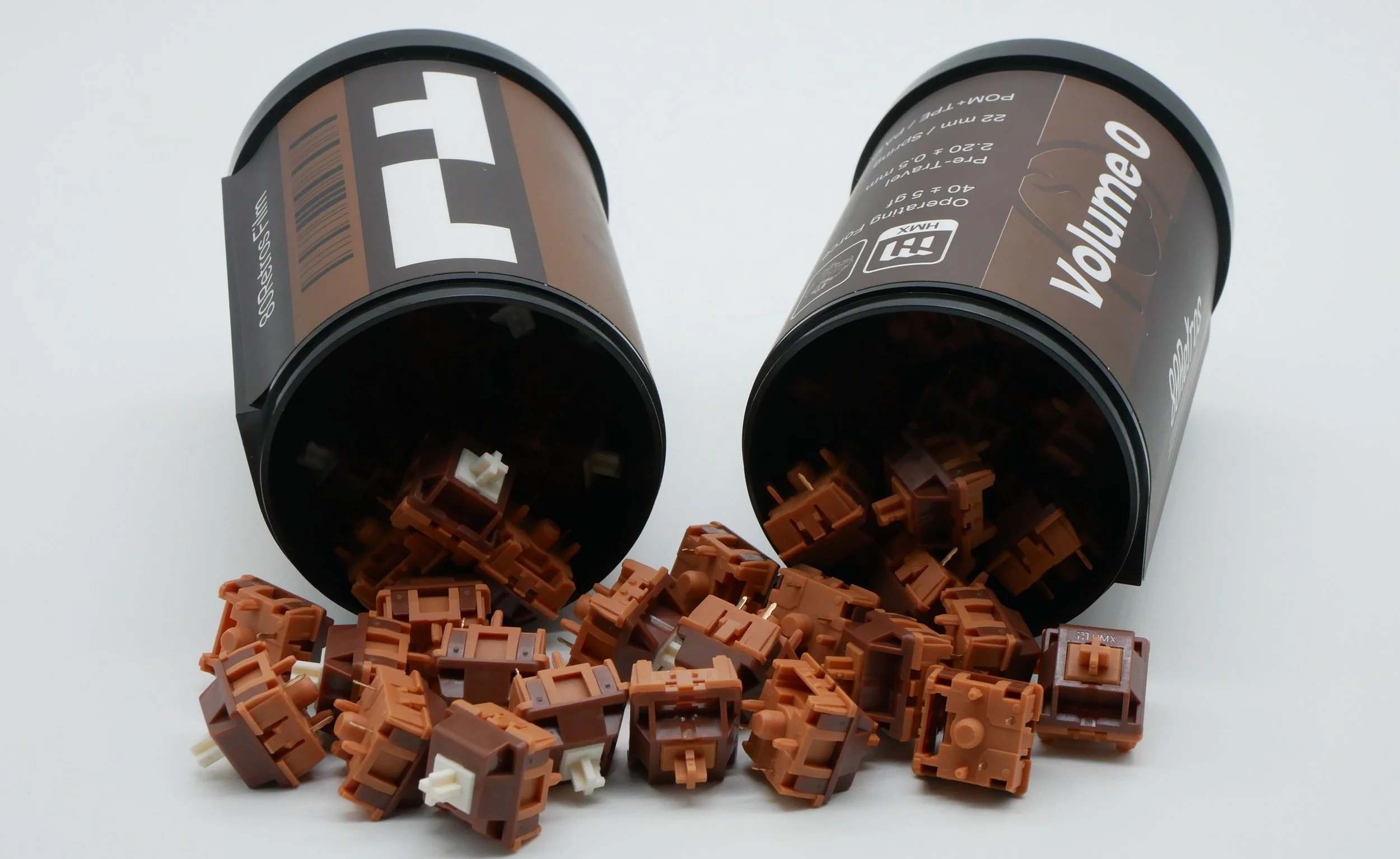
Figure 12: Color comparison of the HMX Volume 0-T (Left) and Volume 0 (Right) switches.
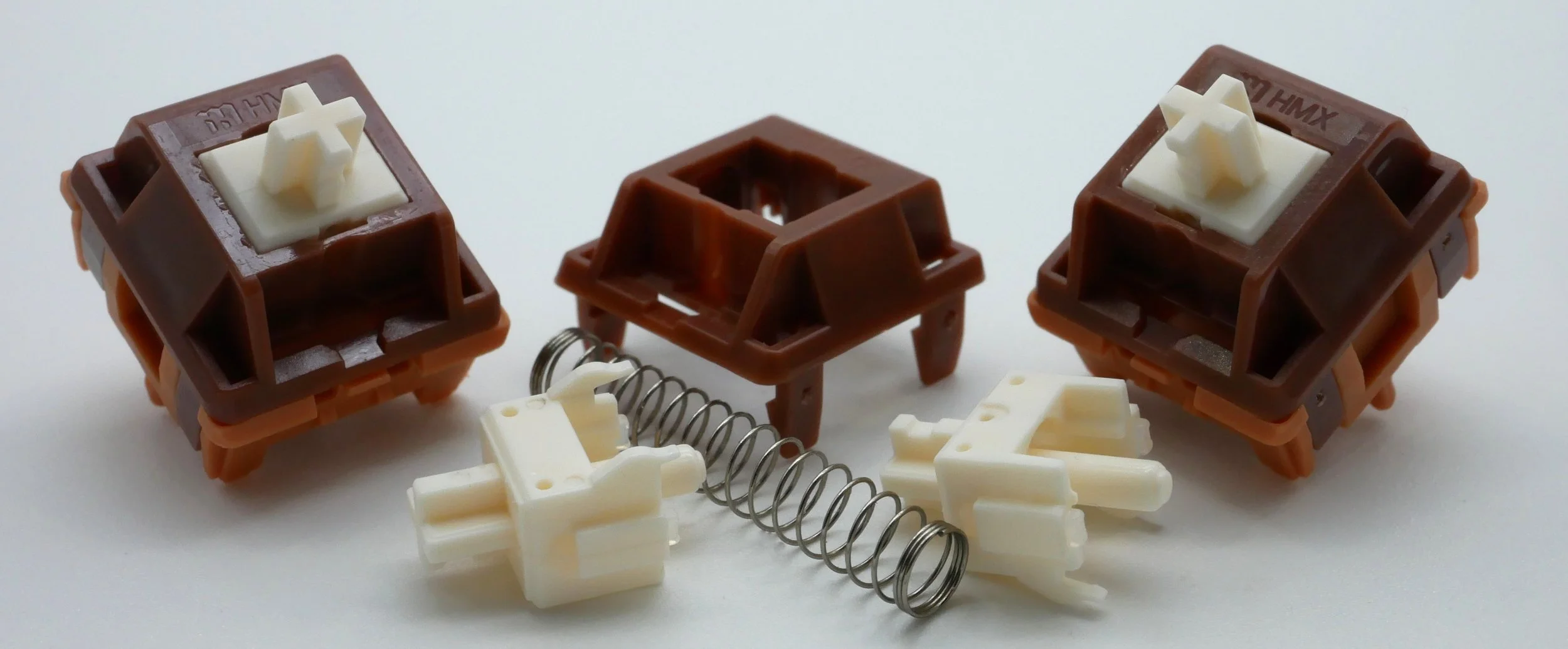
Figure 13: HMX Volume 0-T switches and their components.
Looking first to the dark brown, “PA12” top housings of the HMX Volume 0-T switches, we’re greeted with fairly few details that make these switches stand out as the premium, designed from scratch silent tactiles that they are billed as. While it may be easy to assume that these top housings would be entirely differently designed from something like the HMX Anti switches which I recently reviewed on account of them being on different ends of the complexity and design effort spectrums, that really wouldn’t be a correct assumption to make. In fact, the ‘bargain bin’ HMX Anti switches and Volume 0-Ts are rather similar insofar that they have virtually no details of note or functional benefits to them. They hardly have any markings outside of what is normal to see in switches and even lack obvious mold markings in any of the places they would conventionally be. Furthermore, the Volume 0-Ts lack scratches, bumps, extra padding, or even errant factory lubing that would indicate some complex inner workings going on in the switches other than what is commonplace for switches as such. The only real detail that differentiates these from other HMX switches is the “ ‘M’ HMX “ nameplates on the top of their housings. This nameplate, which features the sliced ‘M’ logo of HMX followed by the manufacturers shorthand abbreviation, is one that has actually only* ever been seen on previous premium 80Retros’ switches such as the Game 1989, KD200, and FJ400 from the initial Film Trio release. While this may seem like a deliberate choice by HMX at first to ensure their branding is marked well and clear on switches they produce, it is worth pointing out that they seem surprisingly unconcerned with making and using custom nameplates as brands like Sillyworks, Akko, and even ‘SPM’ have all had HMX made switches featuring their own branding. And yet for some reason, 80Retros doesn’t seem to have any desire for custom branding of their own.
*Editor’s Note: It turns out this is not true as HMX Cloud V2 and Blackberry switches also bare the ‘M HMX’ nameplate too.
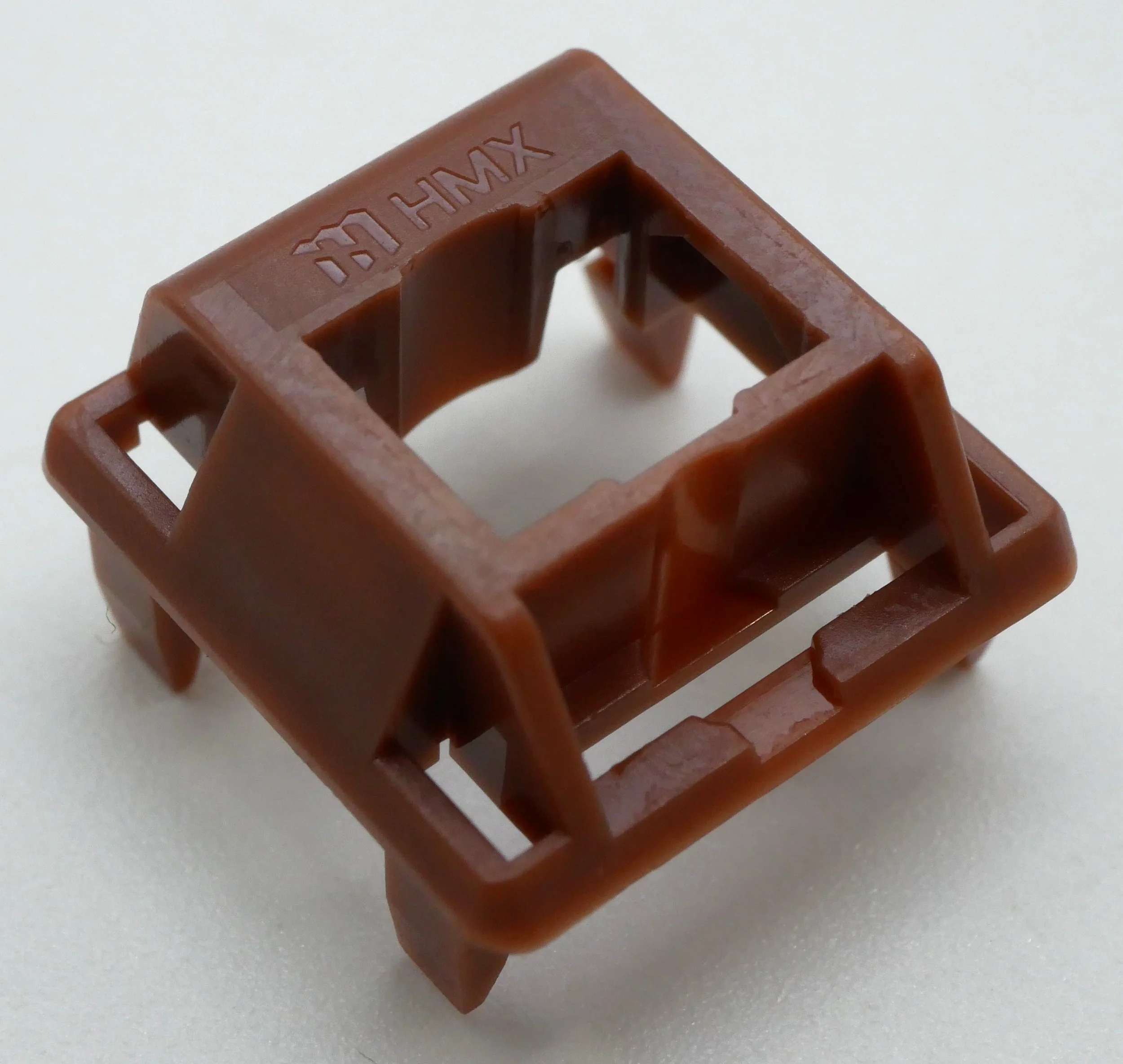
Figure 14: HMX Volume 0-T top housing exterior showing long rectangular LED/diode slot and ' 'M' HMX ' nameplate seen on other premium 80Retros switches made by HMX.
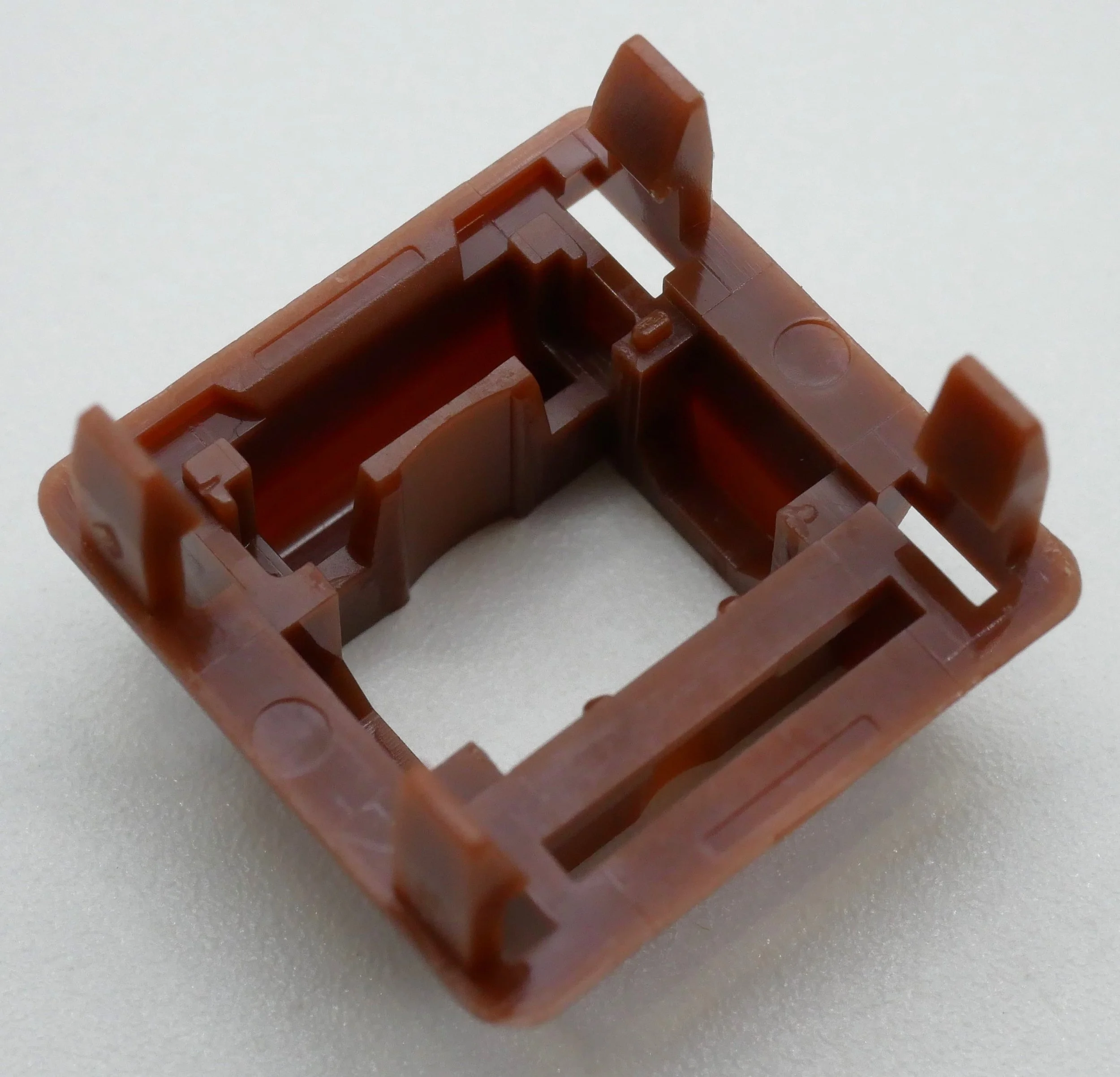
Figure 15: HMX Volume 0-T top housing interior showing utter lack of features that make them unique from other previous HMX-made switches.
Moving next to the white, POM and “TPE” stems of the HMX Volume 0-T silent tactiles, we’re greeted with quite a few details which show that this is clearly where the bulk of 80Retros’ and HMX’s design efforts were placed. Unlike traditional silent stems where the soft material dampening pads are mechanically inserted into voids in, on, or around the partially completed slider rails on the stems, the Volume 0-T switch stems appear to have full integration of the dampening pads into the stem design itself. (Quite similarly to Cherry’s silent switch stems, for that matter.) While all the expected and common features such as flat slide rails, a normal length stem pole with a slight tier, and pronounced tactile bumps are all there for a silent tactile switch, this more complex design carries an additional feature which is the most noticeable when inspecting the stems for the first time – a large hole in the upper center of the back plates of the stems. Paired with matching through-stem holes in the front plate of the stem, this hole is believed to be the injection point in which the softer dampening material of the Volume 0-T stems is injected into the stems themselves, leading to them having the fully integrated design wherein they not only sit flush behind the slider rails but all the way up into the body of the stem and around where the body connects to the center pole. While I’ve yet to discuss this design feature in any of my silent switch reviews, for some odd reason, the reason that all of these extra holes are believed to exist in stems as such is because of this two-step injection molding process, with them being necessary to shoot softer plastic into the partially completely hard plastic stems.
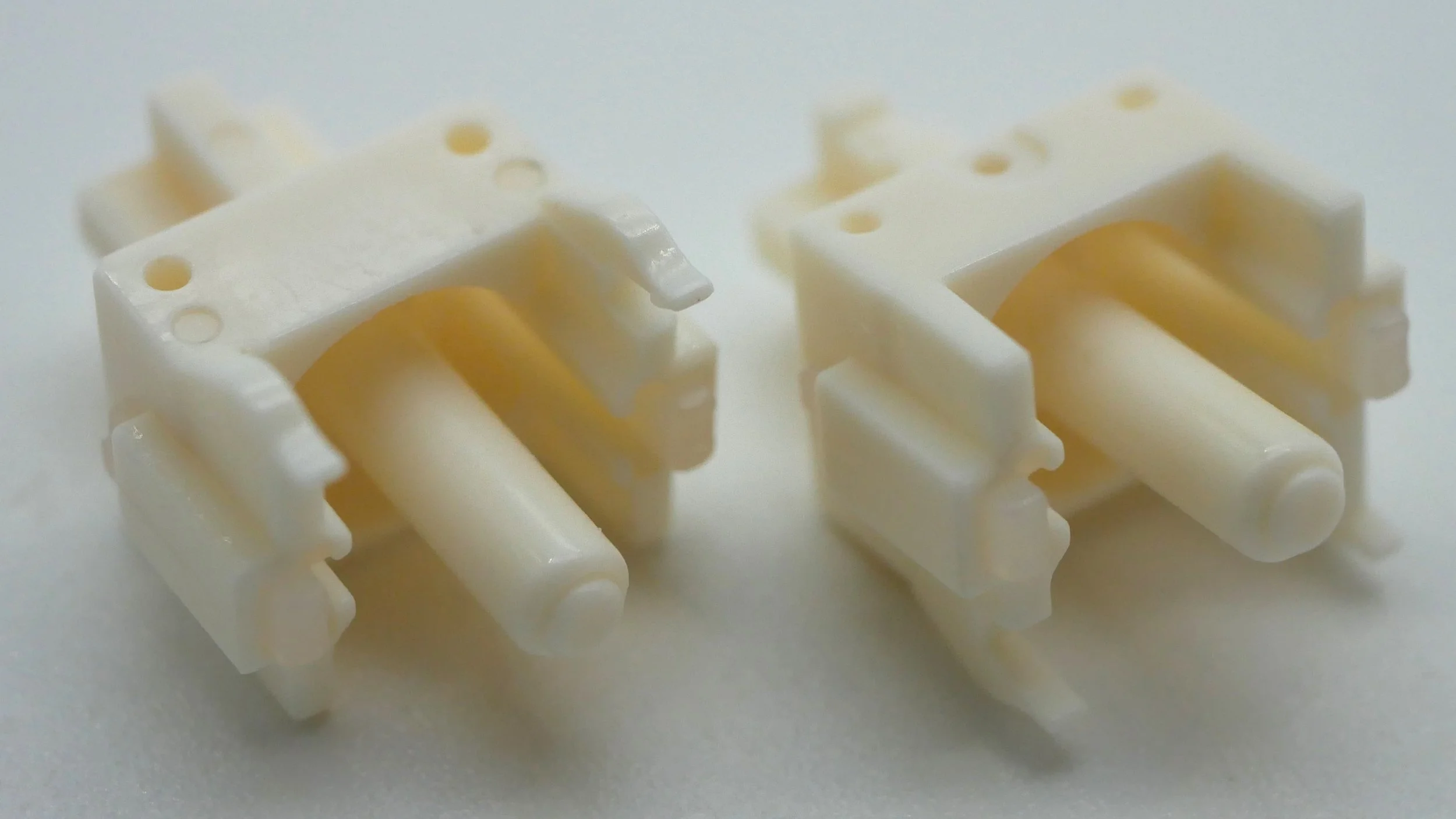
Figure 16: HMX Volume 0-T stem front and backs showing barely tiered center poles, squared off slider rails with dampening pads protruding from the bottom, and series of front and back plate holes for mold ejection and injection molding of the dampening pads.
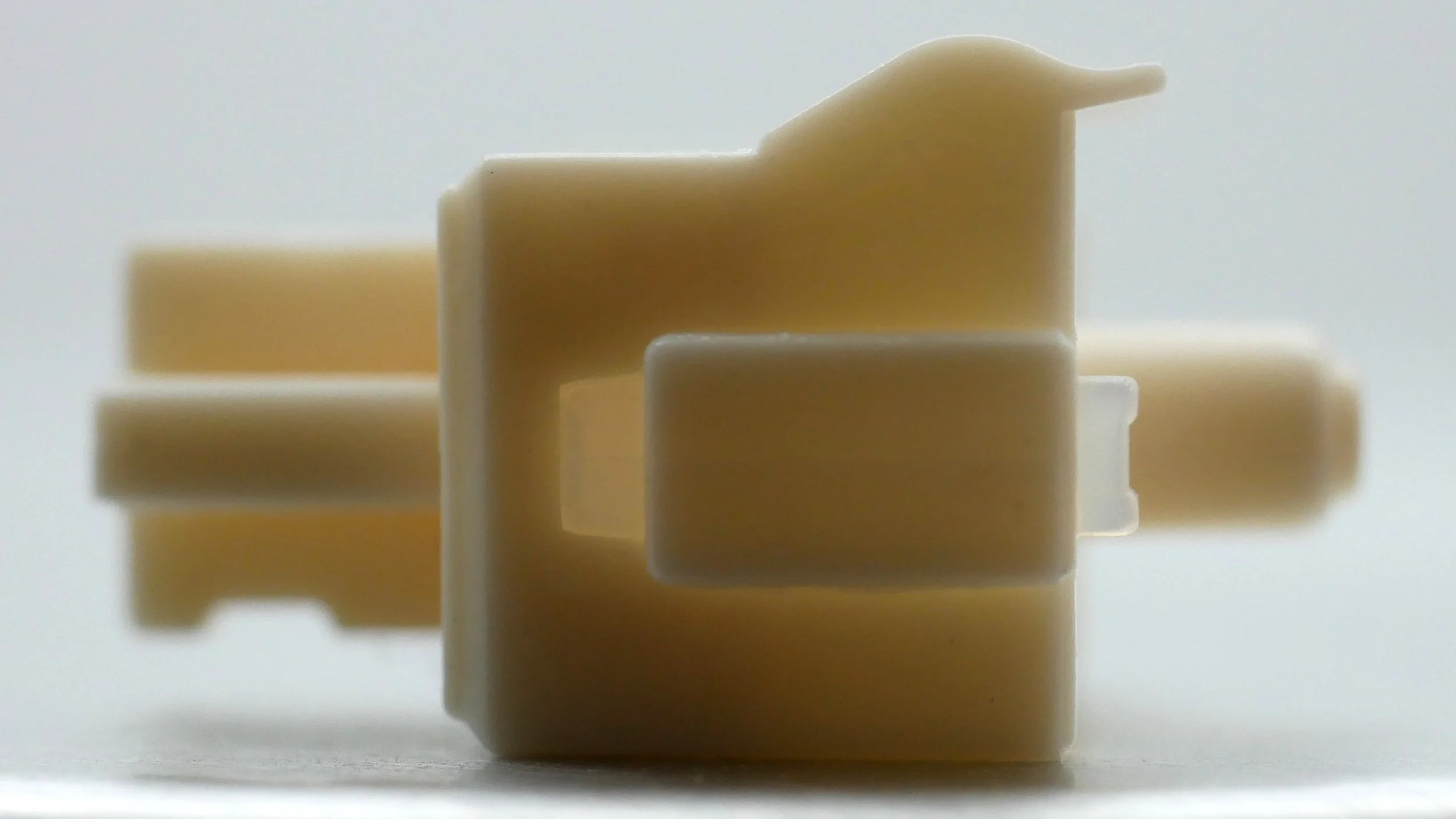
Figure 17: Side profile of the HMX Volume 0-T stems emphasizing the tactile bumps on their stem legs and the length of the dampening pads on the slider rails.
Finally arriving at the caramel colored, “P4” material bottom housings of the HMX Volume 0-T switches, these feature a good amount of details for an HMX switch but none that are as complex and integrative as the stems discussed above. Internally the housings feature a slew of common modern switch details including rounded dampening pads at the base of the guider rails, a large south side spring collar, and even trace amounts of factory lube on the leaves at the point where they contact the stems. For those of you who aren’t familiar with this practice, its typically done to reduce scratch throughout the actuating part of the switch’s stroke where the stem directly bends the leaves – something which is historically scratchy in tactile switches. Externally, the Volume 0-T switches come in the 5-Pin/PCB mount variety only and are otherwise barren of any HMX, 80Retros, or specialized branding. The only markings present on the housings are the two part mold markings that are located upside down in both corners of the housing directly beneath the PCB mounting pins. Note that this is an entirely different type of marking and location of marking than what was previously noted in the HMX Anti Switch Review.
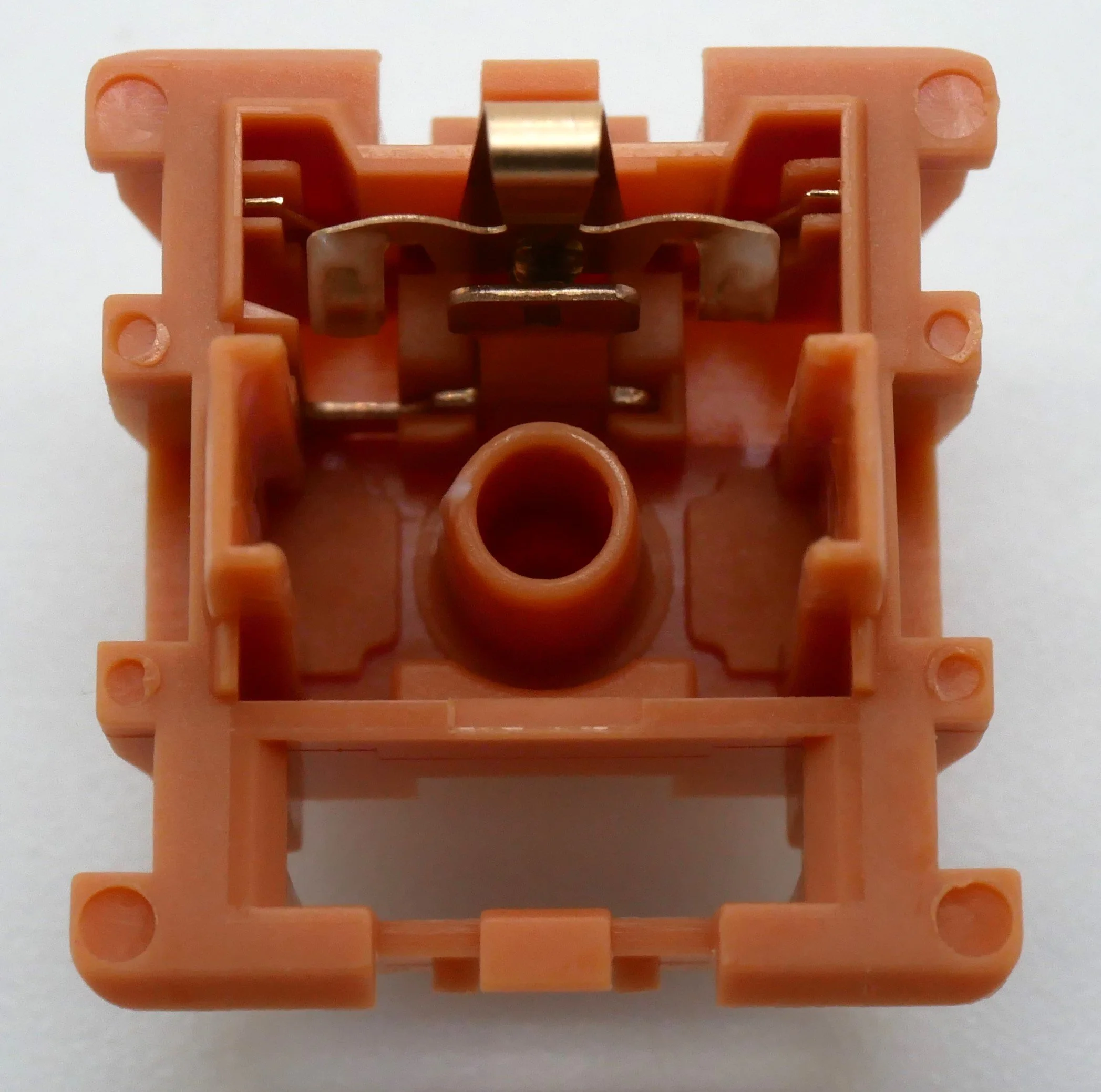
Figure 18: HMX Volume 0-T bottom housing interior showing dampening pads at the base of slider rails, a south-side spring collar, and trace amounts of factory lubing, especially on the points of the leaves where they contact the stems.
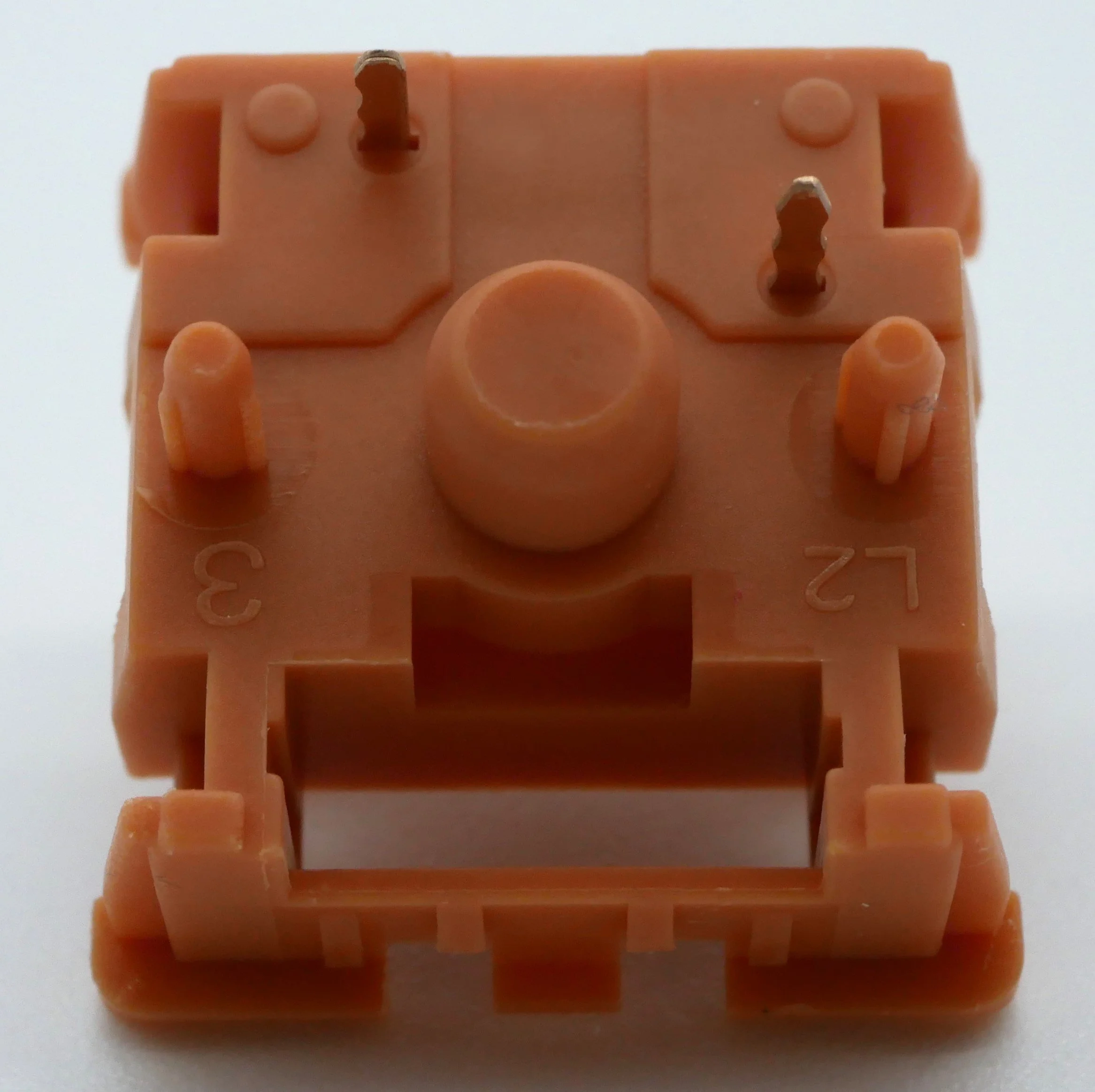
Figure 19: HMX Volume 0-T bottom housing exterior showing PCB mounting pins and unique, inverted two part mold marking system not previously seen on other HMX switches.
Push Feel
While any given silent tactile has lots of features which one needs to try and take in all at once when testing them out for the first time – their tactility, smoothness, silencing at bottom and topping out, etc. – it was the tactile bump of the HMX Volume 0-Ts that stood out to me the most at first. The tactile bumps of these switches feel… unassuming? Simultaneously forceful but not sharp or even punchy? The force curve I recorded for the Volume 0-Ts below actually somewhat saved my sanity here as my initial drafts for this section just had me describing the tactile bumps as feeling “flat” and really none of the other word I used above. And yet they don’t feel flat in that they are linears or non-tactile, rather they just have a force that isn’t sharp or arching in the lead up to its bump or following along after it. The distinctive medium strength tactile bump of the Volume 0-Ts just kind of feels like it punches straight out and then then falls with a subtle snap right into the post-bump linear region. And while the force curve giveth some sanity, it also taketh away some sanity as well the longer I looked at it. Despite having a shape that kind of embodies the ‘flat but tactile’ nature I am clearly struggling to put into words in this paragraph, the curve doesn’t really match these switches otherwise at all. They don’t feel like they have a double tactile bump at all, for one. As well, the slight notch up in force at the end of the tactile bump that is present across all of my copies of these force curves that I’ve taken just isn’t noticeable in hand at all. And most finally, they definitely feel like they are at or beyond the 4.00 mm mark in stem travel. While I recognize that the difference between a 3.69 mm and 4.00 mm stem travel distance isn’t much, it feels way differently here than in other switches which bottom out around the same amount.
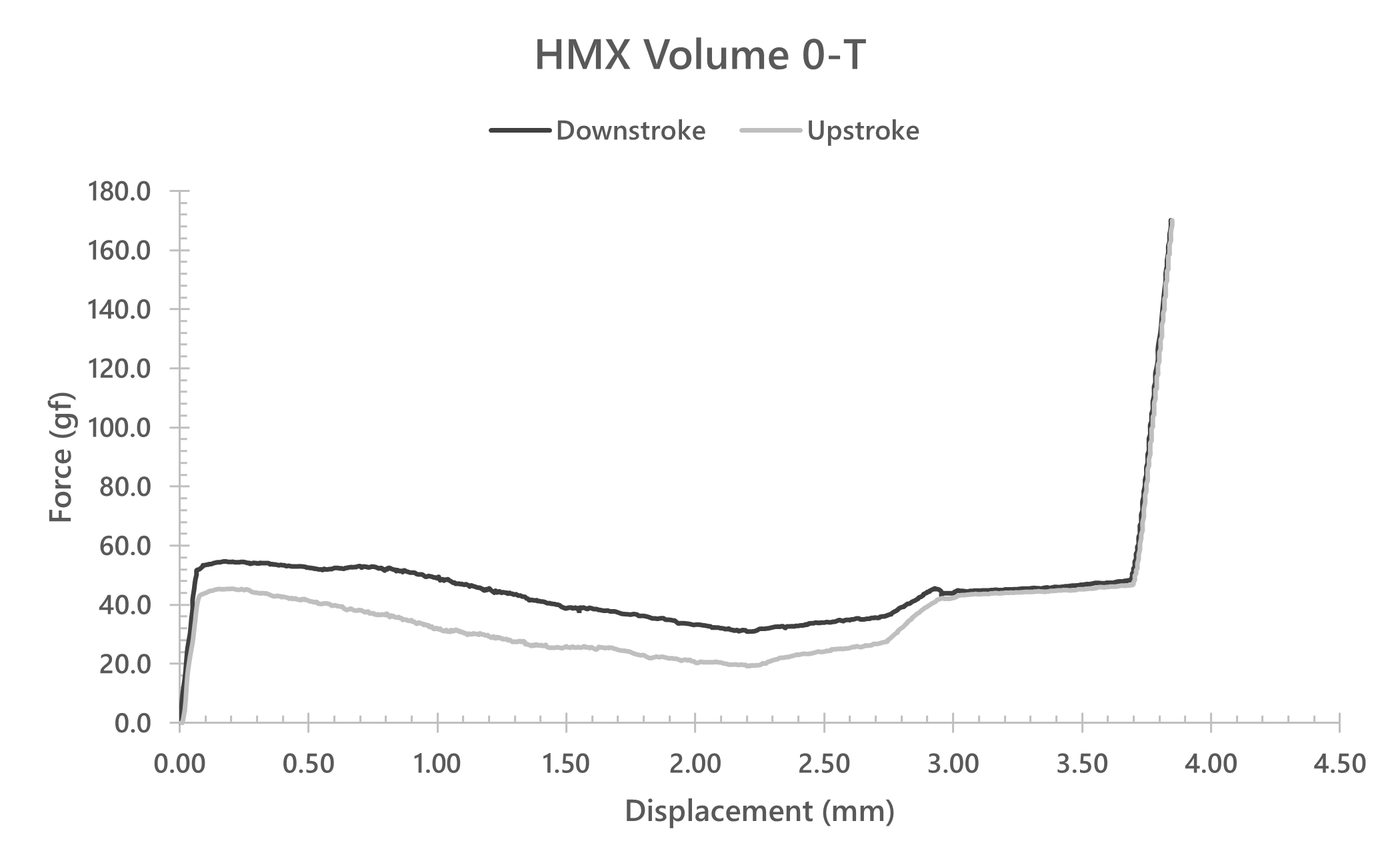
Figure 20: Force curve diagram for the stock HMX Volume 0-T switch.
As for the other, non-tactile portions of the HMX Volume 0-T switches, there’s a surprisingly good amount of stuff that can be said. For one, the factory lubing from HMX is absolutely spot on, with these switches feel smooth, not scratchy, and evenly covered through the majority of their strokes. While the tactile bumps, themselves, do feel a bit thinner and as if more character shows through than on the linear portions, that’s hardly much to complain about. As well the dampening on the Volume 0-Ts is rather surprisingly strong as well – both in its dampening ability as well as its actual physical hardness. I know that I described the dampening pads of the stems above as being the ‘softer’ component of the stems, though actually pushing on them finds that they hardly yield much at all and are actually more like a soft hard rubber than they are anything you’d think would really dampen something like a keystroke. On any given push these dampening pads budge ever so slightly to brake the strokes going up or down, but only do so in providing a firm, ever so slightly squishy return that feels more consistent than not. Additionally, the topping and bottom outs of the HMX Volume 0-Ts appear to be pretty well balanced at all – both internally as well as across the batch of switches that I received.
Sound
Personally, I’m one of those people that likes to get the bad news before the good news in one of those dreaded situations where they arrive at the same time. The good old ‘rip the band-aid off quickly’ style which I’ll now apply here for you all as well; The most unfortunate and least polished part of the HMX Volume 0-T’s switch performance is that they, much like the vast majority of other silent tactile switches to have ever been produced in the MX footprint, suffer the most with respect to their sound profiles. There’s seemingly just something about the complexity of shoving a tactile bump with prolonged leaf contact as well as both housing collisions under the control of just a small piece of soft plastic and well placed lubed that really never seems to pan out quite as well as expected by manufacturers and designers. And yet the bright side to this, though, is that the HMX Volume 0-Ts are definitely pretty quiet. Just a bit lower on the volume scale than conventional light tactiles, the main sound that the HMX 0-Ts emit is one of a deep, medium pitched, and very soft leathery tone with subtle accents of scratch and ping from the point of stem/leaf contact as well. At either end of this bump the sound profile is accompanied by dampened, firm, occasionally variable housing collisions that seemingly turn snappy at some random points in time and at all typing speeds. Speaking of which, there is also some drift in all of these sounds as actuation speeds picking up, with them generally across the board pitching up both in tone and volume as they’re used more rapidly. Despite all of these negative aspects, though, the HMX Volume 0-Ts are definitely among some of the more well-constructed and composed silent tactiles that I recall having listened to in quite some time.
Wobble
Aside from their indirect ability for me to justify a LEGO-like tax deduction from this year’s tax return, one of the most impressive features of the HMX Volume 0-T switches is their lack of stem wobble. With only the faintest amount of give in the N/S and E/W directions, these switches are about as close as one can get to perfection on this metric without quite being there. As well, this lack of wobble was surprisingly well maintained across the batch that I received, with no drastic aberrations standing out at all.
Measurements
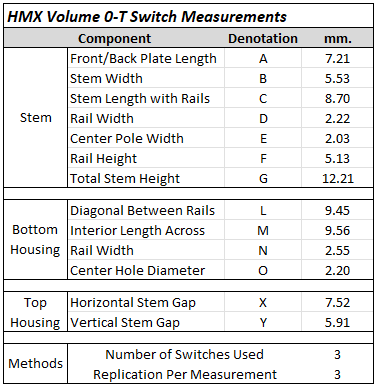
If you’re into this level of detail about your switches, you should know that I have a switch measurement sheet that logs all of this data, as well as many other cool features which can be found under the ‘Archive’ tab at the top of this page or by clicking on the card above. Known as the ‘Measurement Sheet’, this sheet typically gets updated weekly and aims to take physical measurements of various switch components to compare mold designs on a brand-by-brand basis as well as provide a rough frankenswitching estimation sheet for combining various stems and top housings.
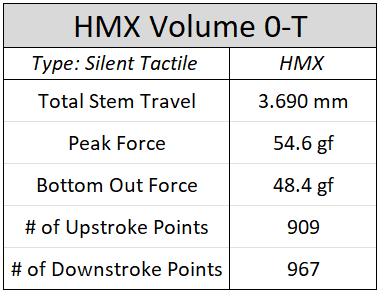
Figure 22: Numerical details regarding the force curves of the stock HMX Volume 0-T switches.
Have you ever wanted to be bombarded with more switch data than you’ve ever seen at any point in your life before? Consider checking out the ‘Force Curve Repository’ hosted on my GitHub that contains all force curves that I take both within and outside of these full-length reviews. In addition to having these graphs above, I have various other versions of the graphs, raw data, and my processed data all available for over 1500 different switches for you to use however you see fit. Check it out via the ‘Archive’ tab at the top of this page or by clicking any of the force curve cards above.
Break In
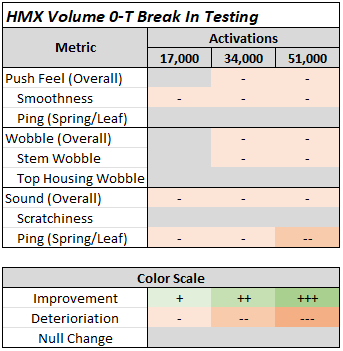
Break In Notes
17,000 Actuations
- Through 17,000 actuations, what little factory lubing was present in the HMX Volume 0-T switches appears to move quite a bit as the switches broken in this far not only feel slightly scratchier than their stock counterparts, but they also sound more pingy as well – something which would be affected by factory lube migrating away from the stem/leaf interface.
34,000 Actuations
- In addition to similar changes noted above, the Volume 0-T switches broken in to 34,000 actuations also begin to pick up slight differences in firmness at the point of their bottom out. Some switches, in fact, felt as if they picked up slightly ‘ploppy’ tones in some strokes, as if there was factory lubing pooled underneath the otherwise rather solid and firm dampening pads on the slider rails.
- After 34,000 actuations, the HMX Volume 0-T switches began to show their first signs of mechanical wear with ever so slight increases in both N/S and E/W direction stem wobble.
51,000 Actuations
- After 51,000 actuations, the HMX Volume 0-T switches don’t appear to be appreciably different from the notes listed above for the 34,000 actuation batch, save for the fact that these are overall just less consistent. While it is fairly minor in the grand scheme of things, those switches that were broken in to 51,000 actuations just seemed to sound ever so slightly different and have different volumes and tones than the comparatively uniform, singular sounding batch of stock switches.
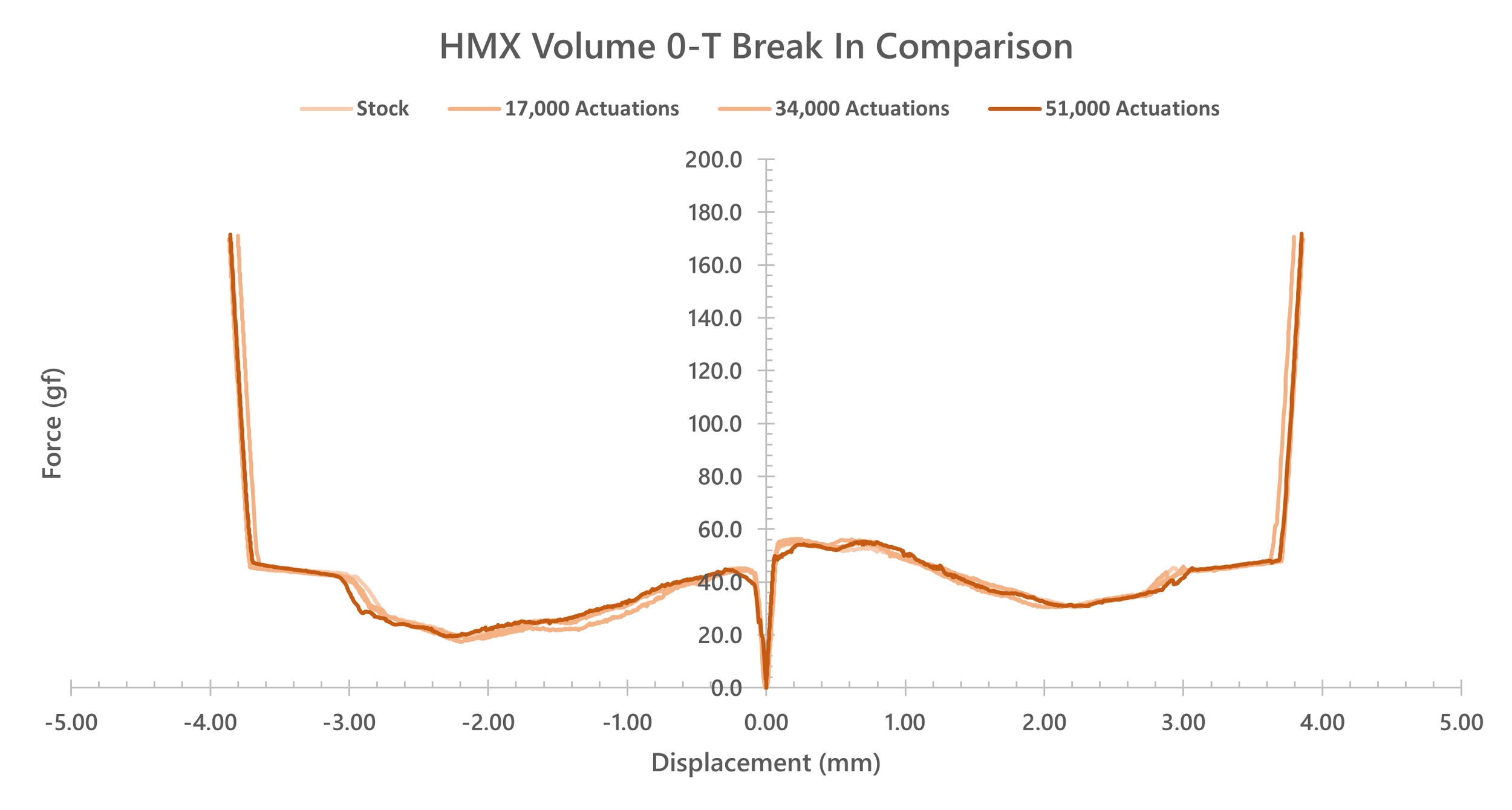
Figure 24: Comparative force curve diagram showing no substantial, consistent change in the force curves of the Greetech OG Brown switches throughout the break in process.
Other
While the ‘Other’ section for full length reviews is typically reserved for switch packaging, how could I do anything here other than share the 80Retros’ Switch Café Pinqi block set marketed and sold alongside the initial run of the HMX Volume 0-T switches? A LEGO-like brick building alternative, Pinqi (otherwise known as Pantasy) is a Chinese-based block building company that designs and produces complex sets across a wide range of IPs and themes, most notably that of a “Retro Collection” that likely is what first caught 80Retros’ eyes. Rather than leaning into a Retro-themed release, though, the specialized set for 80Retros’ was a small, 363-piece switch café that features an entire café built in the shape of a switch, a small cityscape outdoors surrounding the café, and a pair of characters with various accessories to match as well. In addition to just visually being cool, there is an additional bit of neat engineering here insofar that the stem of the café actually slightly articulates up and down as well, suspended internally on a thin rubber band which can deflect a tiny bit with some force. The set, itself, came together fairly easily in my books, though then again I’m not super into LEGOs and thus am not the reviewer you should rely on for feedback like that. Go ask Arslock from Carolinamech about those things.
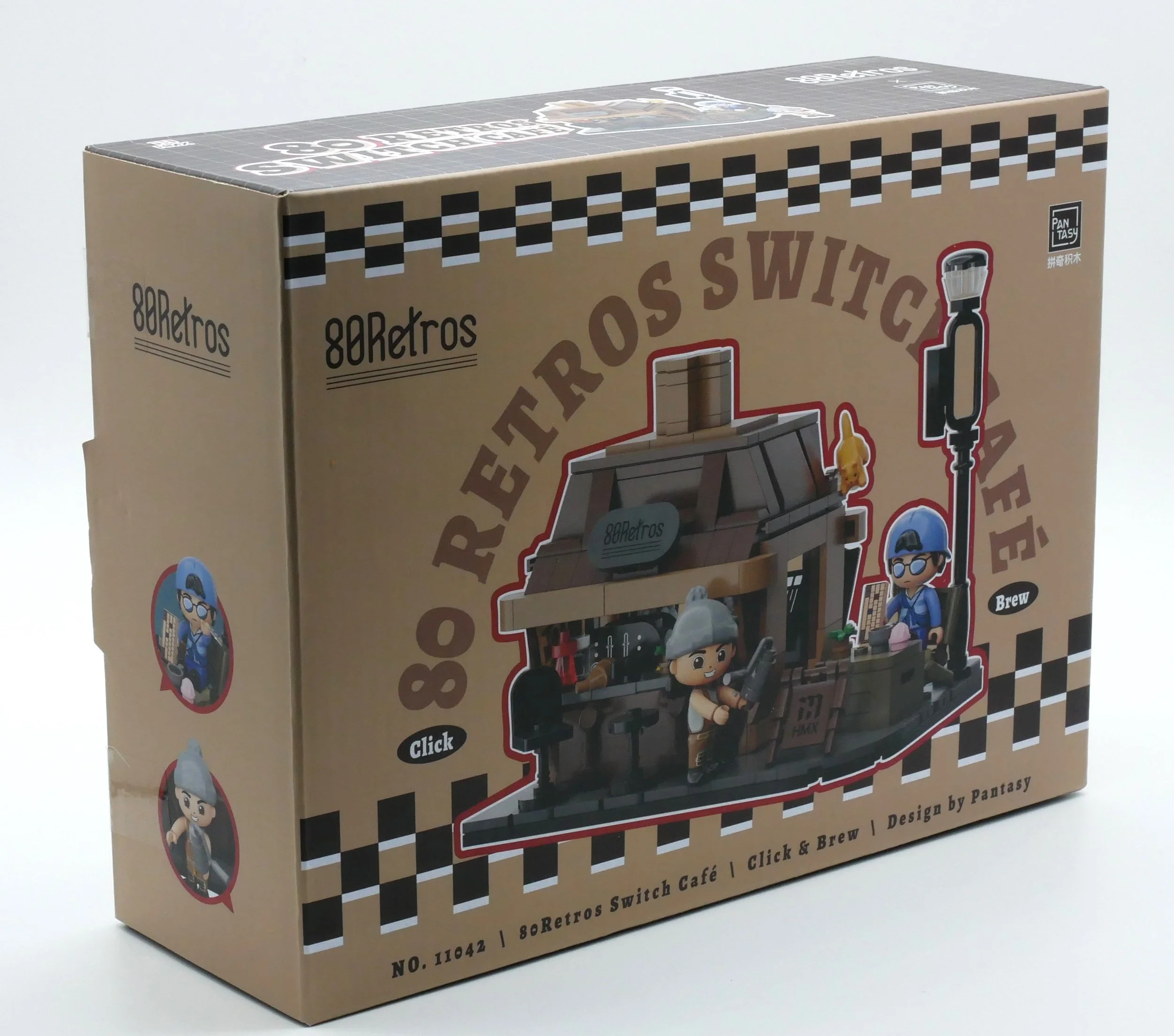
Figure 25: 80Retros' Switch Cafe block set box front.
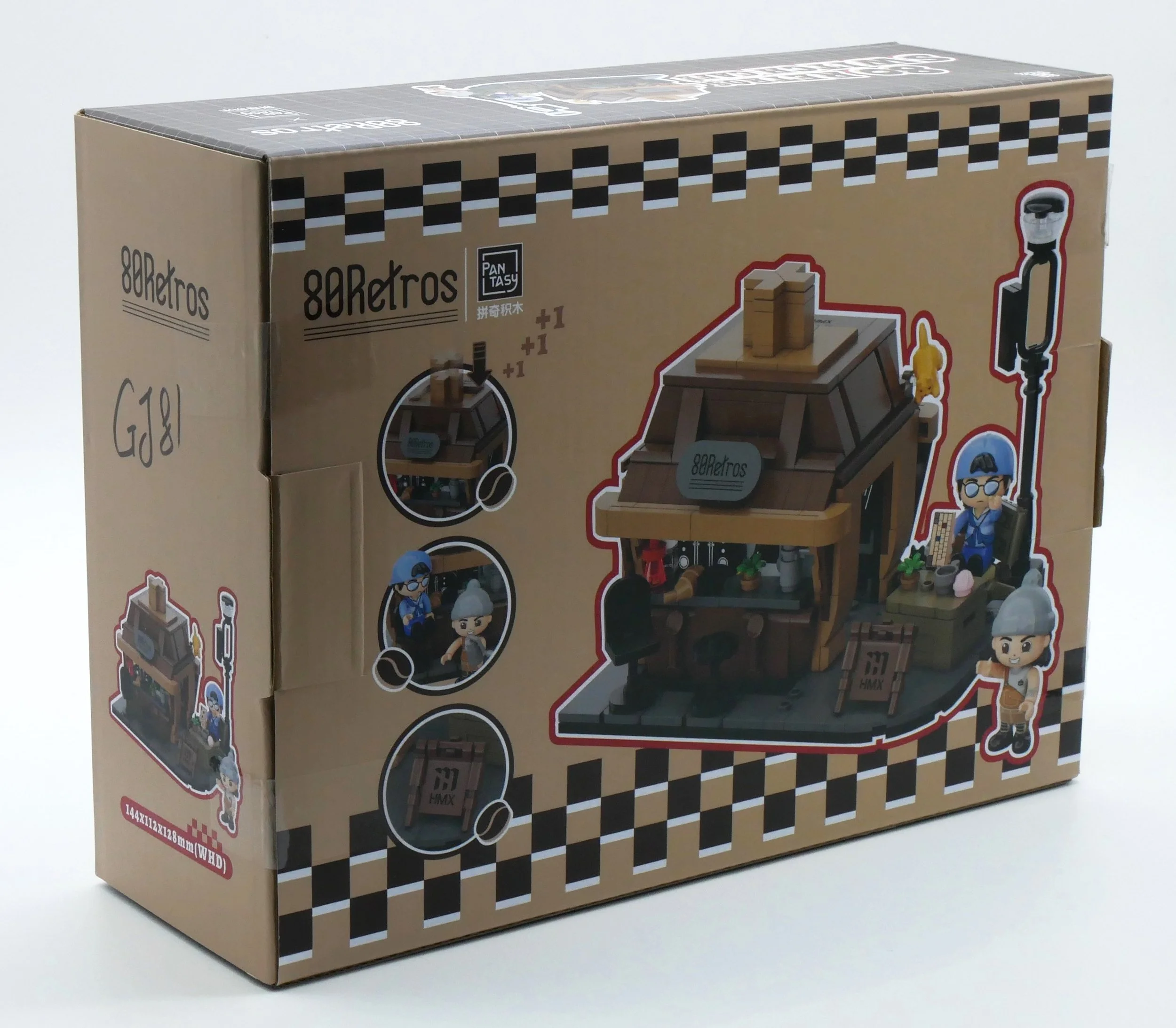
Figure 26: 80Retros' Switch Cafe block set box back.
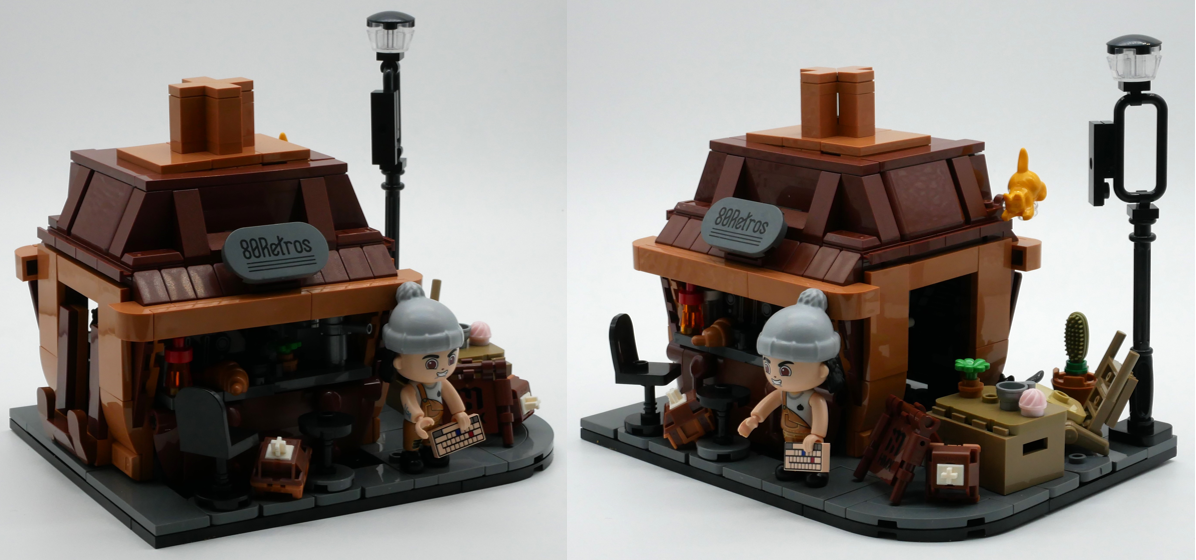
Figure 27: Angles of the front of the completed 80Retros Switch Cafe block set.
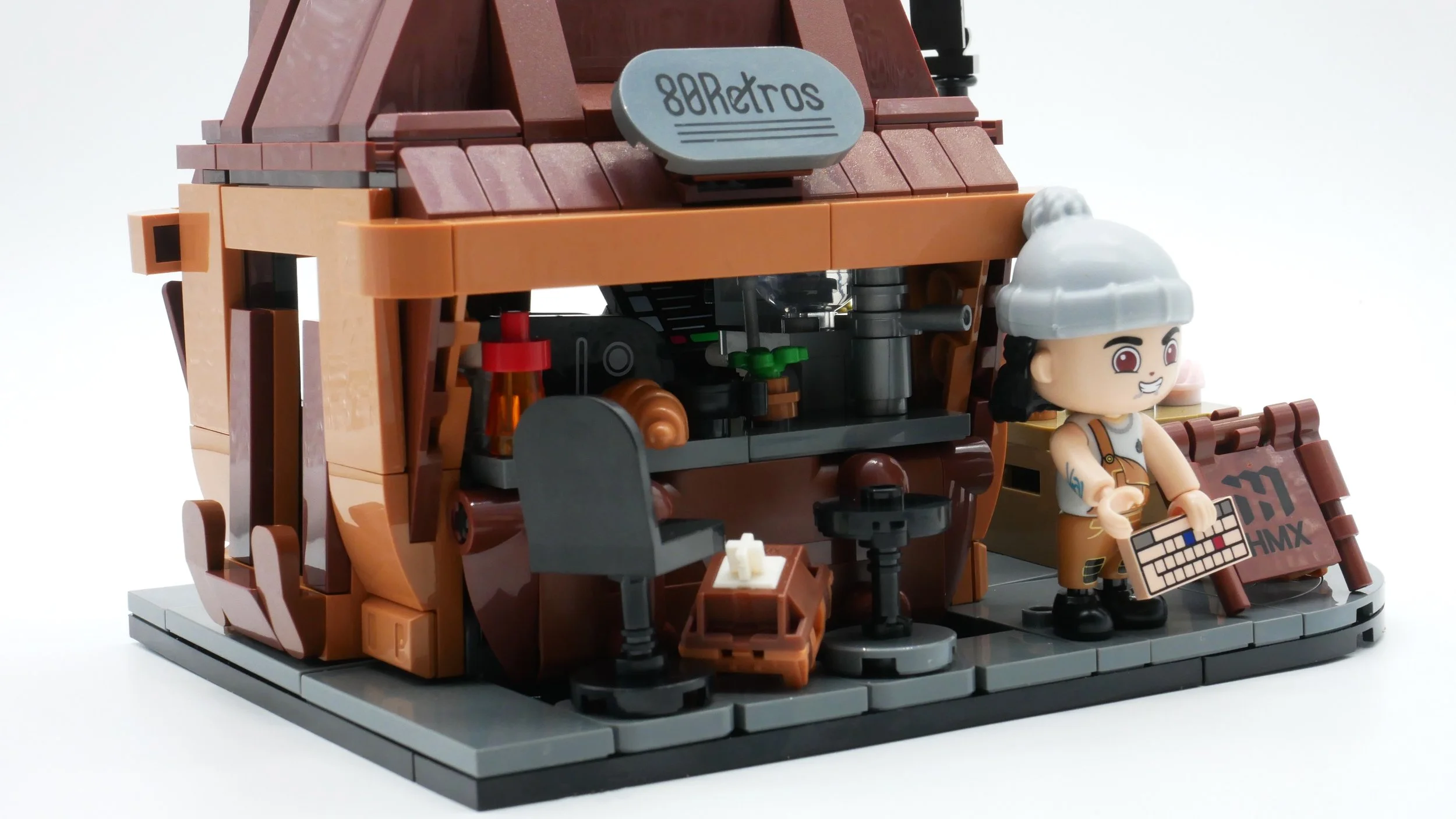
Figure 28: Enhanced view of the interior of the Switch Cafe showing multiple machines and food items included in the build.
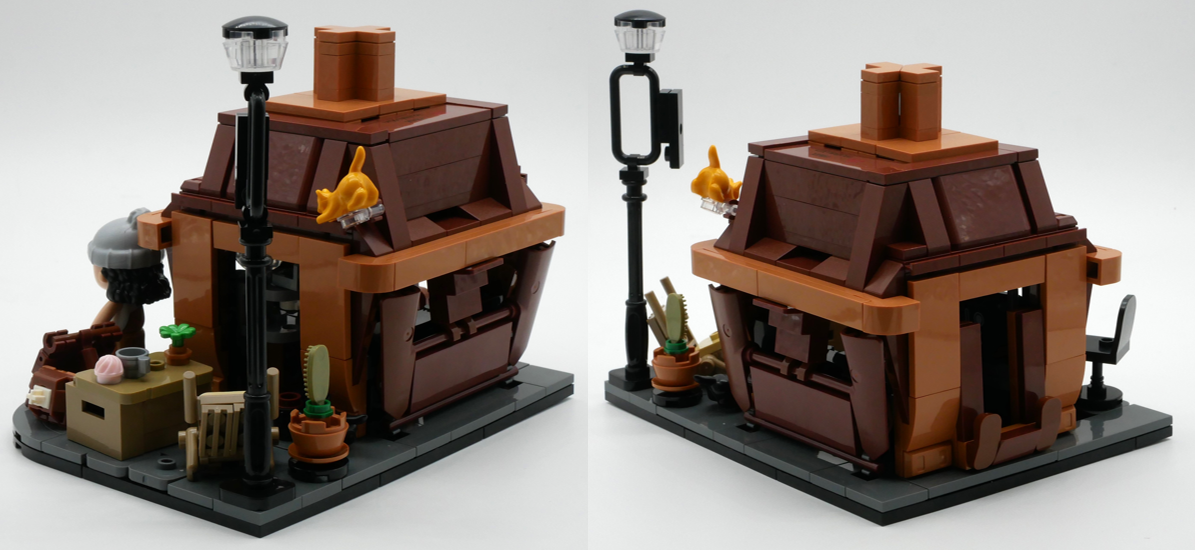
Figure 29: Angles of the back of the completed 80Retros Switch Cafe block set.
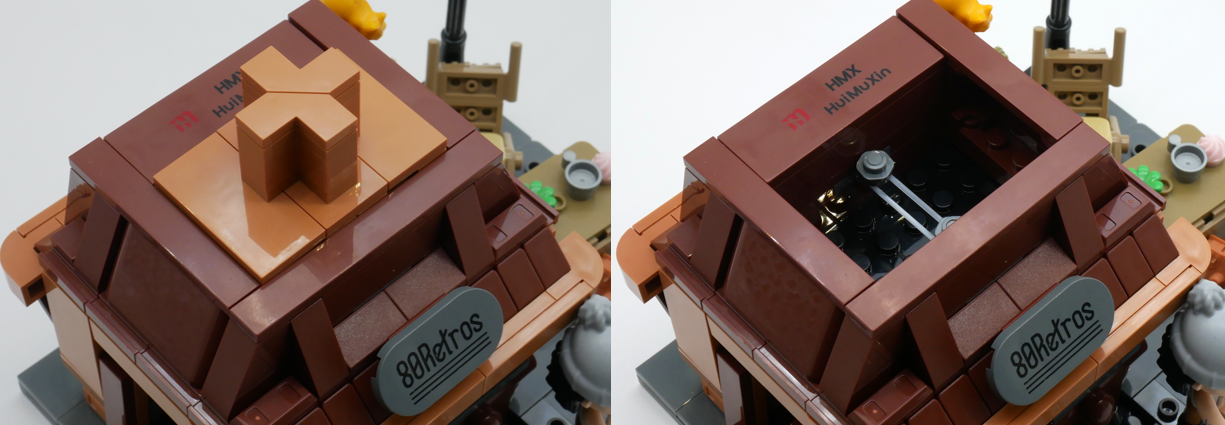
Figure 30: Views of the 80Retros Switch Cafe with and without the stem roof showing that the band that allows the stem to move up and down.
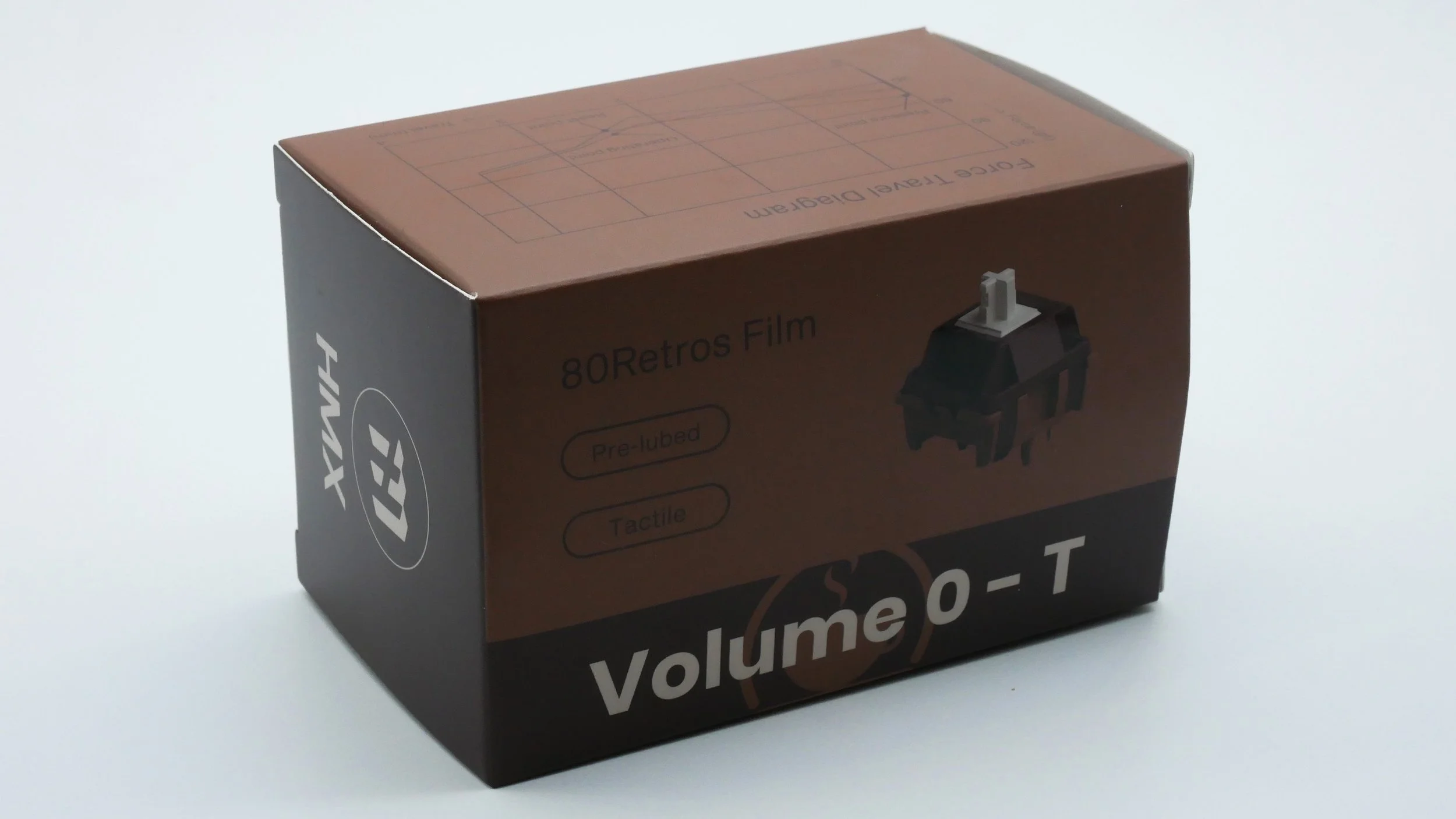
Figure 31: Front and top sides of the box that the HMX Volume 0-T canister came in.
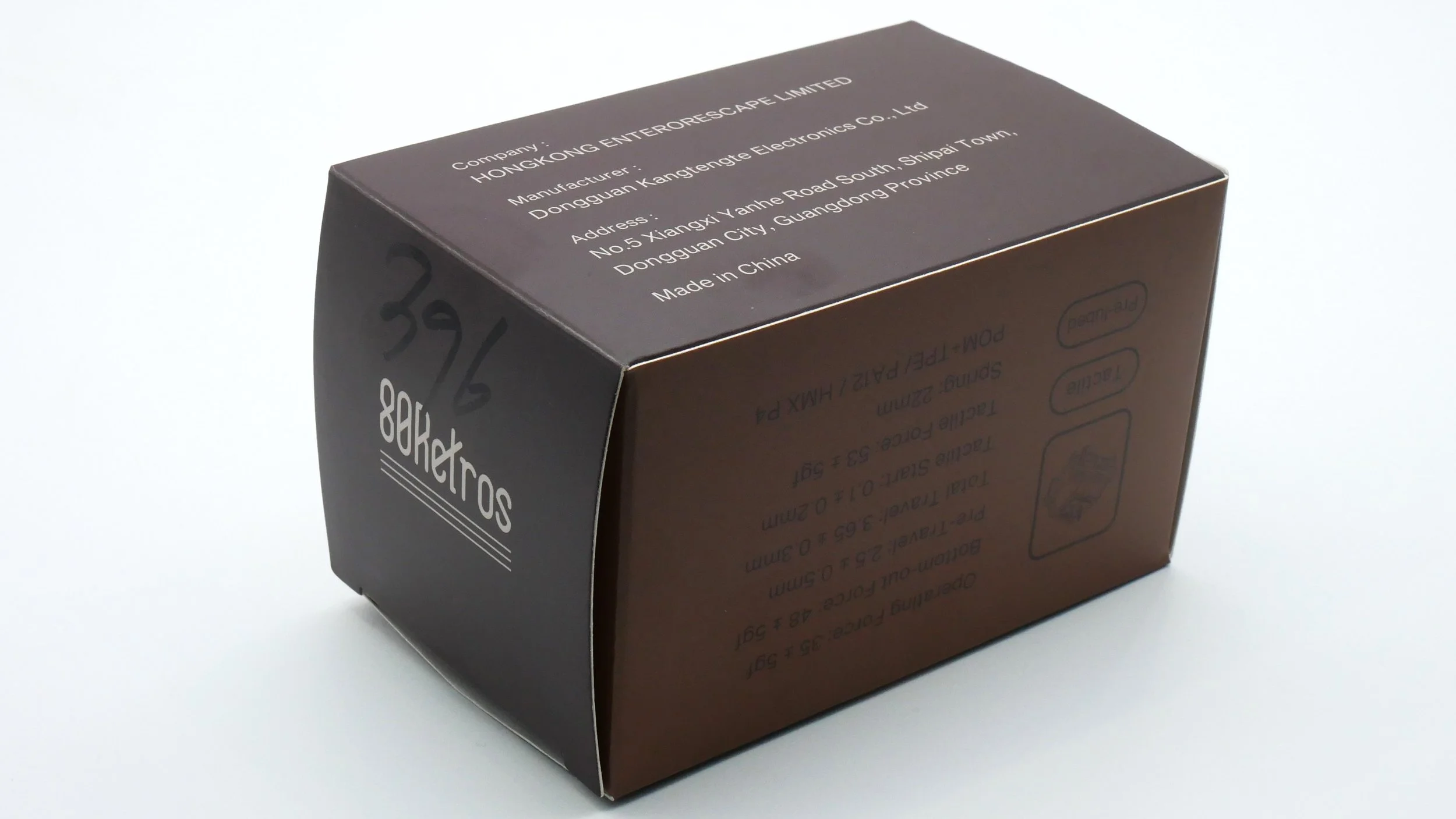
Figure 32: Back and bottom sides of the box that the HMX Volume 0-T canister came in with some interesting manufacturer information...

Figure 33: HMX Volume 0-T switches with their matching 80Retros film canister.
Comparison Notes to Other Notable Silent Tactile Switches
Note – These are not aimed at being comprehensive comparisons between all factors of these switches as this would simply be too long for this writeup. These are little notes of interest I generated when comparing these switches to the HMX Volume 0-T switches side by side.
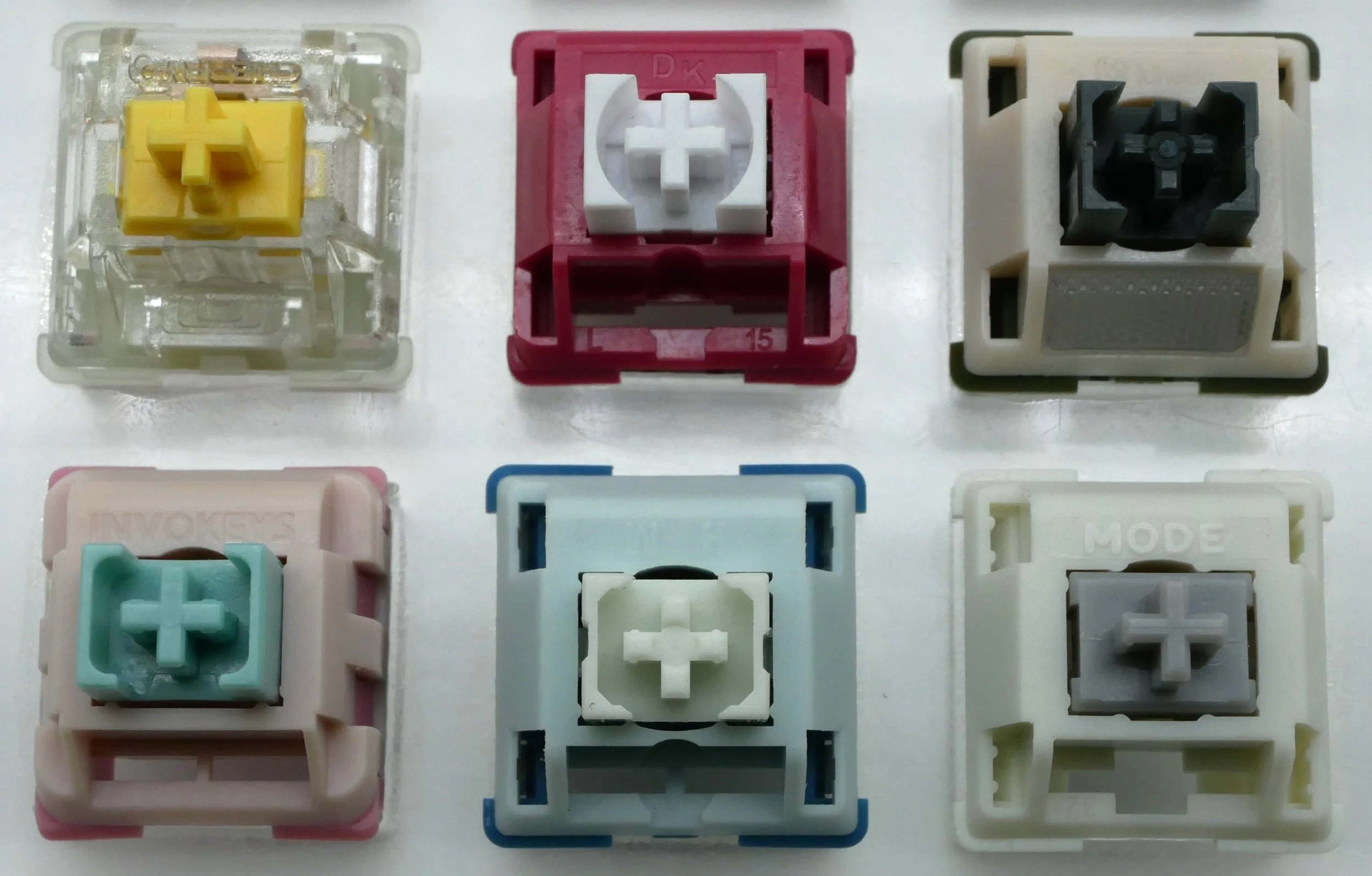
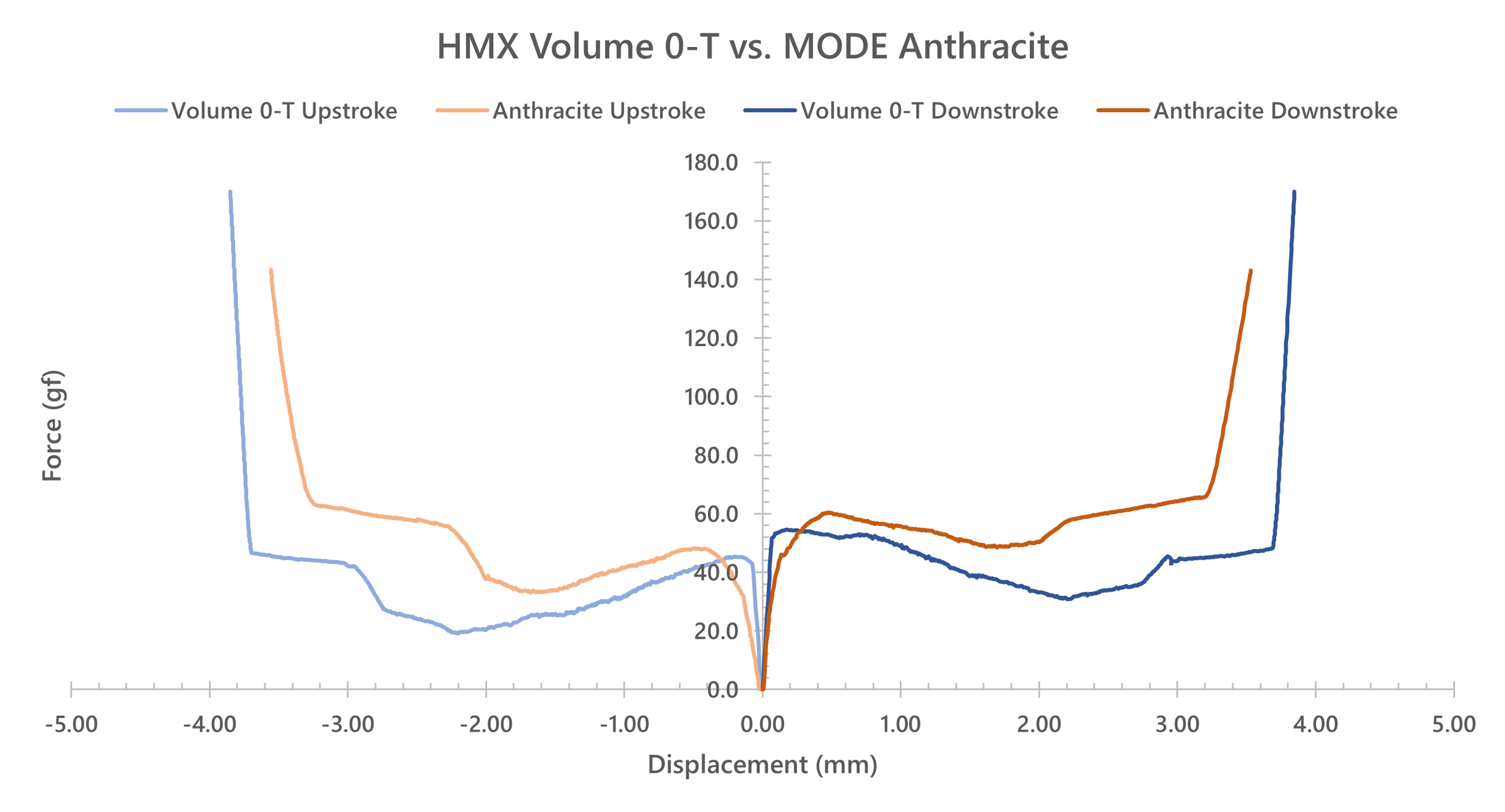
Figure 34: Switches for comparison. (L-R, Top-Bot: Cherry MX Honey, Red Velvet, Kinetic Labs Turtle, Invokeys x Alas Daydreamer, Haimu Whisper, and MODE Anthracite)
Cherry MX Honey
- While the Cherry MX Honey switches were definitely better than most Cherry-made switches when it comes to stem wobble, they still have quite a bit more N/S and E/W give to their stems than the HMX Volume 0-T switches.
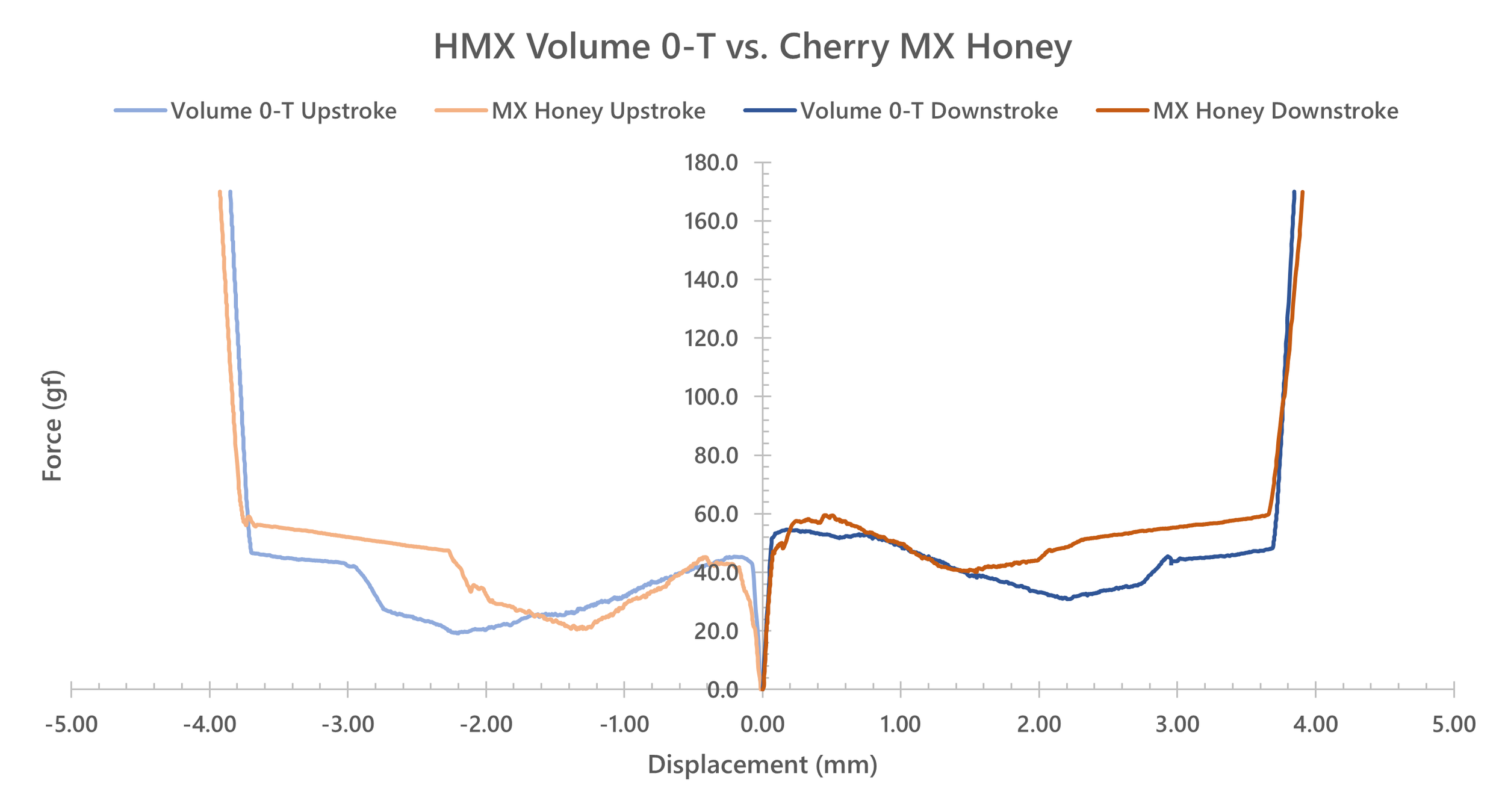
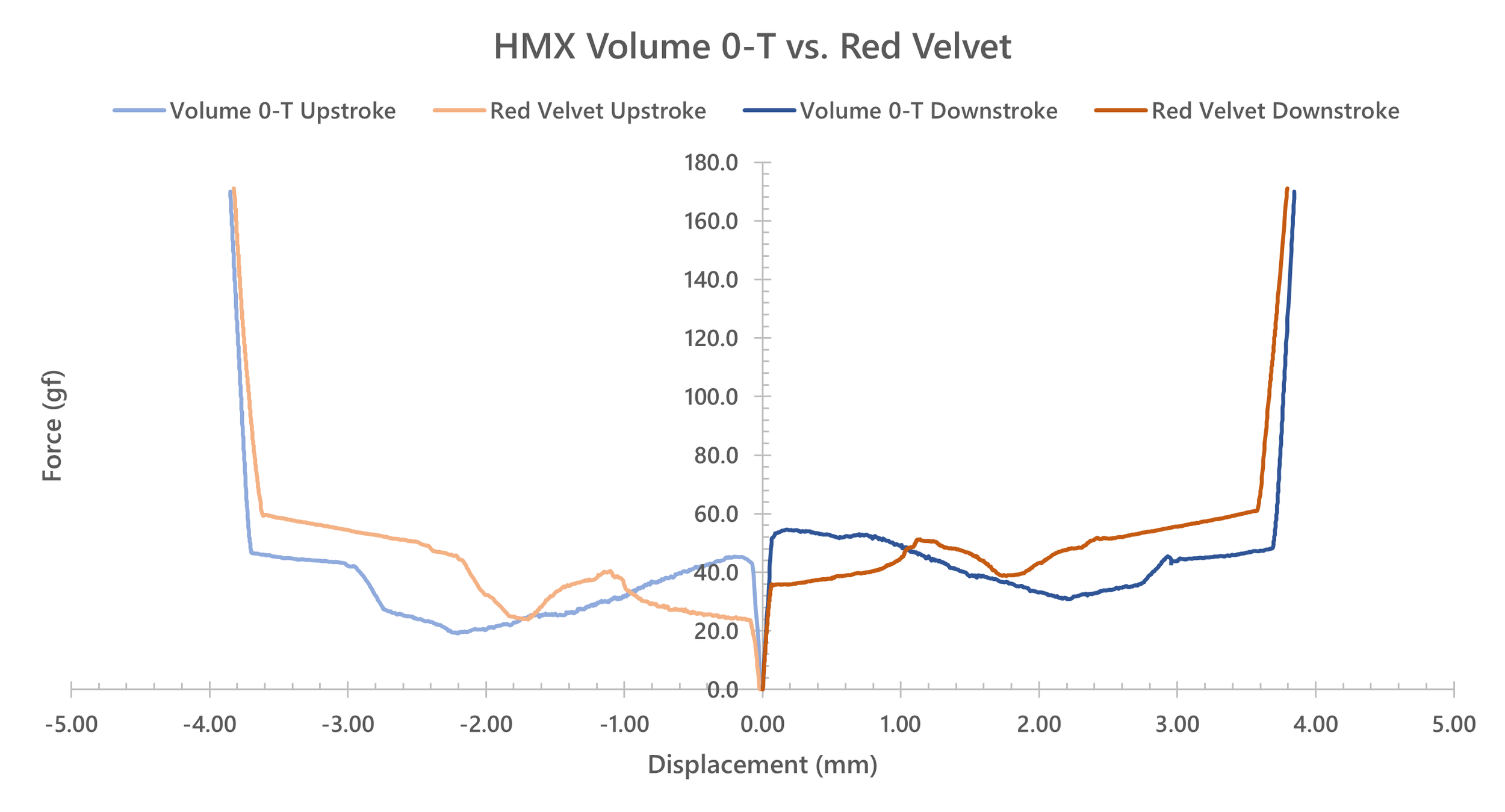
- Despite what the comparative force curve below might show, the MX Honeys feel quite a bit more punchy and forceful through their tactile bump than the 0-T switches. I suspect that this is due largely to their differences in velocity through the bump, where the Honeys are quicker getting up to and leaving their peak force than the more winding, slowly unfurling tactility of the Volume 0-Ts.
- Due to the slightly harder dampening pads of the HMX Volume 0-T switches, they are slightly louder than the Cherry MX Honeys and especially at the point of bottom out. Additionally the tactile bumps of the Volume 0-Ts are also a tiny bit louder than the MX Honeys, though also richer and more full sounding as well.
Red Velvet
- The Red Velvet and HMX Volume 0-T switches exist on very different ends of the tactility spectrum as the Red Velvets are small, mid-stroke tactile bumps like conventional light tactile designs whereas the Volume 0-Ts are medium strength, early stroke tactile bumps that are more akin to the conventional strong tactile switch.
- The Red Velvet switches are far and away the quieter of these two silent tactiles, with really their only noticeable sound being that of a slightly squishy bottom out instead of a snappy tactile bump or bottom out as heard in the HMX Volume 0-T switches.
- There is quite a bit less N/S and E/W direction stem wobble in the Volume 0-T switches than the KTT-made Red Velvet switches.
Kinetic Labs Turtle
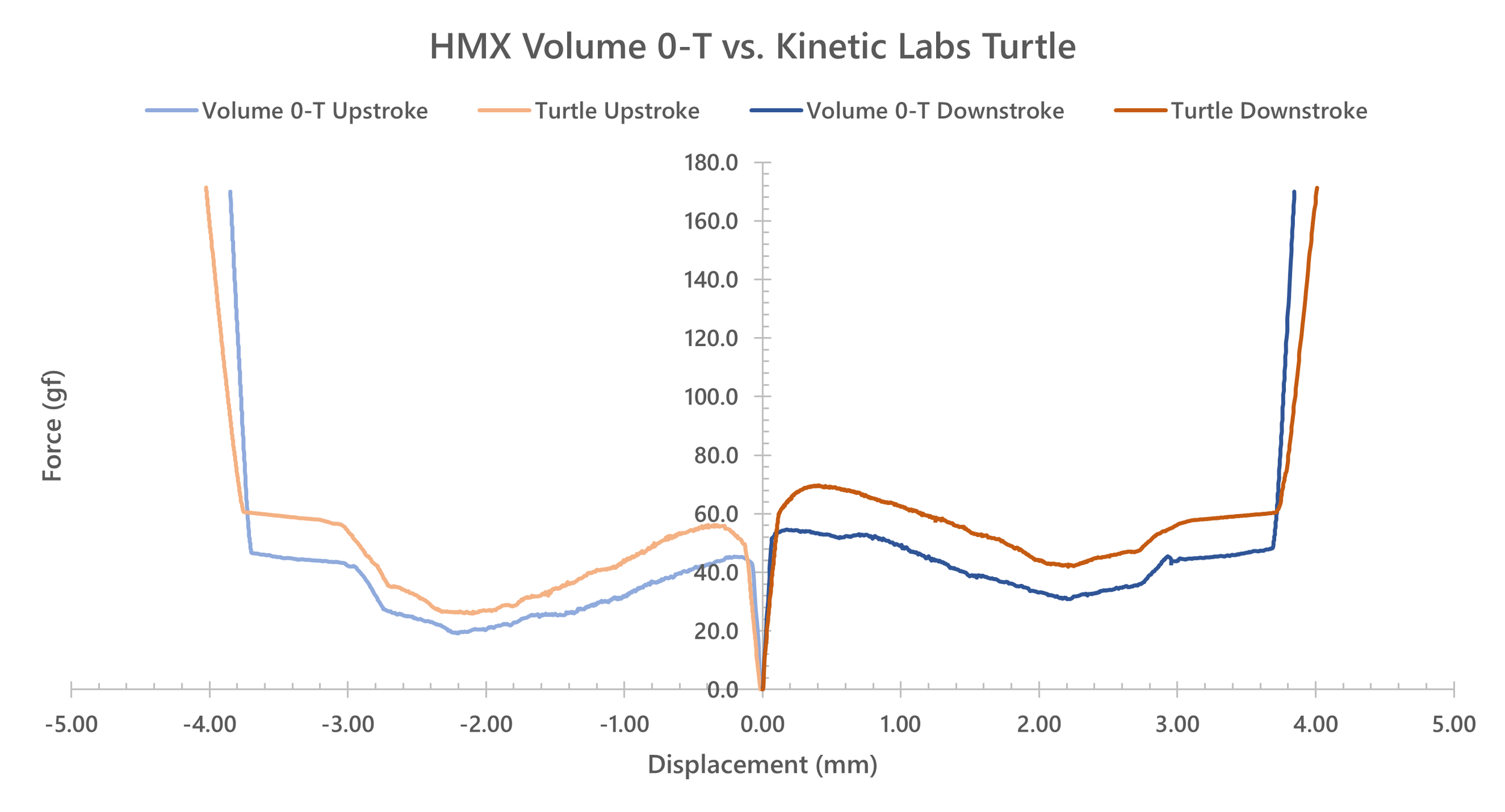
- Looking at the comparative force curve between these two switches below, I am honestly shocked at just how similar they appear there as well as feel in hand. It really is as if the Haimu-made Kinetic Labs Turtles are just heavier, slightly more snappy versions of the HMX-made Volume 0-T switches.
- For all of the similarities that these switches do share, though, do take note that the Volume 0-Ts are definitely the better lubed, more quiet, and don’t have the same degree of scratch or spring ping that was originally noted in the full length review of the Kinetic Labs Turtle switches.
- Like every other switch on this list, the Kinetic Labs Turtles have more N/S and E/W direction stem wobble than the HMX Volume 0-T switches.
Invokeys x Alas Daydreamer
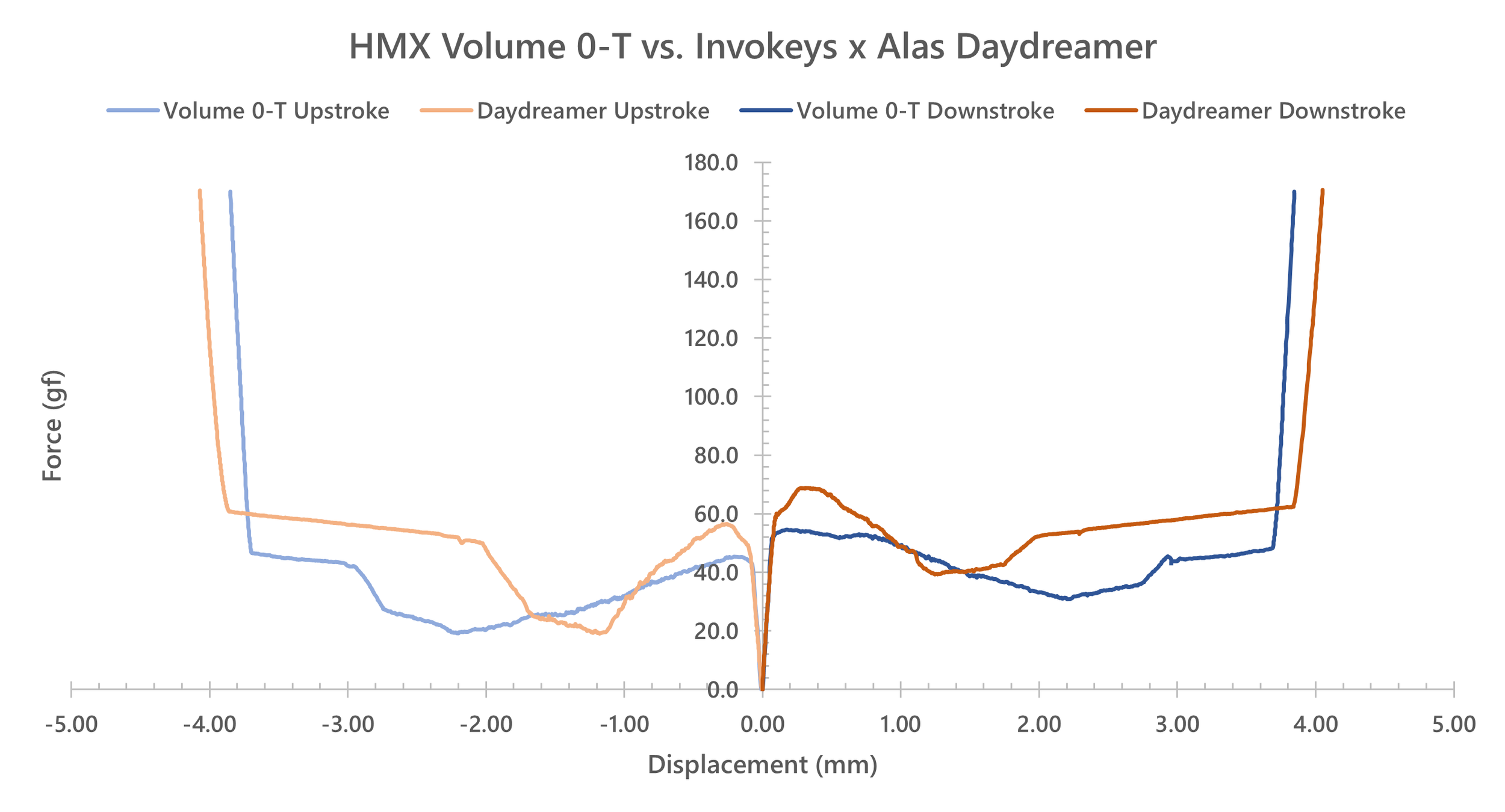
- Despite the Invokeys x Alas Daydreamers ostensibly having a much more forceful, snappy tactile bump, in hand they feel at most only as snappy and forceful through their tactile bump as the HMX Volume 0-T switches do. I honestly am not entirely sure why this is the case on this one.
- As a result of the incredibly well designed LICHICX silencing stems, the Daydreamer switches are as expected much more quiet and muted than those of the HMX Volume 0-T switches at all points of their stroke.
- Whereas the Volume 0-T switches have some noted inconsistencies with the strength and firmness of their bottom outs when typing, the Daydreamers seem to suffer more so with intermittent ‘stickiness’ as if excess factory lubing pools in the base of the housings and causes bottom outs to change.
Haimu Whisper
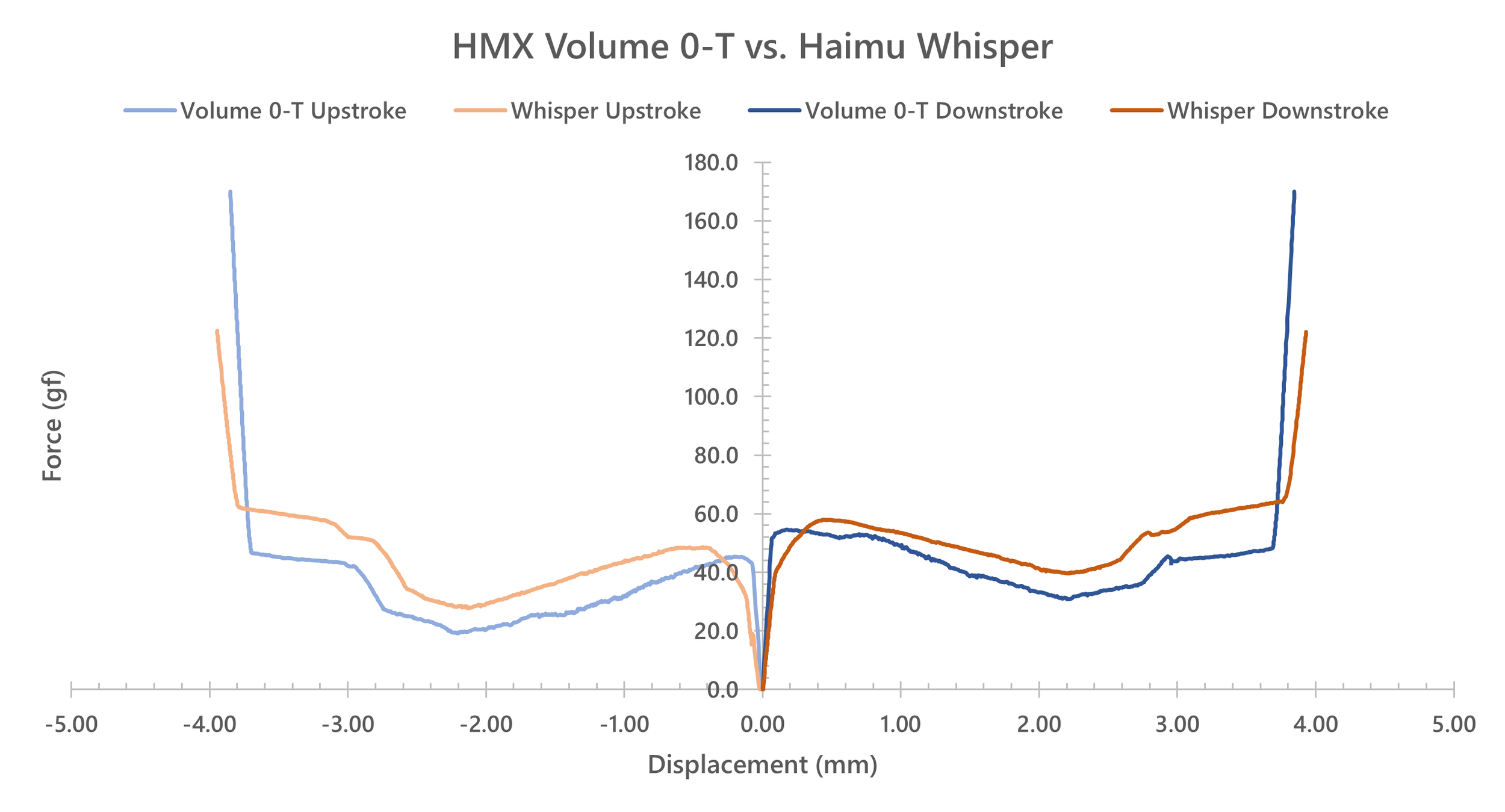
- There’s quite a bit less stem wobble in both N/S and E/W directions of the HMX Volume 0-T switches than there is in the Haimu Whisper silent tactiles.
- While the Whispers seem to carry a similar force curve profile to that of the HMX Volume 0-T switches like the comparison to the also Haimu-made Turtle switches above, the similarity in force between these two here actually makes the Volume 0-Ts feel more snappy and forceful by comparison. Side by side, the Haimu Whispers almost feel like a conventional light tactile in terms of their strength.
- While the HMX Volume 0-T switches are slightly louder than the Haimu Whispers, it is largely because of the snappier, bass heavy tones that their stem/leaf leg interfaces and bottom outs make.
MODE Anthracite
- The MODE Anthracite switches are far and away the more quiet, subdued, and subtle sounding of these two switches with none of the snappiness nor aggressiveness at bottom out that the HMX Volume 0-T switches back.
- Aside from differences in their tactility – in which the HMX Volume 0-T switches are overwhelmingly more tactile and forceful through their bump than the Anthracites – the most notable difference in feeling between these two switches is their smoothness, with the Anthracites being much less precisely lubed and more sandpapery as a result.
- There is a lot less stem wobble in the HMX-made Volume 0-T switches than the Outemu-made MODE Anthracite switches.
Scores and Statistics
Note – These scores are not necessarily completely indicative of the nuanced review above. If you’ve skipped straight to this section, I can only recommend that you at least glance at the other sections above in order to get a stronger idea of my opinion about these switches.
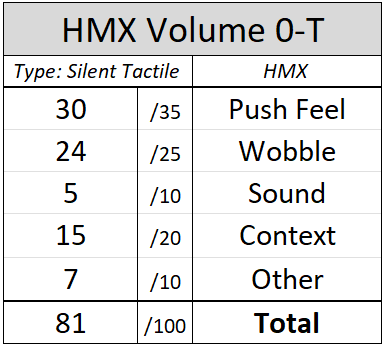
Push Feel
The HMX Volume 0-T switches are HMX’s first silent tactiles and boast an interesting bump and bottom out to go alongside the debut. Rather than ramping up in force or being overly punchy, the bump itself punches straight out into snappiness that rolls right off the top end of the stroke and into a firm, but ever so slightly dampened bottom out that has no mushiness at all. While there is some grittiness at the interface between the stem/leaf leg as well as some inconsistency in housing collision firmness, overall a rather solid feeling silent tactile switch.
Wobble
There is almost no stem wobble in N/S or E/W direction in an HMX Volume 0-T nor across the batch that I received. These switches are incredibly consistent with only the tiniest budges in both directions – something fairly surprising given their mid-ground spring weighting.
Sound
While the Volume 0-T switches are definitely quieter than a normal tactile of similar strength and stature, they definitely are not the most quiet switches ever. Both the tactile bump and housing collisions have snappy, deep, and firm sounding collisions that are pleasant on the ears until you remember you really shouldn’t hear them at all. As well, there’s the faintest bit of stem/leaf ping that is noticeable here as well in some switches if you listen closely.
Context
Priced in the sub $0.50 per switch range and available in effectively all regions of the globe as a result of 80Retros’ (and HMX’s) growing community footprint, these are definitely among the best bang-for-buck silent tactiles that exist out there going into 2026 so long as users don’t mind that they’re not the most silent of silent tactiles on the market.
Other
This is among the best debuts of a switch type I’ve seen for a manufacturer and I can only hope HMX will continue pushing silent switches in the current void of a champion without LICHICX.
Statistics
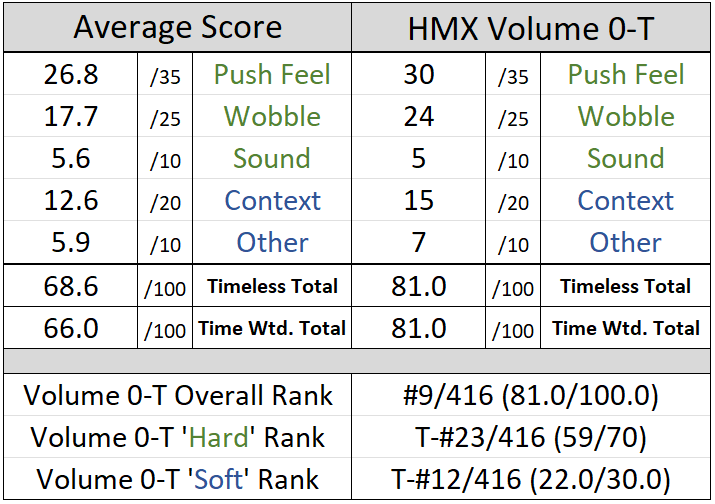
If you are looking at this statistics section and wondering what the heck ‘Timeless’ and ‘Time Weighted’ scoring is, consider checking out my short article titled ‘A Scorecard Time Change’. As a result of scoring becoming a bit anachronistic over the years, switches are now ranked in this statistics table using a “time weighted total” as opposed to their day-of scoring as discussed in that article. If you’d also like to learn about what ‘hard’ versus ‘soft’ ranks refer to specifically, I’d encourage you to head on over to my GitHub linked in the table above or at the links in the top right hand of this website to check out my database of scorecards as well as the ‘Composite Score Sheet’ which has a full listing of the rankings for each and every switch I’ve ranked thus far.
Final Conclusions
At the tail end of the last review of the year, I’m honestly surprised at just how well the HMX Volume 0-T switches turned out and that we get to cap off the year on such a high note. While a bit unfair of me, sure, I suspect that this shock is due in large part to the intersection of quite a few non-switch related factors all hitting at the same time. For one, I can admit that I was mostly interested in obtaining and reviewing these switches for their attached Pinqi block decoration set as well as for a chance to get to deep dive on 80Retros’ background before it continues to balloon into 2026. While I have certainly enjoyed their other switches they’ve released thus far, it has been much more as a result of their extrinsic factors such as their packaging and marketing more than the intrinsic performance of the switches themselves. (Which have been fine, by the way, just not stand out enough to make me want to review them at length.) Another reason that I was caught off guard by the Volume 0-T switches is that I tend to not hold out too much hope for first time switch types from manufacturers which have clearly entrenched themselves into one type of switches for a significant part of their history prior. HMX has made a whole lot of switches leading up to the release of the Volume 0-T switches with exceedingly few of them being silent and absolutely none having been silent tactile, and when manufacturers have historically stepped out of their comfort zones for first time releases as such it hasn’t ended all that well. Here, though, HMX (with assumed help from 80Retros) did a pretty damn solid job. The HMX Volume 0-T switches are different-from-the-rest silent tactiles with a slowly unrolling, snappy tactile bump that starts off right at the top of the downstroke, with no lead in, and a slow ride out to a bottom out that is firm, flat, and just dampened enough to take the edge off a bit. Paired with great, precise factory lubing and an equally firm topping out, the switches are on first inspection absolutely solid performers. Closer inspection will certainly find the flaws in these switches, though, with some stem/leaf ping showing up and the fact that they do make a fair bit more noise than the most silent of silent tactile switches, but then again when have silent tactiles as a type of switch ever been good at being truly silent? If you’re willing to accept a tiny bit of fairly pleasant noise from your silent tactiles in exchange for a solid performance at a reasonable price, the HMX Volume 0-T switches might be something you’ll want to consider checking out. Or something you’ll want to try and shove onto your Christmas list at the last moment in hopes that Santa can swing by HMX’s factory before he hits up your house in a couple of days. The HMX Volume 0-Ts were definitely a great way to round off yet another calendar year of amazing switch releases.
Sponsors/Affiliates
Mechbox UK
- A wonderful UK based operation which sells singles to switches that I’ve used above in my comparisons for collectors and the curious alike. Matt has gone out of his way to help me build out big parts of my collection, and buying something using this link supports him as well as my content!
KeebCats UK
- A switch peripheral company based out of the UK which sells everything switch adjacent you could ask for, they’ve been a huge help recently with my film and lube supply for personal builds, and they want to extend that help to you too. Use code ‘GOAT’ for 10% off your order when you check them out!
proto[Typist] Keyboards
- An all-things keyboard vendor based out of the UK, proto[Typist] is a regular stocker of everything from switches to the latest keyboard and keycap groupbuys. While I’ve bought things from the many times in the past, they also are a sponsor of my work and allow me to get some of the great switches I write about!
Divinikey
- Not only do they stock just about everything related to keyboards and switches, but they’re super friendly and ship out pretty quick too. Divinikey has been a huge help to me and my builds over the last year or two of doing reviews and they’ll definitely hook you up. Use code ‘GOAT’ for 5% off your order when you check them out!
ZealPC
- Do they really need any introduction? Zeal and crew kicked off the custom switch scene many years ago with their iconic Zealios switches and the story of switches today couldn’t be told without them. Use code ‘GOAT’ (or click the link above) for 5% off your order when you check them out!
MechMods UK
- A rising vendor based in the UK, Ryan and crew have been a pleasure to work with and have nearly everything you’d need to build your first or fourteenth keyboard. Go build your latest or greatest one right now with them by using code ‘GOAT’ at checkout for a 5% discount!
Dangkeebs
- A longtime supporter of the website and the collection, Dangkeebs has quite possibly the widest variety of switches of any vendor out there. Not only is their switch selection large, but it rotates and is constantly adding new stuff too. You’re going to need 5% off your order with my affiliate to save off the cost of all those switches!
SwitchOddities
- The brainchild of one my most adventurous proxies, SwitchOddities is a place where you can try out all the fancy, strange, and eastern-exclusive switches that I flex on my maildays with. Follow my affiliate code and use code ‘GOAT’ at checkout to save 5% on some of the most interesting switches you’ll ever try!
Cannonkeys
- Does anybody not know of Cannonkeys at this point? One of the largest vendors in North America with keyboards, switches, keycaps, and literally everything you could ever want for a keyboard always in stock and with an incredibly dedicated and loving crew. Follow my affiliate link above in their name to support both them and I when you buy yourself some switches!
Kinetic Labs
- One of the most well-rounded keyboard vendors out there, Christian and crew have been supporters of all my switch and switch-adjacent needs for some years now. I’m honored to have them as an affiliate and think you should check them out using my affiliate link above to support both them and I when you check out their awesome products!
Keebhut
- Want to try out some switch brands that fly under most vendor’s radars? Keebhut is always seeking out that next latest and greatest and has been super helpful in hooking me up with new brands over the past year. They are all about sharing that love as well, and want to give you 5% off your next order with them when you use code ‘GOAT’ at checkout!
Kailh
- No, you’re not mistaken – this is actually that Kailh that manufactures switches. As one of the longest running manufacturers in the hobby, they have a massive variety of switches available over on their website at any point in time. I’m lucky to be affiliated with them now, and so consider using my affiliate link above when ordering some Kailh switches to support me!
Keebz N Cables
- Australia and Oceania’s very own is now a part of the sponsor list here and I couldn’t be happier to add this long time supporter of the collection to it. They’ve always got an amazing selection of switches (and other keyboard parts) in stock and they want to share the love that they’ve shown me with you all too! Use code ‘thegoat’ for 5% off your first order when you visit!
Further Reading
80Retros’ Game 1989 Switch ZFrontier Groupbuy Post
80Retros’ Film Trio ZFrontier Interest Check
80Retros’ Film Series Expansion ZFrontier Post
80Retros’ HMX V0 and V0-T ZFrontier Post
Unikeys’ HMX Volume 0-T Switch Sales Page
Divinikeys’ HMX Volume 0 and Volume 0-T Switch Sales Page
RNDKBD’s HMX Volume 0-T Switch Sales Page
Milktooth’s HMX Volume 0-T Switch Sales Page