TTC Brother V2 Switch Review
I guess after all of the high strangeness that was scattered across the last couple of months and reviews that made their way up here that I was finally due for a bit of a lull in everything. While I’m quite certain that the world is only taking the briefest of breaks rather than having actually ran out of the absurd, I can still appreciate it for what it is – both in keyboards and in life as a whole. Stranded in between the bright hot heat of the summer and the cusp of college football season, my absolute favorite time of year for sports in the US, it really has been a couple of uneventful weeks since the Cherry MX Lumina Brown Switch Review. I’ve seen a couple of movies, been watering the garden with our new fancy rain barrel system that we have set up, and even added a few salvaged plants from a local park closing down that the girlfriend made me go out and dig up. Maybe I even attended the most legendary birthday party I’ve ever been witness to and got knockdown drunk to the point I was late putting this review out. Normal stuff, you know. I suppose the next real intentionally eventful thing that we have planned is a trip here in a couple of months to visit Arizona to catch hummingbirds during their fall migration back towards Mexico, but even that is a bit further away. Fully expecting the unexpected between now and then to fill the space at the front of a review, I wasn’t going to share much about that likely until after we had returned and caught photos of the 14 or so different species that we’re making the trip down there to see. All in all, it really just has been a couple of nondescript weeks here in Goat world.

Figure 1: I guess we have been rewatching the X-Files at home and so the culmination of the 'Samantha Mulder' plot from Season 2 could have easily absorbed all that strangeness with its conclusion…
Switch Background
With introductions to reviews in previous weeks having shown me clearly struggling with the changing of seemingly everything all over the place all at once, the past couple weeks of stillness have left me trying to embrace the chaos a little bit more – specifically within the keyboard switch scene as a whole. Change still definitely did strike me off guard in preparation for this review, do not get me wrong, but I’m trying my best to be one with the unexpected. More specifically, I picked up a set of the TTC Brother V2 switches in quite a hurry when I found out they were available as I thought they were going to be a 2026 continuation of arguably the very best click jacket clicky switches I’ve ever encountered over the years that I’ve been collecting and reviewing. This excitement mounted quite steadily up until the point of sitting down this week to work on prep for this review upon discovering that TTC pivoted away from click jacket click mechanisms to click bars in the latest iteration of these Brother switches. While this was quite upsetting to find as the opportunity to a review a proper click jacket clicky switch is highly unlikely to hit at any other point in the dwindling year, I am at least trying to appreciate their novelty as being the first click bar clicky switches that TTC has put out to the best of my memory. That, alone, is a silver lining of a contextual backdrop as it also puts TTC in slim company with manufacturers Kailh, BSUN, and Outemu as being now the only fourth large, modern day company to produce a full size MX switch with a click bar. (Kailh has all of their Box platform clicky switches, BSUN has the Invokeys Pea Flowers and most recently Jade Pots, and Outemu has the Glorious line of switches.) In the still remaining enthusiasm to review a clicky switch of any form in 2026, even if it wasn’t the type that I had imagined it was, it did lead me into thinking a bit more about clicky switches as a whole, and more specifically how they seem to be a switch type that is largely falling by the wayside anymore.
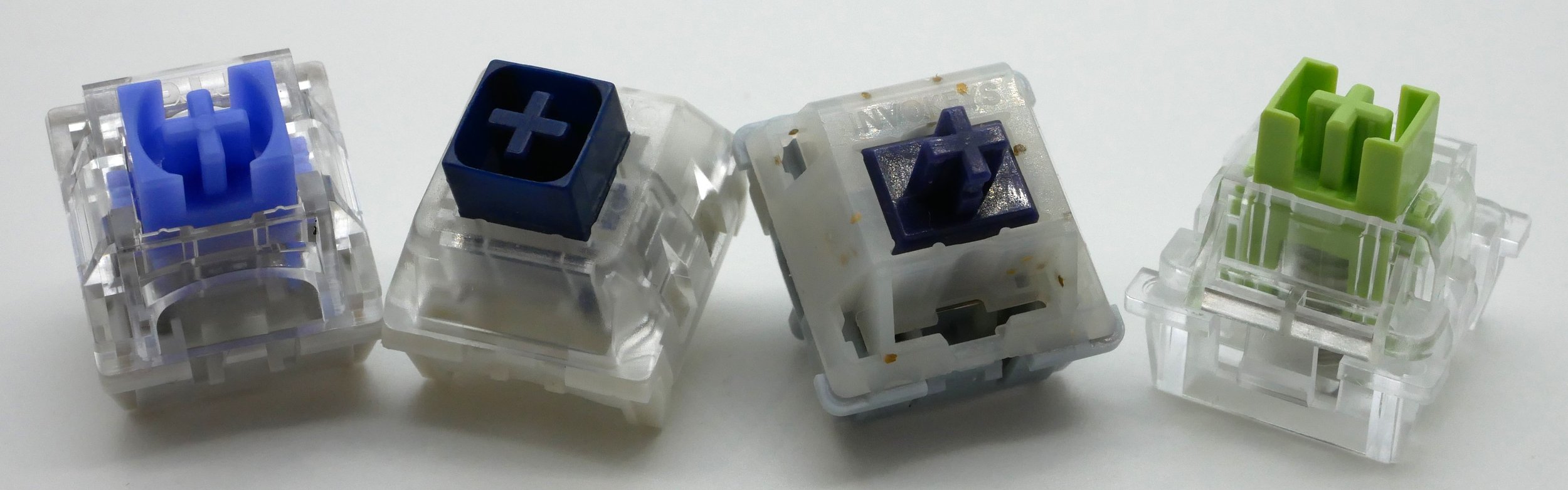
Figure 2: Representative click bar clicky switches from the four aforementioned manufacturers including (L-R) TTC's Brother V2, Kailh's Box Navy, BSUN's Invokeys Pea Flower, and Outemu's Glorious Raptor HE.
Yes, yes, I know – the statement that clicky switches are ‘falling by the wayside’ may be a bit doomerist in light of some notable clicky switches being released in the last year or two such as the Gateron Melodics, Glorious Raptors (questionably noteworthy), and the WS Biglucky Clickies, but do you really remember any anticipation or community excitement leading up to the release of those switches? I know that switches very rarely have extensive pre-sale marketing nowadays, but I really only remember there being a smidge of community intrigue into the Gateron Melodics before they were listed for sale, and definitely none for those other on that short list. (Of course the entire existence of the Melodics was pretty summarily overshadowed shortly thereafter with the tactile offshoot that was the Gateron Lanes taking all of the attention for the new, smaller tactile leaf mechanism that Gateron introduced.) We’re quite far away from the days of the Novelkeys Cream Clickies or Zeal 3-in-1 Clickiez switches. Discounting the Melodics, the reality is that the hang time in between now and the last clicky switch you remember excitedly reading about was actually much longer than you’d ever guess. My thought as to why, though, is simple – it’s because of Hall Effect switches. Having first squeaked their way into the modern mechanical keyboard switch scene around mid-2024, Hall Effect style mechanisms have only been occupying increasing amounts of market share in the custom community year over year since. And despite this style of switch growing in both attention and variety in that short two years of time, the vast majority of these HE switches are still only offered as linears. No amount of glitter in the top housings, QR codes printed on the underside of the switch, n-polygon shaped stems, or really any other neat and novel quirk of function-less design can really hide the fact that most of these switches are just simply linear. While there have been some exceptions to this majority such as Glorious’ Panda HE switches which were among the first to introduce tactility into the HE footprint or very recently the Geonworks Strike HEs with a clicking mechanism, it’s likely that these will remain the exception rather than the start of a new rule because these feedback mechanisms don’t well mesh with the sort of main thesis of Hall Effect switch design. Hall Effect switches are ones that were originally marketed around the fact that they have modifiable actuation points. Using software attached to your keyboard, you could change how one set of switches registered keystrokes into a whole range of different options. With those kinds of options available to you and a blank canvas that is a linear downstroke, why would you want to interrupt those choices with a feedback mechanism fixed in a singular point of that downstroke that can’t be modified like the actuation points? Most people wouldn’t opt to have their actuation point of a switch be before or even part way up a tactile bump nor before the noise making mechanism of a clicky style switch, so what is the incentive for them to pay extra for those features that just limit where they could reasonably move an actuation point? And so while it is likely possible that some mechanism could be made with a sort of floating point tactility that could one day make for truly modifiable feelings in Hall Effect switches, it just doesn’t simply exist yet in 2026. In turn, clicky switches, which are an already severely underrepresented switch type in the modern market, continue to only grow more rare as MX mechanisms are phased out for HE ones that don’t support them for the time being.
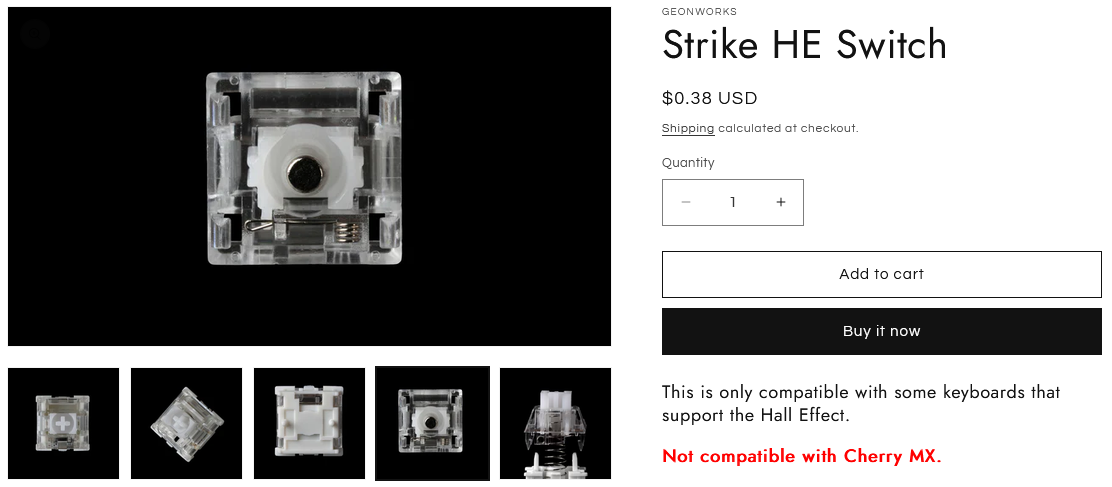
Figure 3: Geonworks certainly seems to think there may be a market for non-linear HE switches. Geonworks 'Strike' HE switches with a click bar mechanism...
There is actually a non-obvious continuation from the thoughts of the previous paragraph above that paradoxically poses a more rosy outlook for clicky switches in the not too far flung future, though. As we see clicky switches slowly fading from the mainstream of offerings as a result of growing sentiment for HE switches, many people imagine that storefronts will need to take a stand somewhere on the axis of MX versus HE switches and what kind of vendor they want to be. Offer an even split in between them? Stay the traditional MX route like vendors of old or fully convert towards the newest and hottest mechanism on the block? However, I see the market stratifying not just on that axis per se, but more so scattering along a plane as a result of a perpendicular axis to this MX vs. HE divide that splits these switches based on their core competencies. Taking a step back from how I got to these pair of dividing axes as a final conclusion, though, I want to go back to the very beginning of when Hall Effect style switches first began hitting storefronts. Generally speaking, these newer switches were almost exclusively marketed along the lines of how they could assist gamers and be part of a new wave of prebuilt, mass-produced gaming keyboards that has never really offered much of intrigue to the more custom community in recent years. Naturally, I imagined this would have caused HE switches to be isolated to more prebuilt, less enthusiast grade keyboards and MX switches to stay as the gold standard of the enthusiast community. However, dedicated enthusiasts brands like Geonworks, who have made compatible Hall Effect PCBs readily available for a wide range of keyboards, mixed with not insignificant other vendors like AEBoards and Wuque Studio adopting these designs and new switch styles quite openly has turned this estimated hard divide into more of a soft spectrum than a dichotomy. Pulling in the clash of the movable actuation point versus fixed tactile or clicky mechanism from the previous paragraph into this one, we also must consider that in addition to vendors stratifying on what type of switch that they want to support that the switch types themselves will naturally divide themselves apart in terms of their most easily attainable mechanisms – that is Hall Effect switches will be predominantly linear while MX switches will still specially hit tactile and clicky mechanisms that HE switches just can’t. I suppose what we will have in the future is some companies largely catering towards the newer, sleeker Hall Effect switches with a wide array of linear weights and housing materials while others will be pushing for the kinds of functionalities you can only cleanly get in MX switches – leaves, click bars, click jackets, etc. Yes, there will be some outlier companies that still push to sell good MX linears and other, more adventurous types that will push for clicky and tactile Hall Effect switches, but these companies will play to the strengths of the type of mechanism they want to adopt in order to stay relevant. In turn, to play to the strengths of the MX footprint where an actuation point is predefined, I imagine those companies will push for tactile and clicky switch mechanisms to be made more than linears as the MX platform, as of right now, will always make more cohesive, reasonable tactile and clicky switch designs than Hall Effect style switches. Put more simply, they’ll have to make more clicky switches to emphasize why they chose an MX footprint over a Hall Effect one. The very thing limiting clicky switch adoption right now in Hall Effect switches may actually drive a renewal in interest for them in the MX footprint in the future.
A trip down quite a few of my thoughts on the future of Hall Effect switch design and ability certainly does feel a bit of a tangent from the background of the TTC Brother V2 clicky switches, I will admit, but I think it speaks to the assumed surprise that you all had as readers that I not only found but chose to review a clicky switch in 2026. Custom made, not just OEM-style ‘Blue’ clicky switches, designed with a clickbar by someone other than Kailh in 2026 is a notable event purely on the basis of just how rare it is at this point in time. (Stating this as being because of the rise of Hall Effect switches is why it is a tangent thought rather than a disconnected one.) In turn, it also highlights what I’m guessing will be a local, but not global low in clicky switches over time. While this perhaps would suggest that I should have just held off into the near-ish future for those more exciting clicky switches than these, I wanted to appreciate these for where they are now, in time, in the event that I’m wrong. Without much marketing or lead up to them being released presumably on account of being a follow up to an already named switch, or on account of TTC not doing much in the way of actionable marketing for anything other than their OG Lunar New Year switches anymore, they sort of just showed up sometime around February of 2026. Not to be confused with the original TTC Brother “V2” switches which featured LED diffusers unlike the very first ones, the TTC Brother V2 switches released as such in 2026 are click bar clicky switches with a marketed medium-weight peak force around 58 gf, and a somewhat shortened stem travel of around 3.7 mm in length. Available via a whole range of both eastern and western facing vendors, the TTC Brother V2 switches are generally priced around $0.40 – 0.50 per switch, being at about $0.47 per switch in packs of 15 directly from TTC. While TTC generally does support their switches for a good couple of months or low number of years historically, recent changes to the numbers and types of releases that they have been doing in recent years (such as releasing more HE style switches) have made it hard to judge just how long the Brother V2 switches will be made available for.
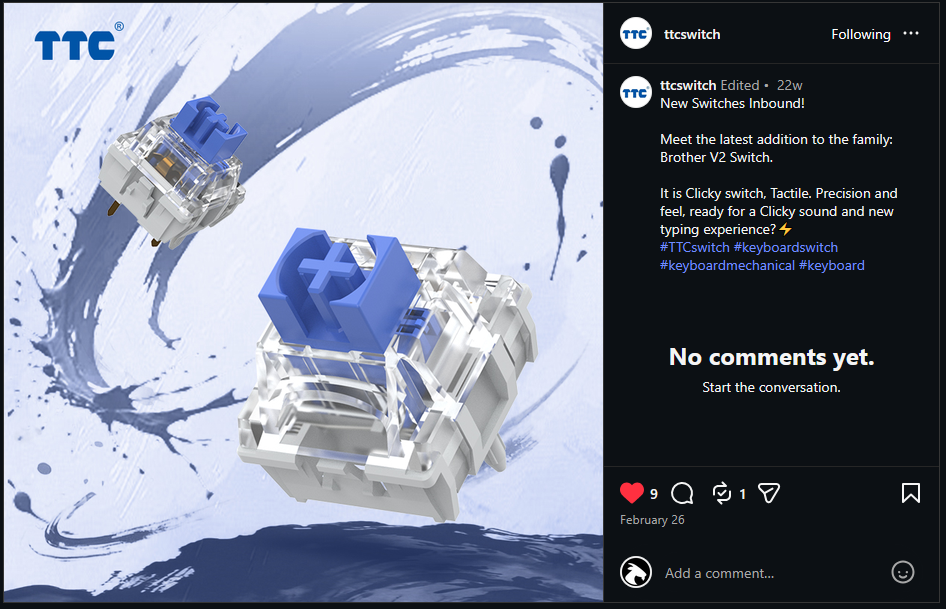
Figure 4: TTC's Instagram announcement for the Brother V2 switches from February 2026.
Brother V2 Performance
Appearance
At the highest level, the TTC Brother V2 switches come in a three-part colorway of clear over light grey with a denim blue dustproof stem that is similar to, but not quite the same as their older, V1 siblings. In a lightly ironic fashion for a familial themed switch, the Brother V2s are visually differentiable from the V1s as a result of their grey bottom housings as opposed to the aggressively yellow V1 bottom housings as well as in actual mechanism, with the V2s having click bars versus the V1’s click jackets. (Younger siblings always get the nicer toys after all, right?) Despite being slightly different in appearance and mechanism, though, these switches very much still look like a TTC Brother continuation and carry a lot of the features common to TTC switches made in the MX footprint and at a slightly lower price point. These readily distinguishable features include those of the old school, blocky ‘TTC’ nameplate, combination of dustproof stems with the built-in half height LED diffusers, and then the pair of curved rectangular pads next to the PCB mounting pins on the underside of the switch. In addition to these fairly standard features for TTC switches, there are also a fair few interesting and different features of note that are worth looking at in TTC’s first click bar switch. Highlights of these more notable features may be found in the following paragraphs and photos below.
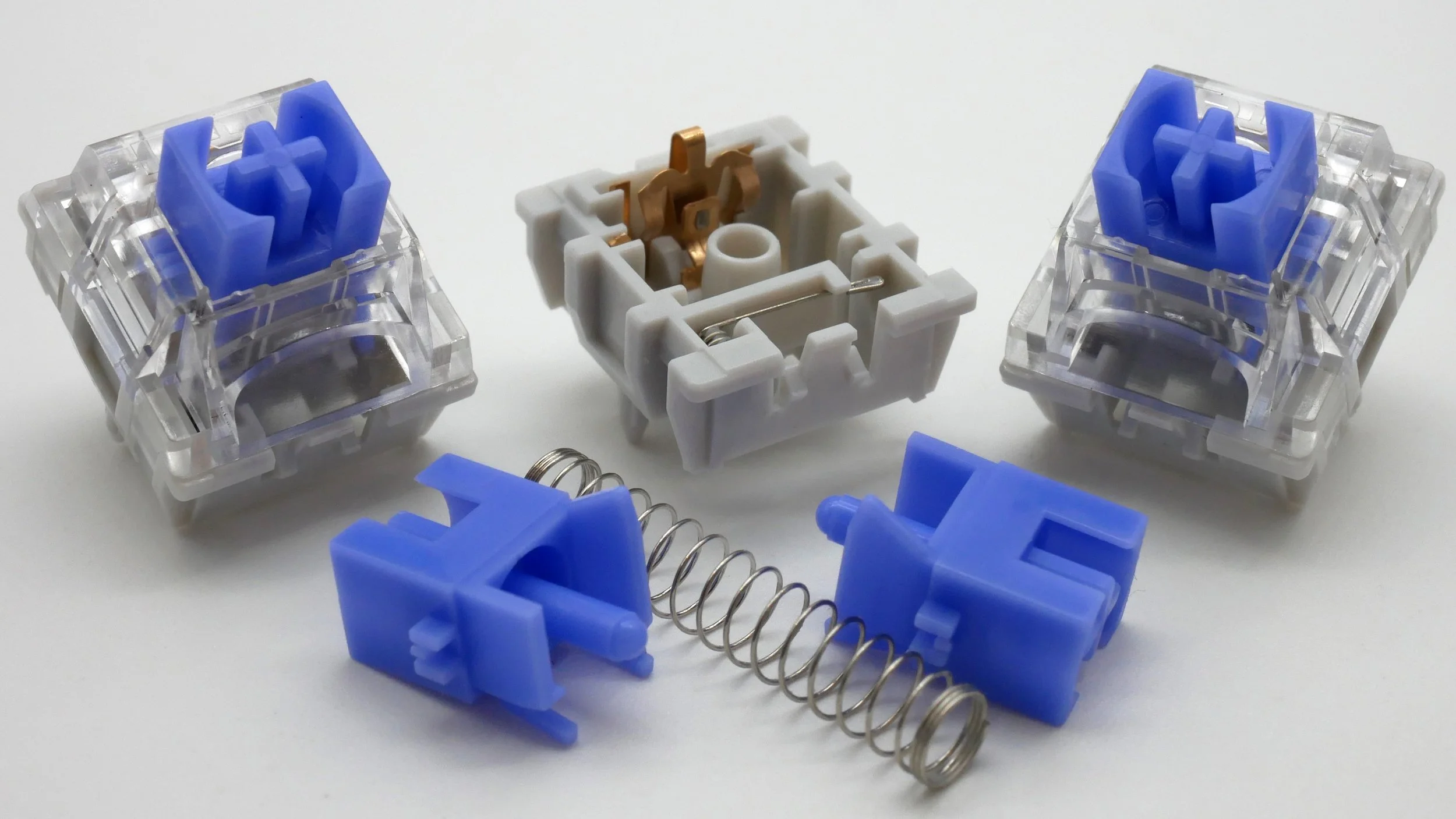
Figure 5: TTC Brother V2 switches and their components.
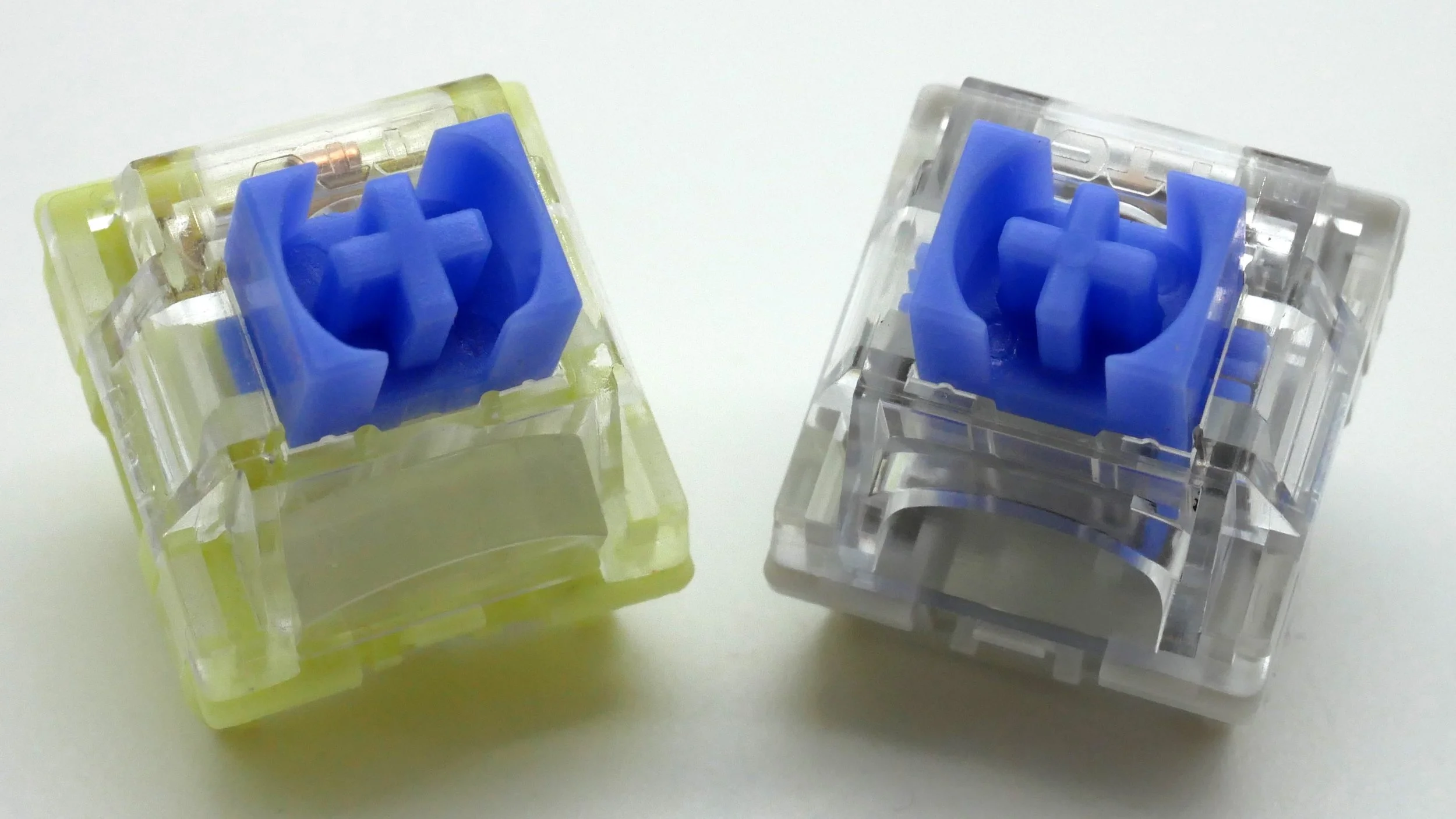
Figure 6: Color comparison of the TTC Brother V1 (Left) and V2 (Right) switches. Yes, the V1s were in fact that exact shade of lemon yellow when they were originally released.
Looking first to the clear polycarbonate top housings of the TTC Brother V2 switches, these are by far the least interesting of the components of the Brother V2 switches only because they are the ones most similar to that of existing, classic TTC switch design. While it has been more commonly seen in a non-inverted fashion on full black nylon, OEM-style housings, the large, blocky ‘TTC’ logo is present here on the TTC Brother V2 switches and feels a bit refreshing as a simpler design relative to a lot of what TTC has been producing in recent years. In addition to this inverted nameplate, the top housings feature a built in LED diffuser as well as a four-pin attachment style. Internally, there’s effectively two points of note which I do not recall having seen in TTC switches prior. (Admittedly it has been a minute since I opened one, however.) The one feature which is present only on account of the click bar mechanism is that of a small notch on the left-hand side of the south-side guiding rail next to the LED diffuser. While this doesn’t directly interact with the click bar, itself, it is present to accommodate the large clicking wedge attached to the stem as can be seen in the next paragraph below. The other feature of note is that of the mold markings, which are located in the standard positions of the upper corners underneath the edge of the nameplate portion of the housing. Unlike traditional mold markings, though, these are super small in size and appear to be two-digit/two-letter for both locations and extremely hard to make out by eye.
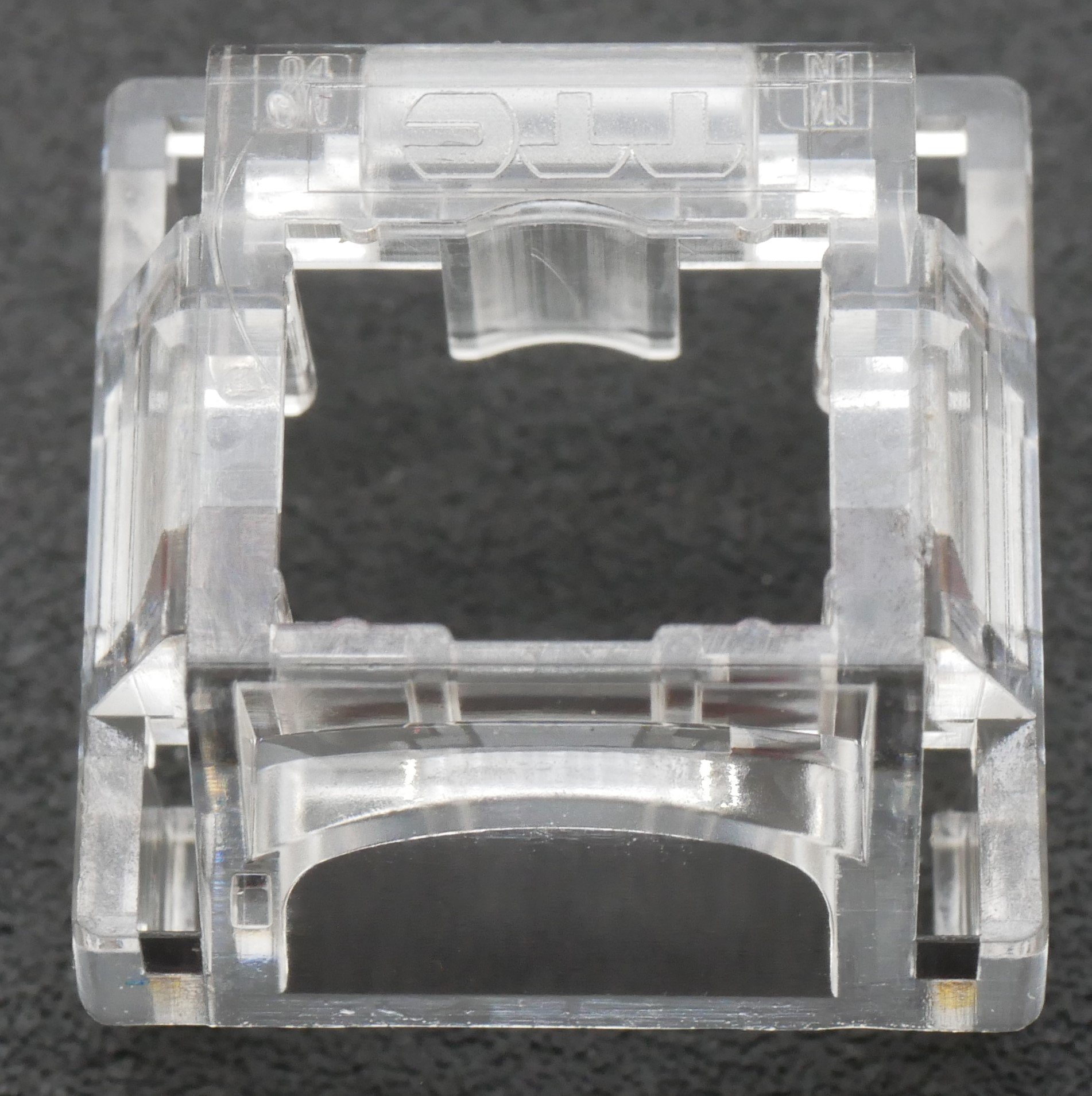
Figure 7: Top housing exterior of the TTC Brother V2 switches showing an inverted 'TTC' nameplate as well as a built in, half height LED diffuser.
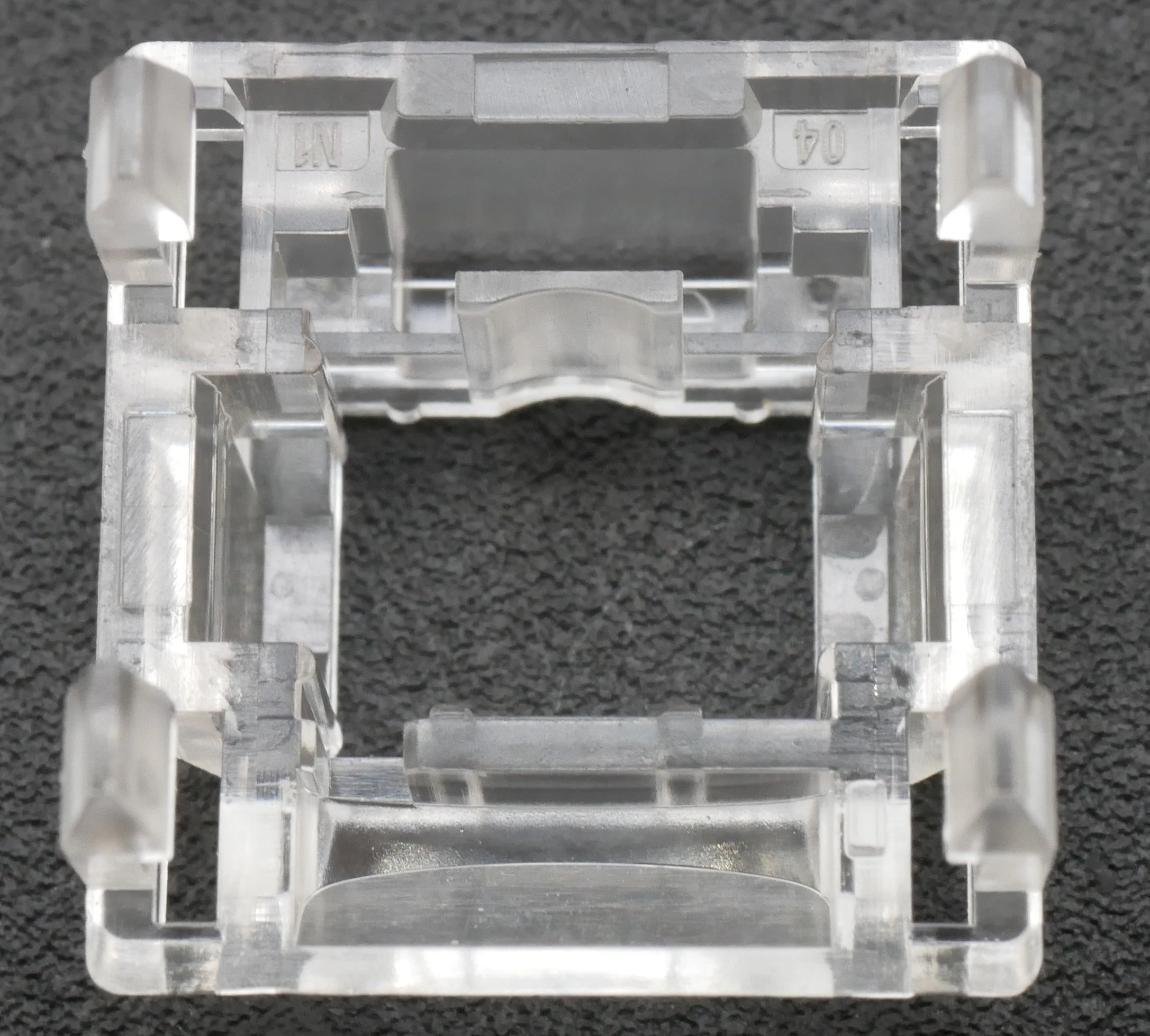
Figure 8: Top housing interior of the TTC Brother V2 switches showing no attached guiding rails for the stem, a notch in the bottom left-hand corner to accommodate the click wedge of the stem for the click bar mechanism, and mold markings in the upper left- and right-hand corners underneath the nameplate region.
Stopping next at the denim blue, presumably POM stems of the TTC Brother V2 switches, we’re greeted with a rather large feature expected of a stem in a click bar switch as well as one that is definitely not as expected, nor necessarily locked to that style of switch. The most prominent feature on the stems of the TTC Brother V2s is that of the large triangular wedge located opposite of the PCB leaf actuating legs on the stem. In addition to riding within that slot open in the top housings, there is a similarly placed, similarly sized gap in the bottom housings where this wedge rides up and down in, though raking back and forth across a fine metal click bar to make noise in the bottom housings. The other less expected feature of the Brother V2 stems is that of their significantly shortened slider rails. With a lack of proper bottom guiding rail heights in the bottom housings of the Brother V2s as well as a standard top housing construction, these shortened slider rails effectively provide no apparent functional support to the stem when traveling up or down. While this also gives the double edged sword of therefore reducing the surface area of contact through which scratch could develop in these switches, it seems somewhat odd of TTC to do this and in turn effectively leave the stem stabilization during pushing to that of the click wedge and its specific slot. The stems, otherwise, appear fairly normal with a small, slightly rounded center pole, commonly shaped TTC dustproof walls, and a thin application of factory lubing on all four sides of the stems.
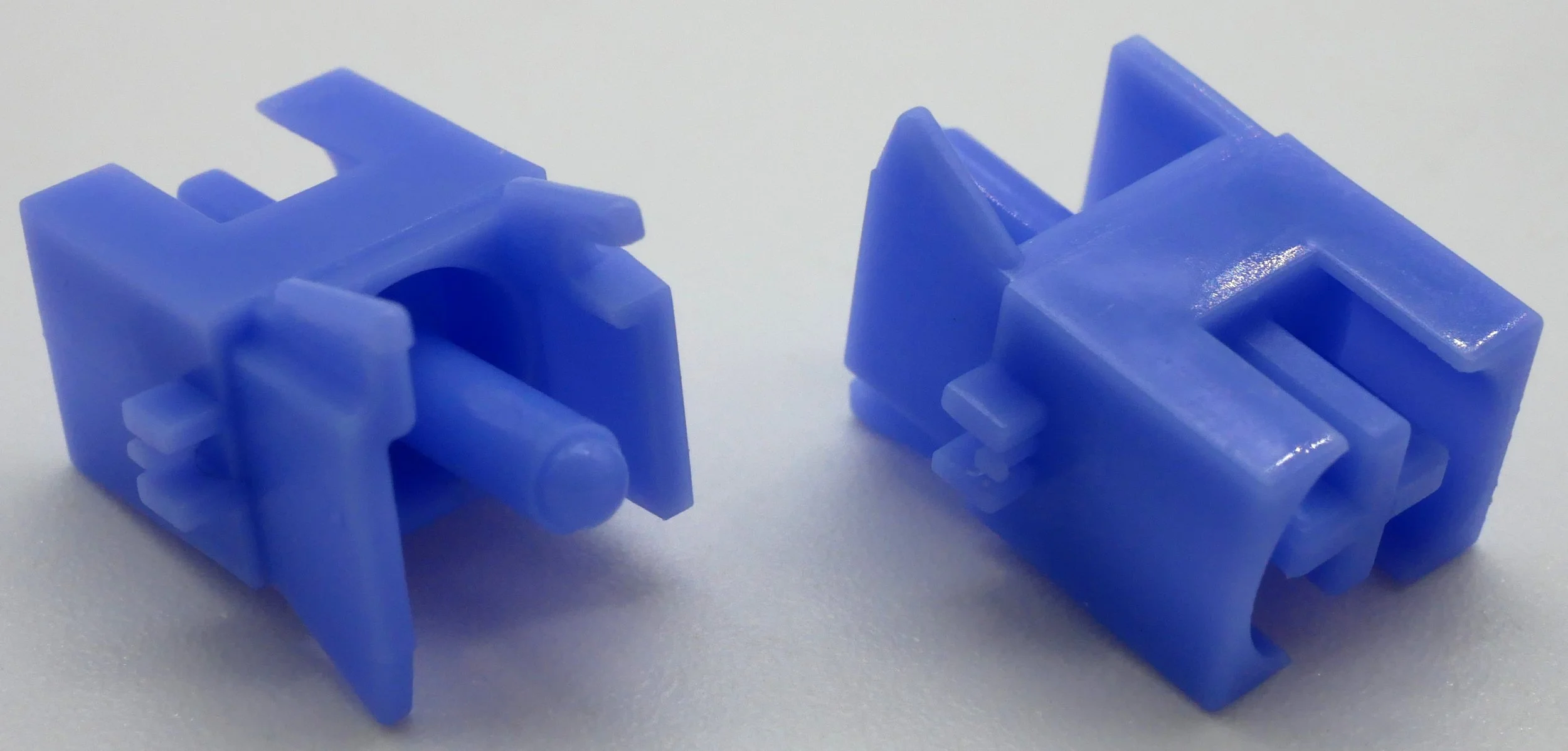
Figure 9: Front and back sides of the TTC Brother V2 stems showing a large click wedge for actuating the click bar mechanism on the back side of the stem, very short slider rails, and otherwise fairly normal features for a TTC-made stem.
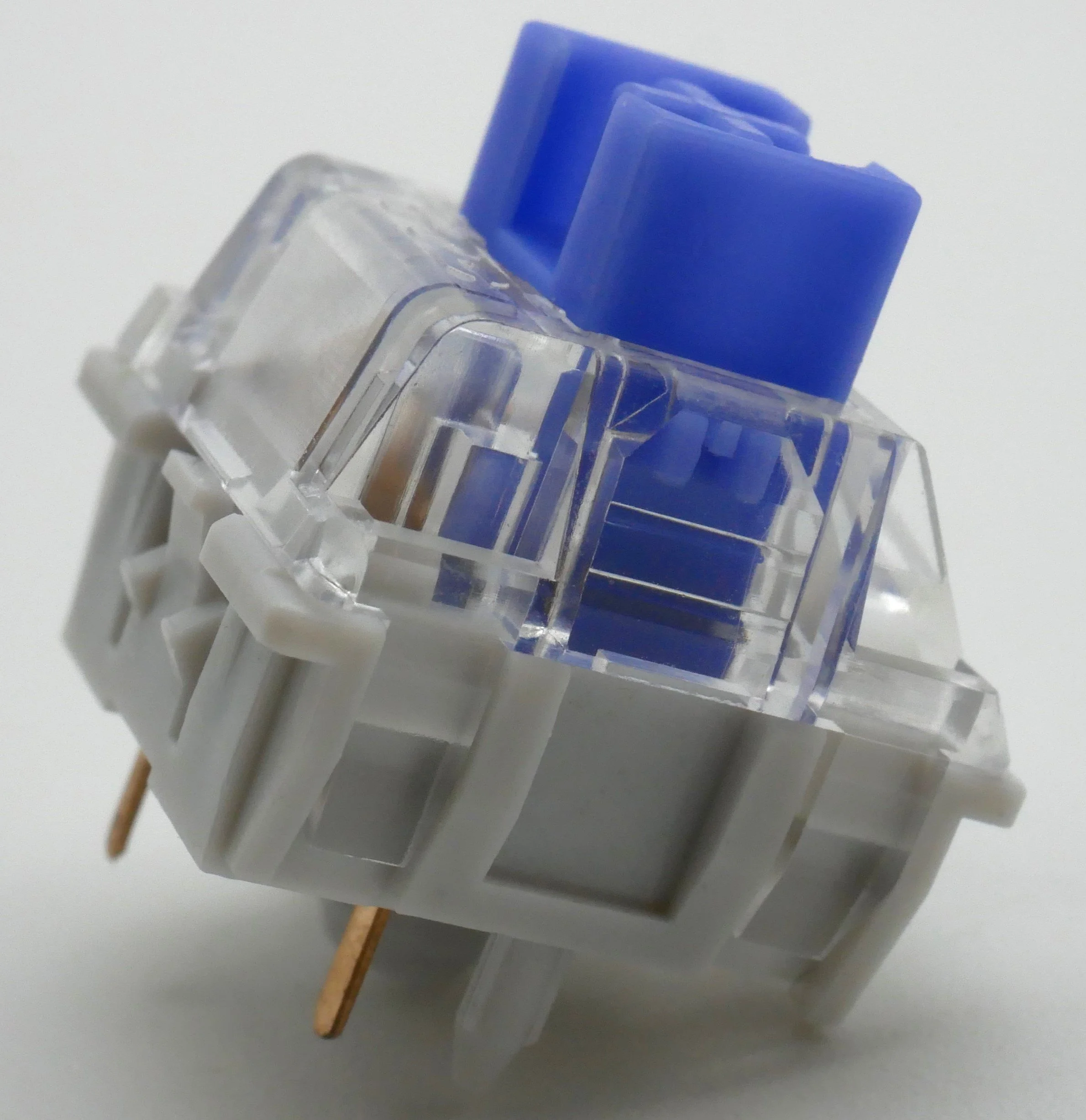
Figure 10: Side view of a closed TTC Brother V2 switch showing just how little stabilizing interaction exists between the 'slider rails' of the stems and the housings of the switch.
Finally arriving to the light grey, polycarbonate bottom housings of the TTC Brother V2s, we round out this section with a bit of the expected and unexpected with respect to the design of these housings. Along the more traditional, expected ends of things for a click bar mechanism is that of the click bar, embedded in one end of the housing underneath the LED diffusing bubble of the switch and spanning across the front of the housing to be lightly flicked up and down by the stem upon pressing the switch. Internally the housings also have some small dampening pads at the bases of their guider rails, a moderately sized south side spring collar, trace amounts of factory lubing, and a small squishy pad at the base of the center pole hole for sound dampening. (Note: ‘Dampening Pads’ here is used to refer to thicker areas of housing material included with the aim to deaden bottom outs onto the sides of the stem. This is not the same as the softened pad located in the very base of the stem pole hole of these switches which aims to deaden bottom out noise on the stem pole.) As already alluded to above, the strangest internal feature for the Brother V2s is that of the lack of guider rails. Without these standing upright to help guide the stem up and down in its transit, the housings on their own appear much more flat and uncannily uniform. Externally, the Brother V2 switches come in a PCB mount/5-Pin variety with the set of curved wedge extrusions on the insides of the pins that are iconic of TTC switch designs new and old alike. While not all TTC-made switches do feature these, it is worth noting that the Brother V2s are not ones which feature an embossed ‘TTC’ logo between the metal PCB pins in similar location and orientation to those of the Gateron anticounterfeit markings first appearing after the Stealios Controversy. (It is worth noting, though, that the TTC logo marking in this fashion predates the Stealios Controversy by several years, first showing up on the undersides of TTC-made Razer switches sometime in 2014-2016.)
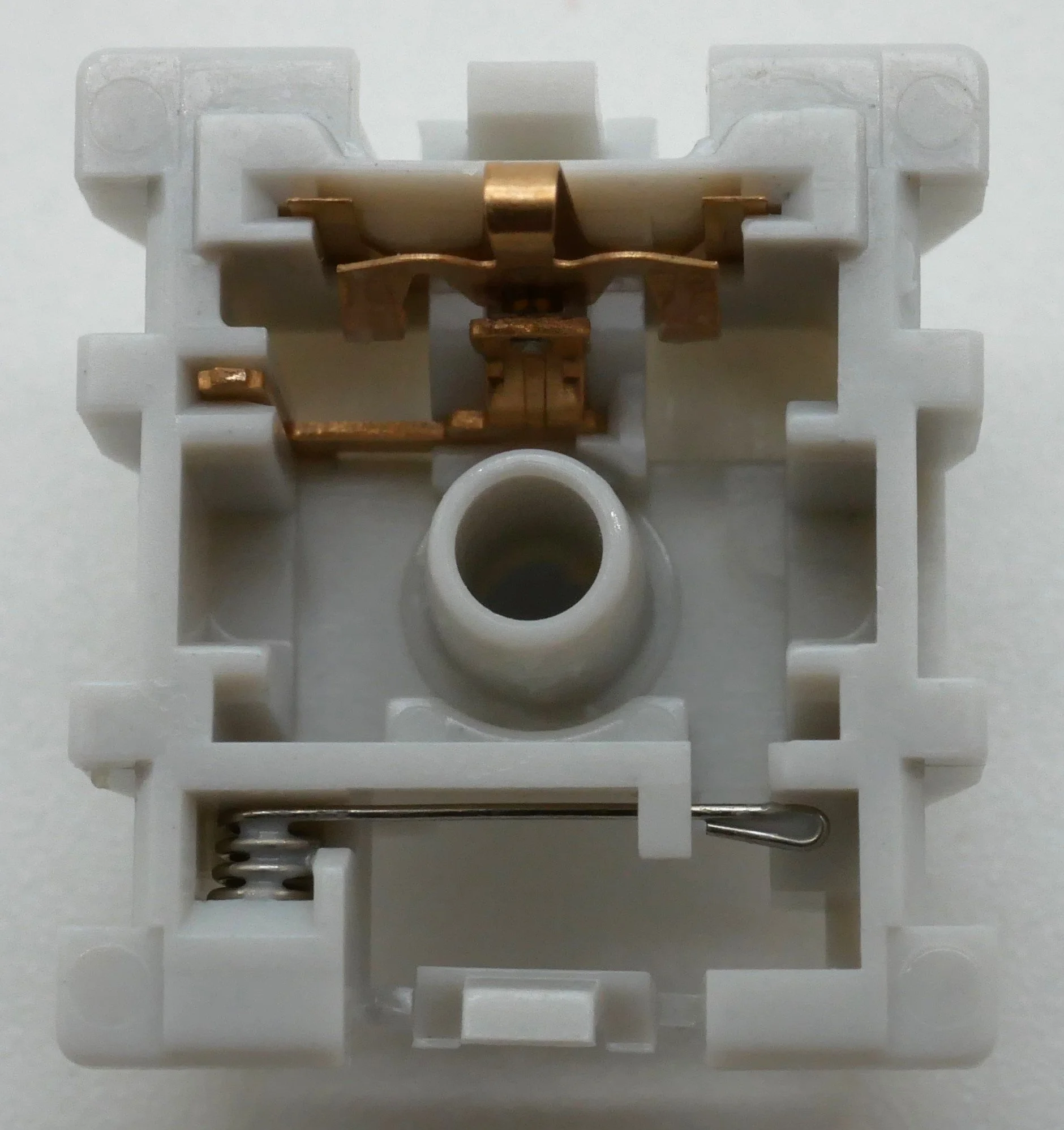
Figure 11: TTC Brother V2 bottom housing interior showing dampening pads at the base of the non-existent slider rails, a small south side spring collar, trace amounts of factory lubing, and the click bar mechanism which also has trace factory lubing apparently caught in it as well.
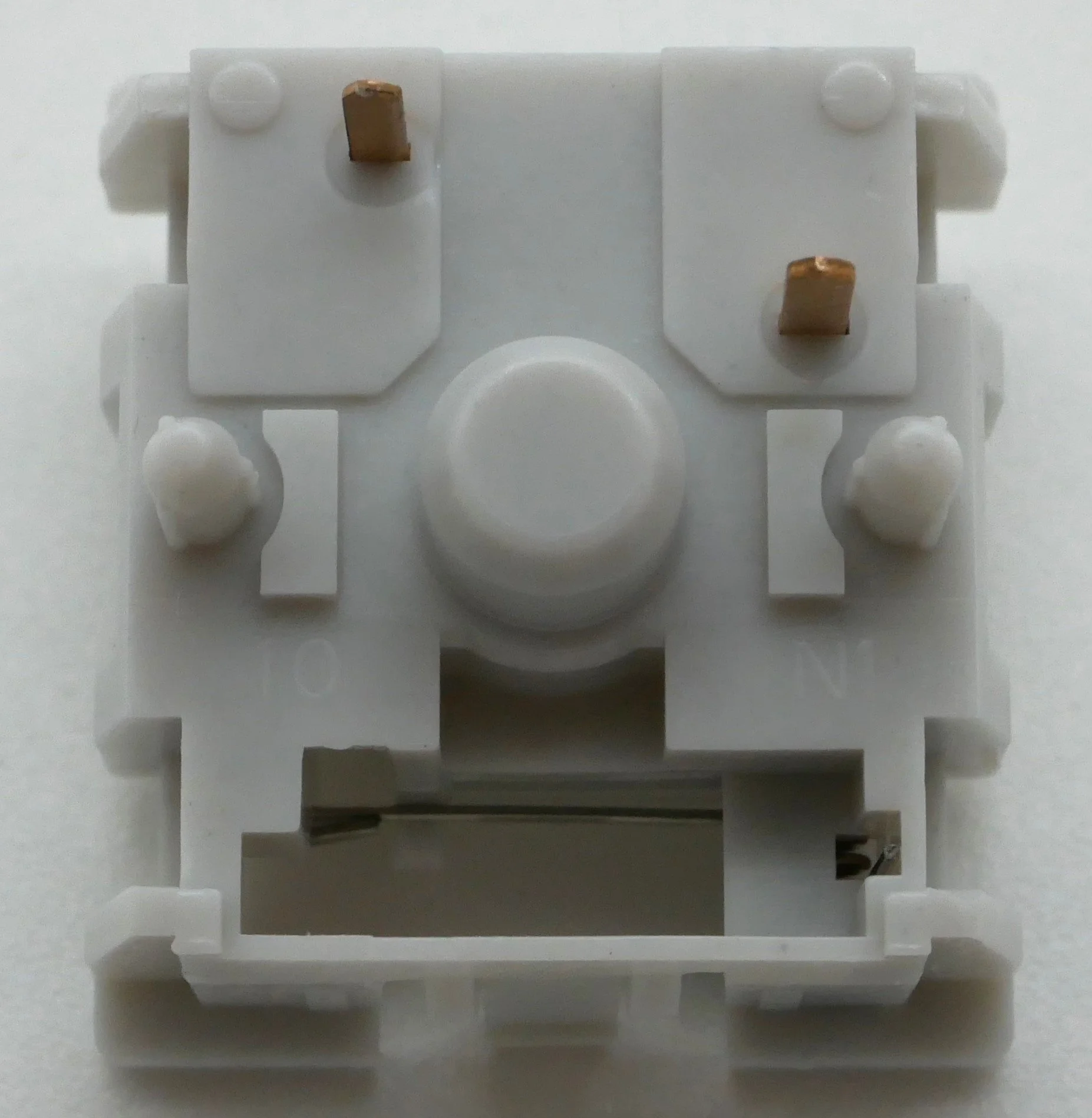
Figure 12: TTC Brother V2 bottom housing exterior showing PCB mounting pins, curved wedges typical of TTC switch designs next to them, and small, faint mold markings underneath those wedges. Note the absence of a 'TTC' logo between the metal PCB pins.
Push Feel
Given how rare click bar clicky switches are in this day and age, there’s a nonzero chance a decent portion of you all reading this have never had the experience of typing on switches like these before. If that is the case, let me tell you that it is certainly quite the unique typing experience and those who have tried them know exactly what I am talking about. In general, and completely counter to what you might try and interpret from the fairly standard looking force curve for this style of mechanism below, click bars always feel like the epitome of instantaneous tactility. Take all of the build up, wind down, and gentle arching over the peak of force of your favorite harsh tactile switch and cram it into the blink of an eye where it all blurs together. The TTC Brother V2 switches, to that end, perfectly mimic this nearly instantaneously perceived ‘snap’ in force, popping the user firmly down through the downstroke and a bit lighter, though still noticeably firm on the return. Unlike some of the more famous click bar switches like the Kailh Box Jades and Navys, however, the TTC Brother V2 switches do not feel overly harsh nor sharp, and are instead only a tiny bit forceful at the quick apex of their force. While definitely still enough to fatigue users with more sensitive fingers over long periods of typing on them, it doesn’t have nearly as much of a grind on the fingers as those other aforementioned click bars. Perhaps this is indicative of TTC either using thinner gauge click bars and/or having a different style of material to them? (In fact I’ve always wondered why alternative metal click bars were never explored by Kailh before…) As for all other aspects of the TTC Brother V2 switch’s push feeling, it’s generally hard to notice anything else with such a large, in your face part of their feeling (and overall physical presence by way of sound for that matter) being their click bar mechanisms. You don’t really notice the pre- nor post-click point linear regions leading into the or out of the click bar for that matter, nor really the bottom out that caps off the downstroke either. Without a long stem pole and TTC clearly opting to deaden the bottom out of these switches a bit in their design, the housing collision at the point of bottom out is soft, or at least so much more radically softer than that of the click bar as to just not stand out at all at normal typing speeds. Paired up with some well applied factory lubing that makes the linear portions of their strokes smooth, TTC very clearly designed the Brother V2s to emphasize their key feature and did so quite well.
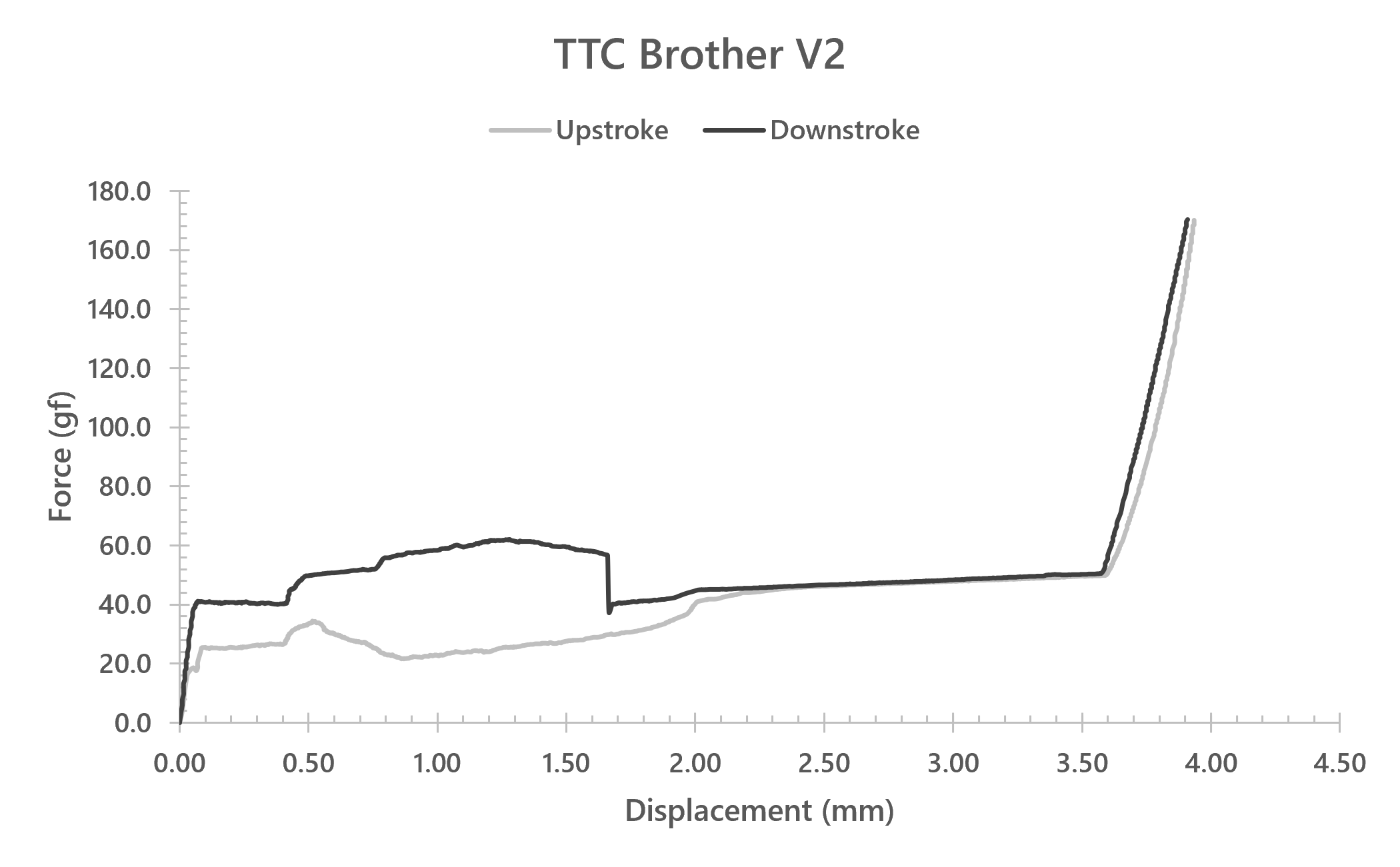
Figure 13: Force curve diagram for the stock TTC Brother V2 switch.
Sound
Much like with the push feeling notes above, it really is hard to take in anything other than the clicking mechanism when considering the sound profile of a click bar switch like that of the TTC Brother V2s. To that end, the Brother V2s have a click that is expectedly loud, singular, sharp, and high pitched, though without some of the more harsh bites that other click bar clicky switches have had over the years. Sawed off at the peak of its pitch and sharpness, these switches definitely are in your face, aggressive clickies though more so because of their volume than anything else. They definitely feel intentionally softer, or as if TTC was trying to produce to a more reasonable loud clicking sound than just a purely aggressive one that pokes and prods on the ears in prickly ways. Also unlike other click bar switches I’ve tried, and aiding in this softer, more subtler side of these switches, there is some solid undertone depth to these click bars that gives their sound quite a fair bit of body. It’s not a metallic ping, nor is it like a plastic-on-plastic collision, but it definitely feels as if there is a more blunt point of collision between the stem and click bar here that makes it sound squarely struck rather than grazed. This more bass-y ‘body’ of sort is also somewhat more noticeable in some switches than others, with some having a bit softer pitch and more of that undertone to them and in turn creating some batch-wide variation in terms of sound. The degree of variability across the batch that I received is not all that much, and certainly unlikely to be something that users would need to cherry pick switches for, but it is definitely more noticeable when trying them out in hand.
Wobble
While the TTC Brother V2 switches have a moderate amount of equal magnitude N/S and E/W direction stem wobble that is slightly greater than the average and likely to bother some users that are more sensitive about this metric, it is not nearly as much as you’d expect given the lack of stem stabilization that the nubby rails on the stems provide. I genuinely had expected this to be much worse given that the stem wobble stabilization is largely relegated to the tolerances of the click wedge on the stem and the small slots in the top and bottom housings that it rides in.
Measurements
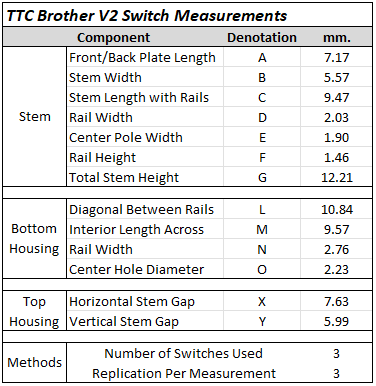
If you’re into this level of detail about your switches, you should know that I have a switch measurement sheet that logs all of this data, as well as many other cool features which can be found under the ‘Archive’ tab at the top of this page or by clicking on the card above. Known as the ‘Measurement Sheet’, this sheet typically gets updated weekly and aims to take physical measurements of various switch components to compare mold designs on a brand-by-brand basis as well as provide a rough frankenswitching estimation sheet for combining various stems and top housings.
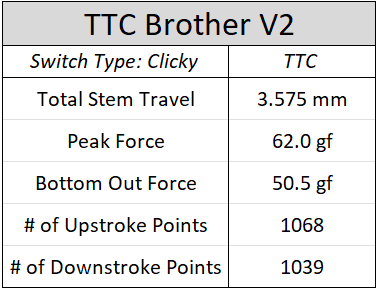
Figure 15: Numerical details regarding the force curve for the stock TTC Brother V2 switches.
Have you ever wanted to be bombarded with more switch data than you’ve ever seen at any point in your life before? Consider checking out the ‘Force Curve Repository’ hosted on my GitHub that contains all force curves that I take both within and outside of these full-length reviews. In addition to having these graphs above, I have various other versions of the graphs, raw data, and my processed data all available for over 2000 different switches for you to use however you see fit. Check it out via the ‘Archive’ tab at the top of this page or by clicking any of the force curve cards above.
Break In
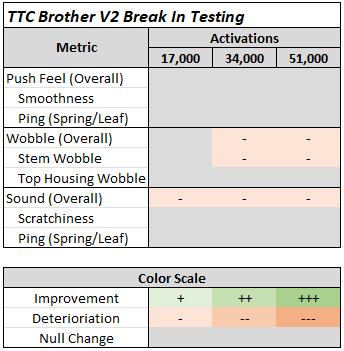
Break In Notes
17,000 Actuations
- After 17,000 actuations, the only notable change in the performance of the TTC Brother V2 switches was a slight increase in the sharpness of their clicking sound across the entirety of the group that was broken in. While this certainly doesn’t put them in the range of an ‘ear-piercing’ sound, it is definitely a sound that is a bit more aggressive than their stock counterparts.
34,000 Actuations
- In addition to the increased sharpness in the clicking sound of the Brother V2 switches across the board, the batch of switches broken in to 34,000 actuations also had an increased degree of variation in their sound as well. Those switches which had deeper, bassier tones to their sound prior to break in only somehow appeared to grow deeper in tone here by comparison.
- There was a slight increase in both N/S and E/W direction stem wobble of the Brother V2 switches after being broken in to 34,000 actuations, though admittedly this is a bit of a minor change by all reasonable standards.
51,000 Actuations
- Much to my surprise, the TTC Brother V2 switches broken in to 51,000 actuations showed no real change in performance from those broken in to only 34,000 actuations. These are definitely among some of the more resilient switches when it comes to break in testing that I’ve tried in quite some time…
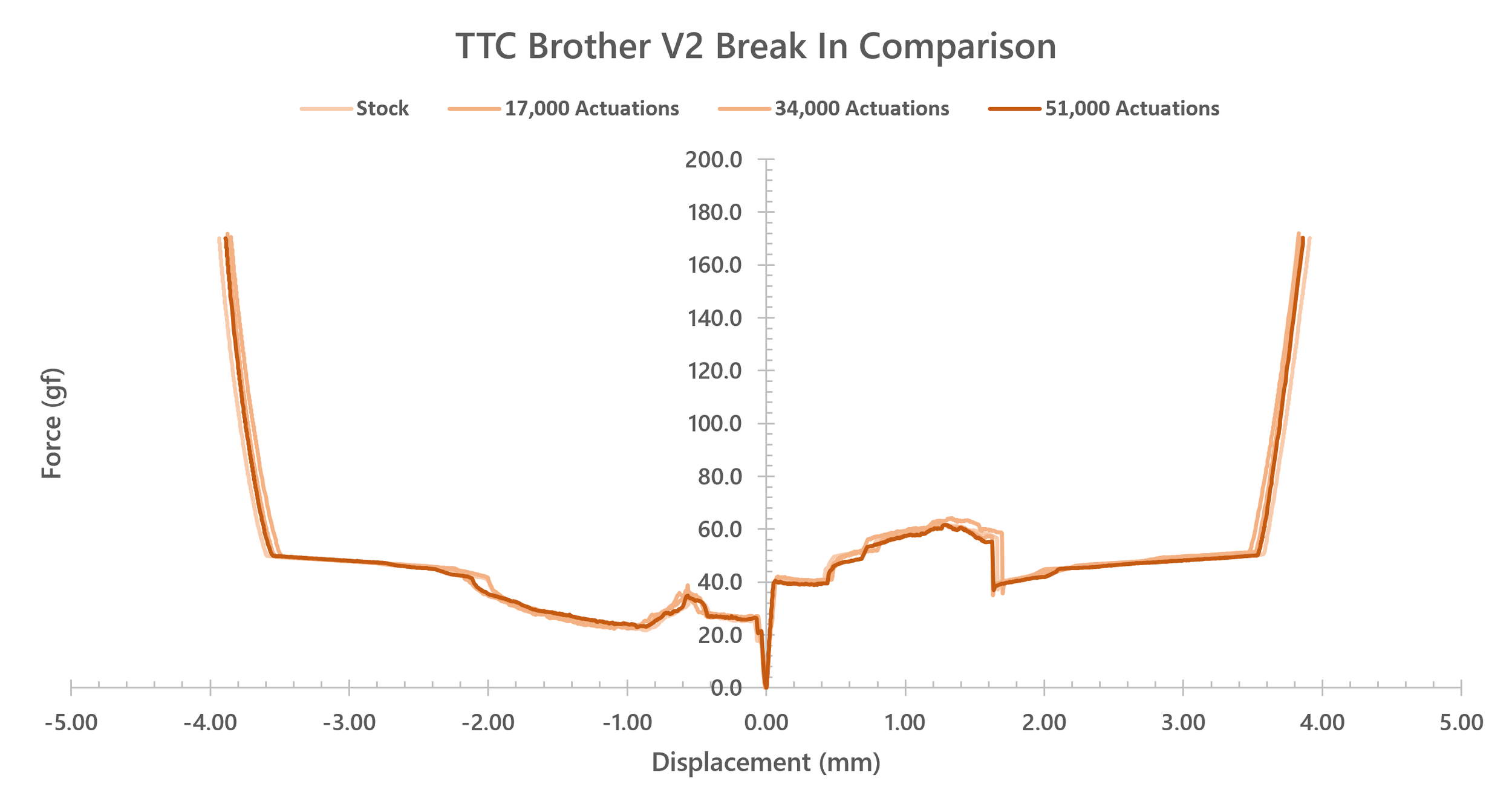
Figure 17: Comparative force curve diagram showing no substantial, consistent change in the force curves of the TTC Brother V2 switches throughout the break in process.
Comparison Notes to Other Notable Clicky Switches
Note – These are not aimed at being comprehensive comparisons between all factors of these switches as this would simply be too long for this writeup. These are little notes of interest I generated when comparing these switches to the TTC Brother V2 switches side by side.
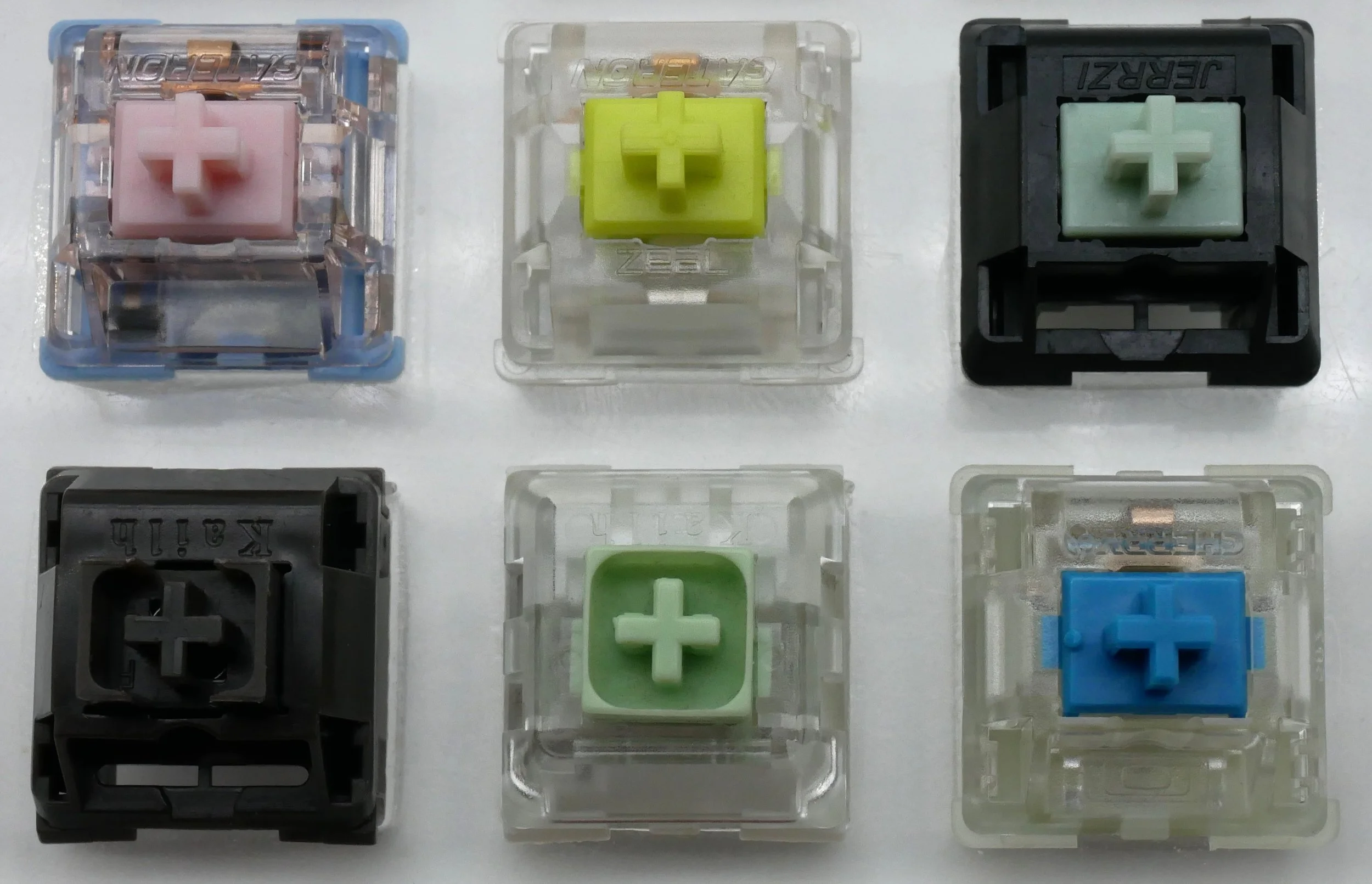
Figure 18: Switches for comparison. (L-R, Top-Bot: Gateron Melodic, Zeal 3-in-1 Clickiez (40g, Clicky), XCJZ Jerrzi Lotus Stem, Novelkeys Cream Clickie, Kailh Box Jade, and Cherry MX2A RGB Blue)
Gateron Melodic
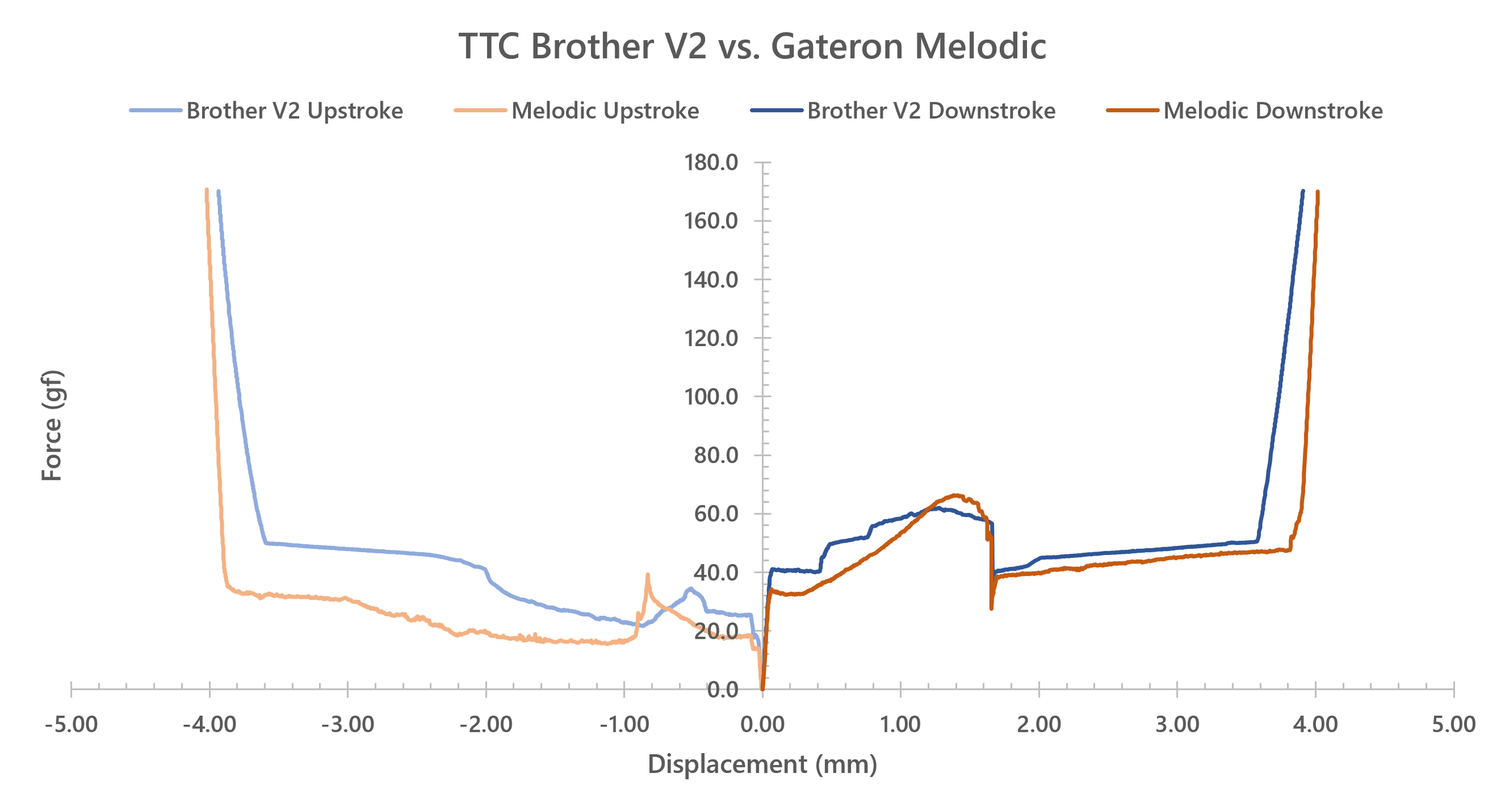
- There is a fair bit less N/S and E/W direction stem wobble in the Gateron Melodic switches than there is in the TTC Brother V2 switches.
- With respect to their sound profiles, the Brother V2 switches are far and away more loud and less delicate sounding tactiles than the Melodics. More descriptively, the Melodics have a sort of medium-volumed light, airy, bubble-like sound that is in direct contrast to the sharp, singular, shooting click sound of the Brother V2s.
- On account of the Melodics having a similarly small area of contact but significantly smaller amount of force required to actuate their clicking mechanism than the click bars of the Brother V2 switches, they are much more suitable to longer periods of typing and less likely to fatigue users whose fingers don’t have biceps of their own. (This is me, I am one of those typists. Some of you out there wanting 80gf.+ springs for your switches are insane.)
Zeal 3-in-1 Clickiez (40g)
- While the TTC Brother V2 and Zeal 3-in-1 Clickiez switches do have a similar overall volume to one another, or at least are definitely both on the louder end of clicky switches, they definitely come across quite differently on account of the types of sound that they make. In a head to head comparison the Clickeiz have a significantly more wide, rounded sound to them that has all manner of deeper tones, bassy features, and a bit of a resounding feeling that makes them just sound more substantial than the more singular, pointy sound of the TTC Brother V2s.
- There’s a bit more N/S and E/W direction stem wobble in the TTC Brother V2 switches than there is in the Clickiez 3-in-1 switches in their clicky configuration.
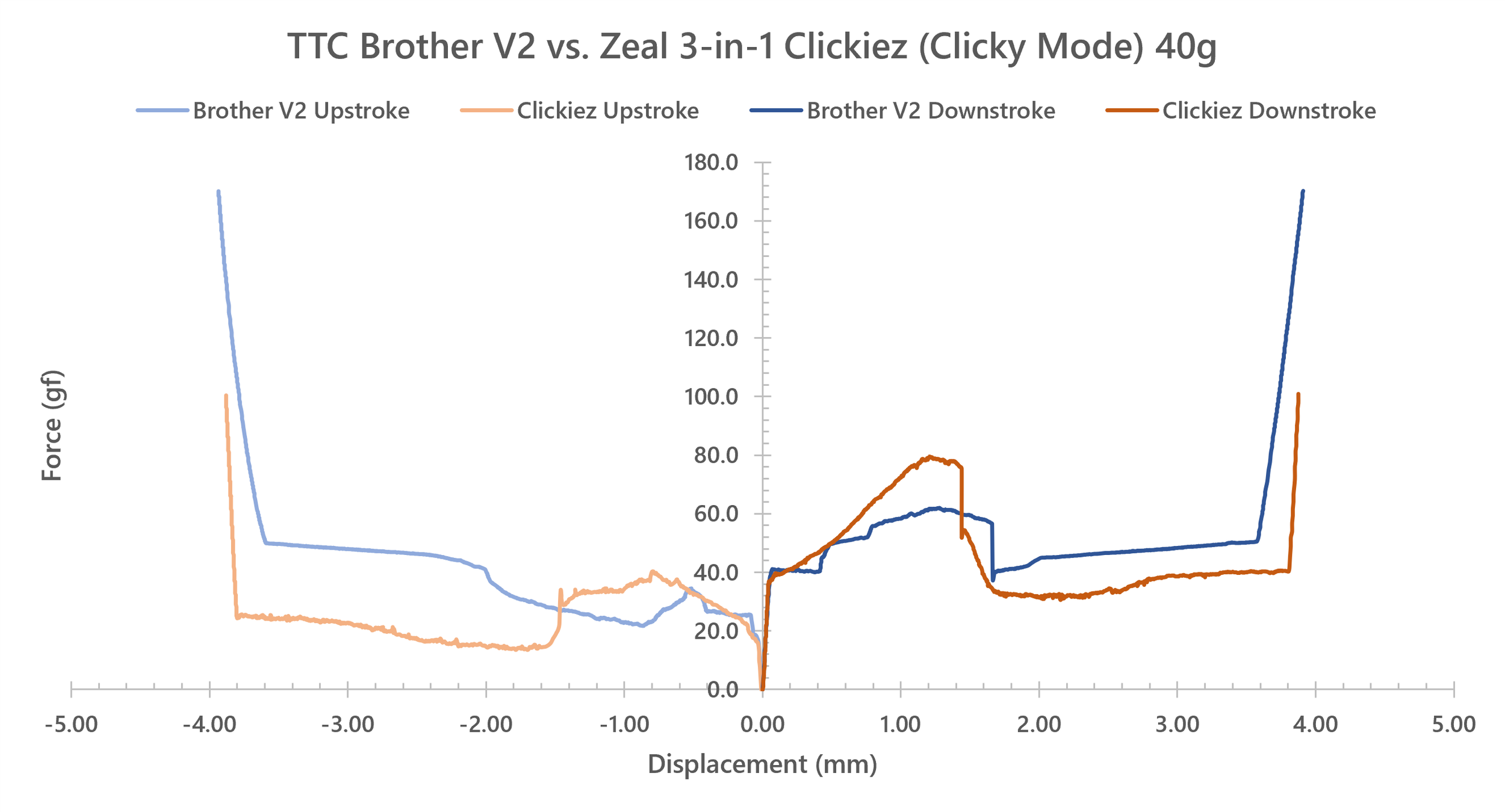
- Actuating the click leaf mechanism of the Zeal 3-in-1 Clickiez, as can be felt in hand as well as seen in the comparative force curve below, requires quite a bit more force than the TTC Brother V2 switches and in turn makes them quite a bit more of a workout on the fingertips than the Brother V2s.
XCJZ Jerrzi Lotus Stem
- As a more modern, freshly designed representative of the click jacket mechanism than the classic Cherry switch design below, even the Jerrzi Lotus Stem switches show themselves to be producing sound via an inferior mechanism when compared with the click bars of the TTC Brother V2s. The sound of the Lotus Stems is one that is just more plasticky, inconsistent, grating, and far from refinement as compared to the singular sound of the Brother V2s.
- There is surprisingly a bit more N/S and E/W direction stem wobble in the XCJZ Jerrzi Lotus Stem switches than there is in the TTC Brother V2 switches.
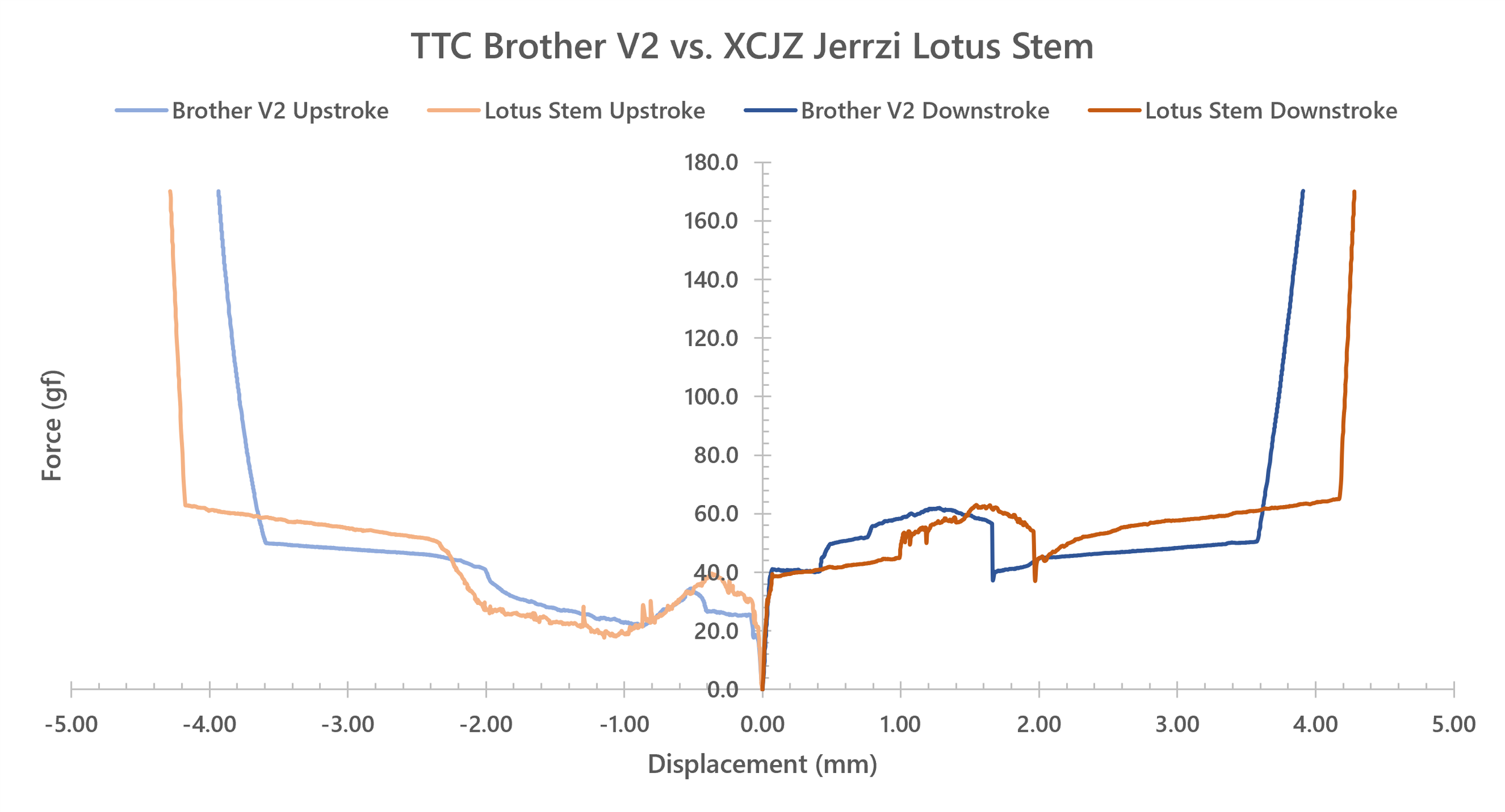
- While it is always hard to compare smoothness in clicky switches as this is far from the most notable feature of their push feeling, it is quite evident that the Jerrzi Lotus Stem switches have a fair bit more scratch to their stroke than the TTC Brother V2 switches.
Novelkeys Cream Clickie
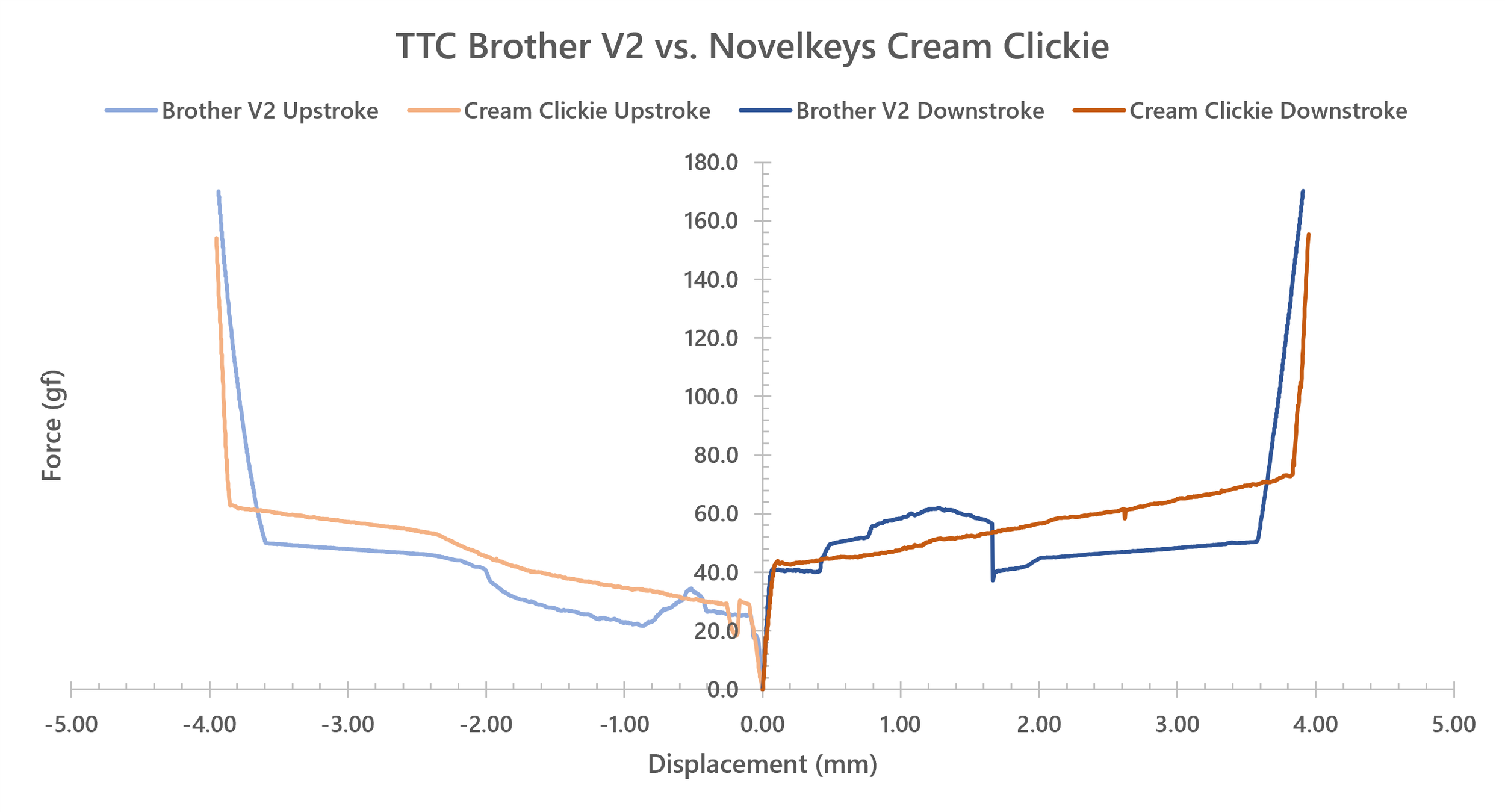
- Given the uniqueness of the ‘click plate’ mechanism in the Novelkeys Cream Clickie switch design, these are about as far from the TTC Brother V2 switches in terms of feeling, sound, and overall presence of any of the switches on this comparison list. Situated at the bottom end of the stroke rather than in the middle, the clicking of the Cream Clickies is more subtle, sonorous, and has such little impact as to leave the switches feeling more linear than tactile.
- For all of the strengths that the Novelkeys Cream Clickie switches do have, they were not the best well designed with respect to stem wobble and thus have a bit more N/S and E/W direction stem wobble than the modern TTC-made Brother V2s.
- Another subtle difference between the Cream Clickies and Brother V2s (or rather all other clicky switches on this list) is that the Cream Clickie switches do not actuate and produce a clicking sound on both downstroke and upstroke, instead only produce a sound on downstroke. All other switches, and especially click bars like the Brother V2s make sound as their stems interact with the click bar on both the way down and back up.
Kailh Box Jade
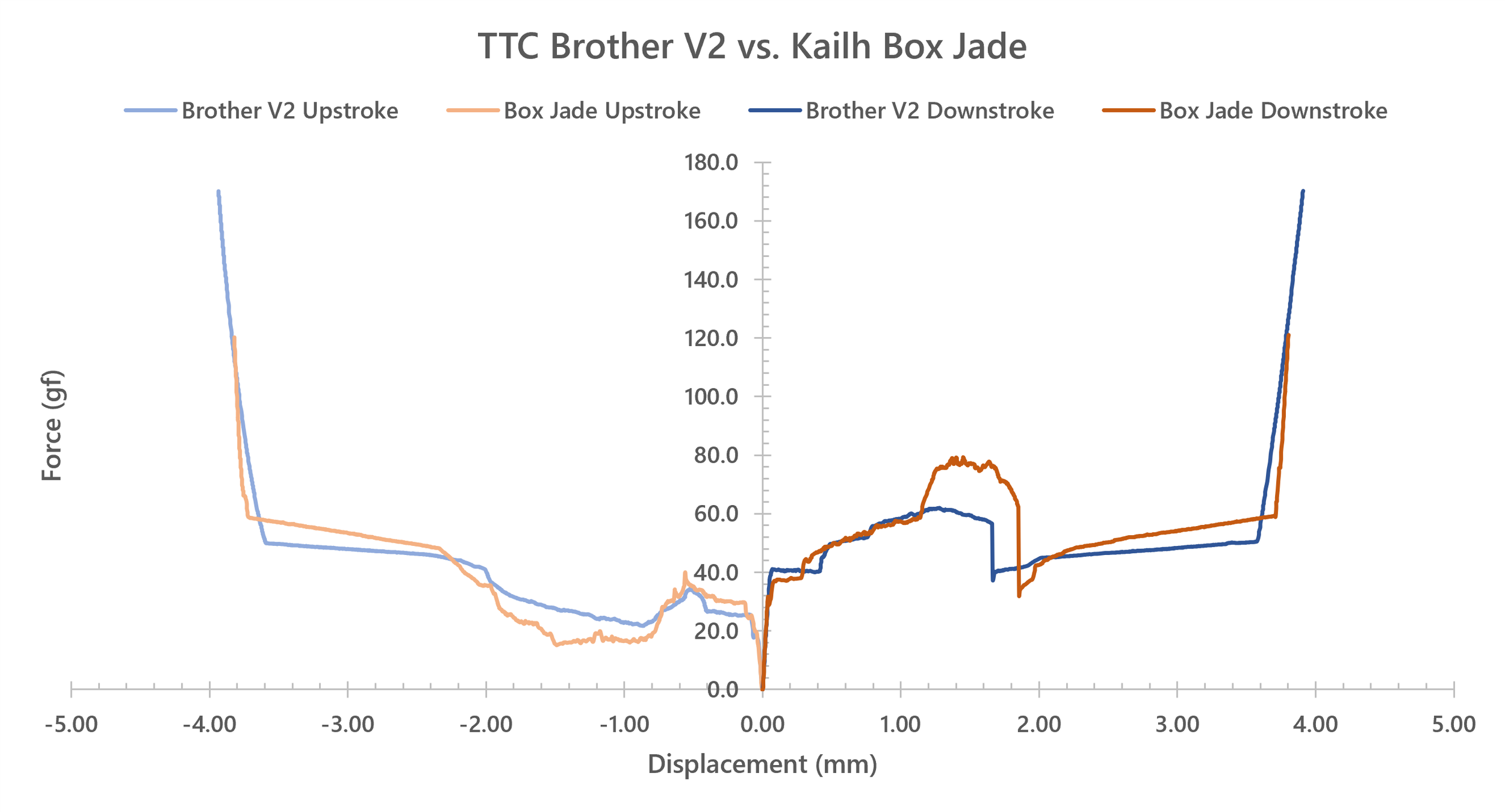
- As is somewhat alluded to in the full length review above, the Kailh Box Jade switches are far and away the more louder, aggressive, and sharper sounding switch of these two when compared head to head. Even being the lighter of the original Box clickies in the Box Jades and Box Navys, the Box Jades are all around more imposing in both sound and feeling than the Brother V2 switches.
- While I could imagine that newer Box Jade switches may have benefitted from improved tolerances and manufacturing standards by Kailh over the years, the set I use for comparison are from well before 2018 and in turn the difference in manufacturing standards show. These Box Jades have so much more stem wobble than the Brother V2 switches that it isn’t even funny.
- In addition to just being the louder and more aggressive clicky switch of these two, the Box Jades also have a bit more depth and complexity to their sound than the Brother V2s. When testing them side by side the Brother V2s feel like they were much more singularly designed and tuned for a specific sound that while being loud, is still precise.
Cherry MX2A RGB Blue
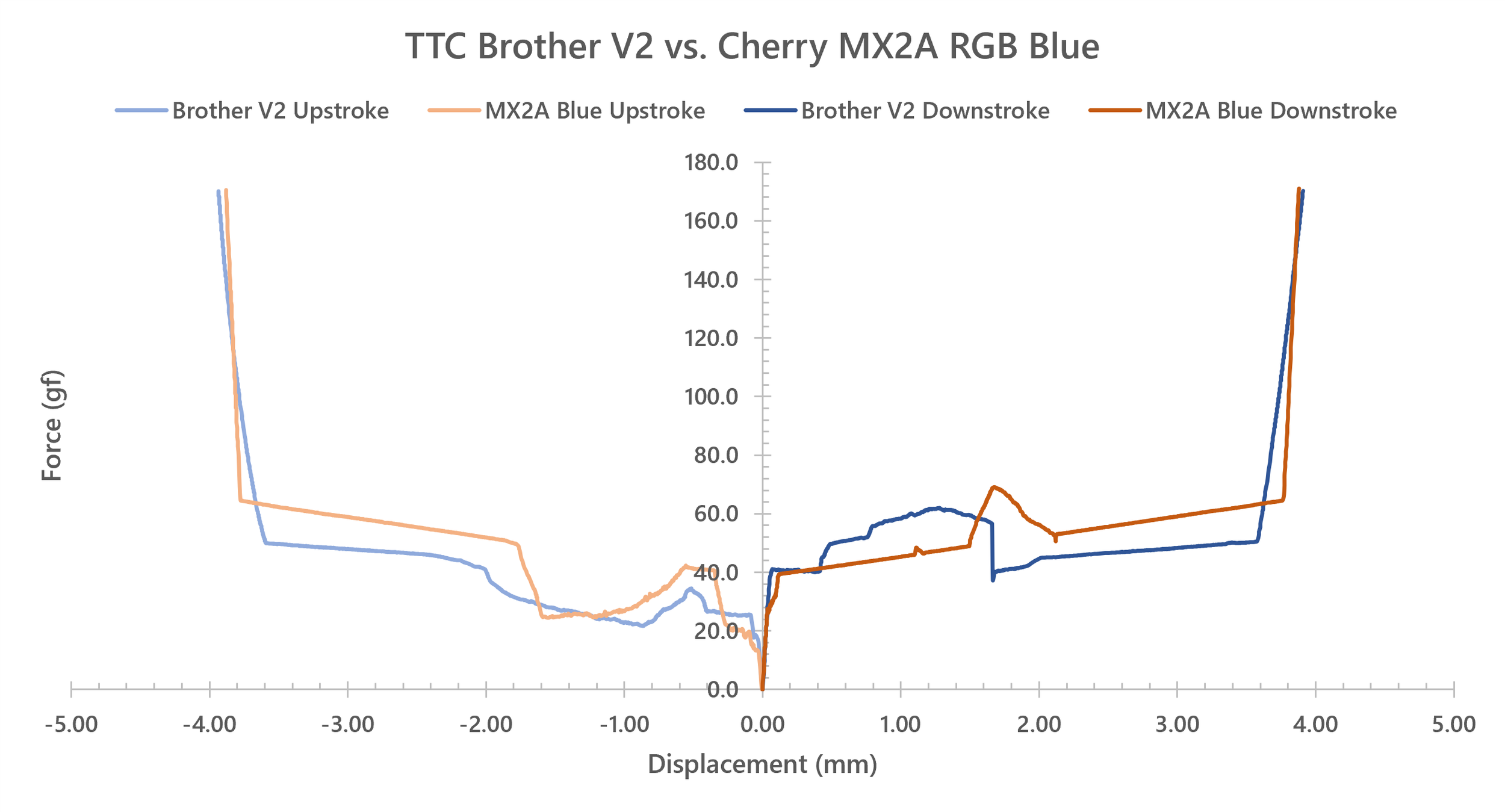
- Not even the new school, freshly made Cherry MX2A click jacket switches hold a candle to the click bars of the Brother V2 switches when it comes to their sound profiles. Much like with the comparison to the XCJZ Jerrzi Lotus Stem switches above, the MX2A RGB Blues just sound more chaotic, less focused, and more plasticky sounding than the TTC Brother V2s.
- There is a comparable amount of N/S and E/W direction stem wobble between the Cherry MX2A RGB Blue switches and the TTC Brother V2s.
- With respect to their overall volume, the TTC Brother V2 switches are drastically louder than the Cherry MX2A RGB Blues, even when the latter are being typed on at the fastest of speeds and produce the most chaotic of sounds.
Scores and Statistics
Note – These scores are not necessarily completely indicative of the nuanced review above. If you’ve skipped straight to this section, I can only recommend that you at least glance at the other sections above in order to get a stronger idea of my opinion about these switches.
Push Feel
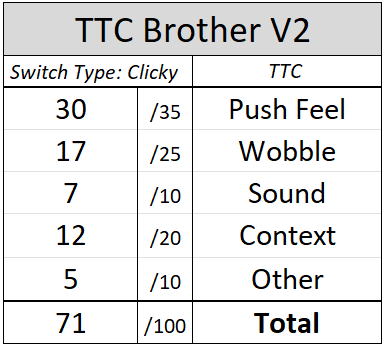
Outfitted with an early to mid-stroke dainty, yet still forceful click bar, the TTC Brother V2 switches have all of the instantaneously sharp and snappy feeling that would be expected of such a clicky mechanism thought without as much of the harsh forcefulness required in similar switches. Additionally, the switches are precisely lubed from the factory and designed in such way as to maximize emphasis on the click bar and no other portion of their push feeling.
Wobble
There is a reasonably average amount of N/S and E/W direction stem wobble to the TTC Brother V2 switches that is not likely to bother most users except those particularly picky about such a metric.
Sound
The sound profile of the TTC Brother V2 switches is one that has all of the hallmarks of a click bar clicky switch – a loud, sharp, singular explosion of sound on downstroke with a slightly subdued though just as noticeable sound on return and not much else to them. Unlike more well known switches with this mechanism, though, the Brother V2s are not nearly as aggressive and are a bit softer, quieter, and also prone to batch wide variation with some switches having more bass notes and a more rounded sound than the shining examples of any batch.
Context
Priced well for their performance between $0.40-0.50 depending on their source and generally widely available, these have all the accessibility that they could want for though without a lot of community awareness or (at the moment) appreciation for the mechanism. There’s really no telling how long these switches will continue to be made by TTC for despite being fairly new.
Other
While I doubt these will be overly historically relevant in due time, at the moment the presence of these click bar clickies in 2026 is a sight for sore eyes and a great niche offering by TTC.
Statistics
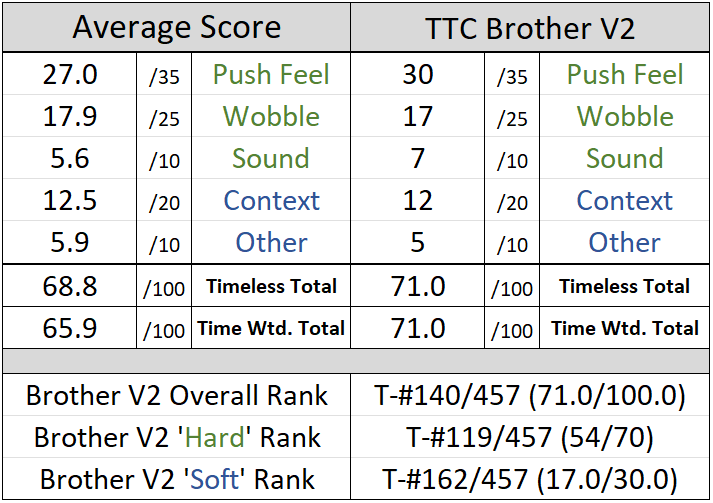
If you are looking at this statistics section and wondering what the heck ‘Timeless’ and ‘Time Weighted’ scoring is, consider checking out my short article titled ‘A Scorecard Time Change’. As a result of scoring becoming a bit anachronistic over the years, switches are now ranked in this statistics table using a “time weighted total” as opposed to their day-of scoring as discussed in that article. If you’d also like to learn about what ‘hard’ versus ‘soft’ ranks refer to specifically, I’d encourage you to head on over to my GitHub linked in the table above or at the links in the top right hand of this website to check out my database of scorecards as well as the ‘Composite Score Sheet’ which has a full listing of the rankings for each and every switch I’ve ranked thus far.
Final Conclusions
At the tail end of this review, I feel like I can walk away simultaneously quite happy with how the TTC Brother V2 switches turned out and also sad for the state of modern clicky switches as whole. Obviously the TTC Brother V2 switches don’t have quite the same charm or impressively strong performance as the original V1 versions and their stellar click jackets, though the V2s still perform quite well outfitted with click bar mechanisms. In fact, in the direct comparison to the Kailh Box Jades I did come to realize just much more subtle and not overly aggressive or forceful the click bars of the Brother V2s are. Sure, the Brother V2s hit all of the hallmarks of this type of clicky switch with relatively aggressive, singular sharpness in both force and sound, but there’s some good and bad features mixed in there that give them bit of a unique twist of their own. On the good end of things, it’s evident that TTC well lubed these switches and designed them in such way to fully emphasize the click bar – there’s no scratchiness, no overly strong bottom out, and nothing to detract from that. In turn, it also seems as if they pulled back on the click bar’s strength and forcefulness a bit in order to still leave it the star of the show while not making for an overwhelmingly fatiguing typing experience. On the less good end of things, though, TTC wasn’t perfect with their manufacturing. There’s still some degree of batch wide variability in sound and feeling of these switches as well as a moderate amount of stem wobble, but these ultimately do feel a bit minor in the grand scheme of things. And this is especially true on account of these being click bar clicky switches in 2026! I suppose it is a bit sad to see a fairly straight-down-the-middle, as expected click bar clicky switch feel like such an interesting offer in 2026 that I had to go out of my way to review such, but perhaps this is just a brief lull in their availability if my guesses at the top end of this article turn out to be true. In the meantime though, I’m glad that these switches got made and hope they aren’t the last traditional MX-style clicky switch that I’ll be seeing for some time…
Sponsors/Affiliates
Mechbox UK
- A wonderful UK based operation which sells singles to switches that I’ve used above in my comparisons for collectors and the curious alike. Matt has gone out of his way to help me build out big parts of my collection, and buying something using this link supports him as well as my content!
proto[Typist] Keyboards
- An all-things keyboard vendor based out of the UK, proto[Typist] is a regular stocker of everything from switches to the latest keyboard and keycap groupbuys. While I’ve bought things from the many times in the past, they also are a sponsor of my work and allow me to get some of the great switches I write about!
Divinikey
- Not only do they stock just about everything related to keyboards and switches, but they’re super friendly and ship out pretty quick too. Divinikey has been a huge help to me and my builds over the last year or two of doing reviews and they’ll definitely hook you up. Use code ‘GOAT’ for 5% off your order when you check them out!
ZealPC
- Do they really need any introduction? Zeal and crew kicked off the custom switch scene many years ago with their iconic Zealios switches and the story of switches today couldn’t be told without them. Use code ‘GOAT’ (or click the link above) for 5% off your order when you check them out!
MechMods UK
- A rising vendor based in the UK, Ryan and crew have been a pleasure to work with and have nearly everything you’d need to build your first or fourteenth keyboard. Go build your latest or greatest one right now with them by using code ‘GOAT’ at checkout for a 5% discount!
Dangkeebs
- A longtime supporter of the website and the collection, Dangkeebs has quite possibly the widest variety of switches of any vendor out there. Not only is their switch selection large, but it rotates and is constantly adding new stuff too. You’re going to need 5% off your order with my affiliate to save off the cost of all those switches!
SwitchOddities
- The brainchild of one my most adventurous proxies, SwitchOddities is a place where you can try out all the fancy, strange, and eastern-exclusive switches that I flex on my maildays with. Follow my affiliate code and use code ‘GOAT’ at checkout to save 5% on some of the most interesting switches you’ll ever try!
Cannonkeys
- Does anybody not know of Cannonkeys at this point? One of the largest vendors in North America with keyboards, switches, keycaps, and literally everything you could ever want for a keyboard always in stock and with an incredibly dedicated and loving crew. Follow my affiliate link above in their name to support both them and I when you buy yourself some switches!
Kinetic Labs
- One of the most well-rounded keyboard vendors out there, Christian and crew have been supporters of all my switch and switch-adjacent needs for some years now. I’m honored to have them as an affiliate and think you should check them out using my affiliate link above to support both them and I when you check out their awesome products!
Keebhut
- Want to try out some switch brands that fly under most vendor’s radars? Keebhut is always seeking out that next latest and greatest and has been super helpful in hooking me up with new brands over the past year. They are all about sharing that love as well, and want to give you 5% off your next order with them when you use code ‘GOAT’ at checkout!
Kailh
- No, you’re not mistaken – this is actually that Kailh that manufactures switches. As one of the longest running manufacturers in the hobby, they have a massive variety of switches available over on their website at any point in time. I’m lucky to be affiliated with them now, and so consider using my affiliate link above when ordering some Kailh switches to support me!
Keebz N Cables
- Australia and Oceania’s very own is now a part of the sponsor list here and I couldn’t be happier to add this long time supporter of the collection to it. They’ve always got an amazing selection of switches (and other keyboard parts) in stock and they want to share the love that they’ve shown me with you all too! Use code ‘thegoat’ for 5% off your first order when you visit!
Further Reading
TTC’s Brother V2 Switch Sales Page
Swagkeys’ TTC Brother V2 Switch Sales Page
Milktooth’s TTC Brother V2 Switch Sales Page
MechanicalKeyboard’s TTC Brother V2 Switch Sales Page
TTC Brother V2 AliExpress Switch Sales Page
TTC’s Instagram Announcement for Brother V2 Switches
TTC’s Brother V2 Switch Typing Test