Geonworks Strike HE Switch Review
As the first tinges of fall weather have struck the midwestern United States where I live, I’ve been forced to contend with the fact that we are nearing close to the end of yet another year. And oh, what a year 2026 has been – both for me personally and for all of us, I imagine. Completely acknowledging the fact that I can’t even remember what January of this year was like at this present point in time, I would wager that had I made a bingo sheet predicting what the rest of the year would or could possibly entail that it wouldn’t have anything even remotely resembling the reality of things. Is this another Goat-brained spin off into the abyss about the general state of the world or the ever-imposing presence of AI, you ask? No, this existentialism was brought to you by none other than GMK and their hybrid announcement-launch of their new GMK TriggerKey product earlier this week. For those of you who are still blissfully unaware, in the year of our lord 2026, GMK has designed a new type of keycap never tried before to ostensibly capture some of the growing market interest in Hall Effect style switch “benefits”. Not a new style of keycaps, nor a new sculpt or colorway, but rather a switch-attached, lever-based mechanism that allows you to effectively modify the stroke length of your switch prior to actuation… from the level of the keycap. To restate the obvious, in a very roundabout and completely unintuitive fashion, it is as if these keycaps were designed to induce one of the larger selling points of HE-style switches in their modifiable actuation points into standard fair MX-style switches. While I couldn’t even fathom a way that it would be possible for a keycap to then convert an analog signal into a digital one for a full-on mimicking of HE style switches in the MX footprint, it still pushes MX style switches in a fascinatingly strange direction I wouldn’t have ever been able to anticipate. In fact, I’ll even double down on emphasizing the odd turmoil this brings up internal to me as this would then be the first external-to-switch mechanism that directly impacts the overall stroke length and feeling of a switch it is applied to in well over a decade of time at this point – with the GMK TriggerKeys standing tall on the very small shoulders of the classic rubber O-ring switch mod. Needless to say, I’ll have to assimilate into the madness and get a set of these for me to try out.
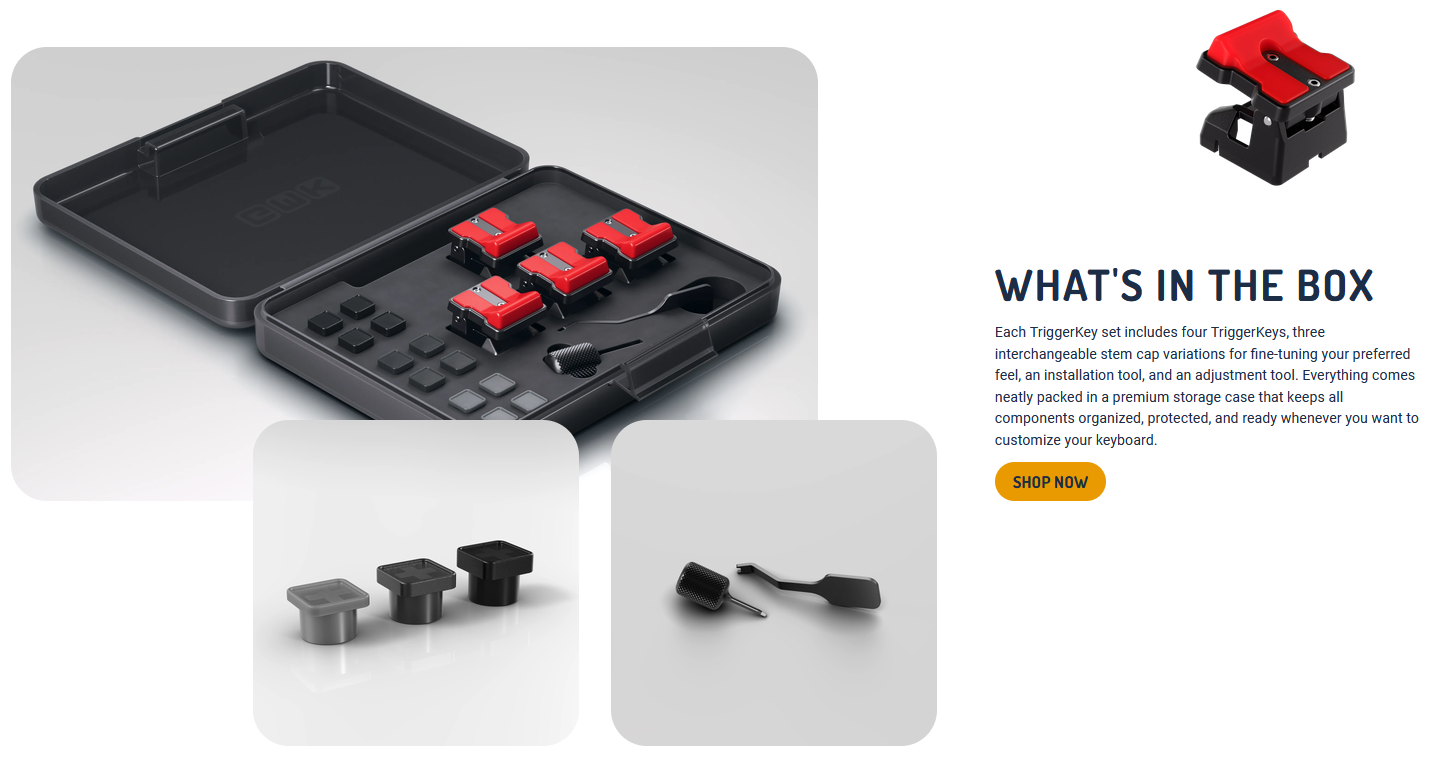
Figure 1: I do have to give some credit to GMK here, though, as this is one of the most talked about products in the community that I've seen them launch in years.
Switch Background
With now even GMK seemingly trying to get in on the style points that Hall Effect switches bring to the keyboard table, my multi-review background section fixation on the rise of Hall Effect switches and the state of the hobby continues here yet again. In reading on the community responses to the new TriggerKeys announcement, I actually encountered an uncharacteristically salient Reddit comment that pointed to potential use case concerns for these keycaps – mainly that people wouldn’t want to swap out keycaps just for the purpose of gaming and/or have an entirely separate keyboard with these keycaps on them and a normal, day-to-day typing set on the other. With this thought process in mind, the ability to modify the actuation point of a switch by using these keycaps, let alone actually adjusting the internal mechanism of such to further tune this point, is just as annoying to implement as swapping between two different sets of switches in a hotswap keyboard. In turn, it kind of undermines the whole ‘ease of modifiability’ pitch that these keycaps are aiming to address. Aside from being a poignant critique of what is otherwise a neat concept realized, this sentiment led me to consider the exact same kind of ‘reward for the effort’ payoff in Hall Effect switches as they exist today. This train of thought keeps dead ending me in the same question: How often do users of Hall Effect switches actually modify their actuation points? (Or, if you’re one of the sparse few that have Clickiez, Novelkeys Cream+, or Kailh Mix-7 switches which have modifiability of their own, how often are you adjusting or changing these switches?) Sure, in the case of Hall Effect style switches this is just a simple modification via a selection in a firmware menu of the associated PCB they’re attached to, and thus it is noticeably quicker to tune and adjust than finding a keycap puller in whatever drawer you lost in it last time, but still… who is actually doing this? Perhaps we have a new generation of gamers who are more sophisticated than I ever was back in the day, but when I had multiple RGB lighting settings for my gamer gear, a variable DPI setting in both games and on hardware, and all manner of adjustments to the shape of my fancy Corsair gaming mouse, I didn’t change a damn thing once they were in use. In fact, I would actually get annoyed at just how easy it was to accidentally change my DPI settings on my mouse and mess up my feeding streak in LoL. With a preponderance of evidence either for or against this claim, I have to imagine that the majority of users still act the same way. And so I wonder what even is the appeal of HE switches to a broader audience that isn’t even going to leverage their customizability beyond when they are first put into the keyboard – a process not dissimilar to just picking a switch with a targeted actuation point before you buy them… Furthermore, why would any prospective Hall Effect enthusiast select a tactile or clicky HE switch in the first place when they have a fixed tactile/clicking feature that may inadvertently be located in the exact place they want to put their actuation point upon initial tuning?

Figure 2: Your average Hall Effect switch user may post up like this to go 0/10/0 in bot lane, but I refuse to believe they're changing the actuation point on their switches to do so.
Looking back towards the background of the TTC Brother V2 Switch Review where I really focused in on the idea of tactile and clicky Hall Effect switches, I want to revisit the premise established there that there could be an eventual separation in types of switches offered in HE versus conventional MX-style mechanisms. In that premise, tactiles and (especially) clickies would be the types of switches that would predominantly remain a staple of the MX ecosystem as they struggle to adapt their fixed features of note like tactile bumps and click mechanisms to the modifiable actuation selling point of HE style switches. Why would someone want to actuate a clicky switch some random time before the click mechanism is hit? Or for the more gradual example in tactiles, why would they choose for their actuation point to be part way up or down the slope away from the peak in tactile force? These kinds of mechanisms really only make sense in fixed places relative to their actuation point (typically rapidly before actuation) to signal to the user that they’ve made the switch actuate; Moving this point elsewhere only confounds this connection. While one argument in favor of the infinite modifiability of actuation points in HE style switches is that they truly have unlimited options for the user to select from, it’s a bit harder of a stance to take against the MX-style design that has had no less than several thousand variations over the last decade of time, with surely some switch out there hitting at the exact right millimeter of stroke length that a picky user is looking for. Though if the Hall Effect mechanism were to slowly and every increasingly consume the switch market to magnetically reign supreme over tactile and clicky offerings too, I suppose there could be some ways that they could choose to introduce such that actually make sense with the infinite modifiability of actuation points in mind. Specifically, for clicky switches, I could see this actually working if…
The click mechanism itself was also modifiable independently of the actuation point of the switch.
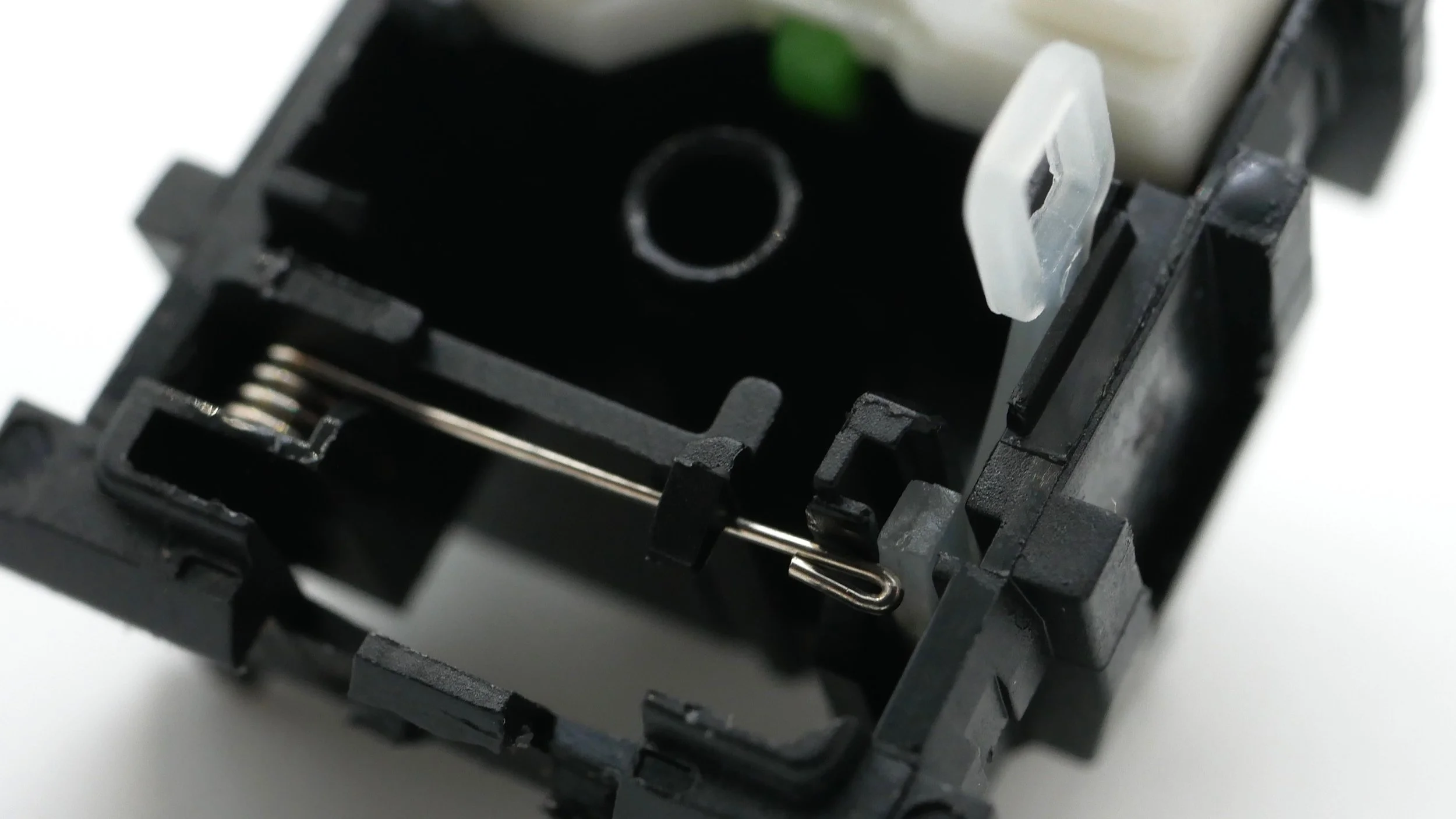
Figure 3: Think of the mechanism in the bottom housings of the Kailh Mix-7s, but instead of just moving the click bar away from the stem it moved the whole thing vertically up and down.
Clearly this is a bit of a fanciful pipe dream on my behalf, but it is a very obvious solution to the problem of one feature being modifiable in the switch and the other being locked in place. Why not just be able to modify the placement of both features instead of only one? Given that Hall Effect actuation point modification is one that is accomplished via firmware adjustments at the PCB level, this leaves even more leeway for clicking mechanisms to be adjusted at the switch hardware level without interference. (Yes, I do understand this conflicts with my statements a few paragraphs above speaking to the difficulty of modifying switches actually preventing users from doing such, but the people want what they want.) In this far-flung ideation, perhaps something like a vertical Kailh Mix-7 mechanism that would have a slider to raise or lower a click bar inside of a switch housing to cause the stem to strike at different points of the downstroke would be one way to accomplish this. Or perhaps clicking snap springs of various sizes, dimensions, or contortions that could be swapped into the switch via different inserts like the Zeal 3-in-1 Clickiez leaves or the stem pole modifiers of the Novelkeys Cream+ switches. Given the wide range of click mechanisms that have been integrated in just the MX footprint alone, let alone the whole range of keyboard and console switches across all of computing history, it’s not inconceivable that something out there could be modified to then be modifiable. On a perhaps bit less handwavy and more industrially practical sense, we could also see…
The stems themselves have asymmetrical designs that could be adjusted to differently articulate a fixed-point clicking mechanism.
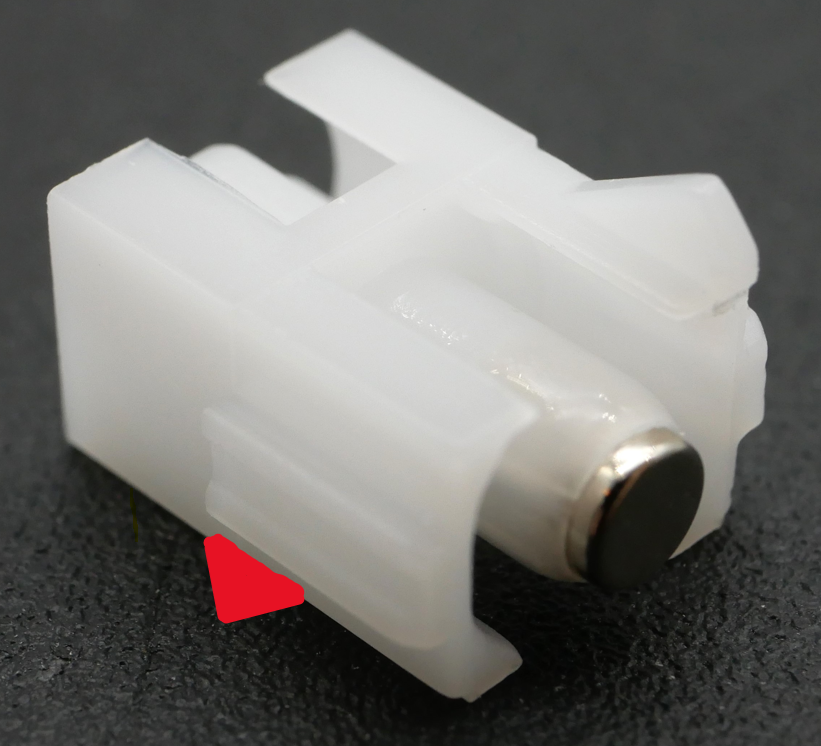
Figure 4: Consider the very hypothetical design of a stem that I conjured up via MS Paint on a stem you'll see discussed below. What's even funnier about this is that my girlfriend does have good Photoshop abilities and could have done this better justice.
With Hall Effect style switches not needing the conventional conducting leave structure that takes up a sizable portion of the internals of an MX-footprint switch, we’ve seen quite a few oddball stem designs in the last year or two that take up all manner of free space inside of magnetic switch housings. And yet, the overall volume of many of these switches remains about the same as their MX counterparts in order to accommodate the overall side and form factor that the MX standard has enforced on keyboard designs at large. What if a company made use of this excess internal space by making a ‘two-sided stem’ that had a set of highly set legs for hitting a click bar late in the stroke on one side and a set of lowly set legs on the opposite for an out-of-the-gate clicking sound? Given that the stems otherwise have rotational symmetry except for these legs, a feature which can be seen in many linear Gateron HE switches where you can turn the stems 180 degrees inside of their housings to no effect, this could allow the users to rotate the stems to induce a different clicking point within their switch. While this would still make for a more difficult to modify mechanism than some fanciful, closed switch adjuster like the pads on the sides of the Kailh Mix-7s, surely this is infinitely more technically feasible for a manufacturer to produce. Hell, what if we wanted to completely avoid the development of external parts of strange, confounding mechanism designs that require modifiability on the user’s behalf by just…
Having the click mechanism exist in a place that wouldn’t normally be concerned with actuation points.
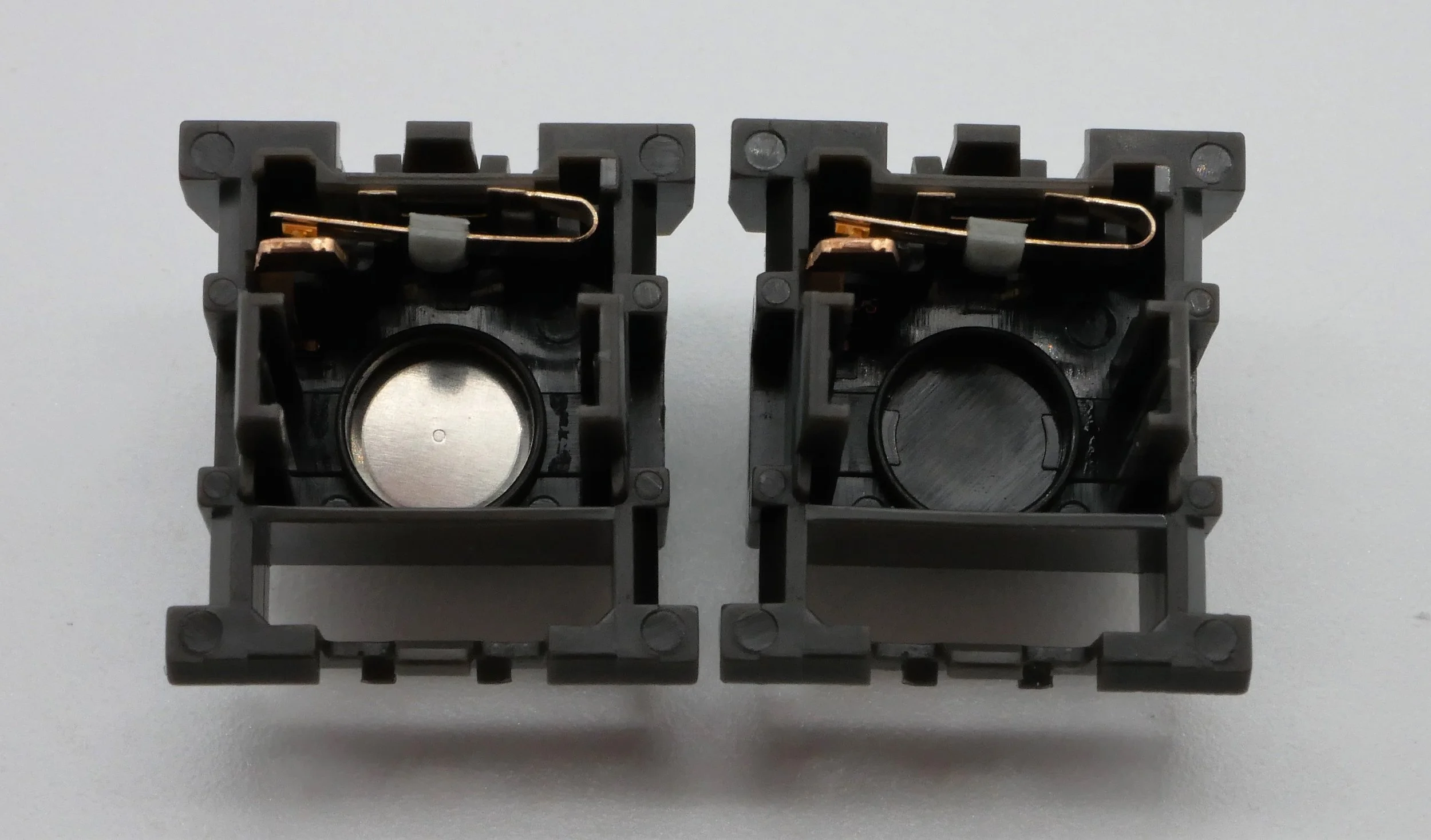
Figure 5: How about all the way down there, perhaps? Internal click plate mechanism view of the Novelkeys Cream Clickies.
Ignoring the strangely technopomorphized wording of that idea, there are places inside of the normal upstroke and downstroke of a switch where actuation points are never located – the bottom out and topping out. What if a click mechanism was just put there so that it doesn’t matter where a sane, normal user would put the actuation point? What if this was already effectively done with the ‘snapple cap’ style click plate mechanisms of the Novelkeys Cream Clickie switches? Actuating extremely late in the downstroke through use of the center pole of the stem, these switches ultimately were designed in such fashion where the clicking mechanism was nearly independent of the conducting leaf of the switch or really anything that could interact with such like features protruding from the stem. In fact, these switches were designed in such a way that Kailh could have easily made them tactile, giving their stem legs a curvy shape to bounce across their switch leaves without ever affecting the placement or feeling of the clicking mechanism at all. Sure, I can recognize that this mechanism as it is currently implemented directly conflicts with the magnetic stem design of a traditional Hall Effect switch, but what would stop a prospective HE switch designer reading this very article from placing a click bar at the very bottom of the stroke? Why not put a click bar so high up in the stroke that it effectively clicks as the starting point of the switch stroke not dissimilar to how strong tactiles were designed for a long while just a few years ago? Perhaps this very specific idea was drawn out of the ether by the premise of a similarly specific Hall Effect style switch kind of leaning into this exact kind of design tweak in their execution…
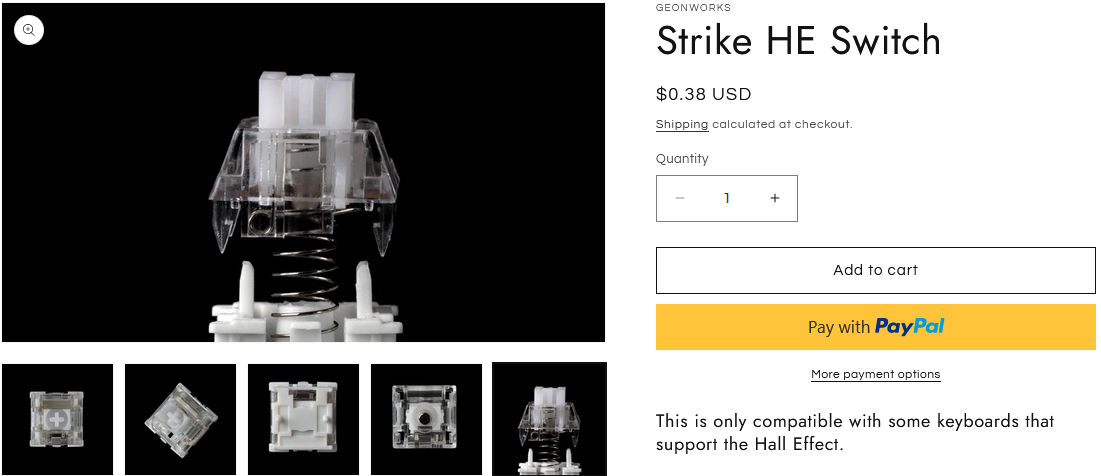
Figure 6: Hmm... unless...?
As for the completely distinctively separate and in no way connected to that cliffhanger of a paragraph ending above Geonworks Strike HE switches, these first showed up on their eponymous website around mid-July of 2026 with zero marketing whatsoever. With equally as little background to them having only made their way to one, or maybe two vendors outside of Korea, there’s honestly not much that can be said about them in the context of community interest. Much like the Glorious Raptor HE clicky switches that predate them, these too come across as a ‘filling out of options’ for their respective vendors rather than being novel or flagship designs for their switch lineups. Unlike the Glorious Raptor HEs before them, though, these appear to be designed by Co-Gain/XUDA, which I first debuted nearly a year ago in 2025’s Manufacturer Update and promptly haven’t said a damn thing about since. This manufacturer, which was the leader in manufacturing modern optical switches for brands like DareU, appears to have made the recent jump into the deep Hall Effect switch market and in turn appear to not just be sticking with linear designs based on the creation of the Strike HE switches. Presently only available on Geonworks’ website at a price point of $0.38 per switch, it is entirely unlikely that these will remain in stock forever nor restocked once they run out of the store based less on Geon’s historical practices and more so on Co-Gain/XUDA’s non-existent long term, multi-run switch offerings.
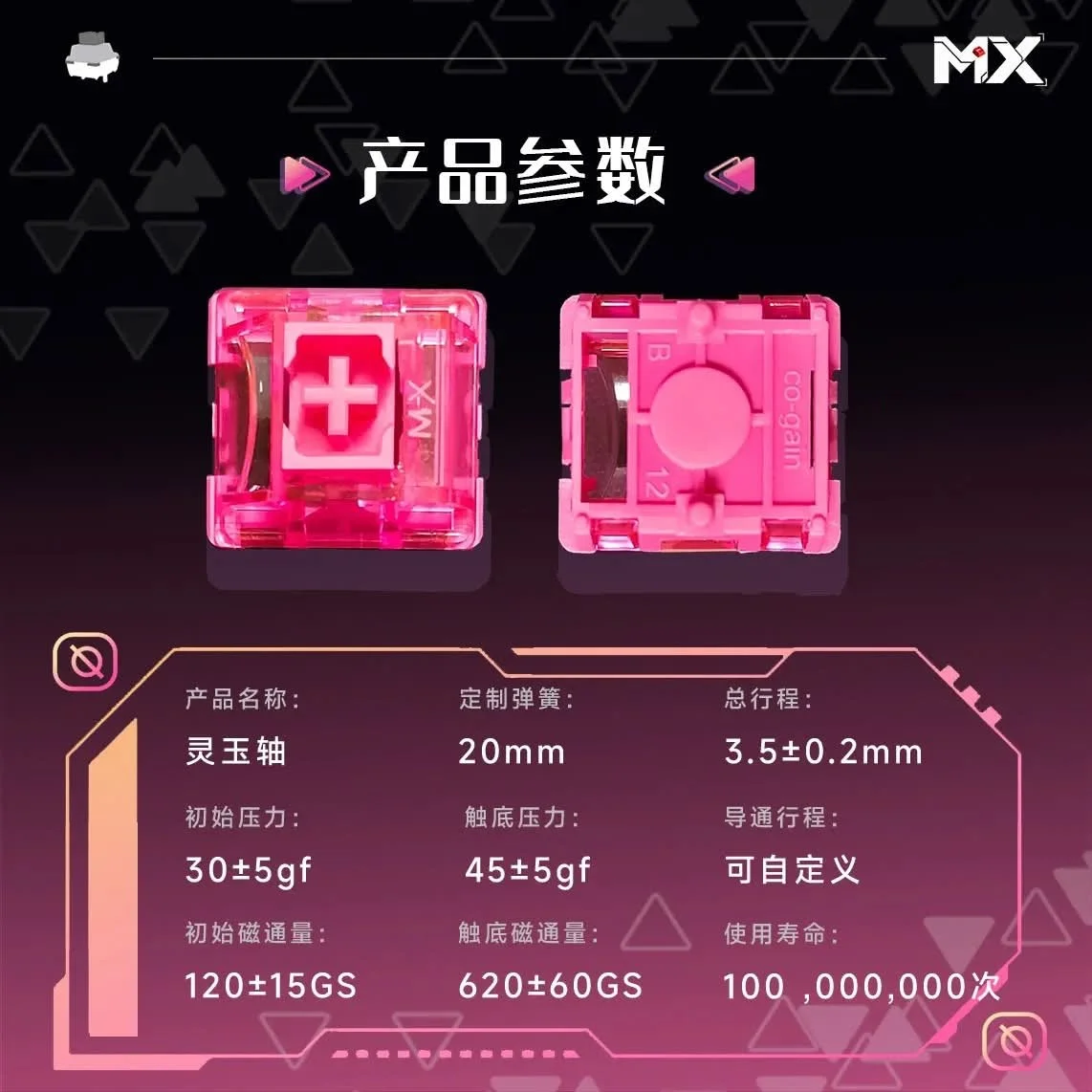
Figure 7: For reference, another very recently teased Hall Effect switch fromm Co-Gain/XUDA that shares strong similarities in design to the Geonworks Strike HE. No, despite the name 'MX', these have absolutely zero to do with the MX style of switches nor Cherry
Strike HE Performance
Appearance
At the highest level, the Geonworks Strike HE switches come in a transparent over white housing combination with ghost-white, translucent stems that are relatively nondescript at first glance despite the Halloween suggestive color name. While Geonworks initially started out with switch offerings that had a bit more color to them, such as their Tecsee-made Geon Lubed Black Switches and their translucent red over black Raptor / Raptor Extreme / Raptor HE trio, the design of these newest switches largely conforms with the muted, white and clear aesthetic that was first introduced in the Geonworks ‘RAW’ family of switches. In addition to not baring nameplates or logos of the company like their similar looking RAW predecessors, the Strike HE switches both are not reported to be part of the ‘RAW’ run of offerings and look visually different on account of being designed and manufactured by Co-Gain/XUDA. While most hobbyists outside of the more dedicated switch collectors likely won’t recognize the small details that evidently mark these as having been made by this manufacturer, they are fairly easy to see once compared to other Co-Gain/XUDA switches as well as pointed out. These notable details which separate the Geonworks Strike HE switches from other historical offerings may be found documented in the paragraphs and photos below.
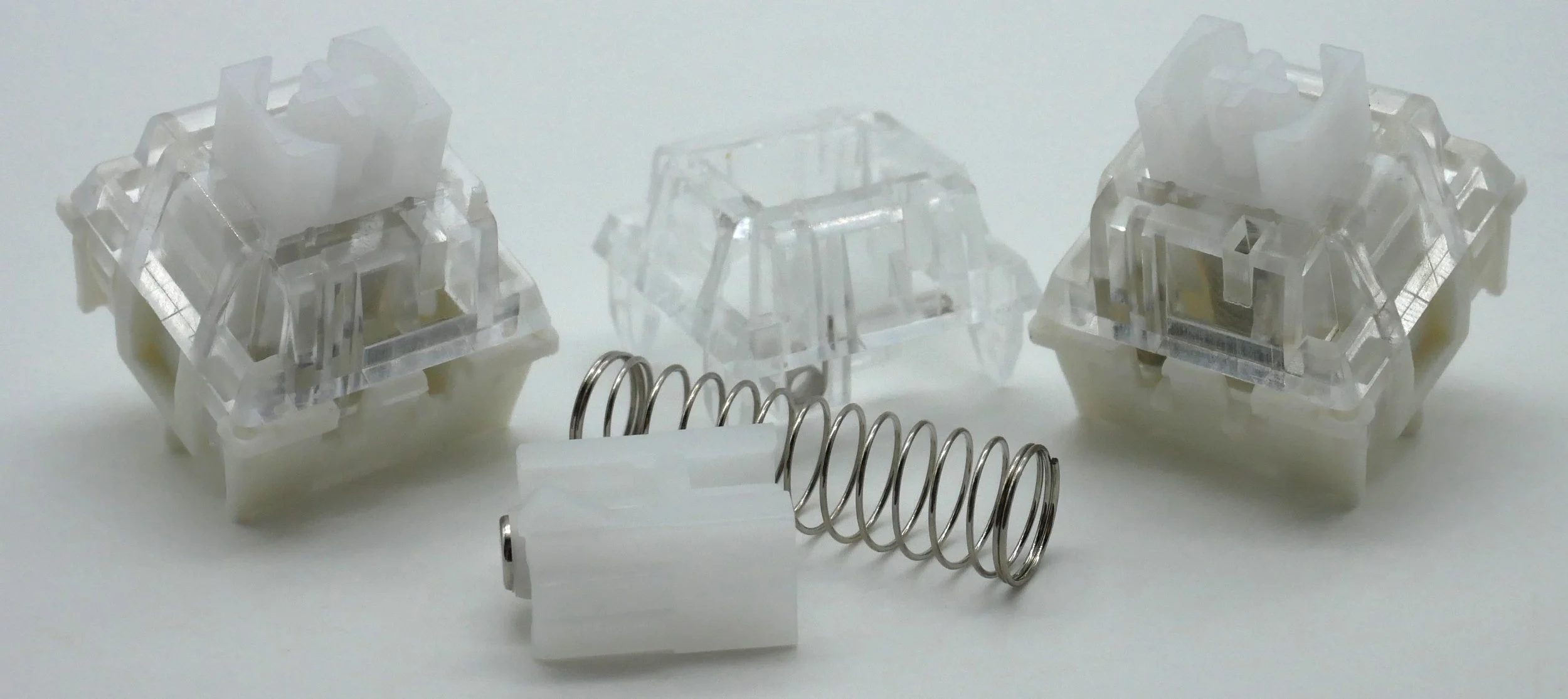
Figure 8: Geonworks Strike HE switches and their components.
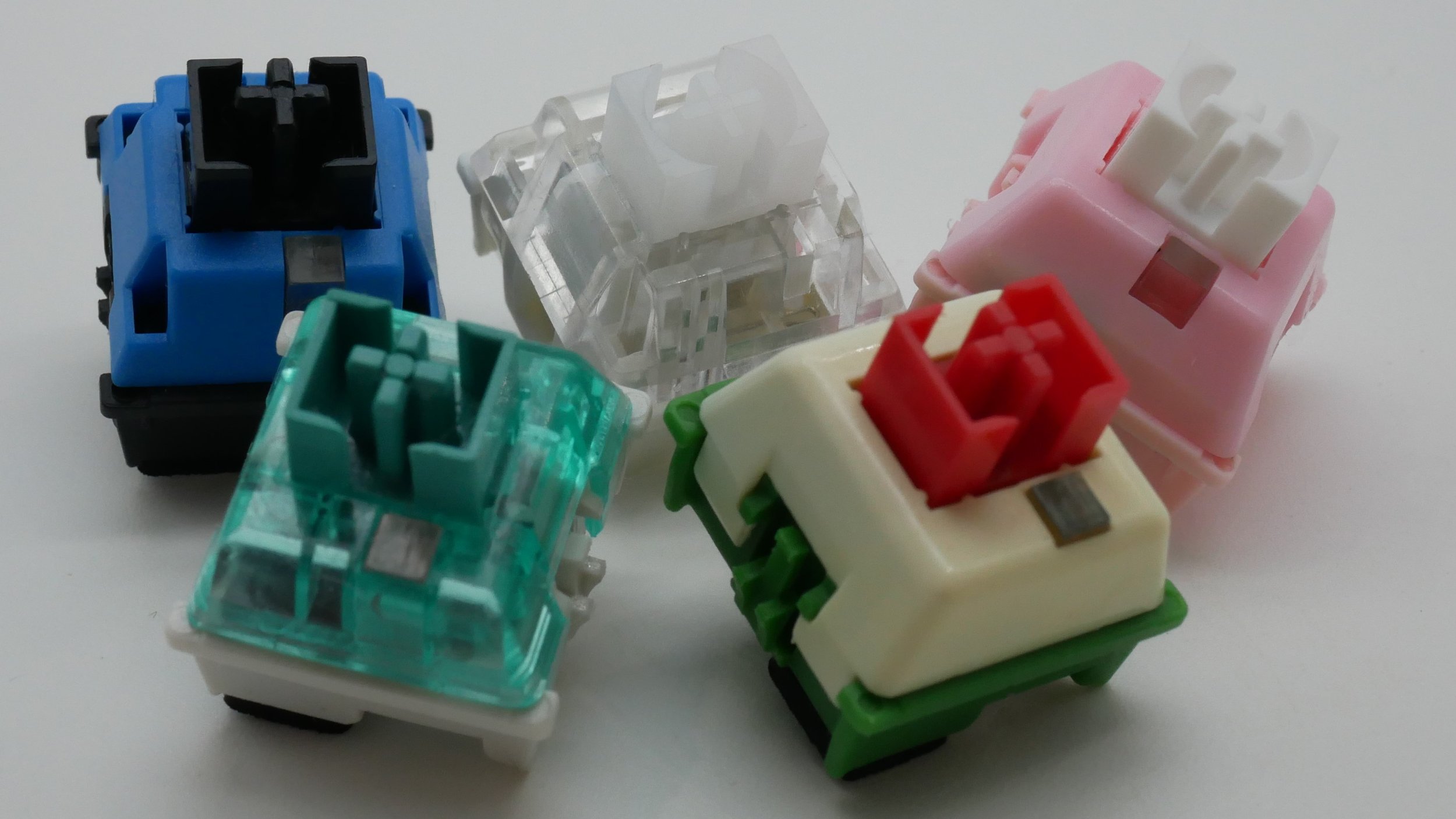
Figure 9: Geonworks Strike HE switches (back, center) amidst a variety of Co-Gain/XUDA made optical switches.
Looking first to the transparent polycarbonate top housings of the Geonworks Strike HE switches, we are greeted by effectively the entirety of the magic that makes up these switches and their design. Or, put in less fanciful terms, it is the magic that directly inspired me to write this review and the background section above. While the Geonworks Strike HE switches are click bar style clicky switches, utilizing the same type of mechanism that was popularized by Kailh in dozens of Box switches over the years, the Strike HE switches are unique in their execution as their click bars are actually attached to the top housings rather than the bottom housings. Attached on the same frontward facing side of the switch where the LED diffuser slot would normally be, the click bars of the Strike HE top housings are secured identically to those of Kailh with one small, coiled end being wedged inside of a tight housing and the longer bar end extending across the switch to be raked over by an outcropping on the stems to be actuated. Aside from being immediately interesting based on this feature alone, the overall size and shape of the Co-Gain/XUDA style top housings is what prompted some of the fanciful thinking in the background section above. Whereas most other switch top housings have a nameplate style region that overall higher and with more free space underneath of them than the side opposite of them where the LED diffuser slot would go, Co-Gain/XUDA’s housing ends are nearly equal in size, suggesting that this click bar could actually be further moved up towards the top end of the switch to push the clicking mechanism to the top end of the stroke as opposed to closer to the center of the stroke as can be seen in the force curve of ‘Push Feel’ section below. It should also be noted that there is a small rectangular hole on this front facing side of the housing that could be assumed to be for noise related purposes, but is actually a vestigial leftover feature of Co-Gain/XUDA’s optical style switch housings. Aside from this more bulky front facing feature which contains a hole, a design and shape specific to this manufacturer, and the integrated click bar mechanism, the housings are surprisingly commonplace and appear very similar to conventional four pin style top housings with no nameplate on them.
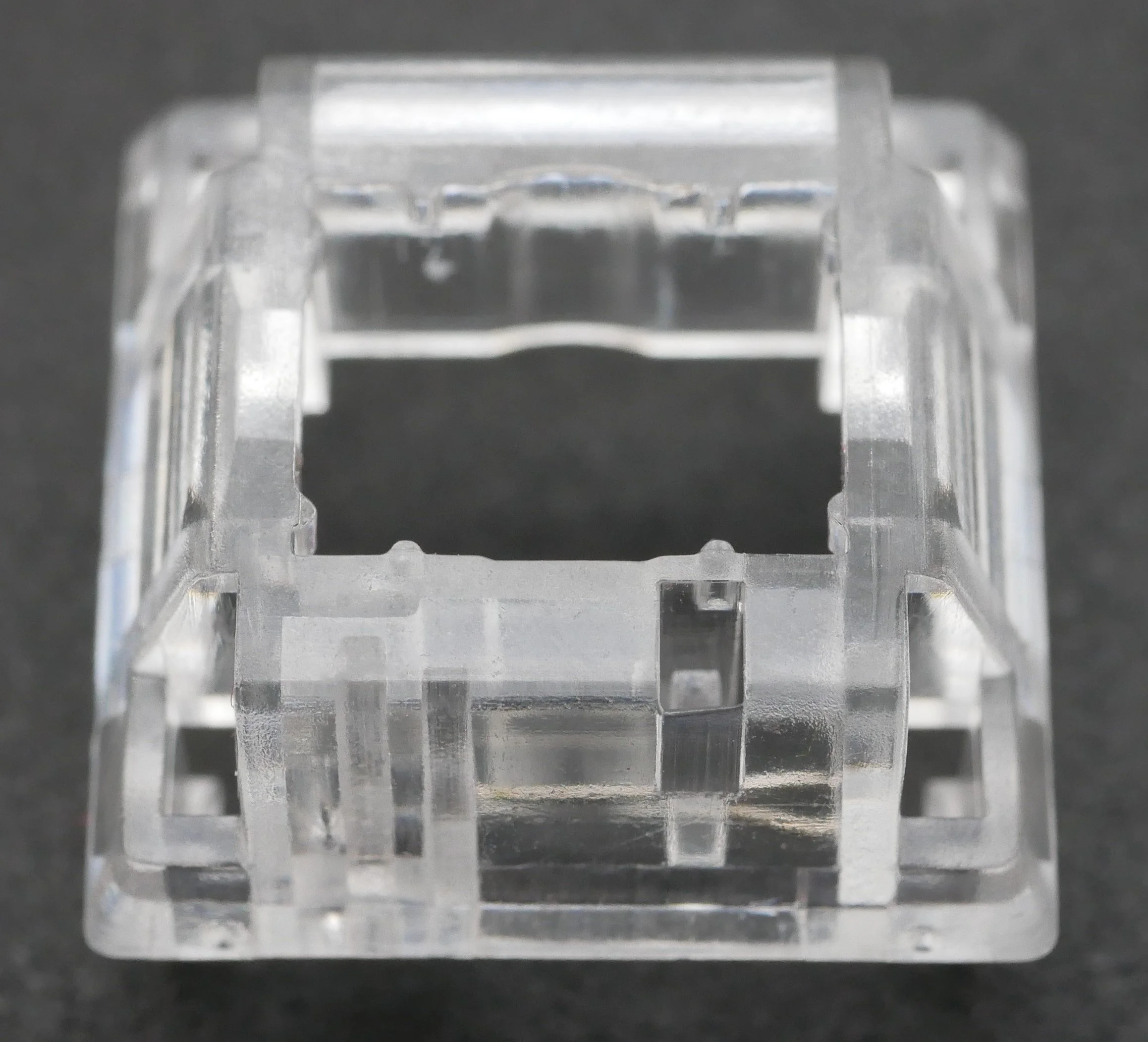
Figure 10: Top housing exterior of the Geonworks Strike HE switches showing blank nameplate, large LED diode region housing structure, rectangular hole in the front right-hand corner of such, and the click bar mechanism faintly behind such.
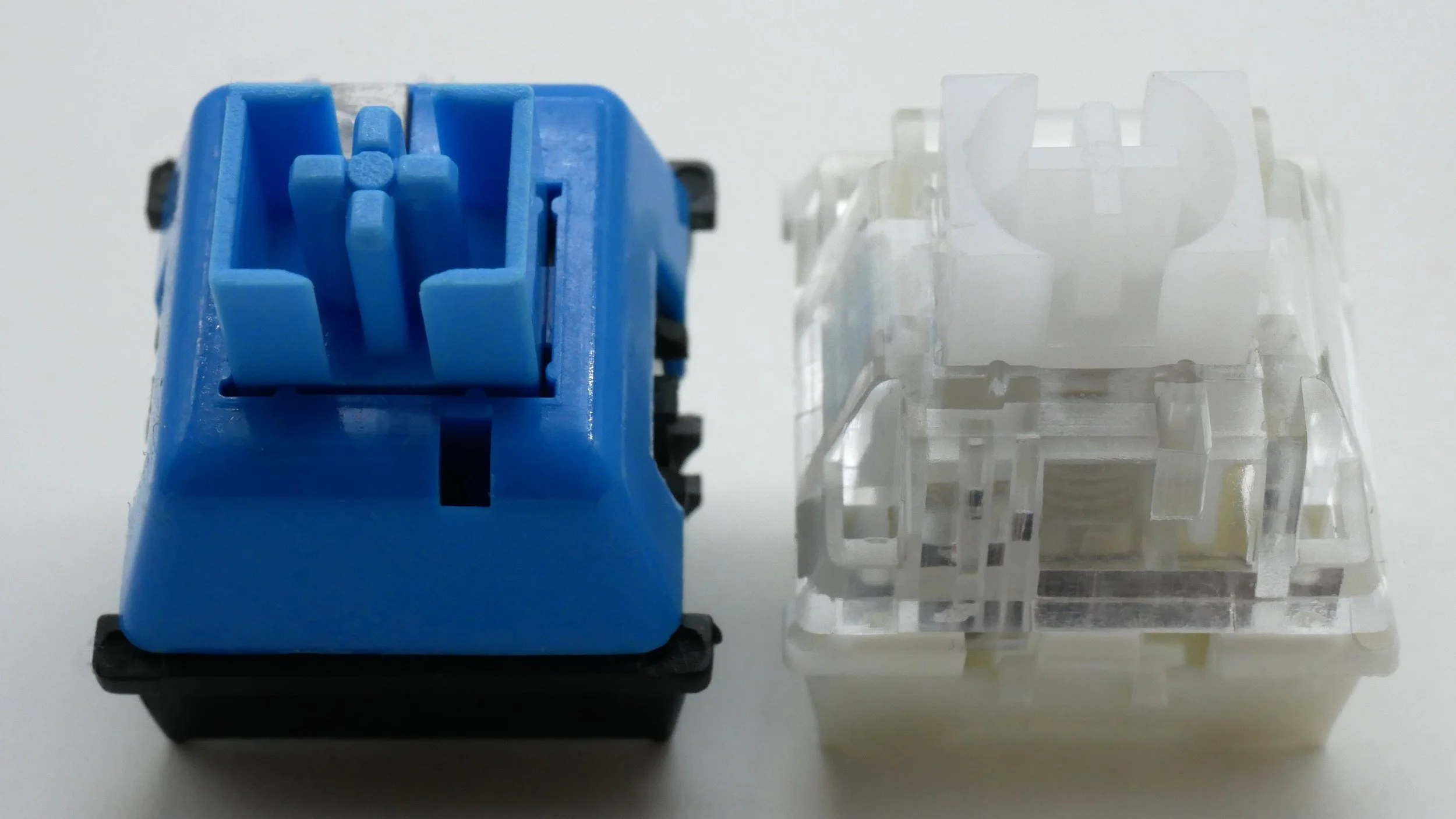
Figure 11: Co-Gain J04X Linear (Left) compared next to Geonworks Strike HE (Right) to show commonality in front side rectangular hole.
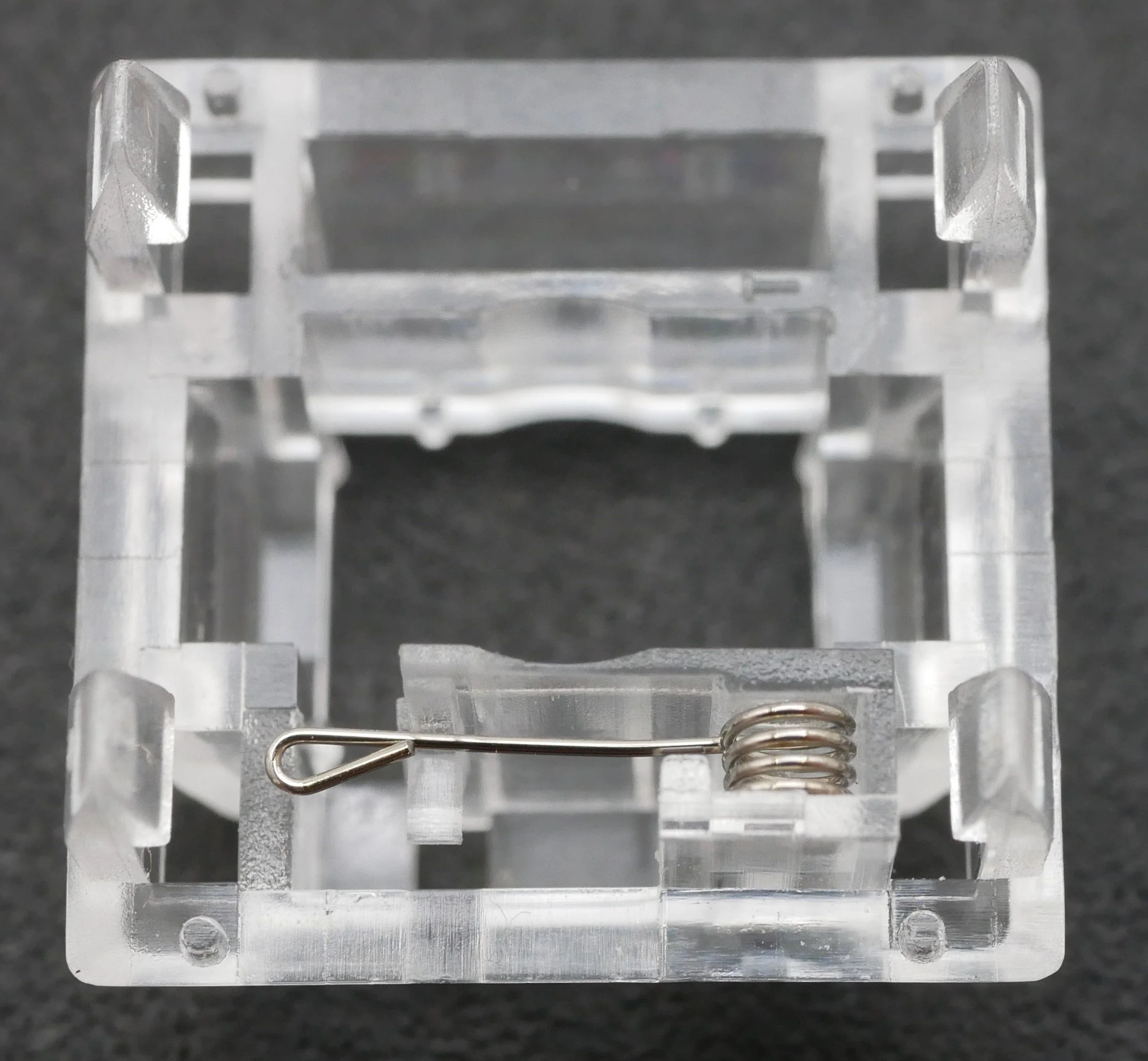
Figure 12: Top housing interior of the Geonworks Strike HE switches showing notably a small capital letter mold marking on the interior edge of the nameplate region and a click bar installed in the front end of the housing via similar attachment style as popularized by Kailh.
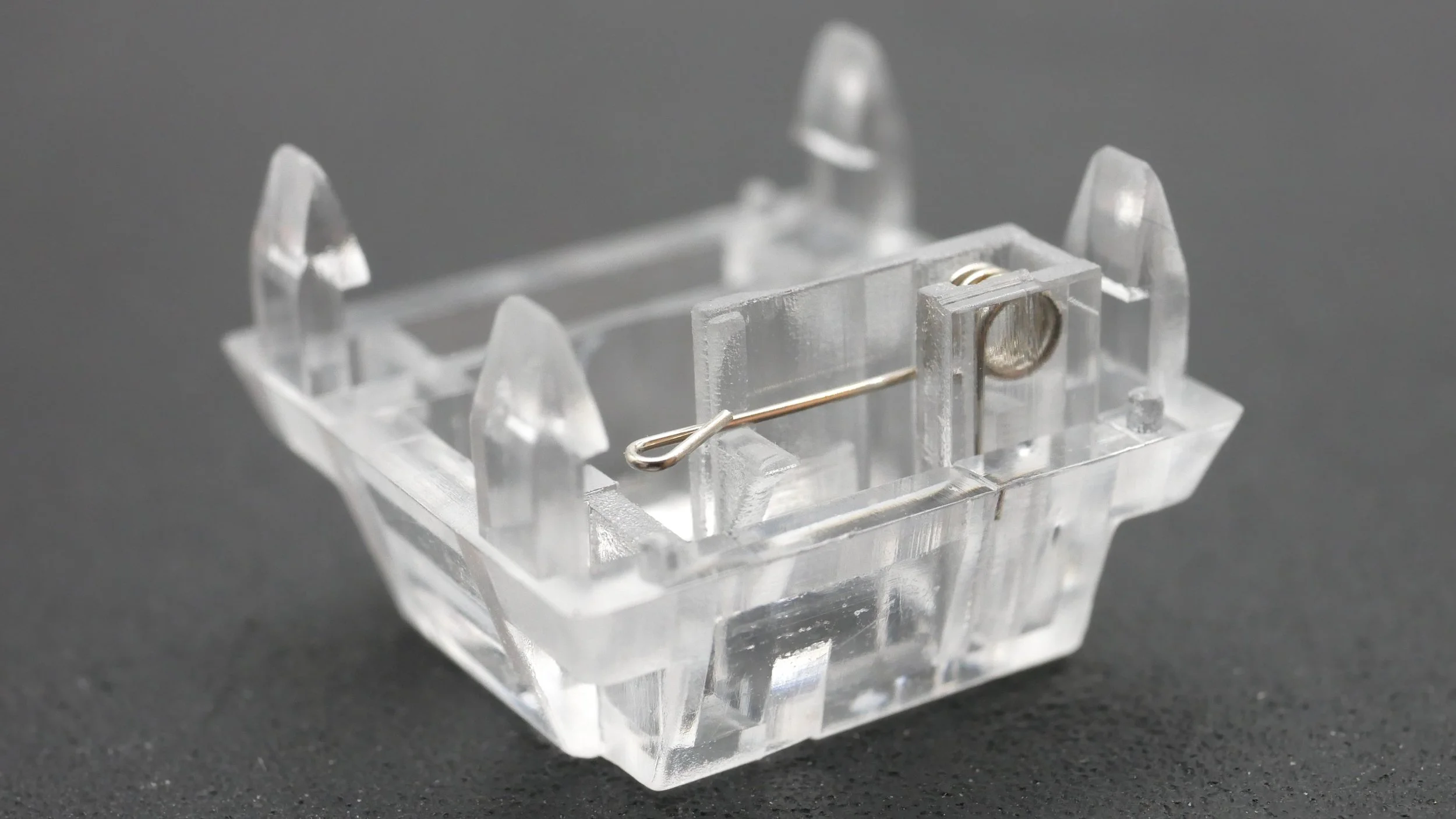
Figure 13: Alternative view of the top housing interior of the Geonworks Strike HE switches emphasizing the large amount of vertical room in which it could, theoretically, be adjusted at the design level.
Moving next to the ghost-white dustproof POM stems of the Geonworks Strike HE switches, these have features and details that are largely in line with the common expectation of Hall Effect style stems. Emblematic of the tropes of design for this style of switches, the Strike HE stems feature a very large gauge center pole that has an embedded magnet in their bases that slightly protrudes out of the bottom side. The outside edges of the stem, otherwise, are fairly plain and feature non-tapered slider rails of normal length with raised edge ridges to the reduce the surface area of contact between the stem slider rails and the bottom housing guide rails during actuations. While it is noted in marketing that these switches were factory lubed, what little was present appeared to be on both the sides and front/back plates of the stems and were rather easily rubbed off with touch. The only other feature of the stems that merits any noting is that of the wedge shaped protrusion on the front of the stem that acts to rake across the click bar mechanism above to make the clicking noise. It should be said, though, that if the stem were to accidentally be installed backwards wherein the wedge was facing the nameplate portion of the top housing / ‘leaf’ area of the bottom housing as opposed to its stock orientation, it would still be able to fully articulate and render the switch to effectively be a linear as opposed to a clicky. (I suppose this does make this switch modifiable, in a sense, though it was aimed at pointing to the feasibility of asymmetrically designed click wedges on opposite sides of the stems!)
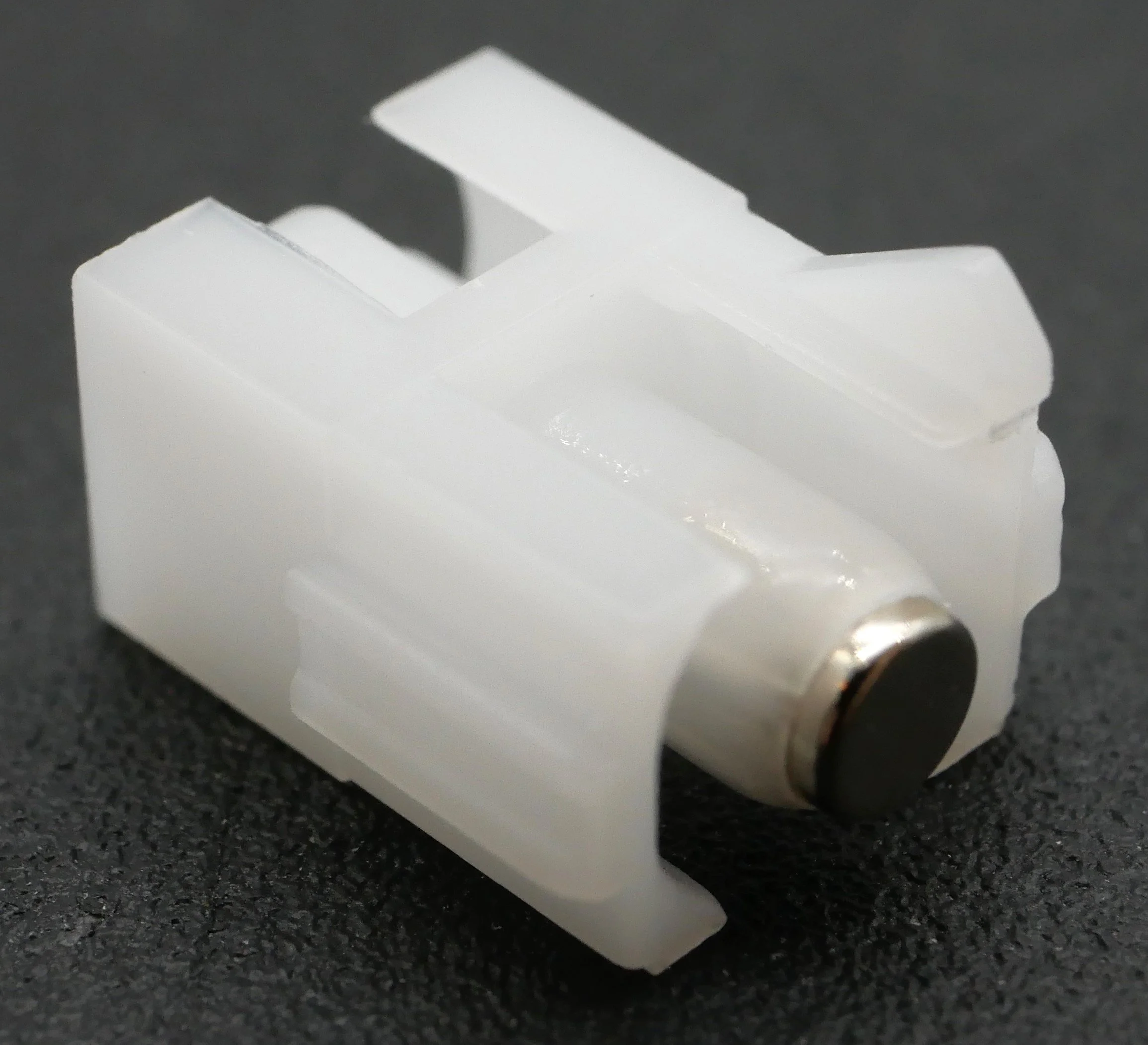
Figure 14: Geonworks Strike HE stem front side showing large gauge center pole with embedded magnet, non-tapered slider rail with raised edges, and front right-hand side wedge for actuating the click bar mechanism.
Finally arriving to the flat white, nylon bottom housings of the Geonworks Strike HE switches, we encounter the most plain and simple of the components of this switch. Internally the housing appears like most other HE switches insofar that it has a very large, wide open center pole hole to accommodate the large gauge stem and otherwise flat interior with trace amounts of factory lubing. Unlike most other HE switches, though, there is a decent bit of open real estate in the area that would be the through-switch LED/diode threading point, which is assumed to be vestigial to other designs chosen by Co-Gain/XUDA rather than of any specific functionality. Additionally, the only notable mold marking anywhere on this switch is found in the interior base of the bottom housings in the form of an upright single number in the dead center of where both conducting leaves would sit in a conventional MX-style switch design. Externally, the Geonworks Strike HE switch bottom housings come only in PCB mount/5-Pin variety and feature a fair amount of manufacturer specific, non-labeled geometric designs. While it is common to see a “Co-Gain” marking somewhere on the base of this housing in switches that they’ve produced, typically running across the top-end panel where the metal PCB pins and anticounterfeit marks would exist in conventional MX-style switches, it does not appear here in these Geon-specific switches. It can still heavily be assumed that Co-Gain/XUDA is the manufacturer of these switches in spite of this missing detail, though, due to the overwhelming similarity in design to their other switches that have been released to date.
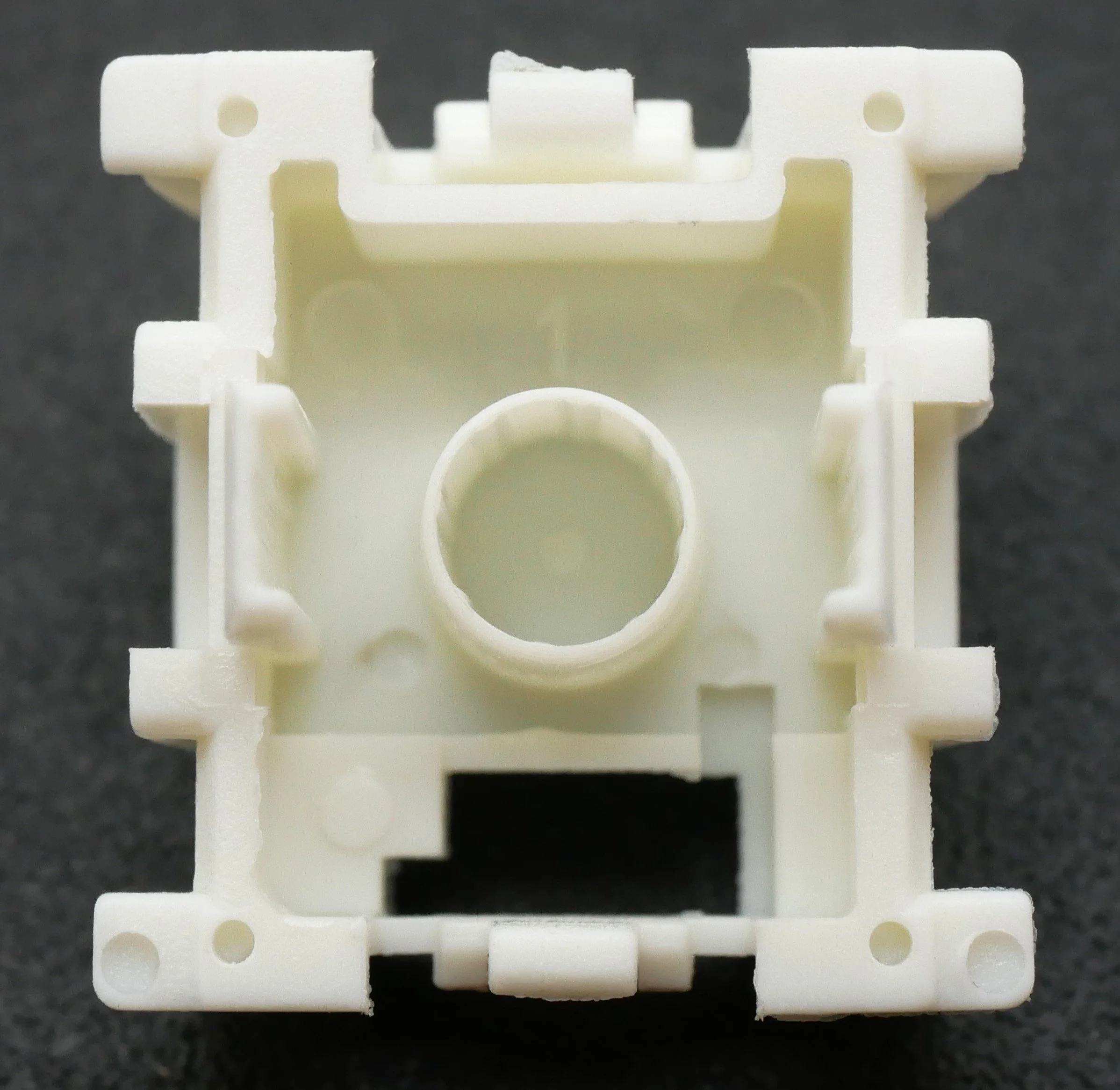
Figure 15: Bottom housing interior of the Geonworks Strike HE switches showing a single numerical mold marking in the upper portion, a large gauge, ribbed center pole hole in the middle, and vestigial open features in the lower portion.
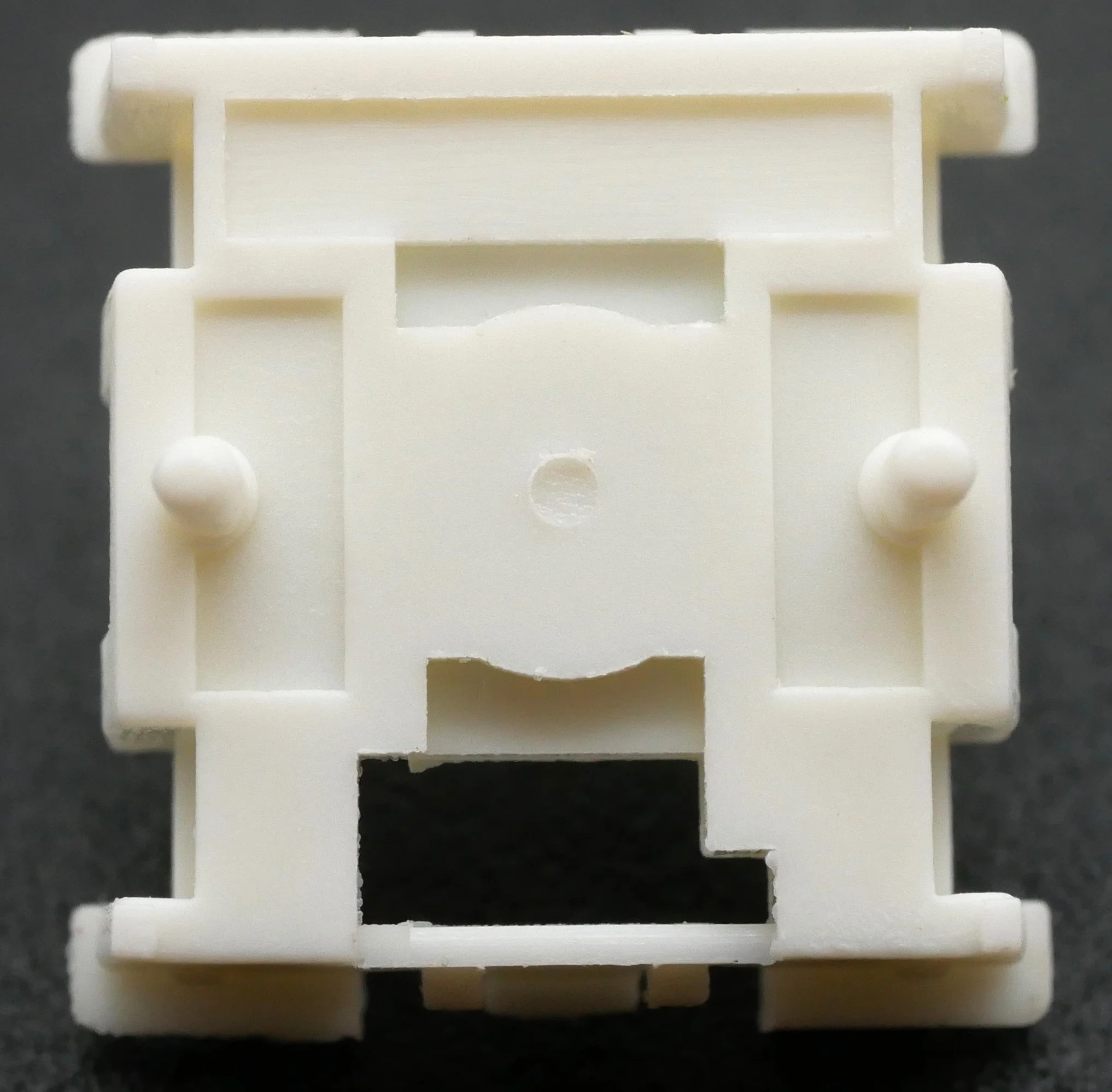
Figure 16: Bottom housing exterior of the Geonworks Strike HE switches showing PCB mounting bins and complex, blank structuring featuring no distinctive branding commonly seen in Co-Gain/XUDA made switches.
Push Feel
In the most general of senses, click bar style clicky switches can effectively be thought of as tactile switches when it comes purely to their push feeling. If a user typing on them were to be completely deaf, and thus the sound a complete non-impact on their engagement with them, switches like these would have a tactile kick that is generated by an increase of force that the wedge protruding from the stem puts onto the click bar mechanism until it rapidly peaks in force, snapping through the bar and transitioning into a linear free fall to the point at bottom out. This idea is very much quite present in the feeling of the Geonworks Strike HE Switches, though unlike conventional click bar switch designs like in the famous Kailh Box Jades or Navies, the Strike HE switches are different based on the length of time over which these actions take place. They’re much more gradual in their force increase, and it shows in both their in hand feeling and in the force curve below. Rather than going through a linear pre-stroke region that quickly hits a mountain wall of tactility to sharply and harshly drop off in force, the Strike HE switches take more than 50% of their total stroke length to slowly build up that force, inching up at a rate that is hardly different from a slightly strong linear switch. At apex, the click bars of the Strike HEs give way with a thin, sharp feeling that isn’t overly aggressive as much as it is sudden. It’s sharp, but not pointy to the point of aggravation, with no pun intended. This snap in force also gives way just as quickly to a firm, somewhat plasticky bottoming out that is a bit jarring though harder to notice under the force of the click bar. (What is actually more jarring than the bottom out is the thinner, sharper feeling topping out, though that is as expected from their polycarbonate construction.) While the force curve below does well to belay those feelings to a degree, in hand they’re even more general – the linear pre-travel region isn’t there at all and the up hill, slow climb in force feels as if it takes off right from the get go and the linear post-click region is shorter, feeling like half or less of what it displays there. And the thin amount of factory lubing that is present in these switches all but eliminates their scratch, leaving this gradual buildup to sharp, not too forceful snap and subsequent end of force repeating in an endlessly smooth cycle.
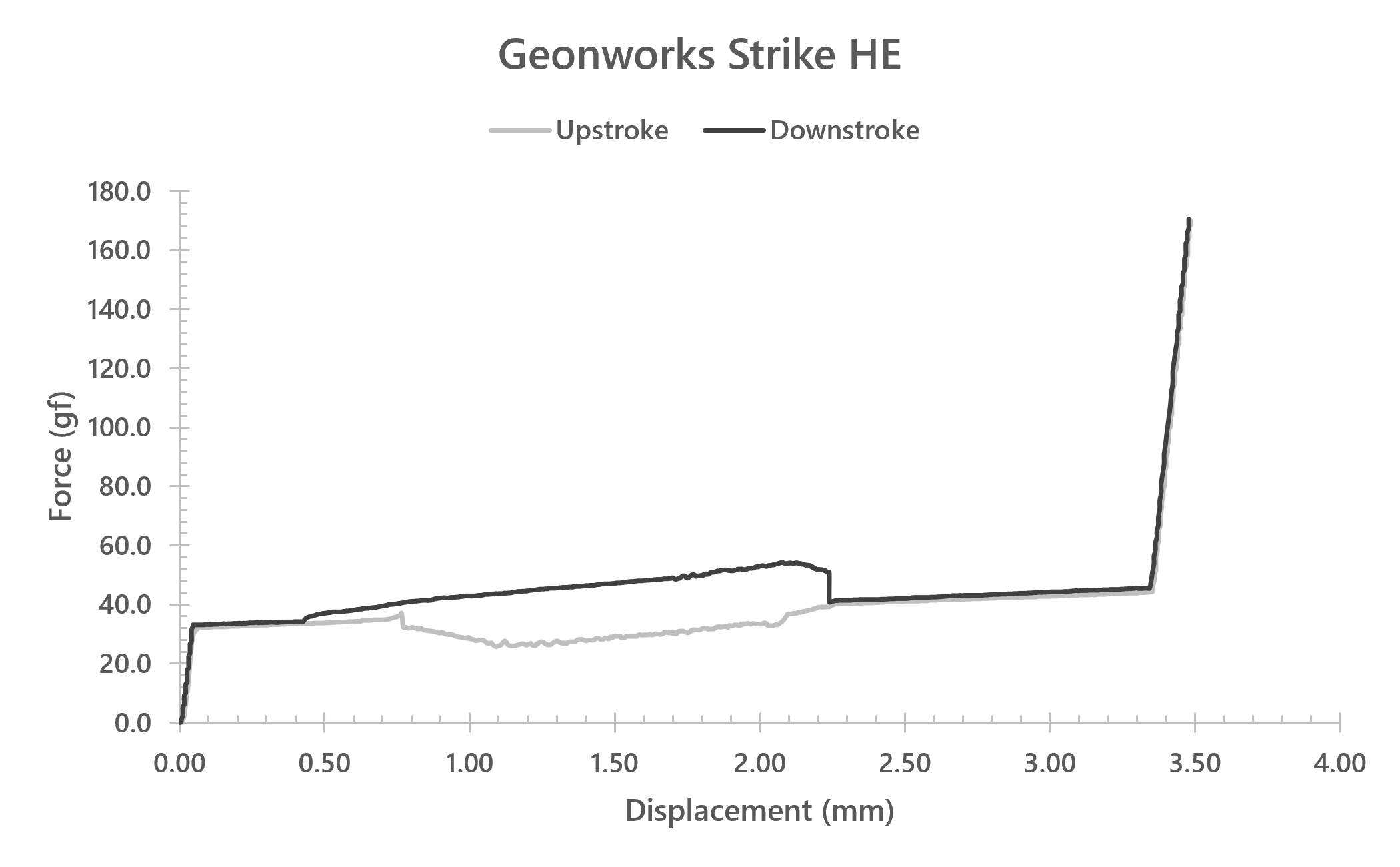
Figure 17: Force curve diagram for the stock Geonworks Strike HE switch.
Sound
Also in the most general of senses, a click bar clicky switch is one whose entire sound profile is driven by the sound of the click bar. Sure, these switches have slightly muted, dampened bottom outs and a thinner, sharper sounding topping out as is expected with the iconic combination of polycarbonate over nylon that Co-Gain/XUDA chose for their design. As well, the Strike HEs don’t have scratch like would be more than expected from modern day, well lubed switches from any respectable manufacturer. And yet, you don’t hear any of those details behind the sharp, precise, and persistently front and center sound of a click bar. So as for the click bars of the Strike HE switches, they’re actually a bit more subdued and less aggressive than one might think – especially considering their push feeling notes above and any preconceived notions you likely have had from trying click bar clicky switches prior. Likely due to some combination of their slow buildup in force as well as the sharp, though not far fall in force from their peak through the click bar mechanism these actuate with only a medium-loud sound that puts them towards the quieter end of click bar clicky switch range and with a sound that is in turn not nearly as sharp, pin-pricky, or aggressive on the ears. In turn, this reduced sharpness, which is still plenty sharp versus other mechanisms for what it’s worth, gives way to a clicking sound that is ‘bottom heavy’, carrying a general roundedness and fullness in those deeper, richer tones that accent the sound of the switch overall. In a really hand wavy sort of way, the sound almost hits my brain as being “tear drop shaped”, with the high pitched tip of that drop being the tiniest portion of their sound profile enveloped on the bottom end by a deep, richer, and more fuller sound that props it up from underneath. However, it is also critical that I note that this is generally true for most of the Geonworks Strike HE switches, though not all of them. For some unknown reason, there is a decently wide variety in this ‘tear drop’ shape of their sound across the batch that I received, with some switches having really skinny tear drops – equally as sharp and pointy at the higher ends as they are warm at the deeper, bassier ends – and others having a flatter, duller point that is drowning in abundant roundedness and depth. These variations, as well, are also quite noticeable when comparing a slew of these switches against one another. Would I personally cherry pick through these to try and find a matching set for a clicky keyboard build? Sure, though, I will also point out that I’m quite a fair bit picky when it comes to my switches for builds than most of you out there.
Wobble
Present a small amount in the N/S direction and a little bit more in the E/W direction, the Geonworks Strike HE switches have a noticeable amount of stem wobble but not too likely to bother most users. The bit of stem wobble that is present, though, is somewhat aided by the fact that it is incredibly consistent across the batch of switches that I received and thus isn’t as easily able to be detected across an entire keyboard of switches.
Measurements
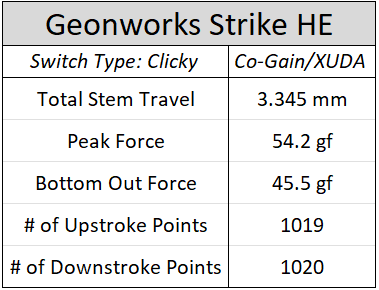
Figure 18: Numerical details regarding the force curve for the stock Geonworks Strike HE switches.
Have you ever wanted to be bombarded with more switch data than you’ve ever seen at any point in your life before? Consider checking out the ‘Force Curve Repository’ hosted on my GitHub that contains all force curves that I take both within and outside of these full-length reviews. In addition to having these graphs above, I have various other versions of the graphs, raw data, and my processed data all available for over 2000 different switches for you to use however you see fit. Check it out via the ‘Archive’ tab at the top of this page or by clicking any of the force curve cards above.
Break In
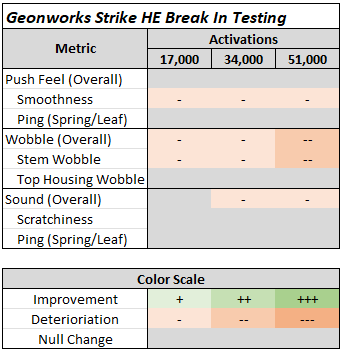
Break In Notes
17,000 Actuations
- After 17,000 actuations, the most notable change in performance of the Geonworks Strike HE switches comes in an increase in both the N/S and E/W direction stem wobble. While this is ultimately subtle, it is still noticeable enough to differentiate this broken in batch from the stock ones.
- Likely as a function of factory lube migrating throughout the switch upon break in testing, the Strike HE switches broken in to this degree to have an ever so slight grainy scratch to them that wasn’t present before. This is even more subtle than the increase in stem wobble, though, so it’s definitely unlikely to bother most users.
34,000 Actuations
- The same increases in stem wobble and scratchiness noted at 17,000 actuations still apply here to the same degree for those switches broken in to 34,000 actuations. The only other change beyond this, though, is a slight change to the overall sound profiles of the Strike HE switches. While they retain the same inconsistency and variety in tone as their tock counterparts, a fair number of the switches broken in to this degree have lost their sharper, higher pitched tones – something which may not even necessarily be worth a ‘-‘ to be entirely fair. However, given that these sharper, louder tones tend to be a defining feature of click bar clicky switches to users who enjoy them, I imagine this may be a bit disappointing for them to encounter.
51,000 Actuations
- After 51,000 actuations, the only change in performance of the Geonworks Strike HE switches from the previous stages of break in was a further slight increase in N/S and E/W direction magnitude, with both of them being more wobbly to the same degree than the 17,000 actuation and stock batches.
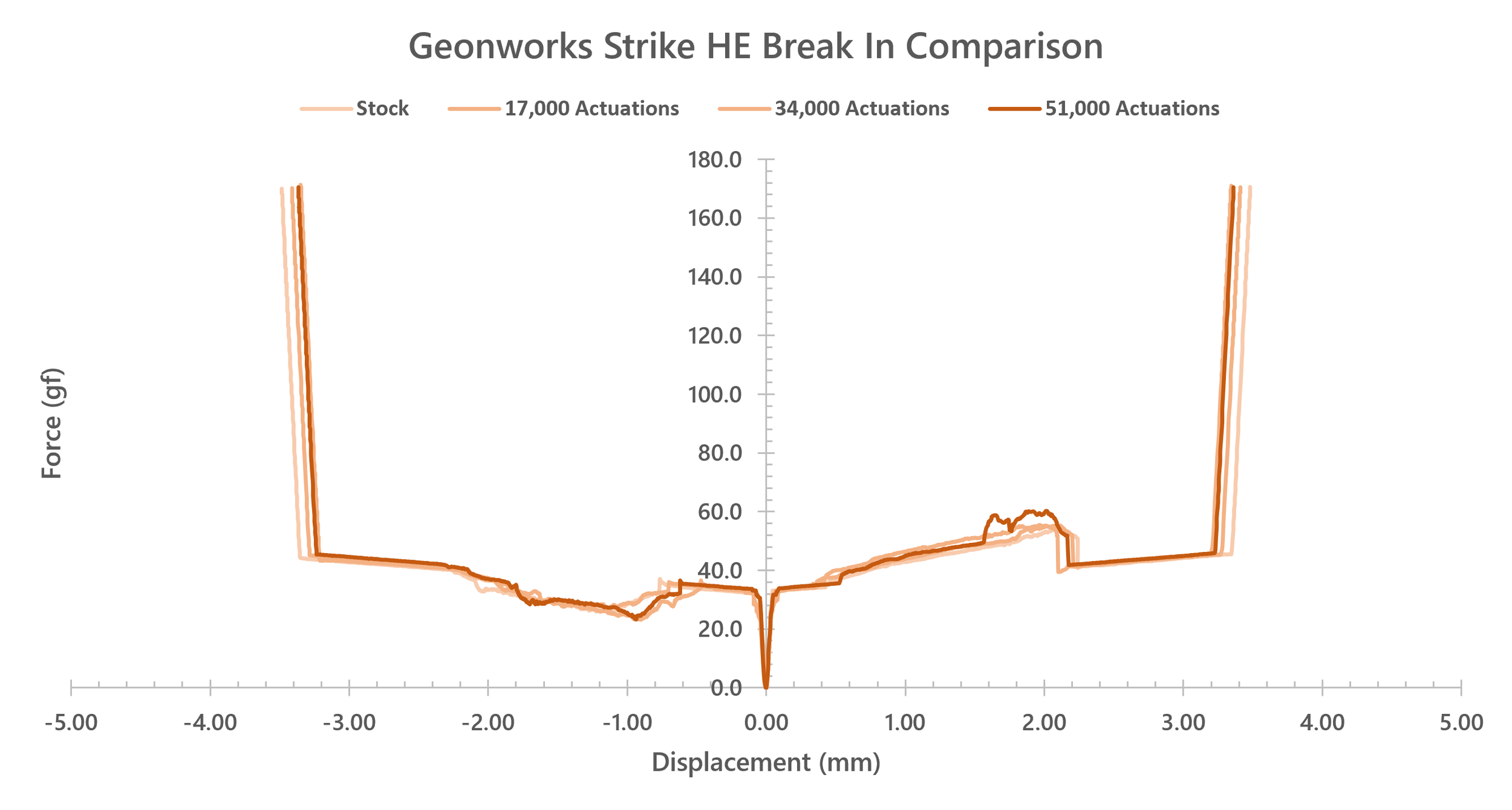
Figure 20: Comparative force curve diagram showing non-linear differences in the Geonworks Strike HE switches throughout the break in process that I was not able to distinguish by feel nor believe dramatically altered the feeling of the switches.
Comparison Notes to Other Notable Clicky Switches
Note – These are not aimed at being comprehensive comparisons between all factors of these switches as this would simply be too long for this writeup. These are little notes of interest I generated when comparing these switches to the Geonworks Strike HE switches side by side.
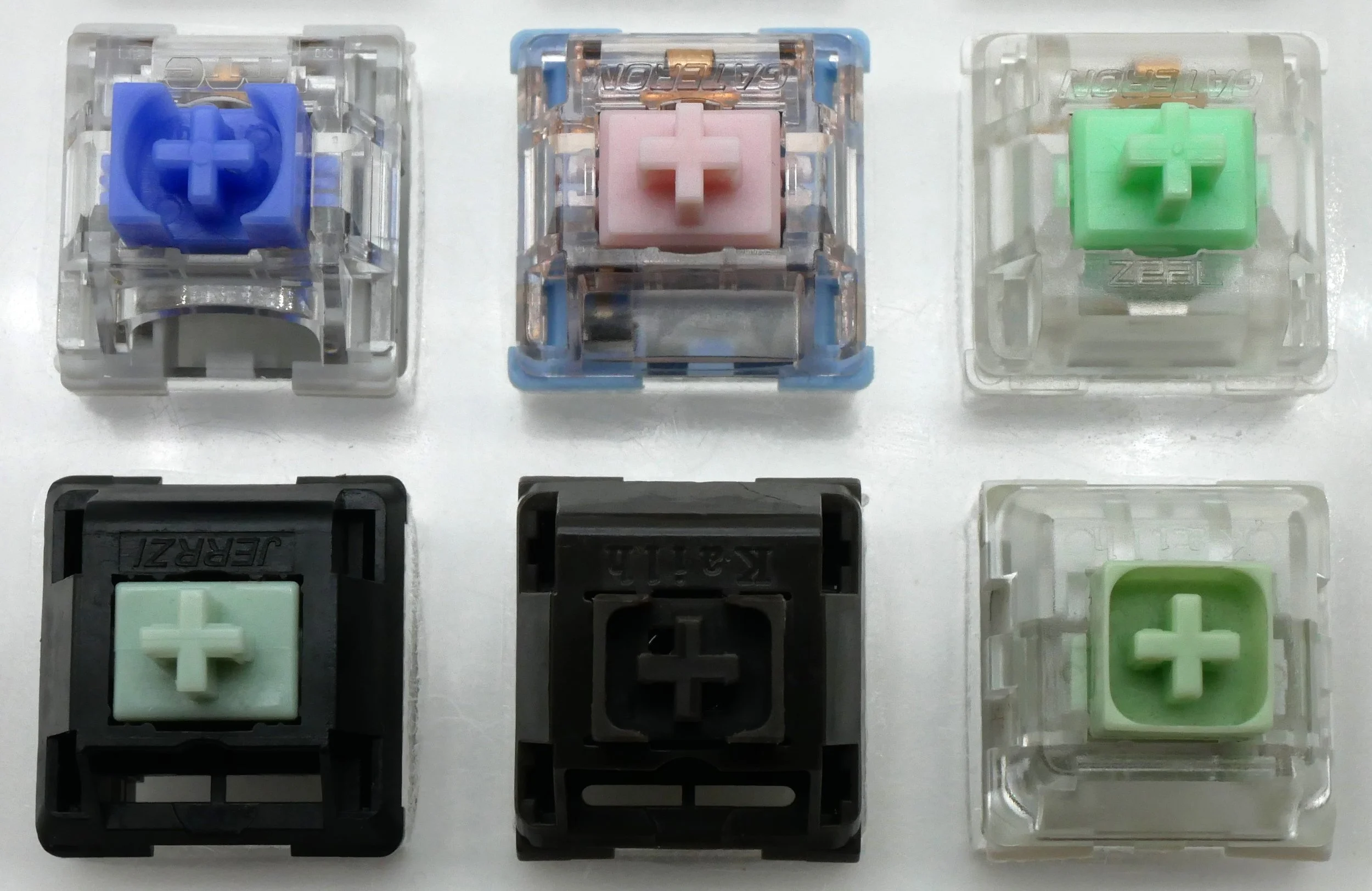
Figure 21: Switches for comparison (L-R, Top-Bot: TTC Brother V2, Gateron Melodic, Zeal 3-in-1 Clickiez (40g), XCJZ Jerrzi Lotus Stem, Novelkeys Cream Clickie, and Kailh Box Jade)
TTC Brother V2
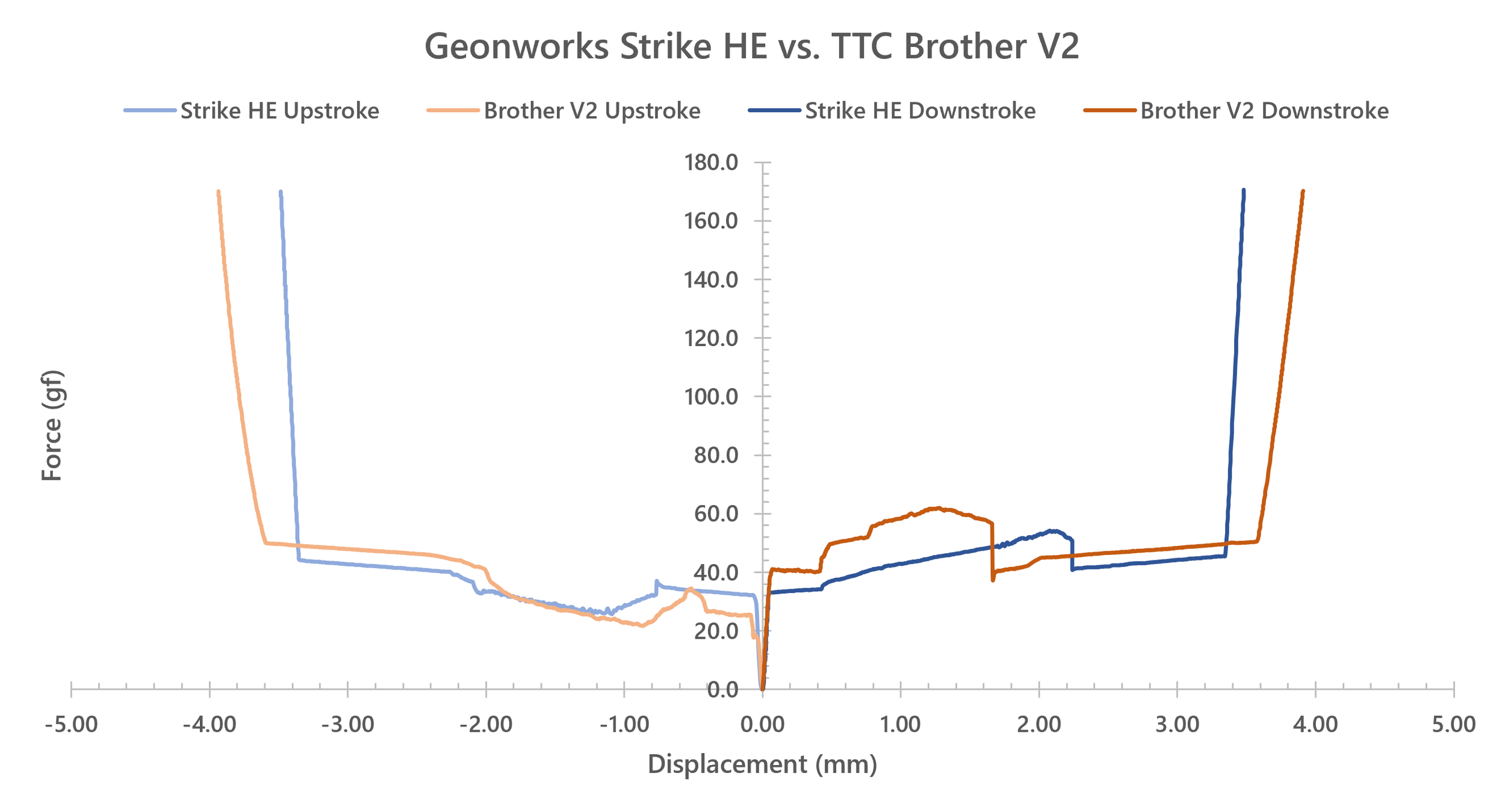
- Comparing the sound profile of the TTC Brother V2 and Geonworks Strike HE switches head to head, which are both click bar clickies for the record, the Brothers are much more in line with what you’d conventionally expect from this kind of mechanism – they’re louder, with a singular, more crisp sounding click that is quick, sharp, pointy rather than rounded, thick, and on the quieter side. It should be noted though that the TTC Brother V2 switches also suffered from a wide ranging cross-batch variation like the Strike HE switches did too.
- The Geonworks Strike HE switches have perhaps a tiny bit less stem wobble in both N/S and E/W directions than the TTC Brother V2 switches.
- While testing these switches out slowly in hand, I can definitely feel the difference in pre-click rate of increase in force, with the Strike HE switches feeling more gradual and less abrupt than the start of the click mechanism in the Brother V2 switches. However, in a keyboard and at reasonable typing speeds, I’m dubious if such a minor difference in force across such a short distance will realistically be feasible to feel at all.
Gateron Melodic
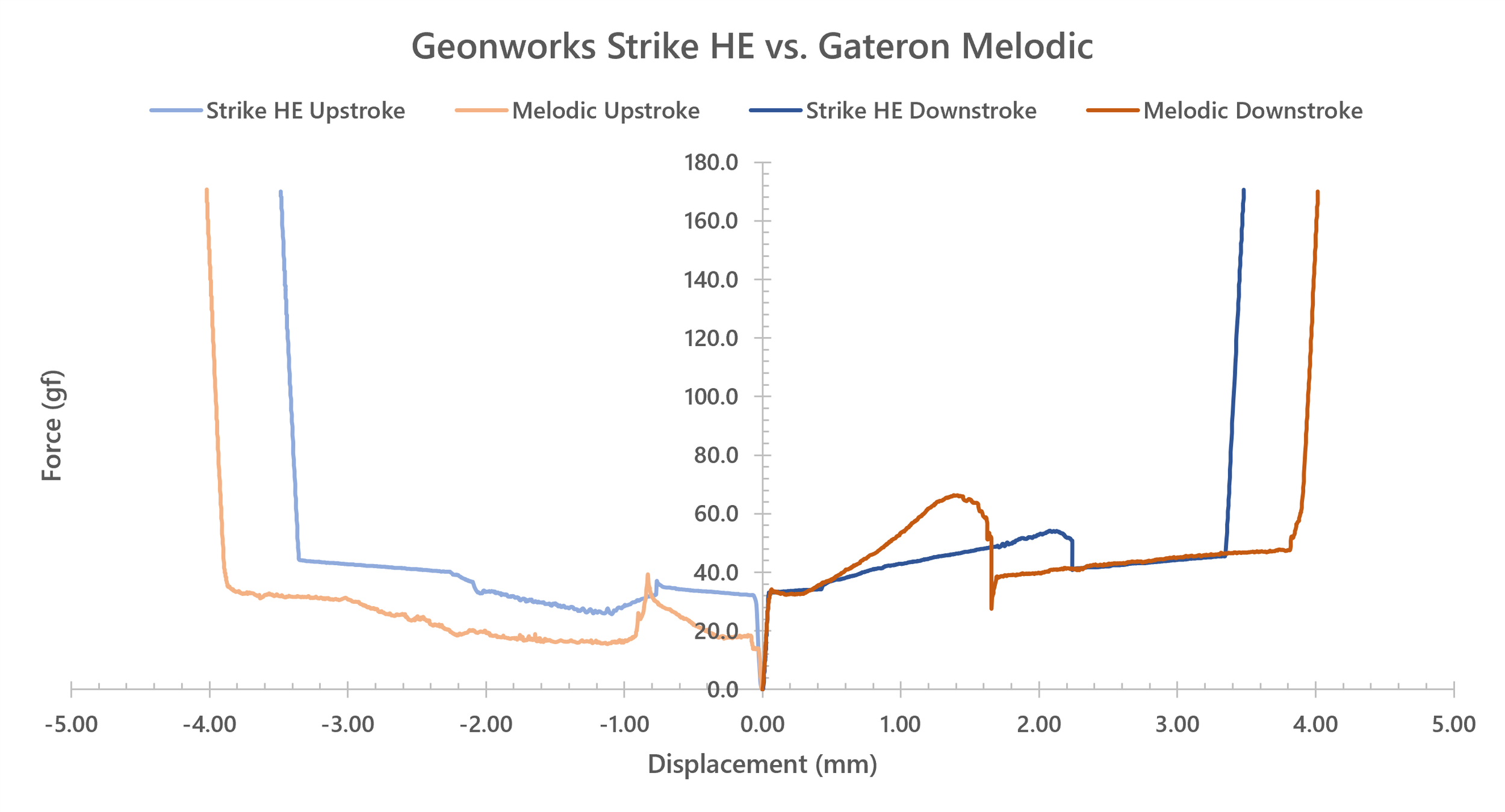
- The Gateron Melodic switches and their small click leaf mechanism have a sound that is much more subtle, subdued, and softer on the ears than the Strike HE switches, carrying a light, airy tone that is more fleeting than the rounded, bottom-heavy snap of the click bars that can be heard in the Geonworks Strike HEs.
- Look I know what the comparative force curve below would suggest, but I could swear that the Gateron Melodics I used to comparison in this section did not feel anywhere near as strong as the Geonworks Strike HE switches, let alone the difference shown here. Perhaps my batch of Melodics has somehow weakened over time? This is by far one of the largest disparities between comparative force curve and in hand performance that I’ve encountered to date.
- The Gateron Melodics are a bit better than the Strike HE switches when it comes to both N/S and E/W direction stem wobble.
Zeal 3-in-1 Clickiez (40g)
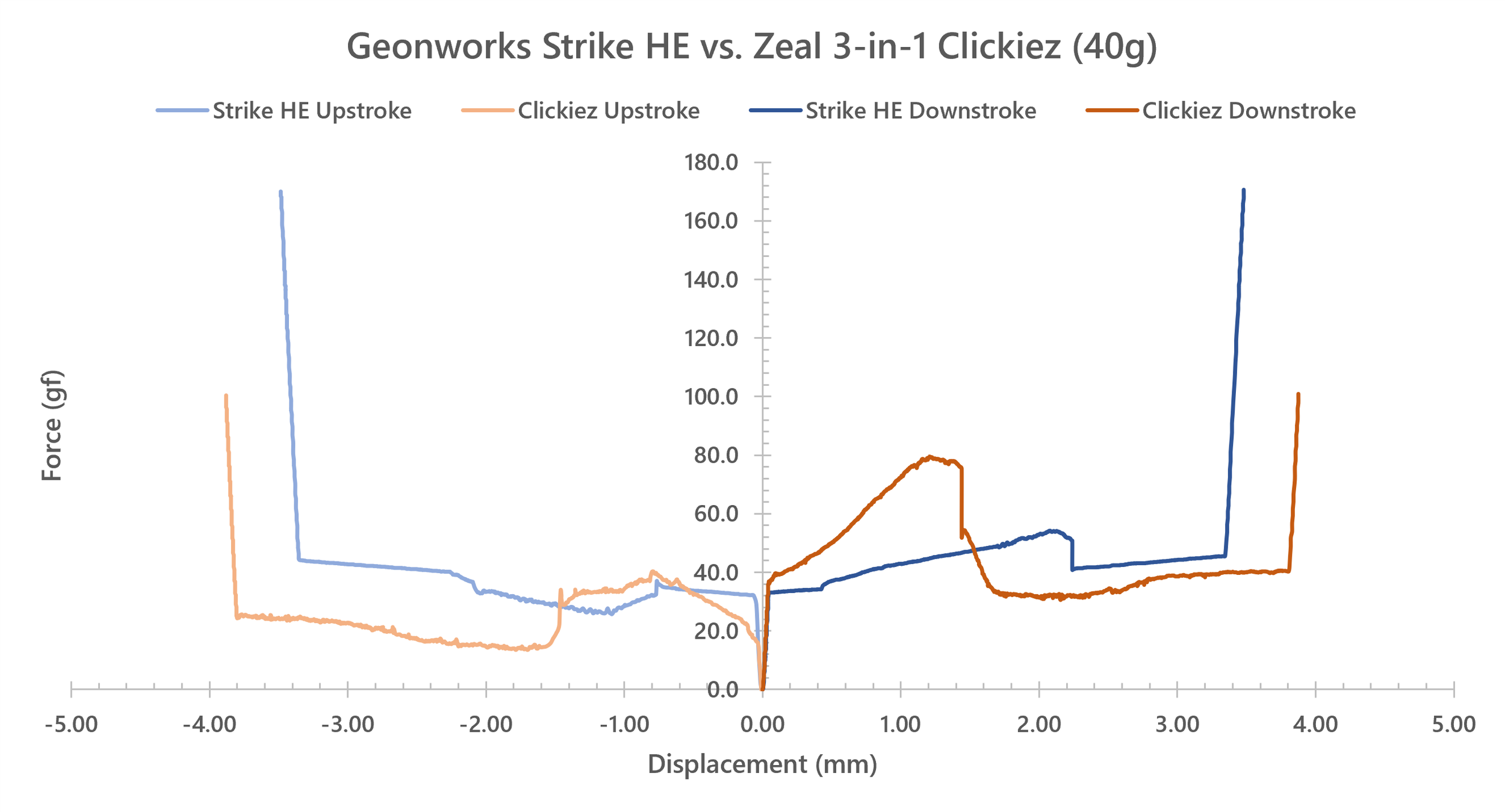
- Much like with the comparison to another click leaf mechanism above, the sound of the Clickiez switches is much more subtle, though with a zinging bubble pop-like sound that comes across entirely different than the sharp, metallic, and full bodied twang of the Geonworks Strike HE switches. The Strike HE switches as well, despite being relatively soft sounding for a click bar style mechanism, are significantly more loud and audibly imposing than the Clickiez.
- There is a fair bit N/S and E/W direction stem wobble in the Zeal 3-in-1 Clickiez switches than there is in the Geonworks Strike HE switches.
- Likely due in large part to differences in their age and era of arrival, the Zeal 3-in-1 Clickiez switches are just not as well lubed or smooth as the Geonworks Strike HE switches.
XCJZ Jerrzi Lotus Stem
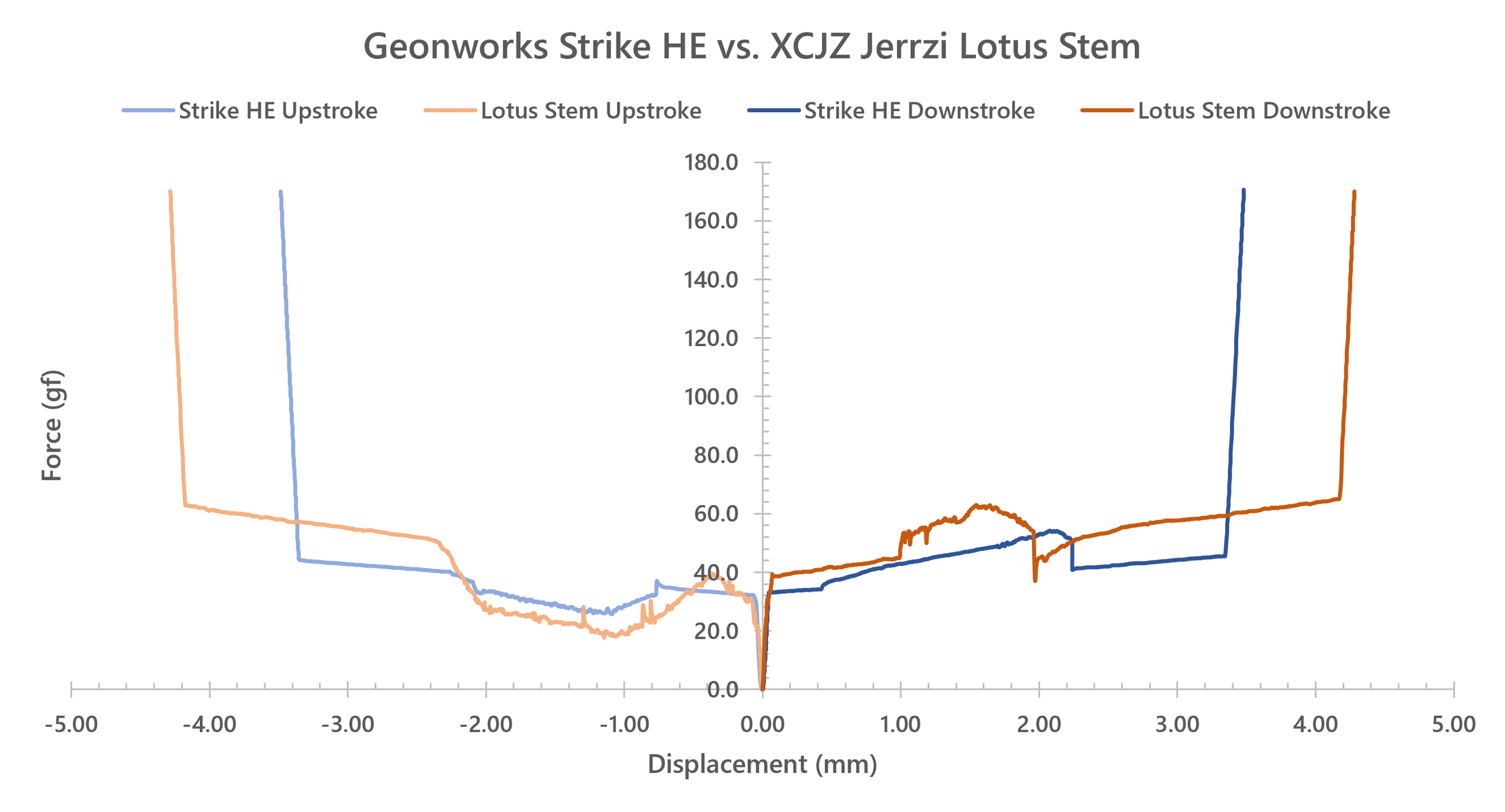
- Being click jacket style clicky switches, the XCJZ Jerrzi Lotus Stem switches have a sound profile that can simply be summarized as being ‘inferior’ to that of the modern click bar mechanism of the Geonworks Stike HE switches. The Lotus Stems, by comparison, are quieter, more fuzzy, have intermittent plasticky sounds, and just sound significantly more disheveled than the Strike HE switches.
- The Geonworks Strike HE switches are a bit better than the Lotus Stem switches when it comes to both their N/S and E/W direction, even with the Lotus Stems being asymmetrically better in the E/W direction than N/S one.
- In addition to the sound profile being more plasticky, chaotic, and inconsistent feeling in the XCJZ Jerrzi Lotus Stem switches, they also have these same issues in feeling on top of a scratchy, not so well lubricated stroke. The Geonworks Strike HE switches just simply don’t have any of these issues.
Novelkeys Cream Clickie
- Perceived as being iolated at completely opposite ends of their strokes, the Novelkeys Cream Clickie and Geonworks Strike HE switches are fun demonstrations of the range of placement that one can have in a clicky mechanism in a switch. Yes, I’m aware that the comparative force curve below would suggest that the click of the Strike HE switches is actually fairly late in the overall stroke length, but typing on them at speed gives a feeling that they are much higher up than what is shown here.
- While both of these switches carry a similar ‘tear drop’ shaped sound profile and have depth, rich undertones that prop up their thinner, more pointed high end peaks of sound, the Cream Clickie switches just sound more narrow and singular in their sound. Without actually doing this test for comparison, I could imagine that two or three Cream Clickies being actuated at the same time right next to each other would begin to mimic that sort of volume that is present in the sound of the Geonworks Strike HE switches.
- The stem wobble of the Geonworks Strike HE switches is a fair bit better than the Novelkeys Cream Clickies in both the N/S and E/W directions.
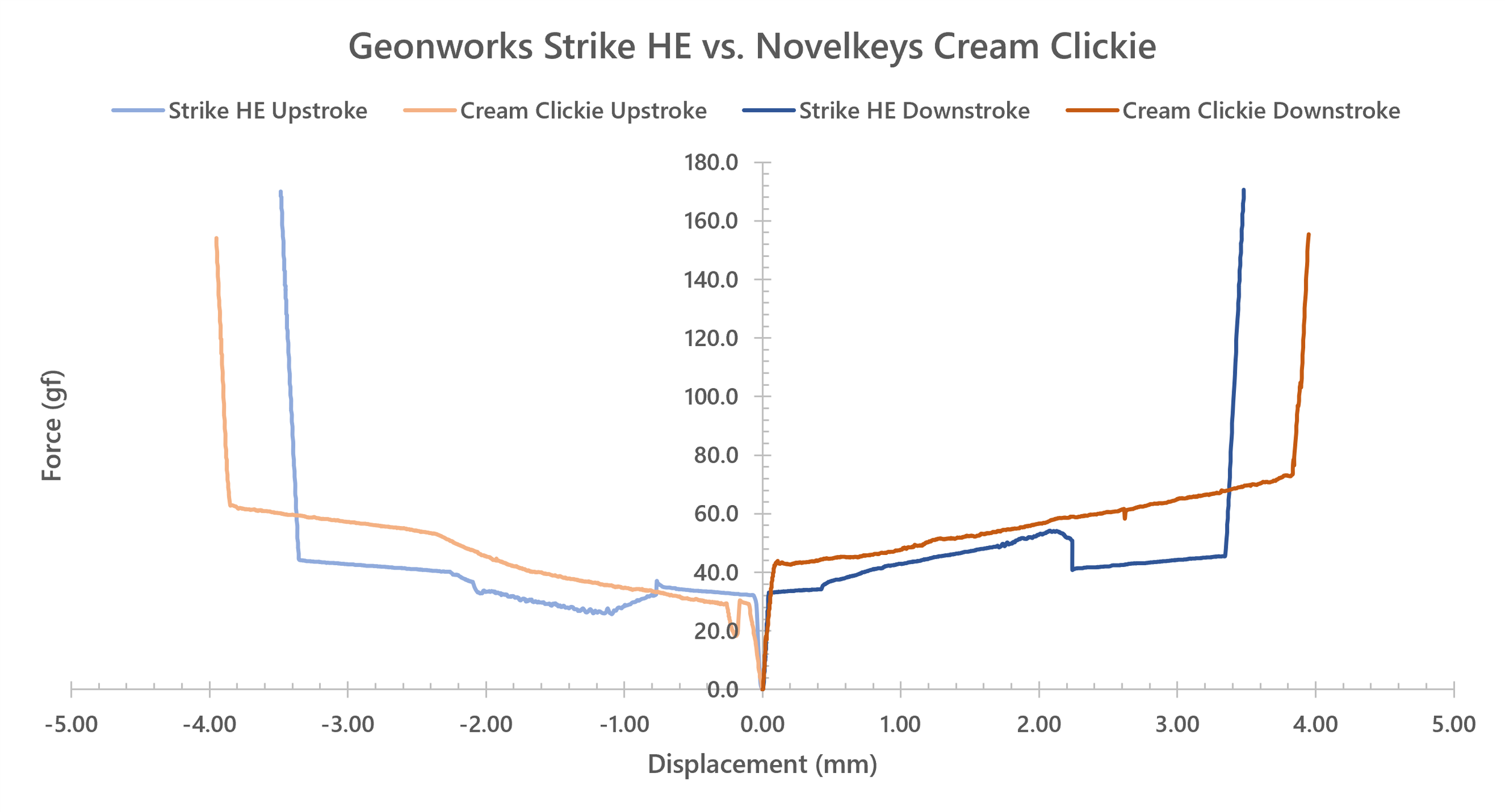
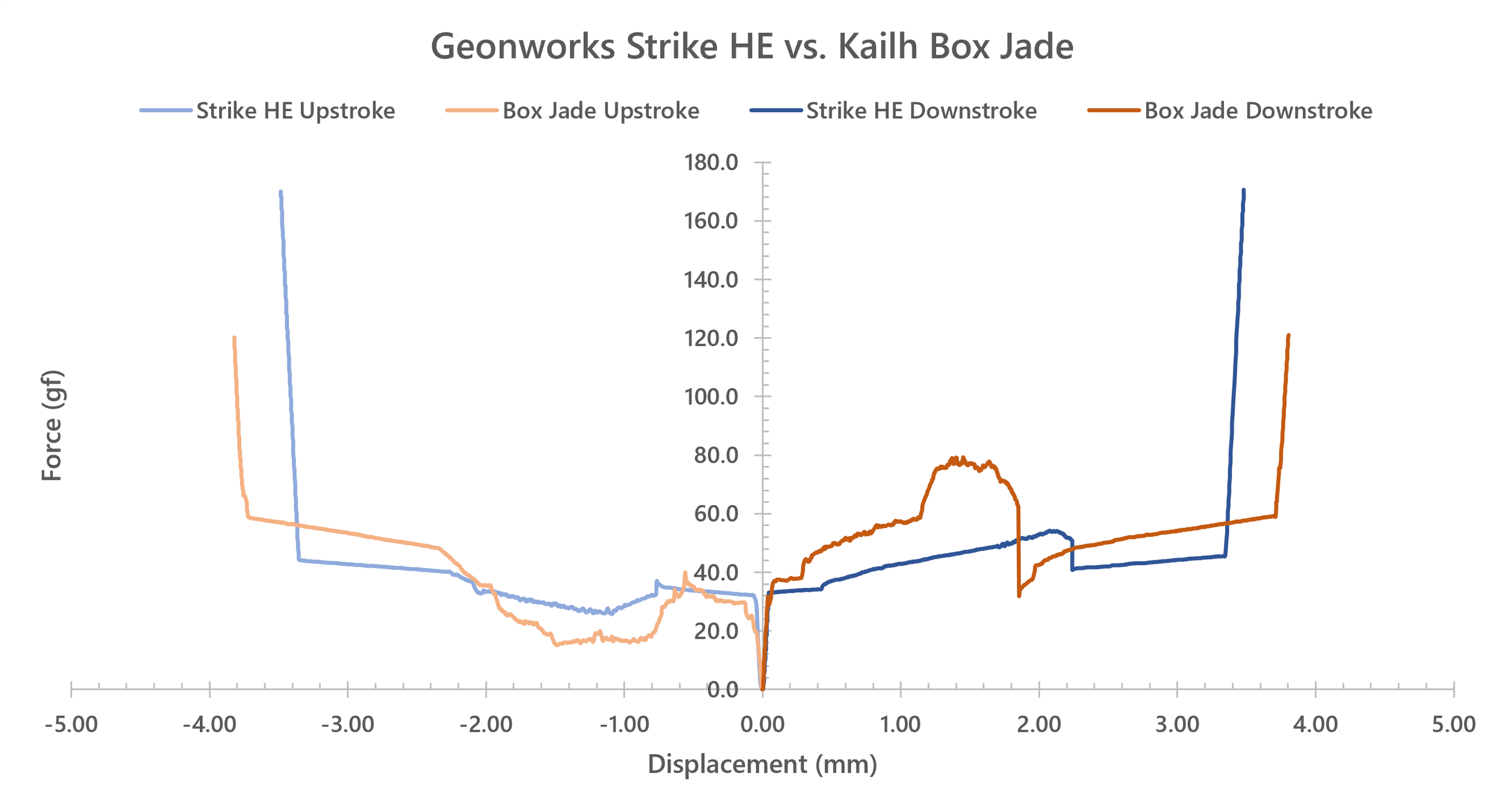
Kailh Box Jade
- Compared to the truly iconic stereotype of the click bar mechanism in the Kailh Box Jades, the Geonworks Strike HE switches just do not sound as loud, as punchy, or anywhere near as ‘in your face’ as the Box Jades are. There’s just a certain sharp snappiness to the click bars in the Box Jades that just ‘feels’ so much more impactful than the Strike HE switches.
- Given that these switches were produced in such vastly different points in the community’s growth and development, the Kailh Box jades have a significantly greater amount of stem wobble than the Geonworks Strike HE switches even though they were fairly good for the days in which they first showed up.
- The comparative force curve below does do a good example of demonstrating the difference in lead up force to click bar engagement that I tried to highlight in the various performance sections of this review. This is noticeable in hand. You can tell the exact instant that the Box Jade’s stem begins touching with and trying to force through the click bar mechanism whereas the stems more slowly and softly engage with the click bar in the Strike HE switches until they just softly break free.
Other
It has admittedly been a fair moment since I purchased switches directly from Geonworks, and so somewhere between a few years ago and today they’ve updated their packaging for keyboard size quantities of switches. It’s certainly not the most fanciful or noteworthy of packaging, though I did find it neat enough to want to share it with you all here. Either that or I’m just doing this to just pad my perpetually growing historical word count.
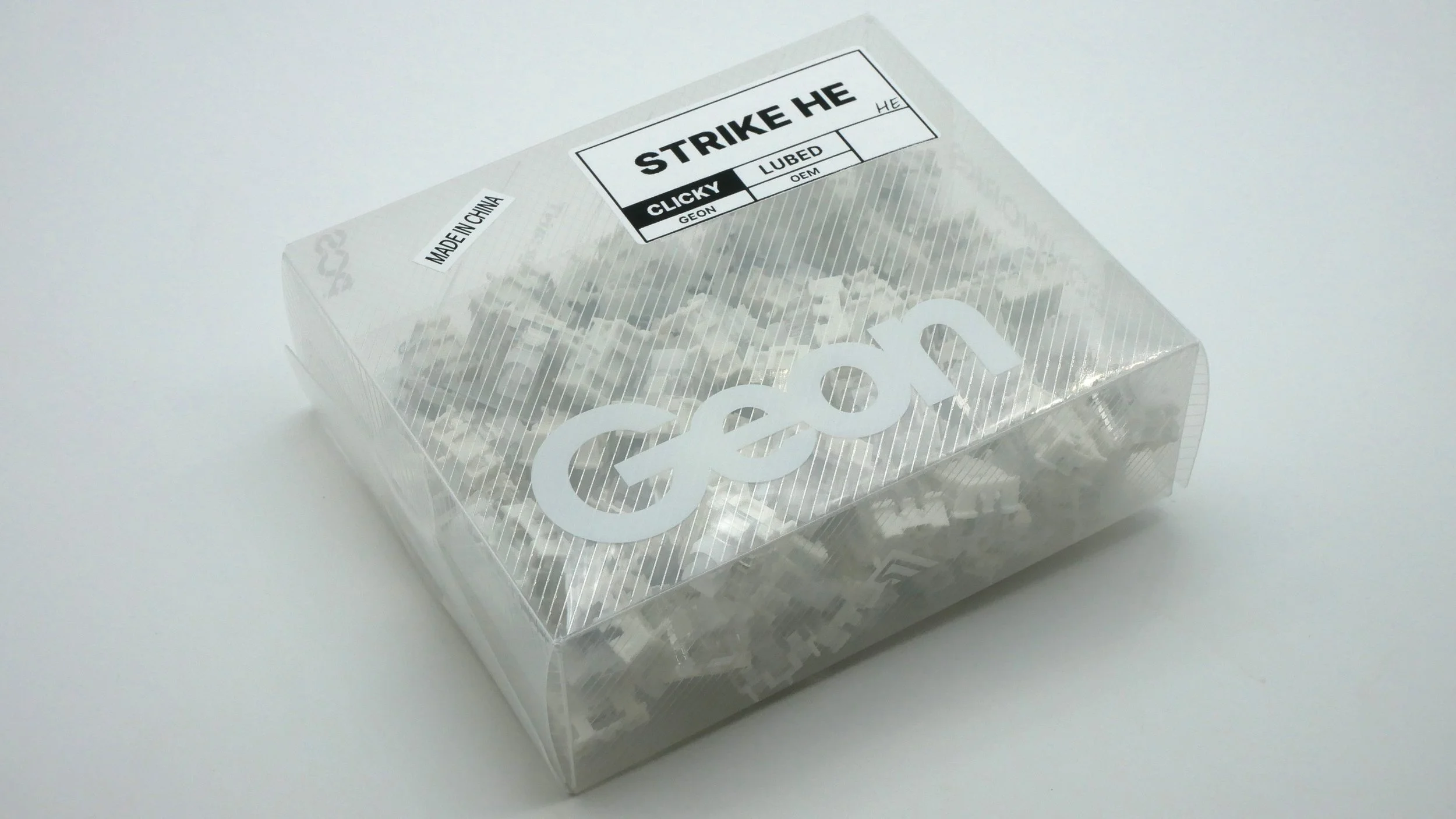
Figure 28: Keyboard quantity switch packaging box front from Geonworks for the Strike HE switches.
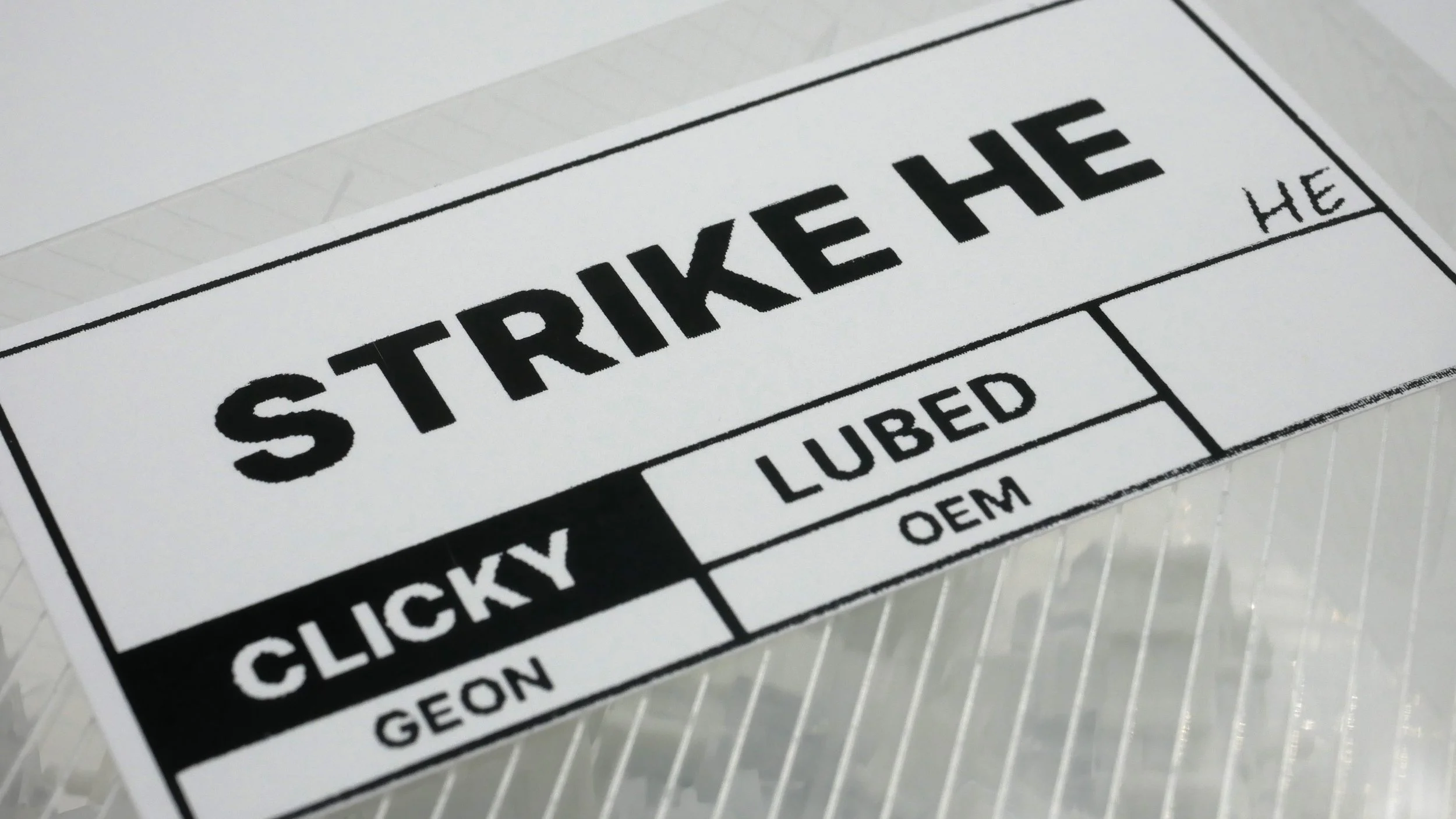
Figure 29: Closeup view of the Strike HE label on the front side of the new Geonworks switch boxes.
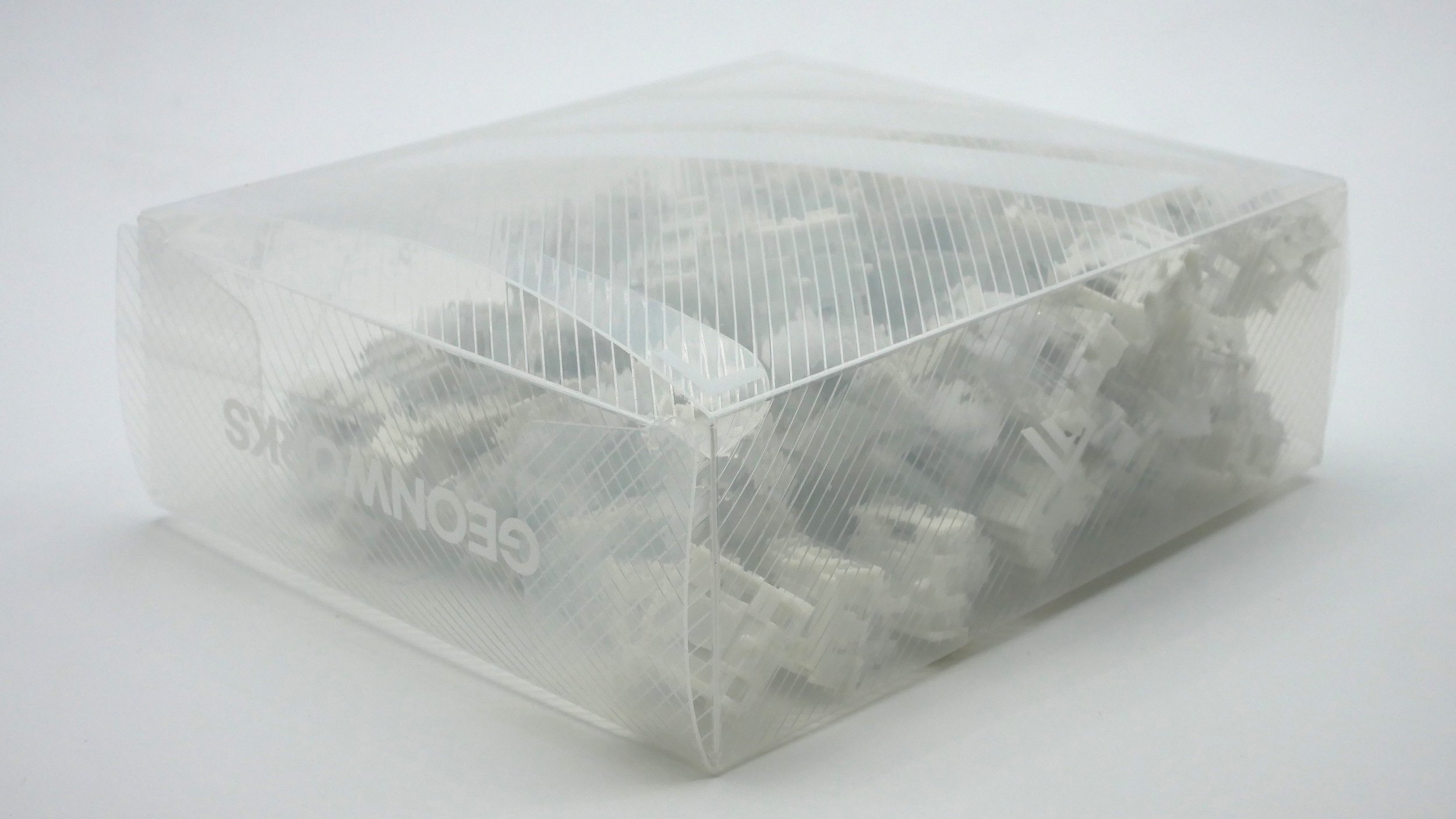
Figure 30: Back and top sides of the Geonworks Strike HE switch box packaging.
Scores and Statistics
Note – These scores are not necessarily completely indicative of the nuanced review above. If you’ve skipped straight to this section, I can only recommend that you at least glance at the other sections above in order to get a stronger idea of my opinion about these switches.
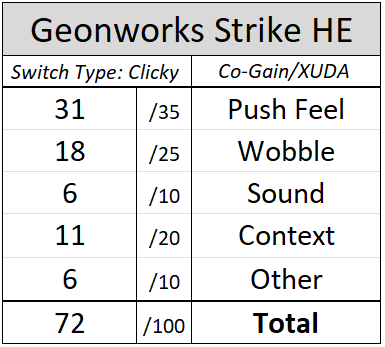
Push Feel
The Geonworks Strike HE switches distinguish themselves from the vast majority of other click bar switches out there on account of both how relatively soft the breakthrough force is in the click bar as well as how gradually it builds up to that peak force. With good, thin factory lubing giving these switches a smooth approach, they really feel rounded, less sudden, and more gradual going up and down in stroke with perhaps the stereotypical polycarbonate over nylon housing collisions being the most jarring portion of their feeling.
Wobble
Equal in magnitude in N/S and E/W directions, the Strike HE switches have a reasonable amount of stem wobble that isn’t likely to bother most users.
Sound
Describable as a quiet-for-click-bars ‘tear drop’ shaped sound profile, the click bars of the Strike HE switches have a thin, sharp high pitched portion and an engulfing, large amount of deeper, richer, and more complex tones toward the bottom end of their sound that, while being singular and not fuzzy, give the Strike HEs a rather complex sound. Unfortunately, though, across the batch of Strike HE switches tested there was a fair amount of variety in the shape of these profiles, with some coming across thinner, with a volume of sharp high tones that matched their deeper ones, or thicker, with the higher pitched, sharper ends being squashed entirely.
Context
Priced incredibly well for their performance and sheer niche as a clicky Hall Effect switch, these are available from a truly global supplier in Geonworks, though to what end? I sincerely doubt these have much of a historical shelf life due to anything other than novelty.
Other
In spite of all reasonable qualms about combining fixed mechanisms with changing actuation points, the Strike HE switches are at least somewhat uniquely made and appreciated for such.
Statistics
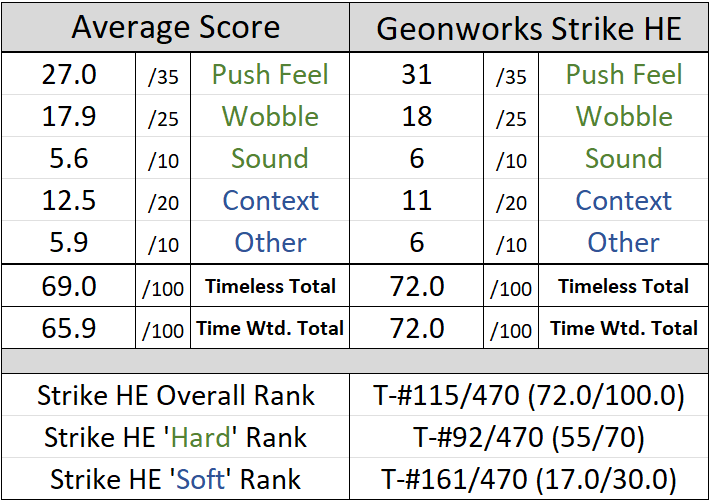
If you are looking at this statistics section and wondering what the heck ‘Timeless’ and ‘Time Weighted’ scoring is, consider checking out my short article titled ‘A Scorecard Time Change’. As a result of scoring becoming a bit anachronistic over the years, switches are now ranked in this statistics table using a “time weighted total” as opposed to their day-of scoring as discussed in that article. If you’d also like to learn about what ‘hard’ versus ‘soft’ ranks refer to specifically, I’d encourage you to head on over to my GitHub linked in the table above or at the links in the top right hand of this website to check out my database of scorecards as well as the ‘Composite Score Sheet’ which has a full listing of the rankings for each and every switch I’ve ranked thus far.
Final Conclusions
While I could be accused of all manner and flavor of bias when it comes to reviewing the Geonworks Strike HE switches on account of me not completely understanding why users would want a fixed mechanism of note – like a click bar – with a modifiable actuation point in the first place, I have to admit that there were aspects of these switches that I did find surprisingly enjoyable. For one, these switches are notably softer, quieter, and in turn a bit more subdued than the stereotype of a click bar clicky. Kailh Box Jades and Navies are fun switches, sure, but they also are incredibly aggressive in both how they sound and feel and I couldn’t imagine people typing on them regularly for any length of time as a result of such. The Strike HE switches have that same sort of edge in a much more tolerable fashion. Additionally, the Strike HE switches have a rich depth and complexity that isn’t so metallically pointed nor sharp as the aforementioned stereotype, either. As for the physical design end of things, I find the integration of the click bar mechanism into the top housings of these switches to be a nice touch by Co-Gain/XUDA, though only because it makes possible so many more interesting future designs not realized here. (Imagine if the click bar was truly slammed all the way to the top of the top housing!) With respect to their less savory aspects, though, there is a fair amount of work that could be done to improve the switches and their design, with their switch by switch inconsistency in sound profile being the biggest point of criticism that comes to mind. Yeah, sure, the choice of standard polycarbonate over nylon housings without any modification to those materials did their housing collisions no favor here, but the sound and presence of the click bar is arguably the single most important point of focus in a switch like this and everything else starts off at a far off second place. All in all, while I found these switches intriguing to review and will certainly think about them or some time into the future, I can’t imagine most users would select these for long term use in their respective Hall Effect switch boards. At this price point, though, maybe these will see greater adoption than they have thus far for people wanting to have a novel experience they may not otherwise achieve. If there is a second iteration of the Geonworks Strike HE switches, though, I certainly will be one of the first to show up to buy them as I think there’s a whole lot of room on top of a solid foundation for Co-Gain/XUDA and Geonworks to truly turn these into a click bar clicky Hall Effect switch that is notable and standout far beyond just being a niche offering.
Sponsors/Affiliates
Mechbox UK
- A wonderful UK based operation which sells singles to switches that I’ve used above in my comparisons for collectors and the curious alike. Matt has gone out of his way to help me build out big parts of my collection, and buying something using this link supports him as well as my content!
proto[Typist] Keyboards
- An all-things keyboard vendor based out of the UK, proto[Typist] is a regular stocker of everything from switches to the latest keyboard and keycap groupbuys. While I’ve bought things from the many times in the past, they also are a sponsor of my work and allow me to get some of the great switches I write about!
Divinikey
- Not only do they stock just about everything related to keyboards and switches, but they’re super friendly and ship out pretty quick too. Divinikey has been a huge help to me and my builds over the last year or two of doing reviews and they’ll definitely hook you up. Use code ‘GOAT’ for 5% off your order when you check them out!
ZealPC
- Do they really need any introduction? Zeal and crew kicked off the custom switch scene many years ago with their iconic Zealios switches and the story of switches today couldn’t be told without them. Use code ‘GOAT’ (or click the link above) for 5% off your order when you check them out!
MechMods UK
- A rising vendor based in the UK, Ryan and crew have been a pleasure to work with and have nearly everything you’d need to build your first or fourteenth keyboard. Go build your latest or greatest one right now with them by using code ‘GOAT’ at checkout for a 5% discount!
Dangkeebs
- A longtime supporter of the website and the collection, Dangkeebs has quite possibly the widest variety of switches of any vendor out there. Not only is their switch selection large, but it rotates and is constantly adding new stuff too. You’re going to need 5% off your order with my affiliate to save off the cost of all those switches!
SwitchOddities
- The brainchild of one my most adventurous proxies, SwitchOddities is a place where you can try out all the fancy, strange, and eastern-exclusive switches that I flex on my maildays with. Follow my affiliate code and use code ‘GOAT’ at checkout to save 5% on some of the most interesting switches you’ll ever try!
Cannonkeys
- Does anybody not know of Cannonkeys at this point? One of the largest vendors in North America with keyboards, switches, keycaps, and literally everything you could ever want for a keyboard always in stock and with an incredibly dedicated and loving crew. Follow my affiliate link above in their name to support both them and I when you buy yourself some switches!
Kinetic Labs
- One of the most well-rounded keyboard vendors out there, Christian and crew have been supporters of all my switch and switch-adjacent needs for some years now. I’m honored to have them as an affiliate and think you should check them out using my affiliate link above to support both them and I when you check out their awesome products!
Keebhut
- Want to try out some switch brands that fly under most vendor’s radars? Keebhut is always seeking out that next latest and greatest and has been super helpful in hooking me up with new brands over the past year. They are all about sharing that love as well, and want to give you 5% off your next order with them when you use code ‘GOAT’ at checkout!
Kailh
- No, you’re not mistaken – this is actually that Kailh that manufactures switches. As one of the longest running manufacturers in the hobby, they have a massive variety of switches available over on their website at any point in time. I’m lucky to be affiliated with them now, and so consider using my affiliate link above when ordering some Kailh switches to support me!
Keebz N Cables
- Australia and Oceania’s very own is now a part of the sponsor list here and I couldn’t be happier to add this long time supporter of the collection to it. They’ve always got an amazing selection of switches (and other keyboard parts) in stock and they want to share the love that they’ve shown me with you all too! Use code ‘thegoat’ for 5% off your first order when you visit!