Sillyworks x HMX Waverider V2 Switch Review
As a fairly freshly minted homeowner of something like six months’ time now, I have to say that it has been quite a bit different experience than I had imagined. Going into it all I really had anticipated that these first few months would be spent around the house doing things like painting, redoing all the trim and doors, or even buying a whole lot of furniture on the scale up to a bigger living space. The reality, though, has really been anything but that. Repainting and re-trimming the entire house is not only expensive, but such a massive undertaking of time that I just simply can’t even find the motivation to do it lately with how things have been at work. As for the furniture, believe it or not that is also expensive as well, and the stuff I drug with me from the last apartment is doing pretty a-okay still. Instead, this first fraction of my mortgage has been spent focusing on every small detail I could never have imagined caring about – shimming squeaky floors, building shelving for tools and yard equipment in the garage, and just taking care of a garden and lawn of all things. Being completely honest with you all, I may have spent more time in the last couple of months reading about lawn care, drainage, soil retention, and every possible topic you could ever imagine about lawns than I did about the keyboard hobby as a whole. (In the event you don’t believe me about this either and will be at Keycon here in a few months, please feel free to put me to the test and I’ll gladly flex my knowledge on lawn soil treatment additives!) And so thus far, the months of home ownership can be summed up as enjoyable for all of the small things I’ve accomplished. Setting up a nice bird feeder stand for the girlfriend so that she can watch birds from bed in the morning was a pretty rewarding task. Or most recently, adding these cute little mushroom lights shown below to the garden. The past few weeks have seen us renovating our garden bed, planting some new native species, mulching it, and then just last weekend finally putting in these solar powered, LED-enclosed mushroom lights in red, orange, and yellow that have quite a stunning glow at night. So while I could probably have rounded out this introduction section saying something about work, the rapidly closing in Keycon, or some of the fun volunteer activities that the girlfriend and I have been up to around town the past couple of weeks, it really did feel fitting to share a brief mention of these mushroom lights. I think that I’ve gone all the way out into the yard before bed each and every day this week just to check out how they look in the middle of the night.
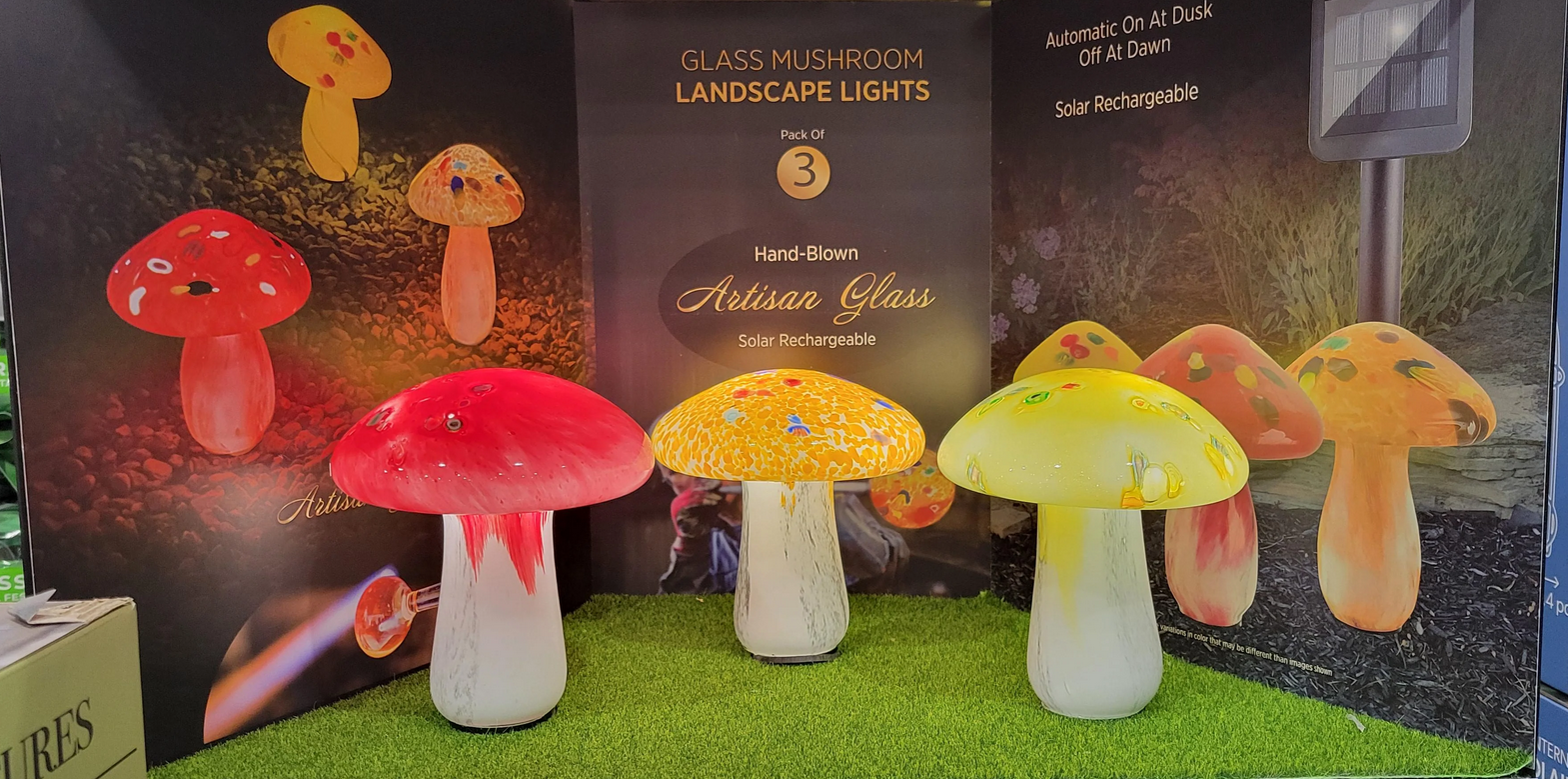
Figure 1: Specifically these mushroom lights. I bought them from Costco, but it does look like you can get them online a few other places.
Switch Background
Sillyworks really doesn’t need much in the way of an introduction in the modern mechanical keyboard switch scene. For one, they are the designers and brains behind arguably one of the most impactful and community-lauded tactiles in the MX footprint of the last couple of years in the Sillyworks x Gateron Type R switches – a release that has sold out multiple of times over across their various storefronts that they were listed on. And for one definitely less impressive reason overall, but arguably just as important to me, they don’t really need an introduction as I’ve already covered a large amount of their background in depth in my own Sillyworks x Gateron Type R Switch Review! Sure, in the months since that review there has been some more activity on Sillyworks’ (sauceinmyvein’s) ZFrontier page such as the release announcement for the HMX-made Sonja switches as well as some rather opaque, hard to translate drama with another community member of the Chinese keyboard community, though largely they’ve just been enjoying the successes of their Type R switches. Given just how impressed I was with the Type R switches, my excitement when I first saw the announcement for the Sillyworks x HMX Waverider V2 switches pop up on ZFrontier in March of this year was more than justified. I simply had to jump on a set for my collection. Another tactile switch release from a designer who clearly knows how to execute on captivating tactiles releasing yet another tactile switch with a whole slew of stunning marketing photos was simply impossible to resist. Luckily for me, though, Sillyworks did include one tiny, not so obvious detail to their debut backdrop that also gave me the opportunity to also pick up a set not just for myself and my own reasons, but also for a review as well. Whether you’ll believe it or not here at the end of this first paragraph, I’ve managed to get yet another switch for a review that ties into the growing and already quite expansive web of switch backgrounds that I’ve strung together over the last handful of months.

Figure 2: I'm with Sillyworks - screw whoever this guy is.
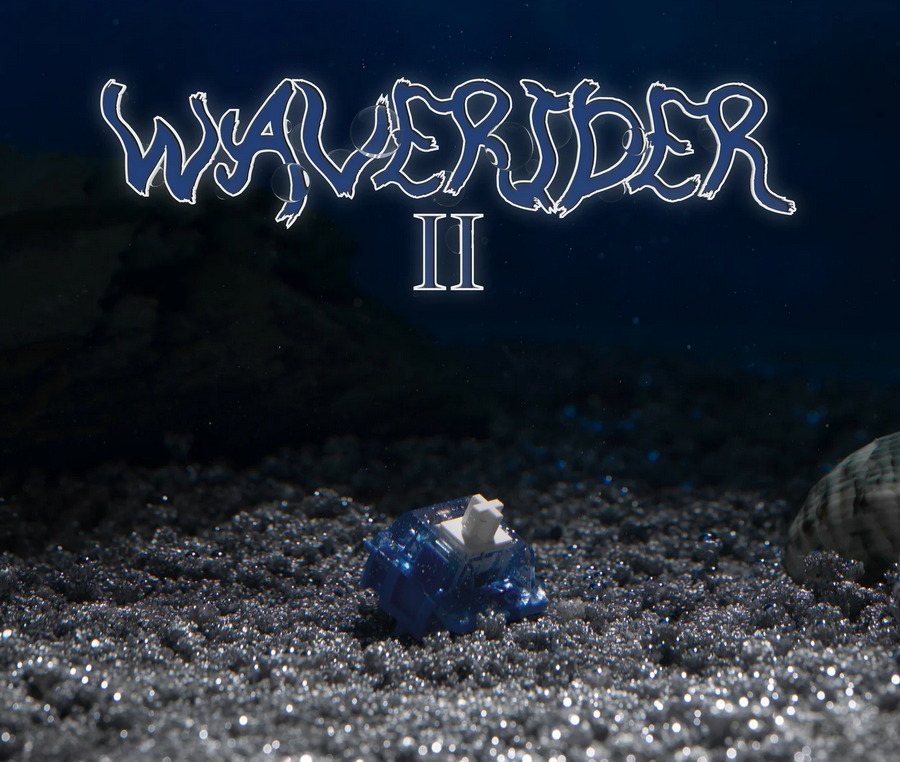
Figure 3: Introductory image from Sillyworks' Waverider V2 ZFrontier post. I can't say I recall many if any switches getting a "cover image" like this, and I absolutely dig it.
Don’t worry, don’t worry – I’m not going to drop some revolutionary truth bombshell on you all that manages to interconnect HMX into the BSUN Identity crisis that I covered in my Taro N Sweet Potato V2 Switch Review or the strange continuation of LICHICX traditions by new manufacturers in their eternal financial absence that I covered in my 2025 Manufacturer Update, either. I’m not even here to tell you that Sillyworks is actually just a secret pseudonym for prolific brand designer Tango, either! The small detail that stood out to me about the Waverider V2 switches is that they were made by HMX – something which feels a bit strange when realizing the V1 iterations of the Waveriders were made by KTT. This is not a new or surprising revelation that I’ve pulled from the ether on my own, either, rather this is actually something that Sillyworks addressed in their debut post of these switches. Rather than being a design that came about from engineers or designers immediately jumping ship and stealing their molds to run off to a new factory like has been suggested in the origin stories of some other switches, in that background Sillyworks shared that these designs were in motion at HMX all the way back in 2023 when they first popped up on the scene and really began differentiating themselves from KTT. Though with a couple of iterations of failed designs not quite living up to the idea that Sillyworks had envisioned, as well as a result of the growing success of their SLAYER series and their most famous member thereof in the Type R switches, the plans around the Waverider V2s really did fall by the wayside. Here we are a few years later, though, with them finally coming into a design iteration that really spoke to them. Far away from the then incredibly intriguing schism of KTT and HMX, something which was first covered in my Raptor MX Extreme Switch Review, this really marks one of the more clear, evident, and high profile times that we’ve ever had a V2 version of a switch be continued and iterated upon by a manufacturer that is cleanly, uniquely distinct from the one that debut their V1 iterations. This isn’t one of those weird internally consistent though questionable from a marketing standpoint decision like Gateron pimping out their Azure Dragon colorways through EverFree molds to Nuphy for their own purposes, or any one of the billion different instances where a manufacturer claimed to be producing out of the original Invyr Panda molds, rather it is something unique to the modern day and age of keyboard switches. These are a ‘manufacturer transient reissuing’ of a switch, jumping from one place to another during an iteration.
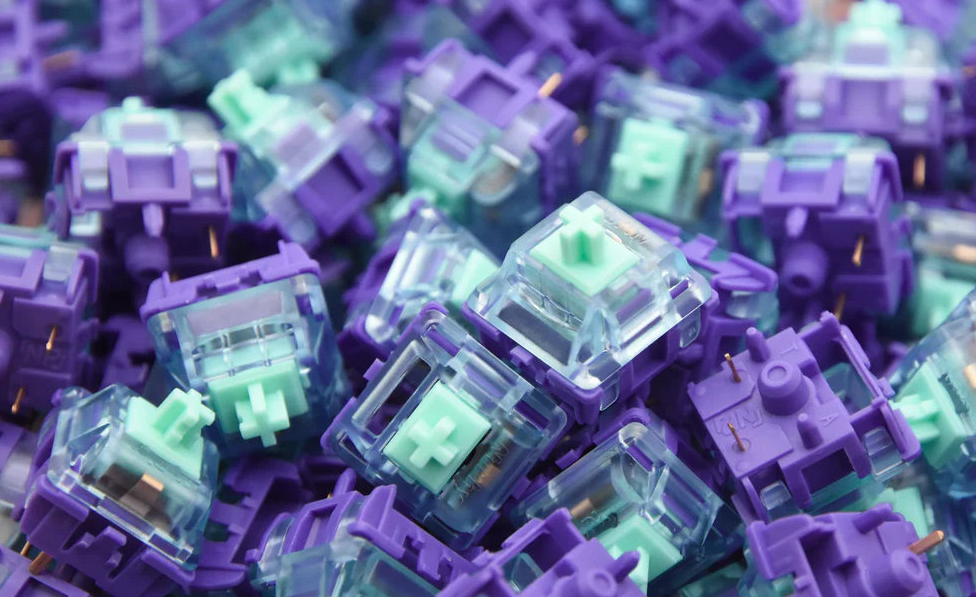
Figure 4: And to think Gateron went through all of this just to copy the Type R switches. Gateron Azure Dragon V4 switches from kbd news' article on such.
The concept of a ‘manufacturer transient reissuing’ of switches, since I absolutely could not think of any more catchy term for such, is for all intents and purposes a direct byproduct of the current state of switch production for the hobby. Just a handful of years ago when I first started collecting switches, the idea of such would have been nearly impossible to actually turn into a reality. The manufacturers back then were established, large, and had fairly clear divisions of their capabilities – you’d never see Kailh trying to step on the feet of Gateron or either of them trying to take over a design space integral to Cherry’s business. Of course they would still obviously compete for market share, but there were no attempts by Gateron to take over Kailh’s full POM switch reign nor Kailh pumping out yellow-stemmed linear switches to try and impede on Gateron’s iconic linear line. While I suppose that Durock/JWK may have somewhat violated this convention with the premise of the Stealios switches, even in the years following that manufacturers did tend to stay away from one another a bit. Nowadays, though, it’s anything but that. The recent months of background sections should have clearly painted the picture of just how convoluted the connections between switches, brands, and manufacturers are getting, but even if you don’t want to read through all of that the Novelkeys Classic Blue Switch Review from last year more than paints a confusing picture already. We’ve not only fully and obviously slipped into a realm where individual switch parts are being manufactured in multiple places and combined into singular ones elsewhere, we’re now witnessing the complete dissolution of intellectual property and design lines that used to keep them separate. While I’m pointing to the HMX Waverider V2s as a clear example of this jump into a strange new world, they’re actually just the first ones to have done so with as big of a contextual backdrop and community awareness by way of Sillyworks. The practice is already more common than you’d believe. Remember those TKC Prototype switches that I showed off for TWCKM 2024 that were never released? The ones that were Tecsee-made versions of all their famous switches? Those are probably the earliest instance of this phenomenon happening. As for publicly accessible changes, do the Candling Dragon linears ring a bell? Those were made by Tecsee for V1 and Keygeek for V2. Wisterias? Meirun to Aflion in their iterations. Longjing S switches have also made the jump from Gateron to HMX too. The ‘EMT’ linears are even the first triple crown winners in this race leaping from BSUN to Haimu and eventually Grain Gold across their lineage too. And more close to home than anything else, the concept of manufacturer transient reissuings isn’t even new to Sillyworks who famously flip flopped their Hyacinth switches from KTT to HMX back around the time their split first started. So while this is far from a new concept with many of those reissuings taking place in the last year or two, this is continuation of a trend that is really gaining some traction.
After having recognized this all as a growing trend in the state of the modern keyboard switch scene, it really does leave me pondering a strange string of hypotheticals in both directions from this point in time. (A string that basically just renders this paragraph a whole slew of rhetorical questions smashed together.) What does the future extreme of manufacturer transient reissuings looks like? Will we continue to see brands/designers like Sillyworks or Tango Studio/KNT take their concepts, their designs, and their ideas for switches and pivot them between new, hot, and upcoming manufacturers until someone can execute on them? Will we ever see a designer bring together the parts of two very different manufacturers and let us know about it? For example, a TYPEPLUS-like intermediate standing in the middle getting stems from a company like Gateron and putting them in housings from Kailh and then releasing a switch marketed on these facts. What about manufacturers just directly selling their classic molds or designs to one another? One day Gateron may wake up and decide to sell their Ink thermoplastic materials and molds to a company like Tecsee since it seems like they’re not making as much use of it anymore. And in the other direction, one can only wonder what switches would have looked like in the past if this IP-jumping practice would have been any more common. Would designers like the famously Durock/JWK-attached 43Studios still be making switches if they had pivoted to Tecsee or KTT? Could the molds for Invyr Pandas have actually survived at a second manufacturer instead of just leaving us with countless rumors about this one specific mold that escaped being destroyed? Honestly, I could sit here and go on and on for endless pages of alt-history for keyboard switches, but just sitting to recognize just how impactful this practice can be on switches I think is valuable enough. This could very well change the way switches are designed, sold, and continued in the future in ways that they simply never were even thought of in the past.

Figure 5: If I ever made an alt-history switch discussion you all know quite well it would basically be Dan Carlin-esque in length and complexity.
Grounding us firmly back into reality rather than whatever hypothetical spiral that I had us taking on the way out of that last paragraph, the Sillyworks x HMX Waverider V2 switches were first debuted by Sillyworks on ZFrontier on March 23rd, 2026. While different from the original, KTT-made iteration of these switches by their spring weight, tactile strength, and overall aesthetic design, their identical matching of materials for each component mixed with close proximity of tactile type led to these being described as reasonably faithful reinterpretations of the Waverider V1 switches, which didn’t entirely sell all that well on their own as per Sillyworks’ admission. Not wanting to waste any time with groupbuys or pre-production purchase windows, this announcement was made the exact day that the Waverider V2 switches were first being listed for sale on the TYPIST CLUB Taobao store, priced at 1.8 yuan or ~$0.26 USD per switch in groups of 10 with decorative Sillyworks-branded packaging for purchases of 70 or more switches. Following their initial release on March 23rd, these switches became very quickly available on more western facing vendors such as Unikeys, Ilumkb, and Milktooth, where they are generally priced around $0.40 per switch as is common to see for sales of this type. As of the time of writing, it is worth noting that on all of these storefront the HMX Waverider V2s are effectively sold out, though given how Sillyworks has handled previous popular switch success with the Type Rs, I imagine they will continue to restock switches as such. Furthermore, Sillyworks has very clearly anticipated the hype surrounding these switches as he states at the bottom of the introductory post that there will eventually be a “Waverider V2D” variant of these switches with dampened, but not altogether silent stems for people specifically looking for more quiet switches. These are directly stated as being made by HMX, though, meaning that we will not be seeing a second three-switch-manufacturer hop like the EMTs mentioned above.
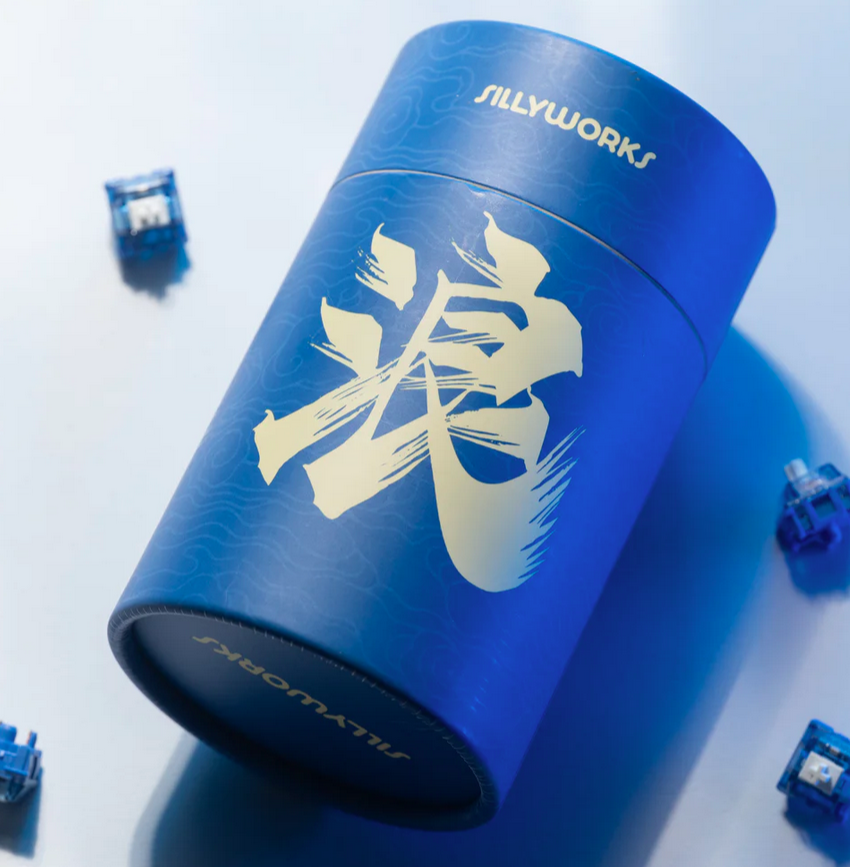
Figure 6: Decorative Sillyworks packaging for purchases of 70 or more Sillyworks x HMX Waverider V2 switches from the initial TYPIST CLUB sales page.
Waverider V2 Performance
Appearance
At the highest level, the Sillyworks x HMX Waverider V2 switches come in a three part colorway with sparkly translucent blue top housings, an opaque, solid blue bottom housings, and white stems that make for surprisingly striking up close yet subtle-from-afar visual dichotomy. Unlike fruit or animal themed switches, I can’t entirely comment on how true to source material the colorway of these switches as I’m not sure what a “Waverider” is supposed to look like, though clearly this was a point of design emphasis for Sillyworks. As per notes in their ZFrontier debut post, there is some inspiring source behind the design of these switches that Sillyworks felt wasn’t as cleanly represented in the V1 of the switches as was accomplished here in the V2s, which were designed to more figuratively match the look of waves on a bright, sunshine covered ocean. While there have been a couple of switches which have taken on blue and white colorways over the years, I believe these are entirely unique in their execution and thus shouldn’t be too hard to differentiate from other releases. Up close this task is especially more easily done upon noticing the ‘SILLY.’ stylized nameplate that the Waverider V2 switches possess. In addition to that design feature, there are quite a few other details of note in the design of all parts of the Waverider V2 switches that make them stand out from the rest of the proverbial switch crowd. Discussions and documentation of these features may be found in the paragraphs and photos below.
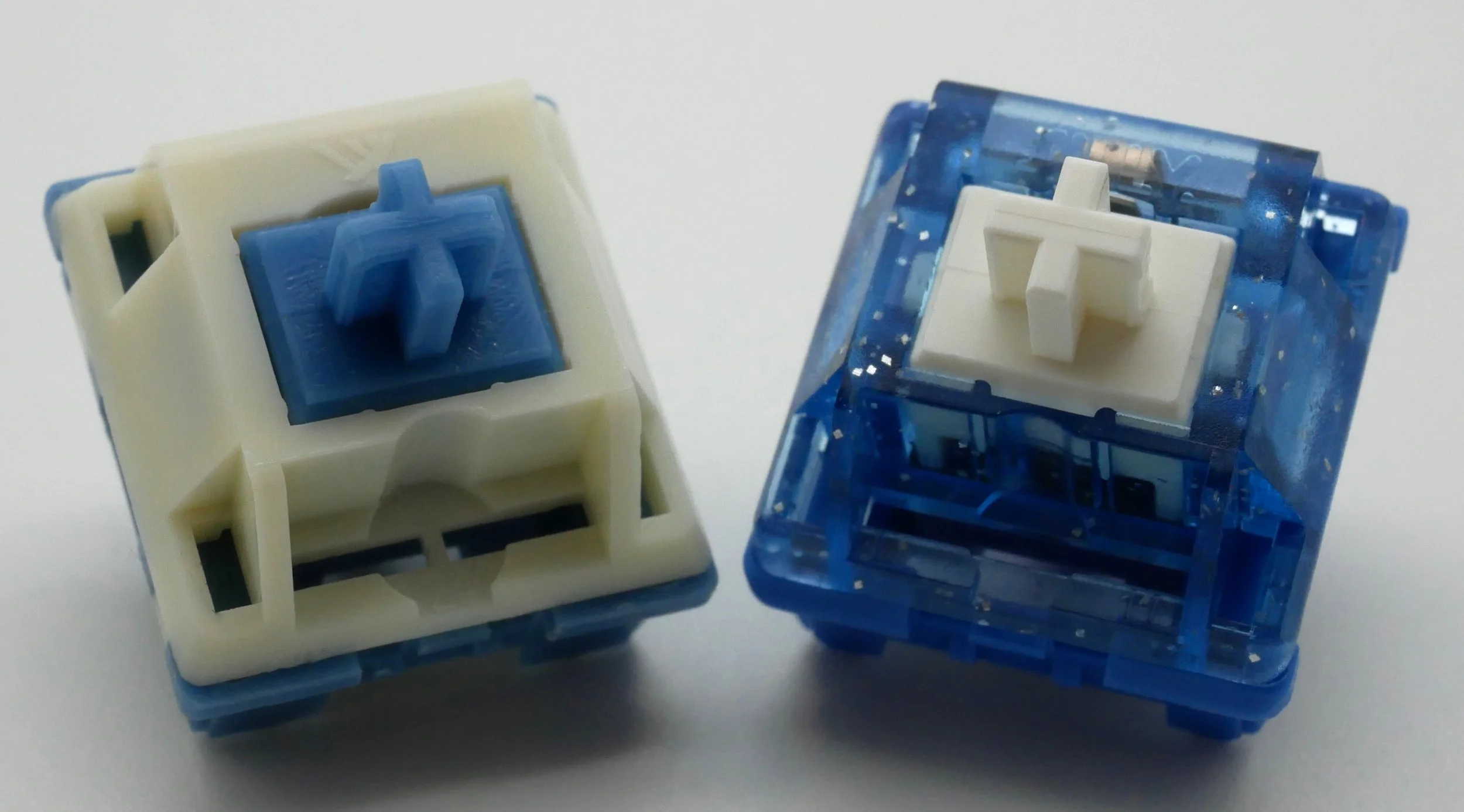
Figure 7: Color comparison between KTT-made Waverider V1s (Left) and HMX-made Waverider V2s (Right).
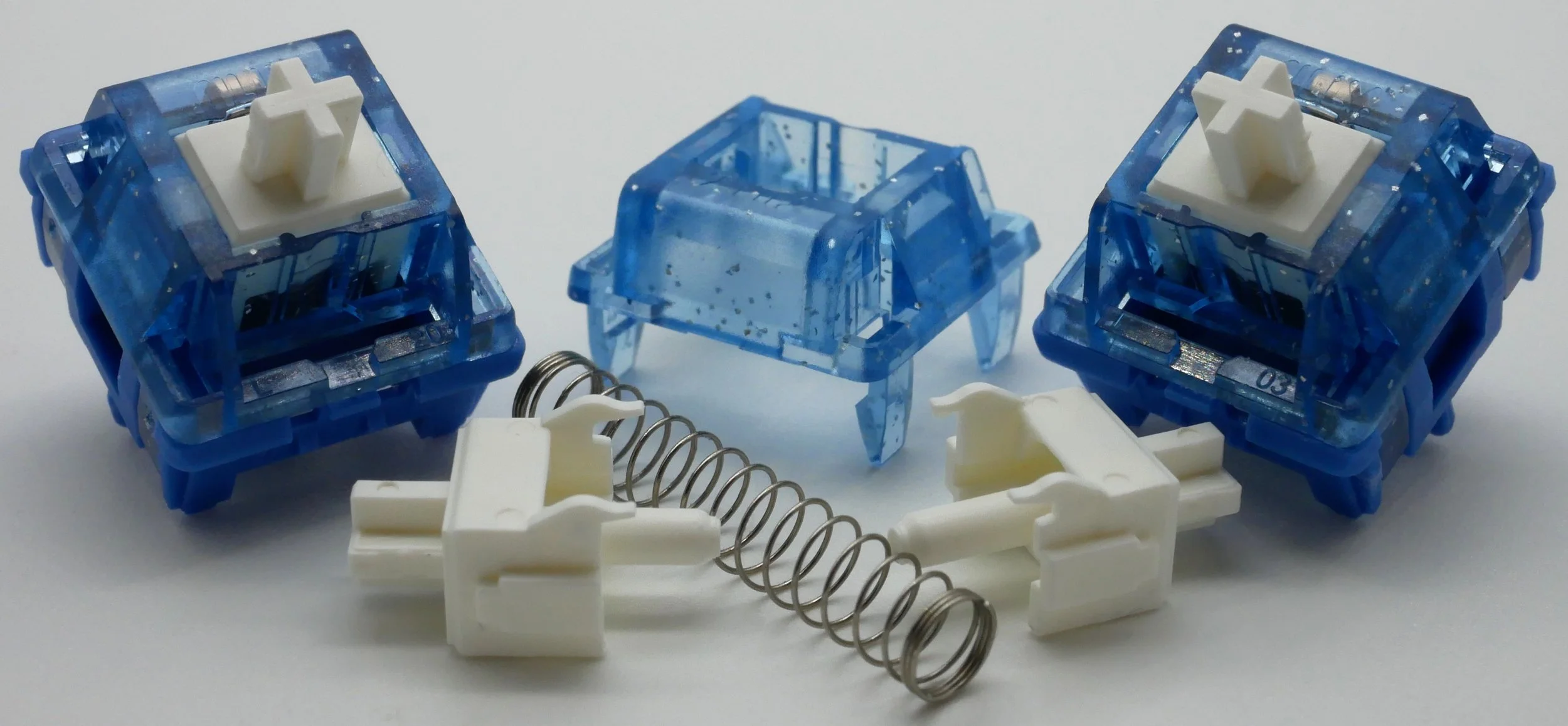
Figure 8: Sillyworks x HMX Waverider V2 switches and their components.
Looking first to the silver sparkle embedded, translucent blue polycarbonate top housings of the Sillyworks x HMX Waverider V2 switches, there are a couple of details that stand out about their design though they do largely conform to the HMX platform as has been documented here on the website before. The most stand out of the features is the presence of the ‘SILLY.’ stylized nameplate that Sillyworks has used on quite a few of their switches in the past other than the Gateron-made Type R switches. The exterior of the Waverider V2 top housings also feature the mold markings for the housing, coming on the front left- and right-hand corner edges of the long, rectangular LED/diode slot that they have in the housings. Like most other HMX-made switches the left-hand mold marking is a single capital letter whereas the right-hand mold marking is a pair of numbers. Internally, the Waverider V2 top housings also look similar to other HMX-made housings, down to their left-right asymmetry toward the lower edge of the regions underneath their nameplate. While this feature has not yet shown itself to have any direct, tangible purpose in any of the HMX switches that I’ve seen it in, it is still an interesting identifying mark no less.
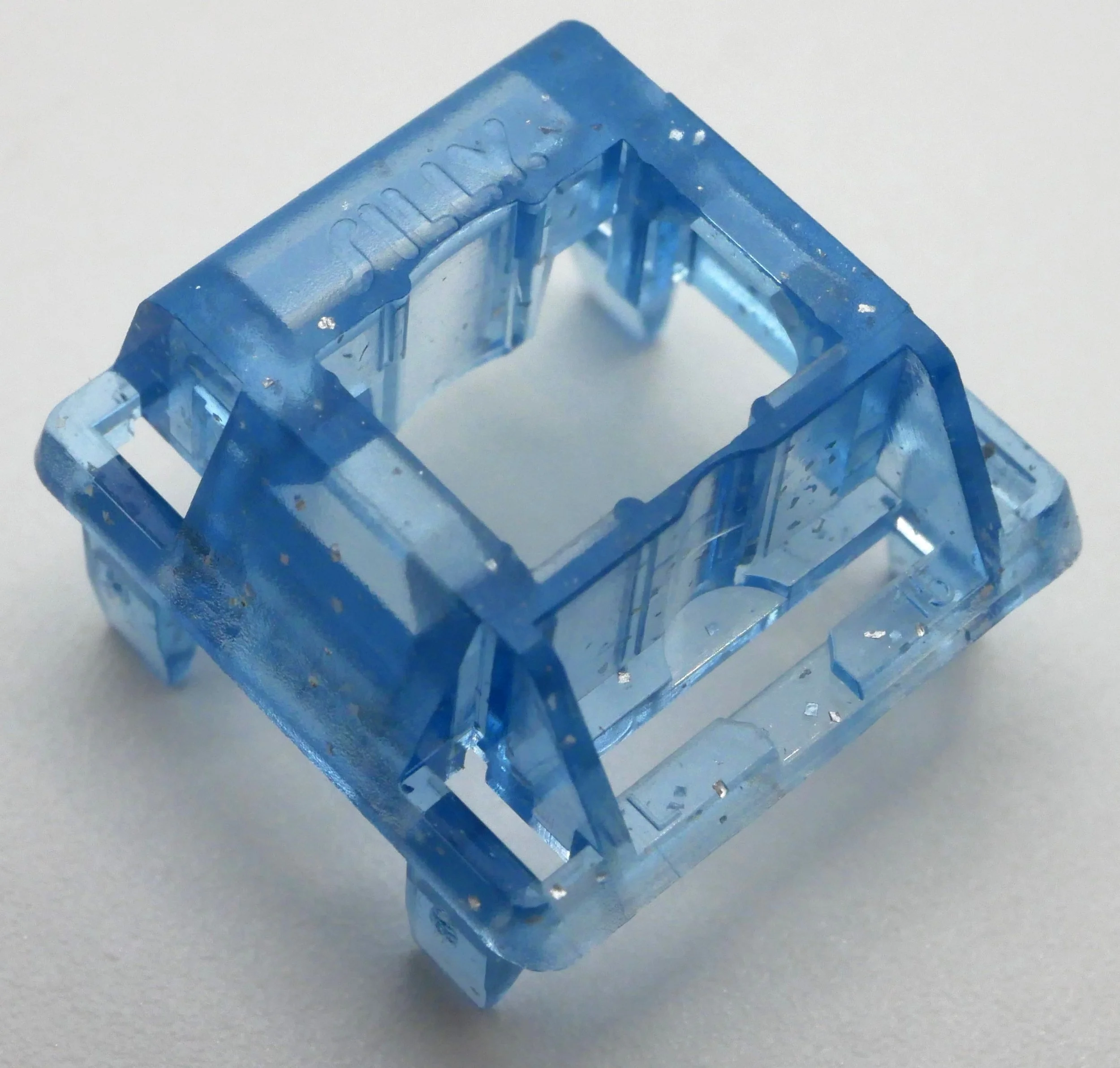
Figure 9: Sillyworks x HMX Waverider V2 top housing exterior showing 'SILLY.' nameplate, wide rectangular LED/diode slot, and pair of mold markings on outer edge of that slot.
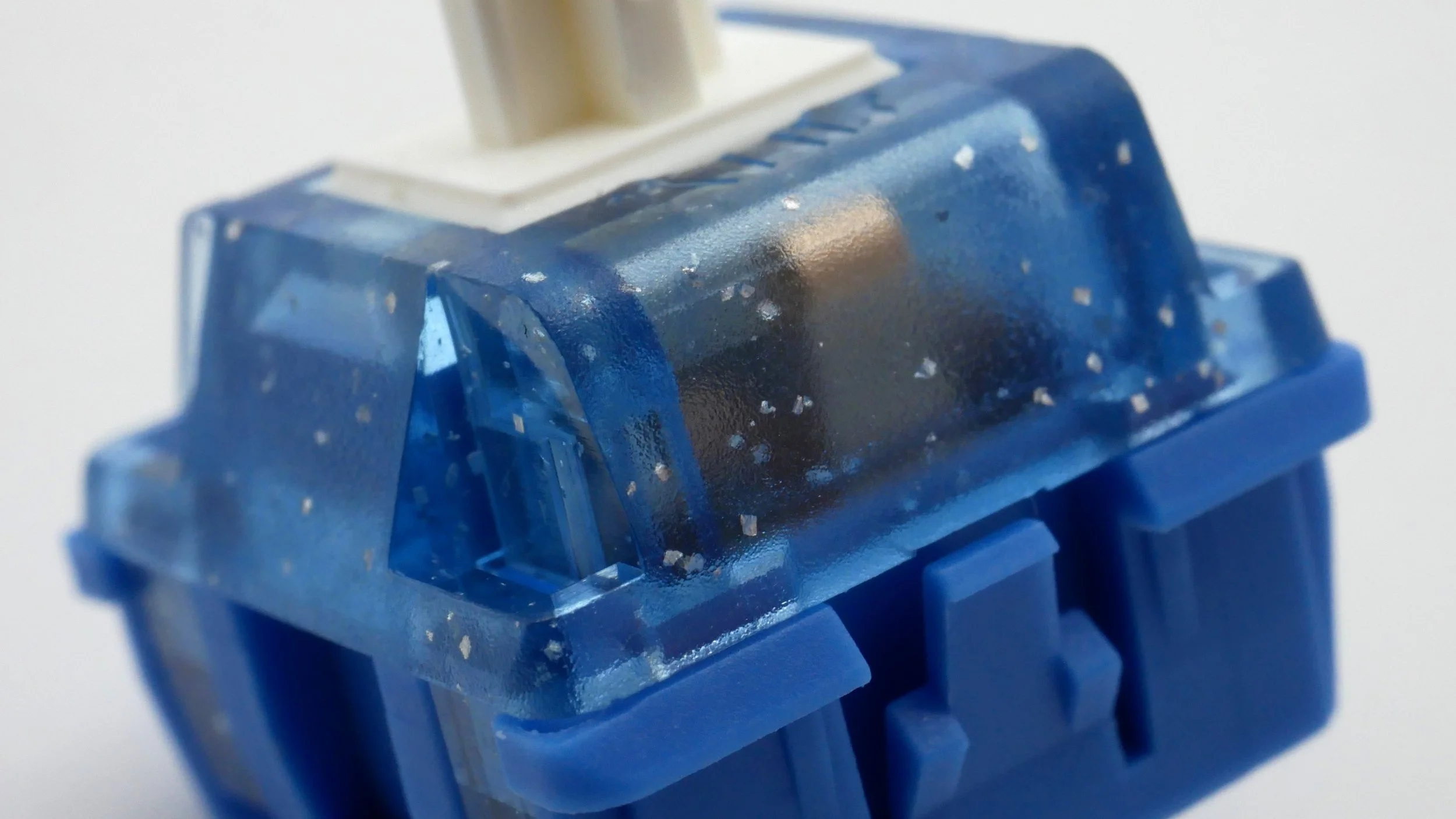
Figure 10: Exterior zoom of silver glitter embedded into translucent blue top housings of the Sillyworks x HMX Waverider V2 switches.
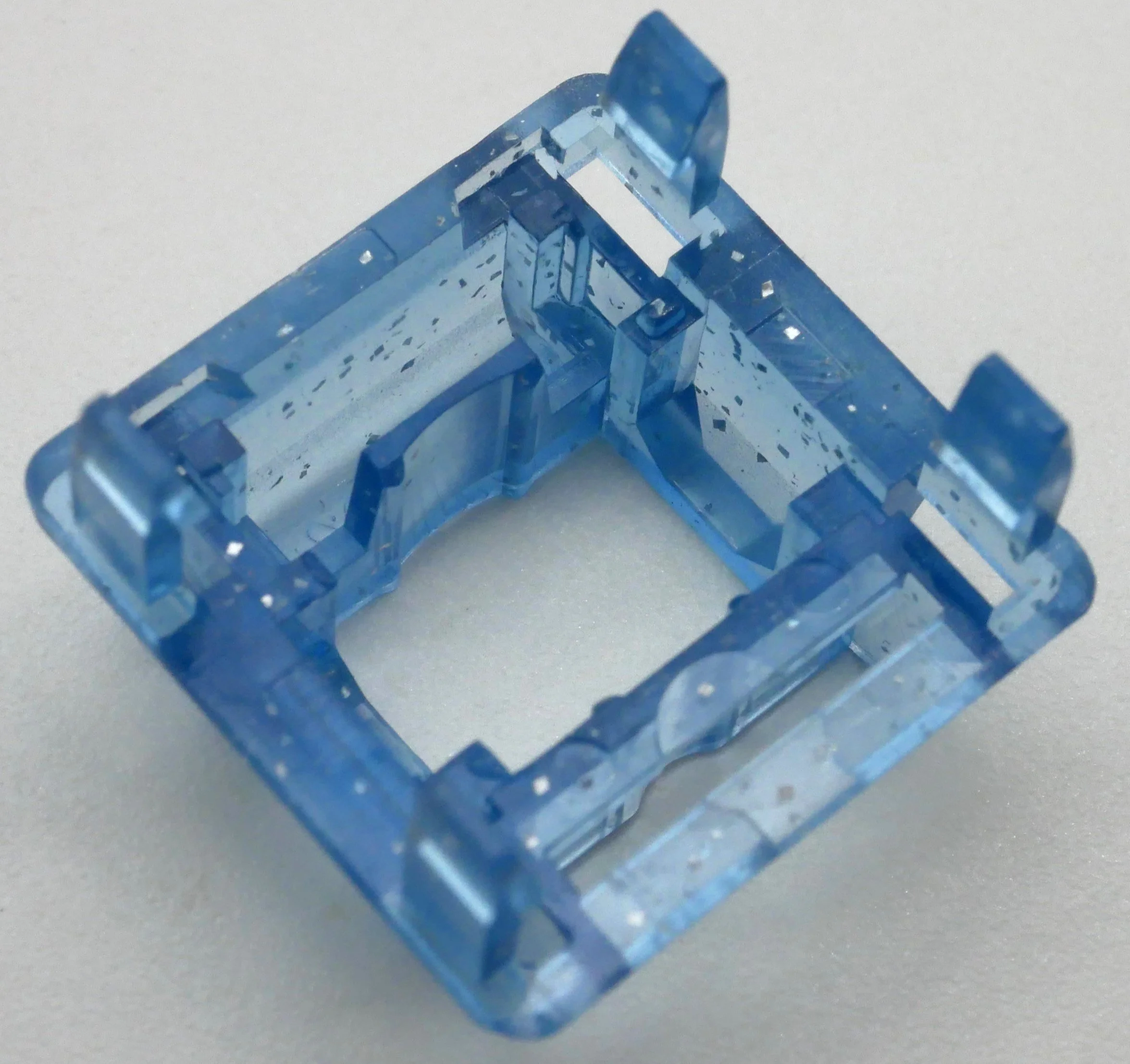
Figure 11: Sillyworks x HMX Waverider V2 switch top housing interior showing typical left-to-right asymmetry associated with HMX housing interiors.
Moving next to the white, POM tactile stems of the Sillyworks x HMX Waverider V2 switches, these too feature quite a few details that are directly in line with most other HMX-made switches. In fact, on account of being white in color and fairly normal overall in size, these stems largely look like they could have fallen out of really any tactile switch given how simplistic the designs of HMX stems are. The simplistic elements that HMX continually leans on in their switch iterations such as non-tapered slider roles, a barely tiered, somewhat long stem pole, as well as mold ejector circles on the front plates of the stems are all here plain as day. Perhaps the only feature worth note in the stems, other than what the pictures show below, is that they do carry trace amounts of factory lubing on all sides of the stems even after some handling, with the lube surrounding the slider rails of the stems being especially stuck on and not coming off under normal handling.
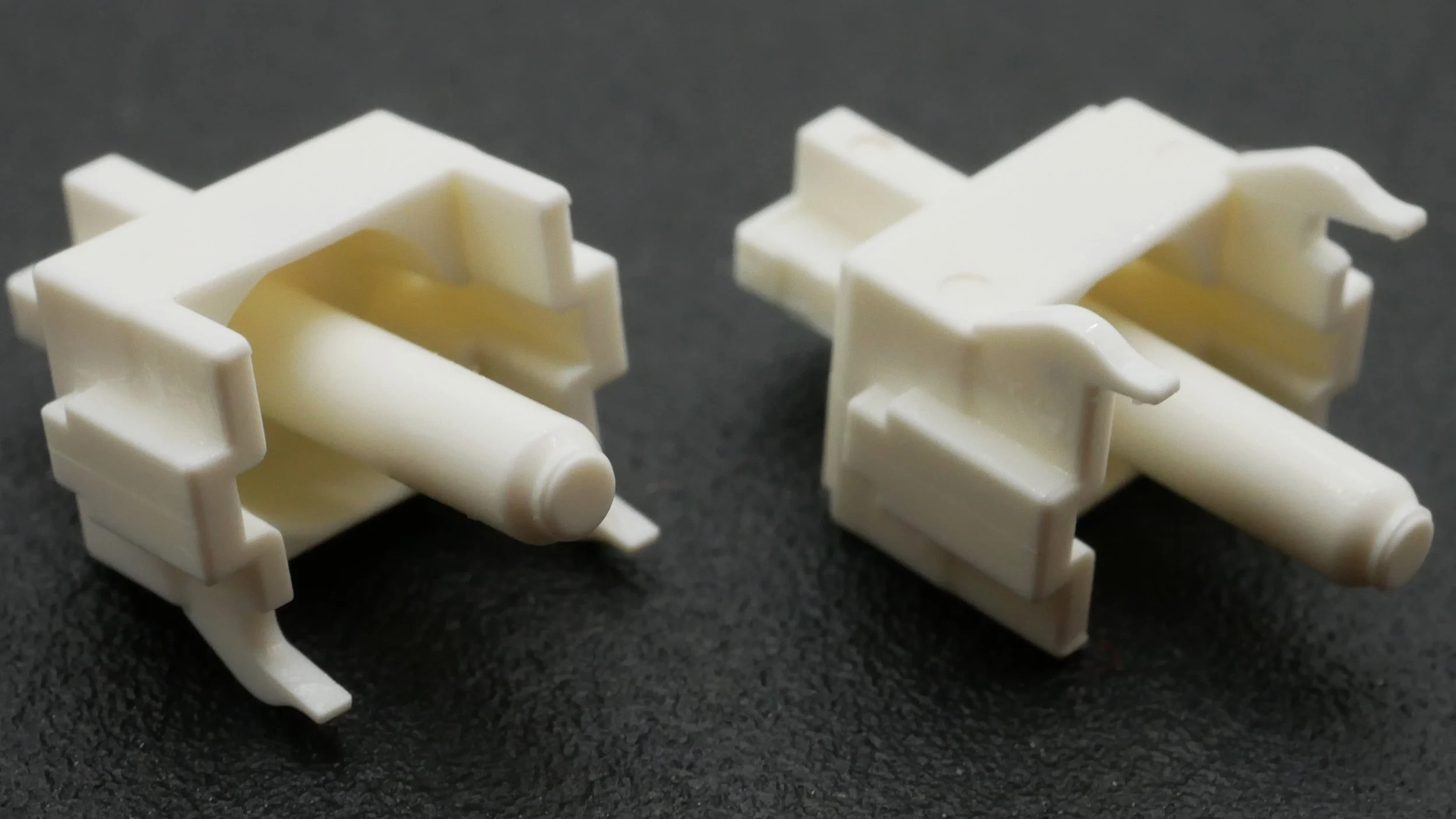
Figure 12: Front and back of the Sillyworks x HMX Waverider V2 stems showing their tiered center pole, non-tapered slider rials, mold ejector circles above the stem legs, and copious factory lubing on the stem legs.
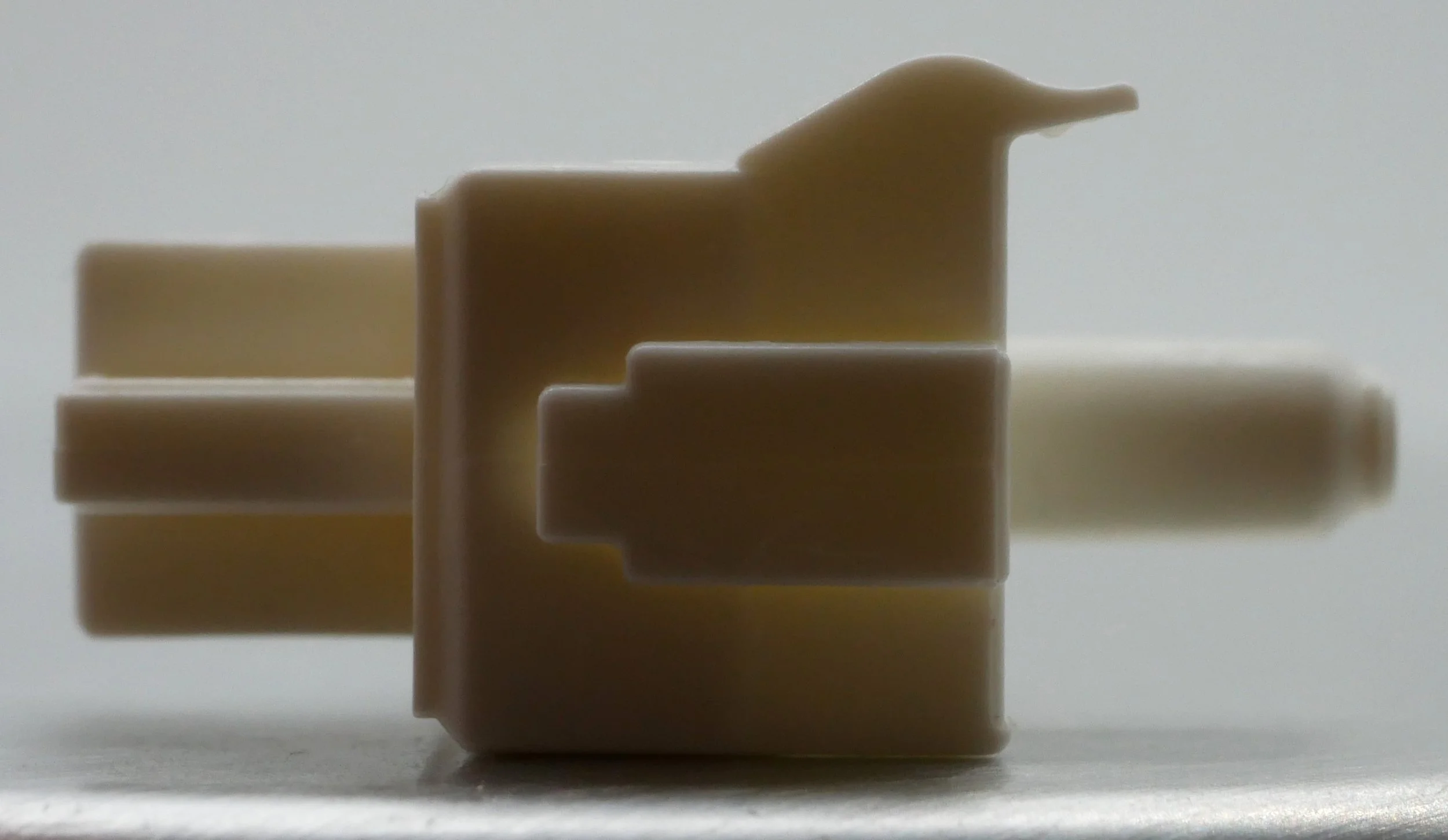
Figure 13: Side profile of the Sillyworks x HMX Waverider V2 stems.
Finally arriving to the flat blue, nylon bottom housings of the Sillyworks x HMX Waverider V2 switches, this is where we begin to see a few details that are surprisingly different from many of the releases that I’ve covered on this website at length. While I would have imagined a large portion of the R&D and design efforts in these switches would have been done by way of their stems, it surprisingly seems as if most of the legwork in trialing was done for the bottom housings of these switches. The most obvious unique feature is that of their large dampening pads at the base of the slider rails of the stems, something which very clearly and cleanly addresses the entirety of the bottom edge of the stems and not just the edges of the slider rails on the sides of the stems. Looking upwards from the base of the housings which also contain a south side spring collar, I could also swear that the mold ejector circles and polished, shiny areas of the housing around the attachment points between upper and lower housings is unique and/or has some differences versus standard HMX releases. On the exterior, the bottom housings feature very narrow, flat PCB mounting pins with shiny rings around the base of them as well as two mold markings located beneath each of them with similar layout and content as to what was seen on the top housing exterior of these switches.
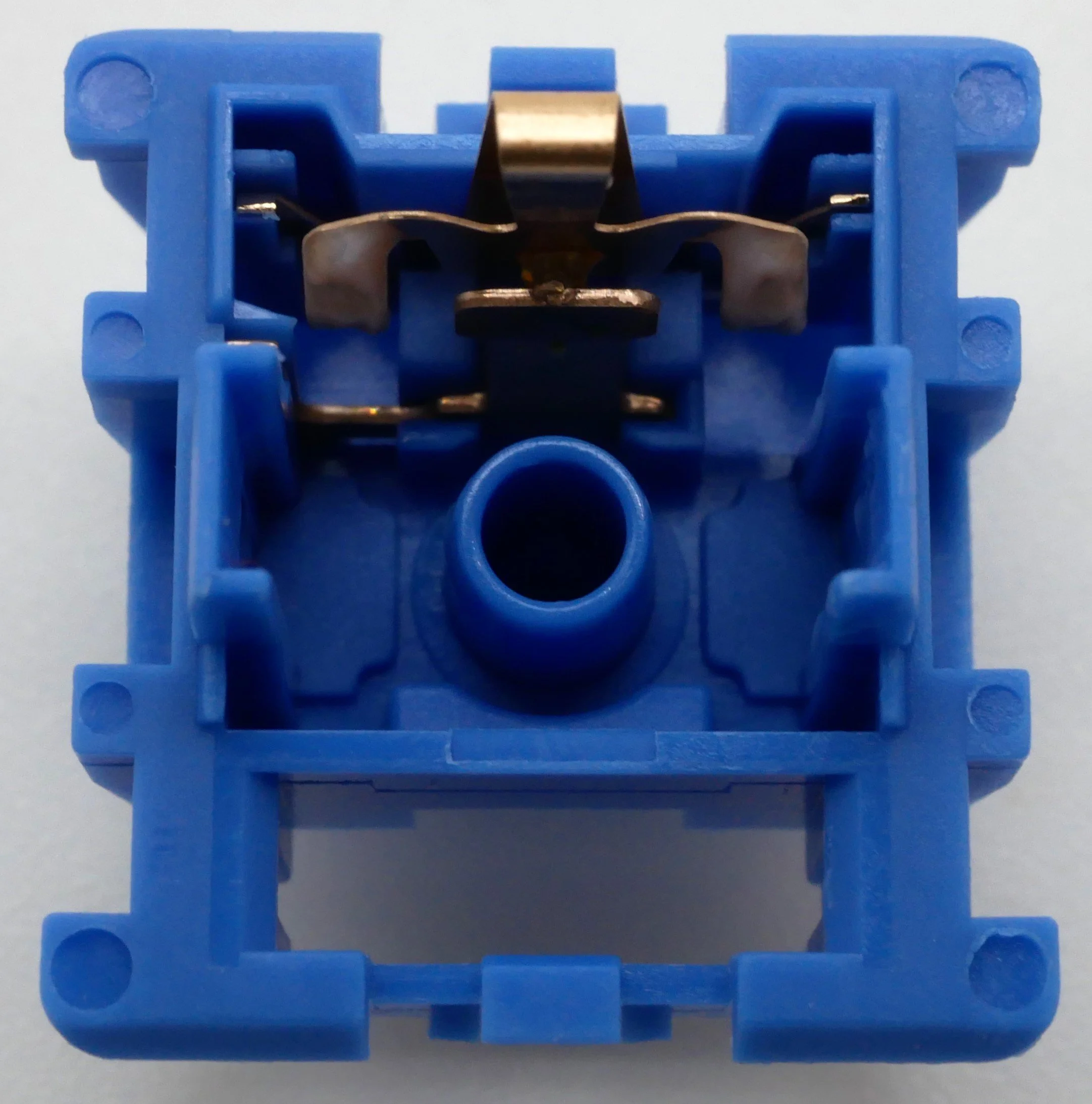
Figure 14: Sillyworks x HMX Waverider V2 bottom housing interior showing large dampening pads underneath the slide rails, a south side spring collar, and large amounts of residual factory lubing on the leaves.
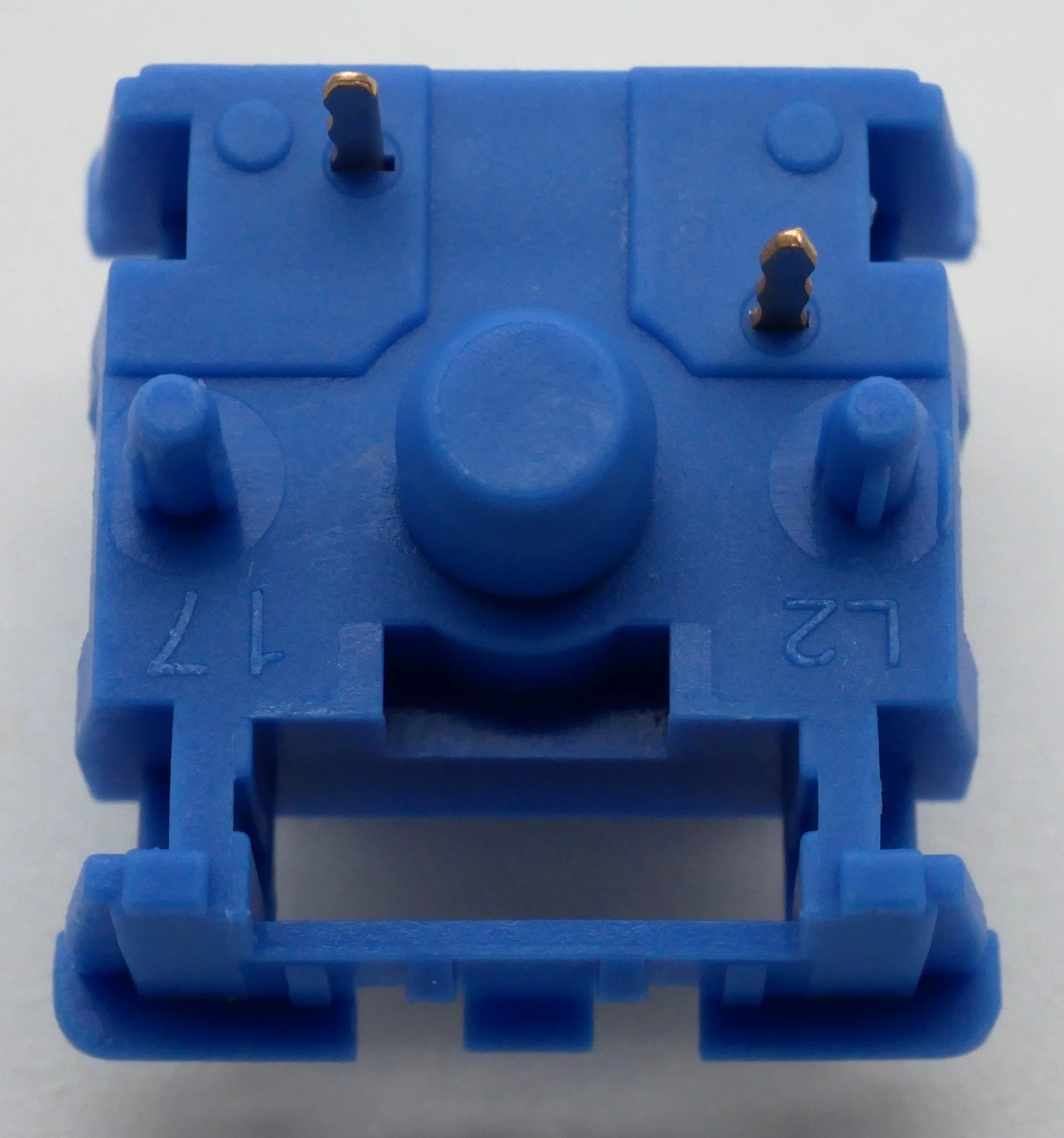
Figure 15: Sillyworks x HMX Waverider V2 bottom housing exterior showing PCB mounting pins and inverted mold markings consistent with other HMX-made switches.
Push Feel
The Sillyworks x HMX Waverider V2 switches might be some of the most deceiving tactiles I’ve ever encountered in a full length switch review on account of just how far apart their in hand feeling is from their force curve I’ll share in just a few sentences here. I really mean it too. The Waverider V2 switches, as tactiles, are medium to medium-strong in strength and have a snappy, right out of the gate tactile bump with no linear pretravel and a well-rounded but still short feeling tactile bump that just absolutely rockets its way towards bottom out. Paired up with an overall smooth but just a tiny bit scratchy stroke, the in hand feeling of these tactiles is really only able to be summed up by the word ‘parabolic’ – they quickly come right up to peak force, through their snappy, tight peak in force, and just sling all the way out towards bottom out in an arcing, meteoric fashion. And with those descriptions in mind, I’m sure you imagine that the force curve probably has some pretty strong curves, a nicely rounded peak, and maybe even a bit of a waviness to it that would match their name. Instead, their force curve looks like this:
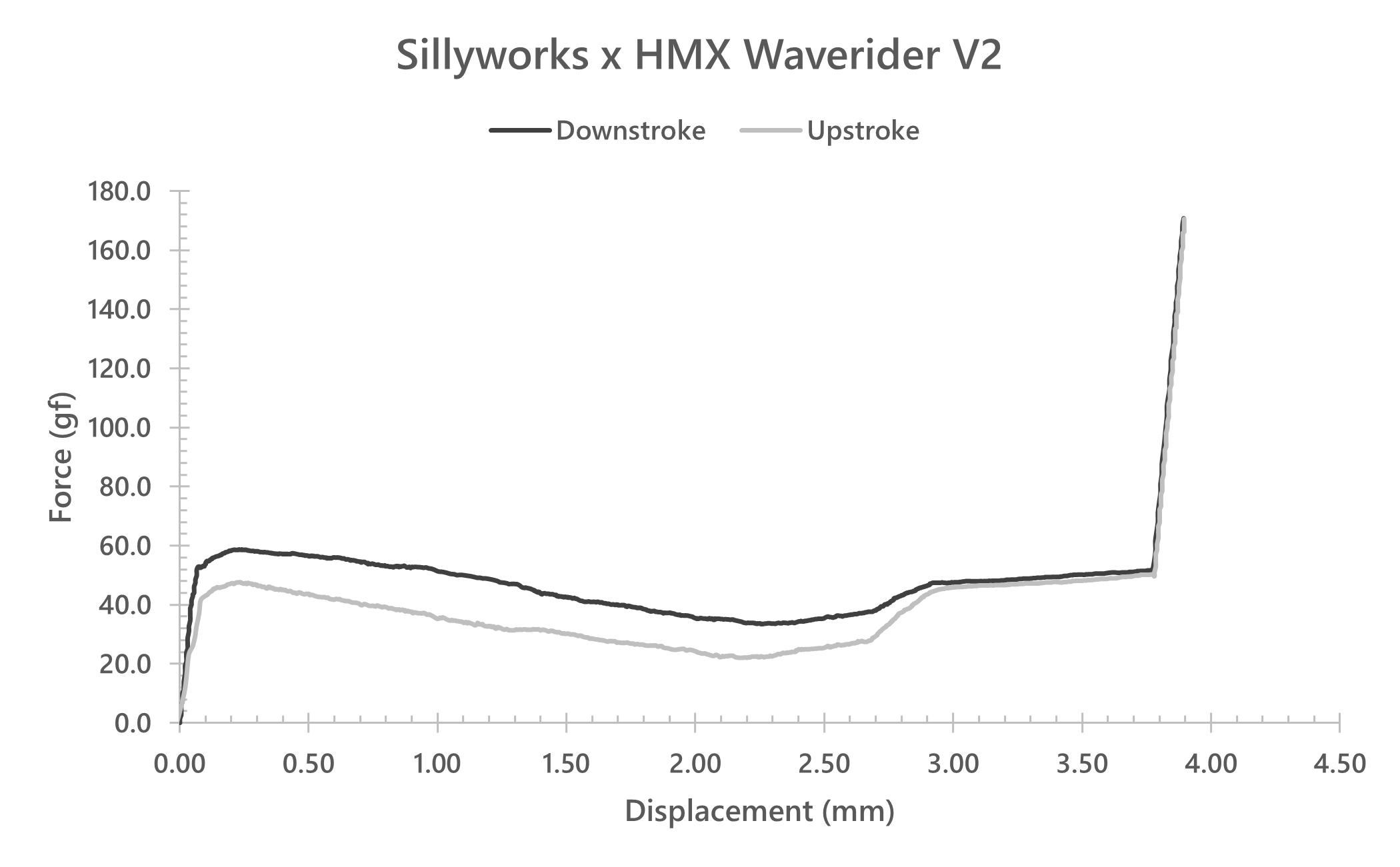
Figure 16: Force curve diagram for the stock Sillyworks x HMX Waverider V2 switch.
I mean just look at this thing. I’ve tried a whole lot of switches and measured a whole lot of force curves over the years and if you had handed me these switches and blindly asked me to draw their force curve it wouldn’t have looked any thing like that. Perhaps the only semi-accurate points about it are the locations of the peak tactile force and bottom out around 59 gf and 52 gf, respectively, as these switches feel punchy and noticeable without being overly heavy or fatiguing on the fingers. This force curve also does well to hide quite a few other interesting details about these switches as well. For one, their bottom out could easily be described as soft, deep, and maybe a tiny bit pokey under normal typing conditions and in contrast to their tight tactile bump – something that makes perfect sense when paired up with their bottom out dampening pads above. However, if you begin to type on the Sillyworks x HMX Waverider V2s with any force, squarely slamming the stems into the bottom housings like a pro OSU player, you can actually bypass this feeling entirely and cause the stem pole to squarely, harshly, and very directly hit bottom out with a strength that dwarfs their tactile bumps. The kicker to this though is that when this is done their topping outs which are a fair bit poppy but still well matched to their strokes also become increasingly more aggressive and forceful, altogether drowning out the tactility of the switches. Without much better analogy to lean into here, it really is as if these switches have two different modes to their feeling – one that is a snappy, somewhat punchy daytime, surfable wave crashing into a beach and another more violent, chaotic, and forceful one like a deep, stormy night filled with riptide currents.
Sound
Despite being presumably developed through at least a few rounds of iterations by Sillyworks and HMX with these switches having been shelved and revived, the sound profile of the Waverider V2 switches is probably their weakest performance point as a tactile switch – and it’s not even solely because of a continuation of that two-tone behavior from the push feeling section above. Under normal circumstances and use cases, the Waverider V2s have an average sound profile that is medium in volume, flat in tone, and ever so slightly poppy in character primarily driven by their equivalent feeling tactile bump. There’s not really much in the way of a bottom out that is present here in these switches, with the topping out playing second fiddle to the tactile bump with a similar sounding, but slightly more subdued sound that accents the bump quite well. However, a not insubstantial amount of the switches in the batch that I received have stem leg/leaf ping that is accompanied by their deceptively strong tactile bump and takes away from that tactile bump-topping out duo that they do well normally. This is especially surprising to actually hear upon testing as visual inspection of the switch parts as I showed above very clearly show these switches as having massive amounts of factory lubing on their leaves at the point where they contact the stem. Generally, this phenomenon is one that shows up on tactile switches that come unlubed from the factory, though even in spite of a generous helping of such from HMX it still persists here in these switches. As for the more aggressive, Dr. Jekyll portion of the Sillyworks x HMX Waverider V2 switches’ sound profiles, more forceful typing sees these switches become loud, sharp, and almost angry sounding. While they don’t quite pitch up highly enough in this mode to be ear piercing, the housing collisions of the Waverider V2s carry enough of a point to stand out and feel immediately aggressive on the ears of anyone nearby. With the topping outs also increasing with a similar frenetic slant under these harsh typing conditions, it really makes for a switch that just sounds too much by all standards – for me, for you, or for anyone listening. It even goes as far as to almost entirety drown out the snappy, slightly poppy sounding tactile bump that is perhaps the best singular part of this switch’s sound profile.
Wobble
While one may be tempted to think that a switch that invokes the concept of waves moving across the ocean may have stem wobble that is likewise a bit rocking in its motion, the Sillyworks x HMX Waverider V2 switches actually have fairly little stem wobble. Present just barely in both N/S and E/W directions, it is unlikely that this would bother most users, even the ones that are a bit picky about this metric. Despite being fairly consistent in magnitude from switch to switch, I am surprised to see ever so slight variations in the magnitude difference between the N/S and E/W direction stem wobble of the switches across the batch that I received. It should be noted, though, that this difference is exceedingly minor and is more for note than it is an actual criticism of their performance.
Measurements
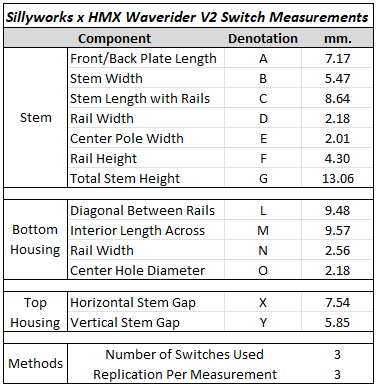
If you’re into this level of detail about your switches, you should know that I have a switch measurement sheet that logs all of this data, as well as many other cool features which can be found under the ‘Archive’ tab at the top of this page or by clicking on the card above. Known as the ‘Measurement Sheet’, this sheet typically gets updated weekly and aims to take physical measurements of various switch components to compare mold designs on a brand-by-brand basis as well as provide a rough frankenswitching estimation sheet for combining various stems and top housings.
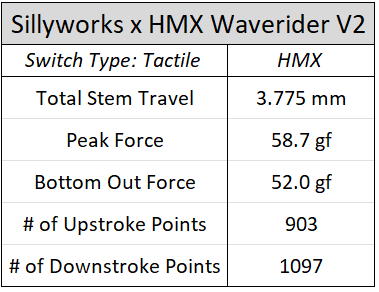
Figure 18: Numerical details regarding the force curve for the stock Sillyworks x HMX Waverider V2 switches.
Have you ever wanted to be bombarded with more switch data than you’ve ever seen at any point in your life before? Consider checking out the ‘Force Curve Repository’ hosted on my GitHub that contains all force curves that I take both within and outside of these full-length reviews. In addition to having these graphs above, I have various other versions of the graphs, raw data, and my processed data all available for over 2000 different switches for you to use however you see fit. Check it out via the ‘Archive’ tab at the top of this page or by clicking any of the force curve cards above.
Break In
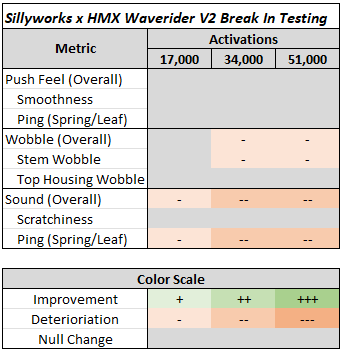
Break In Notes
17,000 Actuations
- After 17,000 actuations, the only change that is actually quantifiable in the chart above for the Sillyworks x HMX Waverider V2 switches is an increase in the presence and volume of stem leg/leaf ping across all switches. Those switches which were noticeable prior to the breaking in period became even more noticeable afterwards and those that didn’t have this before became more noticeable after the break in period.
- While not quantifiable in any sort of plus or minus scale, the tactility of the Waverider V2 switches broken in to 17,000 actuations just feels different. Struggling greatly to find an exact way to describe it, it is almost as if the peak of the tactile bump become a bit ‘deadened’ in those switches broken in to this stage, making the overall switch feel ever so slightly less poppy and rounded through at the apex of its tactile bump. This is definitely not a phenomenon I’ve ever encountered before.
34,000 Actuations
- After 34,000 actuations, there is both a noticeable uptick in both N/S and E/W direction stem wobble as well as the ping first noted in the 17,000 actuation set above. Almost all of the switches broken in to this stage of testing exhibited some degree of audible stem leg/leaf ping, and those that did prior to the start of the breaking period did so in a much worse fashion.
51,000 Actuations
- At the point of 51,000 actuations there really were no more changes to the Sillyworks x HMX Waverider V2 switches that wasn’t captured in either break in stage above. While certainly not the largest swing in performance nor overly good nor bad, this definitely is one of the more.. strange?... break in test results I feel like I’ve had with any switch.
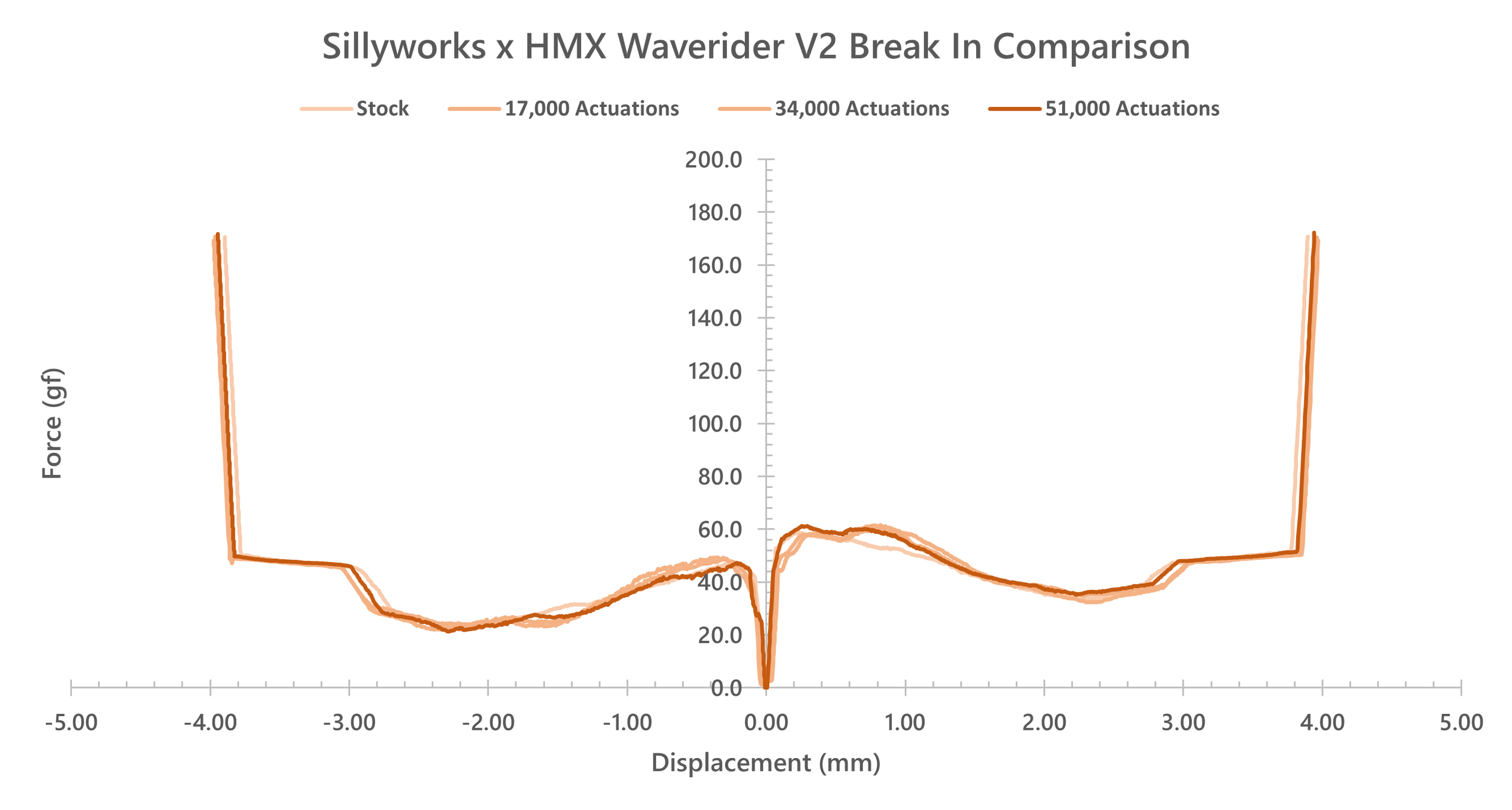
Figure 20: Comparative force curve showing substantial, consistent change in the force curves of the Sillyworks x HMX Waverider V2 switches throughout the break in process.
For once, it does actually appear that breaking in the Sillyworks x HMX Waverider V2 switches does have a measurable, articulable change to their force curves versus their stock comparisons. In a surprising fashion that I’ve quite literally never seen before in any other tactile switches that I’ve subjected to break in testing, the tactile bump of the Waverider V2 switches almost seems to bifurcate and split into two relatively equal force peaks separate a few fractions of a millimeter apart. While I want to say that this isn’t noticeable in hand, I think this is what is causing the ever so slight deadened bump feeling noted at the 17,000 actuation mark above. With a newly formed second peak that is similar in force to the first one placed relatively close thereafter, I suspect this causes the peak force to feel more laterally spread out in the stroke and in turn make the first peak not feel as strongly differentiated from the rest of the curve as in the stock switches.
Comparison Notes to Other Notable Tactile Switches
Note – These are not aimed at being comprehensive comparisons between all factors of these switches as this would simply be too long for this writeup. These are little notes of interest I generated when comparing these switches to the Waverider V2 switches side by side.
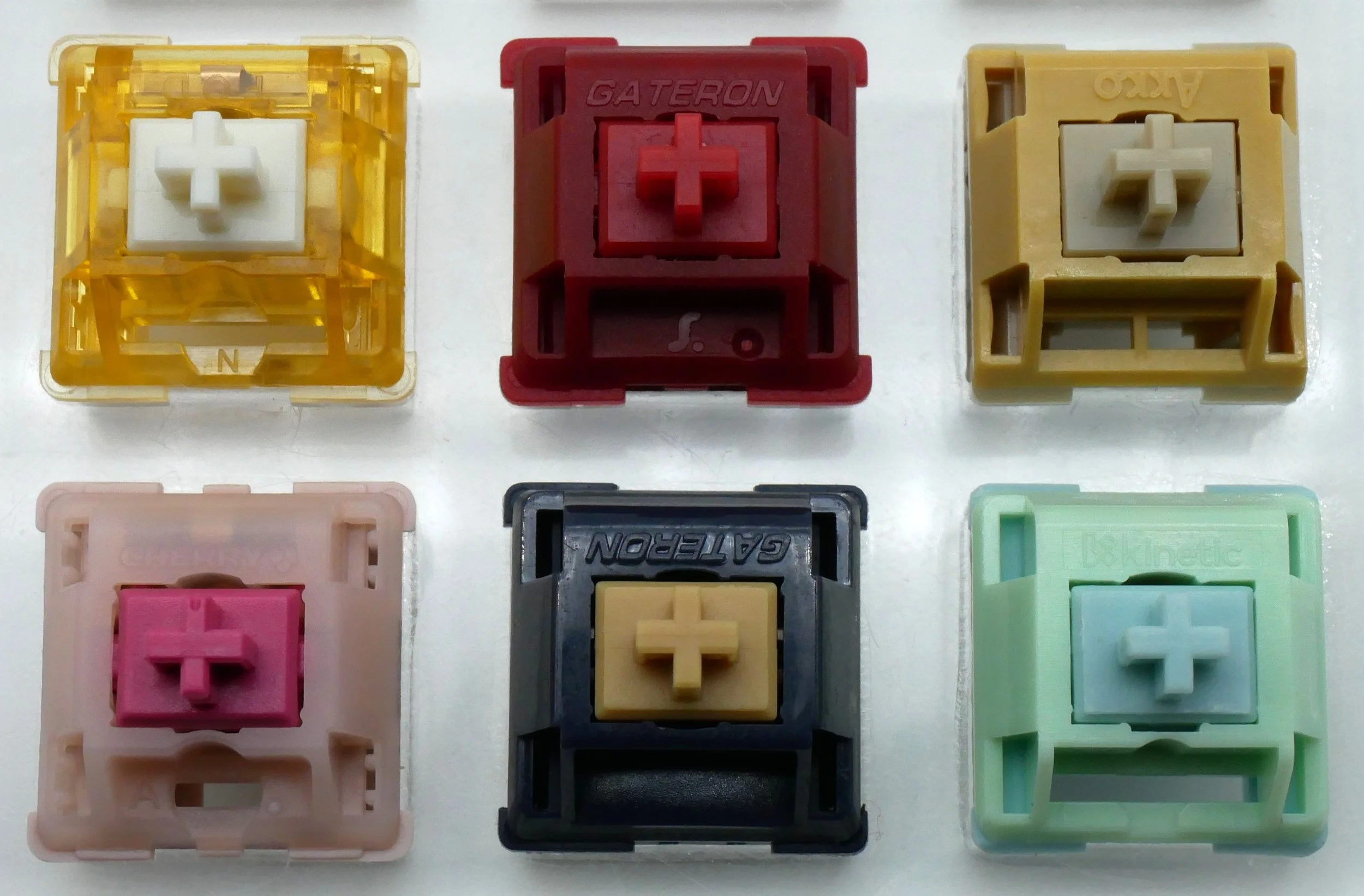
Figure 21: Switches for comparison. (L-R, Top-Bot: BSUN Golden Apple, Sillyworks x Gateron Type R, Akko Bittersweet, Cherry MX Petal, Gateron Lanes, and HMX Frog)
BSUN Golden Apple
- The BSUN Golden Apple switches have ever so slightly greater N/S and E/W direction stem wobble than the Sillyworks x HMX Waverider V2 switches, even when considering the Golden Apple’s asymmetry with such.
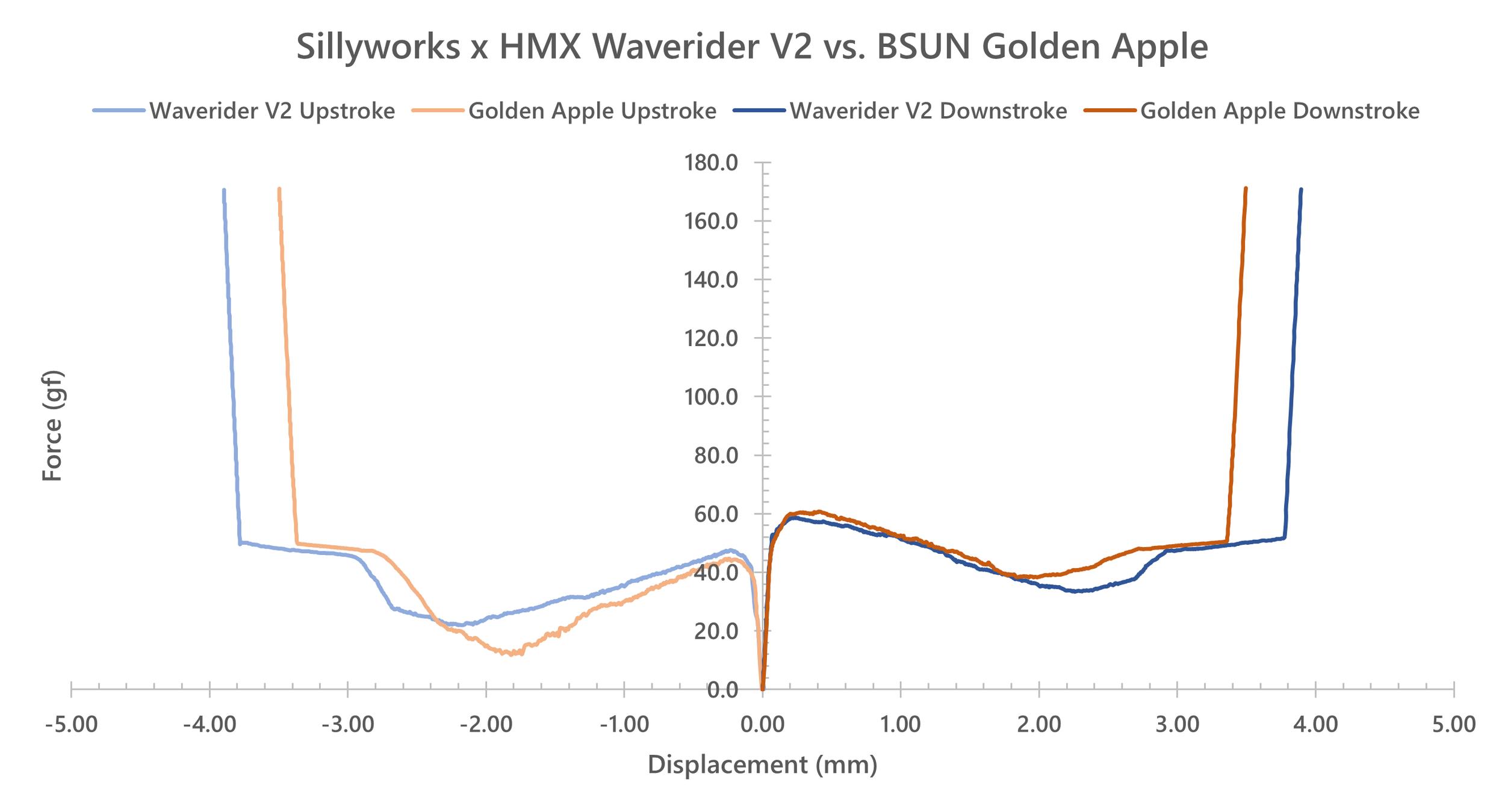
- Despite what the comparative force curve between these two switches below would suggest, the Waverider V2 switches do have a tactile bump that feels a fair bit more poppy and standout-ish than the Golden Apple switches. I suspect that this is largely due to the very tiny range of space over which the stock Waverider V2 switches peak in force – a span which is noticeably shorter and located towards the top end of the stroke than in the Golden Apple switches.
- In terms of their bottom out sound profile, the Golden Apple switches are definitely the better sounding of the two with a deep, rich, and well-rounded tone that comes from their PEI-based bottom housings. The Waverider V2s, by comparison, have thinner, higher pitched, and less well rounded sounding bottom outs.
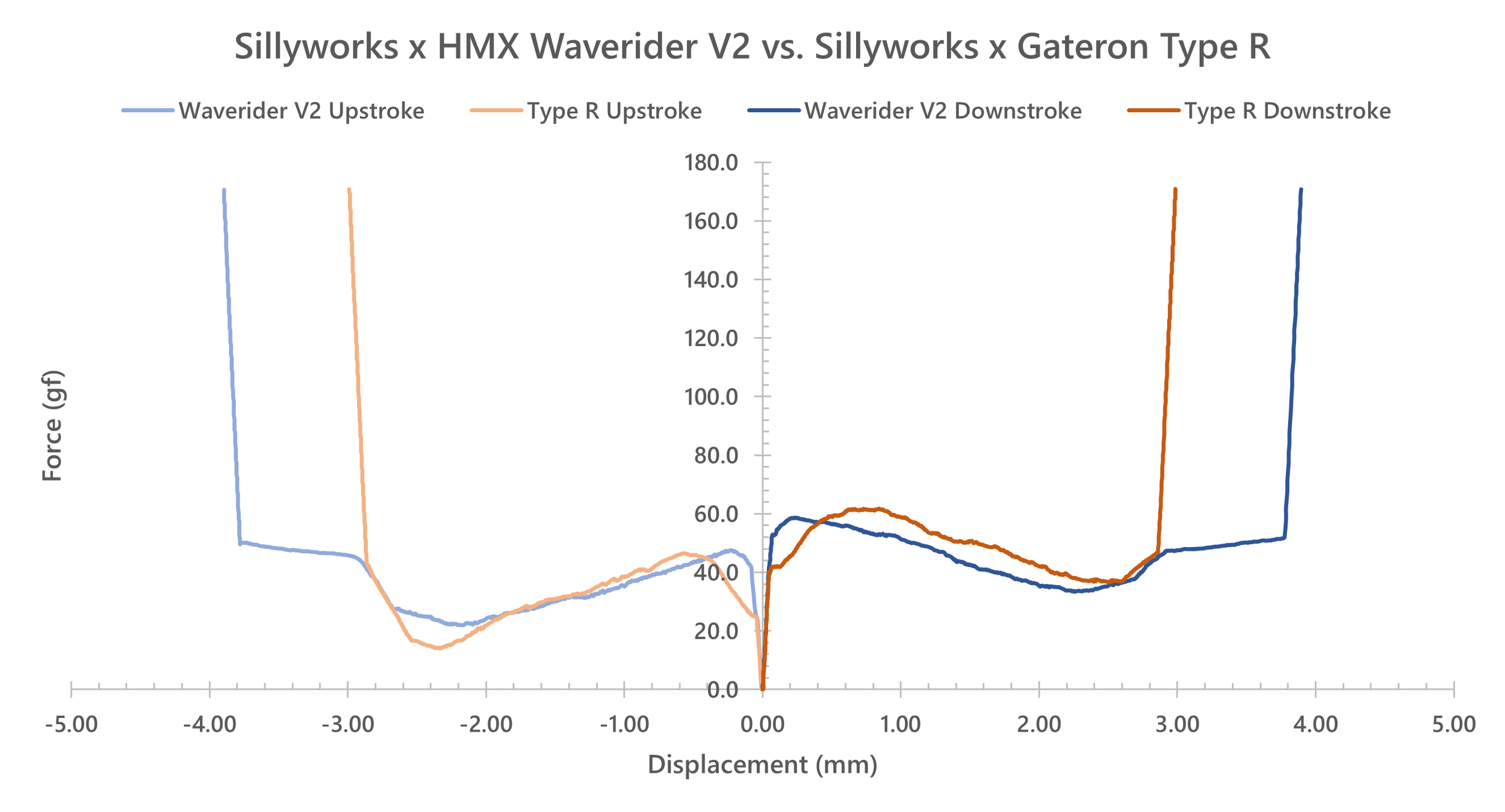
Sillyworks x Gateron Type R
- On the whole, the Gateron-made Type R switches are far and away the better of these two Sillyworks tactiles on sheer account of their switch to switch consistency. In basically all performance metrics that matter, the Waverider V2 switches just don’t have as much batch wide uniformity as well as uniformity across typing experiences.
- Both the peak tactile force and bottom out of the Gateron Type R switches are more punchy, forceful, and noticeable than in the Waverider V2 switches. This, which is due in no small spart to the extremely shortened overall stem travel of the Type R switches, is also what causes them to sound so much more loud and sharp than the Waverider V2s.
- While the strokes and housing on stem interfaces of both of these switches are both fairly smooth on account of the respective factory lubing from HMX and Gateron, the HMX-made Waverider V2s have a bit more of a scratchy feeling over their tactile bump as a result of the stem leg dragging over the leaves of the switches.
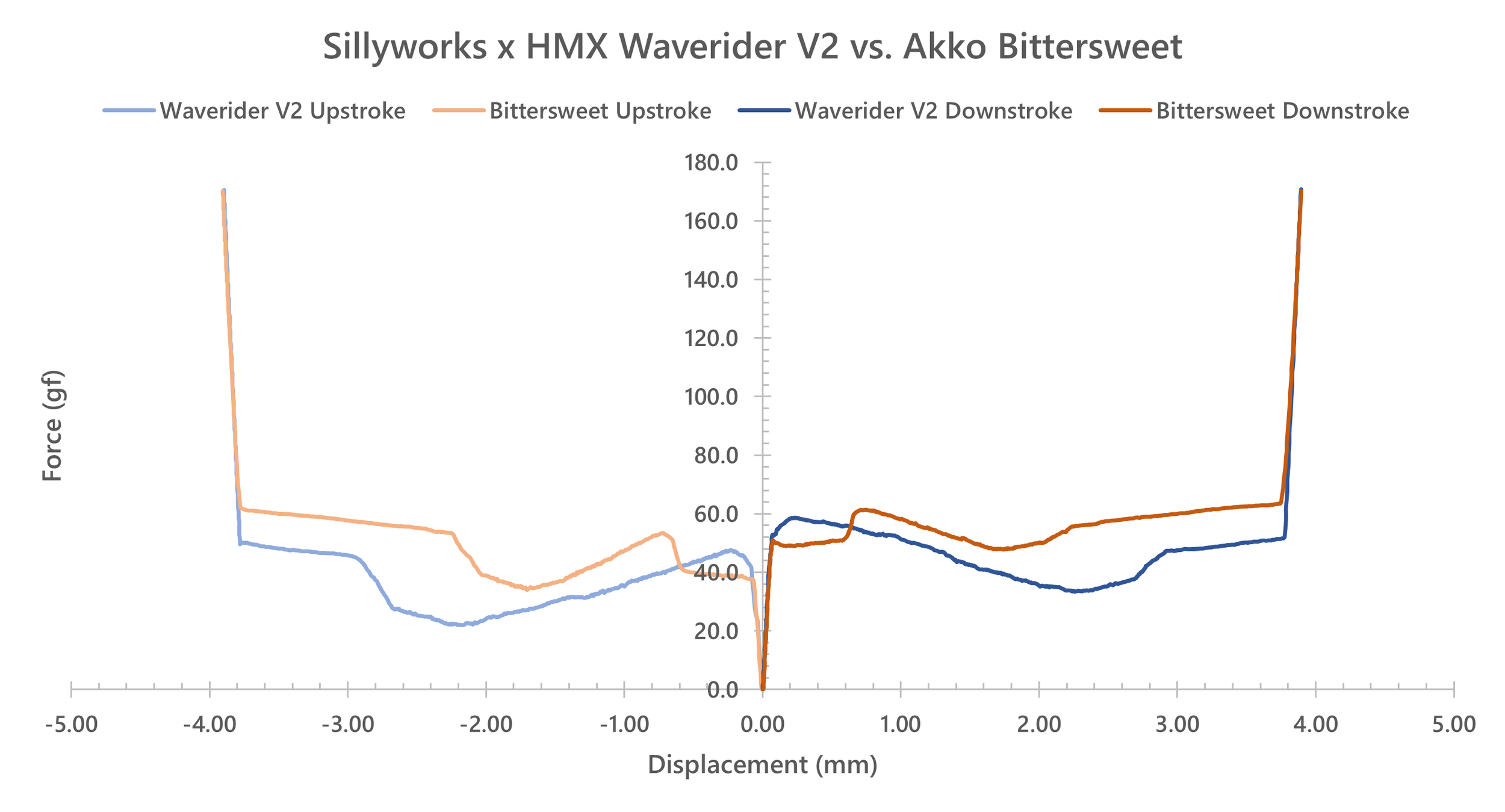
Akko Bittersweet
- As the comparative force curve between these two tactiles below would suggest, they are quite different tactiles from one another. The Akko Bittersweet are more conventional ‘light tactile’ switches featuring a midstroke bump that is soft, rounded, and not too fatiguing on the fingers whereas the Sillyworks x HMX Waverider V2s are more like the classic ‘medium-strong tactiles’ which punch right of the gate with a sharper, snappier feeling tactile bump.
- There is a bit less stem wobble in both directions of the Sillyworks x HMX Waverider V2 switches than there is in the Akko Bittersweet switches.
- The Akko Bittersweet switches have a louder, almost plasticky sounding topping out strike that is a much larger portion of their overall sound profile than the Waverider V2s. Given that this is generally a less desirable sound in a tactile switch, this makes them simply sound not as coherent or well designed as the Waverider V2s, which have their own sound-based issues due to inconsistency.
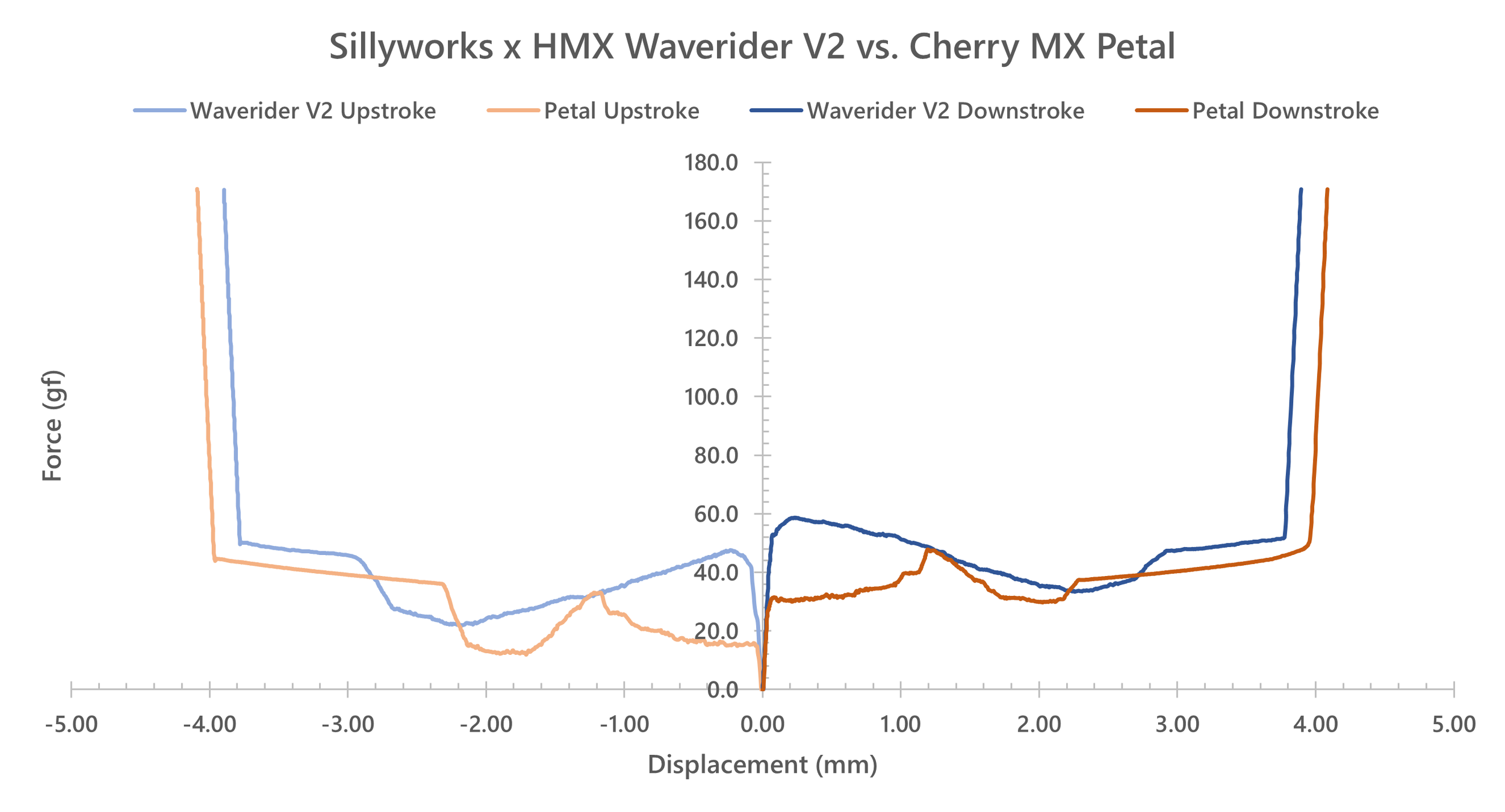
Cherry MX Petal
- The Cherry MX Petals, surprisingly, are only a tiny bit quieter than the Sillyworks x HMX Waverider V2 switches, though for all of the wrong reasons. As opposed to the more crisp and succinct tactile snap of the Waverider V2s, the Petals have sound that is primarily driven by leathery scratch and a wide, fuzzy sounding tactile bump.
- There is quite a bit less N/S and E/W direction stem wobble in the HMX-made Waverider V2 switches than there is in the Cherry MX Petal switches.
- Despite having a relatively similar bottom out weight to one another, the Waverider V2 switches feel quite a bit more substantial and heavy at the ends of their strokes as a result of their more firm, solid collision between their stem pole and bottom housings.
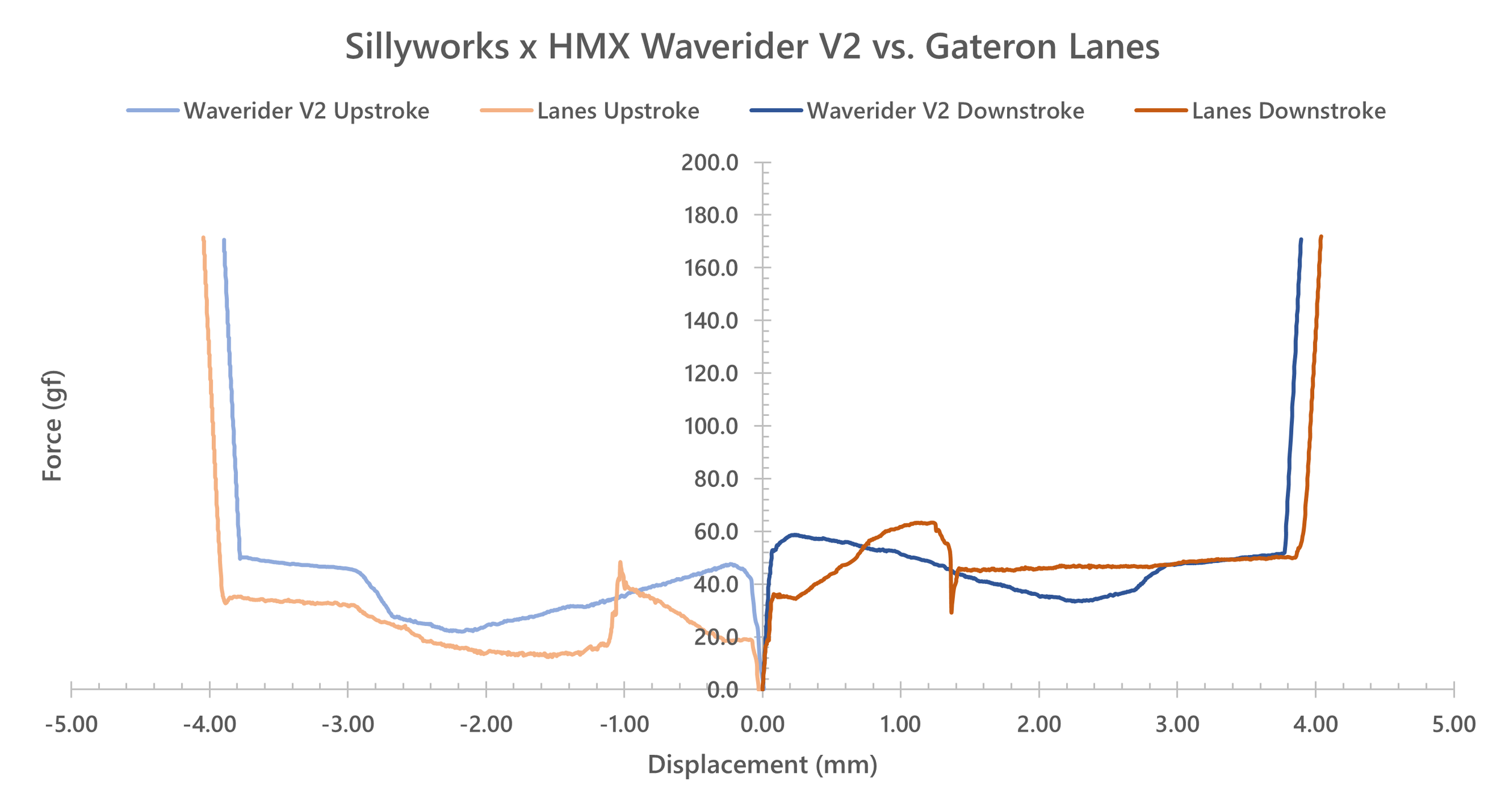
Gateron Lanes
- In similar fashion to the comparison made to the BSUN Golden Apple tactiles above, the Sillyworks x HXM Waverider V2 switches actually feel a bit snappier and more forceful through their tactile bumps than the Lanes despite an overall similar peak tactile force to one another.
- Even with the switch-by-switch inconsistencies that pop up in the sound of the Gateron Lanes as a result of their tactile leaf mechanism, I feel like the inconsistencies of the Waverider V2s are just much more substantial than in the Lanes. While they may not be as immediately noticeable, the Lanes themselves did not change over their break in period and also did not have wild swings in feeling based upon typing speed.
- There is a fair bit less N/S and E/W direction stem wobble in the Sillyworks x HMX Waverider V2 switches than there is in the Gateron Lanes.
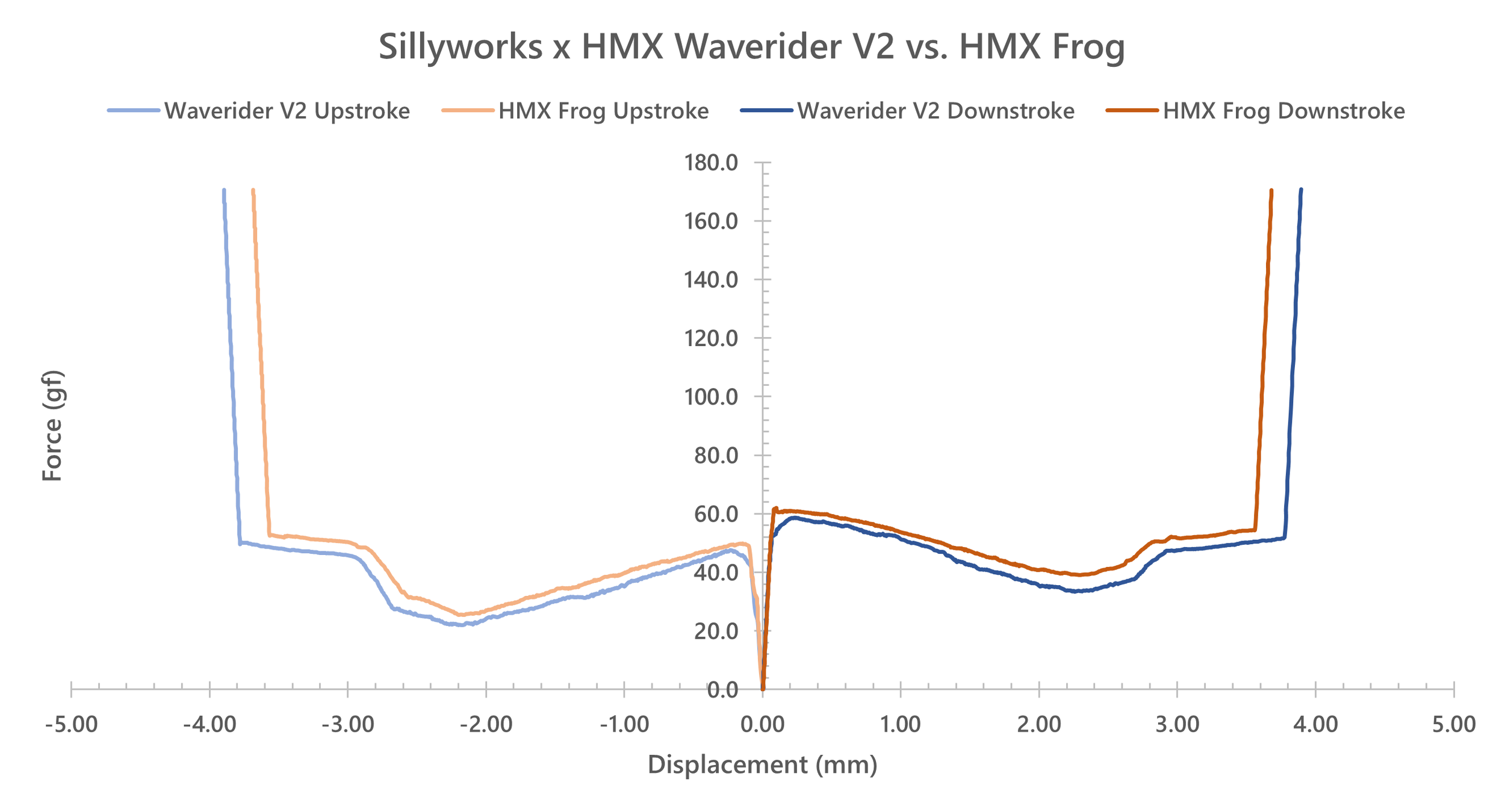
HMX Frog
- Of all of the switches on this comparison list, these are the two which share the most similar feeling in their tactile bumps – both visually in their comparative force curves as well as in their in-hand typing experiences. That being said, though, the HMX Frogs are just a tiny bit heavier feeling than the Waverider V2s at their peak.
- The overall sound profile of the HMX Frogs is one that is significantly more clean, crisp, and singular at all points of their stroke than the Waverider V2s. The Frogs simply do not struggle with the same scratch or switch by switch inconsistency that was noted in the Waverider V2 switches in the review above.
- The HMX Frog and Sillyworks x HMX Waverider V2 switches have fairly comparable N/S and E/W direction stem wobble – something which isn’t all that surprising given that they were both produced by the same manufacturer.
Bonus Round
Much like with the Taro N Sweet Potato V2 Switch Review from a couple of weeks ago, you can’t expect me to review the V2 of any given switch without directly comparing it to its V1 iteration!
KTT Waverider
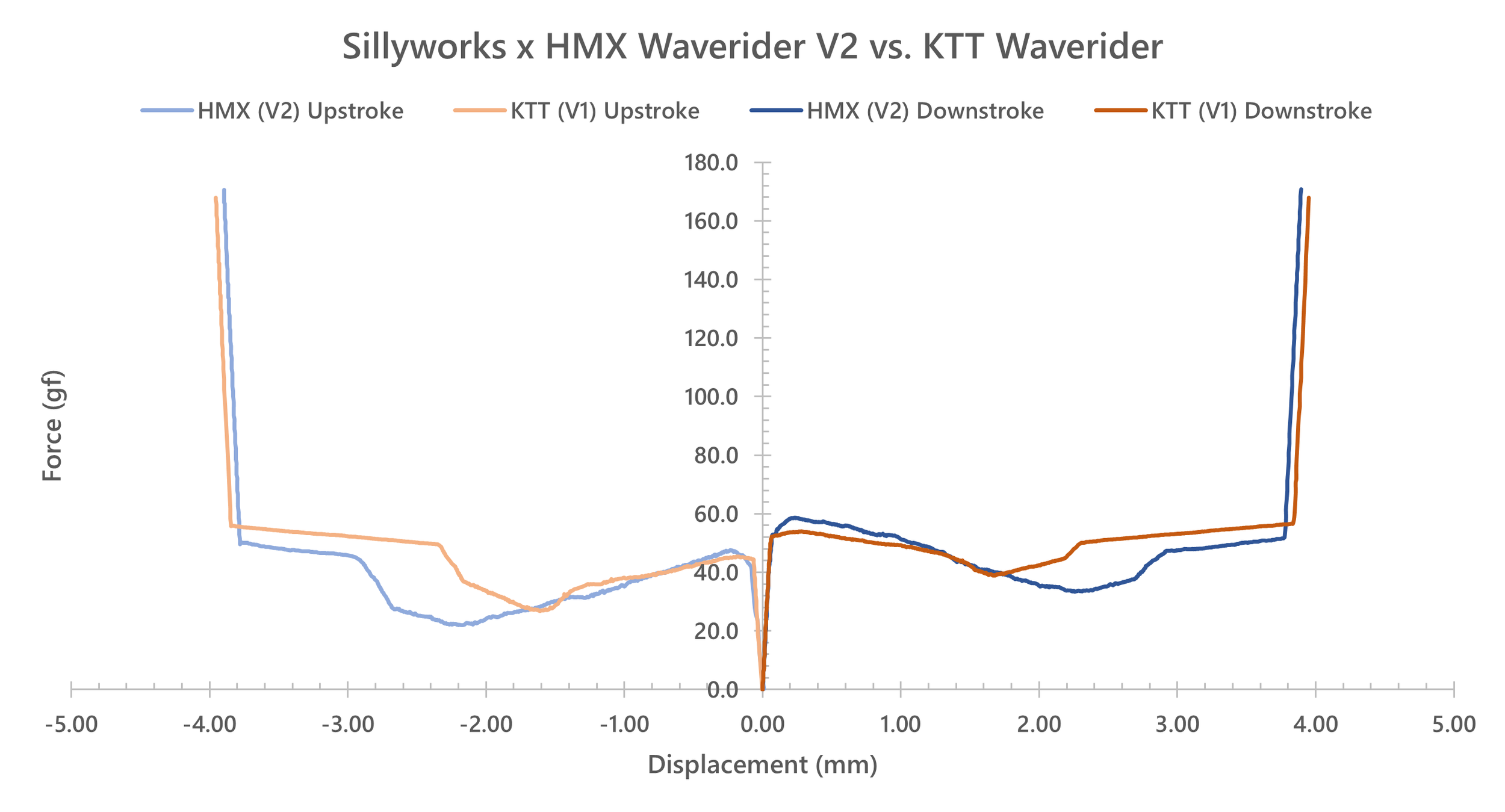
- As the comparative force curve between the two switches below would suggest, the HMX-made Waverider V2s are quite a bit stronger and more snappy feeling through their tactile bump than the KTT-made Waverider V1s. That being said, it doesn’t make them so substantially heavier such that enjoyers of the V1 tactiles wouldn’t also enjoy their V2 variants.
- To the surprise of probably nobody, the Waverider V2 switches do in fact have a fair bit less stem wobble than the KTT-made Waverider V1 switches from several years ago.
- While these two switches are similar sounding to one another on account of them using the same materials for their stems and housings, something which Sillyworks specifically went out of their way to do, the KTT Waveriders do not have the same scratchiness through their tactile bump nor inconsistent sounding bottom out stroke as the HMX-made V2s do. In turn, the HMX-made V2s also do not have spring ping that is quite rampant in the KTT Waverider V1s.
Scores and Statistics
Note – These scores are not necessarily completely indicative of the nuanced review above. If you’ve skipped straight to this section, I can only recommend that you at least glance at the other sections above in order to get a stronger idea of my opinion about these switches.
Push Feel
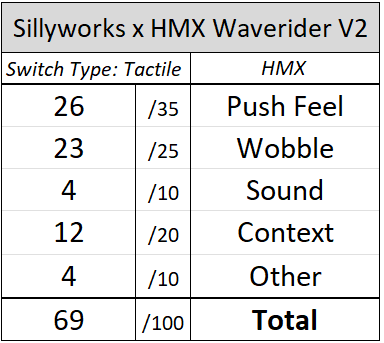
The Sillyworks x HMX Waverider V2 switches are the quintessential medium-strong tactile switch with a snappy, somewhat forceful out of the gate tactile bump that grounds out into a forceful but not overly sharp feeling stem pole bottom out. Despite a fairly clean execution of such, with a tiny bit of stem leg/leaf scratch through their tactile bump, these switches have quite a degree of variability in their stroke with inconsistently forceful feeling bottom outs causing some switches to feel (and sound) significantly sharper, more forceful, and more chaotic through topping and bottoming outs than others.
Wobble
The HMX-made Waverider V2 switches have very little N/S and E/W direction stem wobble that is equal in magnitude and not likely to upset too many, if any typists.
Sound
The sound of the Waverider V2s is one that closely matches the push feeling notes above, and for all of the good and bad reasons. While the polycarbonate over nylon housing collisions are surprisingly well balanced under normal typing conditions and envelope the snappy, not overly sharp tactile bump, it’s the inconsistency, the scratchiness, and their jarring ability to flip from good to bad sporadically that really hinders the good from shining as brightly here.
Context
While these switches are priced decently well at $0.40 per switch, available from more than a few vendors, and have the support of a dogged developer in Sillyworks, they just don’t quite live up to what they are trying to execute and may lead people a bit dissatisfied than not. It is likely these will best be remembered as leading into the Waverider V2D dampened variants.
Other
I appreciate the effort put in here by Sillyworks but these switches just feel an iteration or two short of what they really could (or even should) be coming from a 2026 HMX…
Statistics
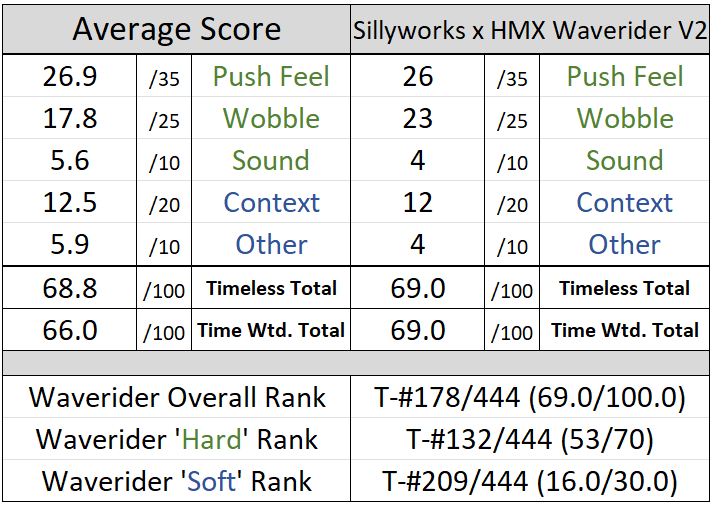
If you are looking at this statistics section and wondering what the heck ‘Timeless’ and ‘Time Weighted’ scoring is, consider checking out my short article titled ‘A Scorecard Time Change’. As a result of scoring becoming a bit anachronistic over the years, switches are now ranked in this statistics table using a “time weighted total” as opposed to their day-of scoring as discussed in that article. If you’d also like to learn about what ‘hard’ versus ‘soft’ ranks refer to specifically, I’d encourage you to head on over to my GitHub linked in the table above or at the links in the top right hand of this website to check out my database of scorecards as well as the ‘Composite Score Sheet’ which has a full listing of the rankings for each and every switch I’ve ranked thus far.
Final Conclusions
After having rounded out this review and made it to this section, I can’t help but feel like I can really only come away with one solid emotion about the Sillyworks x HMX Waverider V2s – a weirdly unsettled disappointment. While I’m sure some large part of this is entirely on me as a switch collector having built up expectations of these switches prior to reviewing them on account of being a Sillyworks reissue using new molds from a modern day HMX, it still doesn’t ultimately change the realities that underline that emotion. On the positive end of things, the Waverider V2s are medium-strong tactiles that punch right out of the gate with snappy, not at all sharp tactile bumps that rocket you over their peak and careening towards a bottom out that is surprisingly soft for just how forceful it is. The rest of the stroke, as well as the ultimate rebounding back up into their polycarbonate top housings, is also fairly strong as well – making for a well-balanced tactile switch in their most ideal state despite conventionally mismatched housing choices. But all of those positives come together before the accounting of the less savory points and overwhelming inconsistencies that take place across a batch off Waverider V2s. The stem leg/leaf scratch is not only surprising to see here in these switches as modern day HMX-made switches but altogether should not be present at all simply on account of how visibly lubed they are at these friction points. The wild swings in feeling and sound as you bottom the Waverider V2s out at different speeds, though, is really hard to stomach. These ‘other halves’ of the Waverider V2s are ones that are infinitely more aggressive through their housing collisions and nearly drown out their tactile bumps altogether (save for their scratch ) in sharp, pointy feeling housing collisions that are incredibly grating. And to end up on the wrong side of the Waverider V2s by just pressing on one of them a tiny bit harder than another makes for quite a tricky proposition when typing on them. I just really do think that these needed at least one more round of revisions at HMX before being pushed out in order to iron out these final kinks. Thankfully, at least, my biggest gripe with them in their bottom out inconsistency should be addressed in their dampened ‘V2D’ variant that should be coming out in the next few months, though I can’t say it’s a good feeling to leave the review for a switch more excited by the prospect of a future variant of it than the one right in front of you – especially when they, themselves, are a V2 reissue of another switch…
Sponsors/Affiliates
Mechbox UK
- A wonderful UK based operation which sells singles to switches that I’ve used above in my comparisons for collectors and the curious alike. Matt has gone out of his way to help me build out big parts of my collection, and buying something using this link supports him as well as my content!
proto[Typist] Keyboards
- An all-things keyboard vendor based out of the UK, proto[Typist] is a regular stocker of everything from switches to the latest keyboard and keycap groupbuys. While I’ve bought things from the many times in the past, they also are a sponsor of my work and allow me to get some of the great switches I write about!
Divinikey
- Not only do they stock just about everything related to keyboards and switches, but they’re super friendly and ship out pretty quick too. Divinikey has been a huge help to me and my builds over the last year or two of doing reviews and they’ll definitely hook you up. Use code ‘GOAT’ for 5% off your order when you check them out!
ZealPC
- Do they really need any introduction? Zeal and crew kicked off the custom switch scene many years ago with their iconic Zealios switches and the story of switches today couldn’t be told without them. Use code ‘GOAT’ (or click the link above) for 5% off your order when you check them out!
MechMods UK
- A rising vendor based in the UK, Ryan and crew have been a pleasure to work with and have nearly everything you’d need to build your first or fourteenth keyboard. Go build your latest or greatest one right now with them by using code ‘GOAT’ at checkout for a 5% discount!
Dangkeebs
- A longtime supporter of the website and the collection, Dangkeebs has quite possibly the widest variety of switches of any vendor out there. Not only is their switch selection large, but it rotates and is constantly adding new stuff too. You’re going to need 5% off your order with my affiliate to save off the cost of all those switches!
SwitchOddities
- The brainchild of one my most adventurous proxies, SwitchOddities is a place where you can try out all the fancy, strange, and eastern-exclusive switches that I flex on my maildays with. Follow my affiliate code and use code ‘GOAT’ at checkout to save 5% on some of the most interesting switches you’ll ever try!
Cannonkeys
- Does anybody not know of Cannonkeys at this point? One of the largest vendors in North America with keyboards, switches, keycaps, and literally everything you could ever want for a keyboard always in stock and with an incredibly dedicated and loving crew. Follow my affiliate link above in their name to support both them and I when you buy yourself some switches!
Kinetic Labs
- One of the most well-rounded keyboard vendors out there, Christian and crew have been supporters of all my switch and switch-adjacent needs for some years now. I’m honored to have them as an affiliate and think you should check them out using my affiliate link above to support both them and I when you check out their awesome products!
Keebhut
- Want to try out some switch brands that fly under most vendor’s radars? Keebhut is always seeking out that next latest and greatest and has been super helpful in hooking me up with new brands over the past year. They are all about sharing that love as well, and want to give you 5% off your next order with them when you use code ‘GOAT’ at checkout!
Kailh
- No, you’re not mistaken – this is actually that Kailh that manufactures switches. As one of the longest running manufacturers in the hobby, they have a massive variety of switches available over on their website at any point in time. I’m lucky to be affiliated with them now, and so consider using my affiliate link above when ordering some Kailh switches to support me!
Keebz N Cables
- Australia and Oceania’s very own is now a part of the sponsor list here and I couldn’t be happier to add this long time supporter of the collection to it. They’ve always got an amazing selection of switches (and other keyboard parts) in stock and they want to share the love that they’ve shown me with you all too! Use code ‘thegoat’ for 5% off your first order when you visit!
Further Reading
Sillyworks x HMW Waverider V2 ZFrontier Post
Unikeys’ HMX Waverider V2 Sales Page
Milktooth’s HMX Waverider V2 Sales Page
Ilumkb’s HMX Waverider V2 Sales Page
Keeb Taro’s HMX Waverider V2 Typing Test
Keeb Science’s HMX Waverider V2 Typing Test