Kailh Xuan Switch Review
In order to keep the steady stream of content coming to you all week in and out, I tend to do my switch purchasing in bulk runs every couple of months. Not wanting to eat the same shipping charge from a vendor every couple of weeks when they inevitably push out new switches, this practice that has been born out of years of experience both saves on costs and is easier for me to manage with the collection. While this does occasionally cause me to miss out on certain switches that I was particularly interested in picking up for a review due to them going out of stock, such as the Gateron Lanes last year or the Geonworks Strike HE switches last week, it generally ends up all working out one way or another. However, the past two switch shopping sprees that I’ve gone on haven’t quite been the same as they’ve always been over the last handful of years; It just seems like there’s not all that many switches coming out. With basically the only exception to this being Unikeys single-handedly holding down the westward-facing supply of HMX, WEKT, and Wingtree offerings, all of my go-to vendors both foreign and domestic have had only one or maybe two switches released in the last four to six months. In fact, if I go all the way back to the start of the calendar year, the only companies which have managed to outpace this slow stream of releases besides Unikeys have been Cannonkeys as a result of their flood of Haimu-made offerings and Wuque Studio and their K2 bonanza of Hall Effect switches. As for the more eastern-facing markets, these too haven’t fared much better with fronts like AliExpress offering continuously fewer switches month in and out and marketplaces like TaoBao and Xianyu becoming increasingly difficult for people like me to access due to their crackdown on US-based accounts. And while it is very evident that the flow of all mechanical keyboard switches has slowed down substantially over the course of 2026 given my experience above, what isn’t as obvious to most people is that this slowdown is especially hard hitting for MX-style switches out of all of them. What I failed to mention in the accounting of releases above is that while most vendors are still putting out a couple of switches every few months, a growing market share of them are Hall Effect or magnetic switches. Even the manufacturers and vendors which haven’t been wholly consumed by this change like Wuque Studio are still seeing half or more of their new releases dedicated to magnetic switches. These very magnetic switches, by the way, are 3, 4 or even 10 times more expensive than the MX switches they’re taking the place of. While I know seemingly everything here in the US is getting more expensive by the day, this hard to ignore change in releases that I was struck with earlier this week paints a very… bleak… outlook on the current state (and future) of mechanical keyboard switches. To say it has been weighing on my mind quite a bit this week would be an understatement.
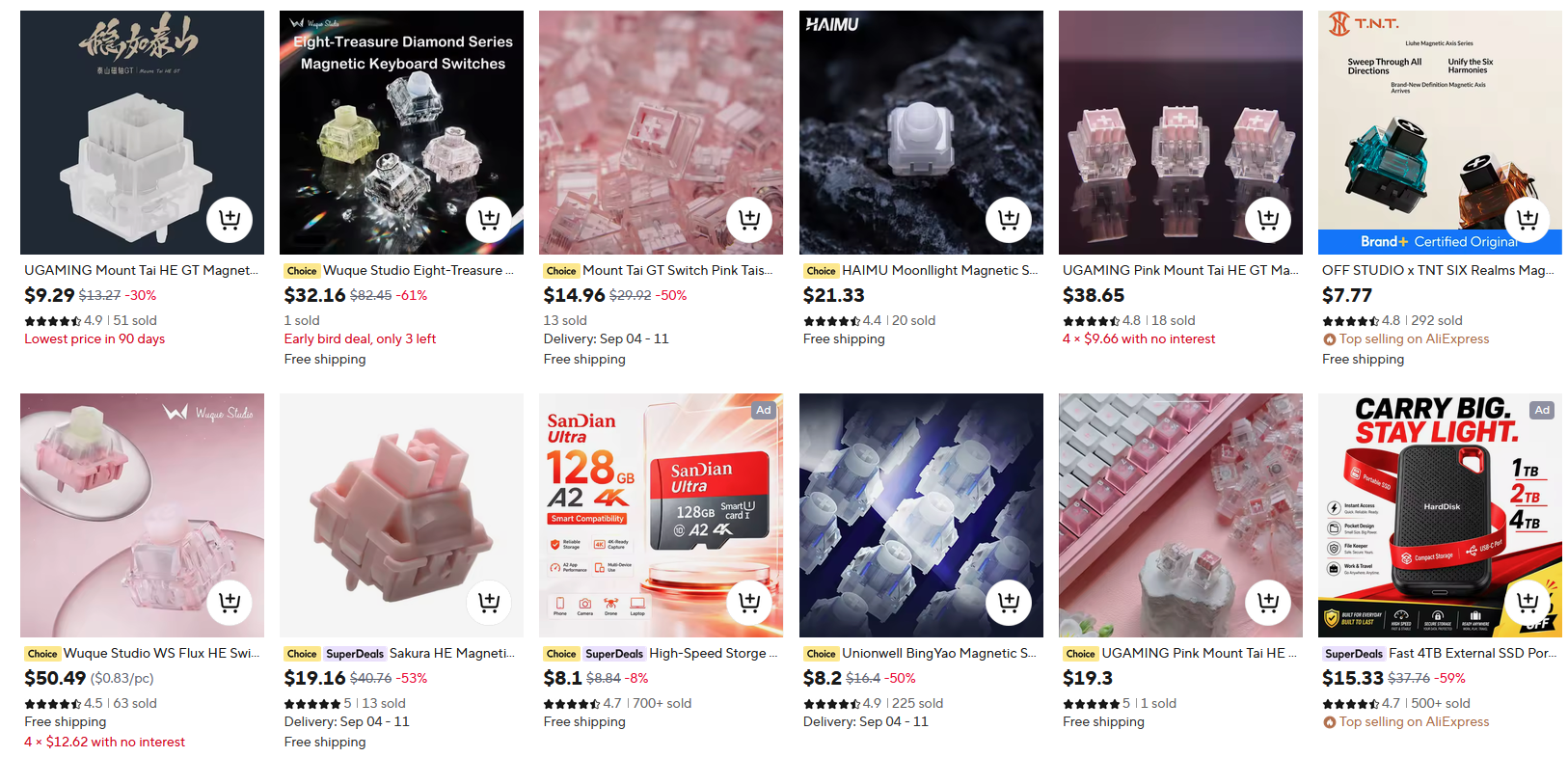
Figure 1: I mean just look at those recommended AliExpress listings - over 10 listings for brand new Hall Effect switches and not a traditional MX one in sight...
Switch Background
I can admit that I certainly am not free from the effects of any cognitive biases, but especially not those of the Baader-Meinhof phenomenon, otherwise known as the ‘frequency bias’. Finally putting one’s thumb on a feeling that has been plaguing their experiences nebulously for weeks or even months at a time can lead anyone to painting their surroundings with that now-named brush and in turn I imagine I’m suffering a bit from that in the writing of this background. However, to really drive home the ‘bias’ part of ‘cognitive bias’, I want to double down that this doomerish feeling regarding the slow consumption of the mechanical keyboard switch scene by HE switches isn’t just in my head and has very much impacted the Kailh Xuans in turn. For the vast majority of you who are unaware, the Kailh Xuan switches are a tactile-stemmed parallel to the Kailh Calligraphy linear switches that were first released around December of 2025, leveraging the same unique housing materials that the Calligraphies were marketed around. When I say ‘unique’ housing materials, I genuinely mean it here. I’m sure you all are just as sick as I am of hearing about switches from manufacturers that have “special housing materials” that are just some non-specific, vaguely labeled mystery blend of something and anything, but the Calligraphy and Xuan switches were far from that, featuring melamine formaldehyde (MF) stems in ‘liquid crystal polymer’ (LCP) housings. And for such an interesting combination of switch materials in a tactile switch style that the community vastly prefers over linears, you’d have to assume that these must be very, very recent releases given that you haven’t heard anything about them, right? Well, they’ve been available for purchase for at least three or four months now and were teased by Kailh even further back in late 2025… Not only have you not heard really any substantial discussions about the Kailh Xuans specifically, but you’ve almost definitely not heard any discussions about their new, unique component materials like MF and LCP that could be leveraged to make switches of very specific sound profiles either – a silence which is quite deafening coming from the same community that nearly melted into a puddle over fully POM switches from Kailh only a handful of years ago. It’s not just you alone, reader, as I too haven’t heard hardly anything about the Kailh Xuans save for the single digit number of reviews I’ve appended to the end of this review too. The Calligraphy switches have hardly fared much better either, with neither of these being available for sale on all that many storefronts.
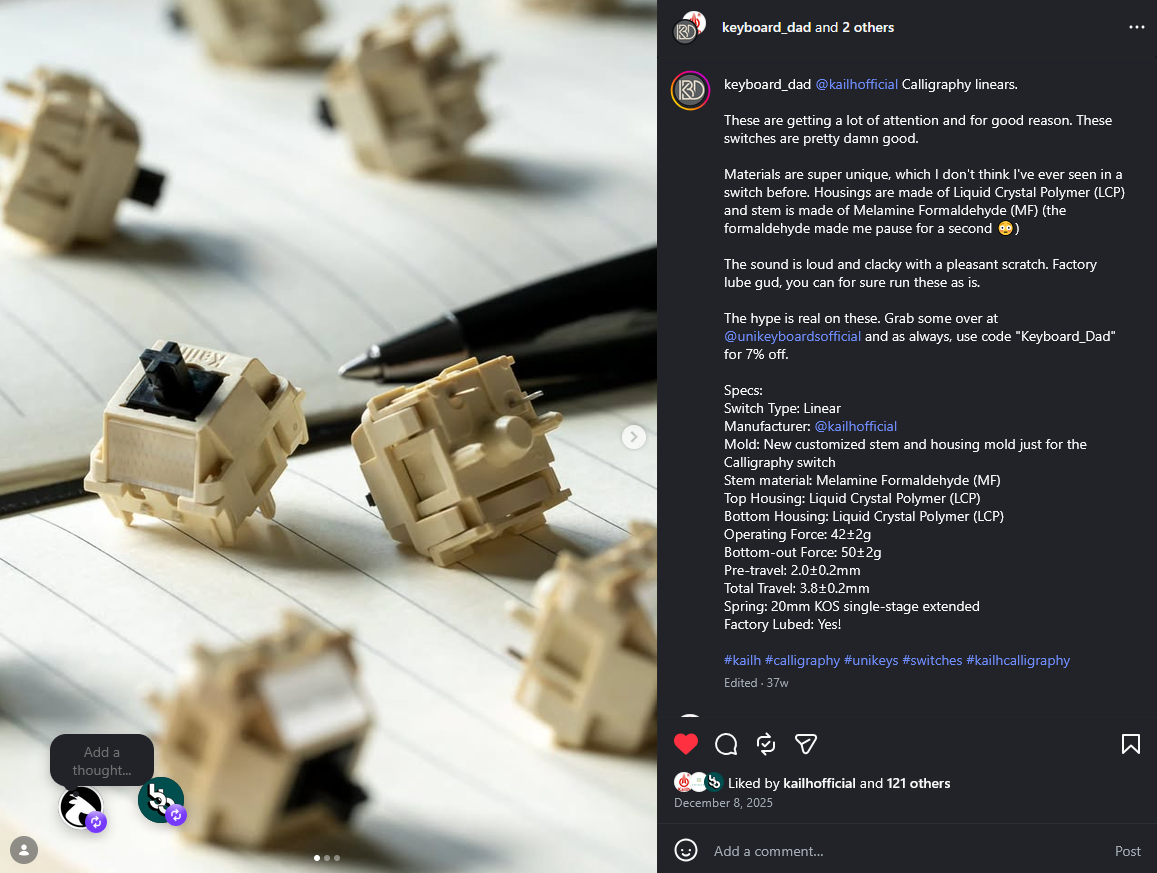
Figure 2: Kailh's most substantial marketing post for the Kailh Calligraphy switches in the form of a collaborative post with keyboard_dad in late 2025.
Historically I have been rather agnostic about switches that have marketing that circles around their housing materials, and especially those which leverage some combination of materials to promise a superlative typing sound – the “clackiest”, the “creamiest”, etc. While this agnosticism is due in large part to the “objectified subjectivity” that everyone loves to talk about switch sound with because of those cursed onomatopoeias, it’s also somewhat due to those combinations of materials not really being all that interesting. I’m sorry, but a sprinkle of POM here or 10% more fiberglass there doesn’t really do much for me. The exceptions, however, that take wild swings relative to both current community offerings as well as historical precedent for switch materials, have always been interesting to me as a switch collector and reviewer though. Take the debut release of Novelkeys Cream switches as the first fully POM linear to hit the community as a prime example of such. Lesser-known examples are just as intriguing despite not being as impactful and include the ABS housings of the Everglide Crystal Purples, HDPE stems of the Invokeys Red Beans, and the PBT over POK combination of Punkshoo’s Indulgence prototypes, to name a few. And after this trend of switches being marketed along the lines of having specific, niche-breaking sound profiles as a result of improvised combinations of new housing materials has gone on for several years now, encountering the Kailh Xuans just seems like one of those truly swing-for-the-fence offerings that community would be talking about. Sure, Kailh has not helped discussions around the Xuans or Calligraphies on account of their ‘design, drop, and run-away’ style of manufacturing, but that hasn’t stopped the community from ogling over their releases before. So, when I finally got my set of Xuans in hand for review, which I as the agnostic specifically sought out because of their housing material combinations, I sat down to find myself as really the only one who seems to care. For me to be so interested in the combination of materials used in a switch and the community to be so completely apathetic to such signals to me that something quite drastic has changed right under my own nose without me being aware.
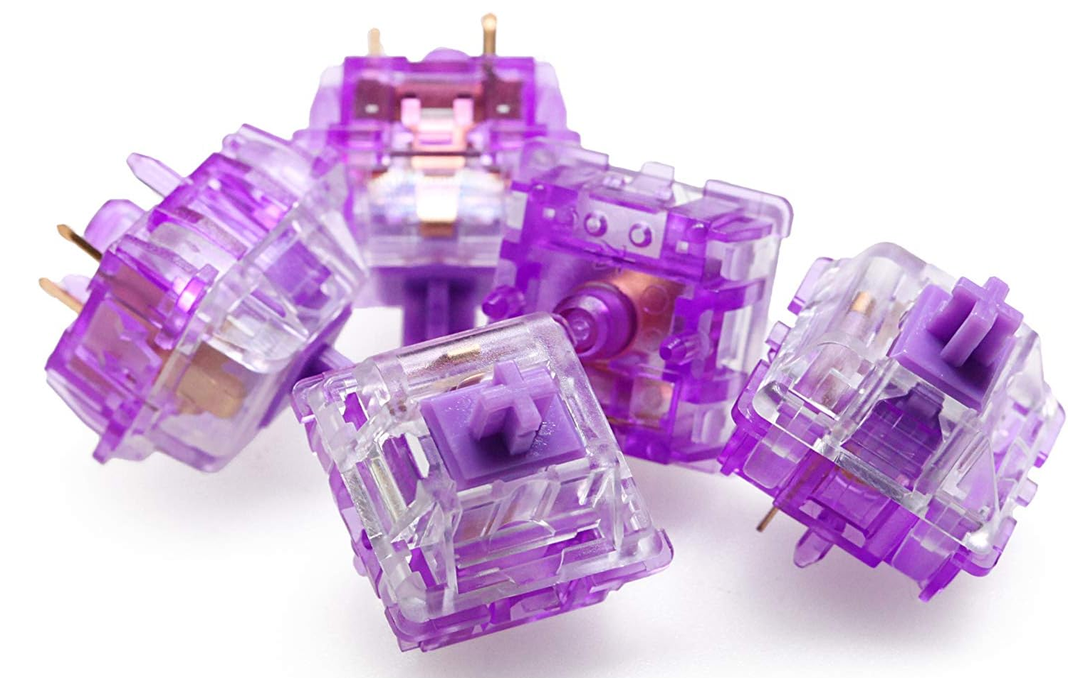
Figure 3: Do keyboard hobbyists even remember the Everglide Crystal Purples? Ever since Drop officially shuttered its door I keep thinking about these purported ABS-based switches that I first saw for sale there.
To put it bluntly, I genuinely think the fact that I find myself in this position, so far out on the island of interest in switch materials that the community at large seemed to be headquartered on for years and years, is really the direct result of the growing market share for magnetic / HE switches. It’s because of the manufacturers moving increasingly towards them and away from MX switches, it’s because of the vendors pushing them harder and harder over their historical offerings, and it’s because of the consumers among us that really continue to support such. (Now whether this is because of more mainstream, non-custom community adoption versus the more niche custom keyboard community is certainly up for debate, though it’s not a hair I really chose to parse here.) While HE switches themselves may be more reliable in the long term on account of having fewer points of potential failure and are on the surface more customizable due to users being able to select their own actuation points, they don’t really have much else substance to them in their current state. They’re really quite boring. And expensive, for that matter. Boring and expensive. For $2 today, you can get a single linear magnetic switch with perfect tolerances and perfect manufacturing execution, but no ability to combine them with any other switch you have on account of them being so narrowly and specifically designed by each brand and manufacturer. Folding in the fact that you may not even be able to combine them switch specific keyboard kits of your choosing on account of the fact that not every HE switch works with every HE PCB, we’ve seemingly sacrificed a standard design with a rainbow array of variability at a significantly lower price point for exclusive, specific switch type that is more restrictive than ever. You do realize that when KTT first came around we could get good MX switches for $0.20 per switch, right? And as these sad facts become more commonplace among increasing numbers of vendors and manufacturers, it also shifts the commonplace community conversation away from the very things that made MX switches so popular for so long – their unique, subtle quirks of performance, their price per performance, and their ability to be leveraged inter- and intra-keyboard kit to make for a truly custom mechanical keyboard experience. These are all the exact kinds of conversations that would have centered around the Kailh Xuan switches which are withering away in parallel with the rise of magnetic switches.
Irrespective of how the Kailh Xuan switches actually perform in the review below, something which I as a first pass writer am breaking the fourth wall here to tell you that I cannot possibly know as I write out this section first, they come across contextually as switches out of time. The background of the Kailh Xuan switches is one that is ‘anachronistic’, in a word. Only a couple of years ago the Xuans would have been leveraged for some flavor of thocky/creamy/crispy/clacky sounding switches that scratched the specific ear of some funky YouTuber or community enthusiasts out there. Just a couple of years before that the combination of MF in LCP housing materials would have led to the community elevating Kailh as being the manufacturer for unique, compelling switch material housing choices as these rode the coat tails of the Novelkeys Creams. Any number of years before then and these would have been almost unfathomably unique relative to all other MX style switches on the open market that the community wouldn’t even know what to do with them. Today, though? Today hardly anyone seems to notice them coming and going, instead focusing on switches like a “limited time” released, full red recolor of some perfect linear magnetic switch that has a dozen variants out already. So, while I did in fact check out far less switches from my various storefront carts this past week than I have in quite some time and do seem to notice increasing numbers of magnetic switches on the open market as separate events from one another, I can’t help but shake the feeling that they are not disconnected phenomenon. The altogether lack of discussion about the Xuans, Calligraphies, or their housing materials in stark contrast to what would have been assumed from them in years prior feels like yet another point that can’t possibly be standalone either. Perhaps I am just as anachronistic in my view of the modern switch market as the Kailh Xuans are in their design.
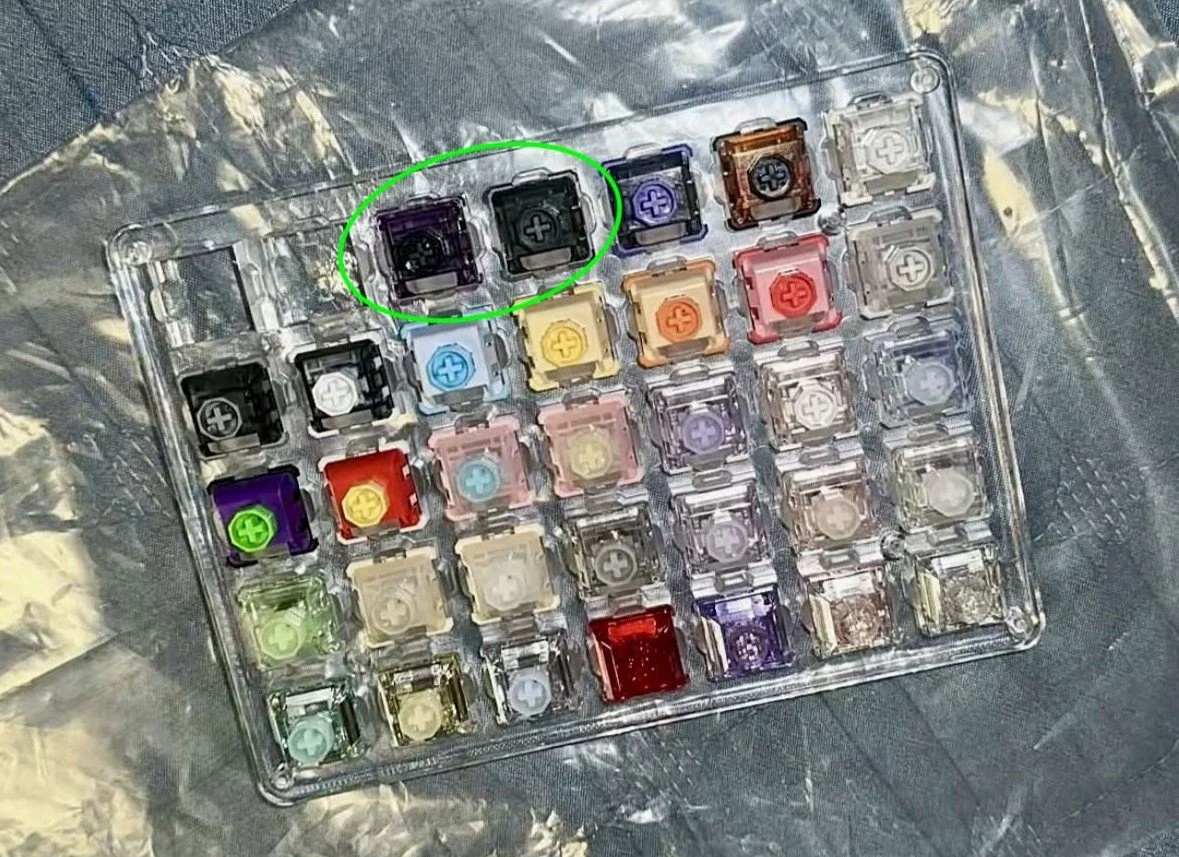
Figure 4: Recent Xianyu photo from a user who is close with Wuque Studio employees showing off the full extent to which K2 HE linears have multiplied. Given that only a fraction of these have been released in the west, it feels hard to think my sentiment is overblown..
As opined above, the Kailh Xuan switches have no substantial historical background nor contextual backdrop presumably on account of the shiny-object fascination that the keyboard community has had with magnetic switches over the past year or so of time. While the Xuan switches didn’t really first hit markets until about mid-2026 by the best estimates that I could find, they did technically first debut as far back as an Instagram post from Kailh on October 21st, 2025. I do use the word ‘technically’ here specifically as the “Xuanmo” switch that was teased in this announcement is of a similar name, and features the identical MF in LCP housing materials that these switches are sold with, though feature a linear force curve and type. The same linear type that the MF in LCP Kailh Calligraphy switches featured in their release two months late in December of 2025. While the connection therein is obvious, what exactly transpired between that first teaser and present day to result in the Xuan switches to be released is not known at all. In the present day, the Kailh Xuans are available from select few vendors with Unikeys being the only strongly consistent example of such, pricing them at $0.45 per switch in packs of 10. While Unikeys generally has a strong reputation for stocking switches for many months or even a year or two past their initial release, the Kailh Xuans being a unique offering from Kailh with a whole lot of attention paid elsewhere by Kailh since their initial teaser announcement leads me to believe that they won’t be available for really all that much longer past this review. At best they may still be available sporadically into 2027.
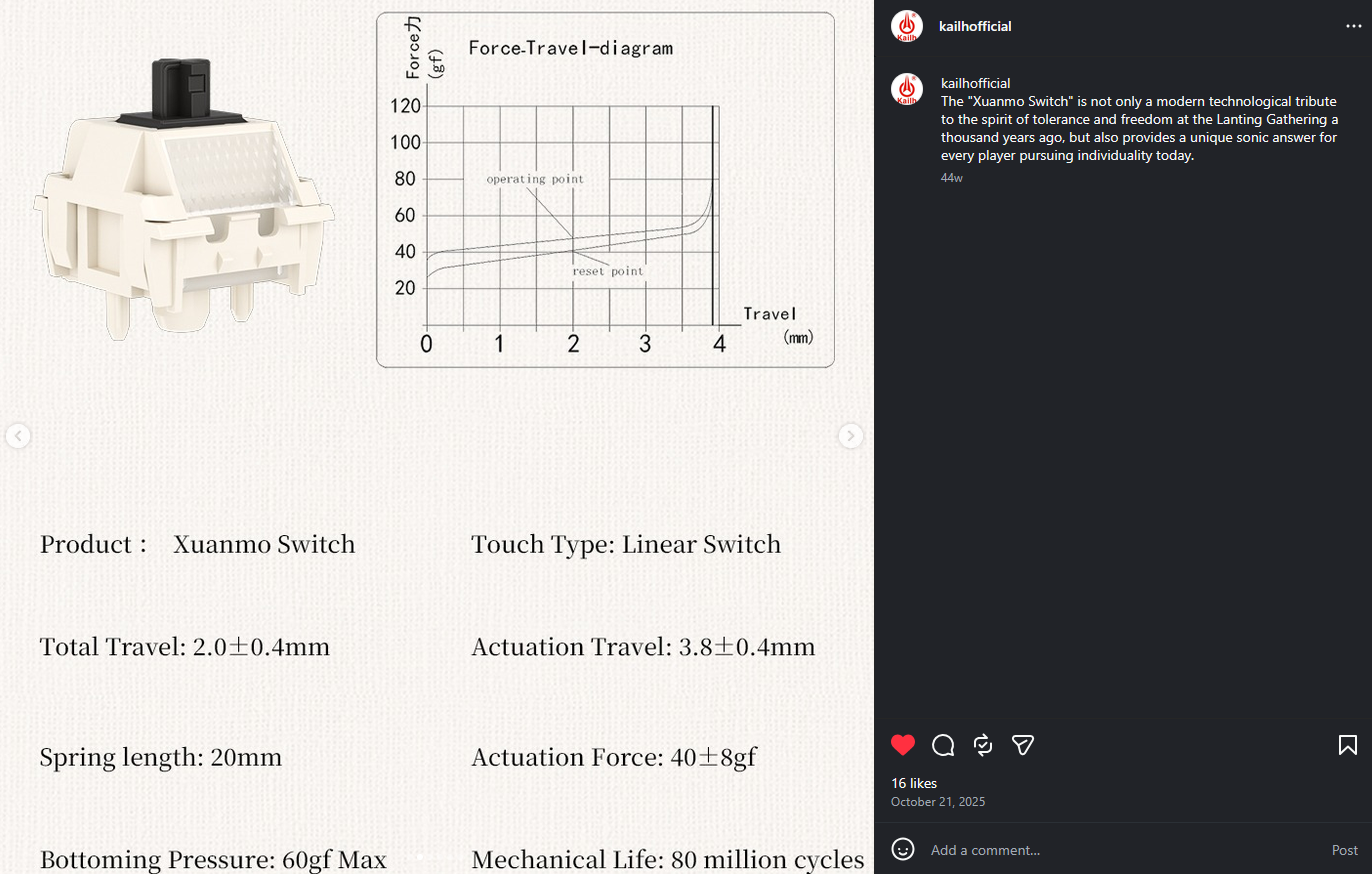
Figure 5: Kailh's first Instagram post where they introduced renders of the 'Xuanmo' switches which ended up in some fashion as the Calligraphy and Xuan switches a couple of months down the road.
Xuan Performance
Appearance
At the highest level, the Kailh Xuan switches come in a colorway that can really only be described as that strange not quite yellow, not quite white tone that stationary and professional office buildings adopt. You know what I mean colors vaguely in the family of beige, manila, cream, or off white. A color that could be a pair of professional slacks, a file folder, or even the walls of a dentist office waiting room, but not anything that you can quite squarely nail down as anything other than ‘that color’. (Trust me I looked up comparative references and these switches aren’t quite any of those vaguely colorful colors I’m alluding to in the previous sentences, I swear.) Also featuring black stems and dimpled, full size wedge shaped LED diffusers, the Xuans are identical in initial appearance to that of the Kailh Calligraphy but impressively standout from the rest of historical switch precedent that I can see in my collection. While neither Calligraphy nor Xuan have any color implications to their names, it is perhaps slightly fitting they are this vague color being a uniquely materialled switch from Kailh just like how the entirety of the Cream family was represented by shades of white to black as opposed to any specific color scheme. From a distance the LED diffusers may be able to give some indication to more astute viewers that these are of Kailh origin, though I suspect that the vast majority of the community will have to wait until they approach them more closely to notice the inverted ‘Kailh’ nameplates to know their true origin. In addition to being made of a peculiar combination of never before seen materials in switches, the Kailh Xuans also have a few sub-part level details with each of their components that are worth noting here in this review. These details of note are described and documented in the paragraphs and photos below.
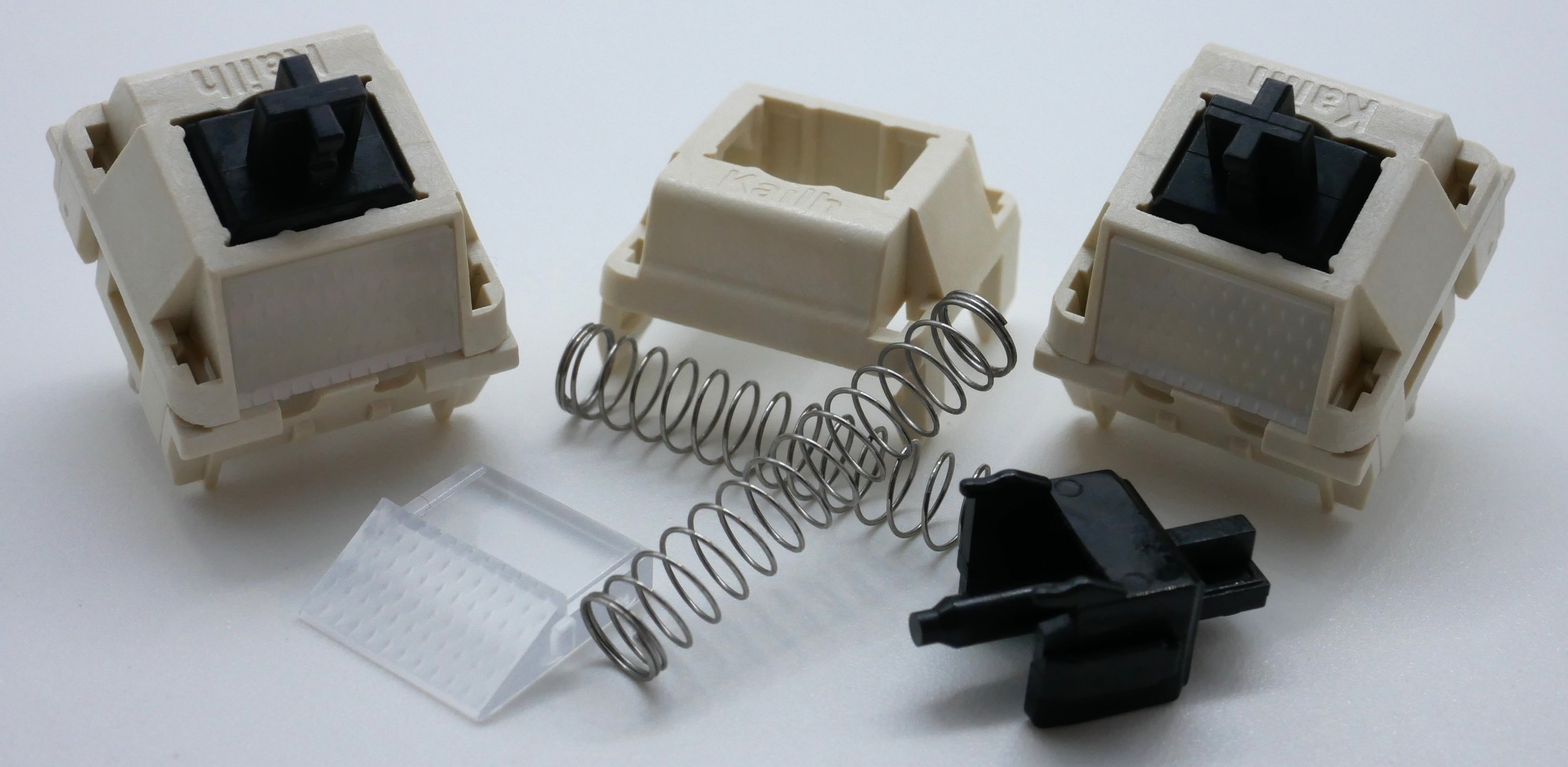
Figure 6: Kailh Xuan switches and their components.
Looking first to the beige-ish colored liquid crystal polymer (LCP) top housings of the Kailh Xuan switches, I’m immediately struck by their texture – something which I very rarely have ever commented on in the appearance section of switches in a review. While I’m not sure what explicitly “LCP” is supposed to be referring to here in these switches as it is a class of high-performance thermoplastics rather than a single, specific polymer, it’s quite evident that something unique is present here as the housings have a rough, almost grainy texture that isn’t grainy in a gravel like way, but rather grains of wood. Even the optical appearance of the top housings have a sort of strange reflectance to them that catches and reflects light not in a wholly diffuse or specular kind of way, but somewhere mildly in between. Additionally the housings carry some degree of texture to their feeling, being obviously made of something that isn’t just ultra-smooth polycarbonate, yet they are overall smooth to the touch despite that grain feeling. Externally, these housings feature an inverted ‘Kailh’ nameplate that is similar in size and font to those of many other recent Kailh switches from over the past few years as well as a similar large slot to accommodate commonplace LED diffusing wedges as well. Internally, the housings bare very little in the way of immediately quantifiable differences of features that I can really put to words, though it is very clear from the photos that there are subtle differences to the supporting structures around the housing that differentiate them from many other switches I’ve reviewed before. In fact the only subtle difference I can point to is the location of the mold marking in the upper left hand corner underneath the nameplate region of the switch, which is downshifted closer to the center of the housing than in most other switches.
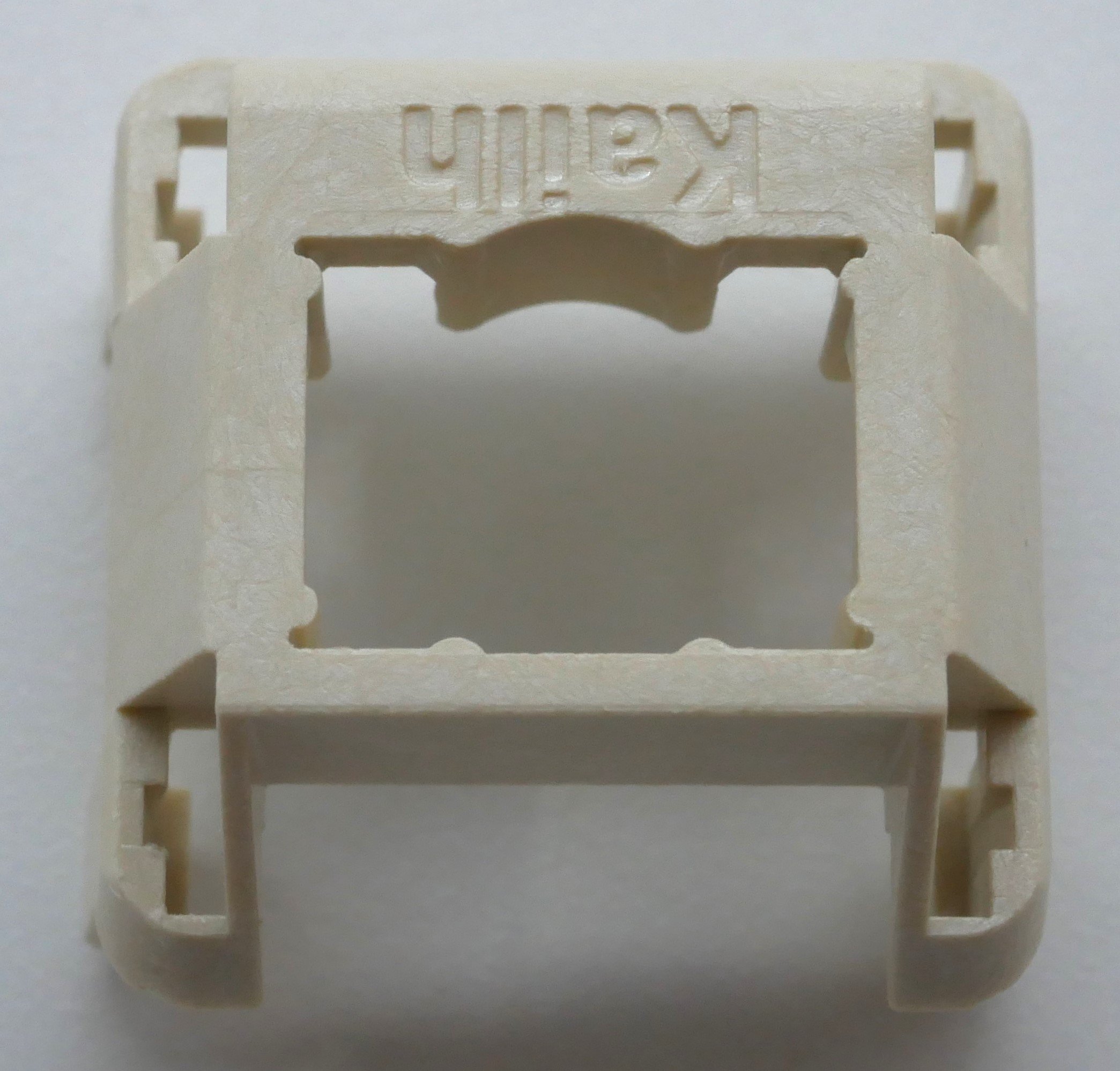
Figure 7: Top housing exterior of the Kailh Xuan switches showing an inverted, large font 'Kailh' nameplate and large, open LED slot for accommodating an LED diffuser wedge.
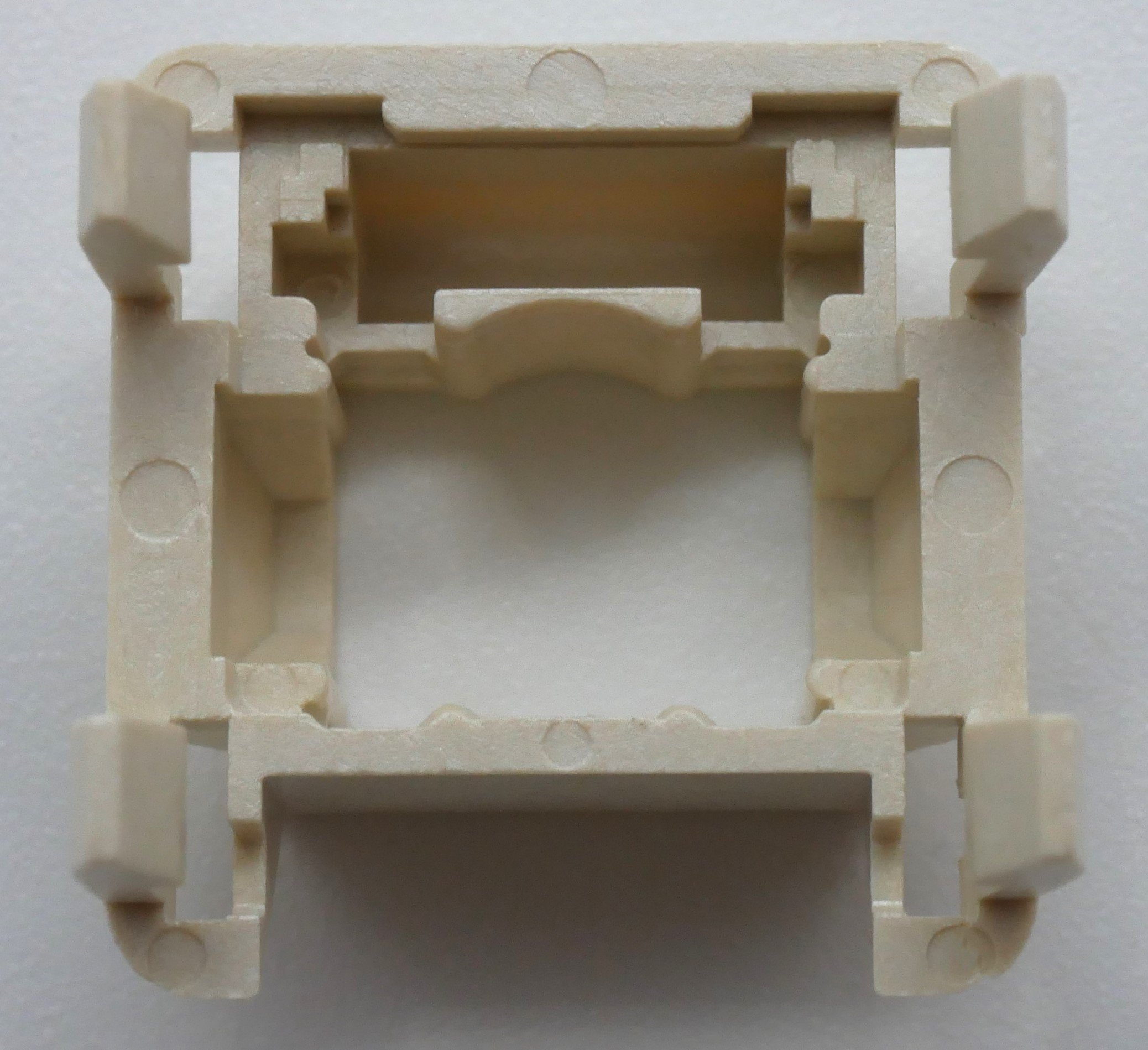
Figure 8: Top housing interior of the Kailh Xuan switches showing relatively mundane features as well as a capital letter mold marking located in a circular depression in the '[' shaped hole towards the left side of the nameplate region of the housing.
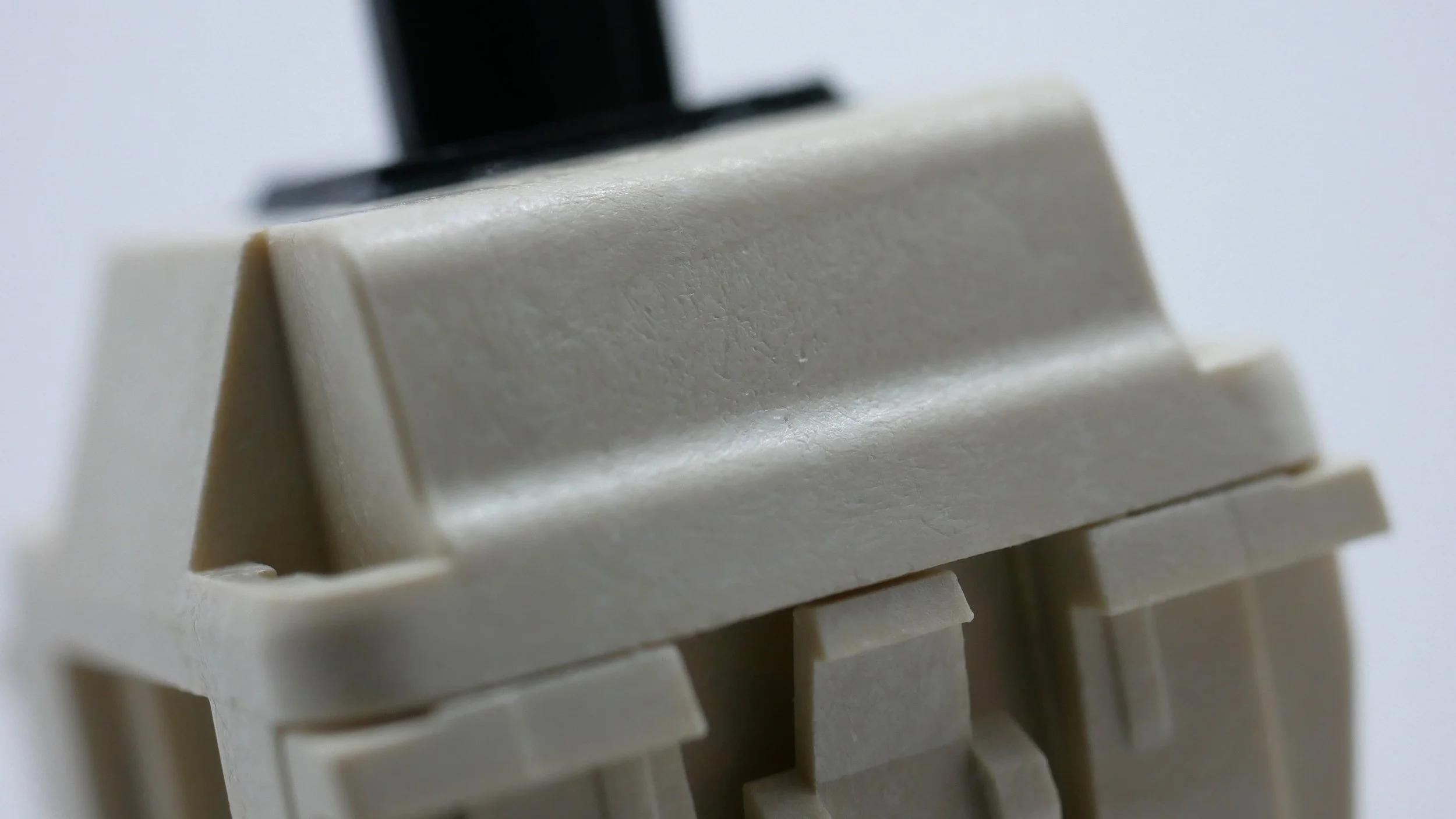
Figure 9: My best attempt at capturing a macro scale image of the noted housing texture present in the Liquid Crystal Polymer (LCP) housings of the Kailh Xuan switches.
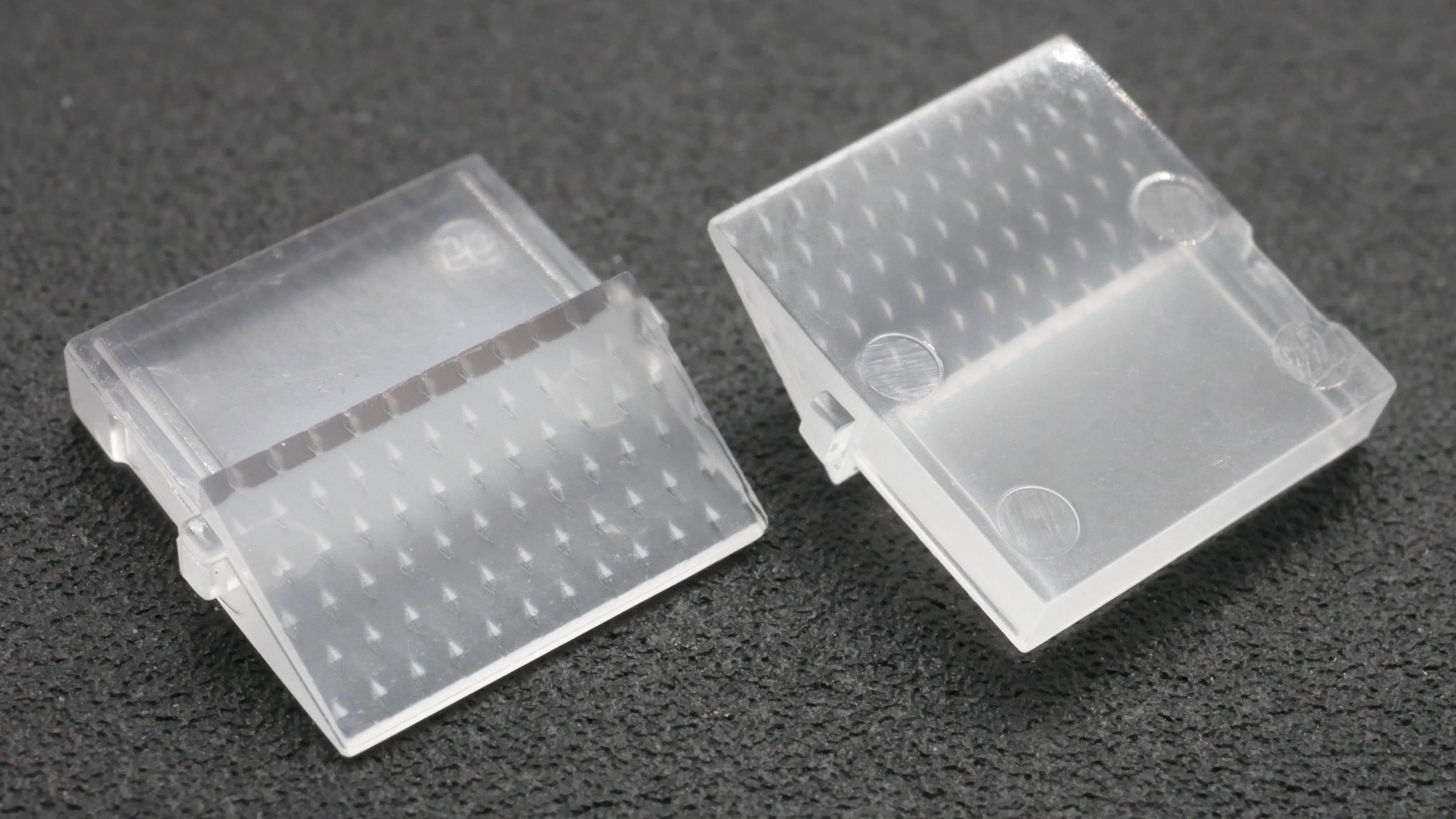
Figure 10: Dimpled LED diffusing wedges of the Kailh Xuan switches showing small, diamond-shaped engravings in the user-facing side.
Moving next to the melamine formaldehyde (MF), jet black stems of the Kailh Xuan switches, I’m sad to report there is not any novel texture discussions to be had here like those found for the top housings in the proceeding paragraph. In fact, by all accounts the stems of the Xuan switches come across rather mundane, being largely normal in shape, size, and appearance. They feature a strongly tiered, relatively normal length stem pole, tapered slider rails, mold ejector circles on their front plates, and even generous amounts of well applied, thin factory lubing coating all sides of the stems. While I do feel like I can see certain parts of the stems catching light with a different style of reflection than other parts, this is not something I’m even remotely equipped to be able to photograph well nor do I think the strange visions I’m having in the appearance of these stems mean anything.
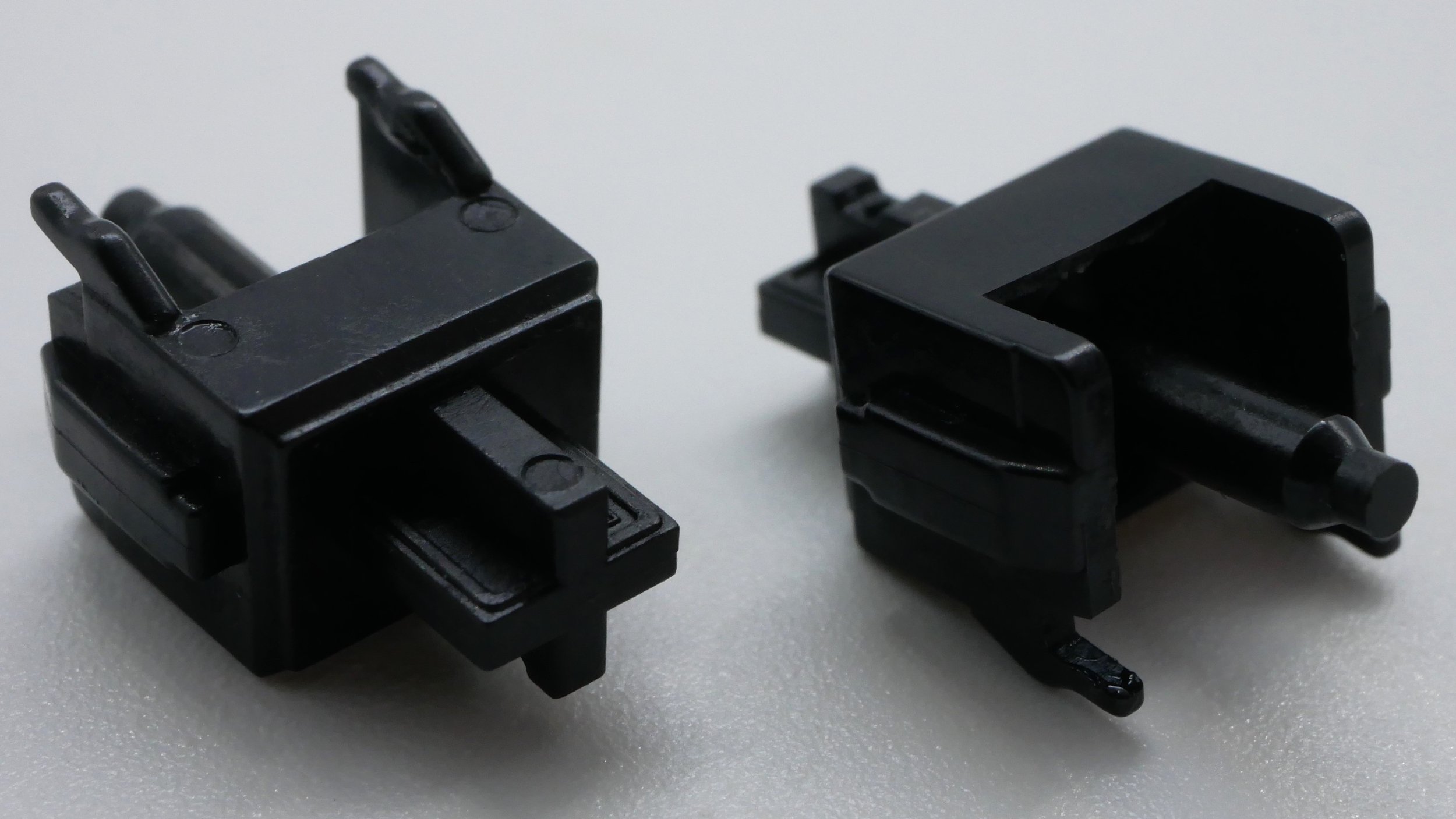
Figure 11: Front and backs of the Kailh Xuan stems showing slightly tapered slider rails, a normal length and tiered center pole, and even mold ejector circles on the front plate above the tactile stem legs.
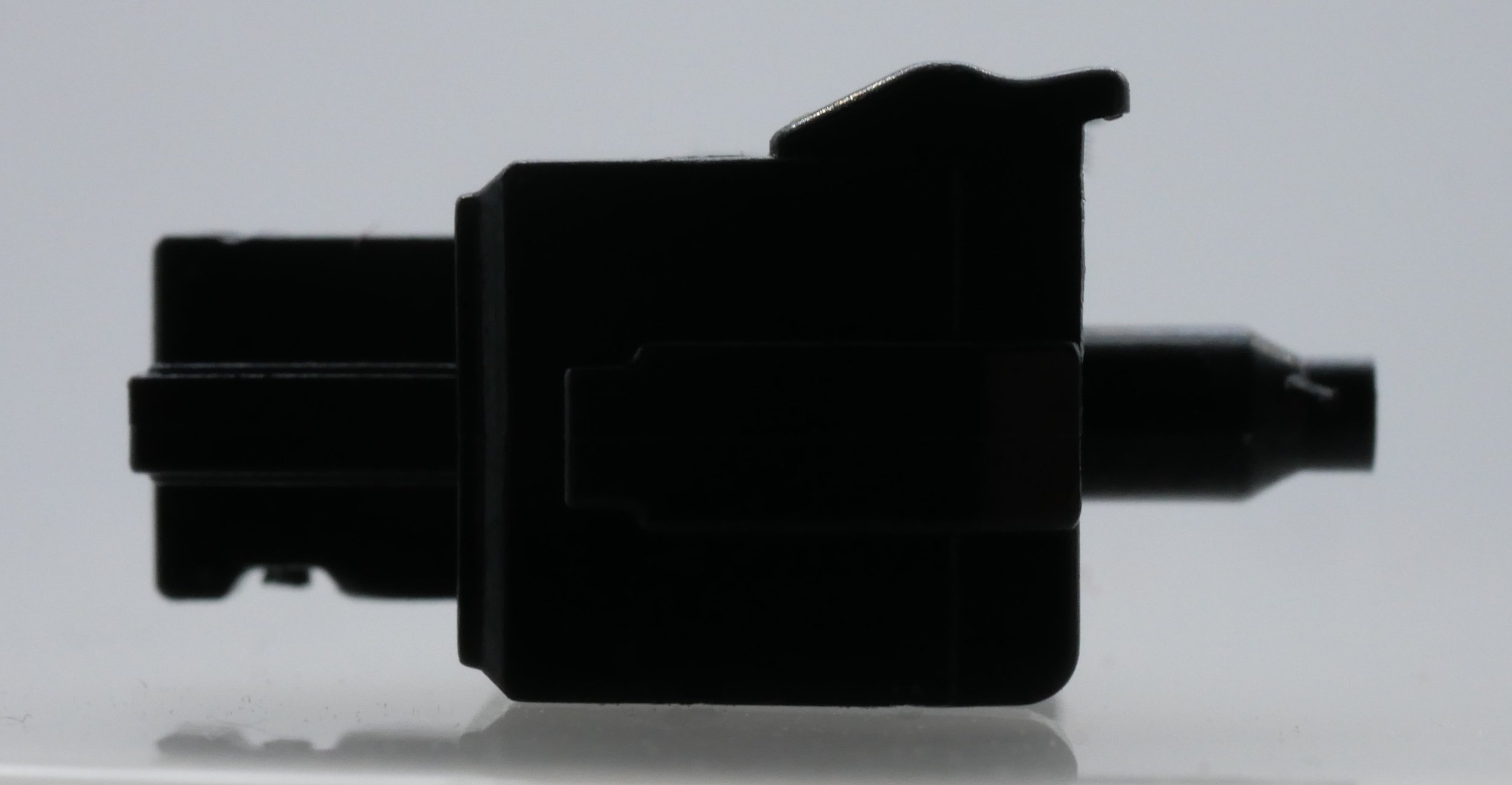
Figure 12: Blurry side profile of the Kailh Xuan stems to demonstrate the shape of their tactile legs.
Finally arriving to the other corporately beige LCP component of the Kailh Xuans in the bottom housings, we’re greeted with quite a few more design features than the top housings that are of note. Before getting to them, though, it is worth stating that the bottom housings do not seem to carry as much of that distinct texturing to them as the top housings do, ostensibly due to not having as large of areas of uninterrupted features as the top housings. Internally, the bottom housings feature no south side spring collar and rather plain, flat slider rails with no padding at their base. Around the center pole hole is not just a small, raised ring but at two small globules of thick, clear factory lubing that stand opposite of that of the slider rails. Much to my surprise this is apparent in nearly all switches that I opened meaning that this was deliberately done by Kailh at the factory and not just some strangely symmetrical factory lube formation that happened to coagulate so specifically in the first switch that I opened for photographs. Externally, the Kailh Xuans come in PCB mount/5-pin variety and feature a reasonable, single letter mold marking underneath the right-hand PCB mounting pin as well as one not so obviously marking. Located between the metal PCB pins and turned sideways like the ‘anticounterfeit’ markings previously documented in reviews on this website for TTC- and Gateron-made switches is a marking that says YIGIIX, I think? Or is it YIGNX? TIGNX? I’ll leave it to all of you to figure out from the photographs below what that very much not Kailh, nor mentioned anywhere in the spare marketing for the Xuan switches name is.
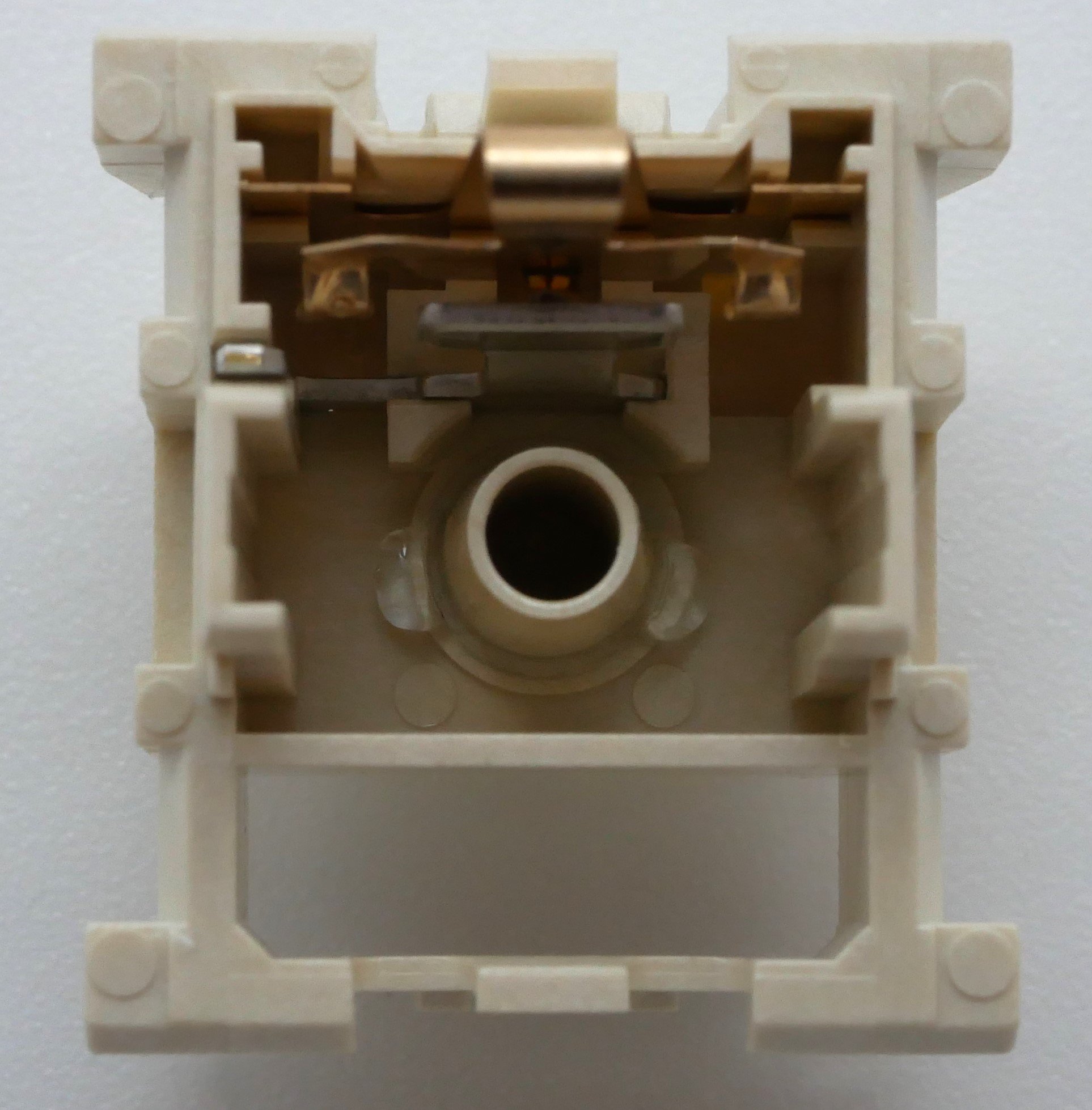
Figure 13: Kailh Xuan bottom housing interior showing no dampening pads at the base of the slider rails, a ring around the center pole hole, and two diametrically placed globs of thick, clear factory lube.
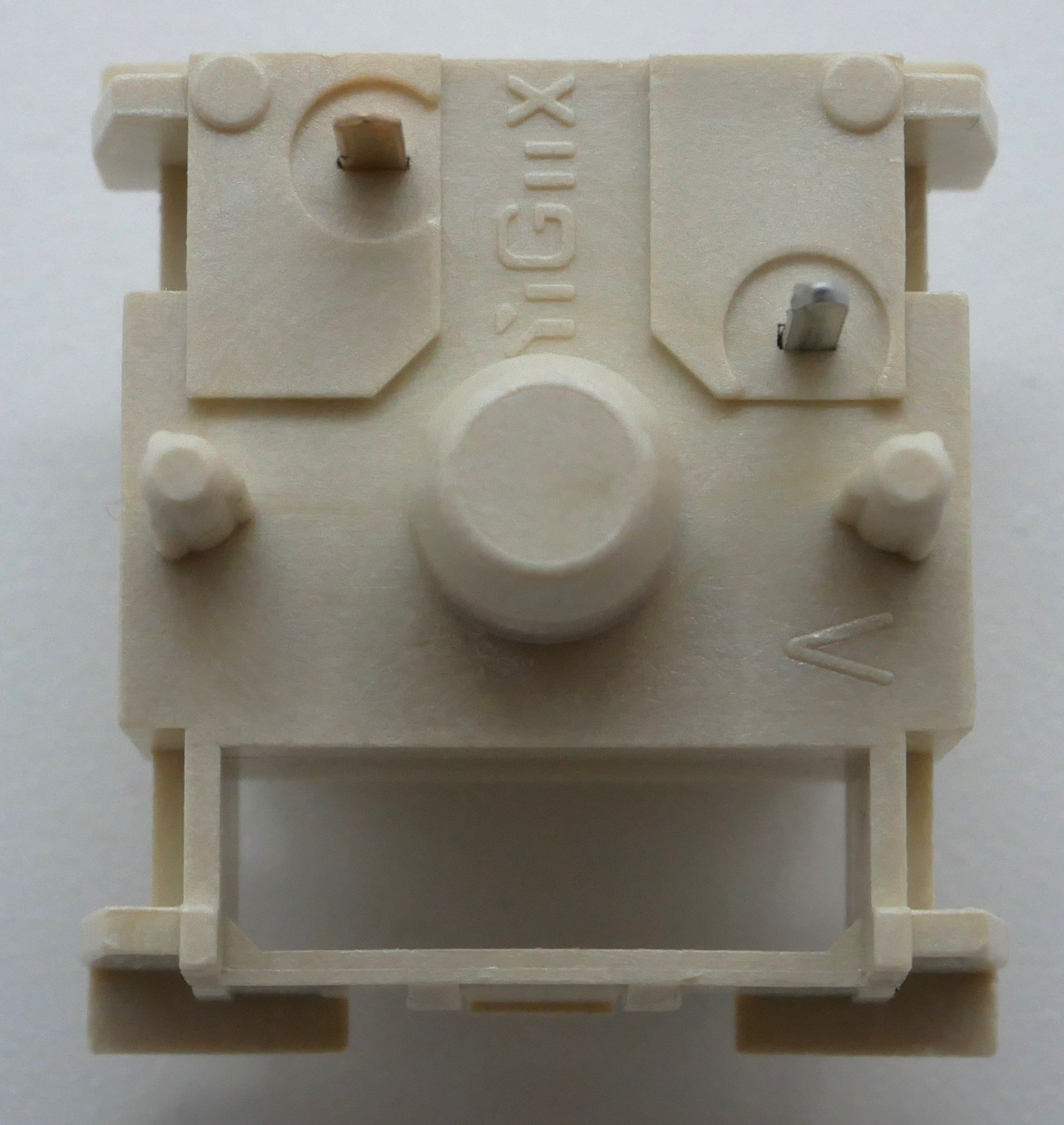
Figure 14: Kailh Xuan bottom housing exterior showing PCB mounting pins, a sideways capital letter mold marking, and a not Kailh branded 'anticounterfeit' marking located sideways between the metal PCB pins of the switch.
Push Feel
Admittedly, one of the reason that I have described myself as agnostic when it comes to switches marketed largely on the special materials used in their construction is the simple fact that I often can’t physically identify any differences in them versus just another bog standard switch. While it is sometimes a bit easier to notice the different impacts of unique material selections in the sound profile of switches, I still maintain that those differences in both push feeling and sound are incredibly subtle unless the material choices are truly pushing some boundaries not remotely approached before. Thankfully, the Kailh Xuans, and by extension their linear Calligraphy siblings, do push this boundary enough with MF stems in LCP housings to give a unique slant to the feeling of these switches. The first place where these differences are most notable in the Xuans is in their strokes, wherein the entirety of them through tactile bump and linear regions alike are saturated with a lightly leathery scratching feeling that isn’t bad, but is definitely unique in its presentation. The consistency of this feature across the entirety of the batch of Xuans that I received, in a way, reminds me of how the Novelkeys Cream switches had a very distinctive, peculiar scratch feeling to them that only really shows up in POM-on-POM housing interactions. (The Xuans do not carry a matching fishy smell, though, unlike those very first Creams.) I’m not saying that the peculiar friction feeling in the Kailh Xuan switches is one that is the same as that in the Creams, but it also is definitely not within the normal subset of switch experiences. The second place where the unique material combination of the Xuans is noticeable is in the housing collisions, which is quite close in presence behind the stem-on-housing feeling. The Kailh Xuan switches have both bottom and top outs that are thin and somewhat poppy at lower typing speeds, with a rounded kickback that just barely lets you know that its there without coming across sharp or aggressive at all. At faster actuation speeds these both thin out a bit more and become a bit more brittle feeling under the fingers, though they maintain a strong balance and still don’t come across sharp nor aggressive. Herein, the combination of MF interacting with the LCP housings, despite all of the factory lubing that is visually present, gives the Xuans an overall feeling that is reminiscent of all of the switches we’ve tried before but something not quite the same as the rest.
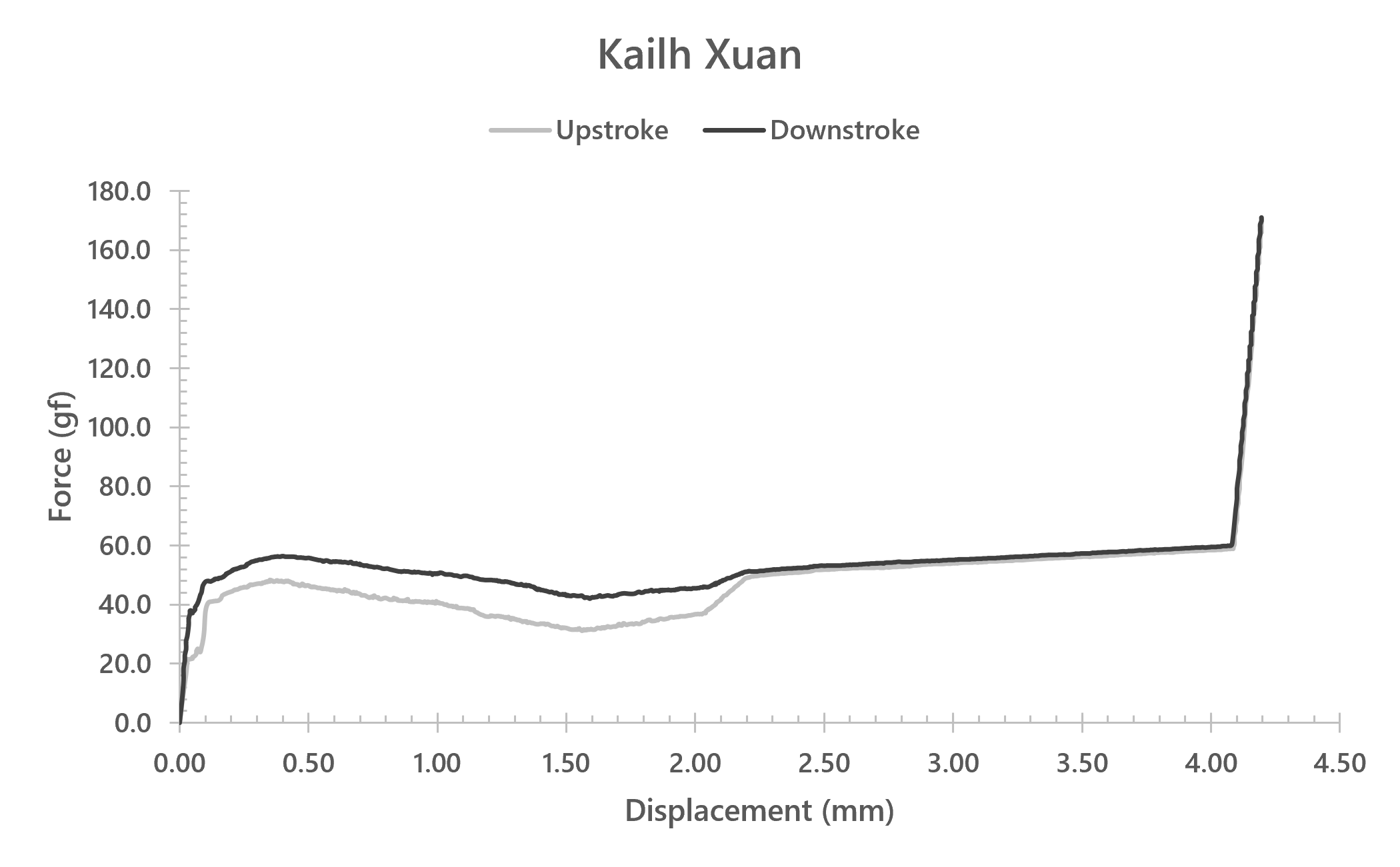
Figure 15: Force curve diagram for the stock Kailh Xuan switch.
As for the tactility of the Kailh Xuan switches, they are admittedly a little bit of an afterthought under finger when really focusing on the subtle, but very much noticeable ways in which the unique housing materials of these switches impact their feelings. The force curve for these switches above does more than enough to emphasize the reason for this as these are deceptively light feeling tactile switches with a soft tactile bump that jabs out of the gate but only noticeably when you’re typing on the Xuans at some reasonable pace. Deliberately actuating the Kailh Xuans slowly causes the bump of these switches to almost entirely go unnoticed, something which likely stems from the fact that their peak tactile force at the pinnacle of the bump is so close in strength to that of majority of the post bump linear region leading into their bottom out. Despite there being distinct tactile and linear regions to the stroke, there’s not a lot of contrast in the force between them. At reasonably fast typing speeds, though, users can catch a tiny bit of the dip in force as the tactile bump unwinds that causes the switch to overall have a light kiss of tactilty at the onset before rolling out into the rest of the stroke. In a way, I suppose that this is a fitting degree of tactility for the Xuans as it both makes them usable for long periods of typing – something you’d want to make people inclined to do in order to become accustomed with the strange materials present here – as well as makes the MF and LCP housing material combination the real star of the show.
Sound
Unfortunately, which is always a great word to start out any section on switch performance with, in spite of all of the positive details that can be pointed to as to how unique the Kailh Xuan switches feel in hand, their sound profiles do suffer notably in execution. In the most ideal of states, these switches have housing collisions as well as a tactile bump that are all snappy sounding, with firm collisions that are definitely higher in pitch and volume, though not at all lacking in the bass tones that give them a sort of full bodied presence. The Xuans have a sound that strikes a great balance of coming across solid and yet lighter, and more airy sounding though without any of the housing thinness or more prickly tones that usually crop up at this lighter end of the switch sound spectrum. Furthermore, the snappiness of the tactility in the Xuans does a fair bit to help hide the subtle shuffling scratch sound of the switches that is present in more or less all of the switches in the batch that I received. However, viewed through a more realistic lens, there is a strong amount of cross batch variability in the “profile” of the sound of at housing collisions for these switches, which is especially apparent at their topping out. When I use the world “profile” here, I’m trying to describe how the sound of the housing collisions sort of ‘fills the space’, if you will. I feel like we all kind of already intuitively understand this premise as I can point to thin, sharp, and plasticky sounding polycarbonate switches as having a thin, pointy ‘profile’ or footprint to their sound whereas bassy, deep nylon switches have a wide footprint or bigger ‘profile’ and more or less most people would agree. (A Bouba/Kiki moment, if you will.) In the Kailh Xuans, while they maintain that same sort of snappiness and depth to all of the switches that I tried, they modulate an absolute ton with respect to the size of their housing collision profiles. Some switches top out (and bottom out too) with a small, more constrained snap whereas others do so with large, stomping snaps and every other switch in this gamut is present too. It’s definitely noticeable enough that I’m not certain it could be ignored across the entirety of a keyboard build for most users, either. I am at least happy to say here that the unique combination of MF stems in LCP housings does not escape me as the skeptical agnostic and that they do very much give a unique sound profile. Arguably, though, it produces too many unique sound profiles at once.
Wobble
While nearly all of the Kailh Xuan switches which I received in my batch have equal magnitude of stem wobble in the N/S and E/W directions, there is a small but noticeable amount of variation in the magnitude of this wobble from switch to switch. Generally, however, the vast majority of these switches have a small degree of wobble that isn’t likely to bother most users and is definitely better than what my recollection is of the historical running average for switches I’ve tested over the years. The differences between the switches in the batch are not likely large enough to require deliberate cherry picking of switches by users for a matching stem wobble across their custom keyboard builds.
Measurements
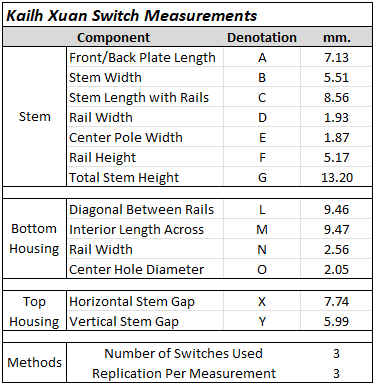
If you’re into this level of detail about your switches, you should know that I have a switch measurement sheet that logs all of this data, as well as many other cool features which can be found under the ‘Archive’ tab at the top of this page or by clicking on the card above. Known as the ‘Measurement Sheet’, this sheet typically gets updated weekly and aims to take physical measurements of various switch components to compare mold designs on a brand-by-brand basis as well as provide a rough frankenswitching estimation sheet for combining various stems and top housings.
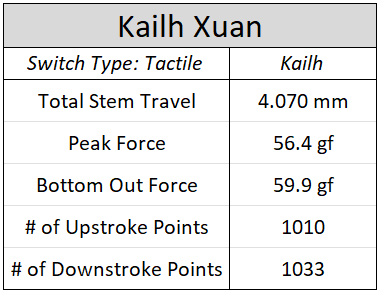
Figure 17: Numerical details regarding the force curve for the stock Kailh Xuan switches.
Have you ever wanted to be bombarded with more switch data than you’ve ever seen at any point in your life before? Consider checking out the ‘Force Curve Repository’ hosted on my GitHub that contains all force curves that I take both within and outside of these full-length reviews. In addition to having these graphs above, I have various other versions of the graphs, raw data, and my processed data all available for over 2000 different switches for you to use however you see fit. Check it out via the ‘Archive’ tab at the top of this page or by clicking any of the force curve cards above.
Break In
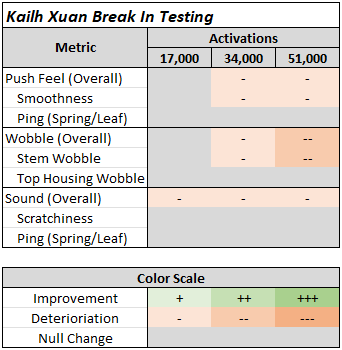
Break In Notes
17,000 Actuations
- Even in spite of the fact that the stock Kailh Xuan switches already have a noticeable range of topping and bottom out feelings, those that were broken in to 17,000 actuations somehow had an increased variability with respect to such. While it definitely feels like more switches polarized towards extreme ends of the sound spectrum than their stock counterparts, there was still a decently well represented range of sound ‘profiles’ from small to large.
34,000 Actuations
- After 34,000 actuations, the most notable change in the performance of the Kailh Xuan switches is an increased scratchiness in all of the switches in the batch. While I would have expected the thick, viscous factory lubing that was seen above in the bottom housings to spread out into the rest of the switch here through this stage of break in, it simply appears that it did not, leaving these broken in switches with a more defined, grainy scratch to them.
- There was a noticeable increase in both N/S and E/W direction stem wobble of the Kailh Xuan switches broken in to 34,000 actuations as compared to their stock or 17,000-actuation counterparts.
51,000 Actuations
- At 51,000 actuations, the Kailh Xuan switches did not pick up any further changes to their sound profile consistency nor scratchiness that wasn’t noted in the previous two stages of break in testing. The only noticeable change beyond this point was that the switches further increased their N/S and E/W stem wobble, making them distinctly more wobbly than their stock versions.
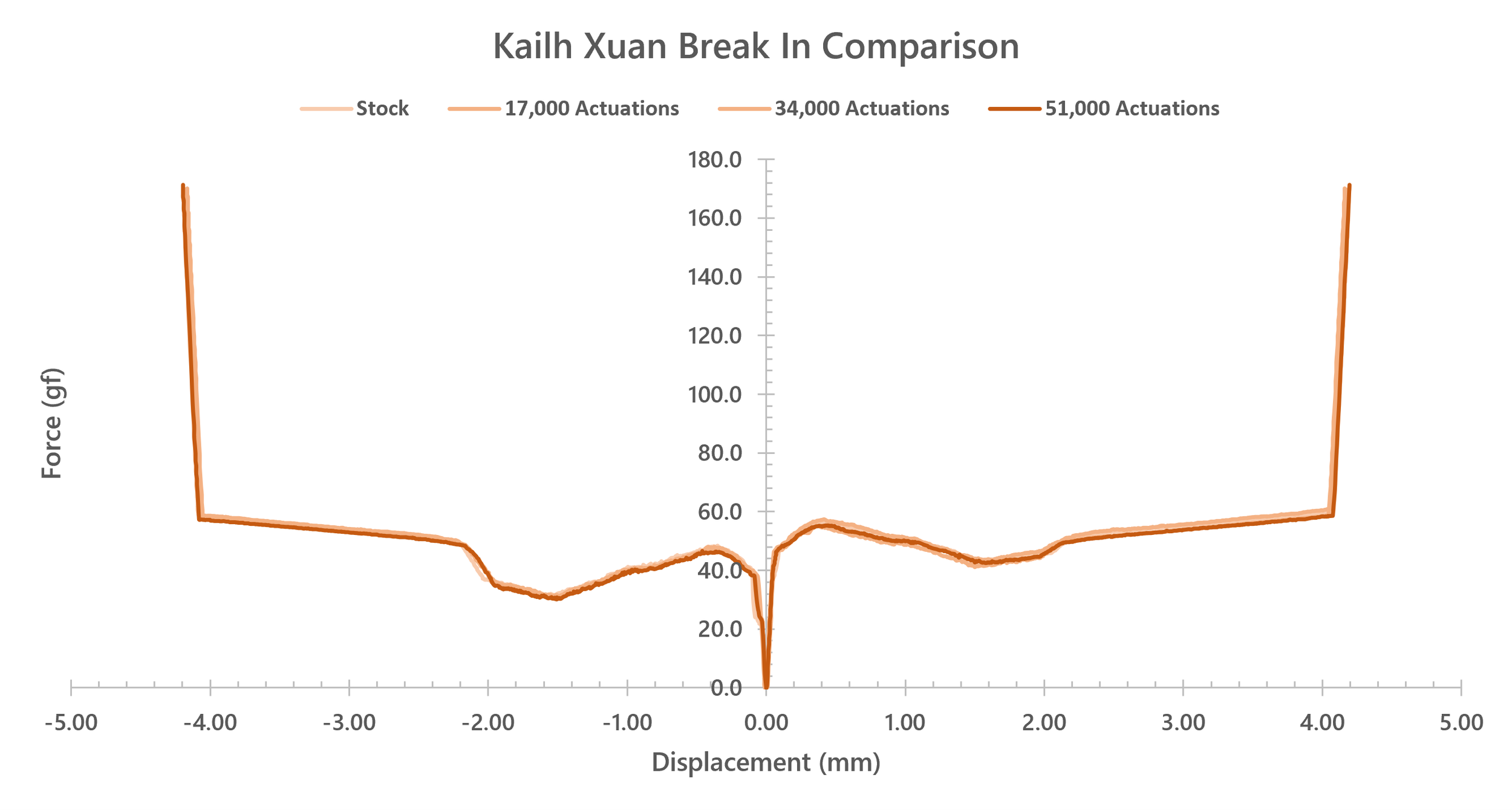
Figure 19: Comparative force curve diagram showing no substantial, consistent change in the force curves of the Kailh Xuan switches throughout the break in process.
Comparison Notes to Other Notable Tactile Switches
Note – These are not aimed at being comprehensive comparisons between all factors of these switches as this would simply be too long for this writeup. These are little notes of interest I generated when comparing these switches to the Kailh Xuan switches side by side.
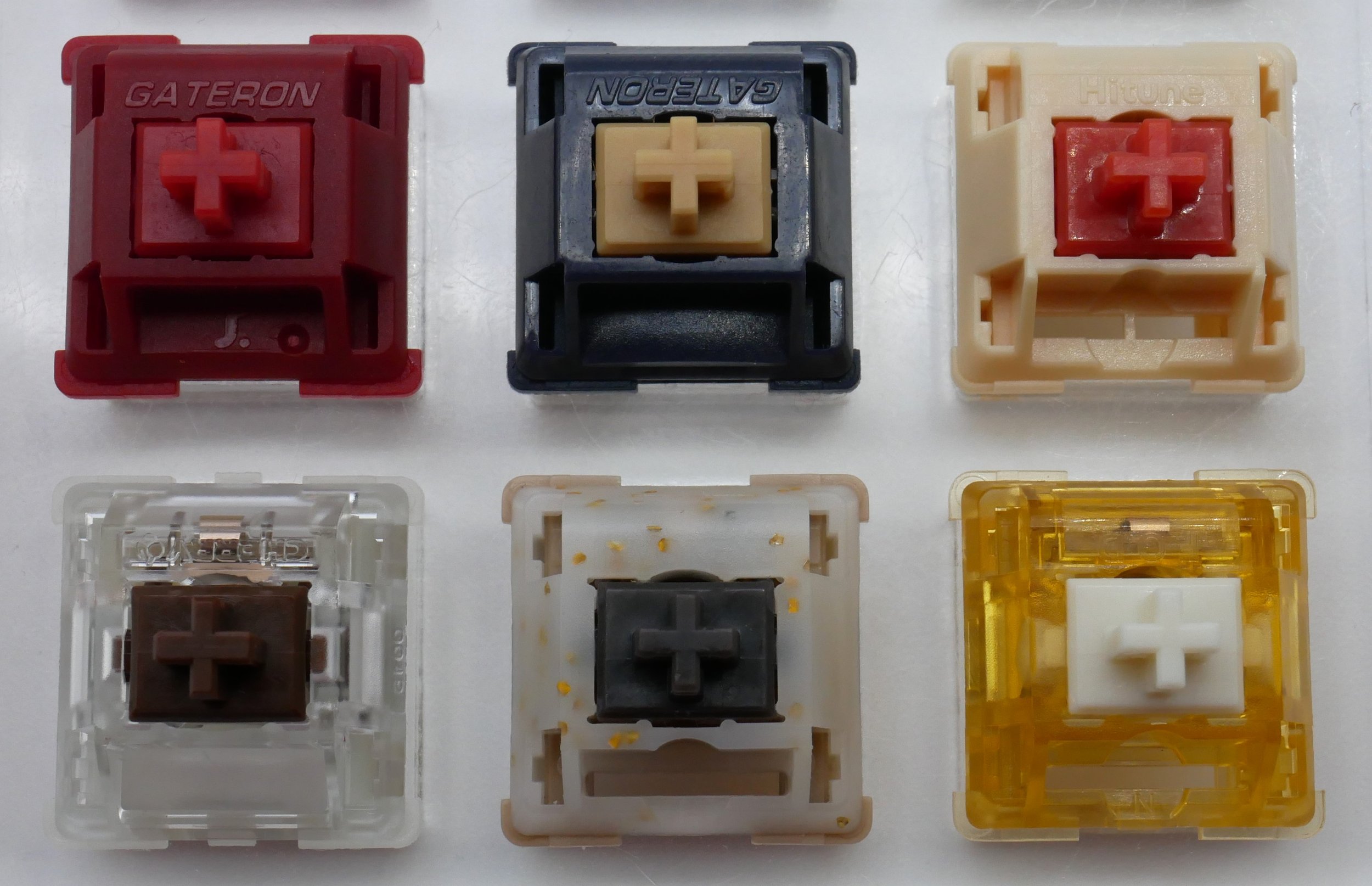
Figure 20: Switches for comparison. (L-R, Top-Bot: Sillyworks x Gateron Type R, Gateron Lanes, Wingtree BM11, Cherry MX Lumina Brown, Hojicha Reserve, and BSUN Golden Apple)
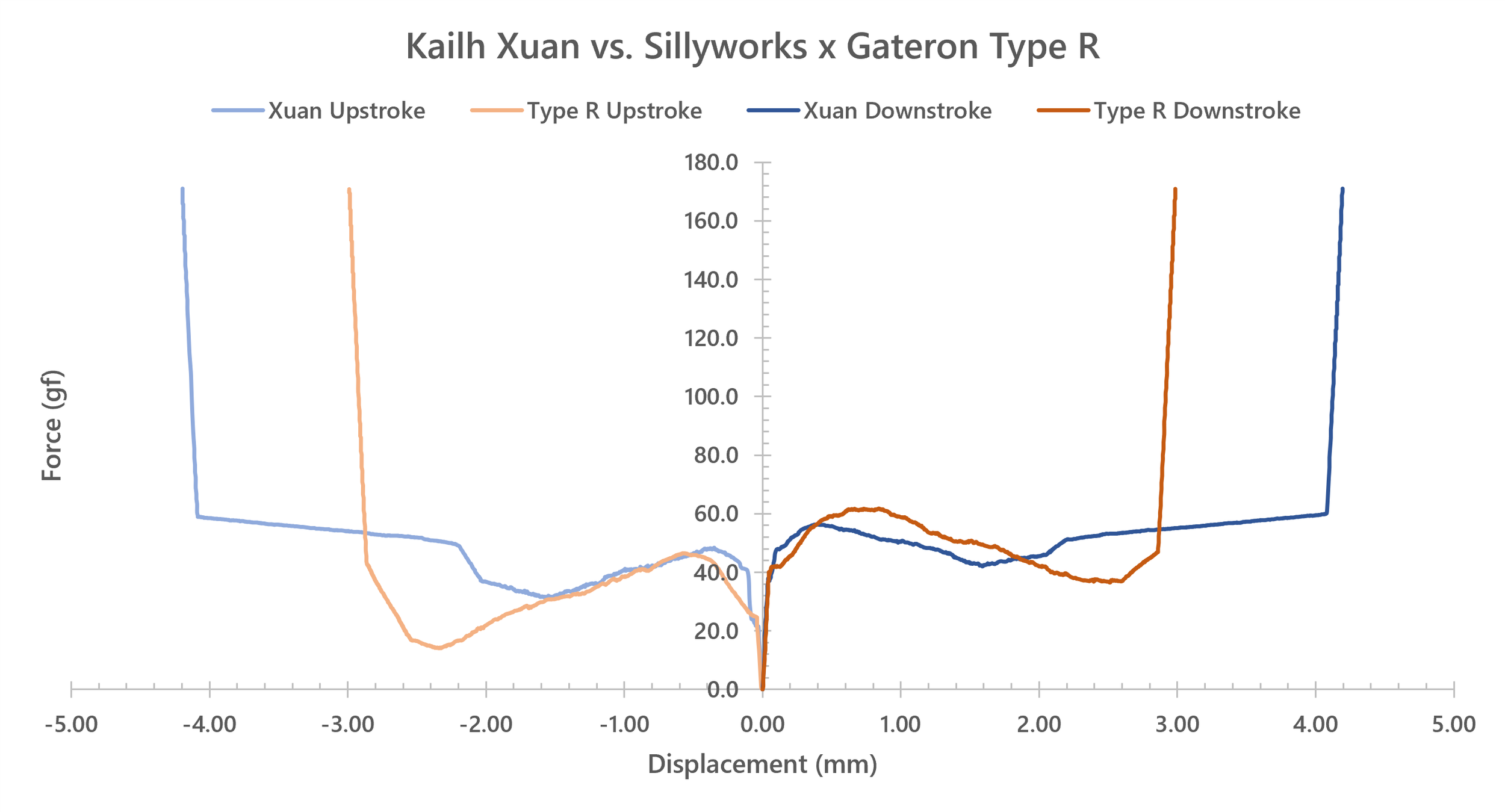
Sillyworks x Gateron Type R
- While the comparative force curve between these two switches below would suggest that the tactile bump of the Kailh Xuan switches hits ever so slightly earlier in feeling than that of the Type R tactile bumps, in hand that is not what is felt at all. Likely due to the significantly larger force of the Type R switches at their peak bump, they do feel as if they punch sooner than the Kailh Xuan switches.
- There is a tiny bit less N/S and E/W direction stem wobble in the Sillyworks x Gateron Type R switches than there is in the Kailh Xuan switches, though admittedly the gap between them is a lot more narrow than I would have expected.
- With respect to their overall sound profiles, the Type R switches are both noticeably louder and more driven by the sound of their aggressive stem pole bottom outs than the more mild, subdued Kailh Xuan switches. As well, the lack of linear pre- or post-bump regions in the strokes of the Type Rs minimizes their ability to have sound strongly impacted by scratch – something which the Kailh Xuan switches have as one of their more key features of their sound profile.
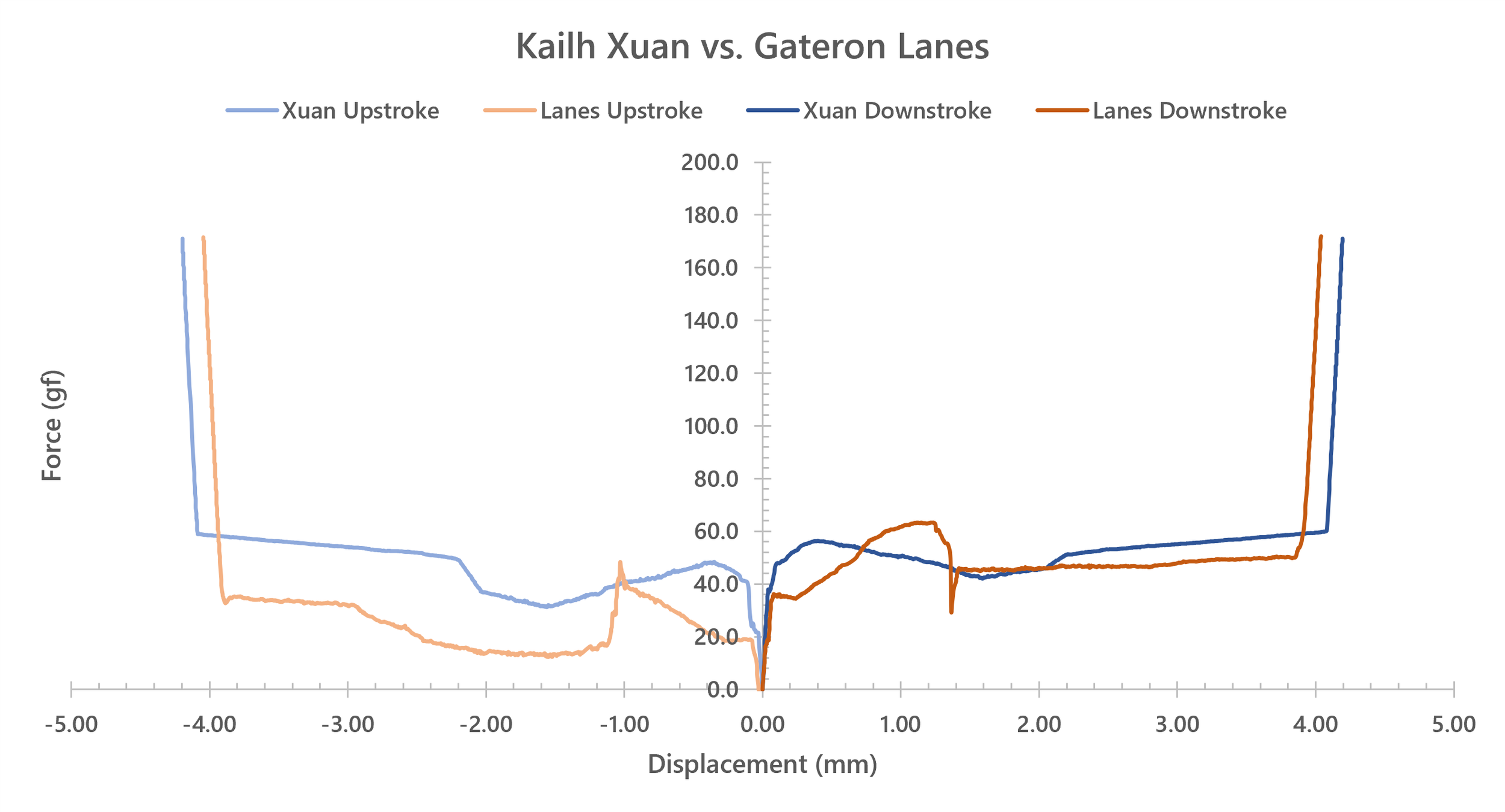
Gateron Lanes
- Likely due to the specific combination of materials chosen in the Kailh Xuan switches, their bottom outs are much more noticeable than that of the Gateron Lanes in terms of both their push feeling and sound. In a way, the relative softness of the bottom outs of the Lanes makes them feel like they have ever so slightly longer strokes than that of the Xuan switches, something which contradicts their comparative force curves seen below.
- There is a similar amount of N/S stem wobble between these two switches, though the E/W direction of the Gateron Lanes is more tight and has less room to give than in the Xuan switches.
- The overall sound of the housing collisions of the Kailh Xuan switches is one that is brighter, higher pitched, and a tiny bit louder than that of the Lanes. By comparison, the click leaves in the Lanes, though, make more noise than the subtle, snappy tactile bumps of the Xuans.
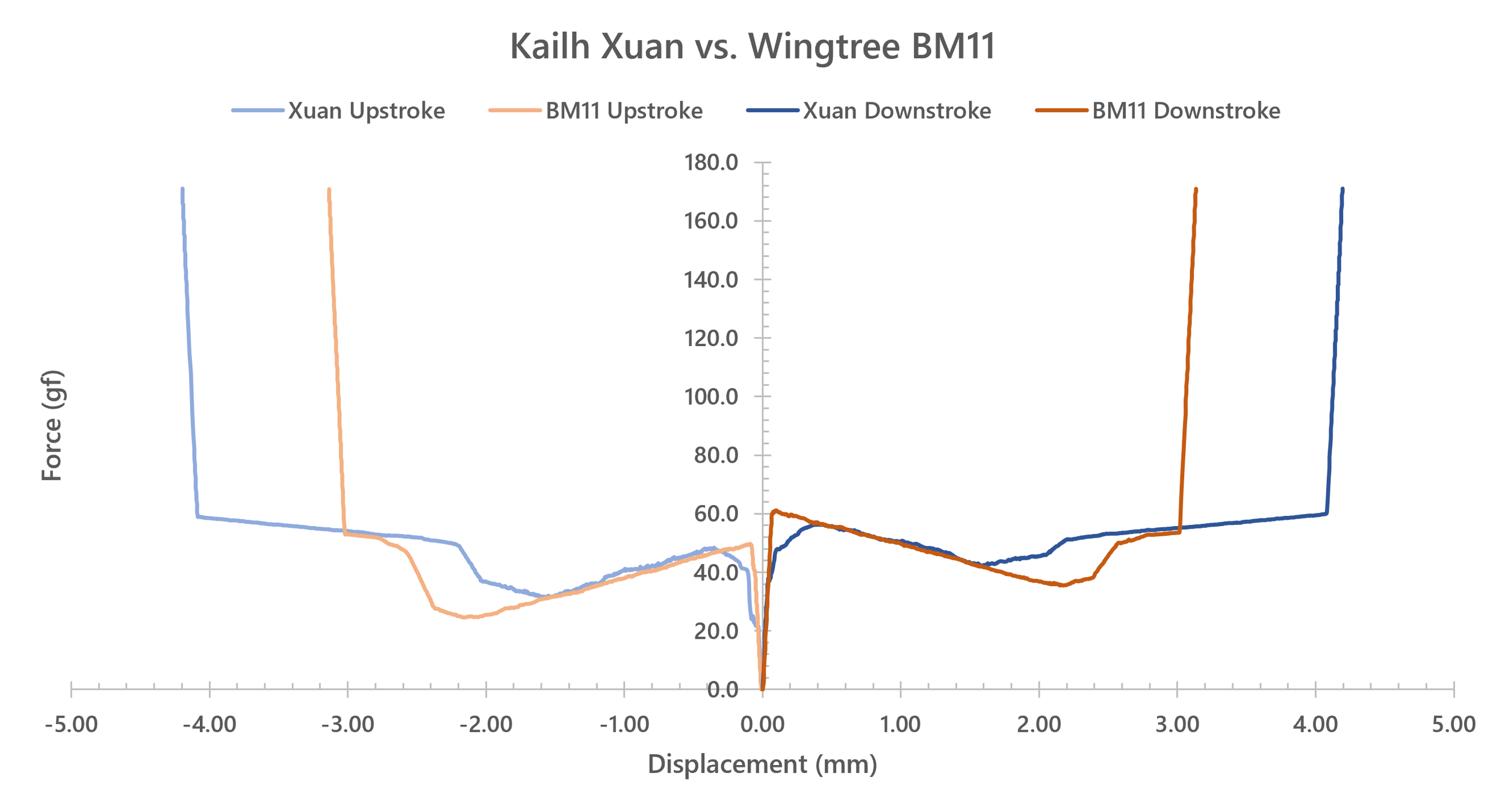
Wingtree BM11
- There is significantly less stem wobble in the N/S and E/W directions of the Wingtree-made BM11 switches than there is in the Kailh-made Xuan switches. I should also note that this appears to be indicative of a larger, manufacturer versus manufacturer trend as Wingtree’s releases over the past year have had exceedingly little stem wobble. I can’t say the same for Kailh, however.
- While both the BM11 and the Xuan switches have a tiny bit of scratch to their feeling, the factory lubing on the BM11s is clearly much more adequately placed to help eliminate that production issue.
- The comparative force curve between these two switches below is actually quite true to how their feel next to each other in hand, with the BM11s feeling as if they punch sooner, punch harder, and clock out sooner at the end of their stroke than the Kailh Xuan switches, which by comparison are more subtle and take more time to develop throughout their strokes.
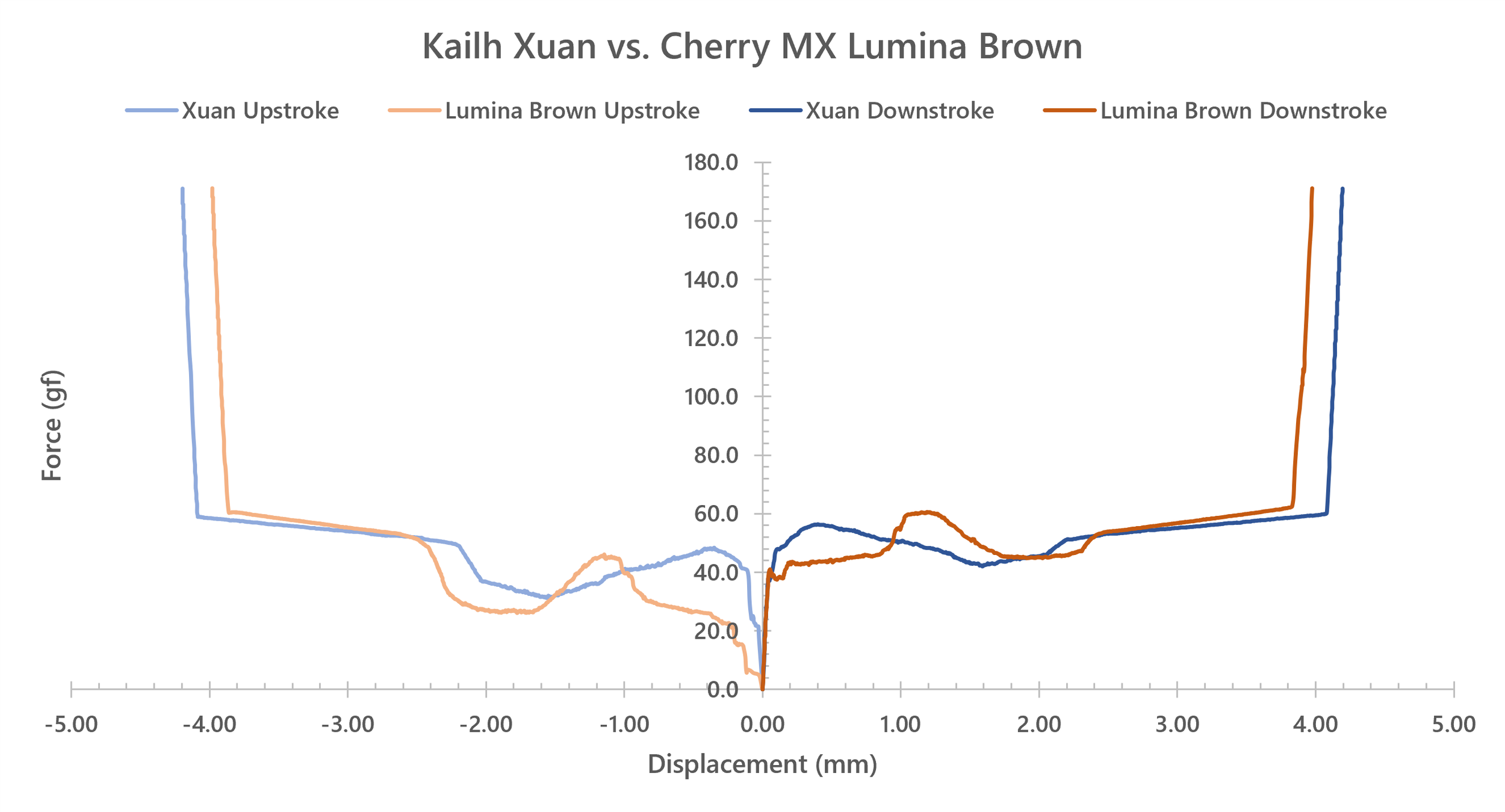
Cherry MX Lumina Brown
- To the surprise of basically nobody who has ever interacted with a Cherry MX Brown switch of any form before, the MX Lumina Browns here are just flat out the more scratchy and gravely feeling of these two switches when compared head to head. This holds true both in the linear portions of the strokes for the MX Lumina Browns and the Xuans as well as through their tactile bump.
- There is noticeably less N/S and E/W direction stem wobble in the Kailh Xuan switches than there is in the Cherry MX Lumina Brown switches.
- Perhaps the strangest point of comparison between these two switches, or really any switches on this comparison list, is that the MX Lumina Browns are actually more consistent across the batch that I reviewed of them than the Kailh Xuan switches. Do not get me wrong – the MX Lumina Browns, on average, perform significantly worse than the Xuans across the board, they just happen to do so in a more consistent fashion than the Xuans.
Hojicha Reserve
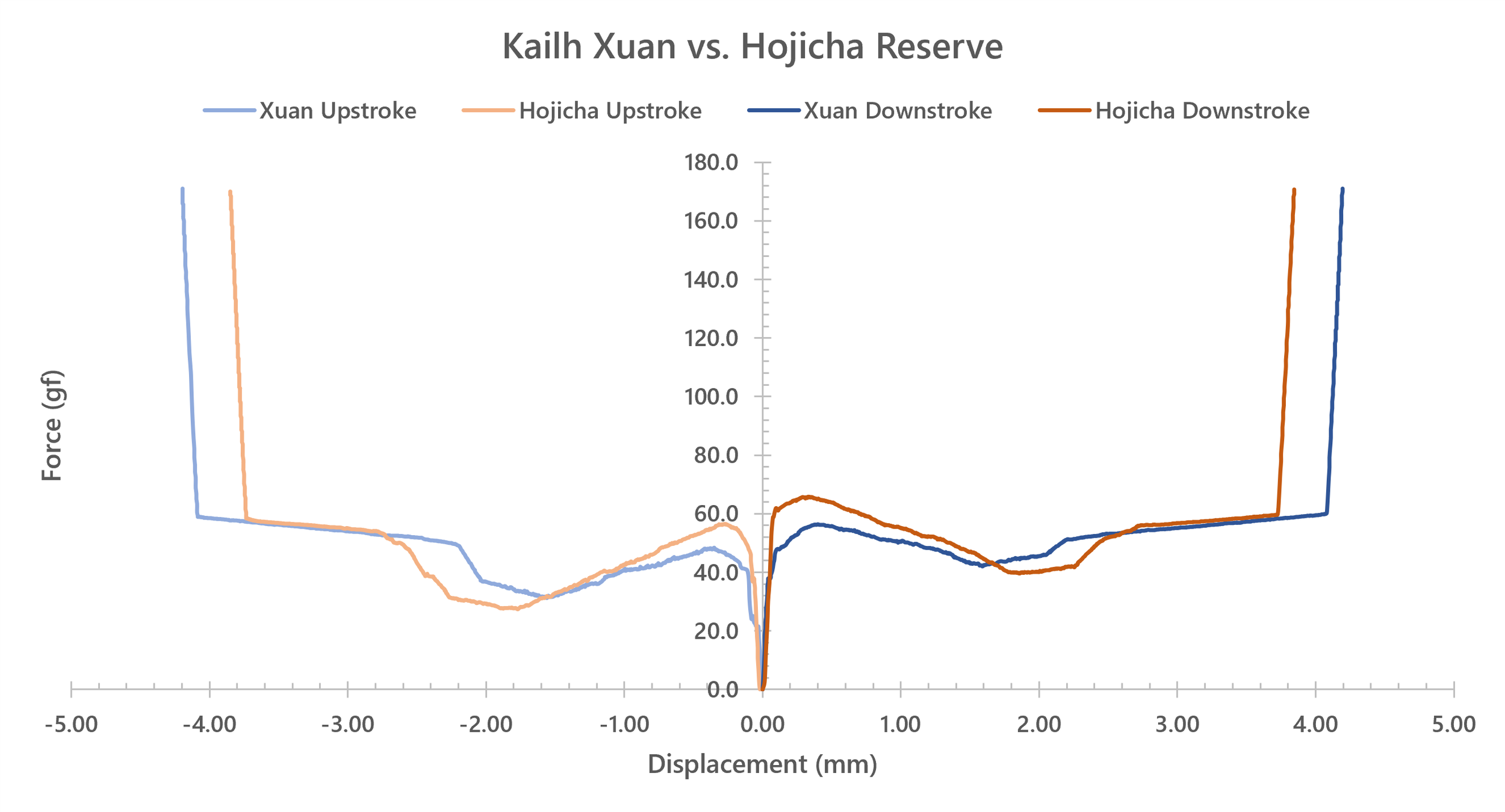
- Of all of the switches on this comparison list the Kailh Xuans and Hojicha Reserve are the two that are most similar to each other as tactile switches. As is also evident from their comparative force curve below, these two switches have similarly strong tactile bumps in similar places of their respective strokes and even bottom out in similar locations as well.
- The Hojicha Reserve switches are noticeably more smooth and heavily lubed in all of their switches than the Kailh Xuans.
- There is less N/S and E/W direction stem wobble in the Hojicha Reserve switches than there is in the Kailh-made Xuan switches.
BSUN Golden Apple
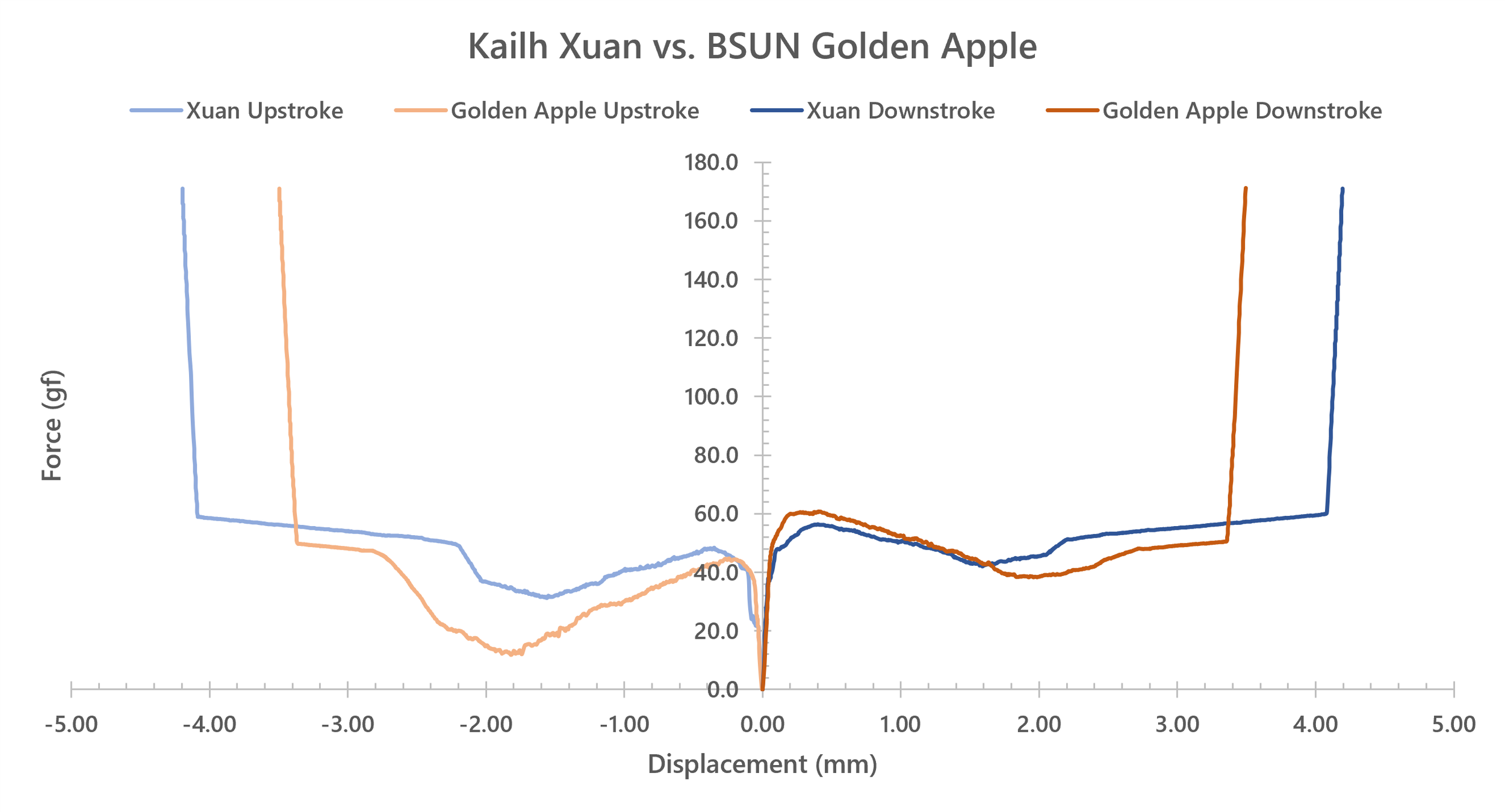
- I imagine that the comparative force curve between these two switches below would make the first claim under the Xuan’s comparison to the Hojicha Reserve switches seem a bit odd. That being said, though, despite the force curves between the Xuans and Golden Apples looking more similar than the comparison between the Xuans and Hojicha Reserves, in hand the Golden Apples feel softer, more rounded, and not nearly as snappy through their bumps as the Xuans do. In turn, the tactile bumps of the Golden Apples also sound snappier as well.
- There is noticeably less N/S and E/W direction stem wobble in the BSUN Golden Apple switches than there is in the Kailh Xuan switches.
- Like most other switches on this comparison list, the Golden Apple switches are much more generously lubed and in turn have smoother feelings to their strokes than the Kailh Xuans.
Scores and Statistics
Note – These scores are not necessarily completely indicative of the nuanced review above. If you’ve skipped straight to this section, I can only recommend that you at least glance at the other sections above in order to get a stronger idea of my opinion about these switches.
Push Feel
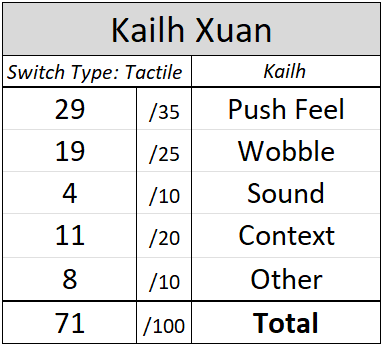
Built as the lightly tactile, early snapping counterparts of the Kailh Calligraphy linears, the Xuans are a switch predominantly centered around the interaction of their melamine formaldehyde (MF) stems and liquid crystal polymer (LCP) housings. These interactions – at topping and bottom out – produce snappy housing collisions that feel airy without the thinness or sharpness of comparable other feelings and is fairly consistent across the batch received. As well, the Xuans are certainly not the best lubed from the factory, though the MF on LCP friction does give a unique grain feeling to their strokes that is not gravely, though definitely unique in texture.
Wobble
Present equally in both N/S and E/W directions, the Xuans have a better than average but potentially noticeable amount of stem wobble that is only likely to bother users that are particularly picky about this metric.
Sound
In the most of ideal states, the light tactile bump meshes well with the housing collisions of the Xuans to produce a rich, rounded snappiness that is medium-high in volume towards the higher end of the pitch with only subtle undertones of velvet scratch. However, the batch of Xuans I received suffers greatly from cross-batch variability in the ‘profile’ of the switches’ sound at housing collisions causing some to sound quite more substantial than others.
Context
While the Kailh Xuans are priced well $0.45 per switch and have some vague community awareness on account of a few Calligraphy reviews, Kailh is historically bad at propagating R&D successes such as MF and LCP housing materials into continual or future releases of switches.
Other
With incredibly fun housing materials and a well balanced tactility that doesn’t override them, I feel sad these switches haven’t gotten nearly as much community attention as they do deserve.
Statistics
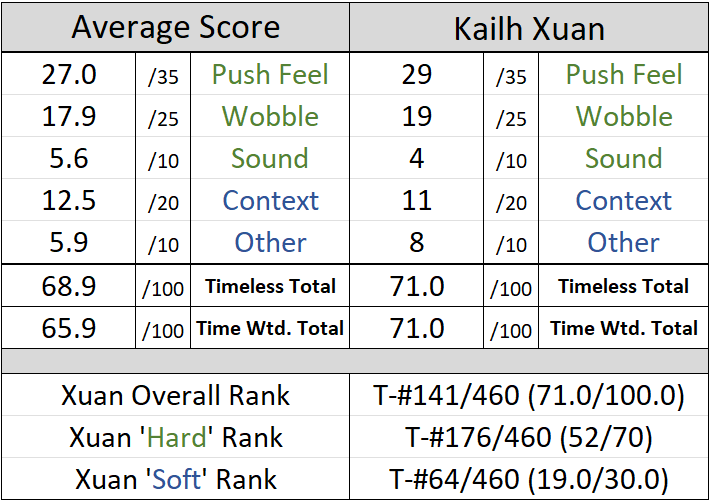
If you are looking at this statistics section and wondering what the heck ‘Timeless’ and ‘Time Weighted’ scoring is, consider checking out my short article titled ‘A Scorecard Time Change’. As a result of scoring becoming a bit anachronistic over the years, switches are now ranked in this statistics table using a “time weighted total” as opposed to their day-of scoring as discussed in that article. If you’d also like to learn about what ‘hard’ versus ‘soft’ ranks refer to specifically, I’d encourage you to head on over to my GitHub linked in the table above or at the links in the top right hand of this website to check out my database of scorecards as well as the ‘Composite Score Sheet’ which has a full listing of the rankings for each and every switch I’ve ranked thus far.
Final Conclusions
Having cobbled together a scorecard for the Kailh Calligraphy switches towards the start of 2026, I went into this full length review with a pretty clear set of expectations as to what I was going to get in the Kailh Xuans. I expected the subtle, leathery scratch of their MF stems on their LCP housings. I expected the wide swings in sound profile despite their relatively consistent feeling, consistent mold designs, and cross batch similarity in their factory lubrication (or ostensible lack thereof) as well. I even expected all of this to not really be changed much by the mere addition of tactility – and yet I’m still more impressed than I would have expected that I would be. I think the Kailh Xuans turned out even better than the Calligraphy linears. Despite the wishes of a community that has been adamant for years that any and all tactility has to be the overwhelming star of the show in the switches that it is present in, Kailh rather artfully walked the fine line with the Xuans and gave them some light, snappy tactility that is noticeable and easy to seek out without overshadowing the bigger selling points of these switches in their unique housing materials. That isn’t to say that Kailh executed on these switches perfectly either, as there’s plenty of room for improvement when it comes to their factory lubing and consistency in the overall performance of the switches derived from such. And yet what there isn’t much room left for Kailh to really toy with here is a sort of unique character that the Kailh Xuan switches embody. I have no doubt that if the Kailh Xuans were tossed into the community at what feels like any other point in time throughout the history of the modern mechanical keyboard scene that they would have made countless waves, been included in endless discussions about frankenswitching, and would have been remembered eternally as a pillar example of just how much customization we all could squeeze out of a seemingly mundane switch footprint with thousands of iterations. These switches fill a niche, sure, but do so as part of a very large, rather expansive patchwork of subtle differences that can be reached for, modified, and improved upon by users to make truly the keyboard of their dreams. And yet, the discourse of the modern day leaves this review as likely some of the only solid documentation and discussion about the Kailh Xuans that will ever exist about them before they inevitably fade from the few storefronts they’re present on. Don’t let the scorecard fool you, I think these switches are more than the sum of their parts and their performance and it leaves me deeply saddened to think that it’s not likely to ever be recognized. I’m not sure I need to belabor that sadness any more than I did at the top end of this review. The Kailh Xuans are great examples of flawed switches with the character that makes the MX footprint and all of its iterations out there over the years as intriguing as it, whether people want to recognize it for such or not.
Sponsors/Affiliates
Mechbox UK
- A wonderful UK based operation which sells singles to switches that I’ve used above in my comparisons for collectors and the curious alike. Matt has gone out of his way to help me build out big parts of my collection, and buying something using this link supports him as well as my content!
proto[Typist] Keyboards
- An all-things keyboard vendor based out of the UK, proto[Typist] is a regular stocker of everything from switches to the latest keyboard and keycap groupbuys. While I’ve bought things from the many times in the past, they also are a sponsor of my work and allow me to get some of the great switches I write about!
Divinikey
- Not only do they stock just about everything related to keyboards and switches, but they’re super friendly and ship out pretty quick too. Divinikey has been a huge help to me and my builds over the last year or two of doing reviews and they’ll definitely hook you up. Use code ‘GOAT’ for 5% off your order when you check them out!
ZealPC
- Do they really need any introduction? Zeal and crew kicked off the custom switch scene many years ago with their iconic Zealios switches and the story of switches today couldn’t be told without them. Use code ‘GOAT’ (or click the link above) for 5% off your order when you check them out!
MechMods UK
- A rising vendor based in the UK, Ryan and crew have been a pleasure to work with and have nearly everything you’d need to build your first or fourteenth keyboard. Go build your latest or greatest one right now with them by using code ‘GOAT’ at checkout for a 5% discount!
Dangkeebs
- A longtime supporter of the website and the collection, Dangkeebs has quite possibly the widest variety of switches of any vendor out there. Not only is their switch selection large, but it rotates and is constantly adding new stuff too. You’re going to need 5% off your order with my affiliate to save off the cost of all those switches!
SwitchOddities
- The brainchild of one my most adventurous proxies, SwitchOddities is a place where you can try out all the fancy, strange, and eastern-exclusive switches that I flex on my maildays with. Follow my affiliate code and use code ‘GOAT’ at checkout to save 5% on some of the most interesting switches you’ll ever try!
Cannonkeys
- Does anybody not know of Cannonkeys at this point? One of the largest vendors in North America with keyboards, switches, keycaps, and literally everything you could ever want for a keyboard always in stock and with an incredibly dedicated and loving crew. Follow my affiliate link above in their name to support both them and I when you buy yourself some switches!
Kinetic Labs
- One of the most well-rounded keyboard vendors out there, Christian and crew have been supporters of all my switch and switch-adjacent needs for some years now. I’m honored to have them as an affiliate and think you should check them out using my affiliate link above to support both them and I when you check out their awesome products!
Keebhut
- Want to try out some switch brands that fly under most vendor’s radars? Keebhut is always seeking out that next latest and greatest and has been super helpful in hooking me up with new brands over the past year. They are all about sharing that love as well, and want to give you 5% off your next order with them when you use code ‘GOAT’ at checkout!
Kailh
- No, you’re not mistaken – this is actually that Kailh that manufactures switches. As one of the longest running manufacturers in the hobby, they have a massive variety of switches available over on their website at any point in time. I’m lucky to be affiliated with them now, and so consider using my affiliate link above when ordering some Kailh switches to support me!
Keebz N Cables
- Australia and Oceania’s very own is now a part of the sponsor list here and I couldn’t be happier to add this long time supporter of the collection to it. They’ve always got an amazing selection of switches (and other keyboard parts) in stock and they want to share the love that they’ve shown me with you all too! Use code ‘thegoat’ for 5% off your first order when you visit!